Categories
Culture Language Learning Science Technology Theocratic

Zàowù‐Zhǔ

Zàowù‐Zhǔ ((Zào·wù Created · Things 造物)‐(Zhǔ Master 主) [Creator]) 👈🏼 Tap/click to show/hide the “flashcard”

[Notes: Tap/click on a Pīnyīn (Pīn·yīn {Piecing Together of} · Sounds → [Pinyin] 拼音) expression to reveal its “flashcard”; tap/click on a “flashcard” or its Pīnyīn (Pīn·yīn {Piecing Together of} · Sounds → [Pinyin] 拼音) expression to hide the “flashcard”. 📖 📄 📘 icons mean 📖 Reveal All, 📄 Reveal Advanced, and 📘 Reveal None re all the “flashcards” in the heading, paragraph, etc. that they are placed at the beginning of.]

At the time of this writing, jw.org had just recently featured the article “How Can You Decide?”, from the No. 3 2021 issue of Awake! magazine. The title of this issue, in English and in Mandarin, is as follows:

English:

Should You Believe in a Creator?—You Decide

Mandarin:

📖 📄 📘 Zhēnde (Zhēn·de Really · ’s 真的) Yǒu ({(There) Is Having} → [(There) Exists] 有) Zàowù‐Zhǔ ((Zào·wù Created · Things 造物)‐(Zhǔ Master 主) [Creator]) Ma ([? ptcl for “yes/no” questions])? (You 你) Néng (Can 能) Zhǎodào (Zhǎo·dào {Look For (and)} · {Arrive At} → [Find] 找到) Dá’àn (Dá’·àn Answering · {Long, Narrow Table or Desk → [Set of Information]} → [Answer] 答案)

As can be seen from the above example, “Zàowù‐Zhǔ ((Zào·wù Created · Things 造物)‐(Zhǔ Master 主) [Creator])”, this week’s MEotW, is the Mandarin expression meaning “Creator”. And, as can be seen from this expression’s Pīnyīn (Pīn·yīn {Piecing Together of} · Sounds → [Pinyin] 拼音) Plus “flashcard”, the literal meanings of its constituent morphemes come together to mean something like “Master (or Lord) Who Created All Things”.

“Did They Give You Evidence”?

A couple more examples of “Zàowù‐Zhǔ ((Zào·wù Created · Things 造物)‐(Zhǔ Master 主) [Creator]) in use can be found in the second paragraph of the above-mentioned article from the No. 3 2021 issue of Awake!:

English:

Your schoolteachers may have confidently stated that the universe and life in it arose spontaneously, that no Creator was involved. But did your teachers provide you with evidence that a Creator does not exist? On the other hand, you may have heard religious leaders preach that there is a Creator. But did they give you evidence to back up their claim? Or did they ask you to accept their statement as a matter of “faith” or doctrine?

Mandarin:

📖 📄 📘 Xuéxiào (Xué·xiào {learning (place) → [school]} · school 学校 學校) lǎoshī (lǎo·shī {old → [experienced]} · teachers → [teachers] 老师 老師) yěxǔ (yě·xǔ {on the whole} · maybe 也许 也許) huì (will) hěn (very 很) kěndìng (kěn·dìng agreeing · {to be set} → [being certain] 肯定) de (-ly 地) gàosu (tell 告诉 告訴) (you 你), yǔzhòu (yǔ·zhòu universe · {all time, past, present, and future} → [universe] 宇宙) ({(together) with} → [and]和/龢) shēngmìng (life 生命) dōu (both 都) shì (were 是) pèngqiǎo (pèng·qiǎo {having bumped into} · {being coincidental} → [by chance] 碰巧) chǎnshēng (chǎn·shēng {given birth to → [produced]} · {given birth to → [caused to exist]} → [brought into being] 产生 產生) de ({’s (things)} 的), gēnběn (gēn·běn {root (of a plant)} · {root or stem of a plant} → [fundamentally] 根本) jiù (then 就) méiyǒu (méi·yǒu not · {did have} → [did not have] 没有 沒有) Zàowù‐Zhǔ ((Zào·wù Created · Things 造物)‐(Zhǔ Master 主) [Creator]). Dàn (but 但) tāmen (tā·men he/she · [pl] [they] 他们 他們) yǒu (had (or) 有) méiyǒu (méi·yǒu not · had → [had not] 没有 沒有) xiàng (to向/曏/嚮) (you 你) tíchū (tí·chū {carried (hanging down from the hand) → [raised] → [referred to]} · out 提出) zhèngjù (evidence 证据 證/証據) ne ([? ptcl] 呢)? Lìng (another 另) (one 一) fāngmiàn (fāng·miàn {direction → [side]} · face → [aspect] 方面), yìxiē (yì·xiē one · {indefinite number of} → [some] 一些) zōngjiào (zōng·jiào {school of thought} · teaching → [religious] 宗教) rénshì (rén·shì persons · {persons trained in a certain field} → [personages] 人士) zhǔzhāng (zhǔ·zhāng advocate · spread → [maintain] 主张 主張) yǒu ({(there) is having} → [(there) exists] 有) (one 一) wèi ({place of a} → [mw for persons] 位) Zàowù‐Zhǔ ((Zào·wù Created · Things 造物)‐(Zhǔ Master 主) [Creator]). Dàn (but 但) tāmen (tā·men he/she · [pl] [they] 他们 他們) tígōng (tí·gōng {did carry (hanging down from the hand) → [did raise]} · {did provide} 提供) zhèngjù (evidence 证据 證/証據) le ({to completion} 了) ma ([? ptcl for “yes/no” questions])? Háishi (Hái·shi {still more → [or]} · {was (it) that} 还是 還是) zhǐshì (zhǐ·shì (they) merely · were 只是) gàosu (telling 告诉 告訴) (you 你), “xìn (believing 信)jiù (then 就) gòule (gòu·le {is enough} · {to completion} 够了 夠了) ne ([? ptcl] 呢)?

A Big Presence in the Teaching Toolbox

It’s worth noting that the No. 3 2021 issue of Awake! is currently in the Teaching Toolbox in the JW Library app. That means that as of this writing, 3 out of the 6 books or brochures in the Teaching Toolbox—fully one half of them—are focused on the subject of creation/evolution. Additionally, the Enjoy Life Forever! book, one of the other publications in the Teaching Toolbox, has an entire lesson on the subject “How Did Life Begin?”. This big presence in the Teaching Toolbox of material focused on creation/evolution reflects a recent heavy emphasis on this issue on the part of the organization.

Indeed, for people in general to find real spiritual truth and make real spiritual progress, the question of the Creator’s existence is the first basic question that needs to be answered well in their minds, otherwise they are left with just the conflicting opinions, speculations, and platitudes of mere limited, imperfect humans. As Proverbs 9:10 says:

The fear of Jehovah is the beginning of wisdom,
And knowledge of the Most Holy One is understanding.

In the Mandarin field in particular, it is especially necessary to focus on the issue of the Creator’s existence, because current worldly Chinese culture has particularly heavily predisposed many Mandarin-speakers to not believe in a Creator.

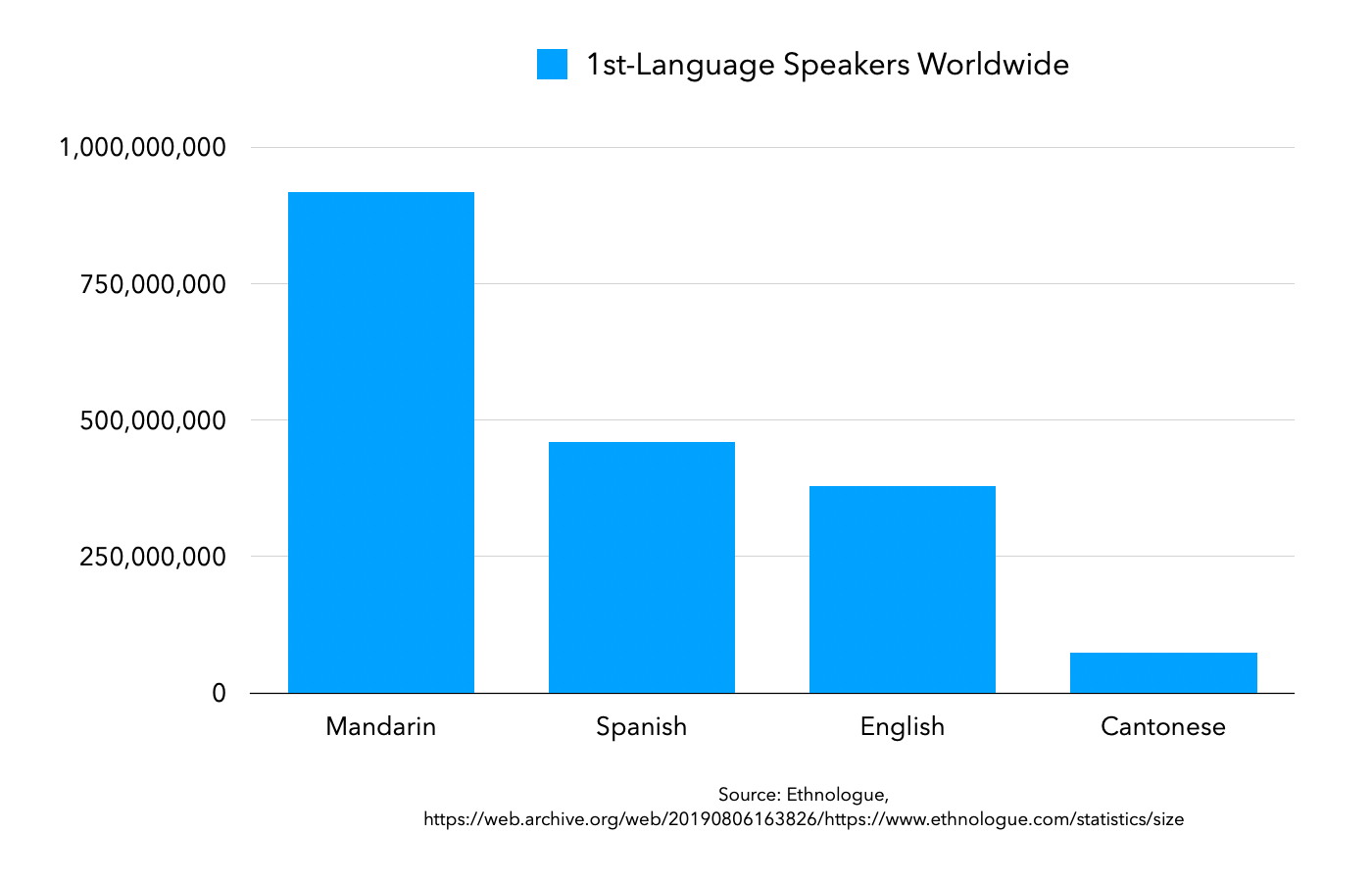
At the same time, the worldwide Mandarin field is by far the largest language field in the world, and it’s likely that it is the largest language field ever in history.

Chart: Languages by First-Language Speakers—2019

So, the need is especially great for Mandarin field language learners to be able to help Mandarin-speakers overcome their cultural backgrounds and cultivate faith in the Creator!

Creation/Evolution, and Also the Great Wall of Characters

However, I suspect that even in their mother tongue, many Mandarin field language learners would be hesitant to discuss creation/evolution, since it is an especially deeply technical subject. Adding the requirement to conduct the discussion in Mandarin, which has traditionally been written using the extraordinarily complex Chinese characters, to many just makes an already daunting task seem even more undoable.

The Great Wall of China

In addition to the inherent technical difficulty of the subject of creation/evolution, Mandarin field language learners also face the Great Wall of characters.

To help with this formidable challenge, the organization’s official Mandarin digital material for the No. 3 2021 issue of Awake!, and for the Was Life Created? and Origin of Life brochures, is available with Pīnyīn (Pīn·yīn {Piecing Together of} · Sounds → [Pinyin] 拼音). Additionally, unofficial Pīnyīn (Pīn·yīn {Piecing Together of} · Sounds → [Pinyin] 拼音) Plus material—specifically designed, not to be spiritual food, but for helping Mandarin field language learners to get past the Great Wall of characters and actually learn to understand and speak the Mandarin they need—is available for the Was Life Created? and Origin of Life brochures, and will soon be available for the No. 3 2021 issue of Awake! too. For updates on these Pīnyīn (Pīn·yīn {Piecing Together of} · Sounds → [Pinyin] 拼音) Plus resources, keep an eye on this blog, on the Links News blog, and on the related account on the social network of your choice listed on this blog’s Contact page.

Categories
Science Technology Theocratic

xiāngduì

xiāngduì (xiāng·duì {[with] each other}; {one another}; mutually · {facing; opposing [→ [compared]]} → [[being] opposite each other; face to face | relative/relatively; comparatively; vis-à-vis] 相对 相對) 👈🏼 Tap/click to show/hide the “flashcard”

[Notes: Tap/click on a Pīnyīn (Pīn·yīn {Piecing Together of} · Sounds → [Pinyin] 拼音) expression to reveal its “flashcard”; tap/click on a “flashcard” or its Pīnyīn (Pīn·yīn {Piecing Together of} · Sounds → [Pinyin] 拼音) expression to hide the “flashcard”. 📖 📄 📘 icons mean 📖 Reveal All, 📄 Reveal Advanced, and 📘 Reveal None re all the “flashcards” in the heading, paragraph, etc. that they are placed at the beginning of.]

The Shēngmìng Láizì Chuàngzào Ma? ((Shēngmìng Life 生命) (Lái·zì Came · From 来自 來自) (Chuàng·zào Initiating · {Making, Creating} → [Creating] 创造 創造) (Ma [? ptcl for “yes/no” questions])? [Was Life Created? (lc)]) (Was Life Created? (lc)) brochure and the Shēngmìng de Qǐyuán—Zhíde Sīkǎo de Wǔ Ge Wèntí ((Shēngmìng Life 生命) (de ’s 的) (Qǐ·yuán {Rising → [Starting]} · Source → [Origin] 起源/原)—(Zhí·de Worth · Getting → [Worth] 值得) (Sī·kǎo {Thinking About} · Examining 思考) (de ’s 的) (Wǔ Five 五) (Ge [mw]個/个) (Wèn·tí Asking · Subjects → [Questions] 问题 問題) [The Origin of Life—Five Questions Worth Asking (lf)]) (The Origin of Life—Five Questions Worth Asking (lf)) brochure were originally published back in 2010, but relatively recently, the English version of the Was Life Created? brochure was updated to the December 2022 Printing, and the Mandarin version of it was updated to the February 2023 Printing. Also, the Was Life Created? brochure and the Origin of Life brochure are now in the Teaching Toolbox section in the JW Library app. So, it would be good to consider some of the expressions used in the Mandarin versions of these publications that can be so helpful when discussing whether life was created.

It’s Relative?

This week’s MEotW, “xiāngduì (xiāng·duì {[with] each other}; {one another}; mutually · {facing; opposing [→ [compared]]} → [[being] opposite each other; face to face | relative/relatively; comparatively; vis-à-vis] 相对 相對)”, occurs in paragraph 3 of the QUESTION 2 section of the Origin of Life brochure, which section is entitled, in English, “Is Any Form of Life Really Simple?”:

English:

Since prokaryotic cells are relatively less complex than eukaryotic cells, many believe that animal and plant cells must have evolved from bacterial cells.

Mandarin (WOL, Pīnyīn (Pīn·yīn {Piecing Together of} · Sounds → [Pinyin] 拼音) Plus):

📖 📄 📘 Xiāngduì (Xiāng·duì {one another} · {facing → [compared]} → [relatively] 相对 相對) lái (coming) shuō ({to say}說/説), yuánhé (yuán·hé primitive · {pit (of a fruit) → [nucleus]} → [prokaryotic] 原核) xìbāo (xì·bāo tiny · wombs → [cells] 细胞 細胞) de ( 的) gòuzào (gòu·zào {constructings → [structures]} · makings → [structures] 构造 構造) ({compared to} 比) zhēnhé (zhēn·hé true · {pit (of a fruit) → [nucleus]} → [eukaryotic] 真核) xìbāo (xì·bāo tiny · wombs → [cells] 细胞 細胞) jiǎndān (jiǎn·dān {are simple} · {are single → [are simple]} → [are simple] 简单 簡單), suǒyǐ (suǒ·yǐ {that which} · {is the reason/cause} → [so] 所以) xǔduō (xǔ·duō numbers · many 许多 許多) kēxué‐jiā ((kē·xué {branches of study} · learning → [science] 科学 科學)‐(jiā -ists 家) [scientists]) rènwéi (rèn·wéi identify · {(it) to be (that)} 认为 認為) dòng‐zhíwù ((dòng moving)‐(zhí·wù planted · things 植物) [plants and animals]) de ( 的) xìbāo (xì·bāo tiny · wombs → [cells] 细胞 細胞) dōu (all 都) bìdìng (bì·dìng certainly · {(it) has been set} 必定) shì (are 是) cóng (from) xìjūn (xì·jūn tiny · bacteria → [bacterial] 细菌 細菌) xìbāo (xì·bāo tiny · wombs → [cells] 细胞 細胞) yǎnshēng (yǎn·shēng {spilling over} · {given life to} → [evolved] 衍生) chulai (chu·lai out · {to come} 出来 出來) de ({’s (cells)} 的).

It’s Complex, Absolutely

In “xiāngduì (xiāng·duì {[with] each other}; {one another}; mutually · {facing; opposing [→ [compared]]} → [[being] opposite each other; face to face | relative/relatively; comparatively; vis-à-vis] 相对 相對)”, “xiāng ({[with] each other}; {one another}; mutually 相) means “each other”, or “one another”. “Duì ({trained on}; {directed at}; facing; opposite; opposing; {[is] towards} [→ [to | treat | [is] correct; [is] right | pair; couple [of] | comparing; checking; verifying]]) literally means “facing” or “opposing”, and can effectively mean “compared”. Together, these morphemes can be taken to effectively mean “relative” or “relatively”, as they are in the above example.

The opposite of “relative” or “relatively” is “absolute” or “absolutely”, and the Mandarin word for that is “juéduì (jué·duì {being cut off → [asolutely]} · {facing → [compared]} → [[is] absolute[ly]; perfect[ly]; definite[ly]] 绝对 絕對)”. The “jué ({cut off}; severed [→ [exhausted; used up; finished; terminated | unique; superb; matchless | died; has become extinct]] | {being cut off} → [absolutely; extremely]絕/絶) used here literally means “cut off”, and can effectively mean “absolutely” or “extremely”. The “duì ({trained on}; {directed at}; facing; opposite; opposing; {[is] towards} [→ [to | treat | [is] correct; [is] right | pair; couple [of] | comparing; checking; verifying]]) in “juéduì (jué·duì {being cut off → [asolutely]} · {facing → [compared]} → [[is] absolute[ly]; perfect[ly]; definite[ly]] 绝对 絕對) is the same one that’s in “xiāngduì (xiāng·duì {[with] each other}; {one another}; mutually · {facing; opposing [→ [compared]]} → [[being] opposite each other; face to face | relative/relatively; comparatively; vis-à-vis] 相对 相對)”.

Relatively speaking, some cells are simpler than other cells, and as mentioned in the example above, some latch on to that and suggest that more complex cells must have evolved from relatively simpler cells. However, as the Origin of Life brochure goes on to show us, any cell is still highly, highly complex in absolute terms, when it comes to what could be formed by random chance.

Relatively and Absolutely “Far Too Complex to Have Arisen by Chance”

The following statement, which occurs towards the end of the QUESTION 2 section of the Origin of Life brochure, describes the complexity of even relatively “simple” cells:

English:

Fact: Some respected scientists say that even a “simple” cell is far too complex to have arisen by chance on earth.

Mandarin (WOL, Pīnyīn (Pīn·yīn {Piecing Together of} · Sounds → [Pinyin] 拼音) Plus):

📖 📄 📘 Shìshí (Shì·shí matter · {being solid} → [fact] 事实 事實): Yǒuxiē (Yǒu·xiē {(there) are having → [(there) are]} · some 有些) bèishòu (bèi·shòu fully · receive 备受 備受) zūnzhòng (zūn·zhòng respecting · {(viewing as) weighty} 尊重) de (’s 的) kēxué‐jiā ((kē·xué {branches of study} · learning → [science] 科学 科學)‐(jiā -ists 家) [scientists]) shuō (saying說/説), jiùsuàn (jiù·suàn {even if} · {figuring → [considering]} 就算) shì ({(it) is} 是) (one 一) ge ([mw]個/个)jiǎndān (jiǎn·dān simple · {single → [simple]} → [simple] 简单 簡單)de (’s 的) xìbāo (xì·bāo tiny · womb → [cell] 细胞 細胞) ((it) also 也) shífēn (shí·fēn ten · portions → [very much] 十分) fùzá (fù·zá {is turned around → [is complex]} · {is mixed} → [is complex] 复杂 複雜), (not 不) kěnéng (kě·néng maybe · {being able} → [possibly] 可能) shì ({had been} 是) pèngqiǎo (pèng·qiǎo {having bumped into} · {being coincidental} → [by chance] 碰巧) zài (on 在) dìqiú (dì·qiú earth · globe 地球) shang (upon 上) xíngchéng (xíng·chéng {form (n)} · {came to be} → [formed] 形成) de ({’s (thing)} 的).

Let us, then, continue to do what we can to help Mandarin-speaking people to get acquainted with the abundant evidence that life was indeed created, and let us help them to get to know our loving Creator.


For convenience:

The direct link for the current-generation Pīnyīn (Pīn·yīn {Piecing Together of} · Sounds → [Pinyin] 拼音) Plus resource for the Origin of Life brochure is:

The short link for Chinese field language-learning links for the Origin of Life brochure is:

More Pīnyīn (Pīn·yīn {Piecing Together of} · Sounds → [Pinyin] 拼音) and Pīnyīn (Pīn·yīn {Piecing Together of} · Sounds → [Pinyin] 拼音) Plus web material based on the Mandarin Origin of Life brochure will be made available in the Pīnyīn (Pīn·yīn {Piecing Together of} · Sounds → [Pinyin] 拼音) Plus web resource as time allows.

Categories
Culture History Language Learning Science Technology Theocratic

shēngjī‐bóbó

shēngjī (shēng·jī life · {mechanism → [being organic]} → [life] 生机 生機)bóbó (bó·bó flourishing; thriving; vigorous · flourishing; thriving; vigorous 勃勃) 👈🏼 Tap/click to show/hide the “flashcard”

[Notes: Tap/click on a Pīnyīn (Pīn·yīn {Piecing Together of} · Sounds → [Pinyin] 拼音) expression to reveal its “flashcard”; tap/click on a “flashcard” or its Pīnyīn (Pīn·yīn {Piecing Together of} · Sounds → [Pinyin] 拼音) expression to hide the “flashcard”. 📖 📄 📘 icons mean 📖 Reveal All, 📄 Reveal Advanced, and 📘 Reveal None re all the “flashcards” in the heading, paragraph, etc. that they are placed at the beginning of.]

The Shēngmìng Láizì Chuàngzào Ma? ((Shēngmìng Life 生命) (Lái·zì Came · From 来自 來自) (Chuàng·zào Initiating · {Making, Creating} → [Creating] 创造 創造) (Ma [? ptcl for “yes/no” questions])? [Was Life Created? (lc)]) (Was Life Created? (lc)) brochure and the Shēngmìng de Qǐyuán—Zhíde Sīkǎo de Wǔ Ge Wèntí ((Shēngmìng Life 生命) (de ’s 的) (Qǐ·yuán {Rising → [Starting]} · Source → [Origin] 起源/原)—(Zhí·de Worth · Getting → [Worth] 值得) (Sī·kǎo {Thinking About} · Examining 思考) (de ’s 的) (Wǔ Five 五) (Ge [mw]個/个) (Wèn·tí Asking · Subjects → [Questions] 问题 問題) [The Origin of Life—Five Questions Worth Asking (lf)]) (The Origin of Life—Five Questions Worth Asking (lf)) brochure were originally published back in 2010, but relatively recently, the English version of the Was Life Created? brochure was updated to the December 2022 Printing, and the Mandarin version of it was updated to the February 2023 Printing. Also, the Was Life Created? brochure and the Origin of Life brochure are now in the Teaching Toolbox section in the JW Library app. So, it would be good to consider some of the expressions used in the Mandarin versions of these publications that can be so helpful when discussing whether life was created.

“Living”

This week’s MEotW, which appears in the title of one of the sections of the Mandarin Was Life Created? brochure, is “shēngjī (shēng·jī life · {mechanism → [being organic]} → [life] 生机 生機)bóbó (bó·bó flourishing; thriving; vigorous · flourishing; thriving; vigorous 勃勃)”:

English:

The Living Planet

Mandarin (WOL; Pīnyīn (Pīn·yīn {Piecing Together of} · Sounds → [Pinyin] 拼音) Plus)

📖 📄 📘 Shēngjī (Shēng·jī Life · {Mechanism → [Being Organic]} → [Life] 生机 生機)Bóbó (Bó·bó Flourishing · Flourishing 勃勃) de (’s 的) Dìqiú (Dì·qiú Earth · Globe 地球)

As can be seen from the above quotes, the Mandarin Was Life Created? brochure uses “shēngjī (shēng·jī life · {mechanism → [being organic]} → [life] 生机 生機)bóbó (bó·bó flourishing; thriving; vigorous · flourishing; thriving; vigorous 勃勃) to effectively mean “living”. Considering the morphemes in it, this expression could also be translated as “brimming with life”, or something similar.

Mechanisms, Organisms, and Crises

The “jī ({machine; mechanism [→ [airplane; aircraft | being organic]]} | {incipient moment; crucial point} | chance; opportunity; occasion | intention; idea機/机) in “shēngjī (shēng·jī life · {mechanism → [being organic]} → [life] 生机 生機)bóbó (bó·bó flourishing; thriving; vigorous · flourishing; thriving; vigorous 勃勃) is a particularly polysemous morpheme, meaning that it has many possible related meanings. For example, it can literally mean “mechanism”, and it can effectively mean “organic”. This seems to indicate that worldly Chinese culture recognizes that living things contain what are effectively mechanisms. Indeed, scientists (and Jehovah’s organization) speak of the molecular machines inside living cells.

A computer-animated visualization of how tiny molecular machines inside our cells copy DNA

The “jī ({machine; mechanism [→ [airplane; aircraft | being organic]]} | {incipient moment; crucial point} | chance; opportunity; occasion | intention; idea機/机) in “shēngjī (shēng·jī life · {mechanism → [being organic]} → [life] 生机 生機)bóbó (bó·bó flourishing; thriving; vigorous · flourishing; thriving; vigorous 勃勃) also appears in the Mandarin expression for “crisis”, “wēijī (wēi·jī {ridge of a roof → [dangerous | endangering]} · {incipient moment; crucial point | occasion} | {(for) ridge of a roof → [(for) danger]} · occasion; opportunity → [crisis] 危机 危機)”, which some have misconstrued as meaning that there is positive opportunity in danger. For more information about that, check out the MEotW post discussing that expression.

Reduplications and Idioms

The latter half of “shēngjī (shēng·jī life · {mechanism → [being organic]} → [life] 生机 生機)bóbó (bó·bó flourishing; thriving; vigorous · flourishing; thriving; vigorous 勃勃) is an example of reduplication, which is quite common in Mandarin. Another expression which features reduplication is past MEotW “rénxīn (rén·xīn people’s · hearts → [popular/public feeling] 人心)huánghuáng (huáng·huáng {being afraid; fearful; scared; frightened [→ [being anxious; uneasy; nervous]]} · {being afraid; fearful; scared; frightened [→ [being anxious; uneasy; nervous]]} 惶惶)”, which has a similar structure to that of “shēngjī (shēng·jī life · {mechanism → [being organic]} → [life] 生机 生機)bóbó (bó·bó flourishing; thriving; vigorous · flourishing; thriving; vigorous 勃勃)”.

Speaking of structure, the MEotW post on “rénxīn (rén·xīn people’s · hearts → [popular/public feeling] 人心)huánghuáng (huáng·huáng {being afraid; fearful; scared; frightened [→ [being anxious; uneasy; nervous]]} · {being afraid; fearful; scared; frightened [→ [being anxious; uneasy; nervous]]} 惶惶) said the following about whether expressions like “rénxīn (rén·xīn people’s · hearts → [popular/public feeling] 人心)huánghuáng (huáng·huáng {being afraid; fearful; scared; frightened [→ [being anxious; uneasy; nervous]]} · {being afraid; fearful; scared; frightened [→ [being anxious; uneasy; nervous]]} 惶惶) and “shēngjī (shēng·jī life · {mechanism → [being organic]} → [life] 生机 生機)bóbó (bó·bó flourishing; thriving; vigorous · flourishing; thriving; vigorous 勃勃) qualify as chéngyǔ (chéng·yǔ {(things that) have become} · sayings → [set phrases (typically of 4 characters)] 成语 成語):

Considering its structure, we can say that “rénxīn (rén·xīn people’s · hearts → [popular/public feeling] 人心)huánghuáng (huáng·huáng {being afraid; fearful; scared; frightened [→ [being anxious; uneasy; nervous]]} · {being afraid; fearful; scared; frightened [→ [being anxious; uneasy; nervous]]} 惶惶) is an idiom. However, it does not seem to be a chéngyǔ (chéng·yǔ {(sth. that) has become} · saying → [set phrase (typically of 4 characters); idiom] 成语 成語). This excerpt from the MEotW post on “chéngyǔ (chéng·yǔ {(sth. that) has become} · saying → [set phrase (typically of 4 characters); idiom] 成语 成語) discusses the difference:

So, it appears that while chéngyǔ (chéng·yǔ {(things that) have become} · sayings → [set phrases (typically of 4 characters); idioms] 成语 成語) can be called idioms in English, not all Chinese idioms are chéngyǔ (chéng·yǔ {(things that) have become} · sayings → [set phrases (typically of 4 characters); idioms] 成语 成語). It seems that “chéngyǔ (chéng·yǔ {(things that) have become} · sayings → [set phrases (typically of 4 characters); idioms] 成语 成語)” specifically refers to Chinese idioms that originated in Classical Chinese, or Literary Chinese. This writing style has largely been replaced by written vernacular Chinese, which has been the standard style of writing for Modern Standard Mandarin for about a century now.

Since they originated in Classical Chinese, which hasn’t been current for about a century, chéngyǔ (chéng·yǔ {(things that) have become} · sayings → [set phrases (typically of 4 characters); idioms] 成语 成語) often cannot be fully understood by modern speakers and readers of Mandarin, since knowledge about the source material for chéngyǔ (chéng·yǔ {(things that) have become} · sayings → [set phrases (typically of 4 characters); idioms] 成语 成語) has naturally been fading with the passing of time.

Lots and Lots of Life

Whether or not “shēngjī (shēng·jī life · {mechanism → [being organic]} → [life] 生机 生機)bóbó (bó·bó flourishing; thriving; vigorous · flourishing; thriving; vigorous 勃勃) is a chéngyǔ (chéng·yǔ {(sth. that) has become} · saying → [set phrase (typically of 4 characters); idiom] 成语 成語), it’s certainly appropriate for describing an earth that is well-suited for, and that is filled with, a huge variety of exquisitely designed living things. It is fitting that the Was Life Created? brochure quotes Psalm 104:24 in this regard:

How many your works are, O Jehovah!
You have made all of them in wisdom.
The earth is full of what you have made.


For convenience:

The direct link for the current-generation Pīnyīn (Pīn·yīn {Piecing Together of} · Sounds → [Pinyin] 拼音) Plus resource for the Was Life Created? brochure is:

The short link for Chinese field language-learning links for the Was Life Created? brochure is:

More Pīnyīn (Pīn·yīn {Piecing Together of} · Sounds → [Pinyin] 拼音) and Pīnyīn (Pīn·yīn {Piecing Together of} · Sounds → [Pinyin] 拼音) Plus web material based on the Mandarin Was Life Created? brochure will be made available in the Pīnyīn (Pīn·yīn {Piecing Together of} · Sounds → [Pinyin] 拼音) Plus web resource as time allows.