Categories
Culture Language Learning Science Technology Theocratic

yǔzhòu

yǔzhòu (yǔ·zhòu universe · {all time, past, present, and future} → [[the] universe; cosmos; space | cosmic] 宇宙) 👈🏼 Tap/click to show/hide the “flashcard”

[Notes: Tap/click on a Pīnyīn (Pīn·yīn {Piecing Together of} · Sounds → [Pinyin] 拼音) expression to reveal its “flashcard”; tap/click on a “flashcard” or its Pīnyīn (Pīn·yīn {Piecing Together of} · Sounds → [Pinyin] 拼音) expression to hide the “flashcard”. 📖 📄 📘 icons mean 📖 Reveal All, 📄 Reveal Advanced, and 📘 Reveal None re all the “flashcards” in the heading, paragraph, etc. that they are placed at the beginning of.]

At the time of this writing, jw.org was featuring an article from the No. 3 2021 issue of Awake! magazine, about what the universe tells us about a Creator. The title of this article, in English and in Mandarin, is as follows:

English:

What the Universe Tells Us

Mandarin:

📖 📄 📘 Yǔzhòu (Yǔ·zhòu Universe · {All Time, Past, Present, and Future} → [The Universe] 宇宙) Gàosu (Tells 告诉 告訴) Wǒmen (Wǒ·men Us · [pl] 我们 我們) Shénme (Shén·me What · [suf] 什么 什/甚麼)?

As can be seen from the above example, “yǔzhòu (yǔ·zhòu universe · {all time, past, present, and future} → [[the] universe; cosmos; space | cosmic] 宇宙)”, this week’s MEotW, is the Mandarin expression meaning “the universe”. And, as can be seen from this expression’s Pīnyīn (Pīn·yīn {Piecing Together of} · Sounds → [Pinyin] 拼音) Plus “flashcard”, its constituent morphemes mean “[the] universe; all time, past, present, and future”.

Wiktionary’s entry for “yǔzhòu (yǔ·zhòu universe · {all time, past, present, and future} → [[the] universe; cosmos; space | cosmic] 宇宙) contains the following comment about the etymology of this expression:

Meyer (2010) proposes that “eaves and roof beams” was a synecdoche for a domicile’s entire space; this figure of speech would later be appropriated by early authors and later Huainanziʼs contributors as “a metaphor for the cosmos, taking “eaves” [] and “roof beams” [] to represent the dimensions of space and time[, respectively] that compose the entire phenomenal universe.”[1]

Spacetime

Interestingly, these meanings of the morphemes in “yǔzhòu (yǔ·zhòu universe · {all time, past, present, and future} → [[the] universe; cosmos; space | cosmic] 宇宙) match up with the morphemes in the English word “spacetime”. The Wikipedia article for this is introduced with the following:

In physics, spacetime, also called the space-time continuum, is a mathematical model that fuses the three dimensions of space and the one dimension of time into a single four-dimensional continuum. Spacetime diagrams are useful in visualizing and understanding relativistic effects, such as how different observers perceive where and when events occur.

Until the turn of the 20th century, the assumption had been that the three-dimensional geometry of the universe (its description in terms of locations, shapes, distances, and directions) was distinct from time (the measurement of when events occur within the universe). However, space and time took on new meanings with the Lorentz transformation and special theory of relativity.

In 1908, Hermann Minkowski presented a geometric interpretation of special relativity that fused time and the three spatial dimensions into a single four-dimensional continuum now known as Minkowski space. This interpretation proved vital to the general theory of relativity, wherein spacetime is curved by mass and energy.

“Because They Were Designed?”

“Yǔzhòu (Yǔ·zhòu universe · {all time, past, present, and future} → [[the] universe; cosmos; space | cosmic] 宇宙) also appears in the concluding paragraph of the above-mentioned article from the No. 3 2021 issue of Awake!:

English:

Based on his scientific knowledge of the universe and its properties, physicist Paul Davies concluded: “I cannot believe that our existence in this universe is a mere quirk of fate, an accident of history, an incidental blip in the great cosmic drama. . . . We are truly meant to be here.” Davies does not teach that God created the universe and human life, but what do you think? The universe and the earth seem to be designed to make life possible. Could it be that they seem that way because they were designed?

Mandarin:

📖 📄 📘 Wùlǐ‐xué‐jiā ((Wù·lǐ things’ · {logic → [laws]} → [physics] 物理)‐(xué studying)‐(jiā -ist 家) [physicist]) Bǎoluó (Paul 保罗 保羅) Dàiwéisī (Davies 戴维斯 戴維斯) gēnjù (gēn·jù {(at) root} · {according to} → [based on] 根据 根據) zìjǐ (self 自己) duì (towards) yǔzhòu (yǔ·zhòu universe · {all time, past, present, and future} → [the universe] 宇宙) (and 及) tiānwén (tiān·wén heavens’ · {natural phenomena} → [astronomical] 天文) fǎzé (fǎ·zé laws · principles 法则 法則) de ( 的) liǎojiě (liǎo·jiě understanding · {untying → [solving]} → [understanding] 了解 了/瞭解) zhèyàng (zhè·yàng this · {form → [way]} 这样 這樣) shuō (said說/説): “ (I 我) wúfǎ (wú·fǎ {do not have} · {way to} → [cannot] 无法 無法) xiāngxìn (xiāng·xìn {each other → [it]} · believe → [believe] 相信), rénlèi (rén·lèi human·kind 人类 人類) zài (in 在) zhèige (zhèi·ge this · [mw] 这个 這個) yǔzhòu (yǔ·zhòu universe · {all time, past, present, and future} → [universe] 宇宙) de (’s 的) cúnzài (cún·zài existing · {being present} 存在), zhǐshì (zhǐ·shì merely · is 只是) qiǎohé (qiǎo·hé {being coincidental → [coincidentally]} · {closing → [fitting]} → [coincidental] 巧合) huò (or 或) xìjù‐xìng ((xìjù (having) drama 戏剧 戲劇)‐(xìng nature → [quality] 性) [dramatic]) de (’s 的) tūfā (tū·fā {chimney → [dashing forward → [unexpectedly]]} · issued → [appeared unexpectedly] 突) shìjiàn (shì·jiàn incident · [mw] 事件)wǒmen de ((wǒ·men us · [pl] 我们 我們) (de ’s 的) [our]) cúnzài (cún·zài existing · {being present} 存在) kěndìng (kěn·dìng agreeing · certainly → [definitely] 肯定) shì (is 是) yǒu (having 有) yuányīn (yuán·yīn origin · reason 原因) de ({’s (thing)} 的).” Dàiwéisī (Davies 戴维斯 戴維斯) bìng (actually並/竝/并) méiyǒu (méi·yǒu not · {has → [does]} → [does not] 没有 沒有) zhǔzhāng (zhǔ·zhāng advocate · spread (that) → [hold (that)] 主张 主張) yǔzhòu (yǔ·zhòu universe · {all time, past, present, and future} → [the universe] 宇宙) ({(together) with} → [and]和/龢) rénlèi (rén·lèi human·kind 人类 人類) shì (are 是) Shàngdì (Shàng·dì Above’s · {Emperor → [God]} → [God] 上帝) chuàngzào (chuàng·zào initiated · {made, created} → [created] 创造 創造) de ({’s (things)} 的). Dàn (but 但) (you 你) juéde (jué·de {to wake to → [to feel]} · {(how do) get} → [how do feel] 觉得 覺得) ne ([? ptcl] 呢)? Jìrán (Jì·rán since · -ly 既然) yǔzhòu (yǔ·zhòu universe · {all time, past, present, and future} → [the universe] 宇宙) ({(together) with} → [and]和/龢) dìqiú (dì·qiú earth · globe → [the earth] 地球) zhème (zhè·me {this (much)} · [suf for interrogatives and adverbs] 这么/末 這麼/末) shìhé (shì·hé {are suitable for} · {are closing with → [are fitting with]} 适合 適合) shēngmìng (life 生命) cúnzài (cún·zài existing · {being present} 存在), nàme (nà·me {(in) that (case) → [then]} · [suf] 那么/末 那麼/末) tāmen (tā·men it · [pl] [they] 它们 它/牠們) shì (are 是) bèi ([passive signifier] [were] 被) shèjì (shè·jì {set up} · planned → [designed] 设计 設計) chulai (chu·lai out · {to come} 出来 出來) de ({’s (things)} 的) ma ([? ptcl for “yes/no” questions])?

A Particular Need in the Mandarin Field

It’s worth noting that the No. 3 2021 issue of Awake! was recently in the Teaching Toolbox in the JW Library app. In fact, for a time, 3 out of the 6 books or brochures in the Teaching Toolbox—fully one half of them—were focused on the subject of creation/evolution. Additionally, the Enjoy Life Forever! book, which is still in the Teaching Toolbox, has an entire lesson on the subject “How Did Life Begin?”. This big presence in the Teaching Toolbox for a time of material focused on creation/evolution reflects a recent heavy emphasis on this issue on the part of the organization.

Indeed, for people in general to find real spiritual truth and make real spiritual progress, the question of the Creator’s existence is the first basic question that needs to be answered well in their minds, otherwise they are left with just the conflicting opinions, speculations, and platitudes of mere limited, imperfect humans. As Proverbs 9:10 says:

The fear of Jehovah is the beginning of wisdom,
And knowledge of the Most Holy One is understanding.

In the Mandarin field in particular, it is especially necessary to focus on the issue of the Creator’s existence, because current worldly Chinese culture has particularly heavily predisposed many Mandarin-speakers to not believe in a Creator.

At the same time, the worldwide Mandarin field is by far the largest language field in the world, and it’s likely that it is the largest language field ever in history.
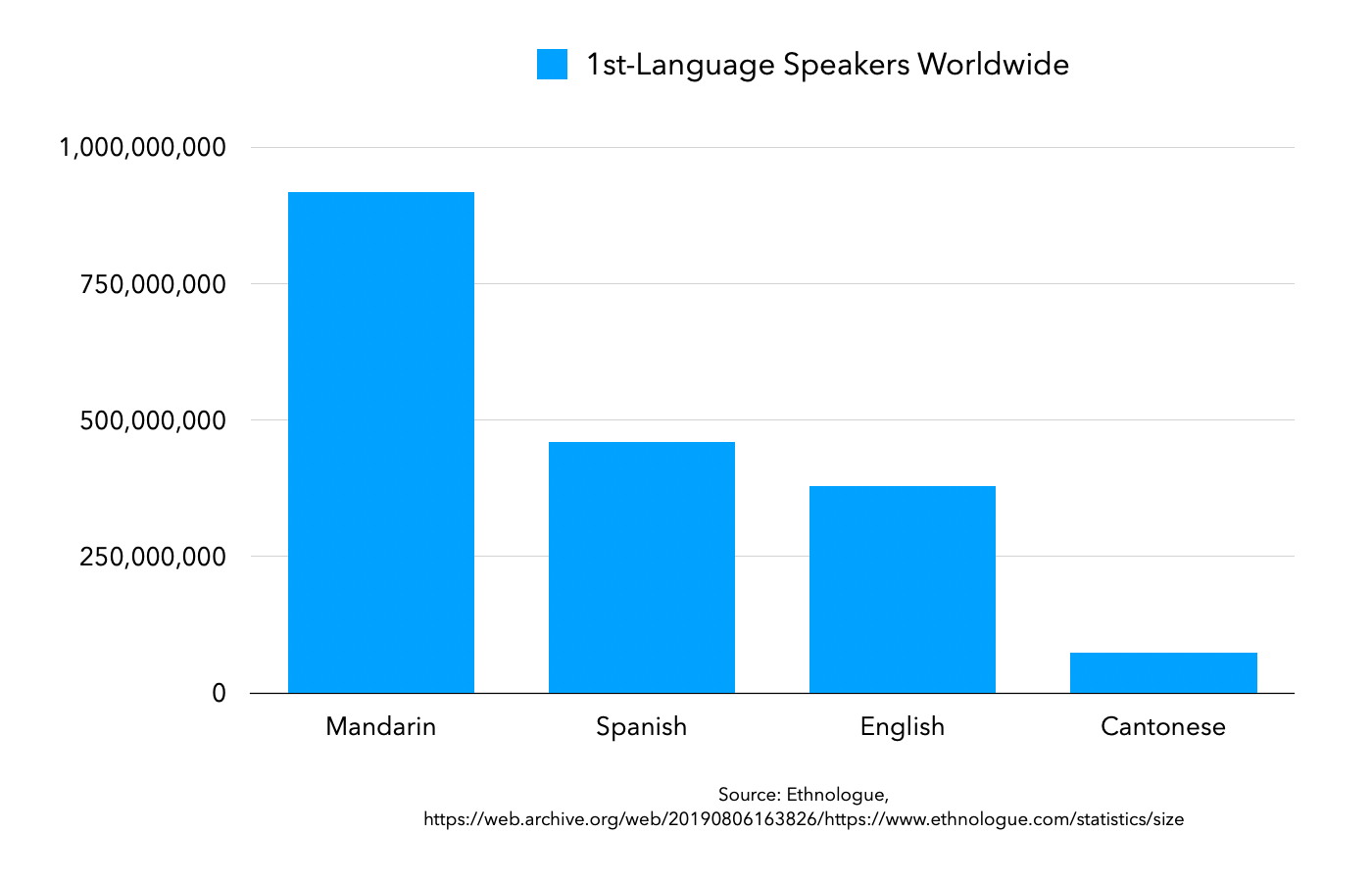
Chart: Languages by First-Language Speakers—2019

So, the need is especially great for Mandarin field language learners to be able to help Mandarin-speakers overcome their cultural backgrounds and cultivate faith in the Creator!

Creation/Evolution, and Also the Great Wall of Characters

However, I suspect that even in their mother tongue, many Mandarin field language learners would be hesitant to discuss creation/evolution, since it is an especially deeply technical subject. Adding the requirement to conduct the discussion in Mandarin, which has traditionally been written using the extraordinarily complex Chinese characters, to many just makes an already daunting task seem even more undoable.

The Great Wall of China

In addition to the inherent technical difficulty of the subject of creation/evolution, Mandarin field language learners also face the Great Wall of characters.

To help with this formidable challenge, the organization’s official Mandarin digital material for the No. 3 2021 issue of Awake!, and for the Was Life Created? and Origin of Life brochures, is available with Pīnyīn (Pīn·yīn {Piecing Together of} · Sounds → [Pinyin] 拼音). Additionally, unofficial Pīnyīn (Pīn·yīn {Piecing Together of} · Sounds → [Pinyin] 拼音) Plus material—specifically designed, not to be spiritual food, but for helping Mandarin field language learners to get past the Great Wall of characters and actually learn to understand and speak the Mandarin they need—is available for the Was Life Created? and Origin of Life brochures, and should eventually be available for the No. 3 2021 issue of Awake! too. For updates on these Pīnyīn (Pīn·yīn {Piecing Together of} · Sounds → [Pinyin] 拼音) Plus resources, keep an eye on this blog, on the Links News blog, and on the related account on the social network of your choice listed on this blog’s Contact page.


Categories
Science Technology Theocratic

hélí

hélí (hé·lí river · {raccoon dog} → [beaver] 河狸) 👈🏼 Tap/click to show/hide the “flashcard”

[Notes: Tap/click on a Pīnyīn (Pīn·yīn {Piecing Together of} · Sounds → [Pinyin] 拼音) expression to reveal its “flashcard”; tap/click on a “flashcard” or its Pīnyīn (Pīn·yīn {Piecing Together of} · Sounds → [Pinyin] 拼音) expression to hide the “flashcard”. 📖 📄 📘 icons mean 📖 Reveal All, 📄 Reveal Advanced, and 📘 Reveal None re all the “flashcards” in the heading, paragraph, etc. that they are placed at the beginning of.]

At the time of this writing, jw.org had recently featured the article “The Beaver’s Construction Ability”. The Mandarin version of this article uses this week’s MEotW, “hélí (hé·lí river · {raccoon dog} → [beaver] 河狸),” as the Mandarin word for “beaver”.

Screenshot of article “The Beaver’s Construction Ability” on jw.org

“River Raccoon Dog”

In “hélí (hé·lí river · {raccoon dog} → [beaver] 河狸),” “hé (river; stream 河) means “river” or “stream”, and “lí ({raccoon dog | leopard cat} 狸) probably means “raccoon dog”.

Readers who did not grow up in Asia or Europe are probably wondering what a raccoon dog is, so here is a picture of one from Wikipedia:

A common raccoon dog in Ukraine

Creative Commons Attribution-Share Alike License logo Ryzhkov Sergey [source]

“Ecosystem Engineers”

Reading the description of beaver dams and looking at the picture of one in the above-mentioned jw.org article, one may well be struck by how complex and involved these structures are. As the article says:

English:

In one study, researchers concluded that “beaver dams resemble engineered structures.” In fact, researchers have built many imitation beaver dams in North America. For good reason, beavers are often called ecosystem engineers.

What do you think? Did the beaver’s construction ability evolve? Or was it designed?

Mandarin:

📖 📄 📘 (one 一) xiàng ({item of}) yánjiū (yán·jiū {grinding → [studying]} · investigating → [study] 研究) tídào (tí·dào {carries (hanging down from the hand) → [raises} · {arriving at} → [mentions] 提到), hélí (hé·lí river · {raccoon dogs} → [beavers] 河狸) jiànzào (build 建造) de (’s 的) shuǐbà (shuǐ·bà water · dams → [dams] 水坝 水壩) jiù (exactly 就) xiàng ({are like} 像/象) shì (were (by) 是) gōngchéng‐shī ((gōng·chéng work · {journeys → [procedures]} → [engineering] 工程)‐(shī masters → [specialists]) [engineers]) shèjì (shè·jì {set up} · planned → [designed] 设计 設計) de ({’s (things)} 的) yíyàng (yí·yàng {(of) one} · {pattern → [way]} → [the same] 一样 一樣). Dàn (but 但) qíshí (qí·shí its · {being solid → [actuality]} → [actually] 其实 其實), zài (in 在) Běi‐Měizhōu ((Běi North 北)‐(Měi·zhōu American · continent (abbr. for Yàměilìjiā Zhōu) 美洲) [North America]), hěn (very 很) duō (many 多) shuǐbà (shuǐ·bà water · dams → [dams] 水坝 水壩) dōu (even 都) shì (are 是) rénlèi (rén·lèi human·kind 人类 人類) mófǎng (mó·fǎng {having imitated} · {having copied} 模仿) hélí (hé·lí river · {raccoon dogs} → [beavers] 河狸) de ( 的) fāngfǎ (fāng·fǎ directions · methods 方法) jiànzào ({to build} 建造) ér (thus 而) chéng ({came to be} 成) de ({’s (dams)} 的). Nánguài (Nán·guài {(it) is difficult} · {(to find it) strange that} → [it’s understandable that] 难怪 難怪) hélí (hé·lí river · {raccoon dogs} → [beavers] 河狸) chángcháng (cháng·cháng often · often 常常) bèi ([passive signifier] [are] 被) chēngwéi (chēng·wéi called · as 称为 稱為)shēngtài xìtǒng ((shēng·tài {living (things’)} · condition → [ecological] 生态 生態) (xì·tǒng {tied (things) → [system]} · {gathered together (things) → [interconnected system]} → [system] 系统 系統) [ecosystem]) gōngchéng‐shī ((gōng·chéng work · {journeys → [procedures]} → [engineering] 工程)‐(shī masters → [specialists]) [engineers])”.

📖 📄 📘 (you 你) rènwéi (rèn·wéi identify · {(it) to be} 认为 認為) ne ([? ptcl] 呢)? Hélí (Hé·lí river · {raccoon dog} → [the beaver] 河狸) jiànzào ({to build} 建造) shuǐbà (shuǐ·bà water · dams → [dams] 水坝 水壩) de ( 的) nénglì (néng·lì ability · power 能力) shì (is 是) jìnhuà (jìn·huà {to advance} · {having transformed} → [having evolved] 进化 進化) (yǎnhuà (yǎn·huà {having performed} · transforming → [having evolved] 演化)) ér (thus 而) lái ({came to be}) de ({’s (thing)} 的), háishi (hái·shi {still more → [or]} · is 还是 還是) jīngguò (jīng·guò {having passed through} · {having passed} → [having undergone] 经过 經過) shèjì (shè·jì {setting up} · planning → [design] 设计 設計) de ({’s (thing)} 的) ne ([? ptcl] 呢)?

We may find it beneficial to share the above comments with interested ones in the Mandarin field. Maybe the impressive industriousness and construction ability (and yes, cuteness) of “river raccoon dogs” will help bypass the prejudice that some may have towards the idea that life was created.


By the way, I came across this video on YouTube about what effects beavers can have on the ecosystem:

Categories
Culture History Language Learning Science

bìyào

bìyào (bì·yào certainly · {[being] needed; required; essential} [→ [need | necessary; indispensable]] 必要) 👈🏼 Tap/click to show/hide the “flashcard”

As part of a series of posts about some common myths about Chinese characters, this post discusses the Indispensability Myth. So, this week’s MEotW is “bìyào (bì·yào certainly · {[being] needed; required; essential} [→ [need | necessary; indispensable]] 必要)”, which can effectively mean “indispensable”.

Can Chinese Characters Be Replaced?

汉字 / 漢字? Pīnyīn?

In the book The Chinese Language: Fact and Fantasy, linguist and sinologist John DeFrancis introduces the chapter entitled “The Indispensability Myth” with the following:

The belief that Chinese characters are indispensable exists on several levels that range from the most shallow mindlessness to the most serious thoughtfulness. As usual, much of the mythology is based on a confusion of terms and on mixing up speech and writing. In its most general form the Indispensability Myth holds that Chinese cannot be written in an alphabetic script. This seemingly straightforward statement turns out on closer examination to involve a great deal of ambiguity centering on the meaning of the two terms “Chinese” and “cannot.” As I have stressed repeatedly in the previous chapters, the term “Chinese” covers a wide range of meanings. The indispensability thesis needs to be tested against each of them.

…scientific linguists have repeatedly demonstrated in actual practice the validity of their thesis that the speech of any individual can be written in an alphabetic script. The overall approach in such an undertaking is the same for all forms of speech in that it involves direct observation and analysis. The specific solutions vary according to the linguistic details (phonemic, morphemic, lexical, syntactical, and so forth) for each form of speech. Any student of linguistics with a modicum of competence can create an alphabetic system of writing for any form of speech in the world. To deny this elementary truth in general or in specific application to Chinese is to reject science and embrace mythology.

DeFrancis goes on to discuss different approaches that have been tried to create alphabetic writing systems for the languages spoken in China. Regarding the most successful approach so far, he writes:

The third solution was adopted in the Latinization movement of the thirties and forties, and by Protestant missionaries and Chinese reformers earlier, to create as many separate schemes of romanization as there are instances of mutually unintelligible forms of speech. The basis for this approach was largely the practical one of creating as simple a system as possible for a given group of speakers in order to facilitate their acquisition of literacy. There was never an overall attempt to determine the exact number of schemes that should be created or to relate the schemes to each other as part of an integrated plan of writing reform. The more or less ad hoc empirical approach is therefore all the more impressive with respect to the results that were actually achieved. Publication in various alphabetic schemes in the century from the initiation of missionary work to the cessation of Latinization activities in the 1940s is significant both for its quantity and for its quality since it includes such diverse items as the Bible, Lewis Carroll’s Through the Looking-glass, Tolstoi’s “The Prisoner of the Caucasus,” Pushkin’s poems, Lu Xun’s “Diary of a Madman” and “Story of Ah Q,” the Soviet Constitution, communist land laws, miscellaneous biographies of Westerners, newpapers and journals, and much additional literature. All this provides practical proof of the theoretical truth that the alleged impossibility of using an alphabetic script in place of Chinese characters to represent spoken Chinese is a bit of unmitigated nonsense. It also provides support for the theoretical assumption that there is in fact no significant limit to the subject matter that can be written in Pinyinized versions of the various regionalects [(the mutually unintelligible varieties of Chinese)].

As the article “Pīnyīn Is a Good, Workable Writing System on Its Own” says:

Pīnyīn can indeed be used to write anything that can be spoken in Modern Standard Mandarin, from the simplest expressions to the most advanced, complex, and deeply meaningful expressions, so it qualifies as a full writing system in that fundamental sense as well—Pīnyīn is indeed “a method of representing the sounds of a language by written or printed symbols”.

Indeed, Pīnyīn (Pīn·yīn {Piecing Together of} · Sounds → [Pinyin] 拼音) can be used to represent the key, indispensable factor in communication on spiritual matters, that Mandarin field language learners should be striving for. This key, indispensable factor is explained to us in the Bible itself at 1 Corinthians 14:8–11:

For if the trumpet sounds an indistinct call, who will get ready for battle? In the same way, unless you with the tongue use speech that is easily understood, how will anyone know what is being said? You will, in fact, be speaking into the air. It may be that there are many kinds of speech in the world, and yet no kind is without meaning. For if I do not understand the sense of the speech, I will be a foreigner to the one speaking, and the one speaking will be a foreigner to me.

Yes, while traditional worldly human Mandarin teachers generally say that characters are indispensable, and that extensive knowledge of characters is thus the goal that Mandarin learners should strive for, the Bible itself tells us that the actual key, indispensable factor required for communication on spiritual matters is “speech that is easily understood”. In that regard, we should note that Pīnyīn (Pīn·yīn {Piecing Together of} · Sounds → [Pinyin] 拼音) can simply and directly represent any and all understandable modern Mandarin speech, no characters required. Besides “speech that is easily understood”, everything else language-related is of lesser or even little importance, and perhaps even to be actively avoided, in our vital work of praising Jehovah and trying to help save lives in the Mandarin field. We should keep this principle in mind as we consider what DeFrancis calls the Speakability Test, and what he goes on to say about various kinds of traditional Chinese writings.

The Speakability Test

What is the Speakability Test? Note how DeFrancis tells us what he means by that:

The preceding discussion of the Indispensability Myth has been based on a definition of “Chinese” that is limited to its spoken manifestation. Strictly speaking, this is the only acceptable definition of the term. Yet this limitation is very often ignored—sometimes deliberately, sometimes out of sheer ignorance in muddling speech and writing. A popular formulation of the Indispensability Myth holds that because homonyms are so numerous in “Chinese,” characters must be used to avoid the unsupportable ambiguity that would result from writing alphabetically. This view has been advanced in a typically exaggerated form by writers.

Now we are asked to consider quite a different question based on some quite different and not entirely clear definitions of “Chinese.” The term is variously used to refer to such concepts as Chinese characters, Chinese characters in a dictionary, written Chinese, the Chinese language written in characters, perhaps even spoken Chinese written in characters. Our new question is: Can “Chinese” as thus loosely defined be written in an alphabetic script? One possible answer to this question is that it should never have been asked in the first place. “Chinese,” we might insist, must mean spoken Chinese. Whether it has been traditionally written in Chinese characters, cuneiform symbols, hieroglyphics, or anything else is totally irrelevant to the question [of] whether Chinese (that is, current spoken Chinese) can be written in an alphabetic script.

However much we might like to adopt this entirely justifiable stand, the need to confront the Indispensability Myth in its various forms requires further discussion of the issues. Actually the answer to the new question, or rather to the new series of questions, is quite simple. It is based on the eminently practical approach of asking another, quite simple question: Can the “Chinese” you have in mind be understood if spoken aloud? If the answer is yes, then this Chinese can be Pinyinized. If the answer is no, then it cannot. We can test this approach, which consists of what might be called the Speakability Test, by applying it to various kinds of Chinese.

Homophones and Homographs

Continuing on, DeFrancis says:

Those who think of “Chinese” in terms of Chinese characters often invoke such imaginary problems as the ninety words pronounced li (without tone indication) or the more modest thirty-eight words pronounced (with tone indication). Most of these “words,” as pointed out in the earlier chapter on the Monosyllabic Myth, exist only in dictionaries. To apply our basic question is in error on two counts. The first is that it is methodologically incorrect to pick out of a dictionary—in any language—a bunch of homophonous expressions and then parade them in isolation to show how ambiguous they are. Such a procedure could also be applied to English to show that it cannot be written alphabetically. See how ambiguous “can” is! On hearing it one cannot tell which of the half dozen or so homophonous words is intended—actually as many as ten or more if we include the slang terms for prison, buttocks, toilet, and the like as well as the standard terms for metal container, to be able to, and so forth.

Yes, the homophones bogeyman that is often trotted out by advocates of characters is an imaginary problem, because in reality, people generally don’t talk in continuous strings of ambiguous homophones (different words that sound the same) because that would be stupid, when the goal of talking to people is generally to communicate understandably! In reality, Mandarin speakers just use sufficient context to clarify the meanings of any homophones and get on with their lives.

DeFrancis continues regarding the second way in which it is in error to question whether Mandarin, with all its homophones, can be written with an alphabet instead of with characters:

The second error in this approach stems from the fact that many entries in Chinese dictionaries, in general contrast to those in English, are not even words. Most of those thirty-eight entries pronounced are not real words. is simply a transcription for thirty-eight characters, and characters in Chinese dictionaries are at best morphemes and at worst might mean nothing at all—as in the case of the two characters 珊瑚 in shānhú (“coral”) if we follow Chao and Yang (1962:140) in refusing to give separate meanings to each of the characters. To cite as a problem in Chinese is therefore even more nonsensical than tearing one’s hair over the problem of “can” in English.

Many thus use the Monosyllabic Myth to support the Indispensability Myth, and fall deeper into error. In contrast, as the Bible says at Proverbs 4:18, “the path of the righteous is like the bright morning light that grows brighter and brighter until full daylight.”

Another thing that we can note is that while many have gotten into the habit of using characters as a crutch to disambiguate Mandarin homophones (different words that sound the same), characters have the corresponding problem of homographs, characters that look the same, but that represent different words with different meanings and pronunciations. For example, as the MEotW post on “zháole huǒ ((zháo·le {having caught} · {to completion} 着了 著了) (huǒ fire 火) [having caught fire; burning; being on fire]) pointed out,

the characters “着/著” can represent 5 different expressions, each with its own pronunciation and set of meanings:

  • zhāo – add; put in | measure word for tricks, devices, moves in chess or martial arts, etc.
  • zháo – touch; come in contact with [→ [feel; be affected by]] | catch; ignite; light (fire); burn | hitting the mark; accomplishing; succeeding (This is the one used in this week’s MEotW.)
  • zhe – being (indicating continuing progress/state)
  • zhù – prominent; outstanding | book; work
  • zhuó – apply | put on/wear (clothes)

“Unspeakable Chinese”

What about written Chinese that doesn’t pass the Speakability Test? DeFrancis continues:

Taking up next the somewhat broader and more legitimate question [of] whether “Chinese” defined as written Chinese or as the Chinese language written in characters can be written alphabetically, here too we can apply our simple Speakability Test to discover whether such “Chinese” is intelligible if read aloud. Much of Chinese writing incorporates many elements alien to speech—at times to such an extent as to make it incomprehensible when read orally. For more reasons than one this might be called unspeakable writing. In the case of such unspeakable Chinese, the Chinese characters are indeed indispensable. Only if written Chinese really conforms to the definition of spoken Chinese written in characters is it possible for the characters to be replaced by alphabetic writing.

Why are many Chinese scholars so hung up on “unspeakable Chinese”? DeFrancis goes on to discuss what they really mean when they say that Chinese “cannot” be written alphabetically:

There are doubtless many purists who would insist on the original regardless of whether or not the hoi polloi [the common people] are capable of handling it.

A dilemma exists in the fact that the work of Pinyinization must be undertaken by people who are already literate—which means literate in characters—and Chinese literati, even of the newer generation, have displayed even less capacity than their Western counterparts to write in a style capable of ready comprehension by ordinary people. The contention that materials written in Chinese characters cannot be written alphabetically therefore has a certain sad validity because to date most Chinese scholars cannot accept the notion that the written style should be determined by its capacity for Pinyinization. They cannot bear the thought of the cultural upheaval involved in the transition from character-based to alphabet-based writing.

CANNOT = SHOULD NOT

With these attitudes the notion that Chinese cannot be written alphabetically has now shifted ground to “should not.” It is this interpretation of “cannot” that forms the basis for much of the contention that Chinese characters are indispensable. The shift in emphasis is not always apparent to unwary readers who fail to note that the approach is often based on unwillingness to place speech before writing and to consider the needs of people who might be unable to master the character-based system of writing.

Latin Bibles and Horses

Making an interesting comparison, DeFrancis writes:

Karlgren’s elitist defense not only of characters, but of the classical style as well, has the musty odor of a defense of Latin against such a break with the European cultural past as upstart writing in Italian and French and English.

If we compare traditional Chinese writings to see if they pass the Speakability Test, and to see if they measure up to the Bible-provided standard of corresponding to easily understandable speech, we’ll find that they often don’t. Indeed, because of not a little cultural and nationalistic snobbery and pride, many Chinese scholars, and even many regular Chinese people, like it that way!

However, even if many traditional Chinese writings are revered and highly valued in the world for their cultural or historical value, they show themselves to be of limited or even negative value among us fellow workers with Jehovah in today’s Mandarin field. As an object lesson on this, consider how Jehovah’s organization depicts the false version of Christianity that insisted that Latin Bibles were indispensable, and that viciously persecuted those who tried to translate the Bible into languages like English that the common people could read, and that corresponded well with how they usually spoke.

In contrast to classical Chinese writings and even many modern ones, it is evident that modern Mandarin versions of the publications of Jehovah’s organization seek to represent easily understandable modern Mandarin speech. In fact, much writing that appears in our publications, such as writing from Mandarin versions of The Watchtower and the Bible, is regularly read aloud at our meetings and easily understood. That could not be the case if it were made up of what DeFrancis calls “unspeakable Chinese”!

It’s no wonder then that Jehovah’s organization is evidently successfully proceeding at maximum practical speed to add Pīnyīn (Pīn·yīn {Piecing Together of} · Sounds → [Pinyin] 拼音) to its Mandarin writings, since, as DeFrancis points out, writing that corresponds to understandable Mandarin speech can be written in an alphabetic writing system like Pīnyīn (Pīn·yīn {Piecing Together of} · Sounds → [Pinyin] 拼音). Also, the unofficial Pīnyīn (Pīn·yīn {Piecing Together of} · Sounds → [Pinyin] 拼音) Plus material based on certain Mandarin publications of Jehovah’s organization achieves functional success in using Pīnyīn (Pīn·yīn {Piecing Together of} · Sounds → [Pinyin] 拼音) as the default full writing system instead of characters, rather than as just a pronunciation aid for the characters.

Even while it is diligently adding Pīnyīn (Pīn·yīn {Piecing Together of} · Sounds → [Pinyin] 拼音) to its Mandarin writings, we can observe that Jehovah’s organization is not getting rid of its writings written in Chinese characters, just as the world in general is not anytime soon getting rid of Chinese characters, an extreme scenario that many supporters of Chinese characters seem to fear. In reality, such an extreme scenario is extremely unlikely to come to pass—people can even still read Latin Bibles if they really want to, and also, people have not killed all the horses even though most now prefer cars. 🐴

Anyway, we can see that when it comes to representing the actual key, indispensable factor for spiritual communication in the Mandarin field—understandable Mandarin speech—and when it comes to the writings that really matter to us Mandarin field language learners, the Indispensability Myth about Chinese characters is…BUSTED!