fǎngxiào+ (fǎng·xiào imitate; copy · imitate; {follow the example of} [→ [emulate]] 仿效 仿/倣效/傚) 👈🏼 Tap/click to show/hide the “flashcard”
As part of a series of posts about some common myths about Chinese characters, this post discusses the Emulatability Myth. So, this week’s MEotW is “fǎngxiào (fǎng·xiào imitate; copy · imitate; {follow the example of} [→ [emulate]] 仿效 仿/倣效/傚)”, an expression that seems to express well the emulating that the Emulatability Myth claims is a good thing.
The first morpheme in “fǎngxiào (fǎng·xiào imitate; copy · imitate; {follow the example of} [→ [emulate]] 仿效 仿/倣效/傚)” means “imitate; copy”, and other expressions in which it appears include “fǎngshēng‐xué+ ((fǎng·shēng {to imitate; copy} · {life → [living things]} 仿生)‐(xué studying 学 學) → [bionics | biomimetics])”, “fǎngfú (resembling; {[is] like}; {as if}; seemingly 仿佛 彷/髣/仿彿/髴/佛)”, and “mófǎng (mó·fǎng imitating · imitating; copying [→ [imitation; model]] 模仿)”.
As for the second morpheme in “fǎngxiào (fǎng·xiào imitate; copy · imitate; {follow the example of} [→ [emulate]] 仿效 仿/倣效/傚)”, it here means “imitate; follow the example of”, and it also appears in the well-known expression “xiàofǎ+ (xiào·fǎ imitate · {follow the model of} 效法)”.
When put together, the morphemes in fǎngxiào (fǎng·xiào imitate; copy · imitate; {follow the example of} [→ [emulate]] 仿效 仿/倣效/傚)” can effectively mean “emulate”. According to the Emulatability Myth, it would be good for other writing systems to emulate Chinese characters when it comes to (supposedly) representing meaning directly, without depending on speech sounds. Is this really a good thing to seek to emulate?
A Good Example?
In the book The Chinese Language: Fact and Fantasy, linguist and sinologist John DeFrancis thus introduces the chapter entitled “The Emulatability Myth”:
The caveat sounded at the end of the preceding chapter is no tongue-in-cheek turn of phrase intended merely to amuse. It is a sober warning of the consequences, some of them quite serious, resulting from the fact that just as the Ideographic Myth leads logically to the Universality Myth, so does the latter lead to the Emulatability Myth—the idea that Chinese characters provide a model to be followed in one way or another in writing without regard to sound.
The Emulatability Myth, then, is the idea that because Chinese characters supposedly represent meaning visually, without dependence on speech sounds (the Ideographic Myth), they are supposedly exceptionally good at functioning across barriers of space, time, and language as universal enablers of communication (the Universality Myth), and thus are able to serve as “a model to be followed in one way or another in writing without regard to sound”. How so? DeFrancis continues:
The reports of missionaries from the sixteenth century onward firmly established the idea that Chinese characters already served as a common written language among the peoples of the East and therefore could be further extended as a universal language for Europe and the rest of the world.
…
Chinese characters can indeed be extended beyond their present use to replace alphabetic writing in the case of English, French, Russian, Hindi, Arabic and all other languages, but at such an astronomical cost that this venture can only be envisaged by those so blinded by their view of Chinese characters and so lacking in responsibility that they feel no need to look below the surface and confront reality. Small wonder that the idea of directly emulating the Asian use of Chinese characters has received little serious consideration in the four centuries that the subject of Chinese as a universal script has been under discussion.
Much more attention has been devoted to the idea of developing a new “Universal Language” and “Universal Writing” based on “Real Characters” or “Universal Characters” that would adapt what were generally considered to be the underlying principles of Chinese writing—namely, that the characters represented meaning without regard to sound and that a single character was ascribed to a single thing, whether concrete or abstract. The supposed one-to-one correspondence between thing and symbol was seized upon for two reasons. The first was the tendency, against which linguists still have to inveigh, to overemphasize the role of vocabulary compared to grammar and other linguistic aspects in the working of language. The second was the need to find a means of labeling and classifying the vast amount of new scientific and technological knowledge that was coming into being. The concept of a universal set of written symbols dovetailed neatly with the concept of a universal taxonomy of nature (Slaughter 1982).
…
In a more recent expression of the emulatability thesis we find the well-known anthropologist Margaret Mead calling on scholars in various fields to put aside their parochial differences and unite in seeking to create
a written form of communication independent of any languages of the world, but dependent upon the concepts essential to high-level philosophical, political, and scientific communication. We have, of course, many such partial artificial languages now in the Arabic numeral system, in chemistry and physics, in engineering diagrams. But the most complete model we have of a written language that is independent of particular languages is the classical Chinese system of writing through which two educated men, who cannot understand a word the other speaks, may nevertheless communicate fully with each other by writing. [Mead and Modley 1968:62]
So, missionaries of Christendom were involved in spreading the idea that Chinese characters could show us how to create a universal language (i.e., a universal writing system) for the world. As we who have learned Bible truth know, this wouldn’t be the first thing that members of Christendom have gotten wrong! Additionally and unfortunately, even people such as the well-known anthropologist Margaret Mead got on board with this particular train of thought.
“Humanly Quite Impossible”
What, in particular, is wrong with the seemingly appealing idea of universal writing? DeFrancis has this to say:
One of the basic reasons for the failure of the proposed schemes is the now obvious impossibility of classifying all things known in tables so devised that each item would be assigned its own universal character. These attempts to invent a universal language based on a universal nomenclature were inevitably incomplete, impossibly clumsy, and wholly impractical (Knowlson 1975; Slaughter 1982). Even more fundamental, such attempts are doomed to failure at the outset because, as pointed out in the earlier discussion refuting the notion of Chinese as an ideographic script, any system of writing not based on actual speech would require feats of memory that are humanly quite impossible.
This reminds us of one of the fundamental flaws of Chinese characters as a writing system for us imperfect humans. While Jehovah in his wisdom designed us to communicate with speech based on the relatively few basic sounds used in any particular human language, combined in various ways to potentially abstractly represent anything one may think or feel, different Chinese characters represent the different syllables (which are the highly numerous combinations of a language’s few basic speech sounds) with meaning that are used in a language, which can theoretically be as infinite in number as are all the things humans may want or need to talk about.
As experience has plainly shown, this high, theoretically potentially infinite number of different Chinese characters, many of which are quite complex, is simply beyond the ability of our limited, imperfect human brains to manageably deal with. The character amnesia that’s common even among native Chinese speakers who have been learning characters for decades is clear evidence of this.
To illustrate the problem of trying to be too direct in representing a large number of things, with too little abstraction, consider an example that many of us in the Mandarin field are quite familiar with:
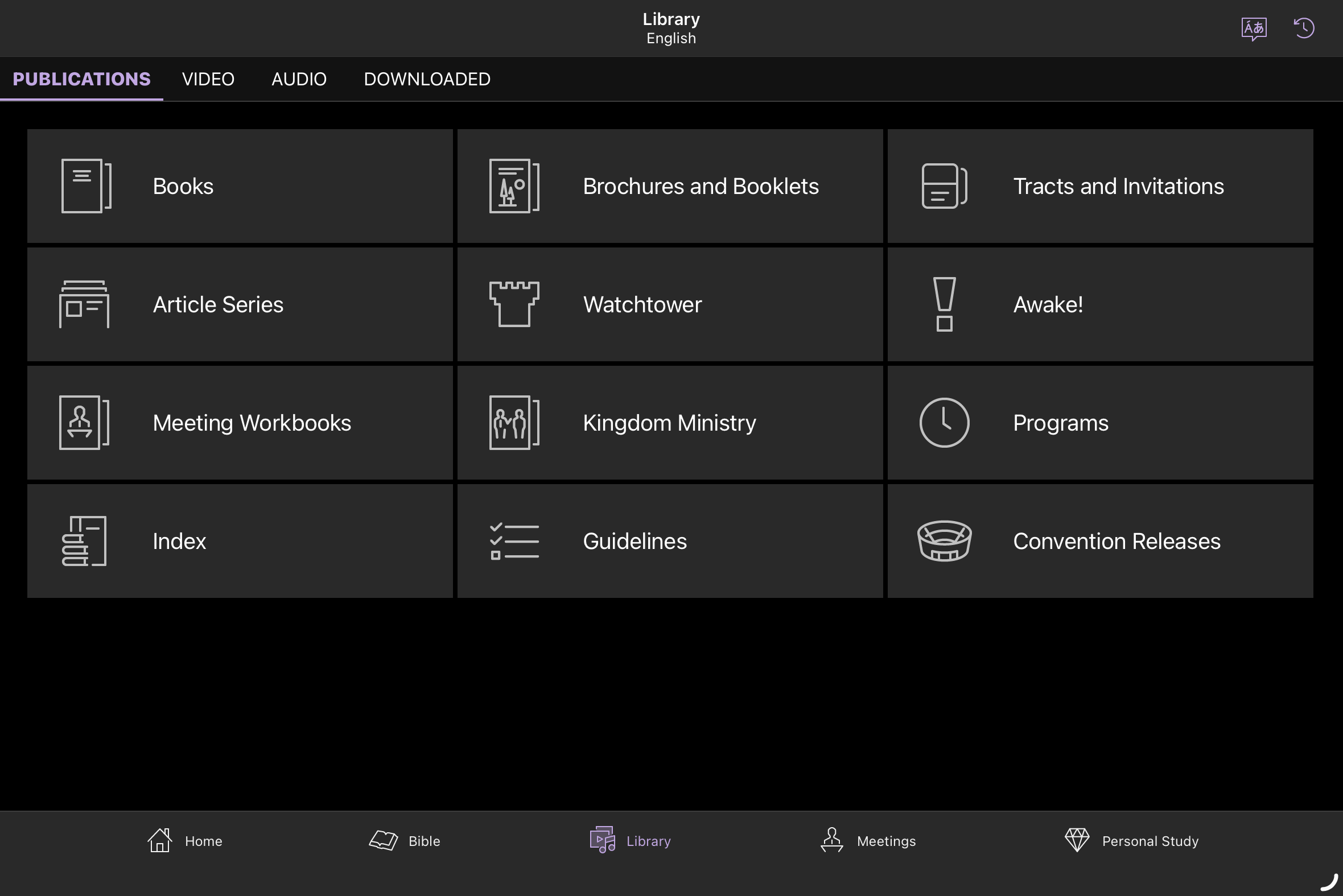
The Library tab in the JW Library app
As shown above, a relatively manageable number of categories are used to abstract and organize the many individual items that are available in the Library tab. Alphabets like the Latin alphabet used in English, French, Spanish, Pīnyīn (Pīn·yīn {Piecing Together of} · Sounds → [Pinyin] 拼音), etc. similarly use a relatively mentally manageable number of symbols to basically represent the sounds of a language, which in turn are combined in various ways and used to abstractly represent the various and hugely numerous meanings that can be expressed in that language.
In contrast, using Chinese characters is more like trying to directly use a single unorganized list of all the many items available in the JW Library app’s Library tab, every book, brochure, tract, video, etc., without the abstraction and organization provided by the categories, or even by consistent sorting. (Imagine if a developer on the JW Library app team actually implemented such a usability nightmare. It’s highly doubtful that this developer would be allowed to remain on the team!) And actually, the situation with Chinese characters is really much, much worse than that, because even the many items available in the JW Library app’s Library tab are few in number compared to the practically infinite number of things and concepts that human language can represent, that Chinese characters seek to represent relatively directly.
Myths and Consequences
Continuing on, DeFrancis highlights a serious harmful effect of the Emulatability Myth about Chinese characters, that reaches beyond those who are trying to learn a Chinese language:
CHINESE INFLUENCE ON READING THEORY
It is not enough, however, to note shortcomings in the aspect of the Emulatability Myth that seeks to create a universal language while still advancing the notion of “the special learning that characterizes a logographic system such as Chinese.” Pursuit of the will-o’-the-wisp of a universal language has the result merely of wasting countless hours of time. Much more serious is the result of the thesis, which underlies Kolers’ reference to “special learning,” that “there are two major systems of writing in the world today, the semantic and the phonetic” (Kolers 1970:113). This belief in the semantic nature of Chinese writing leads Kolers to argue that all research into reading—that is, how we read and how children should be taught to read—should be based on the alleged existence of two completely disparate systems of ideographic and phonetic writing. Kolers’ assumption that readers of the Chinese “semantic” script go directly from print to meaning leads to the conclusion, as Gough points out (1972:335), that “if they can do it, so can we.” And on this conclusion of emulatability is based a pedagogical approach to reading that affects millions of little victims of the Ideographic Myth.
There is an enormous literature on the teaching of reading. For present purposes, at the risk of oversimplifying the complexities involved in this literature, we can say that there are two main schools of thought on the subject: one arguing for the use of phonics [Wikipedia link] in teaching reading, another arguing against the use of phonics and for an approach in which readers go directly from writing to meaning. Adherents of the second approach constantly buttress their argument by reference to the “ideographic” or “semantic” nature of Chinese writing. So widespread is this aspect of the Emulatability Myth, and so serious are its consequences, that the whole question merits a thorough and long-overdue airing.
We can begin by observing that the line of reasoning espoused by adherents of the emulatability approach can be summarized as “Since A is true, therefore B is true.” Since readers of “semantic Chinese” read without regard to sound, therefore readers of “alphabetic English” can read without regard to sound. But what happens to this line of argument if it turns out that A is false? Does this mean that B is also false? Not necessarily. Proposition B may still be correct, but the proof of its correctness must be sought elsewhere than by citing the false proposition A. The least we can say is that confidence in the truth of B is seriously undermined when it is advanced on the basis of something so patently false. Perhaps it should also be added that specialists in reading, although responsible for the application of the Ideographic Myth to the teaching of reading, can be excused to some extent because they have been misled by specialists in Chinese.
This reminds me of an article I came across a few years ago, about how children are being taught to read English:
Millions of Americans can't read well.
That's because schools are still teaching kids the wrong way to read, using a flawed theory long ago debunked by cognitive scientists.
This is a stunning & eye-opening story by @ehanford for @apmreports.https://t.co/M3gIrXsplM
— Dave Mann (@ContrarianDave) August 22, 2019
Here are a couple of excerpts from the article linked to in the above post:
For decades, schools have taught children the strategies of struggling readers, using a theory about reading that cognitive scientists have repeatedly debunked. And many teachers and parents don’t know there’s anything wrong with it.
Goldberg decided to teach some of her students using the phonics program and some of her students using three cueing [Wikipedia link]. And she began to notice differences between the two groups of kids. "Not just in their abilities to read," she said, "but in the way they approached their reading."
Goldberg and a colleague recorded first-graders talking about what makes them good readers.
One video shows Mia, on the left, who was in the phonics program. Mia says she's a good reader because she looks at the words and sounds them out. JaBrea, on the right, was taught the cueing system. JaBrea says: "I look at the pictures and I read it."
Courtesy of Margaret Goldberg, Oakland Unified School District
It was clear to Goldberg after just a few months of teaching both approaches that the students learning phonics were doing better. "One of the things that I still struggle with is a lot of guilt," she said.
She thinks the students who learned three cueing were actually harmed by the approach. "I did lasting damage to these kids. It was so hard to ever get them to stop looking at a picture to guess what a word would be. It was so hard to ever get them to slow down and sound a word out because they had had this experience of knowing that you predict what you read before you read it."
Goldberg soon discovered the decades of scientific evidence against cueing.25 She was shocked. She had never come across any of this science in her teacher preparation or on the job.
This problem is real, and it has really affected us Mandarin field language learners. I remember that a few years ago, I talked to a brother who was learning Mandarin, and who insisted that Pīnyīn (Pīn·yīn {Piecing Together of} · Sounds → [Pinyin] 拼音) was bad, just like learning how to read English with phonics was bad. Unfortunately, the actual, verified cognitive science shows that he was completely wrong! I wonder how many other Mandarin field language learners have been similarly misled by the ripple effects of the linguistic idolatry of the Ideographic Myth and the Emulatability Myth…
Writing Is Not Pictures
Another interesting point that DeFrancis touches on is:
A fundamental error made by psycholinguists who uphold this type of investigation is the belief that since we can recognize many objects in the physical world around us we can equally well memorize the meanings of thousands of Chinese characters or the meanings of English words approached as ideographs. Thus Smith (1973:75) states that
we can both recognize and recall many thousands of words in our spoken vocabulary, and recognize many thousands of different faces and animals and plants and objects in our visual world. Why should this fantastic memorizing capacity suddenly run out in the case of reading? It is surely no more difficult for a person to remember that 家 or the printed word house is called “house” than that 🏠 (or an actual house) is called “house.” Unfortunately, we tend to believe that the alphabetic form house is read in an exclusive manner, simply because it is composed of letters.
This is an astonishing statement. How can the cognitive impact of little two-dimensional black-on-white symbols be compared with that of three-dimensional, multicolored, multitextured, and otherwise differentiated objects in our visual world? Smith has apparently not bothered to acquaint himself with the well-known difficulty of mastering Chinese characters. A modicum of inquiry would have revealed to him the sad but incontrovertible truth that this “fantastic memorizing capacity” does in fact run out for most Chinese, Japanese, and Koreans, not to mention Western students, when they are confronted with what actual experience has clearly shown to be the much more difficult task of recognizing and remembering many thousands of different characters.
While Chinese characters have taken some inspiration from the visual world that we humans see around us, which can be represented in pictures, characters are just characters (a type of writing), not actual pictures. So, while we humans are designed to be able to naturally connect speech and pictures of physical objects with meanings, abundant actual experience shows that connecting the inhumanly numerous and crazy complex (for writing) Chinese characters with meanings in our minds requires a long, hard, unnatural struggle. It follows, then, that no, Chinese characters are not a good model to follow by attempting to design a hypothetical universal writing system for use by us limited, imperfect humans, nor are they a good system to take inspiration from when it comes to teaching children how to read writing written in an alphabet, like English writing is.
Yes, since the Ideographic Myth and the Universality Myth are just myths, the Emulatability Myth that is based on them is also…BUSTED!