Categories
Culture Current Events Language Learning Science Technology Theocratic

yì‐nián‐yí‐dù

yì‐nián‐yí‐dù ((yì one 一)‐(nián year年/秊)‐(yí one 一)‐(dù {spending; passing (of time)} → [mw for occasions/times] 度) [once a year; annual | annually]) ← Tap/click to show/hide the “flashcard”

[Notes: Tap/click on a Pīnyīn (Pīn·yīn {Piecing Together of} · Sounds → [Pinyin] 拼音) expression to reveal its “flashcard”; tap/click on a “flashcard” or its Pīnyīn (Pīn·yīn {Piecing Together of} · Sounds → [Pinyin] 拼音) expression to hide the “flashcard”. 📖 📄 📘 icons mean 📖 Reveal All, 📄 Reveal Advanced, and 📘 Reveal None re all the “flashcards” in the heading, paragraph, etc. that they are placed at the beginning of.]

This week’s MEotW, “yì‐nián‐yí‐dù ((yì one 一)‐(nián year年/秊)‐(yí one 一)‐(dù {spending; passing (of time)} → [mw for occasions/times] 度) [once a year; annual | annually])”, occurs in the following sentence, which, at the time of this writing, jw.org is featuring to invite people to attend the Memorial:

English:

We invite you to attend our annual event to remember the death of Jesus Christ.

Mandarin:

📖 📄 📘 Wǒmen (Wǒ·men we · [pl] 我们 我們) yāoqǐng (invite 邀请 邀請) (you 你) cānjiā (cān·jiā {to take part in} · {to add to} → [to attend] 参加 參加) zhèige (zhèi·ge this · [mw] 这个 這個) yì‐nián‐yí‐dù ((yì one 一)‐(nián year年/秊)‐(yí one 一)‐(dù {spending (of time)} → [mw for occasions/times] 度) [annual]) de (’s 的) jìniàn (jì·niàn remembering · {thinking of} → [commemorating] 记/纪念 記/紀念) jùhuì (meeting 聚会 聚會), jìniàn (jì·niàn {to remember} · {to think of} → [to commemorate] 记/纪念 記/紀念) Yēsū (Jesus 耶稣 耶穌) Jīdū (Christ 基督) wèi (for為/爲) rénlèi (rén·lèi human·kind 人类 人類) xīshēng (xī·shēng sacrificed · {(as with a) domestic animal} → [sacrificed] 牺牲 犧牲) shēngmìng (life 生命).

“Yì‐nián‐yí‐dù ((Yì one 一)‐(nián year年/秊)‐(yí one 一)‐(dù {spending; passing (of time)} → [mw for occasions/times] 度) [once a year; annual | annually]) on one level of literalness means “one year one occasion/time”, which effectively means “annual”. Its final morpheme “dù (degree; extent; {degree of intensity} | {spending; passing (of time)} [→ [mw for occasions/times]] 度) in this expression serves as a measure word for occasions or times, which likely derives from its meaning of “spending; passing (of time)”. In other expressions, “dù (degree; extent; {degree of intensity} | {spending; passing (of time)} [→ [mw for occasions/times]] 度) can also mean “degree; extent; degree of intensity”:

  • 📖 📄 📘 dùguò (dù·guò {spend; pass (time)} · pass; cross → [spend; pass (time/etc.) | pull/get through; survive] 度过 度過)
  • 📖 📄 📘 tàidu (tài·du state · degree → [attitude; manner] 态度 態度)
  • 📖 📄 📘 wēndù (wēn·dù {(of) being warm} · {degree of intensity} → [temperature] 温度 溫度)
  • 📖 📄 📘 zhìdù (zhì·dù system · extent → [system] 制度)

Same Character, Different Tones

Note that in “yì‐nián‐yí‐dù ((yì one 一)‐(nián year年/秊)‐(yí one 一)‐(dù {spending; passing (of time)} → [mw for occasions/times] 度) [once a year; annual | annually])”, the morpheme meaning “one” is first pronounced “yì (one 一)”, with a fourth tone, and then it’s pronounced “yí (one 一)”, with a second tone. This is tone sandhi, and as the MEotW post on “diǎnliàng (diǎn·liàng {dot → [light (v); ignite]} · {to be bright} [→ [illuminate; shine light on]] 点亮 點亮) said:

On the other hand, the unofficial Pīnyīn (Pīn·yīn {Piecing Together of} · Sounds → [Pinyin] 拼音) Plus resources join the official Pīnyīn (Pīn·yīn {Piecing Together of} · Sounds → [Pinyin] 拼音) publications, old and new, in explicitly indicating tone sandhi for “bù (not 不) and “yī (one 一) (e.g., “búzài (bú·zài not · again; further; continuing; anymore 不再) instead of the standard “bùzài (bù·zài not · again; further; continuing; anymore 不再)) to make things easier for readers, even though this practice is not included in the GB/T 16159-2012 [PRC national] standard’s recommendations.

In the end, what matters most re how anything is written is not just what is officially recommended or what happens to be popular among changing, imperfect humans. Rather, what matters most is what really works best to accomplish the goal of writing: To communicate to readers. This is especially true when God-honouring and life-saving Bible truths need to be communicated. So, this blog and the other Pīnyīn (Pīn·yīn {Piecing Together of} · Sounds → [Pinyin] 拼音) Plus resources will continue to seek to render Pīnyīn (Pīn·yīn {Piecing Together of} · Sounds → [Pinyin] 拼音) in ways that maximize how clearly, easily, effectively, and appropriately it communicates with readers.

Same Characters, Different Word Boundaries

Another interesting thing to note is that the last two morphemes in “yì‐nián‐yí‐dù ((yì one 一)‐(nián year年/秊)‐(yí one 一)‐(dù {spending; passing (of time)} → [mw for occasions/times] 度) [once a year; annual | annually]) can in some contexts form the expression “yídù (yí·dù [(at)] one · {spending; passing (of time) → [mw for occasions/times]} [once; at one time; on one occasion; for a time] 一度)”, which is appropriately written in Pīnyīn (Pīn·yīn {Piecing Together of} · Sounds → [Pinyin] 拼音) without a space or other word divider between the two morphemes. Why then, does this blog post render “yì‐nián‐yí‐dù ((yì one 一)‐(nián year年/秊)‐(yí one 一)‐(dù {spending; passing (of time)} → [mw for occasions/times] 度) [once a year; annual | annually]) with a hyphen (that acts as a word divider) between its last two morphemes?

The reason for the different renderings of the same two morphemes in the two different expressions is, well, because we are indeed dealing with two different expressions. Whereas “yì‐nián‐yí‐dù ((yì one 一)‐(nián year年/秊)‐(yí one 一)‐(dù {spending; passing (of time)} → [mw for occasions/times] 度) [once a year; annual | annually]) uses its last two morphemes in a “one-[word divider]-[measure word]” pattern, as does “yí (one 一) ge ([mw]個/个)”, “yídù (yí·dù [(at)] one · {spending; passing (of time) → [mw for occasions/times]} [once; at one time; on one occasion; for a time] 一度), treated as one word without a space in it, is used to effectively mean “once; at one time; on one occasion; for a time”. The ABC Chinese-English Dictionary, edited by John DeFrancis and Victor H. Mair, among others, provides these examples of this expression in use:

📖 📄 📘 Wǒmen (Wǒ·men we · [pl] 我们 我們) yídù (yí·dù (at) one · {passing (of time) → [mw for occasions/times]} [once] 一度) shì (were 是) hǎo (good 好) péngyou (friends 朋友).
We were once good friends.

📖 📄 📘 (she 她) yídù (yí·dù (at) one · {passing (of time) → [mw for occasions/times]} [for a time] 一度) duì (towards) huìhuà (huì·huà painting · paintings 绘画 繪畫) gǎn (felt 感) xìngqù (interest 兴趣 興趣).
She was interested in painting for a time.

Context Is the Key, Not Characters

The above points about how the characters “一” and “度” can have different pronunciations or meanings in different contexts remind us that Chinese characters are NOT the ultimate clarifiers of meaning in Mandarin. This excerpt from the MEotW post on “yǔjìng (yǔ·jìng language · {(set of) boundaries → [(bounded) place; area] → [condition; situation; circumstances]} → [context] 语境 語境) explains further:

Context and Mandarin Writing Systems

Research into the importance of context turned up a couple of interesting sayings from the business world:

Content is king.
—Bill Gates

Content is king, but context is God.
—Gary Vaynerchuk

Mandarin field language-learners may hear the assertion from Chinese culture traditionalists that it is necessary to use Chinese characters to clarify the ambiguity that results from Mandarin having so many homophones, words that sound the same but that have different meanings. The insinuation, or even the outright accusation, is that the upstart Pīnyīn (Pīn·yīn {Piecing Together of} · Sounds → [Pinyin] 拼音) system is thus unusable as a writing system for Mandarin, that the Chinese characters writing system is still the rightful king. Besides, there is so much existing content written in Chinese characters, and content is king!

However, a little consideration of the yǔjìng (yǔ·jìng language · {(set of) boundaries → [(bounded) place] → [situation]} → [context] 语境 語境), the language situation or context, shows up the fallacy of this assertion. The Chinese characters writing system exists along with Mandarin speech, and if Chinese characters are truly required to clearly communicate meaning in Mandarin, then that would mean that Mandarin speech on its own, without the help of visible characters, is unusable as a means of communication. That, however, is obviously not true—people who are proficient in spoken Mandarin communicate clearly with each other all the time, undoubtedly pretty much as clearly as proficient English speakers communicate with each other.

The key reason why proficient Mandarin speakers can communicate clearly with each other despite all of the homophones in Mandarin is not that they are constantly referring to Chinese characters, although people do occasionally do that in the current characters-saturated cultural climate. No, the key reason why Mandarin-speakers routinely communicate clearly with each other is because they use sufficient context to clarify any potentially ambiguous homophones. And, since Pīnyīn (Pīn·yīn {Piecing Together of} · Sounds → [Pinyin] 拼音) is a simple and direct representation of Mandarin speech, anything that is understandable when spoken in Mandarin is understandable when written in Pīnyīn (Pīn·yīn {Piecing Together of} · Sounds → [Pinyin] 拼音)1 Corinthians 14:8–11.

So, while Chinese characters-based content may be so predominant in the Chinese world that it’s king there, context is God, relatively and metaphorically speaking, and Mandarin speech and Pīnyīn (Pīn·yīn {Piecing Together of} · Sounds → [Pinyin] 拼音) rightly rely on context, not on Chinese characters, just like we rightly rely on God, not on merely human kings.

Categories
Science Technology Theocratic

tūbiàn

tūbiàn (tū·biàn {chimney → [dashing forward] → [sudden[ly]; unexpected[ly]]} · changing [→ [mutation]] 突变 突變) ← Tap/click to show/hide the “flashcard”

[Notes: Tap/click on a Pīnyīn (Pīn·yīn {Piecing Together of} · Sounds → [Pinyin] 拼音) expression to reveal its “flashcard”; tap/click on a “flashcard” or its Pīnyīn (Pīn·yīn {Piecing Together of} · Sounds → [Pinyin] 拼音) expression to hide the “flashcard”. 📖 📄 📘 icons mean 📖 Reveal All, 📄 Reveal Advanced, and 📘 Reveal None re all the “flashcards” in the heading, paragraph, etc. that they are placed at the beginning of.]

The Shēngmìng Láizì Chuàngzào Ma? ((Shēngmìng Life 生命) (Lái·zì Came · From 来自 來自) (Chuàng·zào Initiating · {Making, Creating} → [Creating] 创造 創造) (Ma [? ptcl for “yes/no” questions])? [Was Life Created? (lc)]) (Was Life Created? (lc)) brochure and the Shēngmìng de Qǐyuán—Zhíde Sīkǎo de Wǔ Ge Wèntí ((Shēngmìng Life 生命) (de ’s 的) (Qǐ·yuán {Rising → [Starting]} · Source → [Origin] 起源/原)—(Zhí·de Worth · Getting → [Worth] 值得) (Sī·kǎo {Thinking About} · Examining 思考) (de ’s 的) (Wǔ Five 五) (Ge [mw]個/个) (Wèn·tí Asking · Subjects → [Questions] 问题 問題) [The Origin of Life​—Five Questions Worth Asking (lf)]) (The Origin of Life​—Five Questions Worth Asking (lf)) brochure were originally published back in 2010, but recently, the English version of the Was Life Created? brochure was updated to the December 2022 Printing, and the Mandarin version of it was updated to the February 2023 Printing. Also, the Was Life Created? brochure and the Origin of Life brochure are now in the Teaching Toolbox section in the JW Library app. So, it would be good to consider some of the expressions used in the Mandarin versions of these publications that can be so helpful when discussing whether life was created.

Myth 1

This week’s MEotW, which appears several times in the Mandarin Was Life Created? brochure, is “tūbiàn (tū·biàn {chimney → [dashing forward] → [sudden[ly]; unexpected[ly]]} · changing [→ [mutation]] 突变 突變), which is used to translate “mutation”. What is mutation? The English word “mutation” comes from a Latin word that means “to change”, so “a mutation” is basically a fancy way of saying “a change”, continuing a long tradtion in English of deriving words from Latin to represent scientific concepts (and computer programming concepts, etc.) that could be represented more simply with more common, already-existing English words. Wikipedia’s article on mutation provides this summary of how “mutation” is defined in the specific context of biology:

In biology, a mutation is an alteration in the nucleic acid sequence of the genome of an organism, virus, or extrachromosomal DNA.[source]

So, when considering the question of evolution vs. creation, a “mutation” is simply a change in something’s genetic code. Regarding how central mutation is to evolution theory, the Was Life Created? brochure says that mutation is the focus of what it calls Myth 1 about evolution:

English:

Myth 1. Mutations provide the raw materials needed to create new species.

Mandarin:

📖 📄 📘 Jiǎshè (Jiǎ·shè Artificial · {Setting Up} → [Hypothesis] 假设 假設) 1. Tūbiàn (Tū·biàn {chimney → [dashing forward] → [sudden]} · changings → [mutations] 突变 突變) néng (can 能) wèi (for為/爲) xīn (new 新) wùzhǒng (wù·zhǒng {thing → [creature]} · species → [species] 物种 物種) de ( 的) xíngchéng (xíng·chéng forming · {to come to be} 形成) tígōng (tí·gōng {carry (hanging down from the hand) → [raise]} · provide 提供) jīchǔ (jī·chǔ foundation · base 基础 基礎).

How the Expression Breaks Down

The “tū (chimney [→ [sticking out | dashing forward [→ [sudden[ly]; unexpected[ly]]]]] 突) in “tūbiàn (tū·biàn {chimney → [dashing forward] → [sudden[ly]; unexpected[ly]]} · changing [→ [mutation]] 突变 突變) literally means, oddly enough, “chimney”. Based on this traditional literal meaning, “tū (chimney [→ [sticking out | dashing forward [→ [sudden[ly]; unexpected[ly]]]]] 突) can be used to mean “dashing forward”, which in turn can be used to mean “sudden” or “suddenly” (presumably like a chimney seems to suddenly dash forward out of the roof of a house). This is apparently the meaning that’s used in “tūbiàn (tū·biàn {chimney → [dashing forward] → [sudden]} · changing → [mutation] 突变 突變), since genetic mutations are generally not planned or expected, and thus seem, from our human point of view, to appear suddenly. Probably related to this, another expression in which “tū (chimney [→ [sticking out | dashing forward [→ [sudden[ly]; unexpected[ly]]]]] 突) appears is “tūrán (tū·rán {chimney → [dashing forward] → [sudden[ly]; abrupt[ly]]} · {-ly | like that} 突然), which means “suddenly; abruptly”.

As for the “biàn ({change; transform [into]}) in “tūbiàn (tū·biàn {chimney → [dashing forward] → [sudden[ly]; unexpected[ly]]} · changing [→ [mutation]] 突变 突變), it’s a well-known expression that means “change”. Another expression in which it appears is the well-known expression “gǎibiàn (changing 改变 改變). It also occurs in the expression “biànyì (biàn·yì changed · {to be different} 变异 變異), which is used in the Was Life Created? brochure, for example, in this caption of a picture in the section entitled “Evolution​—Myths and Facts” (linked to above):

English:

Mutations can introduce changes in plants​—such as this mutant with large flowers—​but only within limits

Mandarin:

📖 📄 📘 Tūbiàn (Tū·biàn {chimney → [dashing forward] → [sudden]} · changings → [mutations] 突变 突變) néng (can 能) shǐ (cause 使) zhíwù (zhí·wù planted · things → [plants] 植物) fāshēng (fā·shēng {to issue forth} · {to make to come to life} → [to have happen] 发生 發生) biànyì (biàn·yì {being changed} · {to be different} 变异 變異), lìrú (lì·rú example · like → [for example] 例如) shǐ (causing 使) huāduǒ (huā·duǒ flowers · [mw for flowers, clouds, etc.] 花朵) zhǎngde (zhǎng·de {to grow} · {to get} 长得 長得) jiàodà (jiào·dà {being compared → [comparatively]} · {to be large} → [to be larger] 较大 較大), dàn (but 但) biànyì (biàn·yì (the) {being changed} · {to be different} 变异 變異) shì (is 是) yǒu (having 有) júxiàn (limitings → [limits] 局限) de ( 的)

It’s also noteworthy that “biàn ({change; transform [into]}) occurs in “biànzhǒng (biàn·zhǒng changed · kind; type; variety → [mutation; variant; variety | mutant] 变种 變種), which is used in the Was Life Created? brochure to mean “mutant”, for example, in this caption of another picture from the section entitled “Evolution​—Myths and Facts”:

English:

Mutant fruit flies, though malformed, are still fruit flies

Mandarin:

📖 📄 📘 Biànzhǒng (Biàn·zhǒng changed · kind → [mutant] 变种 變種) guǒyíng (guǒ·yíng fruit · flies 果蝇 果蠅) suīrán (suī·rán although · -ly 虽然 雖然) xíngzhuàng (forms 形状 形狀) bùtóng (bù·tóng not · {are the same} → [are different] 不同) le ({to completion} 了), dàn (yet 但) réngjiù (réng·jiù still · {(as in the) past} 仍旧 仍舊) shì (are 是) guǒyíng (guǒ·yíng fruit · flies 果蝇 果蠅)

How Myth 1 Breaks Down

As just the picture captions quoted above show, Myth 1 about evolution, that mutations can power evolution, is truly a myth, not a fact. Of course, the Was Life Created? brochure contains much related information in addition to just these quoted picture captions. Indeed, the Mandarin Was Life Created? brochure uses some interesting expressions in relation to the demonstrated erroneousness of this first myth concerning evolution. Perhaps this blog will consider one or more of these expressions in the future.


For convenience:

The direct link for the current generation Pīnyīn (Pīn·yīn {Piecing Together of} · Sounds → [Pinyin] 拼音) Plus resource for the Was Life Created? brochure is:

The short link for Chinese field language-learning links for the Was Life Created? brochure is:

More Pīnyīn (Pīn·yīn {Piecing Together of} · Sounds → [Pinyin] 拼音) and Pīnyīn (Pīn·yīn {Piecing Together of} · Sounds → [Pinyin] 拼音) Plus web material based on the Mandarin Was Life Created? brochure will be made available in the Pīnyīn (Pīn·yīn {Piecing Together of} · Sounds → [Pinyin] 拼音) Plus web resource as time allows. Work is now underway to produce a Pīnyīn (Pīn·yīn {Piecing Together of} · Sounds → [Pinyin] 拼音) Plus web resource for the Mandarin Origin of Life brochure as well.

Categories
Culture Current Events History Language Learning Science Technology

xuānchuán

xuānchuán (xuān·chuán declaring; proclaiming; announcing · {passing on}; spreading; transmitting → [conducting propaganda; propagating; disseminating; publicizing | propaganda] 宣传 宣傳) ← Tap/click to show/hide the “flashcard”

Several MEotW posts, including last week’s post on “cì’ěr (cì’·ěr {stabs; pricks → [irritates; pierces]} · ear → [grating on the ear; jarring; ear-piercing] 刺耳), have mentioned propaganda. So, it seems that it’s about time to consider the Mandarin expression “xuānchuán (xuān·chuán declaring; proclaiming; announcing · {passing on}; spreading; transmitting → [conducting propaganda; propagating; disseminating; publicizing | propaganda] 宣传 宣傳)”, which is often used to translate “propaganda”.

Morphemic Breakdown

The “xuān (declare; proclaim; announce 宣) in “xuānchuán (xuān·chuán declaring; proclaiming; announcing · {passing on}; spreading; transmitting → [conducting propaganda; propagating; disseminating; publicizing | propaganda] 宣传 宣傳) means “declare; proclaim; announce”, and it also appears in expressions like “xuānbù (xuān·bù declare; proclaim; announce · declare; spread; announce; publish; proclaim 宣布 宣布/佈)”, “xuānjiǎng (xuān·jiǎng declare; proclaim; announce · {speak of → [explain]} 宣讲 宣講)”, “xuānyáng (xuān·yáng declare; proclaim; announce · {raise → [make known]} 宣扬 宣揚)”, etc.

The “chuán ({pass on}; {hand down}; spread; transmit [→ [summon]]) in “xuānchuán (xuān·chuán declaring; proclaiming; announcing · {passing on}; spreading; transmitting → [conducting propaganda; propagating; disseminating; publicizing | propaganda] 宣传 宣傳) means “pass on; hand down; spread; transmit”, and it also appears in expressions like “chuándào (chuán·dào spreading · way → [preaching] 传道 傳道)”, “Chuándàoshū (Chuán·dào·shū Spreading · Way · Book → [Ecclesiastes] 传道书 傳道書)”, “chuánjiǎng (chuán·jiǎng spread · {speak of; say; tell} [(that)] 传讲 傳講)”, “chuántǒng (chuán·tǒng {passed on} · {gathered together (things) → [interconnected system]} → [tradition | traditional] 传统 傳統)”, etc.

The above-mentioned morphemes in “xuānchuán (xuān·chuán declaring; proclaiming; announcing · {passing on}; spreading; transmitting → [conducting propaganda; propagating; disseminating; publicizing | propaganda] 宣传 宣傳) are both basically verbs, and “xuānchuán (xuān·chuán declaring; proclaiming; announcing · {passing on}; spreading; transmitting → [conducting propaganda; propagating; disseminating; publicizing | propaganda] 宣传 宣傳) itself is also basically a verb. However, it’s also used as a noun, making it a verbal noun, or a gerundial noun, in those cases.

How Bad Is It?

As mentioned in the excellent Referenced Theo. Expressions (RTE) resource, “it seems 宣传 [xuānchuán] is a neutral word in Chinese (can be either positive or negative)”. Indeed, the morphemes that make up “xuānchuán (xuān·chuán declaring; proclaiming; announcing · {passing on}; spreading; transmitting → [conducting propaganda; propagating; disseminating; publicizing | propaganda] 宣传 宣傳), mentioned above, are themselves both morally neutral. Like any technology, whether the things that these morphemes represent result in good or harm depends on how they are used. Unfortunately, we are now living in the last days of a world ruled by Satan the Devil, a world filled with self-seeking people who totally would misuse anything that would potentially enable them to exert influence over other people.—2 Timothy 3:1–5; 1 John 5:19.

It should not be surprising, then, that the worldly Chinese governing authorities may at times disseminate what many would recognize as propaganda—biased, misleading distortions of the truth meant to promote certain viewpoints, political or cultural objectives, etc. Add to that how Eastern culture generally encourages people to conform to the group and not question authority, and it’s not surprising that many who grew up marinated in Chinese culture have come to just accept such propaganda as fact, as just the way things are in the Chinese world.

As for the West, even though it has more of a culture of questioning authority, it, along with the world in general that the Internet can reach, has been experiencing a rise in misinformation and disinformation. Social media and other technologies that have become available have given people more power to select what information they want to take in, and, egged on by engagement-seeking algorithms, many have unfortunately chosen to just focus on information sources that tell them what they want to hear, whether it’s true or not. As the Bible foretold long ago:

For there will be a period of time when they will not put up with the wholesome teaching, but according to their own desires, they will surround themselves with teachers to have their ears tickled. They will turn away from listening to the truth and give attention to false stories.
2 Timothy 4:3, 4.

As Jehovah’s people, we especially need to be wary of any worldly propaganda, because we want to be the true worshippers spoken of by Jesus, ones who “must worship with spirit and truth”.—John 4:23, 24.

Unfortunately, these days, even something as basically human as language gets politicized, so even just being language learners in the Mandarin field, we still need to watch out for worldly propaganda. Below are a couple of commonly accepted beliefs about the Chinese languages that are actually propaganda, not truth.

Propaganda About “Dialects”

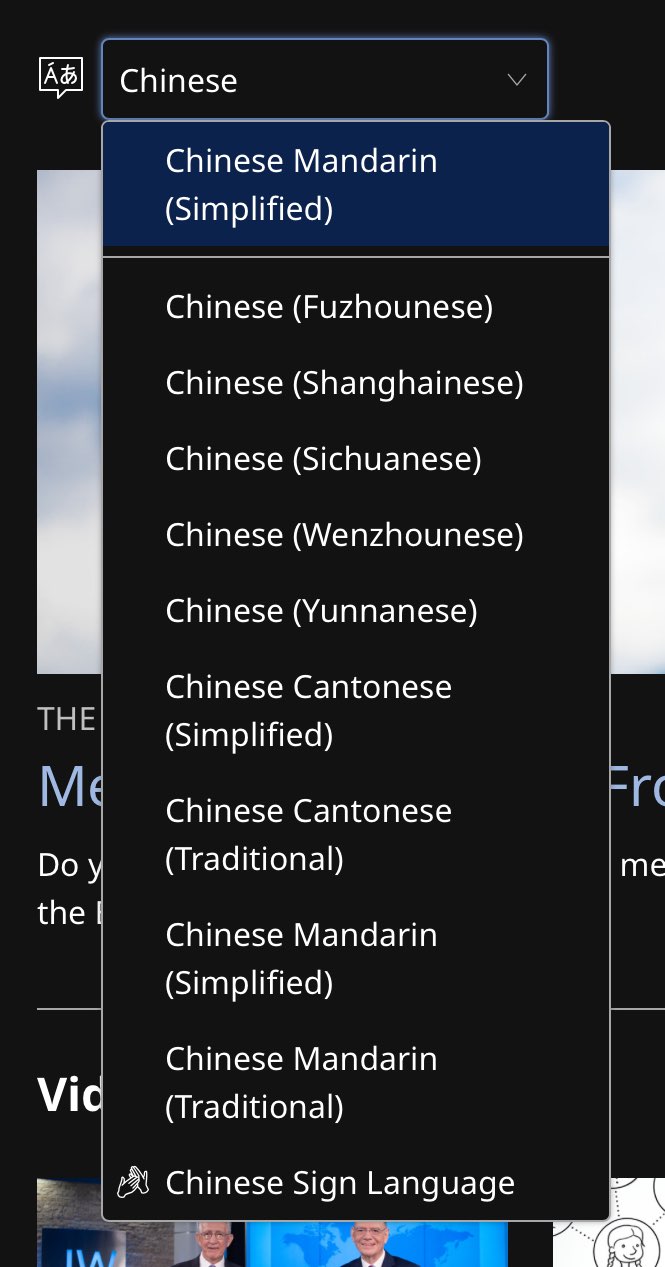
“Mandarin, Cantonese, Shanghainese, etc. are just dialects of the one Chinese language.” The truth is that being mutually unintelligible, Mandarin, Cantonese, Shanghainese, etc. are really different languages, like French and English are different languages. The erroneous belief that Mandarin, Cantonese, Shanghainese, etc. are just dialects of the one Chinese language has been promoted by the worldly central governing authorities in China to bolster the idea that China is indeed one big happy political entity that should have a central government—them.

Historically, though, it wasn’t always the case that there was just one government over the land that China now occupies. That didn’t become the case until Qín Shǐhuáng ((Qín {Qin (dynasty)} 秦) (Shǐ·huáng Beginning · Emperor 始皇) (the founder of the Qín dynasty and the first emperor of China)) conquered the other Warring States—which were peers of his own state of Qín ({Qin (one of the Warring States)} 秦)—and became the first emperor of a forcefully unified China. If it wasn’t for this, China could conceivably have become like modern-day Europe, with several peer states which are recognized as having their own distinct languages and cultures.

So, there is no need to allow the idea that Mandarin, Cantonese, etc. are just dialects to sabotage our efforts to learn Mandarin well by making us think that we can just take Cantonese, etc. and twist it a little to get Mandarin—all we would get then is a twisted mess!

Propaganda and the Characters

“Chinese characters are the primary aspect of the Chinese languages.” The truth is that when it comes to human language, speech is primary, not writing.

However, given how so many people around the world are so enchanted with the visually intricate Chinese characters, some may feel that the characters give China a certain amount of cultural—and maybe even political—soft power. Many also feel that characters have a unifying effect on Chinese people, since they use characters to write even if they speak different Chinese languages, as explained above. Thus, many may also feel that there may be some political advantages to characters for China’s worldly central ruling authorities. So, they may thus be motivated to promote Chinese characters over, say, a system like Pīnyīn (Pīn·yīn {Piecing Together of} · Sounds → [Pinyin] 拼音) that doesn’t have the same perceived visual and cultural pizzaz that the characters have, and that is only for Mandarin.

The truth is, though, that there is really no technical requirement for any language, Chinese or otherwise, to be written using Chinese characters—Pīnyīn (Pīn·yīn {Piecing Together of} · Sounds → [Pinyin] 拼音) works fine as a writing system for Mandarin without incurring the extraordinary costs in time and effort that the characters do, and separate but similar alphabetical systems can conceivably be designed and used for other Chinese languages as well.

Re the supposed unifying effect of the Chinese characters, there is not necessarily really much of a unifying effect among the Mandarin-speakers, Cantonese-speakers, Japanese-speakers, Korean-speakers, etc. who may use characters to write, any more than the use of the Latin alphabet unifies English-speakers, French-speakers, Italian-speakers, Mandarin-speakers, etc. who may use it to write. An especially stark current example of the relative insignificance of any unifying effect that a script or writing system may have is that unfortunately, Russia and Ukraine have hardly been unified because of their both using the Cyrillic script.

We who are Jehovah’s people in particular don’t need a product of human culture like the Chinese characters to unite us—we are united by the culture of spirit and truth from Jehovah God himself!—John 4:23, 24.

Don’t Be a Gullible “Tourist”!

As Jehovah’s people, let us make sure we are advancing the interests of God’s Kingdom, and not unwittingly serving the interests of worldly Chinese governments. As missionaries and rescue workers in the Mandarin field, and not just tourists (email me for login information, and include information on who referred you and/or what group/cong. you are in), let us be focused on what really helps us to do our God-honouring and life-saving work better. Let us not be misled by the self-serving xuānchuán (xuān·chuán declaring · spreading → [propaganda] 宣传 宣傳), the propaganda, from Satan’s world.