Categories
Culture Current Events History Science Technology Theocratic

app

app (a-p-p)

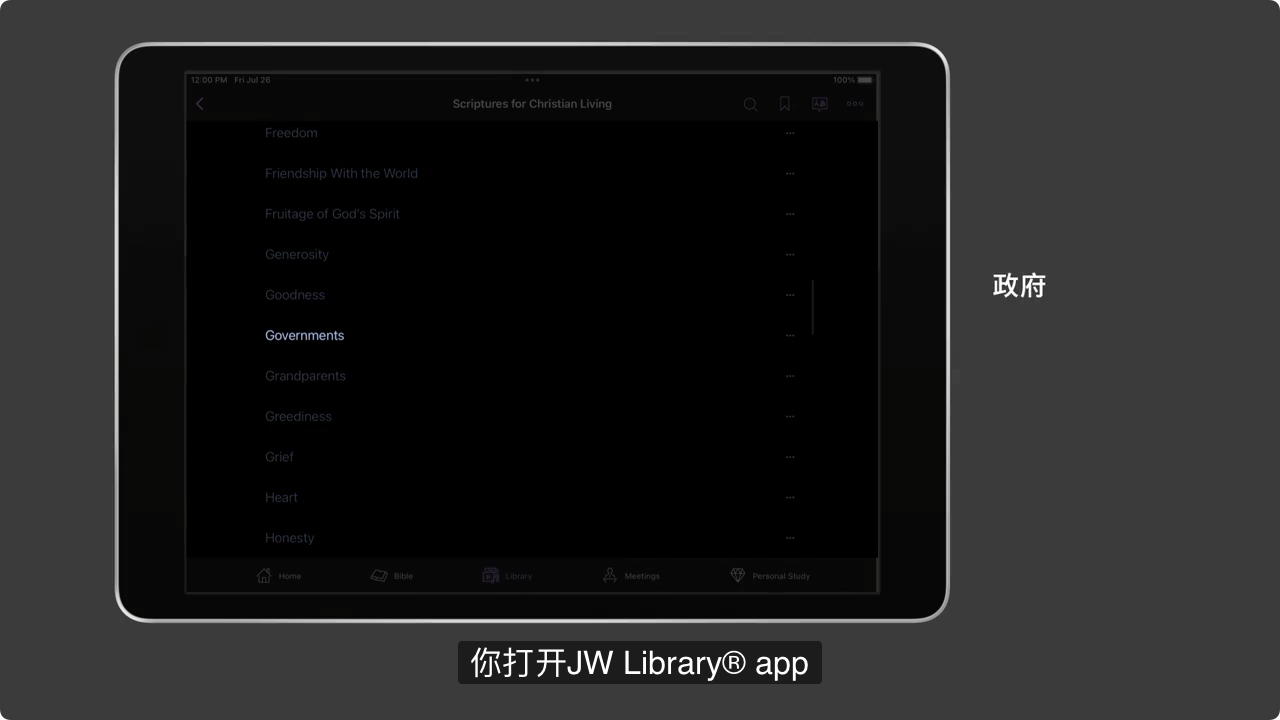
This week’s MEotW, “app” (sometimes written as “APP”), is now the organization’s official way to translate “app” in Mandarin, as much as there is an official way to do so. For example, it’s used in the Mandarin version of the 2024 Governing Body Update #5 video, at around the 11:06 mark—the subtitles say “app”, while the narrator says what sounds like “ay pee pee”.

“app” used in the Mandarin version of the 2024 Governing Body Update #5 video

(By the way, note that in this screenshot, the JW Library app is shown in Dark Mode—afters many years of people being used to using computer displays with white backgrounds that mimick paper, the organization is showing that there is nothing objectionable about the dark or black backgrounds enabled by computing device displays, backgrounds which can be easier on the eyes in some situations. After all, the default mode of the universe that Jehovah created is dark mode!)

An Unexpected Pronunciation

Yes, interestingly, as we can hear from the aforementioned video, when one refers to the JW Library app in Mandarin, in addition to using the English app name “JW Library” instead of a corresponding native Mandarin expression, one spells out the letters of “app” instead of just saying the English word “app”.

Why use three syllables to pronounce this exceedingly simple one-syllable English word in such an unusual and unexpected way? An Internet search turned up a Quora page discussing this question, which page contains the following excerpt that seems to summarize the points made in many of the replies:

Since the the original form “application” is not widely known, app is thought to be an acronym. In the aspect of pronunciation, closed syllables ending with p do not meet the Chinese pronunciation habit.

So, in other words, some believe that:

  • Being unfamiliar with the English word “application” that “app” is an abbreviation for, many Mandarin-speaking people erroneously thought that “app” is an acronym/initialism like “USA” or “PRC”, and acronyms are pronounced by saying the names of the letters in them. [2024-08-21: Thanks to reader SB for bringing up the matter of acronyms vs. initialisms. It seems that there is agreement that initialisms are, or can be, pronounced letter by letter, like “USA” and the Mandarin “app” are. However, there is not agreement about whether expressions pronounced that way count as acronyms, since some hold that only expressions like “NASA” that are pronounced as words should be considered acronyms.]
    • The fact that the Mandarin “app” is sometimes written in all upper case letters as “APP”, like an acronym/initialism would be written, lends credence to this theory.
  • Because Mandarin does not have words that end with a “p” sound, people who have only ever spoken Mandarin are not used to saying such words, and thus were naturally inclined to not just pronounce “app” like it is pronounced in English.
    • Some drag Chinese characters and Pīnyīn (Pīn·yīn {Piecing Together of} · Sounds → [Pinyin] 拼音) into discussion of this question, but these writing systems are just secondary visual representations of the actual primary factor relating to this issue, which is the system of sounds used in Mandarin speech. (I believe that technically, this is referred to as Mandarin phonology.)
    • Personally, I have doubts about this proposed factor, since other one-syllable English words ending with a “p” sound, like “jeep” (“jípǔ (jeep 吉普)”) and “Trump” (“Tèlǎngpǔ (Trump 特朗普)/Chuānpǔ (Trump (Tw) 川普)”), have been borrowed by Mandarin without requiring Mandarin-speakers to spell out their letters. I suppose it’s possible, as some have said, that putting “app” through this process results in a Mandarin expression that sounds confusingly similar to other expressions.

It’s also interesting that “app”, with its spelled-out letters, is used in Mandarin to correspond with the English word “app”, including in official media published by the organization, even though a native Mandarin expression meaning “app” does indeed exist. As shown in dictionaries, “yìngyòng (yìng·yòng apply · use | applied · used [(instance/etc.)] [→ [applied; for practical application; practical | application; practical use | (computing) app]] 应用 應用) may be used to mean “app”, and just as “app” is short for “application”, “yìngyòng (yìng·yòng apply · use | applied · used [(instance/etc.)] [→ [applied; for practical application; practical | application; practical use | (computing) app]] 应用 應用) is short for “yìngyòng chéngxù+ ((yìng·yòng applied · used (instance) → [application] 应用 應用) (chéng·xù {journey → [procedure]} · order; sequence → [(computer) programme] 程序) [application programme]) (or “yìngyòng chéngshì ((yìng·yòng applied · used (instance) → [application] 应用 應用) (chéng·shì {journey → [procedure]} · pattern → [(computer) programme (Tw)] 程式) [application programme (Tw)]) in Taiwan).

“Resistance Is Futile”

While Chinese traditionalists may futilely carry on about keeping Chinese culture “pure”, the common use of “app” in Mandarin is yet another example of Chinese culture naturally being influenced by Western culture, since the phenomenon of the modern mobile app followed on from the Western invention of the iPhone. Regarding the influence of Western culture on Chinese people, I have also noticed that some Chinese people seem to consider it “cool” to sprinkle in some English words here and there when they are speaking Mandarin, Cantonese, etc., even when they know the corresponding native Mandarin, Cantonese, etc. expressions.

Speaking of “cool”, a recent Language Log blog post written by Victor Mair and entitled “The Englishization of Chinese enters a new phase” said the following about “cool”, and about our MEotW “app”:

He takes the well-known example of “cool” (I’ll summarize what he says here). Before the year 2000, if somebody mentioned in a praiseworthy way that something was “kù 酷”, which at that time literally meant “cruel; ruthless; brutal; oppressive; savage”, people would consider that he was mixing English “coo[l]” in his Chinese speech, because at that time English “cool” was still in the early stages of being absorbed into Chinese. Standard dictionaries listed only the negative, pejorative meanings of “kù 酷”; there was not a trace of the positive meaning of “neat; nifty” and so forth. However, with the passage of time and with more and more saying “coo[l]” in a positive, approbatory sense, it gradually became a Chinese word. Now, if you say that someone or something is “kù 酷” (i.e., “cool”), no one would think that you’re mixing English in your speech. The positive meanings “cool; neat; nifty” have now become the primary definitions for “kù 酷”.

…people are no longer feeling the need to syllabize, much less hanziize, English words. They just say them flat out, and nobody blinks an eye that they are English words in Chinese. They have already instantly become Chinese terms — at least in speech. Nobody has cared to figure out how they should be written in hanzi [Chinese characters]. Even if you write them, you write them with roman letters…the roman alphabet has become an integral part of the Chinese writing system

There are hundreds of such words in current Chinese discourse, and they are at diverse stages of absorption into Chinese, e.g., “app”, “logo”, and “Ptú P图” (lit. “P picture/image”).

Yes, along with the “JW Library” app name, “app” is yet another example of how English words and Latin alphabet letters—like those used in Pīnyīn (Pīn·yīn {Piecing Together of} · Sounds → [Pinyin] 拼音)—are being incorporated into how people speak and write Mandarin Chinese “in the wild”, in the real world.

Anyway, as discussed in the 2024 Governing Body Update #5 video mentioned above, we stay neutral with regard to the world’s conflicts. While this obviously includes the world’s wars and political conflicts, in principle, this also applies to the world’s culture wars and its cultural conflicts and competitions. Our focus should be on how we can advance the interests of God’s Kingdom, and promote God’s righteous ways of doing things.—Matthew 6:33.

Categories
Culture Language Learning Technology Theocratic

háowú

háowú+ (háo·wú {(even) a fine hair (of)} · {is not having} → [is not having even a little] 毫无 毫無) ← Tap/click to show/hide the “flashcard”

[Notes: Tap/click on a Pīnyīn (Pīn·yīn {Piecing Together of} · Sounds → [Pinyin] 拼音) expression to reveal its “flashcard”; tap/click on a “flashcard” or its Pīnyīn (Pīn·yīn {Piecing Together of} · Sounds → [Pinyin] 拼音) expression to hide the “flashcard”. 📖 📄 ➕ icons mean 📖 Reveal All, 📄 Reveal Advanced, and ➕ Reveal + Symbols re all the “flashcards” in the heading, paragraph, etc. that they are placed at the beginning of.]

I have long especially liked 1 Corinthians 13. It contains counsel on what really does and doesn’t matter in life, an extensive description and definition of the most important kind of love, and a sublime discussion about the need to become complete, mature, as a person. As these apply to life in general, so too do they apply to our lives as Mandarin field language learners.

As Mandarin field language learners, it can benefit us greatly to consider what we can learn from 1 Corinthians 13, and along the way, we can also consider some of the Mandarin expressions used in that chapter in the current version of the Mandarin New World Translation Bible (nwtsty).

“I Do Not Benefit at All”

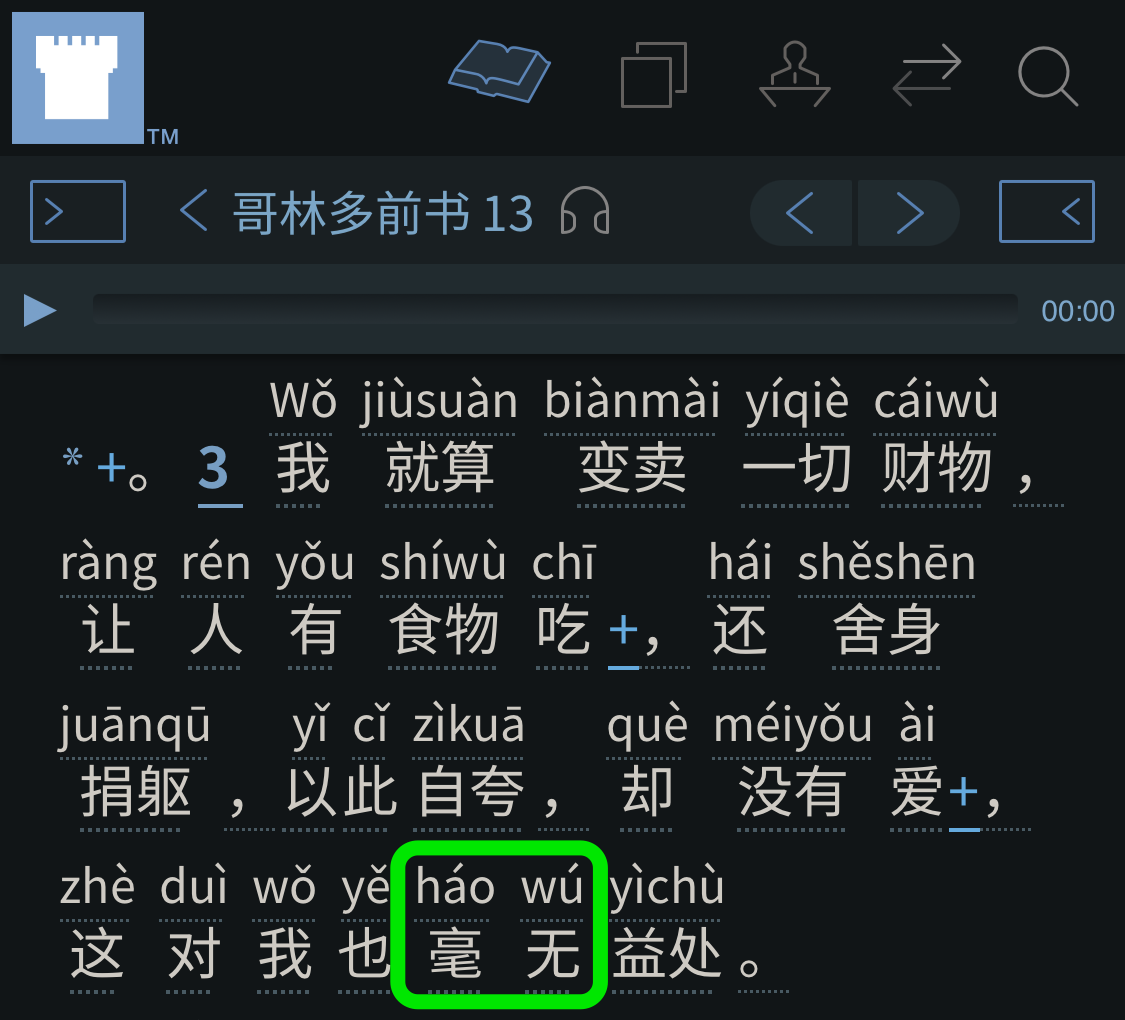
This week’s MEotW, “háowú (háo·wú {(even) a fine hair (of)} · {is not having} → [is not having even a little] 毫无 毫無)”, is used in verse 3 (WOL, Pīnyīn (Pīn·yīn {Piecing Together of} · Sounds → [Pinyin] 拼音) Plus) of 1 Corinthians 13:

Screenshot of “_háowú_” in 1 Co. 13:3 (nwtsty, CHS+_Pīnyīn_ WOL)

(Dark mode for the Watchtower ONLINE LIBRARY (WOL) website, as shown in the above image, can be enabled in the Safari web browser by using the Noir Safari extension. Other web browsers may also have extensions with similar functionality.)

In “háowú (háo·wú {(even) a fine hair (of)} · {is not having} → [is not having even a little] 毫无 毫無)”, “háo ({[(even) a] fine hair [(of)]} | milli- 毫) literally refers to a “fine hair”. As for “wú ({not having}; without; none; no | nothing無/无)”, it means “not having; without; none; no”. So, “háowú (háo·wú {(even) a fine hair (of)} · {is not having} → [is not having even a little] 毫无 毫無) literally means “a fine hair is not having”, and effectively means “is not having even a little”. This is an interesting metaphor for emphasizing to us the ultimate futility of doing things out of pride and not out of love, things like focusing Mandarin field language-learning efforts on Chinese cultural traditions like characters rather than on how best to communicate the good news. As a metaphor, it reminds me of the English expression of not having even a shadow of a doubt about something.

Below are English and Pīnyīn (Pīn·yīn {Piecing Together of} · Sounds → [Pinyin] 拼音) Plus renditions showing how “háowú (háo·wú {(even) a fine hair (of)} · {is not having} → [is not having even a little] 毫无 毫無) is used in 1 Corinthians 13:3 in the current version of the Mandarin NWT Bible to correspond to “at all”, which is used in that verse in the current version of the English NWT Bible:

English:

And if I give all my belongings to feed others, and if I hand over my body so that I may boast, but do not have love, I do not benefit at all.

Mandarin (WOL, Pīnyīn (Pīn·yīn {Piecing Together of} · Sounds → [Pinyin] 拼音) Plus):

📖 📄 📘 (I 我) jiùsuàn (jiù·suàn {even if} · {figuring → [considering]} 就算) biànmài (biàn·mài changing · sell → [sell off] 变卖 變賣) yíqiè (yí·qiè {one (whole)} · {corresponding (set of)} → [all] 一切) cáiwù (cái·wù wealth · things → [belongings] 财物 財物), ràng ({to allow}) rén (people 人) yǒu ({to have} 有) shíwù (shí·wù eating · matter → [food] 食物) chī ({to eat}吃/喫), hái (also) shěshēn+ (shě·shēn {give up} · {(my) body} 舍身 捨身) juānqū (juān·qū {relinquish → [contribute]} · {(my) human body} 捐躯 捐軀), yǐcǐ (yǐ·cǐ using · this 以此) zìkuā (zì·kuā {(about) self} · {to boast} 自夸 自誇), què (but) méiyǒu (méi·yǒu not · {do have} 没有 沒有) ài (love), zhè (this) duì (towards → [to]) (me 我) (even 也) háowú (háo·wú {(even) a fine hair (of)} · {does not have} → [does not have even a little] 毫无 毫無) yìchu (yì·chu beneficial · place → [benefit] 益处 益處).

Having a Word, or Not

While the WOL puts a space between “háo ({[(even) a] fine hair [(of)]} | milli- 毫) and “wú ({not having}; without; none; no | nothing無/无)”, the dictionaries I have checked all treat this expression as one word, with no space between the two morphemes. So, that is how Pīnyīn (Pīn·yīn {Piecing Together of} · Sounds → [Pinyin] 拼音) Plus material renders “háowú (háo·wú {(even) a fine hair (of)} · {is not having} → [is not having even a little] 毫无 毫無)”.

There seems to be a tendency in typical modern Pīnyīn (Pīn·yīn {Piecing Together of} · Sounds → [Pinyin] 拼音) to render many two-morpheme expressions this way, combined into single words. With Pīnyīn (Pīn·yīn {Piecing Together of} · Sounds → [Pinyin] 拼音) Plus material, I have so far decided to go along with this common practice, since the resulting expressions are still relatively easy to read. However, I am not so accepting of extending this common practice to combining three, four, or even more morphemes into single words, with no spaces or even hyphens in them. Doing so produces long, undifferentiated strings of characters that are hard to parse, and thus hard to read and reason on. So, I have decided to generally break up such long expressions into one- or two-morpheme words separated by hyphens or spaces, depending on the situation.

For example, compare “bìbùkěshǎo (bì·bù·kě·shǎo certainly · not · {can; is able; could | may} · {be missing} 必不可少) with “bì (certainly 必)bùkě (bù·kě not · {can; is able; could | may} → [cannot; is not able; could not | may not] 不可)shǎo ({[be] few; little} | {[be] less} | lack; {be deficient} | lose; {be missing} 少)”. While some of the few Pīnyīn (Pīn·yīn {Piecing Together of} · Sounds → [Pinyin] 拼音) traditionalists in existence may object to it, I think the latter rendering is much easier to read and reason on, so that is how Pīnyīn (Pīn·yīn {Piecing Together of} · Sounds → [Pinyin] 拼音) Plus material now renders this expression—one of the few good things about how commonly used Pīnyīn (Pīn·yīn {Piecing Together of} · Sounds → [Pinyin] 拼音) is not is that there is not really much established Pīnyīn (Pīn·yīn {Piecing Together of} · Sounds → [Pinyin] 拼音) tradition or common practice to be “trampled” on, allowing for more leeway for exploring beneficial innovations, compared to the situations with relatively ossified and hidebound writing systems like Chinese characters, or even the modern English writing system.

As for the PRC government’s official national standard for Pīnyīn (Pīn·yīn {Piecing Together of} · Sounds → [Pinyin] 拼音) orthography, with the designation GB/T 16159-2012, as discussed in the MEotW post on “diǎnliàng (diǎn·liàng {dot → [light (v); ignite]} · {to be bright} [→ [illuminate; shine light on]] 点亮 點亮)”, this is at most a set of recommendations that is not legally binding or anything like that, even in China itself.

Categories
Culture History Language Learning Science Technology Theocratic

zìkuā

zìkuā+ (zì·kuā {[(about)] self} · {exaggerate; overstate; boast; brag | praise; compliment} 自夸 自誇) ← Tap/click to show/hide the “flashcard”

[Notes: Tap/click on a Pīnyīn (Pīn·yīn {Piecing Together of} · Sounds → [Pinyin] 拼音) expression to reveal its “flashcard”; tap/click on a “flashcard” or its Pīnyīn (Pīn·yīn {Piecing Together of} · Sounds → [Pinyin] 拼音) expression to hide the “flashcard”. 📖 📄 ➕ icons mean 📖 Reveal All, 📄 Reveal Advanced, and ➕ Reveal + Symbols re all the “flashcards” in the heading, paragraph, etc. that they are placed at the beginning of.]

I have long especially liked 1 Corinthians 13. It contains counsel on what really does and doesn’t matter in life, an extensive description and definition of the most important kind of love, and a sublime discussion about the need to become complete, mature, as a person. As these apply to life in general, so too do they apply to our lives as Mandarin field language learners.

As Mandarin field language learners, it can benefit us greatly to consider what we can learn from 1 Corinthians 13, and along the way, we can also consider some of the Mandarin expressions used in that chapter in the current version of the Mandarin New World Translation Bible (nwtsty).

“…So That I May Boast”

This week’s MEotW, “zìkuā (zì·kuā {[(about)] self} · {exaggerate; overstate; boast; brag | praise; compliment} 自夸 自誇)”, is used in verse 3 (WOL, Pīnyīn (Pīn·yīn {Piecing Together of} · Sounds → [Pinyin] 拼音) Plus) of 1 Corinthians 13:

Screenshot of “_zìkuā_” in 1 Co. 13:3 (nwtsty, CHS+_Pīnyīn_ WOL)

(Dark mode for the Watchtower ONLINE LIBRARY (WOL) website, as shown in the above image, can be enabled in the Safari web browser by using the Noir Safari extension.)

In “zìkuā (zì·kuā {[(about)] self} · {exaggerate; overstate; boast; brag | praise; compliment} 自夸 自誇)”, “zì (self | from; since 自) can mean “(about) self”. (In other expressions, such as “zìjǐ (self[’s] 自己) or “zìyóu+ (zì·yóu self-·determining → [free | freedom] 自由)”, it just means “self”.) As for “kuā ({exaggerate; overstate; boast; brag | praise; compliment}誇/夸)”, it means “exaggerate; overstate; boast; brag” or “praise; compliment”. So, “zìkuā (zì·kuā {[(about)] self} · {exaggerate; overstate; boast; brag | praise; compliment} 自夸 自誇) can effectively mean “boast/brag/etc. about oneself”.

Below are English and Pīnyīn (Pīn·yīn {Piecing Together of} · Sounds → [Pinyin] 拼音) Plus renditions showing how “zìkuā (zì·kuā {[(about)] self} · {exaggerate; overstate; boast; brag | praise; compliment} 自夸 自誇) is used in 1 Corinthians 13:3 in the current version of the Mandarin NWT Bible to correspond to “boast”, which is used in that verse in the current version of the English NWT Bible:

English:

And if I give all my belongings to feed others, and if I hand over my body so that I may boast, but do not have love, I do not benefit at all.

Mandarin (WOL, Pīnyīn (Pīn·yīn {Piecing Together of} · Sounds → [Pinyin] 拼音) Plus):

📖 📄 📘 (I 我) jiùsuàn (jiù·suàn {even if} · {figuring → [considering]} 就算) biànmài (biàn·mài changing · sell → [sell off] 变卖 變賣) yíqiè (yí·qiè {one (whole)} · {corresponding (set of)} → [all] 一切) cáiwù (cái·wù wealth · things → [belongings] 财物 財物), ràng ({to allow}) rén (people 人) yǒu ({to have} 有) shíwù (shí·wù eating · matter → [food] 食物) chī ({to eat}吃/喫), hái (also) shěshēn (shě·shēn {give up} · {(my) body} 舍身 捨身) juānqū (juān·qū {relinquish → [contribute]} · {(my) human body} 捐躯 捐軀), yǐcǐ (yǐ·cǐ using · this 以此) zìkuā+ (zì·kuā {(about) self} · {to boast} 自夸 自誇), què (but) méiyǒu (méi·yǒu not · {do have} 没有 沒有) ài (love), zhè (this) duì (towards → [to]) (me 我) (even 也) háowú (háo·wú {(even) a fine hair (of)} · {does not have} → [does not have even a little] 毫无 毫無) yìchu (yì·chu beneficial · place → [benefit] 益处 益處).

“Your Boasting Is Not Good”

Jehovah designed us, including specific parts of our bodies, such that the primary way we use language to communicate is with speech. (1 Corinthians 14:8–11) In contrast, writing is a human-invented technology, useful in some ways, but secondary at best compared to the gift of speech that Jehovah gave us.

So, if you are boasting, whether out loud or to yourself in your heart, about your knowledge of Chinese characters, which are particularly deeply problematic products of a worldly human culture, while neglecting to praise and appreciate Jehovah’s gift of speech, is it not so that, as 1 Corinthians 5:6 says, “your boasting is not good”? This is especially so because, as 1 John 2:15–17 tells us, we should “not love either the world or the things in the world”.

That scripture also warns us about “the desire of the eyes”. Chinese characters certainly have visually intricate designs that dazzle the eyes of many. The thing is, though, that language is not primarily about what’s visible to the eye. Rather, speech, the actual primary aspect of human language, is something that’s invisible to the eye. If we were to prioritize or even glamourize fancy visible writing over invisible speech that is actually what really matters language-wise, that could be considered linguistic idolatry—literal idolatry similarly involves worshipping visible idols of false gods rather than properly only worshipping the invisible true God.

Sure, in some situations characters are still the only form in which certain spiritually relevant information is written, so in such situations we must use characters to access and use that information in Jehovah’s service. However, that doesn’t mean that we need to love the characters for their own sake, or boast about our knowledge of them. Indeed, it is entirely appropriate to be dismayed by how the unnecessarily extraordinarily complex Chinese characters can make accessing and using important spiritual information much harder than necessary! While it’s still true that Pīnyīn (Pīn·yīn {Piecing Together of} · Sounds → [Pinyin] 拼音) is not yet everywhere that characters are in the Mandarin field, we should ask ourselves why Jehovah’s organization—which we understand to be directed by Jehovah and Jesus—has over time been making Pīnyīn (Pīn·yīn {Piecing Together of} · Sounds → [Pinyin] 拼音) available in more and more places that used to be characters-only.

Similarly, for a long time, the only Bibles available in England were ones written in Latin. While it was not totally impossible for people who lived in England at that time to learn Latin so as to be able to read and understand the Bible for themselves, it was very difficult for most, and practically impossible for many. (Many today similarly find Chinese characters very difficult, or even practically impossible, to deal with, and so they never join a Chinese field, or they may feel forced to leave after a time even if they do join a Chinese field.) In that not-so-merry old England, a privileged few may have boasted about their knowledge of Latin, but Jehovah’s organization has expressed clearly how it views that dark time.

“Glory from One Another”

Something to consider about boasting about characters is: Whom is one doing such boasting trying to impress? Is it Jehovah God? Is Jehovah really impressed by deep worldly knowledge of the culture of the proudly named “Zhōngguó (Zhōng·guó Central · Nation → [China] 中国 中國) (“Central Kingdom”) that he will soon destroy and replace with his own Kingdom? (Daniel 2:44) Really, one who boasts about his knowledge of characters is generally boasting before other humans, is that not so? That being the case, such a one should take care to avoid becoming like the ones to whom Jesus directed the words at John 5:41–44:

I do not accept glory from men, but I well know that you do not have the love of God in you. I have come in the name of my Father, but you do not receive me. If someone else came in his own name, you would receive that one. How can you believe, when you are accepting glory from one another and you are not seeking the glory that is from the only God?

Jesus’ words above join the words at 1 Corinthians 13:3 to tell us that if certain ones do things so that they may boast, so that they may receive “glory from men”, “glory from one another”, such ones “do not have the love of God” in them, and so, they “do not benefit at all”.

“Boast in Jehovah”

Especially as ones who are dedicated to Jehovah God, we should focus on what brings glory to him, and on what brings us “the glory that is from the only God”. We should not seek the fading glories of some worldly human culture, even if that culture is as old and storied—from a human viewpoint, at least—as Chinese culture is. (To Jehovah, for whom ‘a thousand years is as one day’, Chinese civilization has only been around for a few days.—2 Peter 3:8.)

As 1 Corinthians 1:26–31 says, we should boast in Jehovah, not in needlessly and self-indulgently complex knowledge relating to a mere worldly human culture:

For you see his calling of you, brothers, that there are not many wise in a fleshly way, not many powerful, not many of noble birth, but God chose the foolish things of the world to put the wise men to shame; and God chose the weak things of the world to put the strong things to shame; and God chose the insignificant things of the world and the things looked down on, the things that are not, to bring to nothing the things that are, so that no one might boast in the sight of God. But it is due to him that you are in union with Christ Jesus, who has become to us wisdom from God, also righteousness and sanctification and release by ransom, so that it may be just as it is written: “The one who boasts, let him boast in Jehovah.”