Categories
Culture Language Learning Technology Theocratic

jìjiào

jìjiào (jì·jiào count; calculate · {dispute [about]} [→ [haggle over; fuss about; bother about; bicker]] 计较 計較) 👈🏼 Tap/click to show/hide the “flashcard”

[Notes: Tap/click on a Pīnyīn (Pīn·yīn {Piecing Together of} · Sounds → [Pinyin] 拼音) expression to reveal its “flashcard”; tap/click on a “flashcard” or its Pīnyīn (Pīn·yīn {Piecing Together of} · Sounds → [Pinyin] 拼音) expression to hide the “flashcard”. 📖 📄 📘 icons mean 📖 Reveal All, 📄 Reveal Advanced, and 📘 Reveal None re all the “flashcards” in the heading, paragraph, etc. that they are placed at the beginning of.]

I have long especially liked 1 Corinthians 13. It contains counsel on what really does and doesn’t matter in life, an extensive description and definition of the most important kind of love, and a sublime discussion about the need to become complete, mature, as a person. As these apply to life in general, so too do they apply to our lives as Mandarin field language learners.

As Mandarin field language learners, it can benefit us greatly to consider what we can learn from 1 Corinthians 13, and along the way, we can also consider some of the Mandarin expressions used in that chapter in the current version of the Mandarin New World Translation Bible (nwtsty).

‘Keeping Account of the Injury’

This week’s MEotW, “jìjiào (jì·jiào count; calculate · {dispute [about]} [→ [haggle over; fuss about; bother about; bicker]] 计较 計較)”, is used in verse 5 (WOL) of 1 Corinthians 13:

Screenshot of “_jìjiào_” in 1 Co. 13:5 (nwtsty, CHS+_Pīnyīn_ WOL)

(Dark mode for the Watchtower ONLINE LIBRARY (WOL) website, as shown in the above image, can be enabled in the Safari web browser by using the Noir Safari extension. Other web browsers may also have extensions with similar functionality.)

For comparison, here are the current English and Pīnyīn (Pīn·yīn {Piecing Together of} · Sounds → [Pinyin] 拼音) Plus renderings of 1 Corinthians 13:5:

English:

does not behave indecently, does not look for its own interests, does not become provoked. It does not keep account of the injury.

Pīnyīn (Pīn·yīn {Piecing Together of} · Sounds → [Pinyin] 拼音) Plus:

📖 📄 📘 (not 不) zuò ({does do} 做) (not 不) guīju (guī·ju (following) {dividers → [rules]} · {carpenter’s squares → [regulations]} → [following established standards] 规矩 規矩) de ( 的) shì (things 事), (not 不) qiú ({does seek} 求) zìjǐ (self 自己) de (’s 的) lìyì (lì·yì {sharpening → [advantage]} · benefit → [benefit] 利益), (not 不) qīngyì (qīng·yì lightly · easily 轻易 輕易) dòngnù (dòng·nù {does have moved} · anger → [does get angry] 动怒 動怒), (not 不) jìjiào (jì·jiào {does count} · {does dispute about} 计较 計較) biéren (bié·ren other · people 别人 別人) zàochéng (zào·chéng {have created} · {to come to be} 造成) de (’s 的) shānghài (injuring → [injury] 伤害 傷害),

The “jì (counting; computing; calculating; numbering [→ [plot; plan (n or v)]]) in “jìjiào (jì·jiào count; calculate · {dispute [about]} [→ [haggle over; fuss about; bother about; bicker]] 计较 計較) can mean “count; calculate”, and it also appears in “jìsuàn (jì·suàn counting; computing; calculating · computing; calculating; figuring 计算 計算)”. As for the “jiào (compare; contrast | dispute | {being compared} → [comparatively; relatively; fairly; quite; rather | clear[ly]; obvious[ly]]) in “jìjiào (jì·jiào count; calculate · {dispute [about]} [→ [haggle over; fuss about; bother about; bicker]] 计较 計較)”, while it means “compare; contrast” in “bǐjiào (compare; contrast | {being compared} → [comparatively; relatively; fairly; quite; rather] | comparing → [comparison] 比较 比較)”, in “jìjiào (jì·jiào count; calculate · {dispute [about]} [→ [haggle over; fuss about; bother about; bicker]] 计较 計較) it has its older meaning of “dispute”.

Interestingly, besides its morphemes’ literal meanings of “count; calculate · dispute”, “jìjiào (jì·jiào count; calculate · {dispute [about]} [→ [haggle over; fuss about; bother about; bicker]] 计较 計較) can also mean “haggle over; fuss about; bother about; bicker” in some settings. In 1 Corinthians 13:5 in the current English and Mandarin versions of the New World Translation Bible, it corresponds with the English expression “keep account of”.

Nitpicking…

Every human-designed system has its shortcomings and negative aspects, including Pīnyīn (Pīn·yīn {Piecing Together of} · Sounds → [Pinyin] 拼音). However, is it advantageous or helpful to harp on or “fuss about” its potentially negative aspects without considering the whole picture?

For example, some make a fuss about the many homophones (different words that sound the same) in Mandarin, saying that they make Pīnyīn (Pīn·yīn {Piecing Together of} · Sounds → [Pinyin] 拼音) unsuitable to be a full writing system for Mandarin. In the overall picture of reality, though, since Pīnyīn (Pīn·yīn {Piecing Together of} · Sounds → [Pinyin] 拼音) is just a relatively simple representation of Mandarin speech, homophones are no more a problem when people use Pīnyīn (Pīn·yīn {Piecing Together of} · Sounds → [Pinyin] 拼音) than they are when people speak Mandarin. People have learned to deal with the challenge of homophones when speaking Mandarin by using sufficient clarifying context, and so people can similarly understand Pīnyīn (Pīn·yīn {Piecing Together of} · Sounds → [Pinyin] 拼音), homophones and all.

(People who say they have trouble understanding Pīnyīn (Pīn·yīn {Piecing Together of} · Sounds → [Pinyin] 拼音) because of homophones may actually be showing that the texts they are reading were written without sufficient context, and were relying on characters as a crutch rather than accurately representing Mandarin speech like they should. Or, these people may be showing that they themselves don’t actually understand spoken Mandarin very well, rather than that Pīnyīn (Pīn·yīn {Piecing Together of} · Sounds → [Pinyin] 拼音) has some inherent shortcoming, when it just simply and directly represents spoken Mandarin.)

Conversely, in the overall picture, characters have the parallel problem of homographs, characters that could represent multiple different words. So, making an anti-Pīnyīn (Pīn·yīn {Piecing Together of} · Sounds → [Pinyin] 拼音) fuss over Mandarin homophones amounts to jìjiào (jì·jiào counting · {disputing about} (things) → [fussing about (things)] 计较 計較), nitpicking over a problem that’s being adequately handled, while offering a solution in the characters that has its own corresponding problem.

Another objection to Pīnyīn (Pīn·yīn {Piecing Together of} · Sounds → [Pinyin] 拼音) that I have heard is that it makes some English-speaking Mandarin learners think of English sounds, so the Mandarin they speak doesn’t sound like native Mandarin. For this reason, some say, it would be better to use Chinese characters or Zhùyīn (Zhù·yīn {Annotating of} · Sounds → [Zhuyin] 注音 註/注音), which would not similarly remind people of English. Is this a real thing? Or, is it just an excuse used by some who are infected by Exotic East Syndrome to focus on “exotic” Eastern systems rather than the “mundane” Latin alphabet used by English and Pīnyīn (Pīn·yīn {Piecing Together of} · Sounds → [Pinyin] 拼音)?

I do not doubt that some, even many, English-speaking Mandarin learners think of English sounds when they see Pīnyīn (Pīn·yīn {Piecing Together of} · Sounds → [Pinyin] 拼音), but this is actually not a shortcoming of Pīnyīn (Pīn·yīn {Piecing Together of} · Sounds → [Pinyin] 拼音) itself, but rather, a rookie mistake on the part of these English-speaking Mandarin learners, who have not yet trained themselves to recognize Pīnyīn (Pīn·yīn {Piecing Together of} · Sounds → [Pinyin] 拼音) as a system that actually represents Mandarin sounds, not English sounds. It may also indicate that these Mandarin learners still need to become more familiar with and used to the sounds of Mandarin in the first place. The article Pīnyīn Is a Good, Workable Writing System on Its Own has an entire section on this, part of which says:

As English-speaking Mandarin-learners get more familiar with the sounds of correct Mandarin speech, they can come to get used to correctly mentally connecting Pīnyīn to correct Mandarin sounds, rather than to English sounds. Then, they can regularly and reliably use Pīnyīn to help them speak Mandarin-sounding Mandarin, just like people regularly and reliably use written French to help them speak French-sounding French.

…While Ignoring White Elephants

Rather than just nitpicking and harping on the real or perceived shortcomings of Pīnyīn (Pīn·yīn {Piecing Together of} · Sounds → [Pinyin] 拼音) in order to support the traditionally imposed Chinese characters, let us not overlook the white elephant in the room regarding the inhumanly and inhumanely complex characters—learning and remembering them is extremely difficult and costly in terms of time and effort, especially compared to comparatively simple and elegant Pīnyīn (Pīn·yīn {Piecing Together of} · Sounds → [Pinyin] 拼音). Let us not “strain out the gnat but gulp down the camel” like the scribes and Pharisees of Jesus’ day did. (Matthew 23:24) Yes, let us not incorrectly look down on Pīnyīn (Pīn·yīn {Piecing Together of} · Sounds → [Pinyin] 拼音) as merely being training wheels when it is really regular wheels, and let us also not just swallow the reality that Chinese characters are actually more like square wheels than regular wheels!
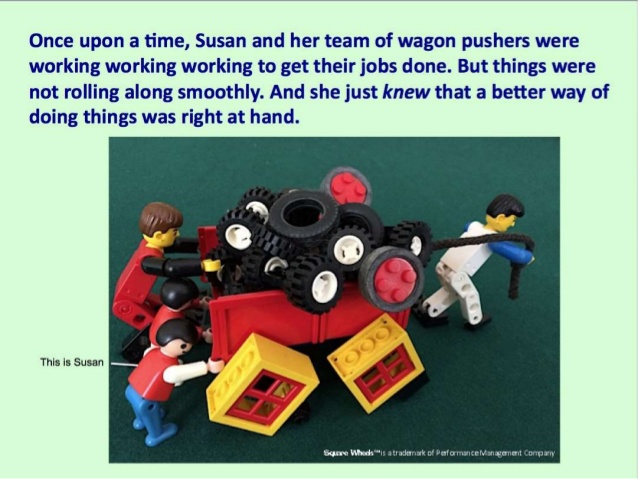
Lego diorama of people pushing a cart with square wheels, when the cart is filled with round wheels

The problem is not that Pīnyīn (Pīn·yīn {Piecing Together of} · Sounds → [Pinyin] 拼音) is like training wheels, because Pīnyīn (Pīn·yīn {Piecing Together of} · Sounds → [Pinyin] 拼音) is actually like regular wheels. The real problem is that characters are like square wheels!

Categories
Culture Experiences Language Learning Science Technology Theocratic

wūdú

wūdú (voodoo 巫毒) 👈🏼 Tap/click to show/hide the “flashcard”

[Notes: Tap/click on a Pīnyīn (Pīn·yīn {Piecing Together of} · Sounds → [Pinyin] 拼音) expression to reveal its “flashcard”; tap/click on a “flashcard” or its Pīnyīn (Pīn·yīn {Piecing Together of} · Sounds → [Pinyin] 拼音) expression to hide the “flashcard”. 📖 📄 📘 icons mean 📖 Reveal All, 📄 Reveal Advanced, and 📘 Reveal None re all the “flashcards” in the heading, paragraph, etc. that they are placed at the beginning of.]

One of the publications that is now recommended to be used on Bible studies is the Yǒngyuǎn Xiǎngshòu Měihǎo de Shēngmìng—Hùdòng Shì Shèngjīng Kèchéng ((Yǒng·yuǎn Eternally · {Far (in Time)} 永远 永遠) (Xiǎng·shòu Enjoy · Receive 享受) (Měi·hǎo Beautiful · Good 美好) (de ’s 的) (Shēngmìng Life 生命)—(Hù·dòng {Each Other} · Moving → [Interactive] 互动 互動) (Shì (Type 式) (Shèng·jīng Holy · Scriptures → [Bible] 圣经 聖經) (Kè·chéng Lessons · Procedure → [Course] 课程 課程) [Enjoy Life Forever!—An Interactive Bible Course (lff)]) (Enjoy Life Forever! (lff)) book. An outstanding feature of this book is its extensive use of the post-paper technology of video, which enables information to be presented much more vividly than could be done with paper. Also, at this time, one of the unique features of Pīnyīn (Pīn·yīn {Piecing Together of} · Sounds → [Pinyin] 拼音) Plus material is Pīnyīn (Pīn·yīn {Piecing Together of} · Sounds → [Pinyin] 拼音) Plus video transcripts. These can help us Mandarin field language learners to analyze and understand the Mandarin speech used in the many videos referenced in the Mandarin Enjoy Life Forever! book. This in turn can help us make more effective use of these videos while participating in Mandarin Bible discussions using this book.

This week’s MEotW, “wūdú (voodoo 巫毒)”, occurs in subtitle 3 of the transcript for the video for lesson 14, point 5 of the Mandarin Enjoy Life Forever! book:

English:

At a tender age, I had a troubled mind

as to how I would be pleasing to God

and also at the same time be pleasing in the eyes of the voodoo.

Mandarin:

1
00:00:02,952 → 00:00:06,556
📖 📄 📘 Cóngxiǎo (Cóng·xiǎo from · {being little → [being young]} → [from childhood] 从小 從小) (I 我) jiù (then 就) yìzhí (yì·zhí one · {being straight} → [all the while] 一直) zài ({had been in} → [had then been] 在) xiǎng (thinking 想)

2
00:00:06,556 → 00:00:11,461
📖 📄 📘 (I 我) zěnyàng (zěn·yàng (in) what · {pattern → [way]} → [how] 怎样 怎樣) zuò ({would do} 做) kěyǐ (kě·yǐ {to be able} · [suf] 可以) tóngshí (tóng·shí {(at the) same} · {(particular) time} 同时 同時) ràng ({to make}) Shàngdì (Shàng·dì Above’s · {Emperor → [God]} → [God] 上帝) xǐyuè ({to be pleased} 喜悦 喜悅),

3
00:00:11,461 → 00:00:14,964
📖 📄 📘 yòu (also 又) ràng ({to make}) wūdú (voodoo 巫毒) de (’s 的) shénlíng (shén·líng gods · spirits 神灵 神靈) xǐyuè ({to be pleased} 喜悦 喜悅).

Speech Is Primary!

The individual morphemes of “wūdú (voodoo 巫毒) have interesting meanings (“witch/wizard/shaman” and “poison”), but ultimately, “wūdú (voodoo 巫毒) is a loanword from the English word “voodoo”, which in turn comes, via Louisiana French, from the Fon word “vodun”, meaning “god; deity”.

How similar these loanwords sound reminds us that, as linguists say, speech, with its invisible sounds to represent meaning, is actually the primary aspect of language, as opposed to writing, which is secondary, no matter how intricate its visual symbols are.

Power-Hungry?

As Jehovah’s people, we have been taught to seek to imitate him and cultivate and display a healthy balance and combination of Jehovah’s four cardinal attributes: power, justice, wisdom, and love. (Ephesians 5:1, 2) However, those who are devoted to voodoo and other forms of spiritism seek power over all else. This unbalanced thirst for power over all else, ignoring and even actively fighting against wisdom, justice, and love, is common in Satan’s world, which is made in Satan’s deformed spiritual image.

The perceived voodooesque power of characters—including their mythical idol-like power to represent invisible meaning with their mesmerizing visual designs, and also the cultural power, social status, and glamour associated with them—is of course appealing to those who conform to the power-hungry template of those infected with the spirit of Satan’s world.

When such ones are presented with the simple, humble effectiveness of Pīnyīn (Pīn·yīn {Piecing Together of} · Sounds → [Pinyin] 拼音), they recoil at this this threat to their precious characters-based power, much as the Pharisees, etc. recoiled at the threat Jesus and his back-to-spiritual-basics teachings posed to their traditions-based power. On the other hand, Mandarin field language learners who are truly motivated by love for God and neighbour see in Pīnyīn (Pīn·yīn {Piecing Together of} · Sounds → [Pinyin] 拼音) an excellent tool for helping them to effectively use Mandarin speech—the actual primary aspect of the Mandarin language—to help them praise and glorify Jehovah and give spiritual assistance to honest-hearted people in the Mandarin field.

汉字 / 漢字? Pīnyīn?

Indeed, whereas some feel that characters present a test of our determination to serve God in the face of difficulties, it is evident that characters can actually present a test of our motivations as Mandarin field language learners, especially when Pīnyīn (Pīn·yīn {Piecing Together of} · Sounds → [Pinyin] 拼音) is available (as it often is now). Are we in our pride hungry for the voodooesque power often associated with the characters? Or are we truly motivated by love of God and neighbour to look for ways to get past the unnecessarily obstructive Great Wall of characters, and to make good use of Pīnyīn (Pīn·yīn {Piecing Together of} · Sounds → [Pinyin] 拼音), in many situations the evidently better tool for glorifying God and helping our Mandarin-speaking neighbours, when it is available?—1 Corinthians 13.

The Great Wall of China

How do we respond to the seemingly powerful Great Wall of characters?


For convenience:

The direct link for the Pīnyīn (Pīn·yīn {Piecing Together of} · Sounds → [Pinyin] 拼音) Plus resource for the Enjoy Life Forever! book is:

The short link for Chinese field language-learning links for the Enjoy Life Forever! book is:

More Pīnyīn (Pīn·yīn {Piecing Together of} · Sounds → [Pinyin] 拼音) and Pīnyīn (Pīn·yīn {Piecing Together of} · Sounds → [Pinyin] 拼音) Plus web material based on the Mandarin Enjoy Life Forever! book will be made available in the Pīnyīn (Pīn·yīn {Piecing Together of} · Sounds → [Pinyin] 拼音) Plus web resource as time allows.

Categories
Culture Experiences Language Learning Science Technology Theocratic

dòngnù

dòngnù (dòng·nù {have moved} · anger; rage; fury → [get angry; lose temper; fly into a rage] 动怒 動怒) 👈🏼 Tap/click to show/hide the “flashcard”

[Notes: Tap/click on a Pīnyīn (Pīn·yīn {Piecing Together of} · Sounds → [Pinyin] 拼音) expression to reveal its “flashcard”; tap/click on a “flashcard” or its Pīnyīn (Pīn·yīn {Piecing Together of} · Sounds → [Pinyin] 拼音) expression to hide the “flashcard”. 📖 📄 📘 icons mean 📖 Reveal All, 📄 Reveal Advanced, and 📘 Reveal None re all the “flashcards” in the heading, paragraph, etc. that they are placed at the beginning of.]

I have long especially liked 1 Corinthians 13. It contains counsel on what really does and doesn’t matter in life, an extensive description and definition of the most important kind of love, and a sublime discussion about the need to become complete, mature, as a person. As these apply to life in general, so too do they apply to our lives as Mandarin field language learners.

As Mandarin field language learners, it can benefit us greatly to consider what we can learn from 1 Corinthians 13, and along the way, we can also consider some of the Mandarin expressions used in that chapter in the current version of the Mandarin New World Translation Bible (nwtsty).

Moved to Anger

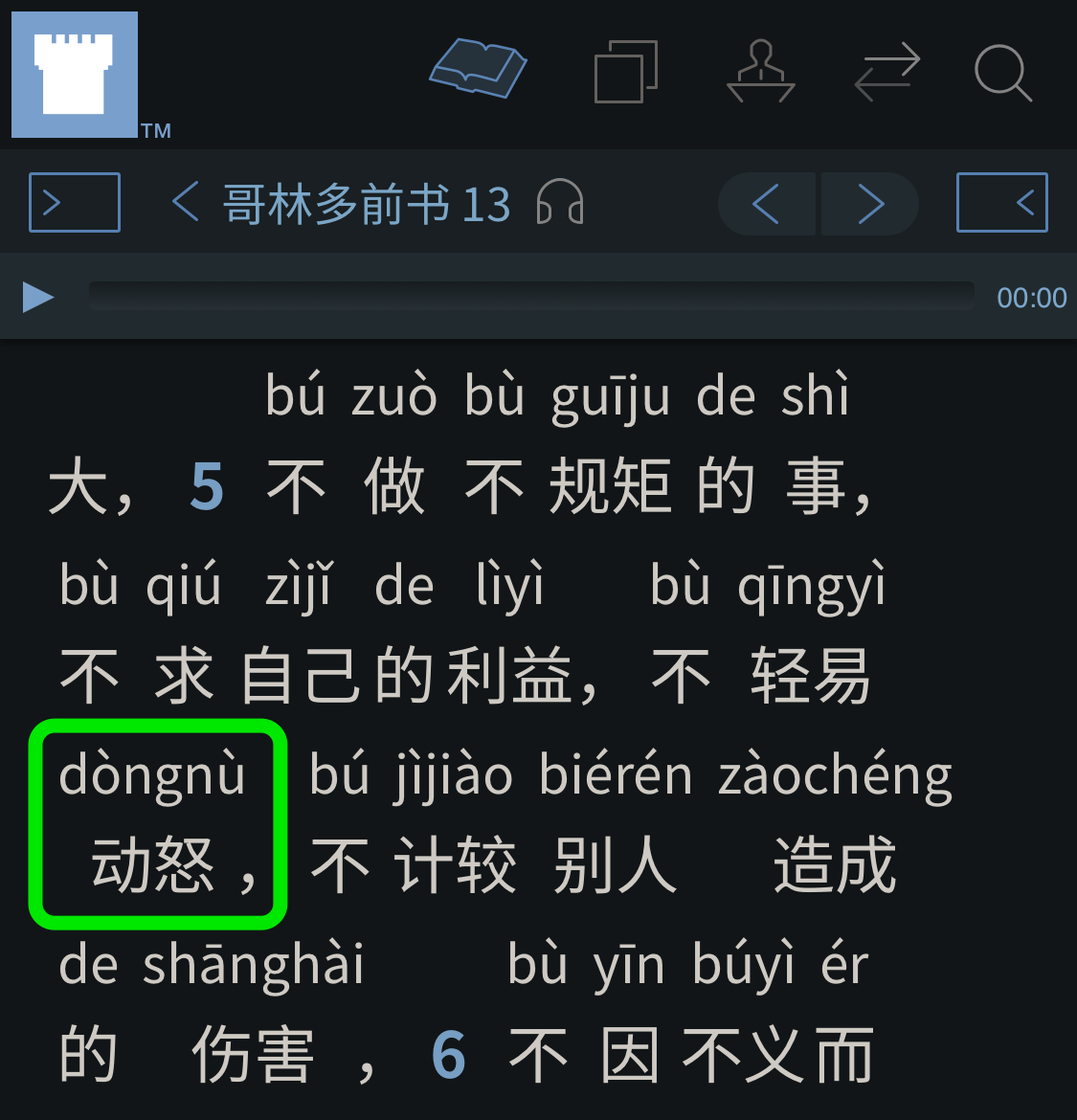
This week’s MEotW, “dòngnù (dòng·nù {have moved} · anger; rage; fury → [get angry; lose temper; fly into a rage] 动怒 動怒)”, is used in verse 5 (WOL) of 1 Corinthians 13:

Screenshot of “_dòngnù_” in 1 Co. 13:5 (nwtsty, CHS+_Pīnyīn_ WOL)

(Dark mode for the Watchtower ONLINE LIBRARY (WOL) website, as shown in the above image, can be enabled in the Safari web browser by using the Noir Safari extension. Other web browsers may also have extensions with similar functionality.)

For comparison, here are the current English and Pīnyīn (Pīn·yīn {Piecing Together of} · Sounds → [Pinyin] 拼音) Plus renderings of 1 Corinthians 13:5:

English:

does not behave indecently, does not look for its own interests, does not become provoked. It does not keep account of the injury.

Pīnyīn (Pīn·yīn {Piecing Together of} · Sounds → [Pinyin] 拼音) Plus:

📖 📄 📘 (not 不) zuò ({does do} 做) (not 不) guīju (guī·ju (following) {dividers → [rules]} · {carpenter’s squares → [regulations]} → [following established standards] 规矩 規矩) de ( 的) shì (things 事), (not 不) qiú ({does seek} 求) zìjǐ (self 自己) de (’s 的) lìyì (lì·yì {sharpening → [advantage]} · benefit → [benefit] 利益), (not 不) qīngyì (qīng·yì lightly · easily 轻易 輕易) dòngnù (dòng·nù {does have moved} · anger → [does get angry] 动怒 動怒), (not 不) jìjiào (jì·jiào {does count} · {does dispute about} 计较 計較) biéren (bié·ren other · people 别人 別人) zàochéng (zào·chéng {have created} · {to come to be} 造成) de (’s 的) shānghài (injuring → [injury] 伤害 傷害),

In the example above, the Mandarin phrase “bù (not 不) qīngyì (qīng·yì lightly · easily 轻易 輕易) dòngnù (dòng·nù {does have moved} · anger → [does get angry] 动怒 動怒) corresponds with the English phrase “does not become provoked”. As for the morphemes in “dòngnù (dòng·nù {have moved} · anger; rage; fury → [get angry; lose temper; fly into a rage] 动怒 動怒)”, they literally mean “have moved anger/rage/fury”, and effectively mean “get angry; lose one’s temper; fly into a rage”.

Angrily Holding On to Tradition

I remember more than one Mandarin field language learner who reacted angrily when I suggested that using Pīnyīn (Pīn·yīn {Piecing Together of} · Sounds → [Pinyin] 拼音) more and deemphasizing characters would help them progress in learning Mandarin. Rather than appreciating the evident truth of what I was saying, or being thankful that I was trying to help them, they seemed offended and upset that I had dared to suggest something so out of step with the human traditions that they had been taught all their lives, and, perhaps, indignant that I had, in their estimation, dismissed and invalidated the blood, sweat, and tears that they had personally invested for years and years into the long, hard, bitter struggle that is learning characters.

On the one hand, some may say that such reactions are only human, but on the other hand, the words of 1 Corinthians 13:5 that love “does not become provoked” show that actually, such ones are not completely acting out of Christian love when they react that way. As the Insight book says:

Love “does not become provoked.” It does not look for an occasion or an excuse for provocation. It is not moved to outbursts of anger, which is a work of the flesh. (Ga 5:19, 20) One having love is not easily offended by what others say or do. He is not afraid that his personal “dignity” may be injured.

Happily, not all Mandarin field language learners react as mentioned above. Rather than reacting out of personal indignation, cultural pride, traditionalism, and chauvinism, or the tribalism of the embattled few in “the club” who have long endured together the difficult burdens of dealing with the unnecessarily extraordinarily complex characters, even some long-time Mandarin field language learners who have worked hard for a long time to learn characters listen humbly to the information I share with them about the linguistic truths that apply to our Mandarin field language learning, and are appreciative that these truths help to set them free from the unnecessary burdens imposed by mere human tradition.—John 8:32.