jìnhuà+
(jìn·huà
{to advance} · transforming → [evolution]
进化
進化)
lùn+
(discussing → [theory; doctrine]
论
論)
← Tap/click to show/hide the “flashcard”
The Shēngmìng Láizì Chuàngzào Ma? ((Shēngmìng Life 生命) (Lái·zì Came · From 来自 來自) (Chuàng·zào Initiating · {Making, Creating} → [Creating] 创造 創造) (Ma [? ptcl for “yes/no” questions] 吗 嗎)? → [Was Life Created? (lc)]) (Was Life Created? (lc)) brochure and the Shēngmìng de Qǐyuán—Zhíde Sīkǎo de Wǔ Ge Wèntí ((Shēngmìng Life 生命) (de ’s 的) (Qǐ·yuán {Rising → [Starting]} · Source → [Origin] 起源/原)—(Zhí·de Worth · Getting → [Worth] 值得) (Sī·kǎo {Thinking About} · Examining 思考) (de ’s 的) (Wǔ Five 五) (Ge [mw] 个 個/个) (Wèn·tí Asking · Subjects → [Questions] 问题 問題) → [The Origin of Life—Five Questions Worth Asking (lf)]) (The Origin of Life—Five Questions Worth Asking (lf)) brochure were originally published back in 2010, but recently, the English version of the Was Life Created? brochure was updated to the December 2022 Printing, and the Mandarin version of it was updated to the February 2023 Printing. Also, the Was Life Created? brochure and the Origin of Life brochure are now in the Teaching Toolbox section in the JW Library app. So, it would be good to consider some of the expressions used in the Mandarin versions of these publications that can be so helpful when discussing whether life was created.
How It Started
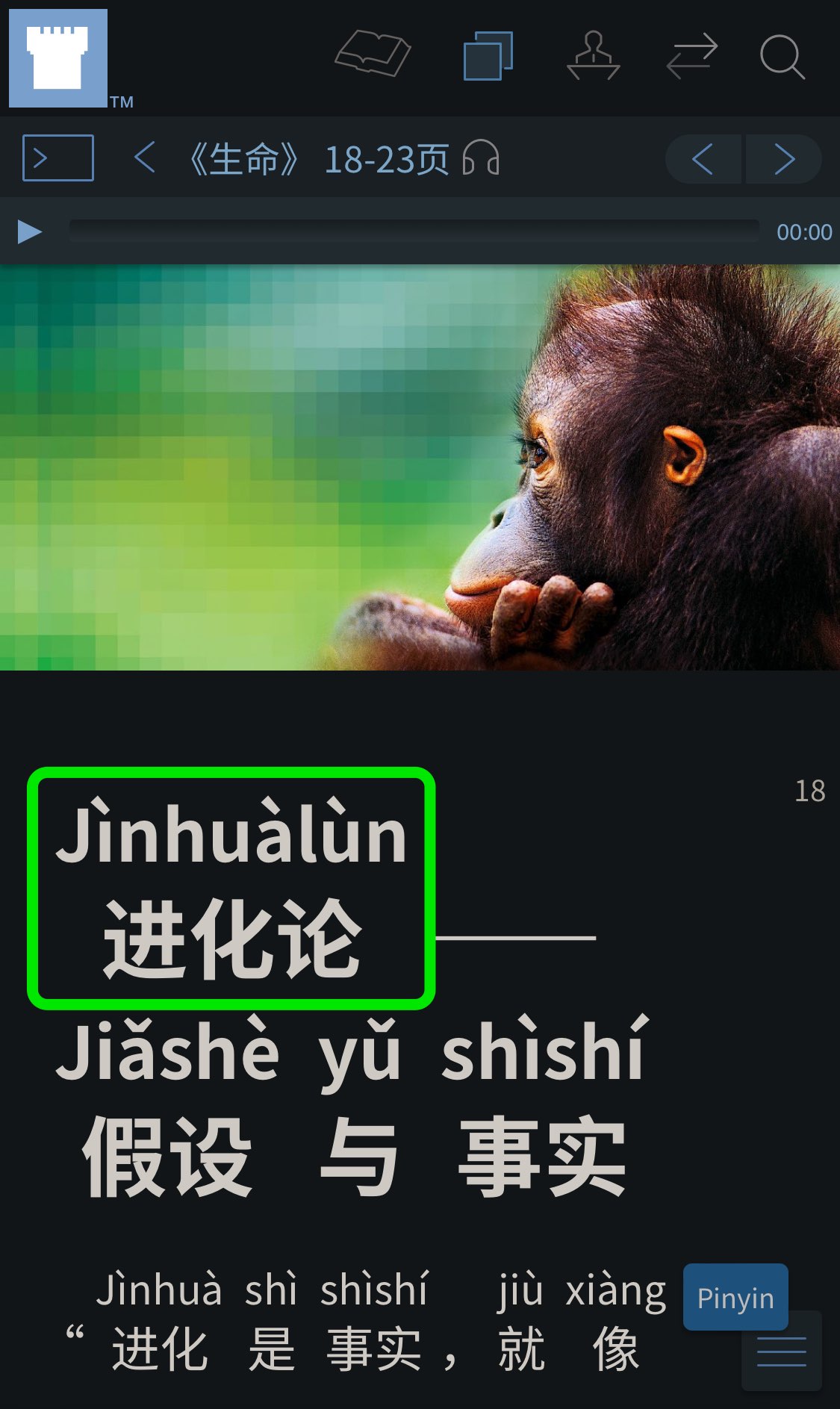
For most of human history, people in general believed that life was created. Of course it was, because how else could the wonderful, extraordinarily complex thing that is life have come into existence? The very first part of the Bible contains an account of how God created life, and many ancient peoples had their creation myths. (The ancient Chinese seem to have had several creation myths.) Eventually, though, the idea represented in English by the word “evolution” and in Mandarin by this week’s MEotW “jìnhuà (jìn·huà {to advance} · transforming → [evolution] 进化 進化) lùn (discussing → [theory; doctrine] 论 論)” came to grow in popularity in this world that’s alienated from God.—Ephesians 4:17, 18.
How It Breaks Down
The “jìn ({advance; enter [into; in]} 进 進)” in “jìnhuà (jìn·huà {to advance} · transforming → [evolution] 进化 進化)” is also used in “jìnbù (jìn·bù {advancing [of]} · steps → [progress[ing]; advancing; improvement] 进步 進步)”, and it means “to advance”.
The “huà (change; transform; convert [→ [melt; dissolve; thaw | abbr. for huàxué (chemistry)]] 化)” in “jìnhuà (jìn·huà {to advance} · transforming → [evolution] 进化 進化)” is also used in “qiánghuà+ (qiáng·huà {to be strong} · transform → [strengthen] 强化 強化)” (“strengthen”), and it basically means “to transform”. Interestingly, this “huà (change; transform; convert [→ [melt; dissolve; thaw | abbr. for huàxué (chemistry)]] 化)” also occurs in “wénhuà+ (wén·huà {(with) writing} · transformed (system) → [culture] | {(with) writing} · transformed → [cultural] 文化)” (“culture”), which seems to literally mean “(system) transformed by writing”.
As for the “lùn (discussing → [theory; doctrine] 论 論)” in “jìnhuà (jìn·huà {to advance} · transforming → [evolution] 进化 進化) lùn (discussing → [theory; doctrine] 论 論)”, it basically means “to discuss”, as it does in “tǎolùn (discussing [→ [discussion]] 讨论 討論)”, and it can effectively mean “theory; doctrine”.
On one level, then, the way that the expression “jìnhuà (jìn·huà {to advance} · transforming → [evolution] 进化 進化) lùn (discussing → [theory; doctrine] 论 論)” works is that it’s “the theory of transforming to advance”.
How It’s Going
A while ago, I saw a video on the Internet in which the presenter pointed out that in science, “theory” does not mean the same as it does in regular usage. As Wikipedia summarizes in its article on scientific theories:
A scientific theory differs from a scientific fact or scientific law in that a theory explains “why” or “how”: a fact is a simple, basic observation, whereas a law is a statement (often a mathematical equation) about a relationship between facts and/or other laws. For example, Newton’s Law of Gravity is a mathematical equation that can be used to predict the attraction between bodies, but it is not a theory to explain how gravity works.[source] Stephen Jay Gould wrote that “…facts and theories are different things, not rungs in a hierarchy of increasing certainty. Facts are the world’s data. Theories are structures of ideas that explain and interpret facts.”[source]
The meaning of the term scientific theory (often contracted to theory for brevity) as used in the disciplines of science is significantly different from the common vernacular usage of theory.[source][source] In everyday speech, theory can imply an explanation that represents an unsubstantiated and speculative guess,[source] whereas in a scientific context it most often refers to an explanation that has already been tested and is widely accepted as valid.[source][source]
How It Could, and Will, End Up
Note, though, the statements that follow in that Wikipedia article:
The strength of a scientific theory is related to the diversity of phenomena it can explain and its simplicity. As additional scientific evidence is gathered, a scientific theory may be modified and ultimately rejected if it cannot be made to fit the new findings; in such circumstances, a more accurate theory is then required.
Yes, while a scientific theory like evolution may be considered by some to be having some evidence supporting it, in true science, it may also end up being disproven and thus rejected after new evidence comes to light. As suggested by the basic meaning of the “lùn+ (discussing → [theory; doctrine] 论 論)” in “jìnhuà (jìn·huà {to advance} · transforming → [evolution] 进化 進化) lùn (discussing → [theory; doctrine] 论 論)”, a scientific theory is an ongoing discussion, not a sealed, unalterable conclusion.
Let us be positive and courageous then, in discussing with Mandarin-speaking people the evidence presented in the Shēngmìng Láizì Chuàngzào Ma? ((Shēngmìng Life 生命) (Lái·zì Came · From 来自 來自) (Chuàng·zào Initiating · {Making, Creating} → [Creating] 创造 創造) (Ma [? ptcl for “yes/no” questions] 吗 嗎)? → [Was Life Created? (lc)]) (Was Life Created? (lc)) brochure and in the Shēngmìng de Qǐyuán—Zhíde Sīkǎo de Wǔ Ge Wèntí ((Shēngmìng Life 生命) (de ’s 的) (Qǐ·yuán {Rising → [Starting]} · Source → [Origin] 起源/原)—(Zhí·de Worth · Getting → [Worth] 值得) (Sī·kǎo {Thinking About} · Examining 思考) (de ’s 的) (Wǔ Five 五) (Ge [mw] 个 個/个) (Wèn·tí Asking · Subjects → [Questions] 问题 問題) → [The Origin of Life—Five Questions Worth Asking (lf)]) (The Origin of Life—Five Questions Worth Asking (lf)) brochure. If the ones we speak to are truly scientific people, as well as being humble people, they will consider the evidence with open minds, and not just dogmatically stick to believing in evolution simply because it’s a currently accepted scientific theory.
For convenience:
The direct link for the current generation Pīnyīn (Pīn·yīn {Piecing Together of} · Sounds → [Pinyin] 拼音) Plus resource for the Was Life Created? brochure is:
The short link for Chinese field language-learning links for the Was Life Created? brochure is:
More Pīnyīn (Pīn·yīn {Piecing Together of} · Sounds → [Pinyin] 拼音) and Pīnyīn (Pīn·yīn {Piecing Together of} · Sounds → [Pinyin] 拼音) Plus web material based on the Mandarin Was Life Created? brochure will be made available in the Pīnyīn (Pīn·yīn {Piecing Together of} · Sounds → [Pinyin] 拼音) Plus web resource as time allows. Work is now underway to produce a Pīnyīn (Pīn·yīn {Piecing Together of} · Sounds → [Pinyin] 拼音) Plus web resource for the Mandarin Origin of Life brochure as well.