Categories
Culture Language Learning Science Technology Theocratic

quèzáo

quèzáo (què·záo firmly; indeed; truly; really · {[is] chiselled} → [[is] [(shown) to be] conclusive; authentic; irrefutable] 确凿 確鑿) ← Tap/click to show/hide the “flashcard”

[Notes: Tap/click on a Pīnyīn (Pīn·yīn {Piecing Together of} · Sounds → [Pinyin] 拼音) expression to reveal its “flashcard”; tap/click on a “flashcard” or its Pīnyīn (Pīn·yīn {Piecing Together of} · Sounds → [Pinyin] 拼音) expression to hide the “flashcard”. 📖 📄 📘 icons mean 📖 Reveal All, 📄 Reveal Advanced, and 📘 Reveal None re all the “flashcards” in the heading, paragraph, etc. that they are placed at the beginning of.]

The Shēngmìng Láizì Chuàngzào Ma? ((Shēngmìng Life 生命) (Lái·zì Came · From 来自 來自) (Chuàng·zào Initiating · {Making, Creating} → [Creating] 创造 創造) (Ma [? ptcl for “yes/no” questions])? [Was Life Created? (lc)]) (Was Life Created? (lc)) brochure and the Shēngmìng de Qǐyuán—Zhíde Sīkǎo de Wǔ Ge Wèntí ((Shēngmìng Life 生命) (de ’s 的) (Qǐ·yuán {Rising → [Starting]} · Source → [Origin] 起源/原)—(Zhí·de Worth · Getting → [Worth] 值得) (Sī·kǎo {Thinking About} · Examining 思考) (de ’s 的) (Wǔ Five 五) (Ge [mw]個/个) (Wèn·tí Asking · Subjects → [Questions] 问题 問題) [The Origin of Life—Five Questions Worth Asking (lf)]) (The Origin of Life—Five Questions Worth Asking (lf)) brochure were originally published back in 2010, but relatively recently, the English version of the Was Life Created? brochure was updated to the December 2022 Printing, and the Mandarin version of it was updated to the February 2023 Printing. Also, the Was Life Created? brochure and the Origin of Life brochure are now in the Teaching Toolbox section in the JW Library app. So, it would be good to consider some of the expressions used in the Mandarin versions of these publications that can be so helpful when discussing whether life was created.

Is That a Fact?

Many people today dogmatically declare, “Evolution is not just a theory, it’s a fact, a fact, I say, a fact!”

This week’s MEotW, “quèzáo (què·záo firmly; indeed; truly; really · {[is] chiselled} → [[is] [(shown) to be] conclusive; authentic; irrefutable] 确凿 確鑿)”, can be useful when discussing this subject. It can be seen in use in the last paragraph of section 1 of the Origin of Life brochure, which section is entitled, in English, “How Did Life Begin?”:

English:

Given the facts, are you willing to make such a leap? Before answering that question, take a closer look at the way a cell is made. Doing so will help you discern whether the theories some scientists propound about where life came from are sound or are as fanciful as the tales some parents tell about where babies come from.

Mandarin (WOL, Pīnyīn (Pīn·yīn {Piecing Together of} · Sounds → [Pinyin] 拼音) Plus):

📖 📄 📘 Kànguo (Kàn·guo {looking at} · {having passed} → [having looked at] 看过 看過) yǐshàng (yǐ·shàng at · above’s 以上) shìshí (shì·shí matters · {being solid} → [facts] 事实 事實) zhīhòu (zhī·hòu it · {after (that)} 之后 之後), (you 你) xiāngxìn (xiāng·xìn it · {do believe (that)} → [do believe (that)] 相信) shēngmìng (life 生命) shì (was 是) pèngqiǎo (pèng·qiǎo {having bumped into} · {being coincidental} → [by chance] 碰巧) chǎnshēng (chǎn·shēng {given birth to → [produced]} · {given birth to → [caused to exist]} → [brought into being] 产生 產生) de ({’s (thing)} 的) ma ([? ptcl for “yes/no” questions])? Huídá (Huí·dá {circling back} · {to answer} 回答) zhèige (zhèi·ge this · [mw] 这个 這個) wèntí (wèn·tí asking · subject → [question] 问题 問題) zhīqián (zhī·qián it · {before (that)} 之前), qǐng (please) zǐxì (zǐ·xì {the young of domestic animals → [with attention to detail]} · {finely → [carefully]} 仔/子细 仔/子細) kànkan (kàn·kan {look at} · {look at} 看看) xìbāo (xì·bāo tiny · womb → [cell] 细胞 細胞) de (’s 的) gòuzào (gòu·zào {constructing → [structure]} · making → [structure] 构造 構造). Zhèyàng (Zhè·yàng this · {form of → [way of]} 这样 這樣) zuò (doing 做) néng (can 能) bāngzhù (help 帮助 幫助) (you 你) kànchū (kàn·chū see · out 看出), yìxiē (yì·xiē one · {indefinite number of} → [some] 一些) kēxué‐jiā ((kē·xué {branches of study} · learning → [science] 科学 科學)‐(jiā -ists 家) [scientists]) jiù (regarding 就) shēngmìng (life’s 生命) qǐyuán (qǐ·yuán {rising → [starting]} · source → [origin] 起源/原) tíchū (tí·chū {carry (hanging down from the hand) → [raise] → [refer to]} · out 提出) de (’s 的) lǐlùn (lǐ·lùn reasonings · {discussings → [theories]} → [theories] 理论 理論) jiūjìng (jiū·jìng {studied carefully → [actually]} · {in the end} 究竟) shì (are 是) zhèngjù ({(by) evidence} 证据 證/証據) quèzáo (què·záo firmly · chiselled → [(shown) to be irrefutable] 确凿 確鑿) de ({’s (theories)} 的), háishi (hái·shi {still more → [or]} · are 还是 還是) xiàng (as 像/象) yǒuxiē (yǒu·xiē {(there) are having → [(there) are]} · some 有些) fùmǔ (fù·mǔ fathers · mothers 父母) jiěshì (jiě·shì {untying → [solving]} · explaining 解释 解釋) bǎobao (bǎo·bao treasures · treasures → [precious/darling babies] 宝宝 寶寶) cóng (from) nǎli (nǎ·li which · inside → [where] 哪里 哪裡/裏) lái (come) shí ({(particular) times}) suǒ ({those which (they)} 所) shuō (say說/説) de ({’s (things)} 的) nàyàng (nà·yàng that · {form → [way]} 那样 那樣) méiyǒu (méi·yǒu not · having 没有 沒有) gēnjù (gēn·jù root · evidence → [basis] 根据 根據).

Looking at the morphemes in “quèzáo (què·záo firmly; indeed; truly; really · {[is] chiselled} → [[is] [(shown) to be] conclusive; authentic; irrefutable] 确凿 確鑿)”, “què (firmly; indeed; truly; really) can mean “firmly” or “indeed”, and indeed, it appears in the expression “díquè (dí·què {in reality}; truly; really · indeed; truly; really; certainly 的确 的確)”, which means “indeed”. As for “záo (chisel (v or n))”, in this context, this expression means “chiselled”. Taken together then, the morphemes in “quèzáo (què·záo firmly; indeed; truly; really · {[is] chiselled} → [[is] [(shown) to be] conclusive; authentic; irrefutable] 确凿 確鑿) literally mean something like “firmly chiselled”, and are used to effectively mean “[(shown) to be] conclusive; authentic; irrefutable”.

What Is Actually Rock Solid?

While evolution is believed in by many in the world today, the evidence, such as that discussed in the Origin of Life brochure, shows that it is actually creation that is zhèngjù ({(by) evidence} 证据 證/証據) quèzáo (què·záo firmly · chiselled → [(shown) to be irrefutable] 确凿 確鑿) de ({’s (teaching)} 的), rock solid, as if chiselled in stone, firmly.

Similarly, in Mandarin language learning, many, because of the weight of long tradition and much worldly propaganda, believe in prioritizing Chinese characters, but it’s actually the modern linguistic principle that speech is primary, and writing is secondary that is zhèngjù ({(by) evidence} 证据 證/証據) quèzáo (què·záo firmly · chiselled → [(shown) to be irrefutable] 确凿 確鑿) de ({’s (teaching)} 的), by evidence from both modern linguistics and God’s Word itself.

For example, on their podcast called Lingthusiasm, linguists Lauren Gawne and Gretchen McCulloch said:

Lauren: I think that is one of the things that makes it really hard for people who grow up in highly literate, highly educated societies to tease writing and reading apart from language. But actually, when you step back, you realise that writing is actually super weird.

Gretchen: It’s so weird! It’s this interesting – it really is a technology. It’s a thing you do on top of language to do stuff with language, but it’s not the language itself. There are thousands and possibly millions of languages that have never been written down in the history of humanity. We have no idea. We’ve never met a society of humans, or heard of a society of humans, without language. But those are spoken and signed languages, which are just kind of there. Writing, by contrast, was invented somewhere between 3 and 4 times in the history of humanity.

Of course, in keeping with the rock solid, evidence-based Bible teaching that God created us, rather than saying that spoken languages “are just kind of there”, we would say that God purposely created us to primarily use language through his gift of speech. It’s not surprising then, that God’s Word the Bible contains the following passage at 1 Corinthians 14:8–11, which emphasizes the primary importance of understandable speech, while not bothering to even mention the mere human invention of writing:

8 For if the trumpet sounds an indistinct call, who will get ready for battle? 9 In the same way, unless you with the tongue use speech that is easily understood, how will anyone know what is being said? You will, in fact, be speaking into the air. 10 It may be that there are many kinds of speech in the world, and yet no kind is without meaning. 11 For if I do not understand the sense of the speech, I will be a foreigner to the one speaking, and the one speaking will be a foreigner to me.


For convenience:

The direct link for the current generation Pīnyīn (Pīn·yīn {Piecing Together of} · Sounds → [Pinyin] 拼音) Plus resource for the Origin of Life brochure is:

The short link for Chinese field language-learning links for the Origin of Life brochure is:

More Pīnyīn (Pīn·yīn {Piecing Together of} · Sounds → [Pinyin] 拼音) and Pīnyīn (Pīn·yīn {Piecing Together of} · Sounds → [Pinyin] 拼音) Plus web material based on the Mandarin Origin of Life brochure will be made available in the Pīnyīn (Pīn·yīn {Piecing Together of} · Sounds → [Pinyin] 拼音) Plus web resource as time allows.
Categories
Culture Experiences Language Learning Theocratic

jiàoyù

jiàoyù (jiào·yù teaching · educating [→ [education]] 教育) ← Tap/click to show/hide the “flashcard”

[Notes: Tap/click on a Pīnyīn (Pīn·yīn {Piecing Together of} · Sounds → [Pinyin] 拼音) expression to reveal its “flashcard”; tap/click on a “flashcard” or its Pīnyīn (Pīn·yīn {Piecing Together of} · Sounds → [Pinyin] 拼音) expression to hide the “flashcard”. 📖 📄 📘 icons mean 📖 Reveal All, 📄 Reveal Advanced, and 📘 Reveal None re all the “flashcards” in the heading, paragraph, etc. that they are placed at the beginning of.]

At the time of this writing, jw.org was featuring the article “Can Education and Money Guarantee a Secure Future?”. Of interest to those of us in the Mandarin field, this article mentions the comments and experiences of several Asians. Where the English version of this article uses the word “education”, the Mandarin version uses this week’s MEotW, “jiàoyù (jiào·yù teaching · educating [→ [education]] 教育)”. (Since this article is from a relatively recent issue of The Watchtower, it provides the option to show Pīnyīn (Pīn·yīn {Piecing Together of} · Sounds → [Pinyin] 拼音).)

Related Expressions

The “jiào (teach | {teaching [→ [religion]]} | cause/ask 教) in “jiàoyù (jiào·yù teaching · educating [→ [education]] 教育) is a verb meaning “teach”. It also appears in past MEotW “jiàodǎo (jiào·dǎo teaching · {guiding [→ [instructing]]} 教导 教導)”, which means “teach” or “instruct”, and in “jiàoxun (teaching → [reprimanding | knowledge gained from an error; lesson; moral] 教训 教訓)”, which means “reprimanding” or “lesson”. (“Jiàoxun (teaching → [reprimanding | knowledge gained from an error; lesson; moral] 教训 教訓) is also discussed in the MEotW post on “jiàodǎo (jiào·dǎo teaching · {guiding [→ [instructing]]} 教导 教導)”.) This “jiào (teach | {teaching [→ [religion]]} | cause/ask 教) can also effectively mean “religion”, as it does in “Jīdū Jiào ((Jīdū Christ 基督) (Jiào Teaching → [Religion] 教) [Christianity | Christian]) and in “Tiānzhǔ Jiào ((Tiān·zhǔ Heavenly · Lord → [Catholic] 天主) (Jiào Teaching → [Religion] 教) [Catholicism])”.

The “yù ({give birth to} | rear; raise; {bring up}; cultivate | educating [→ [education]] 育) in “jiàoyù (jiào·yù teaching · educating [→ [education]] 教育) is a verb meaning “educate”. In other contexts, such as in the expressions “shēngyù ({giving [of] birth} [→ [fertility]] 生育) and “yùzhǒng (yù·zhǒng {giving birth to} · breeds → [breeding] 育种 育種)”, it can mean “give birth to”.

Verbs or Nouns

While “jiàoyù (jiào·yù teaching · educating [→ [education]] 教育) and its constituent morphemes are verbs, they can also be nouns. As the MEotW post for “jiàodǎo (jiào·dǎo teaching · {guiding [→ [instructing]]} 教导 教導) explains:

One interesting thing to note about “jiàodǎo (jiào·dǎo teaching · {guiding [→ [instructing]]} 教导 教導)” (and about “jiàoxun (teaching → [reprimanding | knowledge gained from an error] 教训 教訓)”, for that matter) is that their component morphemes seem to basically be verbs. In certain contexts, however, they are used as nouns. An example of this being done in English is that “teach” and “teaching” are verbs (e.g. “Jesus was teaching the crowd.”), but in certain contexts, “teaching” is used as a noun (e.g. “The crowd was amazed at the teaching Jesus shared with them.”). When a word is used this way, it’s called a verbal noun, or a gerundial noun. Verbal nouns are quite common in Mandarin.

Usage Examples

Here are a couple of examples of “jiàoyù (jiào·yù teaching · educating [→ [education]] 教育) in use, taken from the above-mentioned article:

English:

Can Education and Money Guarantee a Secure Future?

Mandarin:

📖 📄 📘 Jiàoyù (Jiào·yù Teaching · Educating → [Education] 教育) ({(together) with} → [and]和/龢) Cáifù (Cái·fù Wealth · {Being Wealthy} 财富 財富) Néng (Can 能) Dàigěi (Dài·gěi Bring · {to Give to} 带给 帶給) Rén (People 人) Měihǎo (Měi·hǎo Beautiful · Good 美好) de (’s 的) Wèilái (Wèi·lái (What) {Is Not Yet} · Come → [Future] 未来 未來) Ma ([? ptcl for “yes/no” questions])?

English:

Like Franklin, many have concluded that there is more to life than pursuing higher education and riches.

Mandarin:

📖 📄 📘 Hěn (very 很) duō (many 多) rén (people 人) gēn (with 跟) Āfù (Franklin 阿富) yíyàng (yí·yàng {(of) one} · pattern → [the same] 一样 一樣), kànchū (kàn·chū see · out 看出) shēnghuó (shēng·huó life · living 生活) zhōng (within 中) yǒuxiē (yǒu·xiē {(there) are having → [(there) are]} · some 有些) shì (things 事) ({compared to} 比) zhuīqiú (zhuī·qiú pursuing · seeking 追求) gāoděng (gāo·děng high(er) · rank 高等) jiàoyù (jiào·yù teaching · educating → [education] 教育) ({(together) with} → [and]和/龢) cáifù (cái·fù wealth · {being wealthy} 财富 財富) gèng (more 更) zhòngyào (zhòng·yào {being weighty} · {being important} 重要).

Education in the “Deep Things” of the World

In addition to the issues discussed in the above-mentioned article, the world’s higher education also tends to indoctrinate people in the “deep things” of this world that we know is ruled by Satan. Regarding these, chapter 10, paragraph 17 of the Revelation Climax book says:

Satan has other “deep things” today, such as complicated speculations and philosophies that flatter the intellect. In addition to permissive, immoral reasonings, these include spiritism and the theory of evolution. How does the all-wise Creator regard these “deep things”? The apostle Paul quotes him as saying: “I will destroy the wisdom of the wise ones.” In contrast thereto, “the deep things of God” are simple, lucid, and heartwarming. Wise Christians shun the “deep things” of Satan’s sophisticated world. Remember, “the world is passing away and so is its desire, but he that does the will of God remains forever.”—1 Corinthians 1:19, Kingdom Interlinear; 2:10; 1 John 2:17.

Should Chinese characters be counted as being among the “deep things” of Satan’s world? Well, they do come from Satan’s world, and, as per the above quote’s description, they certainly are complicated, and many do seem to enjoy how they flatter the intellect. Also, if they are allowed to, they can serve Satan’s interests by greatly adding to the weighty difficulties faced by Mandarin field language learners. In this respect, Chinese characters are like all the human traditions surrounding the Sabbath that added unnecessary weighty burdens to those trying to serve God in Jesus’ time, except that instead of just affecting God’s people one day a week, characters make things much harder than necessary for Mandarin field language learners every single day.

The article “Pīnyīn (Pīn·yīn {Piecing Together of} · Sounds → [Pinyin] 拼音) Was Plan A” says the following about the attitude of many of those highly educated in Chinese characters towards the prospect of Chinese writing reform that would make things much easier for future language learners:

…as noted above, “opposition [to Chinese writing reform] ‘comes primarily from intellectuals, especially from high level intellectuals.’ ” Lǔ Xùn (鲁迅/魯迅, Lu Xun), considered by many to be the greatest Chinese writer of the twentieth century (he wrote “The True Story of Ah-Q”, “Diary of a Madman”, and “My Old Hometown”), had this to say about the matter:

In addition to the limitations of social status and economic means, our Chinese characters present another high threshold to the masses: their difficulty. If you don’t spend ten or so years on them, it’s not easy to cross this threshold alone. Those who cross over it are the scholar-officials, and these same scholar-officials do their utmost to make writing as difficult as possible because it makes them especially dignified, surpassing all other ordinary scholar-officials.

Chinese characters and the Chinese literary language are already difficult enough by their own nature. On top of that, the scholar-officials have purposely devised all of these additional difficulties that get added on. Such being the case, how could anyone hope that the masses would have any affinity for the Chinese writing system? But the scholar-officials precisely want it to be this way. If the characters were easy to recognize and everybody could master them, then they would not be dignified, and the scholar-officials would lose their dignity along with them.

Being more concerned about one’s own “dignity” than about what would greatly relieve the suffering of others certainly sounds to me like an attitude that’s characteristic of people of Satan’s world. Don’t let Satan’s world—including its well-meaning Mandarin language teachers—“educate” you (in other words, brainwash you) into having such an ungodly and unchristian attitude!

Categories
Culture Experiences Language Learning Science Theocratic

({register or record for reference} [→ [musical notation [→ [set to music; compose (music)]] | sth. to base oneself on | table; chart; list | guide; manual | standards | airs; pretensions | spectrum (physics)]]) ← Tap/click to show/hide the “flashcard”

[Notes: Tap/click on a Pīnyīn (Pīn·yīn {Piecing Together of} · Sounds → [Pinyin] 拼音) expression to reveal its “flashcard”; tap/click on a “flashcard” or its Pīnyīn (Pīn·yīn {Piecing Together of} · Sounds → [Pinyin] 拼音) expression to hide the “flashcard”. 📖 📄 📘 icons mean 📖 Reveal All, 📄 Reveal Advanced, and 📘 Reveal None re all the “flashcards” in the heading, paragraph, etc. that they are placed at the beginning of.]

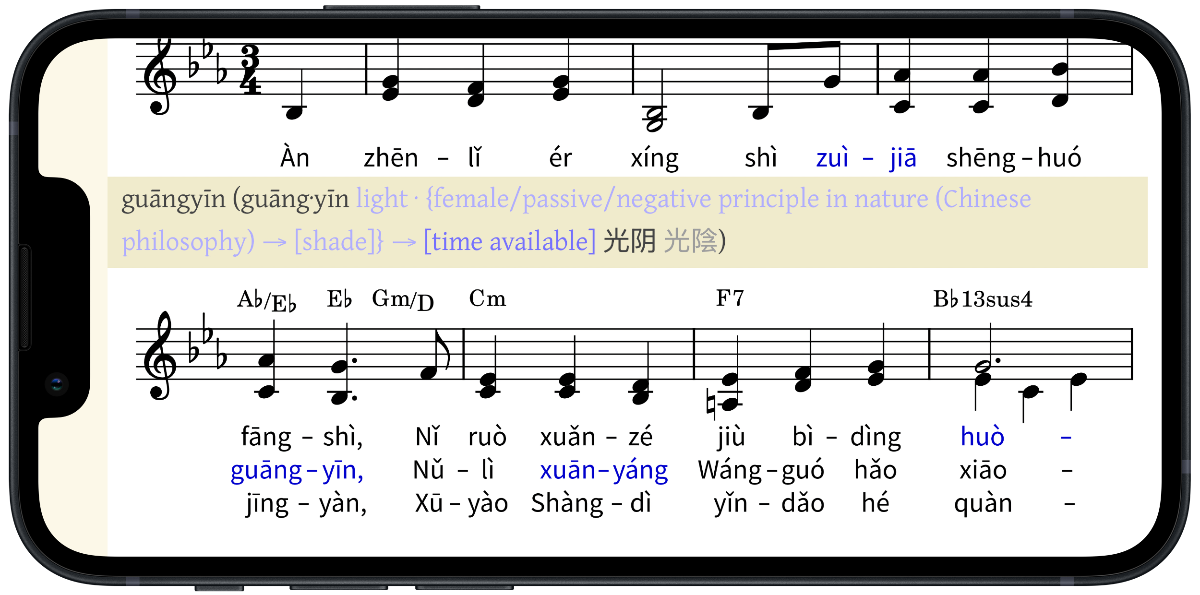
Summer is nearing, and soon, many of us will be singing together in Mandarin at our Mandarin conventions. Unfortunately, at the time of this writing, there was no official Pīnyīn (Pīn·yīn {Piecing Together of} · Sounds → [Pinyin] 拼音) available on the official page for the Mandarin version of this year’s convention song, but I am happy to report that proofread Pīnyīn (Pīn·yīn {Piecing Together of} · Sounds → [Pinyin] 拼音) lyrics or better and proofread musical notation 🎼 with Pīnyīn (Pīn·yīn {Piecing Together of} · Sounds → [Pinyin] 拼音) lyrics for this year’s convention song, and for all the other songs scheduled to be sung at this year’s Mandarin conventions, are now available at this unofficial Pīnyīn (Pīn·yīn {Piecing Together of} · Sounds → [Pinyin] 拼音) Plus resource:

2024 convention song “‘Hǎo Xiāoxi’!” (music+_Pīnyīn_), on iPhone 13 mini (landscape orientation)

[Note: As with all the other Pīnyīn (Pīn·yīn {Piecing Together of} · Sounds → [Pinyin] 拼音) Plus resources, the above-mentioned Pīnyīn (Pīn·yīn {Piecing Together of} · Sounds → [Pinyin] 拼音) Plus resource is made to be supplementary language-learning material for those learning the Mandarin language to help others in the Mandarin field. For spiritual food (which is for you yourself to learn spiritual things from, and which ideally should be in your own mother tongue), please go to jw.org.]

Very Lyrical Mandarin Lyrics

This week’s MEotW, “pǔ ({register or record for reference} [→ [musical notation [→ [set to music; compose (music)]] | sth. to base oneself on | table; chart; list | guide; manual | standards | airs; pretensions | spectrum (physics)]])”, comes from the second verse of the Mandarin version of this year’s convention song:

English:

He will reign for righteousness.
Peace he will provide.
Jesus is the way to endless life.

Mandarin (jw.org, Pīnyīn (Pīn·yīn {Piecing Together of} · Sounds → [Pinyin] 拼音) Plus):

📖 📄 📘 Dāng (when) zhèngyì (zhèng·yì {being upright} · righteousness 正义 正義) shǎnyào (shǎn·yào shines · {to be bright} (on) → [shines on] 闪耀 閃耀) tiānjì (tiān·jì sky · boundary → [horizon] 天际 天際),
({register or record for reference} → [musical notation] → [compose]) hépíng (hé·píng {being (together) with (one another)}’s · {being flat, level, even}’s → [peace’s (nwtsty-CHS Appx. A2 says this term mainly refers to the absence of war or conflict)] 和平) xuánlǜ (xuán·lǜ looping · {regulation → [style of poetry]} → [melody] 旋律),
Qīngchūn (Qīng·chūn {being green → [youth]} · spring → [youth] 青春) huì (will) xiàng (like 像/象) (river 河) bēnliú (bēn·liú rush · flow 奔流) bùxī (bù·xī not · {being ceasing} → [unceasingly] 不息).

Interestingly, this passage of the Mandarin lyrics is more poetic—or lyrical, since we are dealing with lyrics—than is strictly required to correspond to the original English lyrics in meaning. Here is a translation of these Mandarin lyrics back into English:

When righteousness shines on the horizon,
Compose peace’s melody,
Youth will like a rushing river flow unceasingly.

“Pǔ ({register or record for reference} [→ [musical notation [→ [set to music; compose (music)]] | sth. to base oneself on | table; chart; list | guide; manual | standards | airs; pretensions | spectrum (physics)]]) corresponds with “compose” in the above back translation. This Mandarin expression seems to basically mean “register or record for reference”, and it also has several effective meanings other than “compose”, depending on the context. One of these effective meanings is “musical notation”, such as when it’s used in “jiǎnpǔ (jiǎn·pǔ simple · {register or record for reference → [musical notation]} → [numbered musical notation] 简谱 簡譜)”, which refers to a type of simple numbered musical notation that many Chinese people are familiar with. (In fact, a jiǎnpǔ (jiǎn·pǔ simple · {register or record for reference → [musical notation]} → [numbered musical notation] 简谱 簡譜) version of the “Sing Out Joyfully” to Jehovah book is available on jw.org.)

Music and Mandarin Tones

Another effective meaning that “pǔ ({register or record for reference} [→ [musical notation [→ [set to music; compose (music)]] | sth. to base oneself on | table; chart; list | guide; manual | standards | airs; pretensions | spectrum (physics)]]) can have is “spectrum”. So, it seems that this can also be considered a kind of ({register or record for reference} [→ [musical notation [→ [set to music; compose (music)]] | sth. to base oneself on | table; chart; list | guide; manual | standards | airs; pretensions | spectrum (physics)]]):

Chart showing the relative changes in pitch for the four tones of Mandarin Chinese

Chart showing the relative changes in pitch for the four tones of Mandarin Chinese
Creative Commons Attribution-ShareAlike License logo Wereon

Tones in Mandarin are made of pitch, something that is also an important concept in music. It is not surprising, then, that being musically inclined can help one in learning Mandarin. Does that mean that one must be a musical genius to master Mandarin? Not at all! There are about a billion people in China who speak Mandarin just fine, and they can’t all be musical geniuses.

Music, Tones, and Talent

While some are definitely more naturally talented with music or with languages (or with both) than others, talent is far from being the only factor in how well one can come to make music, or learn a tonal language like Mandarin.

As an example, many years ago, early in my own musical journey, I was in a music store trying to tune a guitar by myself. I was trying my best, but I was having a hard time telling which pitches were higher and which were lower—my pitch-discriminating “muscles” were still quite undeveloped. I was doing so poorly that a nearby employee of the music store was imploring me to just let him tune the guitar! Because of my love of music and my determination, though, over time I kept working on improving my ability to distinguish different pitches, and eventually I improved greatly.

I also remember that when I was a young kid in the local Cantonese congregation in an English-speaking country, there was a time when my Bible teacher was putting me through exercises in recognizing different Cantonese tones, and I was doing terribly, not being able to tell which tones were which. Now, though, after acquiring information such as that in the graph above about the nature of the tones, and after ongoing effort and practice over time, my tone-discriminating abilities are much more highly developed, and I can instantly tell which Cantonese or Mandarin tones are which.

Propaganda and Misinformation vs. Truth

Keep in mind, though, that improving the sound of your Mandarin requires focusing on exactly that—the sound of your Mandarin. I have observed that many, influenced by worldly propaganda and misinformation, unfortunately focus instead on the visible Chinese characters, resulting in the invisible sound of their spoken Mandarin being neglected. However, modern linguistics (language science) and God’s Word the Bible both testify that the truth is that speech is actually the real primary aspect of language.—1 Corinthians 14:8–11.

In contrast to the time when I was following the crowd and focusing on characters, I have found that switching to using Pīnyīn (Pīn·yīn {Piecing Together of} · Sounds → [Pinyin] 拼音) as much as possible has helped me to properly focus on the sound of Mandarin. (Matthew 7:13, 14) After I made that switch, people began saying that I sound like a native Mandarin-speaker, whereas no one had ever said that back when I was focused on characters.

Moving Forward Surprisingly Much

So, while I know that others are more talented at music and at Mandarin than I am, I have been able to put whatever talent I have to good use and improve greatly at both music and Mandarin, by continuing to study them and to work at them with the help of the available tools and resources. Regarding Mandarin specifically, I have also been helped to greatly improve by learning to recognize worldly propaganda and misinformation about it, which enables me to avoid being misled by these.

If you continue to study Mandarin and to work on learning it for the Mandarin field out of love, if you continue to take advantage of the available resources and tools like Pīnyīn (Pīn·yīn {Piecing Together of} · Sounds → [Pinyin] 拼音), and if you avoid being misled by worldly propaganda and misinformation, then with the blessing and the help of Jehovah, the Source of music, language, talent, etc., you can also greatly improve, perhaps even to an extent that would surprise your past self!


For convenience:

The direct link for the Pīnyīn (Pīn·yīn {Piecing Together of} · Sounds → [Pinyin] 拼音) Plus resource for the “Sing Out Joyfully” book is:

The short link for Chinese field language-learning links for the “Sing Out Joyfully” book is:

More Pīnyīn (Pīn·yīn {Piecing Together of} · Sounds → [Pinyin] 拼音) and Pīnyīn (Pīn·yīn {Piecing Together of} · Sounds → [Pinyin] 拼音) Plus web material based on the Mandarin “Sing Out Joyfully” book will be made available in the Pīnyīn (Pīn·yīn {Piecing Together of} · Sounds → [Pinyin] 拼音) Plus web resource as time allows.