Categories
Culture Experiences Language Learning Science Theocratic

shūtú‐tóngguī

shūtú‐tóngguī ((shū·tú {[are] different} · ways; roads; routes 殊途)‐(tóng·guī {[are the] same} · {coming together} 同归 同歸) [[are] different roads/routes/etc. to the same place/destination/goal/etc.]) ← Tap/click to show/hide the “flashcard”

[Notes: Tap/click on a Pīnyīn (Pīn·yīn {Piecing Together of} · Sounds → [Pinyin] 拼音) expression to reveal its “flashcard”; tap/click on a “flashcard” or its Pīnyīn (Pīn·yīn {Piecing Together of} · Sounds → [Pinyin] 拼音) expression to hide the “flashcard”. 📖 📄 📘 icons mean 📖 Reveal All, 📄 Reveal Advanced, and 📘 Reveal None re all the “flashcards” in the heading, paragraph, etc. that they are placed at the beginning of.]

One of the publications that is now recommended to be used on Bible studies is the Yǒngyuǎn Xiǎngshòu Měihǎo de Shēngmìng—Hùdòng Shì Shèngjīng Kèchéng ((Yǒng·yuǎn Eternally · {Far (in Time)} 永远 永遠) (Xiǎng·shòu Enjoy · Receive 享受) (Měi·hǎo Beautiful · Good 美好) (de ’s 的) (Shēngmìng Life 生命)—(Hù·dòng {Each Other} · Moving → [Interactive] 互动 互動) (Shì (Type 式) (Shèng·jīng Holy · Scriptures → [Bible] 圣经 聖經) (Kè·chéng Lessons · Procedure → [Course] 课程 課程) [Enjoy Life Forever!—An Interactive Bible Course (lff)]) (Enjoy Life Forever! (lff)) book. This week’s MEotW, “shūtú‐tóngguī ((shū·tú {[are] different} · ways; roads; routes 殊途)‐(tóng·guī {[are the] same} · {coming together} 同归 同歸) [[are] different roads/routes/etc. to the same place/destination/goal/etc.])”, appears in lesson 13, point 4 of this book:

English:

Many people believe that religions are like different roads that all lead to God. But is that true?

Mandarin (WOL, Pīnyīn (Pīn·yīn {Piecing Together of} · Sounds → [Pinyin] 拼音) Plus):

📖 📄 📘 Xǔduō (Xǔ·duō numbers · many 许多 許多) rén (people 人) rènwéi (rèn·wéi identify · {(it) to be} 认为 認為), suǒyǒu (suǒ·yǒu {(all) which} · {(there) are having → [(there) are]} → [all] 所有) zōngjiào (zōng·jiào {schools of thought} · teachings → [religions] 宗教) dōu (all 都) shūtú‐tóngguī ((shū·tú {are different} · roads 殊途)‐(tóng·guī {are the same} · {coming together} 同归 同歸) [are different roads to the same place]), dàn (but 但) zhè (this) shì (is 是) zhēn (true 真) de ({’s (thing)} 的) ma ([? ptcl for “yes/no” questions])?

Morphemic Breakdown

The first morpheme in this week’s MEotW, “shū (different [→ [special; outstanding; remarkable]] 殊)”, literally means “different”. It can in some contexts effectively mean “special; outstanding; remarkable”, which helps explain its appearance in such expressions as “tèshū (tè·shū {[is] special; particular; unusual; exceptional} · {[is] different [→ [[is] special; outstanding; remarkable; unusual]]} 特殊) and “shūróng (shū·róng {different → [special; outstanding; remarkable]} · honour; glory 殊荣 殊榮)”.

The next morpheme, “tú (road; route; journey; way; path; course 途/涂 途/塗)”, means “road; route; journey; way; path; course”. Other Mandarin expressions that make use of it include “mítú (mí·tú lost · way; road; route [→ [lost one’s way]] 迷途)”, “qítú (qí·tú {[(wrong)] branch} · road; route; journey; way 歧途)”, and, notably, “qiántú (qián·tú ahead · road → [future; prospects] 前途)”.

The third morpheme, “tóng (same; similar | {together [with]}; {in common}同/仝)”, is an often-used one that basically means “same”, as it does in “tóngyàng (tóng·yàng {[(in the)] same} · kind; type; appearance; shape; {pattern; form [→ [way]]} [of] 同样 同樣)”, for example.

The last morpheme, “guī ({return to} | {belong to} | {turn over to} | converge; {gather/come together})”, can mean “return to”, “belong to”, “turn over to”, or “converge; gather/come together”, as it does in this week’s MEotW. Other Mandarin expressions in which it appears include “guīhuí (guī·huí return · {to circle back [to]} 归回 歸回) and “wú‐jiā‐kě‐guī ((wú without無/无)‐(jiā home 家)‐(kě {(that) can} 可)‐(guī {be returned to}) [homeless])”.

Taken together, the constituent morphemes in “shūtú‐tóngguī ((shū·tú {[are] different} · ways; roads; routes 殊途)‐(tóng·guī {[are the] same} · {coming together} 同归 同歸) [[are] different roads/routes/etc. to the same place/destination/goal/etc.]) effectively mean “[are] different roads/routes/etc. to the same place/destination/goal/etc.” As the Enjoy Life Forever! book points out, many believe that this concept applies to the different religions, but the Bible, for example, at Matthew 7:13, 14, plainly teaches otherwise.

One True Religion, Exclusive Devotion

Sadly, some people allow this to become a big issue for them. Years ago, I had a call who in many ways seemed like a good call. He was unusual in that he was young, but was a devout Buddhist who was seriously into Buddhism, not just someone who was merely going along with his Buddhist parents. We had a few long, seemingly good discussions, but one thing that he firmly believed was that it was acceptable for us to practise different religions and worship different gods. After a while, he attended a public talk that I gave in which I used the illustration that God requires his true worshippers to practise the one true religion and to be exclusively devoted to him, just like a husband requires exclusive devotion from his wife, and unfortunately, he lost interest after that. I felt bad because of what happened, but a brother reminded me that not everyone has the right heart condition to progress in the truth.—Acts 13:48.

Indeed, for one to make real spiritual progress, one must be willing to take to heart God’s clearly stated views, rather than stubbornly sticking to one’s own preferred ideas regardless of what God has said about them. Such acceptance of God’s direction is the only way for one to truly have a good relationship with him, as opposed to one just viewing and treating Almighty God like a butler who exists (if one even really believes he exists) merely to satisfy one’s whims.

Different Ways to Learn Mandarin?

Just as many find the idea that different religions are just different roads to the same place to be appealing, many also like to believe that there are different acceptable ways to learn Mandarin, including focusing on learning Chinese characters, as encouraged by many traditionally-minded Mandarin teachers. It may be true to an extent that different ways of learning Mandarin can produce acceptable results. However, if we truly want to make best use of our dedicated, limited time and resources in the Mandarin field, we should keep some basic, objective truths in mind, as pointed out in the article “SPEECH is Top Priority, Not Characters”:

It’s good if some have already learned to use characters, but for those of us who are learning Mandarin for the Mandarin field, our focus should really be on understanding Mandarin speech and speaking Mandarin understandably:

Your first linguistic goal should be to “utter speech easily understood.” [emphasis added] (1 Corinthians 14:8-11) Though people may be tolerant, mistakes or a heavy accent may distract them from listening to your message. Giving attention to proper pronunciation and grammar right from the start will prevent you from forming bad habits that are hard to break.
“Serving With a Foreign-Language Congregation”, in the March 15, 2006 Watchtower.

8 For if the trumpet sounds an indistinct call, who will get ready for battle? 9 In the same way, unless you with the tongue use speech that is easily understood [emphasis added], how will anyone know what is being said? You will, in fact, be speaking into the air. 10 It may be that there are many kinds of speech in the world, and yet no kind is without meaning. 11 For if I do not understand the sense of the speech, I will be a foreigner to the one speaking, and the one speaking will be a foreigner to me.
1 Corinthians 14:8–11.

…just like it’s an established fact that the earth is round, according to modern linguistics (the scientific study of language) this is also an established fact: “Speech is primary, writing is secondary and is always derivative of speech.” This scientific truth about language, that Jehovah built us and wired us to primarily communicate meaning through speech, supports what 1 Corinthians 14:8–11 (quoted above) says about understandable speech being of prime importance to Christian evangelizers. …

…publishers need to learn to understand Mandarin speech to benefit spiritually from Mandarin meetings, because the talks, comments, etc. at such meetings are made of Mandarin speech, not characters. In fact, focusing on characters makes this problem worse because it makes learning Mandarin speech harder and slower. At the very least, it distracts from learning Mandarin speech.

Characters focus mainly on themselves, and are at best a scenic route to learning Mandarin speech, while Pīnyīn is a fast, direct route to learning Mandarin speech. As rescue workers in the Mandarin field, rather than tourists, we must give top priority to the fastest, most effective way to help those in the field, not to the way that features cultural attractions for us to see.

Different roads indeed!


For convenience:

The direct link for the current generation Pīnyīn (Pīn·yīn {Piecing Together of} · Sounds → [Pinyin] 拼音) Plus resource for the Enjoy Life Forever! book is:

The short link for Chinese field language-learning links for the Enjoy Life Forever! book is:

More Pīnyīn (Pīn·yīn {Piecing Together of} · Sounds → [Pinyin] 拼音) and Pīnyīn (Pīn·yīn {Piecing Together of} · Sounds → [Pinyin] 拼音) Plus web material based on the Mandarin Enjoy Life Forever! book will be made available in the Pīnyīn (Pīn·yīn {Piecing Together of} · Sounds → [Pinyin] 拼音) Plus web resource as time allows.

Categories
Culture Experiences Language Learning Science Theocratic

hǎohāo[r]

hǎohāo[r] (hǎo·hāo[·r] {[is] well} · {[is] well | with care} [· {child | youth | son → [(diminutive) non-syllabic retroflex suffix; pronunciation feature in Beijing dialect]}] [→ [[is] in perfectly good condition; alright | all out; to one’s heart’s content; earnestly]] 好好[儿] 好好[兒]) ← Tap/click to show/hide the “flashcard”

[Notes: Tap/click on a Pīnyīn (Pīn·yīn {Piecing Together of} · Sounds → [Pinyin] 拼音) expression to reveal its “flashcard”; tap/click on a “flashcard” or its Pīnyīn (Pīn·yīn {Piecing Together of} · Sounds → [Pinyin] 拼音) expression to hide the “flashcard”. 📖 📄 📘 icons mean 📖 Reveal All, 📄 Reveal Advanced, and 📘 Reveal None re all the “flashcards” in the heading, paragraph, etc. that they are placed at the beginning of.]

A few years back, I wrote up a brief web page listing reasons for producing Pīnyīn (Pīn·yīn {Piecing Together of} · Sounds → [Pinyin] 拼音), etc. material for the Imitate (ia) book. Some, especially some who grew up in the West, may have felt that this book is made up of “just stories”, and ones that they were already quite familiar with, at that. However, we must remember that Chinese Bible students may often have a different perspective regarding the Bible accounts that are made to come to life in the Imitate book. As that web page said:

  • Many Chinese people in the world have not been exposed to Bible accounts the way many Westerners have.
  • Also, I have heard that some, perhaps many, Chinese Bible students tend to approach their Bible studies like intellectual exercises for accumulating chōuxiàng (abstract) head knowledge as if for a school exam, rather than as training for their hearts for their own real lives.

Later, the web page touches on how some of the real-world benefits of good storytelling like that found in the Imitate book involve empathy:

    • The actress Natalie Portman once said, “I love acting. I think it’s the most amazing thing to be able to do. Your job is practicing empathy. You walk down the street imagining every person’s life.”
  • The Imitate book helps build Bible students’ empathy towards Bible characters, which in turn helps Bible students realize that others would feel empathy towards them as well if they imitated these Bible characters—not everyone will just think they’re crazy, like many worldly friends or family members might think.

While even fictional stories can have the benefits described in the links and the quote above, true stories from the Bible can have even greater benefits, including spiritual ones.

Besides the Imitate book, another book from Jehovah’s organization that relates Bible accounts is the Learn From the Bible (lfb) book. The letter from the Governing Body in this book says that, similarly to the Imitate book, the Learn From the Bible book also “brings the Bible accounts to life and captures the feelings of those depicted”, while, unlike the Imitate book, it “tells the story of the human family from creation onward”. While the Learn From the Bible book is especially suitable for children, the letter from the Governing Body in this book says that “it can also be used to help adults who desire to learn more about the Bible”. So, it would be good to consider on this blog some of the expressions used in the Mandarin Learn From the Bible book.

Same Character, Different Morphemes/Words

This week’s MEotW, “hǎohāo[r] (hǎo·hāo[·r] {[is] well} · {[is] well | with care} [· {child | youth | son → [(diminutive) non-syllabic retroflex suffix; pronunciation feature in Beijing dialect]}] [→ [[is] in perfectly good condition; alright | all out; to one’s heart’s content; earnestly]] 好好[儿] 好好[兒])”, appears in the second paragraph of Lesson 20 of the Mandarin Learn From the Bible book, which is entitled “Jiē ({Came into Contact with} → [Took Hold of] (the Baton Next) 接) Xialai (Xia·lai Down · {to Come} 下来 下來) de (’s 的) Liù (Six 六) Chǎng ([mw for recreational, sports, or other activities]場/塲) Zāiyāng (Calamities → [Plagues] 灾殃 災殃) (“The Next Six Plagues”):

English:

The next day, the animals began to die. But the animals of the Israelites didn’t die.

Mandarin (WOL, Pīnyīn (Pīn·yīn {Piecing Together of} · Sounds → [Pinyin] 拼音) Plus):

📖 📄 📘 Dì‐èr ((Dì (on the) [pref to form ordinal numbers] 第)‐(èr two 二) [(on the) second]) tiān (sky → [day] 天), Āijí (Egypt 埃及) jiù (then 就) sǐle (sǐ·le {had die} · {to completion} 死了) hěn (very 很) duō (many 多) shēngkou (shēng·kou {domestic animal} · mouths → [domestic animals] 牲口), dànshì (dàn·shì but · {(it) was (that)} 但是) Yǐsèliè‐rén ((Yǐsèliè Israel 以色列)‐(rén people 人) [Israelites]) de ( 的) shēngkou (shēng·kou {domestic animal} · mouths → [domestic animals] 牲口) què (however) dōu (all 都) hǎohāor (hǎo·hāo·r {were well} · {were well} · {child → [(diminutive) non-syllabic retroflex suffix; pronunciation feature in Beijing dialect]} [were alright] 好好[儿] 好好[兒]) de ({’s (domestic animals)} 的).

“Hǎohāo[r] (Hǎo·hāo[·r] {[is] well} · {[is] well | with care} [· {child | youth | son → [(diminutive) non-syllabic retroflex suffix; pronunciation feature in Beijing dialect]}] [→ [[is] in perfectly good condition; alright | all out; to one’s heart’s content; earnestly]] 好好[儿] 好好[兒]) has what may seem at first like an unexpected pronunciation. Because its two morphemes are each written with the same familiar character “好”, one may at first expect that they would both have the same basic pronunciation of “hǎo ({[is] good/well} [→ [[is] very [much]]] | {[is] (more) good/well} [→ [[is] better]] | well/{to a good finish} | {(it) is good/well} → [OK; alright] 好)”, and that, in accordance with Mandarin’s tone sandhi rules, the first morpheme would be pronounced with a second tone and the second morpheme would be pronounced with a third tone.* However, actually, in “hǎohāo[r] (hǎo·hāo[·r] {[is] well} · {[is] well | with care} [· {child | youth | son → [(diminutive) non-syllabic retroflex suffix; pronunciation feature in Beijing dialect]}] [→ [[is] in perfectly good condition; alright | all out; to one’s heart’s content; earnestly]] 好好[儿] 好好[兒]) the second “好” character represents a different morpheme compared to the one represented by the first “好” character—while the first “好” character represents the familiar morpheme that is written in Pīnyīn (Pīn·yīn {Piecing Together of} · Sounds → [Pinyin] 拼音) as “hǎo ({[is] good/well} [→ [[is] very [much]]] | {[is] (more) good/well} [→ [[is] better]] | well/{to a good finish} | {(it) is good/well} → [OK; alright] 好) and that means “well” in many contexts, the second “好” character represents a morpheme that is written in Pīnyīn (Pīn·yīn {Piecing Together of} · Sounds → [Pinyin] 拼音) as “hāo ({with care} | {[is] well} 好) and that in some contexts means “well” and in other contexts means “with care”. (E.g., “hǎohāor (hǎo·hāo·r well · with care · {child → [(diminutive) non-syllabic retroflex suffix; pronunciation feature in Beijing dialect]} 好好[儿] 好好[兒]) gōngzuò (gōng·zuò work · do → [work] 工作) means “work well, with care”.)

While some supporters of Chinese characters erroneously claim that Mandarin has too many homophones (different words that have the same pronunciation) for Pīnyīn (Pīn·yīn {Piecing Together of} · Sounds → [Pinyin] 拼音) to be a practical writing system for it, their beloved characters suffer from homographs, different morphemes/words that are written the same way, with the same character. (“Hǎo ({[is] good/well} [→ [[is] very [much]]] | {[is] (more) good/well} [→ [[is] better]] | well/{to a good finish} | {(it) is good/well} → [OK; alright] 好)”, “hāo ({with care} | {[is] well} 好)”, and also “hào (like; {be fond of} [→ [have a tendency to; be likely to]] 好) make up just one set of examples—there are many more.) And, just as characters are one way to help one distinguish homophones from one another (context is a better way), pronunciation, as represented by Pīnyīn (Pīn·yīn {Piecing Together of} · Sounds → [Pinyin] 拼音), can often help one distinguish homographs from one another, as we can see from the examples of “hǎo ({[is] good/well} [→ [[is] very [much]]] | {[is] (more) good/well} [→ [[is] better]] | well/{to a good finish} | {(it) is good/well} → [OK; alright] 好)”, “hāo ({with care} | {[is] well} 好)”, and “hào (like; {be fond of} [→ [have a tendency to; be likely to]] 好)”.

Children of Beijing

Also notable about the pronunciation of hǎohāo[r] (hǎo·hāo[·r] {[is] well} · {[is] well | with care} [· {child | youth | son → [(diminutive) non-syllabic retroflex suffix; pronunciation feature in Beijing dialect]}] [→ [[is] in perfectly good condition; alright | all out; to one’s heart’s content; earnestly]] 好好[儿] 好好[兒]) is that it may be pronounced with “r ({child | youth | son} → [(diminutive) non-syllabic retroflex suffix; pronunciation feature in Beijing dialect]) at the end. While this “r ({child | youth | son} → [(diminutive) non-syllabic retroflex suffix; pronunciation feature in Beijing dialect]) has a literal meaning of “child” or “son”, the well-regarded ABC Chinese-English Dictionary provides this definition for this “r ({child | youth | son} → [(diminutive) non-syllabic retroflex suffix; pronunciation feature in Beijing dialect])”:

((diminutive) non-syllabic retroflex suffix; pronunciation feature in Beijing dialect)

Something that deserves special attention about this “r ({child | youth | son} → [(diminutive) non-syllabic retroflex suffix; pronunciation feature in Beijing dialect]) suffix is that its pronunciation involves one of the sounds of Mandarin that is not exactly like any of the sounds of English. The relatively well-known Sinosplice website has a couple of related pages with good information about this Mandarin sound, including directions on how to use one’s tongue, etc. to properly pronounce it:


For convenience:

The direct link for the Pīnyīn (Pīn·yīn {Piecing Together of} · Sounds → [Pinyin] 拼音) Plus resource for the Learn From the Bible book is:

The short link for Chinese field language-learning links for the Learn From the Bible book is:

More Pīnyīn (Pīn·yīn {Piecing Together of} · Sounds → [Pinyin] 拼音) and Pīnyīn (Pīn·yīn {Piecing Together of} · Sounds → [Pinyin] 拼音) Plus web material based on the Mandarin Learn From the Bible book will be made available in the Pīnyīn (Pīn·yīn {Piecing Together of} · Sounds → [Pinyin] 拼音) Plus web resource as time allows.


* One expression in which this is the case is “hǎohǎo xiānsheng ((hǎo·hǎo {(it) is good/well → [OK; alright]} · {(it) is good/well → [OK; alright]} 好好) (xiān·sheng earlier · born (one) → [mister; Mr.] 先生) [sb. who tries to please everybody/not offend anybody; Mr. Agreeable; yes-man])”. ^

Categories
Culture Language Learning Technology Theocratic

háowú

háowú (háo·wú {(even) a fine hair (of)} · {is not having} → [is not having even a little] 毫无 毫無) ← Tap/click to show/hide the “flashcard”

[Notes: Tap/click on a Pīnyīn (Pīn·yīn {Piecing Together of} · Sounds → [Pinyin] 拼音) expression to reveal its “flashcard”; tap/click on a “flashcard” or its Pīnyīn (Pīn·yīn {Piecing Together of} · Sounds → [Pinyin] 拼音) expression to hide the “flashcard”. 📖 📄 📘 icons mean 📖 Reveal All, 📄 Reveal Advanced, and 📘 Reveal None re all the “flashcards” in the heading, paragraph, etc. that they are placed at the beginning of.]

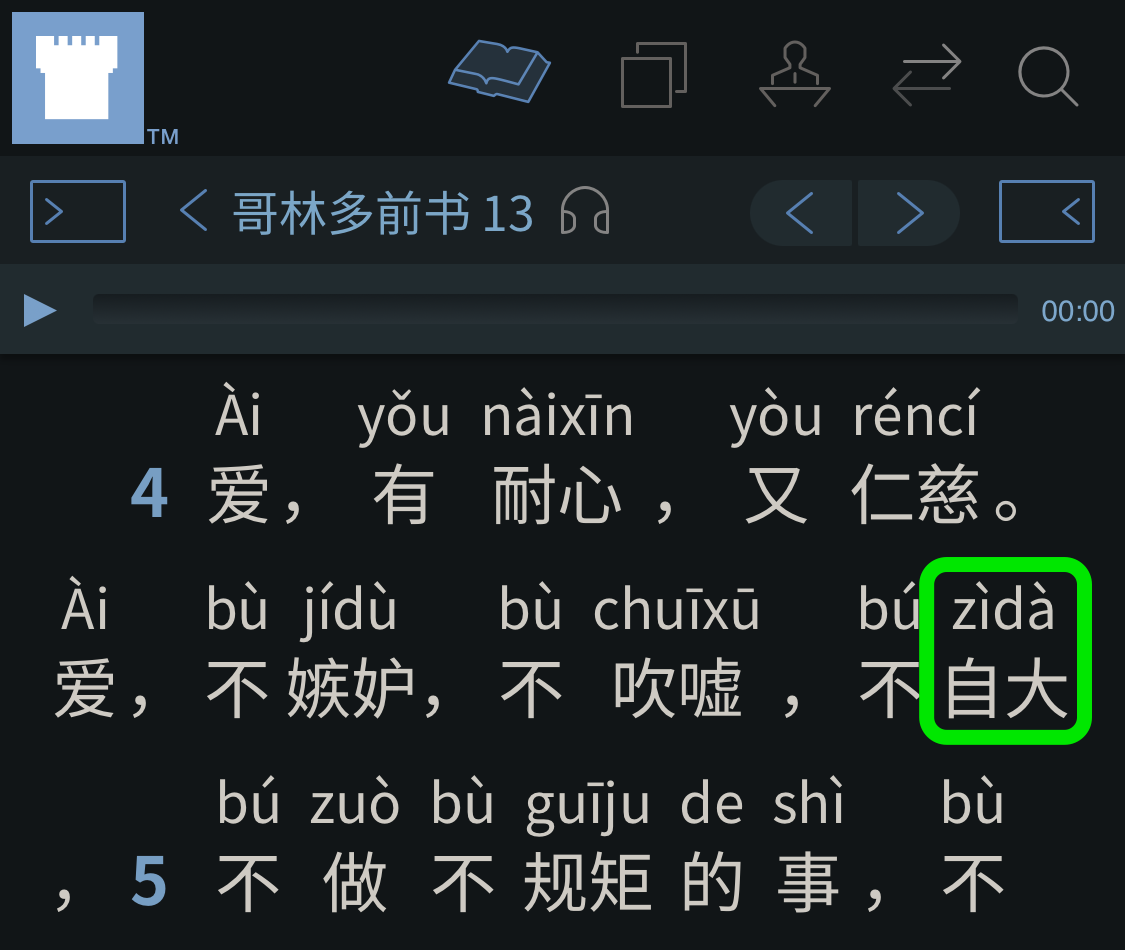
I have long especially liked 1 Corinthians 13. It contains counsel on what really does and doesn’t matter in life, an extensive description and definition of the most important kind of love, and a sublime discussion about the need to become complete, mature, as a person. As these apply to life in general, so too do they apply to our lives as Mandarin field language learners.

As Mandarin field language learners, it can benefit us greatly to consider what we can learn from 1 Corinthians 13, and along the way, we can also consider some of the Mandarin expressions used in that chapter in the current version of the Mandarin New World Translation Bible (nwtsty).

“I Do Not Benefit at All”

This week’s MEotW, “háowú (háo·wú {(even) a fine hair (of)} · {is not having} → [is not having even a little] 毫无 毫無)”, is used in verse 3 (WOL, Pīnyīn (Pīn·yīn {Piecing Together of} · Sounds → [Pinyin] 拼音) Plus) of 1 Corinthians 13:

Screenshot of “_háowú_” in 1 Co. 13:3 (nwtsty, CHS+_Pīnyīn_ WOL)

(Dark mode for the Watchtower ONLINE LIBRARY (WOL) website, as shown in the above image, can be enabled in the Safari web browser by using the Noir Safari extension. Other web browsers may also have extensions with similar functionality.)

In “háowú (háo·wú {(even) a fine hair (of)} · {is not having} → [is not having even a little] 毫无 毫無)”, “háo ({[(even) a] fine hair [(of)]} | milli- 毫) literally refers to a “fine hair”. As for “wú ({not having}; without; none; no | nothing無/无)”, it means “not having; without; none; no”. So, “háowú (háo·wú {(even) a fine hair (of)} · {is not having} → [is not having even a little] 毫无 毫無) literally means “a fine hair is not having”, and effectively means “is not having even a little”. This is an interesting metaphor for emphasizing to us the ultimate futility of doing things out of pride and not out of love, things like focusing Mandarin field language-learning efforts on Chinese cultural traditions like characters rather than on how best to communicate the good news. As a metaphor, it reminds me of the English expression of not having even a shadow of a doubt about something.

Below are English and Pīnyīn (Pīn·yīn {Piecing Together of} · Sounds → [Pinyin] 拼音) Plus renditions showing how “háowú (háo·wú {(even) a fine hair (of)} · {is not having} → [is not having even a little] 毫无 毫無) is used in 1 Corinthians 13:3 in the current version of the Mandarin NWT Bible to correspond to “at all”, which is used in that verse in the current version of the English NWT Bible:

English:

And if I give all my belongings to feed others, and if I hand over my body so that I may boast, but do not have love, I do not benefit at all.

Mandarin (WOL, Pīnyīn (Pīn·yīn {Piecing Together of} · Sounds → [Pinyin] 拼音) Plus):

📖 📄 📘 (I 我) jiùsuàn (jiù·suàn {even if} · {figuring → [considering]} 就算) biànmài (biàn·mài changing · sell → [sell off] 变卖 變賣) yíqiè (yí·qiè {one (whole)} · {corresponding (set of)} → [all] 一切) cáiwù (cái·wù wealth · things → [belongings] 财物 財物), ràng ({to allow}) rén (people 人) yǒu ({to have} 有) shíwù (shí·wù eating · matter → [food] 食物) chī ({to eat}吃/喫), hái (also) shěshēn (shě·shēn {give up} · {(my) body} 舍身 捨身) juānqū (juān·qū {relinquish → [contribute]} · {(my) human body} 捐躯 捐軀), yǐcǐ (yǐ·cǐ using · this 以此) zìkuā (zì·kuā {(about) self} · {to boast} 自夸 自誇), què (but) méiyǒu (méi·yǒu not · {do have} 没有 沒有) ài (love), zhè (this) duì (towards → [to]) (me 我) (even 也) háowú (háo·wú {(even) a fine hair (of)} · {does not have} → [does not have even a little] 毫无 毫無) yìchu (yì·chu beneficial · place → [benefit] 益处 益處).

Having a Word, or Not

While the WOL puts a space between “háo ({[(even) a] fine hair [(of)]} | milli- 毫) and “wú ({not having}; without; none; no | nothing無/无)”, the dictionaries I have checked all treat this expression as one word, with no space between the two morphemes. So, that is how Pīnyīn (Pīn·yīn {Piecing Together of} · Sounds → [Pinyin] 拼音) Plus material renders “háowú (háo·wú {(even) a fine hair (of)} · {is not having} → [is not having even a little] 毫无 毫無)”.

There seems to be a tendency in typical modern Pīnyīn (Pīn·yīn {Piecing Together of} · Sounds → [Pinyin] 拼音) to render many two-morpheme expressions this way, combined into single words. With Pīnyīn (Pīn·yīn {Piecing Together of} · Sounds → [Pinyin] 拼音) Plus material, I have so far decided to go along with this common practice, since the resulting expressions are still relatively easy to read. However, I am not so accepting of extending this common practice to combining three, four, or even more morphemes into single words, with no spaces or even hyphens in them. Doing so produces long, undifferentiated strings of characters that are hard to parse, and thus hard to read and reason on. So, I have decided to generally break up such long expressions into one- or two-morpheme words separated by hyphens or spaces, depending on the situation.

For example, compare “bìbùkěshǎo (bì·bù·kě·shǎo certainly · not · {can; is able; could | may} · {be missing} 必不可少) with “bì (certainly 必)bùkě (bù·kě not · {can; is able; could | may} → [cannot; is not able; could not | may not] 不可)shǎo ({[be] few; little} | {[be] less} | lack; {be deficient} | lose; {be missing} 少)”. While some of the few Pīnyīn (Pīn·yīn {Piecing Together of} · Sounds → [Pinyin] 拼音) traditionalists in existence may object to it, I think the latter rendering is much easier to read and reason on, so that is how Pīnyīn (Pīn·yīn {Piecing Together of} · Sounds → [Pinyin] 拼音) Plus material now renders this expression—one of the few good things about how commonly used Pīnyīn (Pīn·yīn {Piecing Together of} · Sounds → [Pinyin] 拼音) is not is that there is not really much established Pīnyīn (Pīn·yīn {Piecing Together of} · Sounds → [Pinyin] 拼音) tradition or common practice to be “trampled” on, allowing for more leeway for exploring beneficial innovations, compared to the situations with relatively ossified and hidebound writing systems like Chinese characters, or even the modern English writing system.

As for the PRC government’s official national standard for Pīnyīn (Pīn·yīn {Piecing Together of} · Sounds → [Pinyin] 拼音) orthography, with the designation GB/T 16159-2012, as discussed in the MEotW post on “diǎnliàng (diǎn·liàng {dot → [light (v); ignite]} · {to be bright} [→ [illuminate; shine light on]] 点亮 點亮)”, this is at most a set of recommendations that is not legally binding or anything like that, even in China itself.