Categories
Culture Experiences History Language Learning Science Theocratic

zháole huǒ

zháole huǒ ((zháo·le {having caught} · {to completion} 着了 著了) (huǒ fire 火) [having caught fire; burning; being on fire]) 👈🏼 Tap/click to show/hide the “flashcard”

[Notes: Tap/click on a Pīnyīn (Pīn·yīn {Piecing Together of} · Sounds → [Pinyin] 拼音) expression to reveal its “flashcard”; tap/click on a “flashcard” or its Pīnyīn (Pīn·yīn {Piecing Together of} · Sounds → [Pinyin] 拼音) expression to hide the “flashcard”. 📖 📄 📘 icons mean 📖 Reveal All, 📄 Reveal Advanced, and 📘 Reveal None re all the “flashcards” in the heading, paragraph, etc. that they are placed at the beginning of.]

A few years back, I wrote up a brief web page listing reasons for producing Pīnyīn (Pīn·yīn {Piecing Together of} · Sounds → [Pinyin] 拼音), etc. material for the Imitate (ia) book. Some, especially some who grew up in the West, may have felt that this book is made up of “just stories”, and ones that they were already quite familiar with, at that. However, we must remember that Chinese Bible students may often have a different perspective regarding the Bible accounts that are made to come to life in the Imitate book. As that web page said:

  • Many Chinese people in the world have not been exposed to Bible accounts the way many Westerners have.
  • Also, I have heard that some, perhaps many, Chinese Bible students tend to approach their Bible studies like intellectual exercises for accumulating chōuxiàng (abstract) head knowledge as if for a school exam, rather than as training for their hearts for their own real lives.

Later, the web page touches on how some of the real-world benefits of good storytelling like that found in the Imitate book involve empathy:

    • The actress Natalie Portman once said, “I love acting. I think it’s the most amazing thing to be able to do. Your job is practicing empathy. You walk down the street imagining every person’s life.”
  • The Imitate book helps build Bible students’ empathy towards Bible characters, which in turn helps Bible students realize that others would feel empathy towards them as well if they imitated these Bible characters—not everyone will just think they’re crazy, like many worldly friends or family members might think.

While even fictional stories can have the benefits described in the links and the quote above, true stories from the Bible can have even greater benefits, including spiritual ones.

Besides the Imitate book, another book from Jehovah’s organization that relates Bible accounts is the Learn From the Bible (lfb) book. The letter from the Governing Body in this book says that, similarly to the Imitate book, the Learn From the Bible book also “brings the Bible accounts to life and captures the feelings of those depicted”, while, unlike the Imitate book, it “tells the story of the human family from creation onward”. While the Learn From the Bible book is especially suitable for children, the letter from the Governing Body in this book says that “it can also be used to help adults who desire to learn more about the Bible”. So, it would be good to consider on this blog some of the expressions used in the Mandarin Learn From the Bible book.

On Fire 🔥

This week’s MEotW, “zháole huǒ ((zháo·le {having caught} · {to completion} 着了 著了) (huǒ fire 火) [having caught fire; burning; being on fire])”, appears in the first paragraph of Lesson 18 of the Mandarin Learn From the Bible book, which is entitled “Ránshāo (Rán·shāo Ignited · {to Be Burning} 燃烧 燃燒) de (’s 的) Jīngjí‐Cóng ((Jīng·jí Brambles · Thorns 荆棘 荊棘)‐(Cóng Clump) [Bush]) (“The Burning Bush”):

English:

A thornbush was on fire, but it was not burning up!

Mandarin:

📖 📄 📘 Móxī (Moses 摩西) kànjian (kàn·jian {looked at} · {to be seeing} → [saw] 看见 看見) jīngjí‐cóng ((jīng·jí brambles · thorns 荆棘 荊棘)‐(cóng clump) [bush]) zháole huǒ ((zháo·le {having caught} · {to completion} 着了 著了) (huǒ fire 火) [being on fire]), dàn (but 但) yìzhí (yì·zhí one · {being straight} → [all the while] 一直) méiyǒu (méi·yǒu (it) not · {was having → [was]} → [(it) was not] 没有 沒有) shāodiào (shāo·diào {being burned} · {to be falling → [up]} 烧掉 燒掉).

The Mandarin Learn From the Bible book here uses “zháole huǒ ((zháo·le {having caught} · {to completion} 着了 著了) (huǒ fire 火) [having caught fire; burning; being on fire]) to correspond with the English expression “on fire”. “Zháole huǒ ((zháo·le {having caught} · {to completion} 着了 著了) (huǒ fire 火) [having caught fire; burning; being on fire]) is the past participle of “zháohuǒ (zháo·huǒ catch; ignite; light · fire 着火 著火), which corresponds to “catch fire” in English.

Morphemic Breakdown

Going in reverse order, the “huǒ (fire [→ [fiery anger/temper | get fiery with anger]] | fiery; flaming 火) in “zháole huǒ ((zháo·le {having caught} · {to completion} 着了 著了) (huǒ fire 火) [having caught fire; burning; being on fire]) is a well-known expression that means “fire”. As for “le (-ed | {to completion} | [(at the end of a phrase/sentence) indicates a change] 了)”, when it’s used as it is in this week’s MEotW, it’s considered an aspect marker, as was discussed extensively in the MEotW post for “jiéle hūn ((jié·le {tied (a knot of)} · {to completion} 结了 結了) (hūn marrying → [marriage] 婚) [[got] married])”. That brings us to “zháo ({touch; come in contact with} [→ [feel; be affected by]] | {catch; ignite; light (fire)}; burn | {hitting the mark}; accomplishing; succeeding)”, the pronunciation and meaning of which are obvious in Pīnyīn (Pīn·yīn {Piecing Together of} · Sounds → [Pinyin] 拼音), but not so much when one just sees “着” (Simplified) or “著” (Traditional), the characters used to write it.

The Many Faces of “着/著”

According to the dictionaries loaded in my Pleco app, the characters “着/著” can represent 5 different expressions, each with its own pronunciation and set of meanings:

  • zhāo – add; put in | measure word for tricks, devices, moves in chess or martial arts, etc.
  • zháo – touch; come in contact with [→ [feel; be affected by]] | catch; ignite; light (fire); burn | hitting the mark; accomplishing; succeeding (This is the one used in this week’s MEotW.)
  • zhe – being (indicating continuing progress/state)
  • zhù – prominent; outstanding | book; work
  • zhuó – apply | put on/wear (clothes)

While advocates of characters complain about the homophones (different words with the same pronunciation) in Mandarin that Pīnyīn (Pīn·yīn {Piecing Together of} · Sounds → [Pinyin] 拼音) would write the same way, the above illustrates the corresponding problem of homographs (different words that are written the same way) that plagues the characters.

Don’t Fall For the FUD!

How can we deal with homophones and homographs? For both of these contrasting linguistic challenges, the best solution is that which is used in speech, the original, primary aspect of human language, as created by Jehovah God: Use sufficient clarifying context. Contrary to the unjustified FUD (Fear, Uncertainty, and Doubt) spread by many advocates of characters, many millions of people have been speaking modern Mandarin to each other for decades, homophones and all, and because people have learned to use sufficient clarifying context when speaking it, it’s been fine! Similarly, so long as one gives oneself a chance to get used to it, using Pīnyīn (Pīn·yīn {Piecing Together of} · Sounds → [Pinyin] 拼音) to write Mandarin is also fine, since Pīnyīn (Pīn·yīn {Piecing Together of} · Sounds → [Pinyin] 拼音) is just a simple way to represent Mandarin speech.

Of course, if one has a poor understanding of Mandarin speech, then one will thus also have a poor understanding of Pīnyīn (Pīn·yīn {Piecing Together of} · Sounds → [Pinyin] 拼音). Unfortunately, experience has shown that Mandarin learners who just go along with traditional imperfect human culture and focus on the visible, visually elaborate characters often end up neglecting invisible Mandarin speech. The thing is, though, according to both the science of linguistics and the Bible itself, speech is actually the primary aspect of human language, and no matter how exceptional worldly Chinese people may think they are, that applies to Mandarin and all the other Chinese languages as well.—1 Corinthians 14:8–11.


For convenience:

The direct link for the Pīnyīn (Pīn·yīn {Piecing Together of} · Sounds → [Pinyin] 拼音) Plus resource for the Learn From the Bible book is:

The short link for Chinese field language-learning links for the Learn From the Bible book is:

More Pīnyīn (Pīn·yīn {Piecing Together of} · Sounds → [Pinyin] 拼音) and Pīnyīn (Pīn·yīn {Piecing Together of} · Sounds → [Pinyin] 拼音) Plus web material based on the Mandarin Learn From the Bible book will be made available in the Pīnyīn (Pīn·yīn {Piecing Together of} · Sounds → [Pinyin] 拼音) Plus web resource as time allows.
Categories
Culture Experiences Language Learning Science Technology Theocratic

dòngnù

dòngnù (dòng·nù {have moved} · anger; rage; fury → [get angry; lose temper; fly into a rage] 动怒 動怒) 👈🏼 Tap/click to show/hide the “flashcard”

[Notes: Tap/click on a Pīnyīn (Pīn·yīn {Piecing Together of} · Sounds → [Pinyin] 拼音) expression to reveal its “flashcard”; tap/click on a “flashcard” or its Pīnyīn (Pīn·yīn {Piecing Together of} · Sounds → [Pinyin] 拼音) expression to hide the “flashcard”. 📖 📄 📘 icons mean 📖 Reveal All, 📄 Reveal Advanced, and 📘 Reveal None re all the “flashcards” in the heading, paragraph, etc. that they are placed at the beginning of.]

I have long especially liked 1 Corinthians 13. It contains counsel on what really does and doesn’t matter in life, an extensive description and definition of the most important kind of love, and a sublime discussion about the need to become complete, mature, as a person. As these apply to life in general, so too do they apply to our lives as Mandarin field language learners.

As Mandarin field language learners, it can benefit us greatly to consider what we can learn from 1 Corinthians 13, and along the way, we can also consider some of the Mandarin expressions used in that chapter in the current version of the Mandarin New World Translation Bible (nwtsty).

Moved to Anger

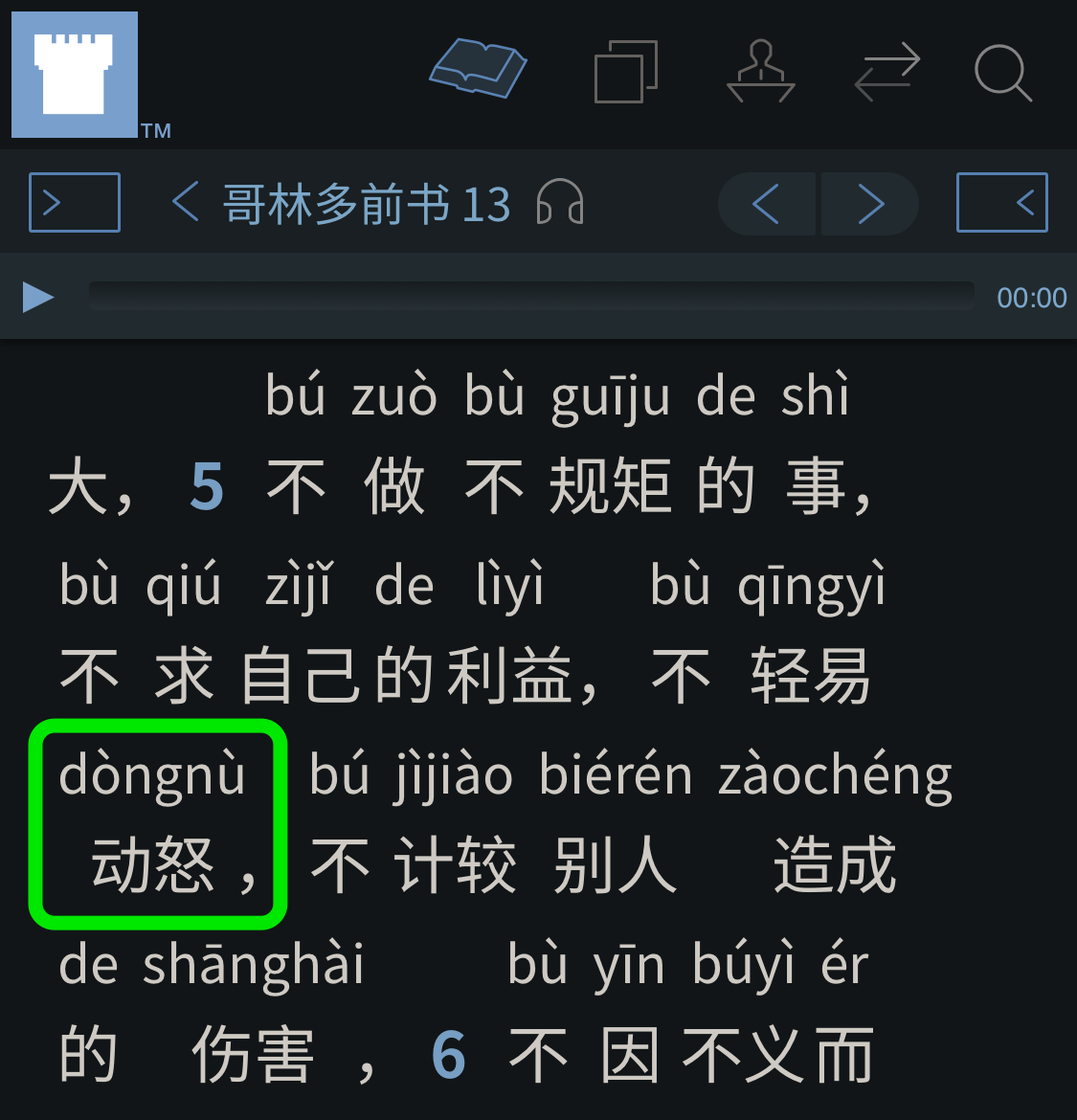
This week’s MEotW, “dòngnù (dòng·nù {have moved} · anger; rage; fury → [get angry; lose temper; fly into a rage] 动怒 動怒)”, is used in verse 5 (WOL) of 1 Corinthians 13:

Screenshot of “_dòngnù_” in 1 Co. 13:5 (nwtsty, CHS+_Pīnyīn_ WOL)

(Dark mode for the Watchtower ONLINE LIBRARY (WOL) website, as shown in the above image, can be enabled in the Safari web browser by using the Noir Safari extension. Other web browsers may also have extensions with similar functionality.)

For comparison, here are the current English and Pīnyīn (Pīn·yīn {Piecing Together of} · Sounds → [Pinyin] 拼音) Plus renderings of 1 Corinthians 13:5:

English:

does not behave indecently, does not look for its own interests, does not become provoked. It does not keep account of the injury.

Pīnyīn (Pīn·yīn {Piecing Together of} · Sounds → [Pinyin] 拼音) Plus:

📖 📄 📘 (not 不) zuò ({does do} 做) (not 不) guīju (guī·ju (following) {dividers → [rules]} · {carpenter’s squares → [regulations]} → [following established standards] 规矩 規矩) de ( 的) shì (things 事), (not 不) qiú ({does seek} 求) zìjǐ (self 自己) de (’s 的) lìyì (lì·yì {sharpening → [advantage]} · benefit → [benefit] 利益), (not 不) qīngyì (qīng·yì lightly · easily 轻易 輕易) dòngnù (dòng·nù {does have moved} · anger → [does get angry] 动怒 動怒), (not 不) jìjiào (jì·jiào {does count} · {does dispute about} 计较 計較) biéren (bié·ren other · people 别人 別人) zàochéng (zào·chéng {have created} · {to come to be} 造成) de (’s 的) shānghài (injuring → [injury] 伤害 傷害),

In the example above, the Mandarin phrase “bù (not 不) qīngyì (qīng·yì lightly · easily 轻易 輕易) dòngnù (dòng·nù {does have moved} · anger → [does get angry] 动怒 動怒) corresponds with the English phrase “does not become provoked”. As for the morphemes in “dòngnù (dòng·nù {have moved} · anger; rage; fury → [get angry; lose temper; fly into a rage] 动怒 動怒)”, they literally mean “have moved anger/rage/fury”, and effectively mean “get angry; lose one’s temper; fly into a rage”.

Angrily Holding On to Tradition

I remember more than one Mandarin field language learner who reacted angrily when I suggested that using Pīnyīn (Pīn·yīn {Piecing Together of} · Sounds → [Pinyin] 拼音) more and deemphasizing characters would help them progress in learning Mandarin. Rather than appreciating the evident truth of what I was saying, or being thankful that I was trying to help them, they seemed offended and upset that I had dared to suggest something so out of step with the human traditions that they had been taught all their lives, and, perhaps, indignant that I had, in their estimation, dismissed and invalidated the blood, sweat, and tears that they had personally invested for years and years into the long, hard, bitter struggle that is learning characters.

On the one hand, some may say that such reactions are only human, but on the other hand, the words of 1 Corinthians 13:5 that love “does not become provoked” show that actually, such ones are not completely acting out of Christian love when they react that way. As the Insight book says:

Love “does not become provoked.” It does not look for an occasion or an excuse for provocation. It is not moved to outbursts of anger, which is a work of the flesh. (Ga 5:19, 20) One having love is not easily offended by what others say or do. He is not afraid that his personal “dignity” may be injured.

Happily, not all Mandarin field language learners react as mentioned above. Rather than reacting out of personal indignation, cultural pride, traditionalism, and chauvinism, or the tribalism of the embattled few in “the club” who have long endured together the difficult burdens of dealing with the unnecessarily extraordinarily complex characters, even some long-time Mandarin field language learners who have worked hard for a long time to learn characters listen humbly to the information I share with them about the linguistic truths that apply to our Mandarin field language learning, and are appreciative that these truths help to set them free from the unnecessary burdens imposed by mere human tradition.—John 8:32.

Categories
Culture Experiences Science Technology Theocratic

ménwèi

ménwèi (mén·wèi door; gate; entrance · {guarding; defending (person)} 门卫 門衛) 👈🏼 Tap/click to show/hide the “flashcard”

[Notes: Tap/click on a Pīnyīn (Pīn·yīn {Piecing Together of} · Sounds → [Pinyin] 拼音) expression to reveal its “flashcard”; tap/click on a “flashcard” or its Pīnyīn (Pīn·yīn {Piecing Together of} · Sounds → [Pinyin] 拼音) expression to hide the “flashcard”. 📖 📄 📘 icons mean 📖 Reveal All, 📄 Reveal Advanced, and 📘 Reveal None re all the “flashcards” in the heading, paragraph, etc. that they are placed at the beginning of.]

We in the Mandarin field should keep in mind that many Mandarin-speaking people were taught to believe in evolution, and thus tend to not believe in God. The Shēngmìng Láizì Chuàngzào Ma? ((Shēngmìng Life 生命) (Lái·zì Came · From 来自 來自) (Chuàng·zào Initiating · {Making, Creating} → [Creating] 创造 創造) (Ma [? ptcl for “yes/no” questions])? [Was Life Created? (lc)]) (Was Life Created? (lc)) brochure and the Shēngmìng de Qǐyuán—Zhíde Sīkǎo de Wǔ Ge Wèntí ((Shēngmìng Life 生命) (de ’s 的) (Qǐ·yuán {Rising → [Starting]} · Source → [Origin] 起源/原)—(Zhí·de Worth · Getting → [Worth] 值得) (Sī·kǎo {Thinking About} · Examining 思考) (de ’s 的) (Wǔ Five 五) (Ge [mw]個/个) (Wèn·tí Asking · Subjects → [Questions] 问题 問題) [The Origin of Life—Five Questions Worth Asking (lf)]) (The Origin of Life—Five Questions Worth Asking (lf)) brochure were originally published back in 2010, but they are still considered current publications, and relatively recently, the English version of the Was Life Created? brochure was updated to the December 2022 Printing, and the Mandarin version of it was updated to the February 2023 Printing. So, it would be good for us to consider some of the expressions used in the Mandarin versions of the Was Life Created? and Origin of Life brochures, which can be so helpful when discussing whether life was created.

Access Restricted

This week’s MEotW, “ménwèi (mén·wèi door; gate; entrance · {guarding; defending (person)} 门卫 門衛)”, occurs starting in the 10th paragraph in the QUESTION 2 section of the Origin of Life brochure, which section is entitled, in English, “Is Any Form of Life Really Simple?”:

English:

Think again of a factory. It might have security guards who monitor the products that enter and leave through the doorways in the factory wall. Similarly, the cell membrane has special protein molecules embedded in it that act like the doors and the security guards.

The cell membrane has “security guards” that allow only specific substances to pass in or out

Mandarin (WOL, Pīnyīn (Pīn·yīn {Piecing Together of} · Sounds → [Pinyin] 拼音) Plus):

📖 📄 📘 Qǐng (please) xiǎngxiang (xiǎng·xiang {think about} · {think about} 想想) gōngchǎng (gōng·chǎng work · factory → [factory] 工厂 工廠) de (’s 的) qíngkuàng (situation 情况 情況). Yǒuxiē (Yǒu·xiē {(there) are having → [(there) are]} · some 有些) gōngchǎng (gōng·chǎng work · factories (that) → [factories (that)] 工厂 工廠) huì (will) yǒu (have 有) ménwèi (mén·wèi door/entrance · {guarding (persons)} 门卫 門衛) zài (at 在) wéiqiáng (wéi·qiáng enclosing · wall 围墙 圍牆) de (’s 的) rùkǒu (rù·kǒu {to be entered} · {mouths → [openings]} → [entrances] 入口) bǎshǒu (bǎ·shǒu {holding → [guarding]} · guarding → [guarding] 把守), jiānkòng (jiān·kòng supervising · controlling 监控 監控) huòwù (huò·wù product · things’ → [products’] 货物 貨物) jìn (entering)chū ({(and) coming out} 出). Tóngyàng (Tóng·yàng same · {pattern → [way]} 同样 同樣), xìbāo (xì·bāo tiny · womb → [cell] 细胞 細胞) (membrane 膜) shang (upon 上) xiāngqiànzhe (xiāngqiàn·zhe embedded · {are being} → [are embedded] 镶嵌着 鑲嵌着/著) yìxiē (yì·xiē one · {indefinite number of} → [some] 一些) tèbié (tè·bié special · differentiated → [special] 特别 特別) de (’s 的) dànbái‐zhì ((dàn·bái egg · white → [protein] 蛋白)‐(zhì substance) [protein]) fēnzǐ (fēn·zǐ {divided (off)} · {small and hard things} → [molecules] 分子), zhèixiē (zhèi·xiē this · {indefinite number of} → [these] 这些 這些) fēnzǐ (fēn·zǐ {divided (off)} · {small and hard things} → [molecules] 分子) (both 既) shì (are 是) mén (doors/entrances), (also 也) shì (are 是) ménwèi (mén·wèi door/entrance · {guarding (persons)} 门卫 門衛).


📖 📄 📘 Xìbāo (Xì·bāo tiny · womb → [cell] 细胞 細胞) (membrane 膜) yǒu (has 有) ménwèi (mén·wèi door/entrance · {guarding (persons)} 门卫 門衛)”, zhǐ (only只/秖/衹/祇) róngxǔ (róng·xǔ {containing → [allowing]} · allowing 容许 容許) mǒuxiē (mǒu·xiē certain · {indefinite number of} → [certain] 某些) tèdìng (tè·dìng specially · set 特定) de (’s 的) wùzhì (wù·zhì matter · substances → [substances] 物质 物質) jìn ({to enter into})chū ({(or) to come out of} 出) xìbāo (xì·bāo tiny · womb → [cell] 细胞 細胞)

As can be seen from the above, the Mandarin Origin of Life brochure uses “ménwèi (mén·wèi door; gate; entrance · {guarding; defending (person)} 门卫 門衛) to translate the English expression “security guards”.

Morphemes and Related Expressions

The morpheme “mén (door; gate; entrance; opening) in “ménwèi (mén·wèi door; gate; entrance · {guarding; defending (person)} 门卫 門衛) means “door; gate; entrance”. Other expressions in which it has this meaning include “kāimén (kāi·mén open · door [→ [(of a shop, etc.) open]] 开门 開門) (“open a door”; “(of a shop, etc.) open”) and “guānmén (guān·mén shut; close · door [→ [(of a shop, etc.) close]] 关门 關/関門) (“shut/close a door”; “(of a shop, etc.) close”). Of particular interest to us in the Mandarin field, “mén (door; gate; entrance; opening) also occurs in “méntú (mén·tú {school of thought} · disciple; follower 门徒 門徒) (“disciple; follower”), where it means “school of thought”. Another noteworthy use of “mén (door; gate; entrance; opening) is in the expression “zhuānmén (zhuān·mén [is] [(in)] special; specialized · {door → [class; category; branch of study | way]} → [[is] special; specialized; customized | specially; for a particular purpose] 专门 專門) (“special; specialized; customized”), in which it effectively means “class; category; branch of study” or “way”.

The “wèi (defending; guarding; protecting [(person) [→ [security guard]]]衛/衞) in “ménwèi (mén·wèi door; gate; entrance · {guarding; defending (person)} 门卫 門衛) effectively means “guarding/defending person”, from a basic meaning of “defend; guard; protect”. Other Mandarin expressions in which it appears include “bǎowèi (bǎo·wèi protect; defend; safeguard · guard; defend; protect 保卫 保衛/衞)”, “shìwèi (shì·wèi attending; serving · defending; guarding; protecting (person) → [[imperial] military bodyguard] 侍卫 侍衛)”, “shǒuwèi (guard; defend | {guarding; defending (person)} → [bodyguard] 守卫 守衛)”, and “wèishēng (wèi·shēng {defending/guarding/protecting of} · life → [hygiene; sanitation | hygienic] 卫生 衛/衞生)”. Incidentally, the character used to write this “wèi (defending; guarding; protecting [(person) [→ [security guard]]]衛/衞) appears in “Dàwèi (David 大卫 大衛) (“David”), but there it is used for how it sounds.

Security by Serendipity?

Our cells have molecule-sized security guards that help protect their proper functioning! This reminds us that even our simplest cells are highly complex, well-regulated systems. Similarly, a computer system may have security software, input validation code, etc. that seek to keep out malware and other kinds of digital stuff that doesn’t belong, in order to help the computer system keep running properly. Would anyone contend that any piece of security software could have evolved by chance? Let us learn how to reason with Mandarin-speaking people about how our cells and their “security guards” are even less likely to have evolved by chance.


For convenience:

The direct link for the current-generation Pīnyīn (Pīn·yīn {Piecing Together of} · Sounds → [Pinyin] 拼音) Plus resource for the Origin of Life brochure is:

The short link for Chinese field language-learning links for the Origin of Life brochure is:

More Pīnyīn (Pīn·yīn {Piecing Together of} · Sounds → [Pinyin] 拼音) and Pīnyīn (Pīn·yīn {Piecing Together of} · Sounds → [Pinyin] 拼音) Plus web material based on the Mandarin Origin of Life brochure will be made available in the Pīnyīn (Pīn·yīn {Piecing Together of} · Sounds → [Pinyin] 拼音) Plus web resource as time allows.