Categories
Culture Language Learning Science Technology Theocratic

mìmì

mìmì (mì·mì {[is] secret} · {[is] dense → [[is] intimate; close] → [[is] secret; confidential]} [(thing)] → [[is] secret; confidential; clandestine | secret [(thing)]] 秘密 秘/祕密) ← Tap/click to show/hide the “flashcard”

I have long especially liked 1 Corinthians 13. It contains counsel on what really does and doesn’t matter in life, an extensive description and definition of the most important kind of love, and a sublime discussion about the need to become complete, mature, as a person. As these apply to life in general, so too do they apply to our lives as Mandarin field language learners.

As Mandarin field language learners, it can benefit us greatly to consider what we can learn from 1 Corinthians 13, and along the way, we can also consider some of the Mandarin expressions used in that chapter in the current version of the Mandarin New World Translation Bible (nwtsty).

Secrets

This week’s MEotW, “mìmì (mì·mì {[is] secret} · {[is] dense → [[is] intimate; close] → [[is] secret; confidential]} [(thing)] → [[is] secret; confidential; clandestine | secret [(thing)]] 秘密 秘/祕密), is used in verse 2 (WOL, Pīnyīn (Pīn·yīn {Piecing Together of} · Sounds → [Pinyin] 拼音) Plus) of 1 Corinthians 13:
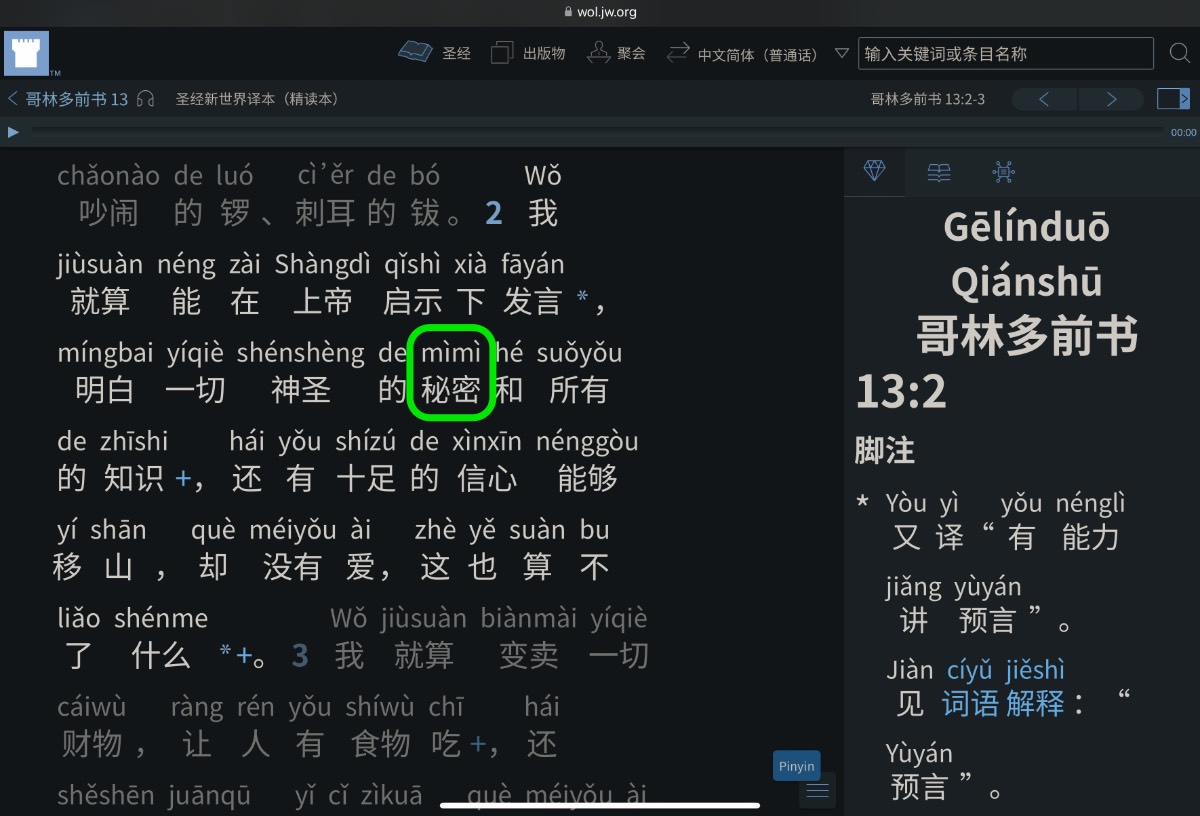
Screenshot of “mìmì” in 1 Co. 13:2 (nwtsty, CHS+_Pīnyīn_ WOL)

(Dark mode for the Watchtower ONLINE LIBRARY (WOL) website, as shown in the above image, can be enabled in the Safari web browser by using the Noir Safari extension.)

While the two morphemes in “mìmì (mì·mì {[is] secret} · {[is] dense → [[is] intimate; close] → [[is] secret; confidential]} [(thing)] → [[is] secret; confidential; clandestine | secret [(thing)]] 秘密 秘/祕密) sound the same, they are different morphemes, with different meanings. The first one, “mì ({secret (n)} [→ [secretary (abbr.)]] | {[is] secret; mysterious; difficult to understand; obscure} [→ [[is] seldom seen; rare]] | {keep sth. secret; hold sth. back} [→ [block; obstruct]]秘/祕), here means “secret” (used as an adjective). Interestingly, this “mì ({secret (n)} [→ [secretary (abbr.)]] | {[is] secret; mysterious; difficult to understand; obscure} [→ [[is] seldom seen; rare]] | {keep sth. secret; hold sth. back} [→ [block; obstruct]]秘/祕) also appears in “mìshū (mì·shū secret · documents (person) → [secretary] 秘书 秘書), which means “secretary”, and it can be used as an abbreviation for “secretary”. (Yes, in both English and Mandarin, the word for “secretary” is based on the word for “secret”. So, be nice to office secretaries, congregation secretaries, etc. everywhere, since they are literally keepers of secrets!)

The second morpheme in “mìmì (mì·mì {[is] secret} · {[is] dense → [[is] intimate; close] → [[is] secret; confidential]} [(thing)] → [[is] secret; confidential; clandestine | secret [(thing)]] 秘密 秘/祕密), “mì ({[is] dense; thick} [[→ [[is] intimate; close] [→ [[is] secret; confidential]]] | [→ [[is] fine; meticulous]]] 密), literally means “dense; thick”, and can effectively mean “intimate; close”. (Compare the English expression “thick as thieves”.) That meaning, in turn, can effectively mean “secret” (used as an adjective), which is how it is used in “mìmì (mì·mì {[is] secret} · {[is] dense → [[is] intimate; close] → [[is] secret; confidential]} [(thing)] → [[is] secret; confidential; clandestine | secret [(thing)]] 秘密 秘/祕密). Another expression in which it’s used that way is “mìmǎ (mì·mǎ {dense → [intimate] → [secret]} · {sth. indicating a number} → [cipher; code | password; PIN] 密码 密碼), which can mean “code”. For example, the Mandarin Was Life Created? brochure uses “yíchuán (yí·chuán {leaving behind} · {passing on} → [genetic] 遗传 遺傳) mìmǎ (mì·mǎ {dense → [intimate] → [secret]} · {sth. indicating a number} → [code] 密码 密碼) to translate “genetic code”. (Compare: English WOL, CHS+Pīnyīn (Pīn·yīn {Piecing Together of} · Sounds → [Pinyin] 拼音) WOL, Pīnyīn (Pīn·yīn {Piecing Together of} · Sounds → [Pinyin] 拼音) Plus.)

Exotic East Syndrome

Speaking of secrets, some may be fascinated by the seemingly secret knowledge of the Chinese characters. However, 1 Corinthians 13:2 tells us that even understanding “all the sacred secrets and all knowledge” means nothing if one does not have love, and while Chinese characters may seem alluringly secret and mysterious to those looking on from outside the culture, they certainly are not sacred. Only things from God are sacred, and Chinese characters are the unnecessarily complex, haphazardly designed, highly imperfect products of mere imperfect humans.

And if I have the gift of prophecy and understand all the sacred secrets and all knowledge, and if I have all the faith so as to move mountains, but do not have love, I am nothing.
1 Corinthians 13:2.

Regarding this tendency of some to exoticize Chinese characters and other aspects of Chinese culture, the MEotW post on “jī‐tóng‐yā‐jiǎng ((jī chicken雞/鷄)‐(tóng {together with}同/仝)‐(yā duck)‐(jiǎng speaking) [people not understanding each other because of speaking different languages (from Cantonese)]) pointed out:

Western-educated publishers learning a Chinese language may unwittingly go along with the Western worldly tendency to exoticize things related to China. (John DeFrancis, in his book The Chinese Language: Fact and Fantasy (p. 37), calls this “Exotic East Syndrome”.) They may be content with—or even enjoy—the alluring veil of mystery and mystique surrounding certain things related to China and Chinese culture. Thus, they don’t seek to learn about and understand deeper truths about such things, that may pierce through this obscuring veil, and burst this bubble.—Compare 2 Corinthians 3:14, including the margin note.

Secrets and Identities

It is of course possible for one to have a balanced approach to Chinese characters, in which love moves one to seek to acquire whatever knowledge of characters is needed to serve effectively in the Chinese field that one is in. Many take the approach of using a system like Pīnyīn (Pīn·yīn {Piecing Together of} · Sounds → [Pinyin] 拼音) when they can, and learning to use characters when they have to. However, regarding how personally and emotionally important to them their knowledge of the secrets of Chinese characters has become to some people, the article “Pīnyīn (Pīn·yīn {Piecing Together of} · Sounds → [Pinyin] 拼音) Was Plan A” said:

In addition to those who feel that phasing out the Hànzì would be a regrettable cultural loss, I have also noticed that there are some for whom knowledge of Hànzì is a matter of pride and self-identity. They are proud of knowing the Hànzì as they do, and they view their knowledge of the Hànzì as part of what makes them who they are, as something that distinguishes them from those who don’t know the Hànzì. Such ones may defend the Hànzì to the point of irrationality in the face of a more accessible alternative that would make them and their hard-earned knowledge of Hànzì less “special”, that would threaten to render worthless all of the blood, sweat, and tears they have invested into grappling with these “Chinese puzzles”. It’s as if they are saying, “That’s not fair! If I had to go through all this bitter hard work to learn characters before I could read and write Chinese, then everyone else has to too!”

…during the 2014 Stanford Commencement address, Bill Gates said:

If we have optimism, but we don’t have empathy, then it doesn’t matter how much we master the secrets of science, we’re not really solving problems—we’re just working on puzzles.

Mr. Gates’ above observation applies to the subject at hand in that while many enjoy trying to solve the puzzles presented by Chinese characters, and while many also enjoy being known for being good at solving these puzzles, empathy should move us to recognize that there are much bigger issues involved than just our personal enjoyment or glorification.

Yes, when even some worldly people can recognize the above points, we Christians should recognize even more the need to show love and empathy rather than being proud, self-glorifying, self-justifying, and self-serving. Also, we should be actively and determinedly following the course of true Christian love and empathy rather than just going along with others who are proud, self-glorifying, self-justifying, and self-serving. We should especially do so when we have scriptures such as this to guide us:

Knowledge puffs up, but love builds up.—1 Corinthians 8:1.

Love and AI

As touched on in the MEotW post on “réngōng (rén·gōng human · work → [artificial] 人工) zhìnéng (zhì·néng intelligence · ability → [intelligence] 智能), lately there has been much discussion in the media about the recent developments in AI (artificial intelligence). AI systems can now be given access to lots and lots of human knowledge, but I don’t think anyone can reasonably claim that modern AI systems have been taught to have love the way the Bible says we need to have love. And so, many continue to worry about AIs falling out of alignment with humans and maybe even harming humans, maybe even to the point of extinction. Yes, as God’s Word pointed out long ago in 1 Corinthians 13:2, if one has much knowledge, even of secrets, but does not have love (Greek: a·gaʹpe), it is ultimately of no benefit. Indeed, without love to guide its use, that knowledge could actually be used to bring great harm!

Categories
Science Technology Theocratic

tūbiàn

tūbiàn (tū·biàn {chimney → [dashing forward] → [sudden[ly]; unexpected[ly]]} · changing [→ [mutation]] 突变 突變) ← Tap/click to show/hide the “flashcard”

[Notes: Tap/click on a Pīnyīn (Pīn·yīn {Piecing Together of} · Sounds → [Pinyin] 拼音) expression to reveal its “flashcard”; tap/click on a “flashcard” or its Pīnyīn (Pīn·yīn {Piecing Together of} · Sounds → [Pinyin] 拼音) expression to hide the “flashcard”. 📖 📄 📘 icons mean 📖 Reveal All, 📄 Reveal Advanced, and 📘 Reveal None re all the “flashcards” in the heading, paragraph, etc. that they are placed at the beginning of.]

The Shēngmìng Láizì Chuàngzào Ma? ((Shēngmìng Life 生命) (Lái·zì Came · From 来自 來自) (Chuàng·zào Initiating · {Making, Creating} → [Creating] 创造 創造) (Ma [? ptcl for “yes/no” questions])? [Was Life Created? (lc)]) (Was Life Created? (lc)) brochure and the Shēngmìng de Qǐyuán—Zhíde Sīkǎo de Wǔ Ge Wèntí ((Shēngmìng Life 生命) (de ’s 的) (Qǐ·yuán {Rising → [Starting]} · Source → [Origin] 起源/原)—(Zhí·de Worth · Getting → [Worth] 值得) (Sī·kǎo {Thinking About} · Examining 思考) (de ’s 的) (Wǔ Five 五) (Ge [mw]個/个) (Wèn·tí Asking · Subjects → [Questions] 问题 問題) [The Origin of Life​—Five Questions Worth Asking (lf)]) (The Origin of Life​—Five Questions Worth Asking (lf)) brochure were originally published back in 2010, but recently, the English version of the Was Life Created? brochure was updated to the December 2022 Printing, and the Mandarin version of it was updated to the February 2023 Printing. Also, the Was Life Created? brochure and the Origin of Life brochure are now in the Teaching Toolbox section in the JW Library app. So, it would be good to consider some of the expressions used in the Mandarin versions of these publications that can be so helpful when discussing whether life was created.

Myth 1

This week’s MEotW, which appears several times in the Mandarin Was Life Created? brochure, is “tūbiàn (tū·biàn {chimney → [dashing forward] → [sudden[ly]; unexpected[ly]]} · changing [→ [mutation]] 突变 突變), which is used to translate “mutation”. What is mutation? The English word “mutation” comes from a Latin word that means “to change”, so “a mutation” is basically a fancy way of saying “a change”, continuing a long tradtion in English of deriving words from Latin to represent scientific concepts (and computer programming concepts, etc.) that could be represented more simply with more common, already-existing English words. Wikipedia’s article on mutation provides this summary of how “mutation” is defined in the specific context of biology:

In biology, a mutation is an alteration in the nucleic acid sequence of the genome of an organism, virus, or extrachromosomal DNA.[source]

So, when considering the question of evolution vs. creation, a “mutation” is simply a change in something’s genetic code. Regarding how central mutation is to evolution theory, the Was Life Created? brochure says that mutation is the focus of what it calls Myth 1 about evolution:

English:

Myth 1. Mutations provide the raw materials needed to create new species.

Mandarin:

📖 📄 📘 Jiǎshè (Jiǎ·shè Artificial · {Setting Up} → [Hypothesis] 假设 假設) 1. Tūbiàn (Tū·biàn {chimney → [dashing forward] → [sudden]} · changings → [mutations] 突变 突變) néng (can 能) wèi (for為/爲) xīn (new 新) wùzhǒng (wù·zhǒng {thing → [creature]} · species → [species] 物种 物種) de ( 的) xíngchéng (xíng·chéng forming · {to come to be} 形成) tígōng (tí·gōng {carry (hanging down from the hand) → [raise]} · provide 提供) jīchǔ (jī·chǔ foundation · base 基础 基礎).

How the Expression Breaks Down

The “tū (chimney [→ [sticking out | dashing forward [→ [sudden[ly]; unexpected[ly]]]]] 突) in “tūbiàn (tū·biàn {chimney → [dashing forward] → [sudden[ly]; unexpected[ly]]} · changing [→ [mutation]] 突变 突變) literally means, oddly enough, “chimney”. Based on this traditional literal meaning, “tū (chimney [→ [sticking out | dashing forward [→ [sudden[ly]; unexpected[ly]]]]] 突) can be used to mean “dashing forward”, which in turn can be used to mean “sudden” or “suddenly” (presumably like a chimney seems to suddenly dash forward out of the roof of a house). This is apparently the meaning that’s used in “tūbiàn (tū·biàn {chimney → [dashing forward] → [sudden]} · changing → [mutation] 突变 突變), since genetic mutations are generally not planned or expected, and thus seem, from our human point of view, to appear suddenly. Probably related to this, another expression in which “tū (chimney [→ [sticking out | dashing forward [→ [sudden[ly]; unexpected[ly]]]]] 突) appears is “tūrán (tū·rán {chimney → [dashing forward] → [sudden[ly]; abrupt[ly]]} · {-ly | like that} 突然), which means “suddenly; abruptly”.

As for the “biàn ({change; transform [into]}) in “tūbiàn (tū·biàn {chimney → [dashing forward] → [sudden[ly]; unexpected[ly]]} · changing [→ [mutation]] 突变 突變), it’s a well-known expression that means “change”. Another expression in which it appears is the well-known expression “gǎibiàn (changing 改变 改變). It also occurs in the expression “biànyì (biàn·yì changed · {to be different} 变异 變異), which is used in the Was Life Created? brochure, for example, in this caption of a picture in the section entitled “Evolution​—Myths and Facts” (linked to above):

English:

Mutations can introduce changes in plants​—such as this mutant with large flowers—​but only within limits

Mandarin:

📖 📄 📘 Tūbiàn (Tū·biàn {chimney → [dashing forward] → [sudden]} · changings → [mutations] 突变 突變) néng (can 能) shǐ (cause 使) zhíwù (zhí·wù planted · things → [plants] 植物) fāshēng (fā·shēng {to issue forth} · {to make to come to life} → [to have happen] 发生 發生) biànyì (biàn·yì {being changed} · {to be different} 变异 變異), lìrú (lì·rú example · like → [for example] 例如) shǐ (causing 使) huāduǒ (huā·duǒ flowers · [mw for flowers, clouds, etc.] 花朵) zhǎngde (zhǎng·de {to grow} · {to get} 长得 長得) jiàodà (jiào·dà {being compared → [comparatively]} · {to be large} → [to be larger] 较大 較大), dàn (but 但) biànyì (biàn·yì (the) {being changed} · {to be different} 变异 變異) shì (is 是) yǒu (having 有) júxiàn (limitings → [limits] 局限) de ( 的)

It’s also noteworthy that “biàn ({change; transform [into]}) occurs in “biànzhǒng (biàn·zhǒng changed · kind; type; variety → [mutation; variant; variety | mutant] 变种 變種), which is used in the Was Life Created? brochure to mean “mutant”, for example, in this caption of another picture from the section entitled “Evolution​—Myths and Facts”:

English:

Mutant fruit flies, though malformed, are still fruit flies

Mandarin:

📖 📄 📘 Biànzhǒng (Biàn·zhǒng changed · kind → [mutant] 变种 變種) guǒyíng (guǒ·yíng fruit · flies 果蝇 果蠅) suīrán (suī·rán although · -ly 虽然 雖然) xíngzhuàng (forms 形状 形狀) bùtóng (bù·tóng not · {are the same} → [are different] 不同) le ({to completion} 了), dàn (yet 但) réngjiù (réng·jiù still · {(as in the) past} 仍旧 仍舊) shì (are 是) guǒyíng (guǒ·yíng fruit · flies 果蝇 果蠅)

How Myth 1 Breaks Down

As just the picture captions quoted above show, Myth 1 about evolution, that mutations can power evolution, is truly a myth, not a fact. Of course, the Was Life Created? brochure contains much related information in addition to just these quoted picture captions. Indeed, the Mandarin Was Life Created? brochure uses some interesting expressions in relation to the demonstrated erroneousness of this first myth concerning evolution. Perhaps this blog will consider one or more of these expressions in the future.


For convenience:

The direct link for the current generation Pīnyīn (Pīn·yīn {Piecing Together of} · Sounds → [Pinyin] 拼音) Plus resource for the Was Life Created? brochure is:

The short link for Chinese field language-learning links for the Was Life Created? brochure is:

More Pīnyīn (Pīn·yīn {Piecing Together of} · Sounds → [Pinyin] 拼音) and Pīnyīn (Pīn·yīn {Piecing Together of} · Sounds → [Pinyin] 拼音) Plus web material based on the Mandarin Was Life Created? brochure will be made available in the Pīnyīn (Pīn·yīn {Piecing Together of} · Sounds → [Pinyin] 拼音) Plus web resource as time allows. Work is now underway to produce a Pīnyīn (Pīn·yīn {Piecing Together of} · Sounds → [Pinyin] 拼音) Plus web resource for the Mandarin Origin of Life brochure as well.

Categories
Language Learning Science Technology Theocratic

wùzhǒng

wùzhǒng (wù·zhǒng {thing → [creature]} · species → [species] 物种 物種) ← Tap/click to show/hide the “flashcard”

The Shēngmìng Láizì Chuàngzào Ma? ((Shēngmìng Life 生命) (Lái·zì Came · From 来自 來自) (Chuàng·zào Initiating · {Making, Creating} → [Creating] 创造 創造) (Ma [? ptcl for “yes/no” questions])? [Was Life Created? (lc)]) (Was Life Created? (lc)) brochure and the Shēngmìng de Qǐyuán—Zhíde Sīkǎo de Wǔ Ge Wèntí ((Shēngmìng Life 生命) (de ’s 的) (Qǐ·yuán {Rising → [Starting]} · Source → [Origin] 起源/原)—(Zhí·de Worth · Getting → [Worth] 值得) (Sī·kǎo {Thinking About} · Examining 思考) (de ’s 的) (Wǔ Five 五) (Ge [mw]個/个) (Wèn·tí Asking · Subjects → [Questions] 问题 問題) [The Origin of Life​—Five Questions Worth Asking (lf)]) (The Origin of Life​—Five Questions Worth Asking (lf)) brochure were originally published back in 2010, but recently, the English version of the Was Life Created? brochure was updated to the December 2022 Printing, and the Mandarin version of it was updated to the February 2023 Printing. Also, the Was Life Created? brochure and the Origin of Life brochure are now in the Teaching Toolbox section in the JW Library app. So, it would be good to consider some of the expressions used in the Mandarin versions of these publications that can be so helpful when discussing whether life was created.

Feeling Unqualified?

Whether or not a Creator exists is one of the first questions that needs to be settled in order for one to make spiritual progress, and these days, much scientific or technical information, both accurate and inaccurate, is available in connection with this question. So, it would be good for us to try our best to get conversant with such scientific or technical information.

However, perhaps some hesitate to discuss scientific or technical subjects in their ministry (especially in their Mandarin ministry), because of feeling unqualified, or not “smart” enough. Even practising professionals in technical industries such as web or app development, etc., sometimes talk about being affected by impostor syndrome, so it wouldn’t be surprising if some of us in the Mandarin field who have neither been highly educated about science nor systematically trained on Mandarin may feel like impostors when confronting the prospect of speaking to people in Mandarin about scientific subjects.

The Bible contains many examples of ones who similarly felt unqualified to do what Jehovah directed them to do, such as Moses, Gideon, Amos, Jeremiah, etc. However, despite them feeling unqualified, Jehovah provided them with the help and support required for them to ultimately accomplish what he wanted them to accomplish. Also, David coming off victorious against Goliath is a classic example of someone who, because of Jehovah’s help, succeeded in spite of appearing unqualified from a human viewpoint.

The article “Do Not Limit Yourself​—Overcoming Feelings of Inadequacy”, from the November 2012 Kingdom Ministry, makes some good points that can help us if we feel unqualified to participate in some aspect of our God-given ministry. It’s focused on the Bible study activity in general, but the points it makes can also apply to, say, speaking to people in Mandarin about evolution and creation.

Related Mandarin Resources

Speaking of speaking to people in Mandarin about evolution and creation, helping us to do so is the official Pīnyīn (Pīn·yīn {Piecing Together of} · Sounds → [Pinyin] 拼音) material for the Shēngmìng Láizì Chuàngzào Ma? ((Shēngmìng Life 生命) (Lái·zì Came · From 来自 來自) (Chuàng·zào Initiating · {Making, Creating} → [Creating] 创造 創造) (Ma [? ptcl for “yes/no” questions])? [Was Life Created? (lc)]) (Was Life Created? (lc)) brochure and for the Shēngmìng de Qǐyuán—Zhíde Sīkǎo de Wǔ Ge Wèntí ((Shēngmìng Life 生命) (de ’s 的) (Qǐ·yuán {Rising → [Starting]} · Source → [Origin] 起源/原)—(Zhí·de Worth · Getting → [Worth] 值得) (Sī·kǎo {Thinking About} · Examining 思考) (de ’s 的) (Wǔ Five 五) (Ge [mw]個/个) (Wèn·tí Asking · Subjects → [Questions] 问题 問題) [The Origin of Life​—Five Questions Worth Asking (lf)]) (The Origin of Life​—Five Questions Worth Asking (lf)) brochure that Jehovah’s organization has made available. Also, some related unofficial 3-line and Pīnyīn (Pīn·yīn {Piecing Together of} · Sounds → [Pinyin] 拼音) Plus material is also available, as detailed at the tiandi.info/lc short link for Chinese language-learning resources for the Was Life Created? brochure. (Pīnyīn (Pīn·yīn {Piecing Together of} · Sounds → [Pinyin] 拼音) Plus material and a short link for the Origin of Life brochure are also in the works.)

This blog will also seek to help out by occasionally discussing expressions that appear in the Mandarin versions of the Was Life Created? brochure and the Origin of Life brochure. One such expression is this week’s MEotW, “wùzhǒng (wù·zhǒng {thing → [creature]} · species → [species] 物种 物種), which is used to translate the English word “species”.

Species and Kinds in Mandarin

First, what does “species” even mean in English? One dictionary gives this definition:

Biology A group of closely related organisms that are very similar to each other and are usually capable of interbreeding and producing fertile offspring.

Now, consider this footnote in the Was Life Created? brochure that discusses how “species” compares to the term “kind” that’s used in the Bible’s Genesis account:

While the word “species” is used frequently in this section, it should be noted that this term is not found in the Bible book of Genesis. There we find the term “kind,” which is much broader in meaning. Often, what scientists choose to call the evolution of a new species is simply a matter of variation within a “kind,” as the word is used in the Genesis account.

With the above in mind, note that the Was Life Created? brochure (Mandarin version © 2010, 2023-02 Printing) uses “wùzhǒng (wù·zhǒng {thing → [creature]} · species → [species] 物种 物種) to translate “species”, and it uses the “lèi ({kind; type; class; category; genus [of]} | {resemble; be similar to}) in “rénlèi (rén·lèi human/man·kind 人类 人類) to translate “kinds”, as referred to in the Bible book of Genesis.

In comparison, worldly dictionaries like those that can be viewed in the Pleco app join the Was Life Created? brochure in presenting Wùzhǒng Qǐyuán ((Wù·zhǒng {Thing → [Creature]} · Species’ → [Species’] 物种 物種) (Qǐ·yuán {Rising → [Starting]} · Source → [Origin] 起源/原) [Origin of Species]) as the Mandarin translation of “Origin of Species”, the famous book by Charles Darwin. Also, note that in the Mandarin translation of this passage:

The Bible word “kinds” is not a scientific term, but it seems to refer to broad divisions of life-forms. Thus, a single “kind” may include many species or varieties.

the 2021 Awake, No. 3 uses “zhǒnglèi (zhǒng·lèi {{species [of]} | {seed; strain; breed [of]} | {type [of]}; {kind [of]}} · {kind; type; class; category; genus [of]} 种类 種類) to translate “species”, and it follows the current Mandarin New World Translation Bible (nwtsty) in using “lèibié (lèi·bié kind; type; class; category; genus · differentiated → [classification; category; kind] 类别 類別) to translate “kinds”. (Compare Genesis 1:24, 25 in English and Mandarin.) Also, in case you ever encounter “pǐnzhǒng (pǐn·zhǒng product · variety → [breed; strain; variety] 品种 品種)”, that’s what this issue of Awake! uses to translate “varieties”.


For convenience:

The direct link for the current generation Pīnyīn (Pīn·yīn {Piecing Together of} · Sounds → [Pinyin] 拼音) Plus resource for the Was Life Created? brochure is:

The short link for Chinese field language-learning links for the Was Life Created? brochure is:

More Pīnyīn (Pīn·yīn {Piecing Together of} · Sounds → [Pinyin] 拼音) and Pīnyīn (Pīn·yīn {Piecing Together of} · Sounds → [Pinyin] 拼音) Plus web material based on the Mandarin Was Life Created? brochure will be made available in the Pīnyīn (Pīn·yīn {Piecing Together of} · Sounds → [Pinyin] 拼音) Plus web resource as time allows. Work is now underway to produce a Pīnyīn (Pīn·yīn {Piecing Together of} · Sounds → [Pinyin] 拼音) Plus web resource for the Mandarin Origin of Life brochure as well.