Categories
Culture History Language Learning Science Technology Theocratic

shēngjī‐bóbó

shēngjī (shēng·jī life · {mechanism → [being organic]} → [life] 生机 生機)bóbó (bó·bó flourishing; thriving; vigorous · flourishing; thriving; vigorous 勃勃) 👈🏼 Tap/click to show/hide the “flashcard”

[Notes: Tap/click on a Pīnyīn (Pīn·yīn {Piecing Together of} · Sounds → [Pinyin] 拼音) expression to reveal its “flashcard”; tap/click on a “flashcard” or its Pīnyīn (Pīn·yīn {Piecing Together of} · Sounds → [Pinyin] 拼音) expression to hide the “flashcard”. 📖 📄 📘 icons mean 📖 Reveal All, 📄 Reveal Advanced, and 📘 Reveal None re all the “flashcards” in the heading, paragraph, etc. that they are placed at the beginning of.]

The Shēngmìng Láizì Chuàngzào Ma? ((Shēngmìng Life 生命) (Lái·zì Came · From 来自 來自) (Chuàng·zào Initiating · {Making, Creating} → [Creating] 创造 創造) (Ma [? ptcl for “yes/no” questions])? [Was Life Created? (lc)]) (Was Life Created? (lc)) brochure and the Shēngmìng de Qǐyuán—Zhíde Sīkǎo de Wǔ Ge Wèntí ((Shēngmìng Life 生命) (de ’s 的) (Qǐ·yuán {Rising → [Starting]} · Source → [Origin] 起源/原)—(Zhí·de Worth · Getting → [Worth] 值得) (Sī·kǎo {Thinking About} · Examining 思考) (de ’s 的) (Wǔ Five 五) (Ge [mw]個/个) (Wèn·tí Asking · Subjects → [Questions] 问题 問題) [The Origin of Life—Five Questions Worth Asking (lf)]) (The Origin of Life—Five Questions Worth Asking (lf)) brochure were originally published back in 2010, but relatively recently, the English version of the Was Life Created? brochure was updated to the December 2022 Printing, and the Mandarin version of it was updated to the February 2023 Printing. Also, the Was Life Created? brochure and the Origin of Life brochure are now in the Teaching Toolbox section in the JW Library app. So, it would be good to consider some of the expressions used in the Mandarin versions of these publications that can be so helpful when discussing whether life was created.

“Living”

This week’s MEotW, which appears in the title of one of the sections of the Mandarin Was Life Created? brochure, is “shēngjī (shēng·jī life · {mechanism → [being organic]} → [life] 生机 生機)bóbó (bó·bó flourishing; thriving; vigorous · flourishing; thriving; vigorous 勃勃)”:

English:

The Living Planet

Mandarin (WOL; Pīnyīn (Pīn·yīn {Piecing Together of} · Sounds → [Pinyin] 拼音) Plus)

📖 📄 📘 Shēngjī (Shēng·jī Life · {Mechanism → [Being Organic]} → [Life] 生机 生機)Bóbó (Bó·bó Flourishing · Flourishing 勃勃) de (’s 的) Dìqiú (Dì·qiú Earth · Globe 地球)

As can be seen from the above quotes, the Mandarin Was Life Created? brochure uses “shēngjī (shēng·jī life · {mechanism → [being organic]} → [life] 生机 生機)bóbó (bó·bó flourishing; thriving; vigorous · flourishing; thriving; vigorous 勃勃) to effectively mean “living”. Considering the morphemes in it, this expression could also be translated as “brimming with life”, or something similar.

Mechanisms, Organisms, and Crises

The “jī ({machine; mechanism [→ [airplane; aircraft | being organic]]} | {incipient moment; crucial point} | chance; opportunity; occasion | intention; idea機/机) in “shēngjī (shēng·jī life · {mechanism → [being organic]} → [life] 生机 生機)bóbó (bó·bó flourishing; thriving; vigorous · flourishing; thriving; vigorous 勃勃) is a particularly polysemous morpheme, meaning that it has many possible related meanings. For example, it can literally mean “mechanism”, and it can effectively mean “organic”. This seems to indicate that worldly Chinese culture recognizes that living things contain what are effectively mechanisms. Indeed, scientists (and Jehovah’s organization) speak of the molecular machines inside living cells.

A computer-animated visualization of how tiny molecular machines inside our cells copy DNA

The “jī ({machine; mechanism [→ [airplane; aircraft | being organic]]} | {incipient moment; crucial point} | chance; opportunity; occasion | intention; idea機/机) in “shēngjī (shēng·jī life · {mechanism → [being organic]} → [life] 生机 生機)bóbó (bó·bó flourishing; thriving; vigorous · flourishing; thriving; vigorous 勃勃) also appears in the Mandarin expression for “crisis”, “wēijī (wēi·jī {ridge of a roof → [dangerous | endangering]} · {incipient moment; crucial point | occasion} | {(for) ridge of a roof → [(for) danger]} · occasion; opportunity → [crisis] 危机 危機)”, which some have misconstrued as meaning that there is positive opportunity in danger. For more information about that, check out the MEotW post discussing that expression.

Reduplications and Idioms

The latter half of “shēngjī (shēng·jī life · {mechanism → [being organic]} → [life] 生机 生機)bóbó (bó·bó flourishing; thriving; vigorous · flourishing; thriving; vigorous 勃勃) is an example of reduplication, which is quite common in Mandarin. Another expression which features reduplication is past MEotW “rénxīn (rén·xīn people’s · hearts → [popular/public feeling] 人心)huánghuáng (huáng·huáng {being afraid; fearful; scared; frightened [→ [being anxious; uneasy; nervous]]} · {being afraid; fearful; scared; frightened [→ [being anxious; uneasy; nervous]]} 惶惶)”, which has a similar structure to that of “shēngjī (shēng·jī life · {mechanism → [being organic]} → [life] 生机 生機)bóbó (bó·bó flourishing; thriving; vigorous · flourishing; thriving; vigorous 勃勃)”.

Speaking of structure, the MEotW post on “rénxīn (rén·xīn people’s · hearts → [popular/public feeling] 人心)huánghuáng (huáng·huáng {being afraid; fearful; scared; frightened [→ [being anxious; uneasy; nervous]]} · {being afraid; fearful; scared; frightened [→ [being anxious; uneasy; nervous]]} 惶惶) said the following about whether expressions like “rénxīn (rén·xīn people’s · hearts → [popular/public feeling] 人心)huánghuáng (huáng·huáng {being afraid; fearful; scared; frightened [→ [being anxious; uneasy; nervous]]} · {being afraid; fearful; scared; frightened [→ [being anxious; uneasy; nervous]]} 惶惶) and “shēngjī (shēng·jī life · {mechanism → [being organic]} → [life] 生机 生機)bóbó (bó·bó flourishing; thriving; vigorous · flourishing; thriving; vigorous 勃勃) qualify as chéngyǔ (chéng·yǔ {(things that) have become} · sayings → [set phrases (typically of 4 characters)] 成语 成語):

Considering its structure, we can say that “rénxīn (rén·xīn people’s · hearts → [popular/public feeling] 人心)huánghuáng (huáng·huáng {being afraid; fearful; scared; frightened [→ [being anxious; uneasy; nervous]]} · {being afraid; fearful; scared; frightened [→ [being anxious; uneasy; nervous]]} 惶惶) is an idiom. However, it does not seem to be a chéngyǔ (chéng·yǔ {(sth. that) has become} · saying → [set phrase (typically of 4 characters); idiom] 成语 成語). This excerpt from the MEotW post on “chéngyǔ (chéng·yǔ {(sth. that) has become} · saying → [set phrase (typically of 4 characters); idiom] 成语 成語) discusses the difference:

So, it appears that while chéngyǔ (chéng·yǔ {(things that) have become} · sayings → [set phrases (typically of 4 characters); idioms] 成语 成語) can be called idioms in English, not all Chinese idioms are chéngyǔ (chéng·yǔ {(things that) have become} · sayings → [set phrases (typically of 4 characters); idioms] 成语 成語). It seems that “chéngyǔ (chéng·yǔ {(things that) have become} · sayings → [set phrases (typically of 4 characters); idioms] 成语 成語)” specifically refers to Chinese idioms that originated in Classical Chinese, or Literary Chinese. This writing style has largely been replaced by written vernacular Chinese, which has been the standard style of writing for Modern Standard Mandarin for about a century now.

Since they originated in Classical Chinese, which hasn’t been current for about a century, chéngyǔ (chéng·yǔ {(things that) have become} · sayings → [set phrases (typically of 4 characters); idioms] 成语 成語) often cannot be fully understood by modern speakers and readers of Mandarin, since knowledge about the source material for chéngyǔ (chéng·yǔ {(things that) have become} · sayings → [set phrases (typically of 4 characters); idioms] 成语 成語) has naturally been fading with the passing of time.

Lots and Lots of Life

Whether or not “shēngjī (shēng·jī life · {mechanism → [being organic]} → [life] 生机 生機)bóbó (bó·bó flourishing; thriving; vigorous · flourishing; thriving; vigorous 勃勃) is a chéngyǔ (chéng·yǔ {(sth. that) has become} · saying → [set phrase (typically of 4 characters); idiom] 成语 成語), it’s certainly appropriate for describing an earth that is well-suited for, and that is filled with, a huge variety of exquisitely designed living things. It is fitting that the Was Life Created? brochure quotes Psalm 104:24 in this regard:

How many your works are, O Jehovah!
You have made all of them in wisdom.
The earth is full of what you have made.


For convenience:

The direct link for the current-generation Pīnyīn (Pīn·yīn {Piecing Together of} · Sounds → [Pinyin] 拼音) Plus resource for the Was Life Created? brochure is:

The short link for Chinese field language-learning links for the Was Life Created? brochure is:

More Pīnyīn (Pīn·yīn {Piecing Together of} · Sounds → [Pinyin] 拼音) and Pīnyīn (Pīn·yīn {Piecing Together of} · Sounds → [Pinyin] 拼音) Plus web material based on the Mandarin Was Life Created? brochure will be made available in the Pīnyīn (Pīn·yīn {Piecing Together of} · Sounds → [Pinyin] 拼音) Plus web resource as time allows.

Categories
Culture Language Learning Science Technology Theocratic

róngyào

róngyào (róng·yào glory; honour · {being bright; dazzling; brilliant; shining → [honour; glory]} → [glory; honour] | glorify · {to be bright; dazzling; brilliant; shining → [to be glorious]} → [glorify] | honourable; glorious · {bright; dazzling; brilliant; shining → [glorious]} → [honourable; glorious] 荣耀 榮耀) 👈🏼 Tap/click to show/hide the “flashcard”

Rather than dismissively thinking to ourselves that the songs produced by the organization are “just songs”, we should remember that the slave class takes seriously its responsibility to provide spiritual food to God’s people, and so it is going to make sure that the lyrics in its songs are spiritually correct, while also being emotionally moving.—Ezekiel 33:32; Matthew 24:45.

“Give Jehovah Glory”

“Róngyào” _Pīnyīn_ Plus info, Song 159 (music+_Pīnyīn_), on iPhone 13 mini (landscape orientation)

This week’s MEotW in the unofficial Pīnyīn (Pīn·yīn {Piecing Together of} · Sounds → [Pinyin] 拼音) Plus resource “Sing Out Joyfully” Bk. (Pīnyīn+Music, Pīnyīn Plus, Web)

This week’s MEotW, “róngyào (róng·yào glory; honour · {being bright; dazzling; brilliant; shining → [honour; glory]} → [glory; honour] | glorify · {to be bright; dazzling; brilliant; shining → [to be glorious]} → [glorify] | honourable; glorious · {bright; dazzling; brilliant; shining → [glorious]} → [honourable; glorious] 荣耀 榮耀)”, comes from the relatively new song 159, which is entitled “Give Jehovah Glory” in English and “Róngyào (Róng·yào Glory · {Being Shining → [Glory]} → [Glory] 荣耀 榮耀) Guīgěi (Guī·gěi {Give Back} · {to Be Given to} 归给 歸給) Yēhéhuá (Jehovah 耶和华 耶和華) in Mandarin (WOL, Pīnyīn (Pīn·yīn {Piecing Together of} · Sounds → [Pinyin] 拼音) Plus).

“Róngyào (Róng·yào glory; honour · {being bright; dazzling; brilliant; shining → [honour; glory]} → [glory; honour] | glorify · {to be bright; dazzling; brilliant; shining → [to be glorious]} → [glorify] | honourable; glorious · {bright; dazzling; brilliant; shining → [glorious]} → [honourable; glorious] 荣耀 榮耀) is flexible regarding what part of speech it can be—it can mean “glory; honour”, “glorify”, or “honourable; glorious”. In the Mandarin field, what kinds of glory should we be mindful of? Whom should we seek to glorify? What kind of glory is truly glorious?

“Glory from Men” Who Glorify Worldly Human Chinese Culture

Some in the Mandarin field may focus on gaining knowledge of Chinese characters so as to obtain glory from certain humans. Ones who do this are taking a different approach from that of Jesus, who said at John 5:41–44:

I do not accept glory from men, but I well know that you do not have the love of God in you. I have come in the name of my Father, but you do not receive me. If someone else came in his own name, you would receive that one. How can you believe, when you are accepting glory from one another and you are not seeking the glory that is from the only God?

Why do some humans heap praise and glory on those who have acquired extensive knowledge of Chinese characters? For one thing, Chinese characters are famously extraordinarily hard to learn and remember (unnecessarily so, actually), and so there is the natural glory given to those who have been able to accomplish a hard thing. Also, though, Chinese characters are glamourized by many as distinctive symbols of worldly human Chinese culture, and many are proud of them, and proud of worldly human Chinese culture. This is a big reason why traditional Mandarin language instruction and traditional Mandarin language teachers in general focus on Chinese characters so much and encourage Mandarin learners to prioritize them.

It is only natural for a student of Mandarin to want to receive glory from his teacher and others like him. Unfortunately, though, experience has shown that going along with a traditional Mandarin language teacher’s focus on characters may lead to a Mandarin learner actually being diverted into a deep rabbit hole and hindered from actually learning how speak Mandarin well. While such ones may, after many years of intense effort, come to be able to recognize many Chinese characters, they may not be able to, say, glorify Jehovah while speaking powerfully and persuasively to Mandarin-speaking people, the way Jesus spoke to people. (Mark 1:22) That’s because this traditional focus on characters has all along been mainly meant, not to help Mandarin learners actually learn to speak Mandarin, but to perpetuate and glorify worldly human Chinese culture.

Glory for Worldly Chinese Political Systems

In this world, certain aspects of Chinese culture can unfortunately get politicized. For example, Simplified characters and Pīnyīn (Pīn·yīn {Piecing Together of} · Sounds → [Pinyin] 拼音) were created in mainland China, so some may promote these systems so as to glorify the political system of mainland China. On the other hand, Traditional characters and Zhùyīn (Zhù·yīn {Annotating of} · Sounds → [Zhuyin] 注音 註/注音) continued to be used in Taiwan after the mainland pivoted away from them, so some may promote these systems so as to glorify the political system of Taiwan. Even the Mandarin expression that people use to refer to the Mandarin language (Guóyǔ (Guó·yǔ National · Language → [(Modern Standard) Mandarin (term commonly used in Taiwan)] 国语 國語)/pǔtōnghuà (pǔ·tōng·huà common; universal · {through(out) → [common]} · speech → [(Modern Standard) Mandarin (term commonly used in China)] 普通话 普通話)/Huáyǔ (Huá·yǔ {Magnificent; Splendid; Flowery; Florescent → [Chinese]} · Language → [(Modern Standard) Mandarin (term commonly used in Singapore)] 华语 華語)/etc.) can be made to take on political connotations. Of course, as Jehovah’s politically neutral servants, we must avoid doing things just to glorify one human political system over another.

Another thing that we Mandarin field language learners must beware of is the erroneous idea that Mandarin, Cantonese, Shanghainese, etc. are just “dialects” of “Chinese”. This misconception has been widely spread as political propaganda, to bolster the idea that China should be united under one political system. So, if we parrot that erroneous view regarding so-called Chinese “dialects” that in reality function like distinct languages, then we are actually parroting political propaganda that is designed to glorify China’s central government regardless of any confusion or other negative effects that may result from such spreading of falsehood.

Glory for Jehovah

Rather than allowing ourselves to be used to glorify humans or things in this worldly human system, we can show that we seek to glorify Jehovah, the God of truth. (John 17:17; 4:23, 24) One way we can do so in the Chinese language fields is by rejecting the many untruths that have been spread about the Chinese languages. Also, we can do so by seeking to choose and use systems and methods based on what really works best to help us to praise and glorify Jehovah, not based on what serves to glorify ourselves or worldly humans, and not based on what serves to perpetuate and glorify worldly human cultures, traditions, and political systems.

As Jesus’ words above showed, Jehovah gives “the glory that is from the only God” to those who seek to give glory to him, rather than to mere humans. So, let us follow song 159’s simple but profound admonition, and give glory to Jehovah!

Categories
Culture Language Learning Languages Science

yǔzú

yǔzú (yǔ·zú language · {ethnic group → [group of things with common characteristics] → [group]} 语族 語族) 👈🏼 Tap/click to show/hide the “flashcard”

[This reposting of a post that was originally posted on February 15, 2021 seems to be a fitting companion to the recent reposting of the post on “yǔxì (yǔ·xì language · {tied (things) → [system; family]} 语系 語系)”. It discusses the important basic issue of how Mandarin should be classified as a language, a subject about which much political and cultural propaganda has unfortunately been spread.]

While “language family” seems to be a commonly accepted linguistic term, there does not seem to be universal consensus on what terms to use for subdivisions of language families. This is suggested by the wording used in the Wikipedia article on language families, under the subheading “Structure of a family”:

Language families can be divided into smaller phylogenetic units, conventionally referred to as branches of the family because the history of a language family is often represented as a tree diagram. A family is a monophyletic unit; all its members derive from a common ancestor, and all attested descendants of that ancestor are included in the family. …

Some taxonomists restrict the term family to a certain level, but there is little consensus in how to do so. Those who affix such labels also subdivide branches into groups, and groups into complexes.

So, it seems that one common—but not universal—language classification scheme is:

  • family > branch > group > complex…

In contrast, noted American sinologist and University of Pennsylvania Professor of East Asian Languages and Civilizations Victor H. Mair, in his article “The Classification of Sinitic Languages: What Is ‘Chinese’?” (p. 749), sets out a slightly different language classification scheme:

  • family > group > branch > language > dialect

The Mandarin Word for “Language Group”

Regardless of whether we consider language families to be first subdivided into branches or into groups, an accepted and acceptable Mandarin translation for “language group” is this week’s MEotW, “yǔzú (yǔ·zú language · {ethnic group → [group of things with common characteristics] → [group]} 语族 語族)”, as Prof. Mair confirms in the article (p. 747) mentioned above.

If “ (clan; race; tribe; {ethnic group}; nationality [→ [class or group of things or people with common characteristics]] 族)” seems familiar, perhaps that is because it occurs in some fairly well-known scriptures. For example, the 2019 Edition of the Mandarin New World Translation Bible translates “every nation and tribe and tongue and people” in Revelation 14:6 as “měi (every 每) ge ([mw]個/箇/个) guózú (guó·zú national · {ethnic group} → [nation] 国族 國族), bùzú (bù·zú sectional · {ethnic group} → [tribe] 部族), yǔyán (yǔ·yán language · {(type of) speech} 语言 語言), (and 和) mínzú (mín·zú {(of) people} · {ethnic group} → [people] 民族)”.

The Mandarin Word for “Language Branch”

For reference, the Mandarin word for “language branch” is “yǔzhī (yǔ·zhī language · branch 语支 語支)”, as Prof. Mair confirms in the article (p. 747) mentioned above.

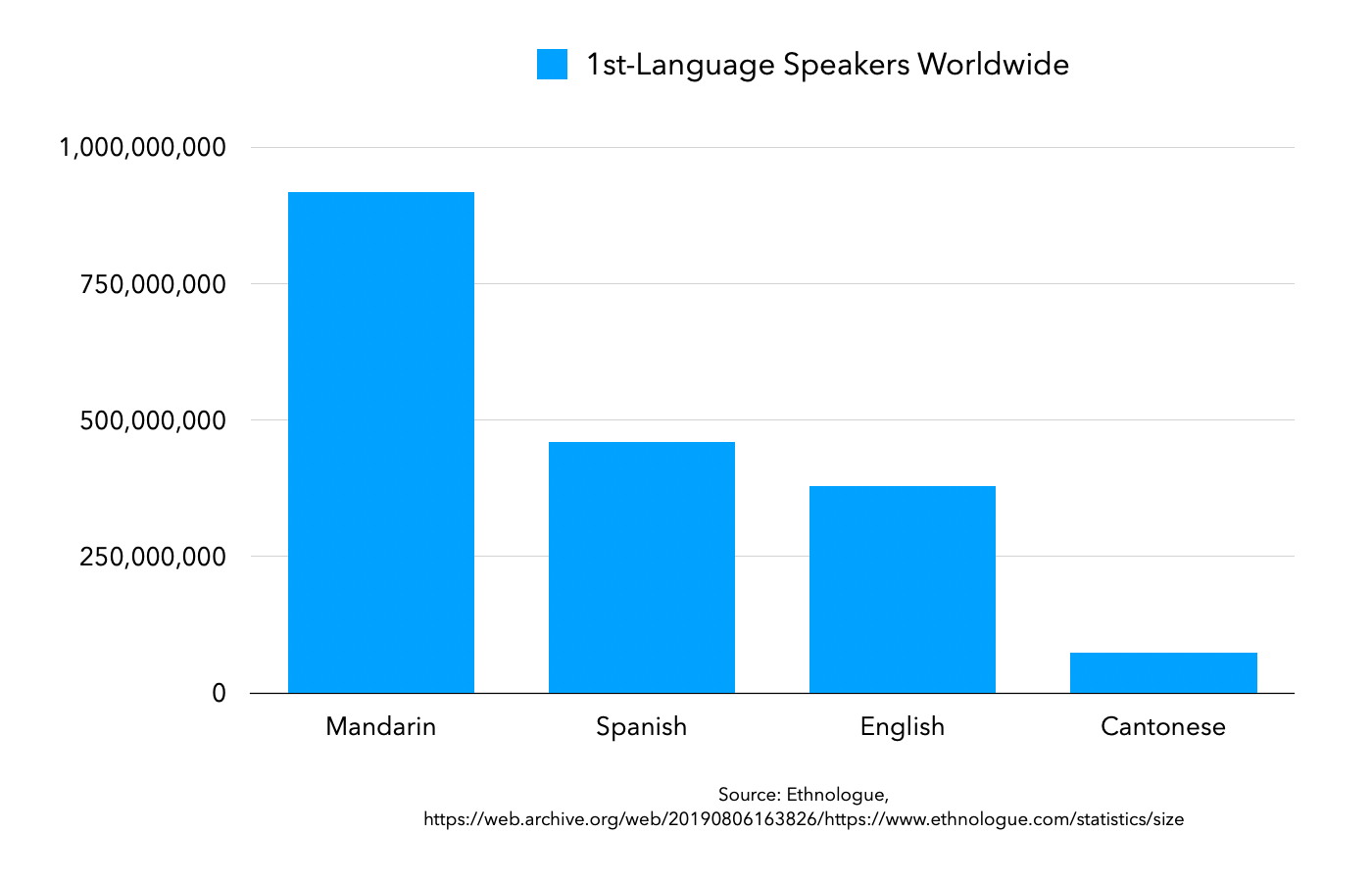
It’s interesting to note that according to Prof. Mair’s article (p. 737) mentioned above, not only are Mandarin and Cantonese separate languages (not just “dialects”), it would be more accurate to consider them to be in separate language branches, as defined by the language classisification scheme he uses:

Cantonese and Mandarin are separate languages. Cantonese is not a ‘dialect’ of Mandarin or of Hanyu, and it is grossly erroneous to refer to it as such. Since Cantonese and Mandarin are separate languages (or, perhaps more accurately, separate branches), it is wrong to refer to them as ‘dialects.’ The same holds for Hokkien, Shanghainese, and so forth.

That Mandarin and Cantonese should really be considered to be in separate language branches emphasizes to us politically neutral Mandarin field language learners that we must not repeat or be misled by the politically motivated erroneous assertion that Mandarin, Cantonese, Shanghainese, etc. are just dialects of “Chinese”. That might be even more wrong than saying that English, French, Spanish, etc. are just dialects of “European”!