Categories
Culture Experiences History Language Learning Names Science Theocratic

Gēlìyà

Gēlìyà (Go·liʹath 歌利亚 歌利亞) 👈🏼 Tap/click to show/hide the “flashcard”

A few years back, I wrote up a brief web page listing reasons for producing Pīnyīn (Pīn·yīn {Piecing Together of} · Sounds → [Pinyin] 拼音), etc. material for the Imitate (ia) book. Some, especially some who grew up in the West, may have felt that this book is made up of “just stories”, and ones that they were already quite familiar with, at that. However, we must remember that Chinese Bible students may often have a different perspective regarding the Bible accounts that are made to come to life in the Imitate book. As that web page said:

  • Many Chinese people in the world have not been exposed to Bible accounts the way many Westerners have.
  • Also, I have heard that some, perhaps many, Chinese Bible students tend to approach their Bible studies like intellectual exercises for accumulating chōuxiàng (abstract) head knowledge as if for a school exam, rather than as training for their hearts for their own real lives.

Later, the web page touches on how some of the real-world benefits of good storytelling like that found in the Imitate book involve empathy:

    • The actress Natalie Portman once said, “I love acting. I think it’s the most amazing thing to be able to do. Your job is practicing empathy. You walk down the street imagining every person’s life.”
  • The Imitate book helps build Bible students’ empathy towards Bible characters, which in turn helps Bible students realize that others would feel empathy towards them as well if they imitated these Bible characters—not everyone will just think they’re crazy, like many worldly friends or family members might think.

While even fictional stories can have the benefits described in the links and the quote above, true stories from the Bible can have even greater benefits, including spiritual ones.

Besides the Imitate book, another book from Jehovah’s organization that relates Bible accounts is the Learn From the Bible (lfb) book. The letter from the Governing Body in this book says that, similarly to the Imitate book, the Learn From the Bible book also “brings the Bible accounts to life and captures the feelings of those depicted”, while, unlike the Imitate book, it “tells the story of the human family from creation onward”. While the Learn From the Bible book is especially suitable for children, the letter from the Governing Body in this book says that “it can also be used to help adults who desire to learn more about the Bible”. So, it would be good to consider on this blog some of the expressions used in the Mandarin Learn From the Bible book.

Goliath, By the Sound of It

This week’s MEotW, “Gēlìyà (Go·liʹath 歌利亚 歌利亞)”, is the Mandarin version of the name “Goliath”. It is used in Lesson 40 of the Mandarin Learn From the Bible book, which is entitled “Dàwèi (David 大卫 大衛) Yǒngzhàn (Yǒng·zhàn Bravely · Fights 勇战 勇戰) Gēlìyà (Go·liʹath 歌利亚 歌利亞) (“David and Goliath”).

It is apparent that “Gēlìyà (Go·liʹath 歌利亚 歌利亞) was chosen to represent “Goliath” in Mandarin because of what it sounds like, not because of the meanings of the supposedly ideographic (representing meaning directly through visible symbols, bypassing speech) Chinese characters used to write it out (“Song Profit Inferior”??? 🤷🏻).

A Cultural Goliath in the Chinese World

In this world ruled by Satan, Chinese characters loom large in people’s minds, like a cultural and traditional Goliath. To Jehovah God, though, the Creator and Sovereign of the entire universe, Goliath was small and insignificant back in David’s time, and Chinese characters are small and insignificant today. Indeed, even though Chinese characters have been around for millenia and are the oldest writing system still in use among humans, to Jehovah, to whom ‘a thousand years is as one day’, characters have only been around for a few days!—2 Peter 3:8.

Don’t Submit to Goliath—Trust in Jehovah!

It may seem like we have no choice but to submit to Chinese characters, these seemingly mighty symbols of worldly Chinese culture, and give them the egregious amounts of time, energy, and devotion they demand. However, for us dedicated ones, our time, energy, and devotion belong to Jehovah, so we should spend them carefully, in ways that are worthwhile with regard to our efforts to glorify Jehovah and accomplish the urgent, life-saving work he has assigned to us.

Chinese characters are a ball and chain made of human tradition.

Back in David’s time, it may have seemed to the Israelites facing Goliath that they had no option but to become slaves to the Philistines, because who could defeat the mighty Goliath? However, rather than being intimidated by this abnormally large but still limited and imperfect human, David put Jehovah first and really trusted in him, resulting in Jehovah blessing his efforts and helping him to soundly and decisively defeat Goliath. And yes, besides trusting in Jehovah, David did also contribute his own efforts—he both prepared to battle Goliath (for example, by carefully selecting “five smooth stones from the streambed”, stones that would come off his sling and fly through the air smoothly), and also actually stepped up and fought this battle.—1 Samuel 17:40.

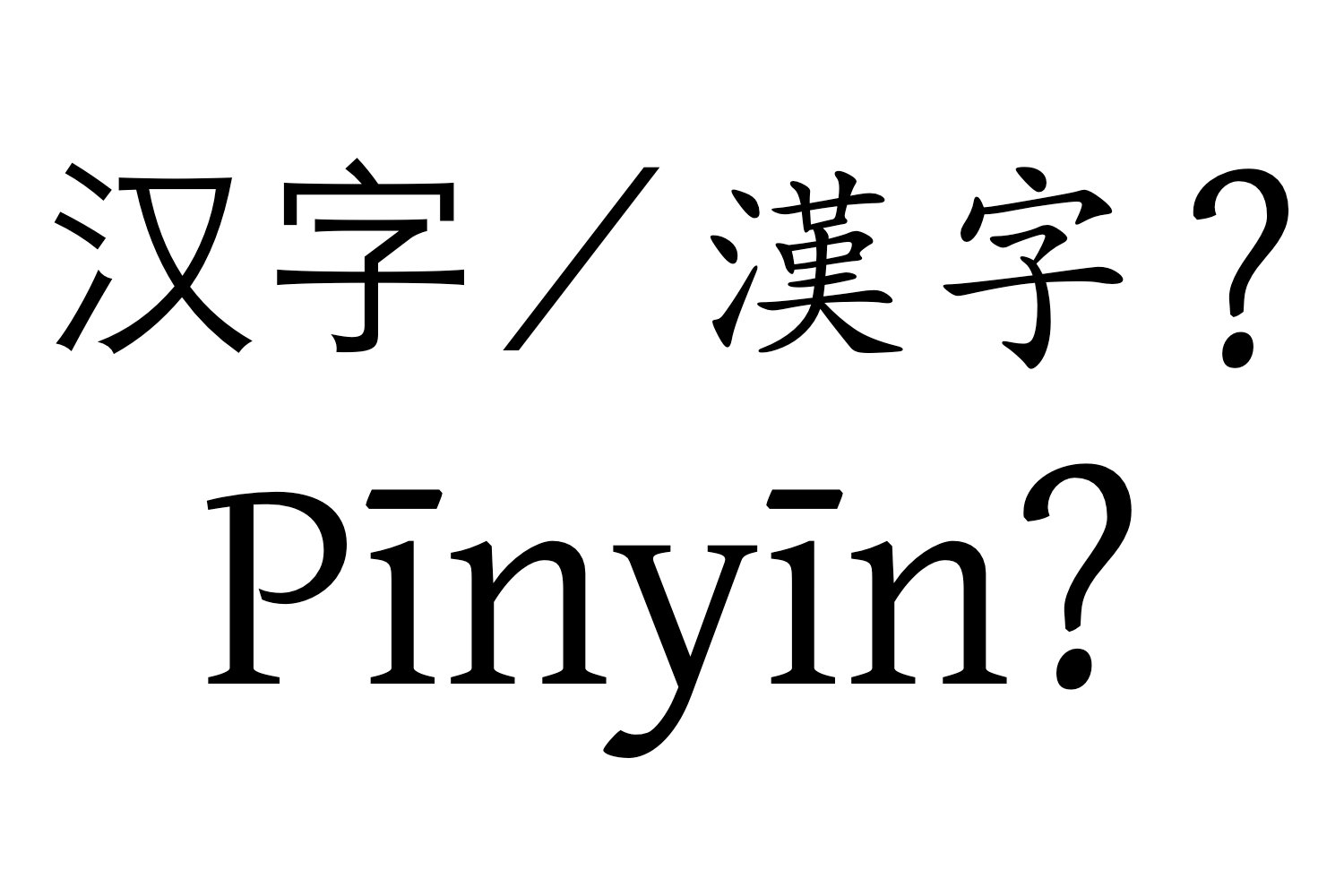
汉字 / 漢字? Pīnyīn?

Today, Pīnyīn (Pīn·yīn {Piecing Together of} · Sounds → [Pinyin] 拼音) can be one of our symbolic “smooth stones” that help us prepare for and successfully fight our personal battle to, with Jehovah’s help, defeat the cultural Goliath that is the characters, and learn to understand Mandarin and speak it understandably (and smoothly!) to the Mandarin-speaking people we meet in the field.


For convenience:

The direct link for the Pīnyīn (Pīn·yīn {Piecing Together of} · Sounds → [Pinyin] 拼音) Plus resource for the Learn From the Bible book is:

The short link for Chinese field language-learning links for the Learn From the Bible book is:

More Pīnyīn (Pīn·yīn {Piecing Together of} · Sounds → [Pinyin] 拼音) and Pīnyīn (Pīn·yīn {Piecing Together of} · Sounds → [Pinyin] 拼音) Plus web material based on the Mandarin Learn From the Bible book will be made available in the Pīnyīn (Pīn·yīn {Piecing Together of} · Sounds → [Pinyin] 拼音) Plus web resource as time allows.

Categories
Culture Language Learning Technology Theocratic

lìyì

lìyì (lì·yì {sharpening → [advantage; benefit; gain | profit; interest]} · benefit; advantage; profit → [benefit; profit] 利益) 👈🏼 Tap/click to show/hide the “flashcard”

[Notes: Tap/click on a Pīnyīn (Pīn·yīn {Piecing Together of} · Sounds → [Pinyin] 拼音) expression to reveal its “flashcard”; tap/click on a “flashcard” or its Pīnyīn (Pīn·yīn {Piecing Together of} · Sounds → [Pinyin] 拼音) expression to hide the “flashcard”. 📖 📄 📘 icons mean 📖 Reveal All, 📄 Reveal Advanced, and 📘 Reveal None re all the “flashcards” in the heading, paragraph, etc. that they are placed at the beginning of.]

I have long especially liked 1 Corinthians 13. It contains counsel on what really does and doesn’t matter in life, an extensive description and definition of the most important kind of love, and a sublime discussion about the need to become complete, mature, as a person. As these apply to life in general, so too do they apply to our lives as Mandarin field language learners.

As Mandarin field language learners, it can benefit us greatly to consider what we can learn from 1 Corinthians 13, and along the way, we can also consider some of the Mandarin expressions used in that chapter in the current version of the Mandarin New World Translation Bible (nwtsty).

“Lookin’ Out for #1”?

This week’s MEotW, “lìyì (lì·yì {sharpening → [advantage; benefit; gain | profit; interest]} · benefit; advantage; profit → [benefit; profit] 利益)”, is used in verse 5 (WOL) of 1 Corinthians 13:

Screenshot of “_lìyì_” in 1 Co. 13:5 (nwtsty, CHS+_Pīnyīn_ WOL)

(Dark mode for the Watchtower ONLINE LIBRARY (WOL) website, as shown in the above image, can be enabled in the Safari web browser by using the Noir Safari extension. Other web browsers may also have extensions with similar functionality.)

For comparison, here are the current English and Pīnyīn (Pīn·yīn {Piecing Together of} · Sounds → [Pinyin] 拼音) Plus renderings of 1 Corinthians 13:5:

English:

does not behave indecently, does not look for its own interests, does not become provoked. It does not keep account of the injury.

Pīnyīn (Pīn·yīn {Piecing Together of} · Sounds → [Pinyin] 拼音) Plus:

📖 📄 📘 (not 不) zuò ({does do} 做) (not 不) guīju (guī·ju (following) {dividers → [rules]} · {carpenter’s squares → [regulations]} → [following established standards] 规矩 規矩) de ( 的) shì (things 事), (not 不) qiú ({does seek} 求) zìjǐ (self 自己) de (’s 的) lìyì (lì·yì {sharpening → [advantage]} · benefit → [benefit] 利益), (not 不) qīngyì (qīng·yì lightly · easily 轻易 輕易) dòngnù (dòng·nù {does have moved} · anger → [does get angry] 动怒 動怒), (not 不) jìjiào (jì·jiào {does count} · {does dispute} 计较 計較) biéren (bié·ren other · people 别人 別人) zàochéng (zào·chéng {have created} · {to come to be} 造成) de (’s 的) shānghài (injuring → [injury] 伤害 傷害),

The “lì (sharpen [→ [do good [for/to]; be beneficial [for/to]]] | sharpened [→ [sharp | favourable; advantageous; good; beneficial; smooth; convenient]] | sharpening [→ [advantage; benefit; gain | profit; interest]] 利) in “lìyì (lì·yì {sharpening → [advantage; benefit; gain | profit; interest]} · benefit; advantage; profit → [benefit; profit] 利益) literally means “sharpening”, and can effectively mean “advantage; benefit; gain”. Similarly, the “yì (benefit; good; advantage; profit; increase | beneficial; profitable | {to increase; to benefit} 益) in “lìyì (lì·yì {sharpening → [advantage; benefit; gain | profit; interest]} · benefit; advantage; profit → [benefit; profit] 利益) means “benefit; advantage; profit”. We can see then, why in 1 Corinthians 13:5 in the current English and Mandarin versions of the New World Translation Bible, “bù (not 不) qiú ({does seek} 求) zìjǐ (self 自己) de (’s 的) lìyì (lì·yì {sharpening → [advantage]} · benefit → [benefit] 利益) corresponds with the English phrase “does not look for its own interests”.

In this regard, true Christian love is completely opposite from the norm in Satan’s world, which is the kind of self-interest and lovelessness that’s expressed by this excerpt from the lyrics of the song “Lookin’ Out for #1”:

Every night is a different game
We gotta work for our fortune and fame
Success is a ladder, take a step at a time
And the people will remember your name

Yes, I found out all the tricks of the trade
And that’s there’s only one way you’re gonna get things done
I found out the only way to the top
Is looking out for number one
And that’s me, I’m looking out for number one

Not Looking For Our Own Interests in the Mandarin Field

Unlike the self-seeking people of Satan’s world, Mandarin field language learners who seek to show Christian love must not view their language learning and ministry as just a game, nor should they be seeking fortune and fame, or success as defined by the world. And rather than wanting people to remember their names, they seek to proclaim Jehovah’s name. Rather than trying to get to the top, they try to help Mandarin-speaking people to get everlasting life. Yes, rather than looking out for number one (themselves), they exert themselves and make sacrifices to help others as spiritual rescue workers, and they seek to glorify, not themselves, but rather, Jehovah, as admonished by our recently introduced song “Give Jehovah Glory”.

To help us gain insight on how well we are doing when it comes to not looking for our own interests in the Mandarin field, we could consider the following:

  • If we are exerting ourselves to learn the traditionally used but exceedingly complex Chinese characters, how much of our motivation is to be more able to help Mandarin-speaking people more effectively and glorify Jehovah more clearly and eloquently, and how much is it to glorify ourselves in the eyes of tradition-loving advocates of worldly Chinese culture?
  • Are we resistant to Pīnyīn (Pīn·yīn {Piecing Together of} · Sounds → [Pinyin] 拼音) because it doesn’t have the same worldly cultural glamour and prestige as the characters do, or do we value it because of how it can help us to more quickly, easily, and effectively glorify Jehovah and give spiritual help to Mandarin-speaking people?
  • This year’s convention program helps us to further appreciate the kind of person Jesus showed himself to be when he was on earth. As Jesus’ Christian followers, we seek to follow his example, including his example in showing love that “does not look for its own interests”.
    • From what we have learned about Jesus, if he were on earth today and serving in the Mandarin field, would he be impressed by the glorious, prestigious traditions of worldly Chinese culture, such as those involving Chinese characters? Would he be okay with allowing such human traditions to make it much more difficult than necessary to glorify Jehovah in Mandarin and give spiritual help to Mandarin-speaking people? Considering how he viewed the Sabbath traditions of the first-century Jews, which only unnecessarily oppressively burdened people one day a week, how would he view today’s human-mandated traditions involving Chinese characters, which unnecessarily oppressively burden his followers in the Mandarin field every single day?John 5:16, 17; 41–44.
Categories
Culture Language Learning Languages Science

Zhōngwén

Zhōngwén (Zhōng·wén {Central → [Chinese]} · Writing 中文) ← Tap/click to show/hide the “flashcard”

[This is a reposting of a post that was originally posted on October 26, 2020. It’s about something that is fundamentally important for Mandarin field language learners to understand correctly.]

As discussed in a previous MEotW, the expression “Zhōngguó (Zhōng·guó Central · Nation → [China] 中国 中國)” is commonly used to refer to China, since historically, China views itself as the centre of the world, so much so, in fact, that it is the only nation to name itself as such. We can see then that Mandarin expressions starting with “Zhōng (Central → [Chinese] 中)-” can refer to things related to China.

In that case then, are “Zhōnghuà (Zhōng·huà {Central → [Chinese]} · Speech 中话 中話)” or “Zhōngyǔ (Zhōng·yǔ {Central → [Chinese]} · Language 中语 中語)” used to refer to any Chinese language, similarly to how “pǔtōnghuà (pǔ·tōng·huà common; universal · {through(out) → [common]} · speech → [(Modern Standard) Mandarin (term commonly used in China)] 普通话 普通話)” and “Guóyǔ (Guó·yǔ National · Language → [(Modern Standard) Mandarin (term commonly used in Taiwan)] 国语 國語)” are used to refer to Mandarin? Apparently not, according to my dictionaries.

Instead, Chinese people commonly use “Zhōngwén (Zhōng·wén {Central → [Chinese]} · Writing 中文)”—this week’s MEotW—to mean “Chinese language”. It should be noted, though, that although “Zhōngwén (Zhōng·wén {Central → [Chinese]} · Writing 中文)” is often used to refer to Chinese speech (e.g., in “shuō (speak說/説) Zhōngwén (Zhōng·wén {Central → [Chinese]} · Writing 中文)” (“speak Chinese”)), “wén (writing; script [→ [language | culture]] 文)” really means “writing”.

Why do so many Chinese people thus conflate writing with speech and language, when they, while related, are really distinctly different things? This seems to be a symptom of the deeply ingrained Chinese cultural conceit that the Chinese characters are the primary aspect of the Chinese languages—to many Chinese people, the characters are the language. This is contrary to the principle recognized by modern linguists (language scientists) that speech is the primary aspect of any language, not writing. The truth of this basic linguistic principle is shown by the fact that many languages don’t even have a writing system, showing that the required foundation of a language is its speech, not its writing.

Our Creator himself touches on this matter in his Word the Bible:

8 For if the trumpet sounds an indistinct call, who will get ready for battle? 9 In the same way, unless you with the tongue use speech that is easily understood, how will anyone know what is being said? You will, in fact, be speaking into the air. 10 It may be that there are many kinds of speech in the world, and yet no kind is without meaning. 11 For if I do not understand the sense of the speech, I will be a foreigner to the one speaking, and the one speaking will be a foreigner to me.—1 Corinthians 14:8–11.

Yes, Jehovah God himself, the One who designed us with our ability to use language, emphasizes the primary importance of understandable speech when it comes to communicating with people, especially when communicating about the potentially life-saving good news of the Kingdom.

Chinese people, however, often have the mistaken view, based on nothing more than deeply ingrained human tradition and not a little cultural pride, that their characters writing system is the primary aspect of the Chinese languages. So, we must take that into consideration when they or people deferring to them erroneously tell us, with all sincerity, that we need to focus first on Chinese characters in our efforts to learn one or more of the Chinese languages. The truth, as testified to by both real language experts among humans and by the Creator himself, is that speech—both understanding speech and speaking understandably—should be our primary focus as Chinese field language-learners.

Regarding the expression “Zhōngwén (Zhōng·wén {Central → [Chinese]} · Writing 中文)”, another thing I have noticed is that when Mandarin-speakers say “Zhōngwén (Zhōng·wén {Central → [Chinese]} · Writing 中文)”, they mean Mandarin speech, but when Cantonese-speakers say “Zhōngwén (Zhōng·wén {Central → [Chinese]} · Writing 中文)” in Cantonese, they mean Cantonese speech. As a Chinese person, I must reluctantly admit that with such habits, and with naming their nation “Zhōngguó (Zhōng·guó Central · Nation → [China] 中国 中國)”, the central nation of the world, many Chinese people have taken quite far the tendency of imperfect humans to consider themselves the centre of the universe!