Categories
Culture Language Learning Science Technology Theocratic

pèi

pèi ({mate (animals)}; {join together}; {join in marriage} [→ [match | deserve; {are worthy of} | compound; mix according to a ratio | distribute according to plan; apportion]] 配) 👈🏼 Tap/click to show/hide the “flashcard”

[Notes: Tap/click on a Pīnyīn (Pīn·yīn {Piecing Together of} · Sounds → [Pinyin] 拼音) expression to reveal its “flashcard”; tap/click on a “flashcard” or its Pīnyīn (Pīn·yīn {Piecing Together of} · Sounds → [Pinyin] 拼音) expression to hide the “flashcard”. 📖 📄 📘 icons mean 📖 Reveal All, 📄 Reveal Advanced, and 📘 Reveal None re all the “flashcards” in the heading, paragraph, etc. that they are placed at the beginning of.]

Rather than dismissively thinking to ourselves that the songs produced by the organization are “just songs”, we should remember that the slave class takes seriously its responsibility to provide spiritual food to God’s people, and so it is going to make sure that the lyrics in its songs are spiritually correct, while also being emotionally moving.—Ezekiel 33:32; Matthew 24:45.

Jehovah Is Worthy of the Glory

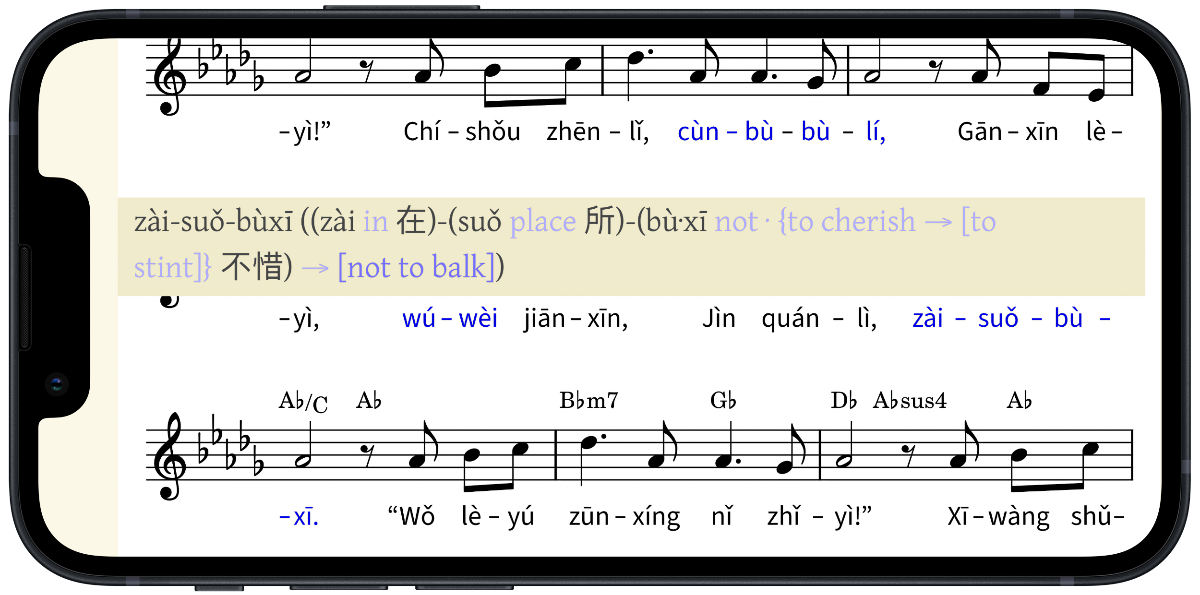
“pèi” _Pīnyīn_ Plus info, Song 159 (music+_Pīnyīn_), on iPhone 13 mini (landscape orientation)

This week’s MEotW in the unofficial Pīnyīn (Pīn·yīn {Piecing Together of} · Sounds → [Pinyin] 拼音) Plus resource “Sing Out Joyfully” Bk. (Pīnyīn+Music, Pīnyīn Plus, Web)

This week’s MEotW, “pèi ({mate (animals)}; {join together}; {join in marriage} [→ [match | deserve; {are worthy of} | compound; mix according to a ratio | distribute according to plan; apportion]] 配)”, occurs in the chorus of song 159, which is entitled “Give Jehovah Glory” in English and “Róngyào (Róng·yào Glory · {Being Shining → [Glory]} → [Glory] 荣耀 榮耀) Guīgěi (Guī·gěi {Give Back} · {to Be Given to} 归给 歸給) Yēhéhuá (Jehovah 耶和华 耶和華) in Mandarin:

English:

So I give you what is due;
All the glory goes to you.

Mandarin (WOL, Pīnyīn (Pīn·yīn {Piecing Together of} · Sounds → [Pinyin] 拼音) Plus):

📖 📄 📘 Zhǐyǒu (Zhǐ·yǒu (there) only · {is having → [is]} 只有) (you 你) pèi ({joining together} → [being worthy] 配) shòu ({to receive} 受) xiǎnyáng (xiǎn·yáng showing · {raising → [being made known]} → [glorifying] 显扬 顯揚).
Róngyào (Róng·yào glory · {being shining → [glory]} → [glory] 荣耀 榮耀) guīgěi (guī·gěi {give back} · {to be given to} 归给 歸給) Yēhéhuá (Jehovah 耶和华 耶和華)!

“Pèi ({mate (animals)}; {join together}; {join in marriage} [→ [match | deserve; {are worthy of} | compound; mix according to a ratio | distribute according to plan; apportion]] 配) literally means “join together (with)”, and can effectively mean “deserve; are worthy of”.

Glorify Jehovah as the Creator

As Jehovah’s servants in the Mandarin field, we should note that “pèi ({mate (animals)}; {join together}; {join in marriage} [→ [match | deserve; {are worthy of} | compound; mix according to a ratio | distribute according to plan; apportion]] 配) also occurs in Revelation 4:11 in the Mandarin version of the current New World Translation Bible:

English:

“You are worthy, Jehovah our God, to receive the glory and the honor and the power, because you created all things, and because of your will they came into existence and were created.”

Mandarin (WOL, Pīnyīn (Pīn·yīn {Piecing Together of} · Sounds → [Pinyin] 拼音) Plus):

📖 📄 📘 Yēhéhuá (Jehovah 耶和华 耶和華) wǒmen de ((wǒ·men us · [pl] 我们 我們) (de ’s 的) [our]) Shàngdì (Shàng·dì Above’s · {Emperor → [God]} → [God] 上帝), (you 你) pèi ({join together} → [are worthy] 配) shòu ({to receive} 受) róngyào (glory 荣耀 榮耀), zūnchóng (zūn·chóng honouring · esteeming 尊崇), lìliang (lì·liang power · quantity 力量), yīnwei (yīn·wei because · for 因为 因為) (you 你) chuàngzàole (chuàng·zào·le {initiated · {made, created} → [created]} · {to completion} 创造了 創造了) yíqiè (yí·qiè {one (whole)} · {corresponding (set)} → [all things] 一切), yíqiè (yí·qiè {one (whole)} · {corresponding (set)} → [all things] 一切) dōu (all 都) shì (are 是) yīnwei (yīn·wei {because of} · {on account of} 因为 因為) nǐ de ((nǐ you 你) (de ’s 的) [your]) zhǐyì (zhǐ·yì will · {meaning → [will]} → [will] 旨意) cái ({only then}才/纔) néng (able 能) cúnzài (cún·zài {to exist} · {to be present} 存在), cái ({only then}才/纔) bèi ([passive signifier] [were] 被) chuàngzào (chuàng·zào initiated · {made, created} → [created] 创造 創造) de ({’s (things)} 的).”

Revelation 4:11 helps us to understand that evolution is a set of lies from Satan the Devil targeted directly at the reason Jehovah God deserves “the glory and the honor and the power”, and that by promoting evolution, Satan seeks to take those things away from Jehovah. Jehovah did create all things, though, so he does deserve “the glory and the honor and the power”. Taking those away from Jehovah by holding that he is not the Creator and that all things actually evolved from nothing is part of the great injustice that Satan has committed against Jehovah, the reproach that Satan has heaped upon Jehovah’s name since he began his rebellious course. This injustice is so great, in fact, that it is the first thing Jesus taught us to pray about in the model prayer, as recorded at Matthew 6:9:

“You must pray, then, this way:

“‘Our Father in the heavens, let your name be sanctified.

We can also note that at this time, 3 out of the 6 books or brochures in the JW Library app’s Teaching Toolbox—fully one half of them—are focused on the subject of creation/evolution.

So, in our efforts to glorify Jehovah in the Mandarin field, let us not neglect helping people to clearly understand the abundant evidence that “Jehovah…created all things”. This is especially important in the Mandarin field, since the cultural background of many Mandarin-speakers predisposes them to believe in evolution, that Satanic set of lies designed to bring reproach on Jehovah and take away from him “the glory and the honor and the power” that he deserves.

Jehovah Is More Deserving of Glory Than Worldly Chinese Culture Is

As our Creator and “the King of eternity”, Jehovah certainly is more deserving of glory than worldly human Chinese culture is, regardless of how old it is compared to other human cultures, and how influential it currently is in the human world. (1 Timothy 1:17) As Mandarin field language learners, let us keep that in mind when, for example, we are considering how much time and effort it is appropriate to expend on learning and remembering Chinese characters, those burdensomely complex and undeservedly glamourized icons of Chinese culture, compared to how much time and effort we are expending on learning how to glorify Jehovah as Jesus did—with clear, understandable, persuasive speech.—Luke 4:32; 1 Corinthians 14:8–11.


For convenience:

The direct link for the Pīnyīn (Pīn·yīn {Piecing Together of} · Sounds → [Pinyin] 拼音) Plus resource for the “Sing Out Joyfully” book is:

The short link for Chinese field language-learning links for the “Sing Out Joyfully” book is:

More Pīnyīn (Pīn·yīn {Piecing Together of} · Sounds → [Pinyin] 拼音) and Pīnyīn (Pīn·yīn {Piecing Together of} · Sounds → [Pinyin] 拼音) Plus web material based on the Mandarin “Sing Out Joyfully” book will be made available in the Pīnyīn (Pīn·yīn {Piecing Together of} · Sounds → [Pinyin] 拼音) Plus web resource as time allows.

Categories
Culture Experiences History Language Learning Names Science Theocratic

Gēlìyà

Gēlìyà (Go·liʹath 歌利亚 歌利亞) 👈🏼 Tap/click to show/hide the “flashcard”

A few years back, I wrote up a brief web page listing reasons for producing Pīnyīn (Pīn·yīn {Piecing Together of} · Sounds → [Pinyin] 拼音), etc. material for the Imitate (ia) book. Some, especially some who grew up in the West, may have felt that this book is made up of “just stories”, and ones that they were already quite familiar with, at that. However, we must remember that Chinese Bible students may often have a different perspective regarding the Bible accounts that are made to come to life in the Imitate book. As that web page said:

  • Many Chinese people in the world have not been exposed to Bible accounts the way many Westerners have.
  • Also, I have heard that some, perhaps many, Chinese Bible students tend to approach their Bible studies like intellectual exercises for accumulating chōuxiàng (abstract) head knowledge as if for a school exam, rather than as training for their hearts for their own real lives.

Later, the web page touches on how some of the real-world benefits of good storytelling like that found in the Imitate book involve empathy:

    • The actress Natalie Portman once said, “I love acting. I think it’s the most amazing thing to be able to do. Your job is practicing empathy. You walk down the street imagining every person’s life.”
  • The Imitate book helps build Bible students’ empathy towards Bible characters, which in turn helps Bible students realize that others would feel empathy towards them as well if they imitated these Bible characters—not everyone will just think they’re crazy, like many worldly friends or family members might think.

While even fictional stories can have the benefits described in the links and the quote above, true stories from the Bible can have even greater benefits, including spiritual ones.

Besides the Imitate book, another book from Jehovah’s organization that relates Bible accounts is the Learn From the Bible (lfb) book. The letter from the Governing Body in this book says that, similarly to the Imitate book, the Learn From the Bible book also “brings the Bible accounts to life and captures the feelings of those depicted”, while, unlike the Imitate book, it “tells the story of the human family from creation onward”. While the Learn From the Bible book is especially suitable for children, the letter from the Governing Body in this book says that “it can also be used to help adults who desire to learn more about the Bible”. So, it would be good to consider on this blog some of the expressions used in the Mandarin Learn From the Bible book.

Goliath, By the Sound of It

This week’s MEotW, “Gēlìyà (Go·liʹath 歌利亚 歌利亞)”, is the Mandarin version of the name “Goliath”. It is used in Lesson 40 of the Mandarin Learn From the Bible book, which is entitled “Dàwèi (David 大卫 大衛) Yǒngzhàn (Yǒng·zhàn Bravely · Fights 勇战 勇戰) Gēlìyà (Go·liʹath 歌利亚 歌利亞) (“David and Goliath”).

It is apparent that “Gēlìyà (Go·liʹath 歌利亚 歌利亞) was chosen to represent “Goliath” in Mandarin because of what it sounds like, not because of the meanings of the supposedly ideographic (representing meaning directly through visible symbols, bypassing speech) Chinese characters used to write it out (“Song Profit Inferior”??? 🤷🏻).

A Cultural Goliath in the Chinese World

In this world ruled by Satan, Chinese characters loom large in people’s minds, like a cultural and traditional Goliath. To Jehovah God, though, the Creator and Sovereign of the entire universe, Goliath was small and insignificant back in David’s time, and Chinese characters are small and insignificant today. Indeed, even though Chinese characters have been around for millenia and are the oldest writing system still in use among humans, to Jehovah, to whom ‘a thousand years is as one day’, characters have only been around for a few days!—2 Peter 3:8.

Don’t Submit to Goliath—Trust in Jehovah!

It may seem like we have no choice but to submit to Chinese characters, these seemingly mighty symbols of worldly Chinese culture, and give them the egregious amounts of time, energy, and devotion they demand. However, for us dedicated ones, our time, energy, and devotion belong to Jehovah, so we should spend them carefully, in ways that are worthwhile with regard to our efforts to glorify Jehovah and accomplish the urgent, life-saving work he has assigned to us.

Chinese characters are a ball and chain made of human tradition.

Back in David’s time, it may have seemed to the Israelites facing Goliath that they had no option but to become slaves to the Philistines, because who could defeat the mighty Goliath? However, rather than being intimidated by this abnormally large but still limited and imperfect human, David put Jehovah first and really trusted in him, resulting in Jehovah blessing his efforts and helping him to soundly and decisively defeat Goliath. And yes, besides trusting in Jehovah, David did also contribute his own efforts—he both prepared to battle Goliath (for example, by carefully selecting “five smooth stones from the streambed”, stones that would come off his sling and fly through the air smoothly), and also actually stepped up and fought this battle.—1 Samuel 17:40.

汉字 / 漢字? Pīnyīn?

Today, Pīnyīn (Pīn·yīn {Piecing Together of} · Sounds → [Pinyin] 拼音) can be one of our symbolic “smooth stones” that help us prepare for and successfully fight our personal battle to, with Jehovah’s help, defeat the cultural Goliath that is the characters, and learn to understand Mandarin and speak it understandably (and smoothly!) to the Mandarin-speaking people we meet in the field.


For convenience:

The direct link for the Pīnyīn (Pīn·yīn {Piecing Together of} · Sounds → [Pinyin] 拼音) Plus resource for the Learn From the Bible book is:

The short link for Chinese field language-learning links for the Learn From the Bible book is:

More Pīnyīn (Pīn·yīn {Piecing Together of} · Sounds → [Pinyin] 拼音) and Pīnyīn (Pīn·yīn {Piecing Together of} · Sounds → [Pinyin] 拼音) Plus web material based on the Mandarin Learn From the Bible book will be made available in the Pīnyīn (Pīn·yīn {Piecing Together of} · Sounds → [Pinyin] 拼音) Plus web resource as time allows.

Categories
Science Technology Theocratic

xiāngduì

xiāngduì (xiāng·duì {[with] each other}; {one another}; mutually · {facing; opposing [→ [compared]]} → [[being] opposite each other; face to face | relative/relatively; comparatively; vis-à-vis] 相对 相對) 👈🏼 Tap/click to show/hide the “flashcard”

[Notes: Tap/click on a Pīnyīn (Pīn·yīn {Piecing Together of} · Sounds → [Pinyin] 拼音) expression to reveal its “flashcard”; tap/click on a “flashcard” or its Pīnyīn (Pīn·yīn {Piecing Together of} · Sounds → [Pinyin] 拼音) expression to hide the “flashcard”. 📖 📄 📘 icons mean 📖 Reveal All, 📄 Reveal Advanced, and 📘 Reveal None re all the “flashcards” in the heading, paragraph, etc. that they are placed at the beginning of.]

The Shēngmìng Láizì Chuàngzào Ma? ((Shēngmìng Life 生命) (Lái·zì Came · From 来自 來自) (Chuàng·zào Initiating · {Making, Creating} → [Creating] 创造 創造) (Ma [? ptcl for “yes/no” questions])? [Was Life Created? (lc)]) (Was Life Created? (lc)) brochure and the Shēngmìng de Qǐyuán—Zhíde Sīkǎo de Wǔ Ge Wèntí ((Shēngmìng Life 生命) (de ’s 的) (Qǐ·yuán {Rising → [Starting]} · Source → [Origin] 起源/原)—(Zhí·de Worth · Getting → [Worth] 值得) (Sī·kǎo {Thinking About} · Examining 思考) (de ’s 的) (Wǔ Five 五) (Ge [mw]個/个) (Wèn·tí Asking · Subjects → [Questions] 问题 問題) [The Origin of Life—Five Questions Worth Asking (lf)]) (The Origin of Life—Five Questions Worth Asking (lf)) brochure were originally published back in 2010, but relatively recently, the English version of the Was Life Created? brochure was updated to the December 2022 Printing, and the Mandarin version of it was updated to the February 2023 Printing. Also, the Was Life Created? brochure and the Origin of Life brochure are now in the Teaching Toolbox section in the JW Library app. So, it would be good to consider some of the expressions used in the Mandarin versions of these publications that can be so helpful when discussing whether life was created.

It’s Relative?

This week’s MEotW, “xiāngduì (xiāng·duì {[with] each other}; {one another}; mutually · {facing; opposing [→ [compared]]} → [[being] opposite each other; face to face | relative/relatively; comparatively; vis-à-vis] 相对 相對)”, occurs in paragraph 3 of the QUESTION 2 section of the Origin of Life brochure, which section is entitled, in English, “Is Any Form of Life Really Simple?”:

English:

Since prokaryotic cells are relatively less complex than eukaryotic cells, many believe that animal and plant cells must have evolved from bacterial cells.

Mandarin (WOL, Pīnyīn (Pīn·yīn {Piecing Together of} · Sounds → [Pinyin] 拼音) Plus):

📖 📄 📘 Xiāngduì (Xiāng·duì {one another} · {facing → [compared]} → [relatively] 相对 相對) lái (coming) shuō ({to say}說/説), yuánhé (yuán·hé primitive · {pit (of a fruit) → [nucleus]} → [prokaryotic] 原核) xìbāo (xì·bāo tiny · wombs → [cells] 细胞 細胞) de ( 的) gòuzào (gòu·zào {constructings → [structures]} · makings → [structures] 构造 構造) ({compared to} 比) zhēnhé (zhēn·hé true · {pit (of a fruit) → [nucleus]} → [eukaryotic] 真核) xìbāo (xì·bāo tiny · wombs → [cells] 细胞 細胞) jiǎndān (jiǎn·dān {are simple} · {are single → [are simple]} → [are simple] 简单 簡單), suǒyǐ (suǒ·yǐ {that which} · {is the reason/cause} → [so] 所以) xǔduō (xǔ·duō numbers · many 许多 許多) kēxué‐jiā ((kē·xué {branches of study} · learning → [science] 科学 科學)‐(jiā -ists 家) [scientists]) rènwéi (rèn·wéi identify · {(it) to be (that)} 认为 認為) dòng‐zhíwù ((dòng moving)‐(zhí·wù planted · things 植物) [plants and animals]) de ( 的) xìbāo (xì·bāo tiny · wombs → [cells] 细胞 細胞) dōu (all 都) bìdìng (bì·dìng certainly · {(it) has been set} 必定) shì (are 是) cóng (from) xìjūn (xì·jūn tiny · bacteria → [bacterial] 细菌 細菌) xìbāo (xì·bāo tiny · wombs → [cells] 细胞 細胞) yǎnshēng (yǎn·shēng {spilling over} · {given life to} → [evolved] 衍生) chulai (chu·lai out · {to come} 出来 出來) de ({’s (cells)} 的).

It’s Complex, Absolutely

In “xiāngduì (xiāng·duì {[with] each other}; {one another}; mutually · {facing; opposing [→ [compared]]} → [[being] opposite each other; face to face | relative/relatively; comparatively; vis-à-vis] 相对 相對)”, “xiāng ({[with] each other}; {one another}; mutually 相) means “each other”, or “one another”. “Duì ({trained on}; {directed at}; facing; opposite; opposing; {[is] towards} [→ [to | treat | [is] correct; [is] right | pair; couple [of] | comparing; checking; verifying]]) literally means “facing” or “opposing”, and can effectively mean “compared”. Together, these morphemes can be taken to effectively mean “relative” or “relatively”, as they are in the above example.

The opposite of “relative” or “relatively” is “absolute” or “absolutely”, and the Mandarin word for that is “juéduì (jué·duì {being cut off → [asolutely]} · {facing → [compared]} → [[is] absolute[ly]; perfect[ly]; definite[ly]] 绝对 絕對)”. The “jué ({cut off}; severed [→ [exhausted; used up; finished; terminated | unique; superb; matchless | died; has become extinct]] | {being cut off} → [absolutely; extremely]絕/絶) used here literally means “cut off”, and can effectively mean “absolutely” or “extremely”. The “duì ({trained on}; {directed at}; facing; opposite; opposing; {[is] towards} [→ [to | treat | [is] correct; [is] right | pair; couple [of] | comparing; checking; verifying]]) in “juéduì (jué·duì {being cut off → [asolutely]} · {facing → [compared]} → [[is] absolute[ly]; perfect[ly]; definite[ly]] 绝对 絕對) is the same one that’s in “xiāngduì (xiāng·duì {[with] each other}; {one another}; mutually · {facing; opposing [→ [compared]]} → [[being] opposite each other; face to face | relative/relatively; comparatively; vis-à-vis] 相对 相對)”.

Relatively speaking, some cells are simpler than other cells, and as mentioned in the example above, some latch on to that and suggest that more complex cells must have evolved from relatively simpler cells. However, as the Origin of Life brochure goes on to show us, any cell is still highly, highly complex in absolute terms, when it comes to what could be formed by random chance.

Relatively and Absolutely “Far Too Complex to Have Arisen by Chance”

The following statement, which occurs towards the end of the QUESTION 2 section of the Origin of Life brochure, describes the complexity of even relatively “simple” cells:

English:

Fact: Some respected scientists say that even a “simple” cell is far too complex to have arisen by chance on earth.

Mandarin (WOL, Pīnyīn (Pīn·yīn {Piecing Together of} · Sounds → [Pinyin] 拼音) Plus):

📖 📄 📘 Shìshí (Shì·shí matter · {being solid} → [fact] 事实 事實): Yǒuxiē (Yǒu·xiē {(there) are having → [(there) are]} · some 有些) bèishòu (bèi·shòu fully · receive 备受 備受) zūnzhòng (zūn·zhòng respecting · {(viewing as) weighty} 尊重) de (’s 的) kēxué‐jiā ((kē·xué {branches of study} · learning → [science] 科学 科學)‐(jiā -ists 家) [scientists]) shuō (saying說/説), jiùsuàn (jiù·suàn {even if} · {figuring → [considering]} 就算) shì ({(it) is} 是) (one 一) ge ([mw]個/个)jiǎndān (jiǎn·dān simple · {single → [simple]} → [simple] 简单 簡單)de (’s 的) xìbāo (xì·bāo tiny · womb → [cell] 细胞 細胞) ((it) also 也) shífēn (shí·fēn ten · portions → [very much] 十分) fùzá (fù·zá {is turned around → [is complex]} · {is mixed} → [is complex] 复杂 複雜), (not 不) kěnéng (kě·néng maybe · {being able} → [possibly] 可能) shì ({had been} 是) pèngqiǎo (pèng·qiǎo {having bumped into} · {being coincidental} → [by chance] 碰巧) zài (on 在) dìqiú (dì·qiú earth · globe 地球) shang (upon 上) xíngchéng (xíng·chéng {form (n)} · {came to be} → [formed] 形成) de ({’s (thing)} 的).

Let us, then, continue to do what we can to help Mandarin-speaking people to get acquainted with the abundant evidence that life was indeed created, and let us help them to get to know our loving Creator.


For convenience:

The direct link for the current-generation Pīnyīn (Pīn·yīn {Piecing Together of} · Sounds → [Pinyin] 拼音) Plus resource for the Origin of Life brochure is:

The short link for Chinese field language-learning links for the Origin of Life brochure is:

More Pīnyīn (Pīn·yīn {Piecing Together of} · Sounds → [Pinyin] 拼音) and Pīnyīn (Pīn·yīn {Piecing Together of} · Sounds → [Pinyin] 拼音) Plus web material based on the Mandarin Origin of Life brochure will be made available in the Pīnyīn (Pīn·yīn {Piecing Together of} · Sounds → [Pinyin] 拼音) Plus web resource as time allows.