Categories
Culture Current Events History Language Learning Science Technology

xuānchuán

xuānchuán+ (xuān·chuán declaring; proclaiming; announcing · {passing on}; spreading; transmitting → [conducting propaganda; propagating; disseminating; publicizing | propaganda] 宣传 宣傳) ← Tap/click to show/hide the “flashcard”

Several MEotW posts, including last week’s post on “cì’ěr (cì’·ěr {stabs; pricks → [irritates; pierces]} · ear → [grating on the ear; jarring; ear-piercing] 刺耳)”, have mentioned propaganda. So, it seems that it’s about time to consider the Mandarin expression “xuānchuán (xuān·chuán declaring; proclaiming; announcing · {passing on}; spreading; transmitting → [conducting propaganda; propagating; disseminating; publicizing | propaganda] 宣传 宣傳)”, which is often used to translate “propaganda”.

Morphemic Breakdown

The “xuān (declare; proclaim; announce 宣)” in “xuānchuán (xuān·chuán declaring; proclaiming; announcing · {passing on}; spreading; transmitting → [conducting propaganda; propagating; disseminating; publicizing | propaganda] 宣传 宣傳)” means “declare; proclaim; announce”, and it also appears in expressions like “xuānbù+ (xuān·bù declare; proclaim; announce · declare; spread; announce; publish; proclaim 宣布 宣布/佈)”, “xuānjiǎng (xuān·jiǎng declare; proclaim; announce · {speak of → [explain]} 宣讲 宣講)”, “xuānyáng (xuān·yáng declare; proclaim; announce · {raise → [make known]} 宣扬 宣揚)”, etc.

The “chuán ({pass on}; {hand down}; spread; transmit [→ [summon]] 传 傳)” in “xuānchuán (xuān·chuán declaring; proclaiming; announcing · {passing on}; spreading; transmitting → [conducting propaganda; propagating; disseminating; publicizing | propaganda] 宣传 宣傳)” means “pass on; hand down; spread; transmit”, and it also appears in expressions like “chuándào+ (chuán·dào spreading · way → [preaching] 传道 傳道)”, “Chuándàoshū (Chuán·dào·shū Spreading · Way · Book → [Ecclesiastes] 传道书 傳道書)”, “chuánjiǎng (chuán·jiǎng spread · {speak of; say; tell} [(that)] 传讲 傳講)”, “chuántǒng+ (chuán·tǒng {passed on} · {gathered together (things) → [interconnected system]} → [tradition | traditional] 传统 傳統)”, etc.

The above-mentioned morphemes in “xuānchuán (xuān·chuán declaring; proclaiming; announcing · {passing on}; spreading; transmitting → [conducting propaganda; propagating; disseminating; publicizing | propaganda] 宣传 宣傳)” are both basically verbs, and “xuānchuán (xuān·chuán declaring; proclaiming; announcing · {passing on}; spreading; transmitting → [conducting propaganda; propagating; disseminating; publicizing | propaganda] 宣传 宣傳)” itself is also basically a verb. However, it’s also used as a noun, making it a verbal noun, or a gerundial noun, in those cases.

How Bad Is It?

As mentioned in the excellent Referenced Theo. Expressions (RTE) resource, “it seems 宣传 [xuānchuán] is a neutral word in Chinese (can be either positive or negative)”. Indeed, the morphemes that make up “xuānchuán (xuān·chuán declaring; proclaiming; announcing · {passing on}; spreading; transmitting → [conducting propaganda; propagating; disseminating; publicizing | propaganda] 宣传 宣傳)”, mentioned above, are themselves both morally neutral. Like any technology, whether the things that these morphemes represent result in good or harm depends on how they are used. Unfortunately, we are now living in the last days of a world ruled by Satan the Devil, a world filled with self-seeking people who totally would misuse anything that would potentially enable them to exert influence over other people.—2 Timothy 3:1–5; 1 John 5:19.

It should not be surprising, then, that the worldly Chinese governing authorities may at times disseminate what many would recognize as propaganda—biased, misleading distortions of the truth meant to promote certain viewpoints, political or cultural objectives, etc. Add to that how Eastern culture generally encourages people to conform to the group and not question authority, and it’s not surprising that many who grew up marinated in Chinese culture have come to just accept such propaganda as fact, as just the way things are in the Chinese world.

As for the West, even though it has more of a culture of questioning authority, it, along with the world in general that the Internet can reach, has been experiencing a rise in misinformation and disinformation. Social media and other technologies that have become available have given people more power to select what information they want to take in, and, egged on by engagement-seeking algorithms, many have unfortunately chosen to just focus on information sources that tell them what they want to hear, whether it’s true or not. As the Bible foretold long ago:

For there will be a period of time when they will not put up with the wholesome teaching, but according to their own desires, they will surround themselves with teachers to have their ears tickled. They will turn away from listening to the truth and give attention to false stories.
—2 Timothy 4:3, 4.

As Jehovah’s people, we especially need to be wary of any worldly propaganda, because we want to be the true worshippers spoken of by Jesus, ones who “must worship with spirit and truth”.—John 4:23, 24.

Unfortunately, these days, even something as basically human as language gets politicized, so even just being language learners in the Mandarin field, we still need to watch out for worldly propaganda. Below are a couple of commonly accepted beliefs about the Chinese languages that are actually propaganda, not truth.

Propaganda About “Dialects”

“Mandarin, Cantonese, Shanghainese, etc. are just dialects of the one Chinese language.” The truth is that being mutually unintelligible, Mandarin, Cantonese, Shanghainese, etc. are really different languages, like French and English are different languages. The erroneous belief that Mandarin, Cantonese, Shanghainese, etc. are just dialects of the one Chinese language has been promoted by the worldly central governing authorities in China to bolster the idea that China is indeed one big happy political entity that should have a central government—them.

Historically, though, it wasn’t always the case that there was just one government over the land that China now occupies. That didn’t become the case until Qín Shǐhuáng ((Qín {Qin (dynasty)} 秦) (Shǐ·huáng Beginning · Emperor 始皇) (the founder of the Qín dynasty and the first emperor of China)) conquered the other Warring States—which were peers of his own state of Qín ({Qin (one of the Warring States)} 秦)—and became the first emperor of a forcefully unified China. If it wasn’t for this, China could conceivably have become like modern-day Europe, with several peer states which are recognized as having their own distinct languages and cultures.

So, there is no need to allow the idea that Mandarin, Cantonese, etc. are just dialects to sabotage our efforts to learn Mandarin well by making us think that we can just take Cantonese, etc. and twist it a little to get Mandarin—all we would get then is a twisted mess!

Propaganda and the Characters

“Chinese characters are the primary aspect of the Chinese languages.” The truth is that when it comes to human language, speech is primary, not writing.

However, given how so many people around the world are so enchanted with the visually intricate Chinese characters, some may feel that the characters give China a certain amount of cultural—and maybe even political—soft power. Many also feel that characters have a unifying effect on Chinese people, since they use characters to write even if they speak different Chinese languages, as explained above. Thus, many may also feel that there may be some political advantages to characters for China’s worldly central ruling authorities. So, they may thus be motivated to promote Chinese characters over, say, a system like Pīnyīn (Pīn·yīn {Piecing Together of} · Sounds → [Pinyin] 拼音) that doesn’t have the same perceived visual and cultural pizzaz that the characters have, and that is only for Mandarin.

The truth is, though, that there is really no technical requirement for any language, Chinese or otherwise, to be written using Chinese characters—Pīnyīn (Pīn·yīn {Piecing Together of} · Sounds → [Pinyin] 拼音) works fine as a writing system for Mandarin without incurring the extraordinary costs in time and effort that the characters do, and separate but similar alphabetical systems can conceivably be designed and used for other Chinese languages as well.

Re the supposed unifying effect of the Chinese characters, there is not necessarily really much of a unifying effect among the Mandarin-speakers, Cantonese-speakers, Japanese-speakers, Korean-speakers, etc. who may use characters to write, any more than the use of the Latin alphabet unifies English-speakers, French-speakers, Italian-speakers, Mandarin-speakers, etc. who may use it to write. An especially stark current example of the relative insignificance of any unifying effect that a script or writing system may have is that unfortunately, Russia and Ukraine have hardly been unified because of their both using the Cyrillic script.

We who are Jehovah’s people in particular don’t need a product of human culture like the Chinese characters to unite us—we are united by the culture of spirit and truth from Jehovah God himself!—John 4:23, 24.

Don’t Be a Gullible “Tourist”!

As Jehovah’s people, let us make sure we are advancing the interests of God’s Kingdom, and not unwittingly serving the interests of worldly Chinese governments. As missionaries and rescue workers in the Mandarin field, and not just tourists (email me for login information, and include information on who referred you and/or what group/cong. you are in), let us be focused on what really helps us to do our God-honouring and life-saving work better. Let us not be misled by the self-serving xuānchuán (xuān·chuán declaring · spreading → [propaganda] 宣传 宣傳), the propaganda, from Satan’s world.

Categories
Culture Experiences History Language Learning

jī‐tóng‐yā‐jiǎng

jī‐tóng‐yā‐jiǎng+ ((jī chicken 鸡 雞/鷄)‐(tóng {together with} 同 同/仝)‐(yā duck 鸭 鴨)‐(jiǎng speaking 讲 講) → [people not understanding each other because of speaking different languages (from Cantonese)]) ← Tap/click to show/hide the “flashcard”

[Yes, this expression comes from Cantonese, but the above Mandarin version does appear in Mandarin dictionaries, so it qualifies as a Mandarin expression!]

Recently, while out to dinner with one of the first families to serve in the local Cantonese congregation, along with the circuit overseer serving the local Chinese circuit and his wife, the subject came up of how Mandarin and Cantonese are actually different languages, not just dialects of the same language.

Chickens Talking with Ducks

The wife of the circuit overseer asked what the difference is between a language and a dialect. So, I proceeded to explain something that is emphasized by American sinologist and University of Pennsylvania Professor of East Asian Languages and Civilizations Victor H. Mair, that a primary way accepted by most linguists to distinguish a language from a dialect is mutual intelligibility, as is discussed in this excerpt from the MEotW post on “fāngyán (fāng·yán {direction → [place]} · speech → [topolect; dialect (common but misleading translation)] 方言)”:

It has been said that “a language is a dialect with an army and navy”, but in his article Professor Mair gives us a more linguistically correct and useful way to distinguish between a language and a dialect:

Regardless of the imprecision of lay usage, we should strive for a consistent means of distinguishing between language and dialect. Otherwise we might as well use the two terms interchangeably. That way lies chaos and the collapse of rational discourse. Mutual intelligibility [emphasis added] is normally accepted by most linguists as the only plausible criterion for making the distinction between language and dialect in the vast majority of cases. Put differently, no more suitable, workable device for distinguishing these two levels of speech has yet been proposed. If there are to be exceptions to the useful principle of mutual intelligibility, there should be compelling reasons for them. Above all, exceptions should not be made the rule.

What is mutual intelligibility? Simply put, in linguistics, two or more speech varieties are said to be mutually intelligible if they are “able to be understood by one another’s speakers”. For example, if one person only knows English, and another person only knows Spanish, they can’t really understand each other if they try to talk to each other—English and Spanish are not mutually intelligible, and are suitably recognized as being different languages, not just different dialects of “European”.

Similarly, if one person only knows Mandarin, and another person only knows Cantonese, they can’t really understand each other if they try to talk to each other—Mandarin and Cantonese are not mutually intelligible. So, while they may be “fāngyán+ (fāng·yán {direction → [place]} · {(patterns of) speech} 方言)”, linguistically, Mandarin and Cantonese should really be considered to be different languages, not just different dialects of “Chinese”.

Indeed, I have heard people use this week’s MEotW, “jī‐tóng‐yā‐jiǎng+ ((jī chicken 鸡 雞/鷄)‐(tóng {together with} 同 同/仝)‐(yā duck 鸭 鴨)‐(jiǎng speaking 讲 講) → [people not understanding each other because of speaking different languages (from Cantonese)])”, to specifically describe Mandarin-speakers and Cantonese-speakers trying to talk to each other, and not understanding each other. 🐓 🦆

After I explained the gist of the above, one of the daughters of the family at the dinner—who had been labouring for decades under the misconception that Mandarin and Cantonese are just dialects and that someone who knows one can easily learn the other—said, “Now I don’t feel like an idiot.”

Uncommon Knowledge?

It could be said that ones such as this family and this circuit overseer and his wife, who have all worked so hard and served for so long in the Chinese language fields, should already have known such a basic thing about the Chinese languages. However, the following things are unfortunately true:

  • Even publishers who are learning a language to serve in that language’s field generally consider such linguistic (language science) knowledge to be specialized technical knowledge that is beyond what they need to learn, and possibly beyond what they could even comprehend.
  • Western-educated publishers learning a Chinese language may unwittingly go along with the Western worldly tendency to exoticize things related to China. (John DeFrancis, in his book The Chinese Language: Fact and Fantasy (p. 37), calls this “Exotic East Syndrome”.) They may be content with—or even enjoy—the alluring veil of mystery and mystique surrounding certain things related to China and Chinese culture. Thus, they don’t seek to learn about and understand deeper truths about such things, that may pierce through this obscuring veil, and burst this bubble.—Compare 2 Corinthians 3:14, including the margin note.
  • The central ruling authorities of China have long actively promoted the scientifically incorrect idea that the different varieties of speech in China are just dialects of the one Chinese language. This idea is political propaganda supporting the idea that it’s good for there to be central ruling authorities in China.
  • Traditional worldly Chinese language instructors and others who are knowledgeable about Chinese languages and Chinese characters are eager to promote and perpetuate the traditional thinking about Chinese languages and characters, that they have invested so much time and effort in, and that they are so proud of.
  • Chinese-educated publishers who are already steeped in the traditional ideas about Chinese languages, Chinese characters, etc., and who are thus lauded and deferred to as experts by other publishers, may be eager to simply unquestioningly pass on the cultural knowledge and ideas that they were taught, and that they are lauded and respected for.
  • With so much misinformation “in the air”, including from trusted authority figures, “everyone knows” that there is one Chinese language, with dialects that include Mandarin, Cantonese, etc. Since “everyone knows” this, it’s easy to just go along with it, especially in an Eastern culture like the Chinese culture that emphasizes conforming to the group. As Eastern cultures, Japanese, Korean, etc. cultures are similar in this respect, so publishers from those cultural backgrounds may also tend to just go along with what “everyone knows” about there being just one Chinese language that has various dialects.—Ephesians 2:2.
  • The Bible makes it clear that Satan the Devil is “a liar and the father of the lie”. It also describes him as “the great dragon…who is misleading the entire inhabited earth”. So, while we can only speculate about the details of what strings are purposely pulled in the spirit realm by Satan and his demons as opposed to what human folly they simply passively observe, we can be sure that Satan is delighted with all the ways in which people are misled in and about the Chinese culture, in which the dragon is considered a positive, revered symbol.—John 8:44; Revelation 12:9.

So, for reasons such as the above, even the basic linguistic truth that Mandarin, Cantonese, Shanghainese, etc. actually function as different languages is unfortunately not yet common knowledge among those serving in the Chinese fields. As the saying goes, which some say is a Chinese proverb, “error will travel over half the globe, while truth is pulling on her boots”.

Jesus said, though, that true worshippers worship “with spirit and truth”, and that “the truth will set you free”. With regard to Chinese languages, Chinese characters, etc., the truth about them can even set one free from unnecessarily feeling like an “idiot”, as the sister mentioned above so eloquently put it, because of labouring under all the political propaganda, traditions, and other kinds of misinformation and wrong thinking that unfortunately surround Chinese languages, Chinese characters, etc.—John 4:23; 8:32.

Huge Worldwide Effects

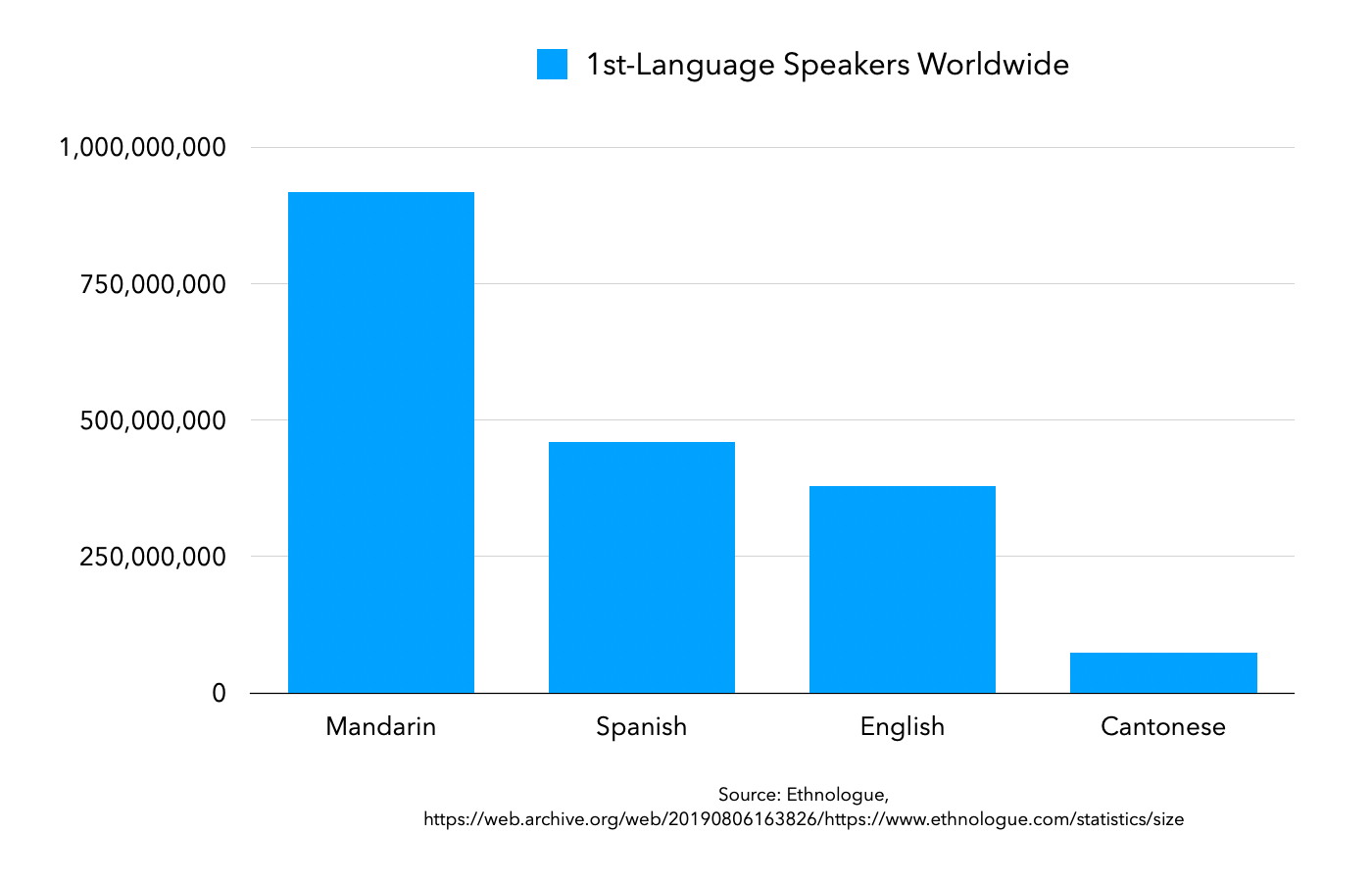
In addition to being hugely freeing for individual language learners, spreading the truth about the Chinese languages, Chinese characters, etc. is also important on a larger scale, since the worldwide Mandarin field, for one, is the largest language field in the world, and probably the largest language field that has ever existed in human history. For comparison, according to Ethnologue, a resource on world languages, the worldwide Mandarin field (those worldwide whose mother tongue is Mandarin) is about twice the size of the second largest worldwide language field, the Spanish field, and it’s about two and a half times the size of the third largest worldwide language field, the English field. Allowing various untruths to continue to divert and bog down the language-learning efforts of those who come to help in the worldwide Mandarin field can have incalculable overall negative effects on the preaching work in this enormous field.

Chart: Languages by First-Language Speakers—2019

So, even as we hang on to Bible truth, let us also hang on to the linguistic truths that we learn, and let us do what we can to share them with our fellow workers in the vast worldwide Chinese fields.

Categories
Culture Language Learning Technology Theocratic

zuìchū

zuìchū+ (zuì·chū most · {at the beginning} [→ [initial[ly]; prime; [at] first; original[ly]]] 最初) ← Tap/click to show/hide the “flashcard”

[Notes: “PyP” is short for “Pīnyīn (Pīn·yīn {Piecing Together} · Sounds → [Pinyin] 拼音) Plus”. Tap/click on a Pīnyīn (Pīn·yīn {Piecing Together} · Sounds → [Pinyin] 拼音) expression to reveal its “flashcard”, tap/click on a “flashcard” or its Pīnyīn (Pīn·yīn {Piecing Together} · Sounds → [Pinyin] 拼音) expression to hide the “flashcard”. 📖 📄 ➕ icons mean 📖 Reveal All, 📄 Reveal Advanced, and ➕ Reveal + Symbols re all the “flashcards” in the heading, paragraph, etc. that they are placed at the beginning of.]

“Zuìchū (Zuì·chū most · {at the beginning} [→ [initial[ly]; prime; [at] first; original[ly]]] 最初)” is the very first expression that occurs in the current Mandarin New World Translation Bible, at Genesis 1:1 (WOL; PyP):

📖 📄 ➕ Zuìchū+ (Zuì·chū most · {at the beginning} 最初), Shàngdì (Shàng·dì Above’s · {Emperor → [God]} → [God] 上帝) chuàngzàole (chuàng·zào·le {initiated · made, created → [created]} · [indicates a change] 创造了 創造了) tiāndì (tiān·dì heavens · earth 天地).

At Revelation 2:4 (WOL; PyP), the current Mandarin NWT Bible also uses “zuìchū (zuì·chū most · {at the beginning} [→ [initial[ly]; prime; [at] first; original[ly]]] 最初)” when it talks about not leaving “the love you had at first”:

📖 📄 ➕ Búguò (Bú·guò not · {do pass} → [however] 不过 不過), yǒu ({(there) is having} 有) yì (one 一) diǎn (point (regarding which) 点 點) wǒ (I 我) yào (must 要) zébèi+ (zé·bèi reprove · prepare → [reprove] 责备 責備) nǐ (you 你), jiùshì (jiù·shì (which) exactly · is 就是) nǐ (you 你) ràng ({have allowed} 让 讓) zìjǐ (selves’ 自己) zuìchū+ (zuì·chū most · {at the beginning} → [at first] 最初) de (’s 的) nèi (that 那) fèn ({portion of} 份) ài (love 爱 愛) lěngdàn (lěng·dàn {to be(come) cold} · {to be(come) bland → [to be(come) indifferent]} 冷淡) xialai (xia·lai down · {to come} 下来 下來).

“Original Intention”? “Beginner’s Mind”?

While “zuìchū (zuì·chū most · {at the beginning} [→ [initial[ly]; prime; [at] first; original[ly]]] 最初)” appears multiple times in the current Mandarin NWT Bible, the expression “chūxīn (chū·xīn beginning; original; initial; {first (in order)} · heart; mind → [original desire/aspiration/intention | (Zen Buddhism) beginner’s mind (attitude of openness, free of preconceptions, when studying a subject)] 初心)”, which may seem somewhat related, does not appear in the current Mandarin NWT Bible.

In normal Mandarin usage, “chūxīn (chū·xīn beginning; original; initial; {first (in order)} · heart; mind → [original desire/aspiration/intention] 初心)” effectively means “original desire/aspiration/intention”. We should be aware, though, that the expression “chūxīn (chū·xīn beginning; original; initial; {first (in order)} · heart; mind → [original desire/aspiration/intention | (Zen Buddhism) beginner’s mind (attitude of openness, free of preconceptions, when studying a subject)] 初心)” (shoshin in Japanese) is also used in Zen Buddhism to mean “beginner’s mind”, an attitude of openness, free of preconceptions, when studying a subject.

While “chūxīn (chū·xīn beginning; original; initial; {first (in order)} · heart; mind → [(Zen Buddhism) beginner’s mind (attitude of openness, free of preconceptions, when studying a subject)] 初心)”, as used in Zen Buddhism, apparently refers to one’s own unprejudiced mental approach to learning about a reality, “zuìchū (zuì·chū most · {at the beginning} [→ [initial[ly]; prime; [at] first; original[ly]]] 最初)”, as used in the Bible, refers to the very beginning of a reality itself, prior to any possible subsequent deviation or corruption. It seems that following the Bible’s example of focusing on the truth of the original reality of something naturally produces the beneficial openness and freedom from preconceptions referred to by the Zen Buddhist usage of “chūxīn (chū·xīn beginning; original; initial; {first (in order)} · heart; mind → [(Zen Buddhism) beginner’s mind (attitude of openness, free of preconceptions, when studying a subject)] 初心)”, especially when we do so with the courage and humility that the Bible often encourages us to cultivate.—2 Timothy 1:7; Joshua 1:9; Proverbs 18:12; 22:4.

Remembering where Zen Buddhism came from and where the Bible came from can help us to understand the difference between the Zen Buddhist concept of chūxīn (chū·xīn beginning; original; initial; {first (in order)} · heart; mind → [(Zen Buddhism) beginner’s mind (attitude of openness, free of preconceptions, when studying a subject)] 初心) and the concept of zuìchū (zuì·chū most · {at the beginning} [→ [initial[ly]; prime; [at] first; original[ly]]] 最初) that is often mentioned in the Bible. Having come from imperfect, limited humans, the Zen Buddhist concept of chūxīn (chū·xīn beginning; original; initial; {first (in order)} · heart; mind → [(Zen Buddhism) beginner’s mind (attitude of openness, free of preconceptions, when studying a subject)] 初心) is unsurprisingly about how an imperfect, limited human can view something—that’s ultimately all it can really be about anyway. On the other hand, the Bible shares with us God’s views of things, and God was actually there at the zuìchū (zuì·chū most · {at the beginning} 最初) time of literally everything in the universe. Also, he has seen how everything has developed since that zuìchū (zuì·chū most · {at the beginning} 最初) time, and he can also perfectly foresee how everything will turn out in the future.

Holding On to Mandarin Field First Love

How might someone leave ‘the love he had at first’ in the Mandarin field? A publisher may have originally entered the Mandarin field with pure motivations, out of love for God and neighbour. Over time, though, with repeated exposure to proud worldly Chinese traditional culture, might some self-glorifying pride creep in regarding knowledge of that worldly Chinese culture, and regarding having gone far down the rabbit hole of the notoriously complex Chinese characters? If so, then the original love that had motivated that publisher may eventually get corrupted, and perhaps even left behind, leaving pride as his main motivation. May we never let that happen to us!

First Things First in Language Learning

The way God made us, zuìchū (zuì·chū most · {at the beginning} 最初), language-wise, there was speech. Only later did imperfect humans eventually come up with some writing systems to visually represent and record some forms of speech. Indeed, there have been, and there still are, many speech-only languages, with no corresponding writing system. Ethnologue, a resource on world languages, says:

Ethnologue (24th edition) has data to indicate that of the currently listed 7,139 living languages, 4,065 have a developed writing system. We don’t always know, however, if the existing writing systems are widely used. That is, while an alphabet may exist there may not be very many people who are literate and actually using the alphabet. The remaining 3,074 are likely unwritten.

Technological First Priority

Writing systems are technologies. About writing, linguist Gretchen McCulloch says:

It really is a technology. It’s a thing you do on top of language to do stuff with language, but it’s not the language itself. There are thousands and possibly millions of languages that have never been written down in the history of humanity. We have no idea. We’ve never met a society of humans, or heard of a society of humans, without language. But those are spoken and signed languages, which are just kind of there. Writing, by contrast, was invented somewhere between 3 and 4 times in the history of humanity.

As with any technology, under-engineering and over-engineering in writing systems are by definition bad. Chinese characters are obviously over-engineered—full of “ceremony”, way more complicated than necessary to fulfil their original purpose of representing Chinese speech. In fact, in the minds of many, Chinese characters have culturally become a thing on their own, the most important thing about Chinese languages, even. Thus, characters have been allowed to improperly overshadow Mandarin, etc. speech, which is actually of primary importance. As the English saying goes, that’s putting the cart before the horse.

Pīnyīn (Pīn·yīn {Piecing Together} · Sounds → [Pinyin] 拼音) is sometimes ridiculed for being just for beginners, but the simplicity and elegance with which it fulfils its zuìchū (zuì·chū most · {at the beginning} → [original] 最初), original purpose of representing Mandarin speech are actually very good things. As Leonardo da Vinci is alleged to have said, simplicity is the ultimate sophistication.