Categories
Culture History Language Learning Science Technology

pĂștao

pĂștao (grape è‘Ąè„) đŸ‘ˆđŸŒ Tap/click to show/hide the “flashcard”

As part of a series of posts about some common myths about Chinese characters, this post discusses the Monosyllabic Myth. So, this week’s MEotW is pĂștao (grape è‘Ąè„)”, since the very existence of this simple, well-known Mandarin word, with its two inseparable syllables that together express a single meaning, handily disproves this myth.

A bunch of grapes hanging on a vine

Creative Commons Public Domain logo Michael Pardo [source]

Monosyllabic?

In the book The Chinese Language: Fact and Fantasy, linguist and sinologist John DeFrancis thus introduces the chapter entitled “The Monosyllabic Myth”:

“In this language there is neither an alphabet nor any definite number of letters, but there are as many characters as there are words or expressions.” So said the sixteenth-century Catholic missionary Michele Ruggieri, one of the first Westerners to undertake what he called the “semi-martyrdom” of studying Chinese (quoted in Bernard 1933:149). Ruggieri’s views were similar to those of his superior, Father Matteo Ricci, as paraphrased by Father Nicola Trigault, who also transmitted the opinion that in Chinese “word, syllable, and written symbol are the same” and that the words “are all monosyllabic; not even one disyllabic or polysyllabic word can be found” (Trigault 1615:25-26).

Even these early observations reveal one of the main reasons for the confusion leading to the Monosyllabic Myth—namely, the failure to distinguish between speech and writing. It is the despair of linguists, who insist on keeping the two apart, that they have so little success in achieving their aim and hence must do incessant battle against the practice of using an observation about writing to reach a conclusion about speech.

Just as with the Emulatability Myth, it seems that missionaries of Christendom were involved in spreading the Monosyllabic Myth, the erroneous idea that each Chinese character represents a one-syllable word. Yes, the list of erroneous ideas that Christendom has been involved in spreading is certainly a long one!

As for speech and writing, the article “PÄ«nyÄ«n (PÄ«n·yÄ«n {Piecing Together of} · Sounds → [Pinyin] æ‹ŒéŸł) Was Plan A” says the following about their relative importance:

Jehovah built right into us the specialized equipment we need to directly produce speech, but we can only produce writing indirectly through the general purpose tools that are our hands, which generally must do so using external, man-made tools and media such as pens and keyboards and paper and computer screens. If even us humans can design and build things with screens that can dynamically display writing, then Jehovah certainly could have designed our bodies to be able to do so as well, but he didn’t. Instead, Jehovah himself designed our bodies so that “speech is primary, writing secondary”.

Chinese Characters, Chinese Speech, and Monosyllabism

Having reminded us of the important distinction between speech and writing when it comes to any human language, including Mandarin, DeFrancis goes into some detail about how the views of many about Chinese writing and about Chinese speech have contributed to the pervasiveness of the Monosyllabic Myth:

MONOSYLLABISM DERIVED FROM WRITING

In alphabetic writing systems such as English the separation of graphic units by white space, a relatively late development in the history of writing (Gelb 1963:19), is a popular means of defining a word despite the somewhat haphazard way in which many of the demarcations came about. In Chinese the fact that the characters in a running text are normally set off from each other by the same amount of space between adjacent characters regardless of how closely they may be tied together in meaning is also an important factor in defining characters as words.

It is individual characters that form the basis for dictionary entries. Each character is provided with a dictionary listing which gives its pronunciation, consisting always of a single syllable, and its meaning, which may be single or multiple. The conventional dictionary pronunciation of a character does not always correspond with the sound in speech that the syllable is supposed to represent. 


A more serious objection to the handling of characters in ordinary dictionaries involves semantics. Each character is presented as an independent unit and is defined as having at least one meaning. The assumption that each character represents an independent meaningful syllable leads to the conclusion that each character represents a monosyllabic word.

MONOSYLLABISM SURMISED FROM SPEECH

The notion of monosyllabism derived from the writing system is further reinforced by the generally held view of Chinese speech. The syllable in Chinese is often considered phonologically distinct in that it is more rigidly determined than is the case in many other languages, such as English. Chinese syllables, with some exceptions that can be disregarded here, are invariant in the sense that they do not undergo the kind of internal change exhibited by English man-men, his-him, love-loved. In itself this is not a particularly distinctive or particularly significant feature. It has, however, helped to create a situation in which “the syllable is accorded a special status in Chinese
as a psychological unit” (Arlotto 1968:521). The syllable is held to be the type of unit between phoneme and sentence that in English is called a “word” (Chao 1968a:136). Since the syllable is represented by a character, the latter too is held to represent a word. The equating of syllable with character, the notion that both represent a word, and the fact that each individual character, and hence each individual syllable attached to it, has individual meaning, all combine to characterize both speech and writing as “monosyllabic.”

Commenting on the extent to which the Monosyllabic Myth has spread because of factors such as those mentioned above, DeFrancis speaks of

the popular view that the syllable always has meaning and is not a mere morpheme [e.g., the “er” in “teacher”] but a full-fledged word.

He goes on to say:

The popular misconception of the Chinese speaking entirely in words of one syllable is reinforced by some specialists who exaggerate
either because they lack
understanding or because in the interest of popularization they oversimplify to the point of error.

Sweet Grapes

Providing a well-known example of a Mandarin word which definitely has more than one syllable, DeFrancis discusses “pĂștao (grape è‘Ąè„)”, this week’s MEotW:

Assiduous scholarly research may sometimes succeed in tracing the provenance of a specific term, such as pĂștao (“grape”). The usual dictionary handling of this term, similar to that for “butterfly,” presents a two-character expression meaning “grape” under both the character è‘Ą (pĂș) defined as “grape” and the character 萄 (tao) also defined as “grape.” In fact, however, the two syllables are inseparable and meaningless in themselves. They actually constitute a phonetic loan derived from an Iranian word *badag(a) that entered into Chinese when the grapevine was brought back from Ferghana in Central Asia by the Chinese general Zhang Qian in 126 B.C. (Chmielewski 1958). This precise dating of the origin of a disyllabic expression in Chinese further illustrates how misleading is the dictionary procedure that gives independent meanings for each of the characters used to write the two syllables in such terms.

Not Created Equal

It’s true that in the Chinese characters writing system, each character represents a Mandarin syllable. However, all Mandarin syllables are not created equal. DeFrancis gives us a breakdown about the different types of Mandarin syllables:

There are thus three types of Chinese syllables:

1. F: free, meaningful
2. SB: semibound, meaningful
3. CB: completely bound, meaningless

These three categories are roughly comparable in English to the free form teach, the semibound form er in “teacher” and “preacher,” and the completely bound forms cor and al in “coral.” The first two categories are morphemes, the third is not, as is the case also with their counterparts in Chinese.


A random sample of two hundred characters reveals the following distribution:

44% free (includes 7% literary)
45% semibound
11% completely bound
100%

So, while the Monosyllabic Myth holds that “each character represents a monosyllabic word”, the reality is that, as shown above, fewer than half of characters stand on their own as free, monosyllabic words—the rest are bound as components of multisyllable words. DeFrancis goes on to share what Zhƍu Yǒuguāng ((Zhƍu {Circumference; Circle (surname)} 摹 摹/週) (Yǒu·guāng Has · Light æœ‰ć…‰) (Chinese linguist, etc., known as “the father of PÄ«nyÄ«n”)), who led the team that developed PÄ«nyÄ«n (PÄ«n·yÄ«n {Piecing Together of} · Sounds → [Pinyin] æ‹ŒéŸł), had to say on the matter:

Zhou Youguang, using a different corpus of characters than the approximately 4,800 of the Chao and Yang dictionary, and also perhaps having a different opinion as to whether a specific character is free or bound, says that “44 percent free is too much!” In his opinion, only 2,000 or so, or about 30 percent, of the 6,800 “modern standard characters” needed to write contemporary Chinese are free words (Zhou 1982:personal communication).

Where’s the Harm?

Is the Monosyllabic Myth merely of academic concern? Has it resulted in any real, practical harmful effects? Note how DeFrancis concludes his chapter on the Monosyllabic Myth:

HARMFUL ASPECTS OF “MONOSYLLABIC”

As in the case of the Ideographic Myth, the Monosyllabic Myth has fostered a kind of clichĂ© thinking about Chinese. Because of its application to both speech and writing it has helped to obscure the difference between the two. Moreover, it has distracted scholarly attention from pursuing certain meaningful lines of research, such as a closer examination of the possible relationship between speech and writing as revealed in China’s voluminous literature.

But the worst aspect of the myth is when it is taken up in a distorted version by the public at large, as for example by the illustrious and authoritative Oxford English Dictionary, in which “monosyllabic” is glossed as a philological term “used as the distinctive epithet of those languages (e.g., Chinese) which have a vocabulary wholly of monosyllables.”


For the impact of the term “monosyllabic” on the general public has been generally bad. The notion of speaking wholly in words of one syllable, or of reading and writing in the same fashion, in many minds carries with it a connotation of inadequacy and backwardness or at best of childish simplicity. 


This is unfortunate because, apart from denigrating a language and a script of enormous complexity and sophistication, it reveals our failure to get across to the public at large the idea that the real world of Chinese speech and writing is much more fascinating than the mythological world of Chinese monosyllabism.

Reverberations Beyond Characters

The Monosyllabic Myth about characters has even reverberated in the world of PÄ«nyÄ«n (PÄ«n·yÄ«n {Piecing Together of} · Sounds → [Pinyin] æ‹ŒéŸł), which some have insisted on writing as if each syl la ble was a sep a rate word, in slav ish de vo tion to the sup pos ed ly mon o syl lab ic na ture of the char ac ters.

At the other extreme, in their efforts to properly move past the erroneously perceived monosyllabism of the Chinese characters when they write PÄ«nyÄ«n (PÄ«n·yÄ«n {Piecing Together of} · Sounds → [Pinyin] æ‹ŒéŸł), some seem to have overcompensated for the Great Wall of spaceless, faceless, seemingly monosyllabic text written in characters by often smooshing multiple syllables together into long, unbroken, hard-to-read expressions. For example, some would write “dānyÄ«njiĂ©â€ as one continuous string.

However, breaking up long, multisyllable expressions with spaces or hyphens can often significantly improve readability, as in the case of “dān‐yÄ«njiĂ©â€ ((dān single 捕 於)‐(yÄ«n·jiĂ© sound · node; knot → [syllable] éŸłèŠ‚ 音節) → [monosyllabic | monosyllable]) compared to “dānyÄ«njiĂ©â€, “wĂčlǐ‐xué‐jiā” ((wĂč·lǐ things’ · {logic → [laws]} [→ [physics]] 物理)‐(xuĂ© studying ć­Š ć­ž)‐(jiā -ist ćź¶) → [physicist]) compared to “wĂčlǐxuĂ©jiā”, or “wĂč‐rĂč‐qĂ­tĂș” ((wĂč {by mistake}; mistakenly; {by accident} èŻŻ èȘ€/悞)‐(rĂč enter; {go into}; join ć…„)‐(qí·tĂș {fork; branch → [different; divergent | wrong]} · road; route; journey; way 歧途) → [go astray; be misled; take a wrong step in life]) compared to “wĂčrĂčqĂ­tĂș” or even “wĂčrĂč‐qĂ­tĂș”. So, PÄ«nyÄ«n (PÄ«n·yÄ«n {Piecing Together of} · Sounds → [Pinyin] æ‹ŒéŸł) Plus material now often uses spaces and hyphens as appropriate to enhance readability when rendering multisyllable Mandarin expressions, especially those with three or more syllables.

Anyway, to conclude, the Monosyllabic Myth about Chinese characters is
BUSTED!

Categories
Culture Experiences Language Learning Science Technology Theocratic

wĆ«dĂș

wĆ«dĂș (voodoo ć·«æŻ’) đŸ‘ˆđŸŒ Tap/click to show/hide the “flashcard”

[Notes: Tap/click on a PÄ«nyÄ«n (PÄ«n·yÄ«n {Piecing Together of} · Sounds → [Pinyin] æ‹ŒéŸł) expression to reveal its “flashcard”; tap/click on a “flashcard” or its PÄ«nyÄ«n (PÄ«n·yÄ«n {Piecing Together of} · Sounds → [Pinyin] æ‹ŒéŸł) expression to hide the “flashcard”. 📖 📄 📘 icons mean 📖 Reveal All, 📄 Reveal Advanced, and 📘 Reveal None re all the “flashcards” in the heading, paragraph, etc. that they are placed at the beginning of.]

One of the publications that is now recommended to be used on Bible studies is the Yǒngyuǎn XiǎngshĂČu Měihǎo de ShēngmĂŹng—HĂčdĂČng ShĂŹ ShĂšngjÄ«ng KĂšchĂ©ng ((Yǒng·yuǎn Eternally · {Far (in Time)} æ°žèżœ 氞遠) (Xiǎng·shĂČu Enjoy · Receive äș«ć—) (Měi·hǎo Beautiful · Good çŸŽć„œ) (de ’s 的) (ShēngmĂŹng Life ç”Ÿć‘œ)—(HĂč·dĂČng {Each Other} · Moving → [Interactive] äș’抚 äș’ć‹•) (ShĂŹ (Type ćŒ) (ShĂšng·jÄ«ng Holy · Scriptures → [Bible] ćœŁç» 聖經) (KÚ·chĂ©ng Lessons · Procedure → [Course] èŻŸçš‹ èȘČ繋) → [Enjoy Life Forever!—An Interactive Bible Course (lff)]) (Enjoy Life Forever! (lff)) book. An outstanding feature of this book is its extensive use of the post-paper technology of video, which enables information to be presented much more vividly than could be done with paper. Also, at this time, one of the unique features of PÄ«nyÄ«n (PÄ«n·yÄ«n {Piecing Together of} · Sounds → [Pinyin] æ‹ŒéŸł) Plus material is PÄ«nyÄ«n (PÄ«n·yÄ«n {Piecing Together of} · Sounds → [Pinyin] æ‹ŒéŸł) Plus video transcripts. These can help us Mandarin field language learners to analyze and understand the Mandarin speech used in the many videos referenced in the Mandarin Enjoy Life Forever! book. This in turn can help us make more effective use of these videos while participating in Mandarin Bible discussions using this book.

This week’s MEotW, “wĆ«dĂș (voodoo ć·«æŻ’)”, occurs in subtitle 3 of the transcript for the video for lesson 14, point 5 of the Mandarin Enjoy Life Forever! book:

English:

At a tender age, I had a troubled mind

as to how I would be pleasing to God

and also at the same time be pleasing in the eyes of the voodoo.

Mandarin:

1
00:00:02,952 → 00:00:06,556
📖 📄 📘 CĂłngxiǎo (CĂłng·xiǎo from · {being little → [being young]} → [from childhood] ä»Žć° ćŸžć°) wǒ (I 我) jiĂč (then ć°±) yĂŹzhĂ­ (yÏ·zhĂ­ one · {being straight} → [all the while] 侀目) zĂ i ({had been in} → [had then been] 朹) xiǎng (thinking æƒł)

2
00:00:06,556 → 00:00:11,461
📖 📄 📘 wǒ (I 我) zěnyĂ ng (zěn·yĂ ng (in) what · {pattern → [way]} → [how] 怎样 æ€ŽæšŁ) zuĂČ ({would do} ず) kěyǐ (kě·yǐ {to be able} · [suf] ćŻä»„) tĂłngshĂ­ (tĂłng·shĂ­ {(at the) same} · {(particular) time} ćŒæ—¶ ćŒæ™‚) rĂ ng ({to make} èź© èź“) ShĂ ngdĂŹ (ShĂ ng·dĂŹ Above’s · {Emperor → [God]} → [God] 侊澝) xǐyuĂš ({to be pleased} ć–œæ‚Š ć–œæ‚…),

3
00:00:11,461 → 00:00:14,964
📖 📄 📘 yĂČu (also 揈) rĂ ng ({to make} èź© èź“) wĆ«dĂș (voodoo ć·«æŻ’) de (’s 的) shĂ©nlĂ­ng (shĂ©n·lĂ­ng gods · spirits 焞灔 焞靈) xǐyuĂš ({to be pleased} ć–œæ‚Š ć–œæ‚…).

Speech Is Primary!

The individual morphemes of “wĆ«dĂș (voodoo ć·«æŻ’)” have interesting meanings (“witch/wizard/shaman” and “poison”), but ultimately, “wĆ«dĂș (voodoo ć·«æŻ’)” is a loanword from the English word “voodoo”, which in turn comes, via Louisiana French, from the Fon word “vodun”, meaning “god; deity”.

How similar these loanwords sound reminds us that, as linguists say, speech, with its invisible sounds to represent meaning, is actually the primary aspect of language, as opposed to writing, which is secondary, no matter how intricate its visual symbols are.

Power-Hungry?

As Jehovah’s people, we have been taught to seek to imitate him and cultivate and display a healthy balance and combination of Jehovah’s four cardinal attributes: power, justice, wisdom, and love. (Ephesians 5:1, 2) However, those who are devoted to voodoo and other forms of spiritism seek power over all else. This unbalanced thirst for power over all else, ignoring and even actively fighting against wisdom, justice, and love, is common in Satan’s world, which is made in Satan’s deformed spiritual image.

The perceived voodooesque power of characters—including their mythical idol-like power to represent invisible meaning with their mesmerizing visual designs, and also the cultural power, social status, and glamour associated with them—is of course appealing to those who conform to the power-hungry template of those infected with the spirit of Satan’s world.

When such ones are presented with the simple, humble effectiveness of PÄ«nyÄ«n (PÄ«n·yÄ«n {Piecing Together of} · Sounds → [Pinyin] æ‹ŒéŸł), they recoil at this this threat to their precious characters-based power, much as the Pharisees, etc. recoiled at the threat Jesus and his back-to-spiritual-basics teachings posed to their traditions-based power. On the other hand, Mandarin field language learners who are truly motivated by love for God and neighbour see in PÄ«nyÄ«n (PÄ«n·yÄ«n {Piecing Together of} · Sounds → [Pinyin] æ‹ŒéŸł) an excellent tool for helping them to effectively use Mandarin speech—the actual primary aspect of the Mandarin language—to help them praise and glorify Jehovah and give spiritual assistance to honest-hearted people in the Mandarin field.

æ±‰ć­— / æŒąć­—? PÄ«nyÄ«n?

Indeed, whereas some feel that characters present a test of our determination to serve God in the face of difficulties, it is evident that characters can actually present a test of our motivations as Mandarin field language learners, especially when PÄ«nyÄ«n (PÄ«n·yÄ«n {Piecing Together of} · Sounds → [Pinyin] æ‹ŒéŸł) is available (as it often is now). Are we in our pride hungry for the voodooesque power often associated with the characters? Or are we truly motivated by love of God and neighbour to look for ways to get past the unnecessarily obstructive Great Wall of characters, and to make good use of PÄ«nyÄ«n (PÄ«n·yÄ«n {Piecing Together of} · Sounds → [Pinyin] æ‹ŒéŸł), in many situations the evidently better tool for glorifying God and helping our Mandarin-speaking neighbours, when it is available?—1 Corinthians 13.

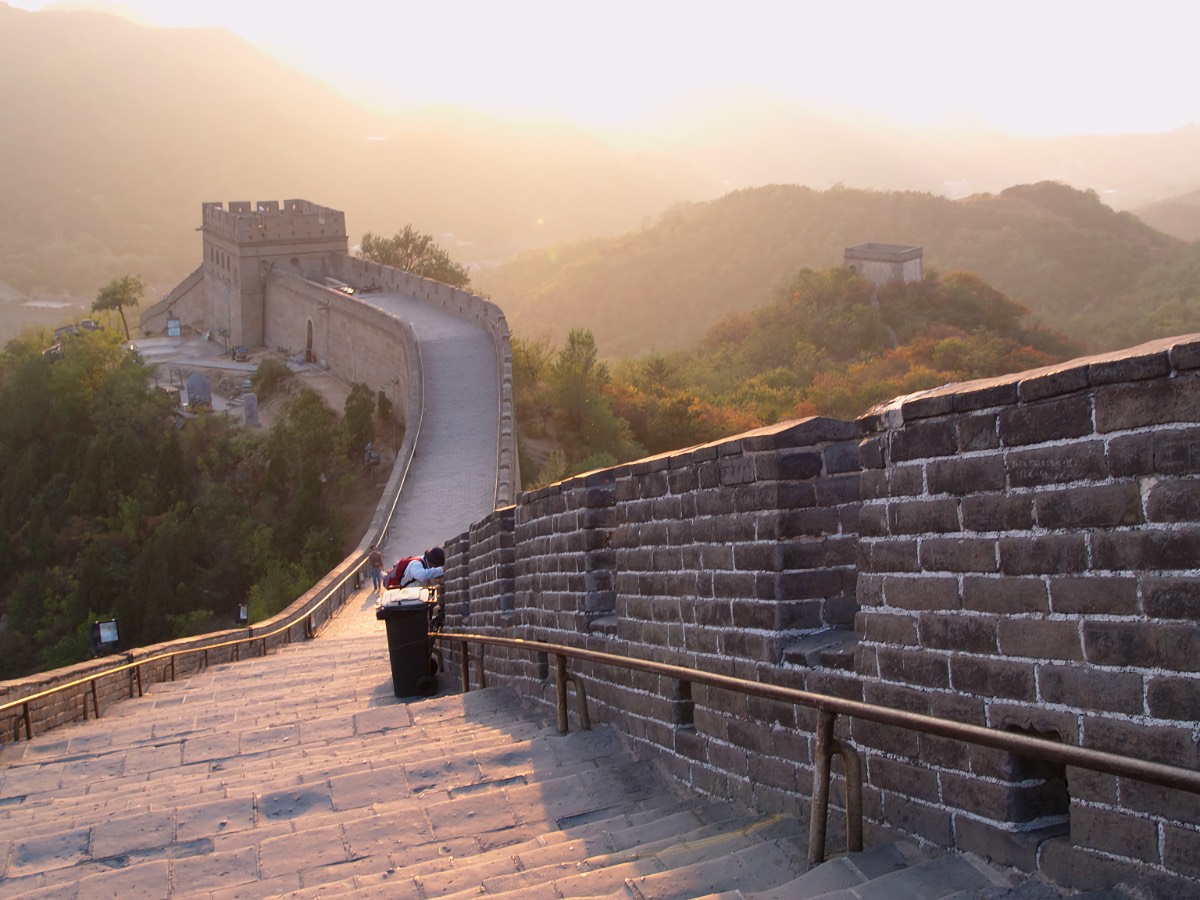
The Great Wall of China

How do we respond to the seemingly powerful Great Wall of characters?


For convenience:

The direct link for the PÄ«nyÄ«n (PÄ«n·yÄ«n {Piecing Together of} · Sounds → [Pinyin] æ‹ŒéŸł) Plus resource for the Enjoy Life Forever! book is:

The short link for Chinese field language-learning links for the Enjoy Life Forever! book is:

More PÄ«nyÄ«n (PÄ«n·yÄ«n {Piecing Together of} · Sounds → [Pinyin] æ‹ŒéŸł) and PÄ«nyÄ«n (PÄ«n·yÄ«n {Piecing Together of} · Sounds → [Pinyin] æ‹ŒéŸł) Plus web material based on the Mandarin Enjoy Life Forever! book will be made available in the PÄ«nyÄ«n (PÄ«n·yÄ«n {Piecing Together of} · Sounds → [Pinyin] æ‹ŒéŸł) Plus web resource as time allows.

Categories
Culture History Language Learning Names Technology

fántǐ‐zì

fĂĄntǐ (fĂĄn·tǐ complicated; complex; difficult · {body → [style] → [typeface; font]} → [traditional Chinese] çčäœ“ çčé«”)‐zĂŹ (characters 歗) đŸ‘ˆđŸŒ Tap/click to show/hide the “flashcard”

[This is a reposting of a post that was originally posted on November 30, 2020. I took the opportunity to flesh out the original post and this repost with additional material.]

For a long, long, long time, Chinese characters were just Chinese characters. Then, in 1956, the Communist government of mainland China issued what came to be known as the First Chinese Character Simplification Scheme (a second round of Chinese character simplification was later attempted and ultimately rescinded), and official simplified Chinese characters came into the world. (Some characters had been unofficially simplified and used for various purposes, both everyday and artistic, before that.)

Name?

To distinguish these newfangled official simplified Chinese characters from the Chinese characters that had existed before, and that continue to be used by many people in many parts of the world, retronyms were coined to refer to these pre-existing Chinese characters, just as the term “acoustic guitar” was coined to refer to a regular non-electric guitar after electric guitars came along.

In the English-speaking world, the pre-official simplification characters have come to be called “traditional Chinese characters”, as opposed to the “simplified Chinese characters”. In the Chinese-speaking world, as is true of many things regarding Chinese characters, the situation is
complicated. Wikipedia summarizes the situation thusly:

Traditional Chinese characters (the standard characters) are called several different names within the Chinese-speaking world. The government of Taiwan officially calls traditional Chinese characters standard characters or orthodox characters (traditional Chinese: æ­Łé«”ć­—; simplified Chinese: æ­Łäœ“ć­—; pinyin: zhĂšngtǐzĂŹ; Zhuyin Fuhao: ă„“ă„„Ë‹ ㄊㄧˇ ㄗˋ).[source] However, the same term is used outside Taiwan to distinguish standard, simplified and traditional characters from variant and idiomatic characters.[source]

In contrast, users of traditional characters outside Taiwan, such as those in Hong Kong, Macau and overseas Chinese communities, and also users of simplified Chinese characters, call them complex characters (traditional Chinese: çčé«”ć­—; simplified Chinese: çčäœ“ć­—; pinyin: fĂĄntǐzĂŹ; Zhuyin Fuhao: ㄈㄱˊ ㄊㄧˇ ㄗˋ). Users of simplified characters sometimes informally refer to them as “old characters” (Chinese: è€ć­—; pinyin: lǎozĂŹ; Zhuyin Fuhao: ㄌㄠˇ ㄗˋ).

Users of traditional characters also sometimes call them “full Chinese characters” (traditional Chinese: 慚體歗; simplified Chinese: ć…šäœ“ć­—; pinyin: quĂĄntǐ zĂŹ; Zhuyin Fuhao: ㄑㄩㄹˊ ㄊㄧˇ ㄗˋ) to distinguish them from simplified Chinese characters.

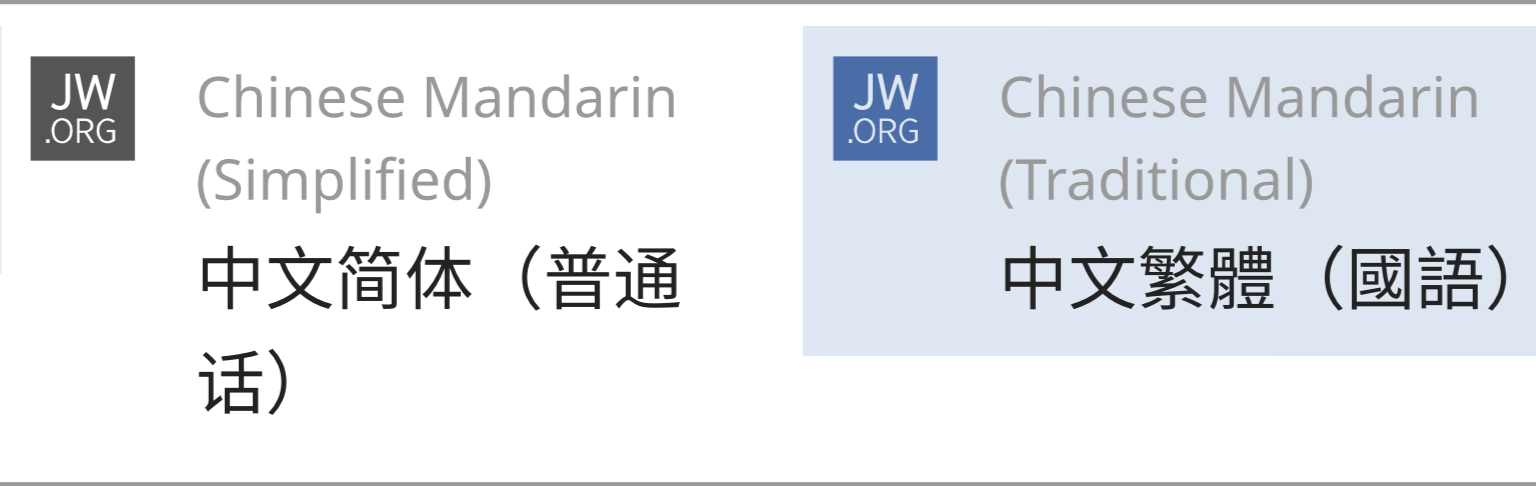
In my experience in the Chinese fields in Canada, I have always heard traditional Chinese characters referred to using this week’s MEotW, “fĂĄntǐ (fĂĄn·tǐ complicated; complex; difficult · {body → [style] → [typeface; font]} → [traditional Chinese] çčäœ“ çčé«”)‐zĂŹ (characters 歗)”. For reference, this is also the term used on jw.org when referring to Mandarin written using traditional Chinese characters:

jw.org referring to Mandarin written using traditional Chinese characters

jw.org refers to traditional Chinese characters as “fĂĄntǐ (fĂĄn·tǐ complicated; complex; difficult · {body → [style] → [typeface; font]} → [traditional Chinese] çčäœ“ çčé«”)” characters.

Beloved by Traditionalists and Purists, But Complicated

Many feel that traditional characters are the best characters of all, since, in their estimation, the official simplified characters have lost some of the heart and soul of characters. As a symbolic example, some point to how the simplified character for “love”, “爱”, omits the “heart” radical (“濃”), which is appropriately in the traditional character for “love”, “愛”.

Yes, as the above post mentions, the obvious, glaring issue with traditional characters is—aggravated by the fact that there are tens of thousands of them—their extreme, extraordinary complexity, the result of their problematically complex basic nature, along with thousands of years of accumulated occasionally arbitrary design decisions and developmental cruft. For example, note the below excerpt from p. 82 of the book The Chinese Language: Fact and Fantasy, by John DeFrancis:

In the case of the rendition for the huáng meaning “sturgeon” we have two variants, one written with the “yellow” phonetic and the other with the “emperor” phonetic, both combined with the semantic element for “fish”:

魚 “fish”
鱑 “fish” + huĂĄng “yellow” = huĂĄng “sturgeon”
鰉 “fish” + huáng “emperor” = huáng “sturgeon”

While etymological research might succeed in clarifying the basis for some of the variation, in many cases, as one specialist in Chinese paleography concludes, “it is simply a matter of the whim of the writer” (Barnard 1978:203).

Scribal whim goes far to explain a diversity bordering on chaos in the forms of the Chinese characters as they evolved in the Shang dynasty and during the long years of political and administrative disunity in the Zhou dynasty (ca. 1028–221 B.C.). The situation was aggravated by the fact that characters were created by writers living in different historical periods, which inevitably meant changes in sounds over the years, and speaking different dialects, which inevitably affected their choice of phonetic elements in the creation of new characters.

Their inherent extraordinary complexity, exacerbated by an accumulated millennia-long history of design decisions made on a whim, out-of-date phonetic elements, etc., causes especially the traditional characters, and even the (moderately) simplified characters, to be extremely difficult for us imperfect humans to learn and to remember. This has lead to character amnesia and the Great Wall of unfamiliar characters being real things, even among those who have been studying characters for decades. How complex can traditional characters get? Theoretically, there is no upper limit!

The extreme, extraordinary complexity of traditional characters undoubtedly contributed greatly to illiteracy having been widespread in China for much of its history. Even for those who are privileged to be able to devote the extraordinary amount of time and effort needed to learn traditional characters, it’s a long, hard slog, compared to learning a comparatively simple and compact alphabetical writing system. It’s little wonder, then, that there have been serious, concerted efforts to simplify and even replace traditional Chinese characters.