Categories
Culture Language Learning Technology Theocratic

lìyì

lìyì (lì·yì {sharpening → [advantage; benefit; gain | profit; interest]} · benefit; advantage; profit → [benefit; profit] 利益) 👈🏼 Tap/click to show/hide the “flashcard”

[Notes: Tap/click on a Pīnyīn (Pīn·yīn {Piecing Together of} · Sounds → [Pinyin] 拼音) expression to reveal its “flashcard”; tap/click on a “flashcard” or its Pīnyīn (Pīn·yīn {Piecing Together of} · Sounds → [Pinyin] 拼音) expression to hide the “flashcard”. 📖 📄 📘 icons mean 📖 Reveal All, 📄 Reveal Advanced, and 📘 Reveal None re all the “flashcards” in the heading, paragraph, etc. that they are placed at the beginning of.]

I have long especially liked 1 Corinthians 13. It contains counsel on what really does and doesn’t matter in life, an extensive description and definition of the most important kind of love, and a sublime discussion about the need to become complete, mature, as a person. As these apply to life in general, so too do they apply to our lives as Mandarin field language learners.

As Mandarin field language learners, it can benefit us greatly to consider what we can learn from 1 Corinthians 13, and along the way, we can also consider some of the Mandarin expressions used in that chapter in the current version of the Mandarin New World Translation Bible (nwtsty).

“Lookin’ Out for #1”?

This week’s MEotW, “lìyì (lì·yì {sharpening → [advantage; benefit; gain | profit; interest]} · benefit; advantage; profit → [benefit; profit] 利益)”, is used in verse 5 (WOL) of 1 Corinthians 13:
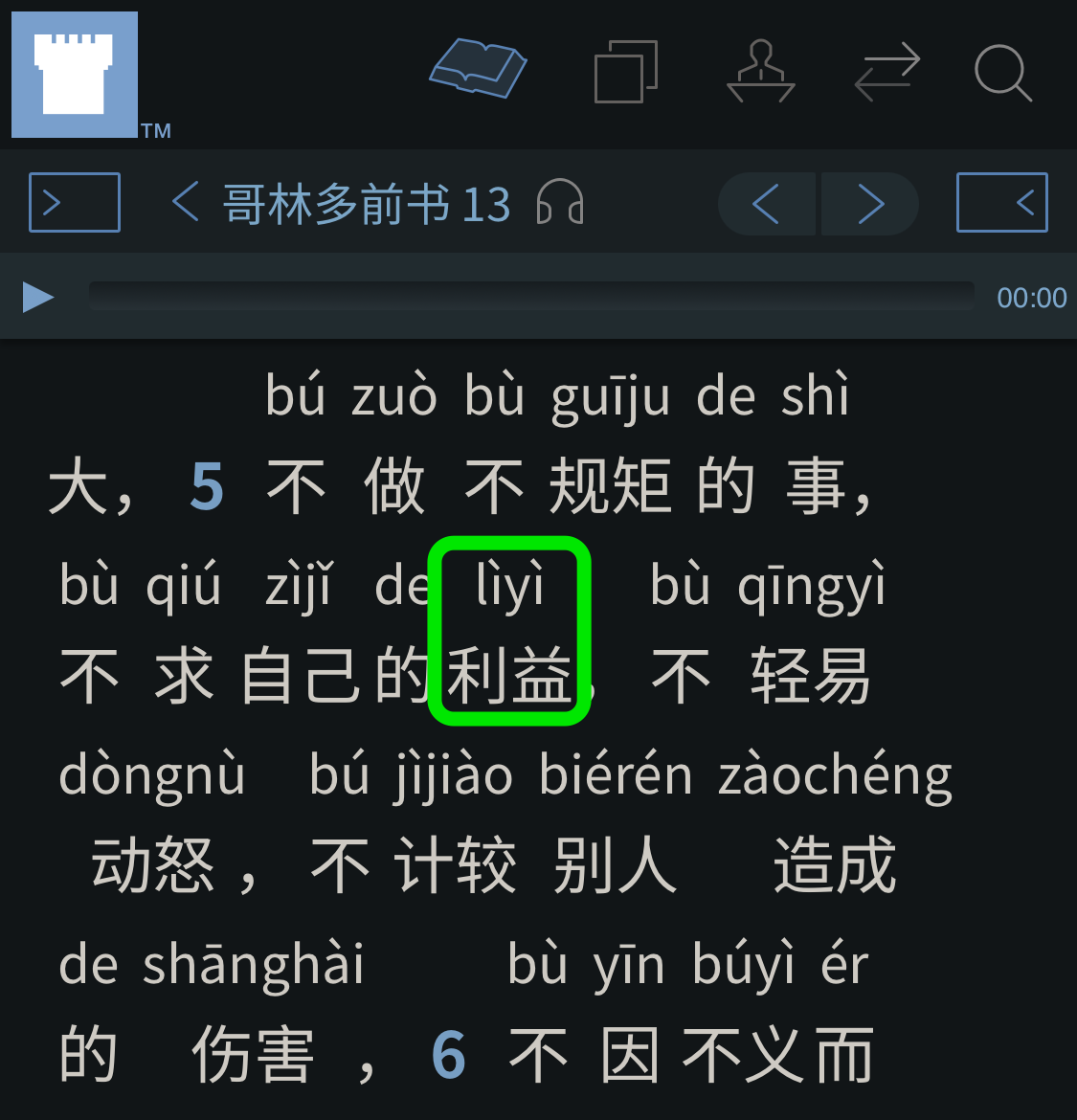
Screenshot of “_lìyì_” in 1 Co. 13:5 (nwtsty, CHS+_Pīnyīn_ WOL)

(Dark mode for the Watchtower ONLINE LIBRARY (WOL) website, as shown in the above image, can be enabled in the Safari web browser by using the Noir Safari extension. Other web browsers may also have extensions with similar functionality.)

For comparison, here are the current English and Pīnyīn (Pīn·yīn {Piecing Together of} · Sounds → [Pinyin] 拼音) Plus renderings of 1 Corinthians 13:5:

English:

does not behave indecently, does not look for its own interests, does not become provoked. It does not keep account of the injury.

Pīnyīn (Pīn·yīn {Piecing Together of} · Sounds → [Pinyin] 拼音) Plus:

📖 📄 📘 (not 不) zuò ({does do} 做) (not 不) guīju (guī·ju (following) {dividers → [rules]} · {carpenter’s squares → [regulations]} → [following established standards] 规矩 規矩) de ( 的) shì (things 事), (not 不) qiú ({does seek} 求) zìjǐ (self 自己) de (’s 的) lìyì (lì·yì {sharpening → [advantage]} · benefit → [benefit] 利益), (not 不) qīngyì (qīng·yì lightly · easily 轻易 輕易) dòngnù (dòng·nù {does have moved} · anger → [does get angry] 动怒 動怒), (not 不) jìjiào (jì·jiào {does count} · {does dispute} 计较 計較) biéren (bié·ren other · people 别人 別人) zàochéng (zào·chéng {have created} · {to come to be} 造成) de (’s 的) shānghài (injuring → [injury] 伤害 傷害),

The “lì (sharpen [→ [do good [for/to]; be beneficial [for/to]]] | sharpened [→ [sharp | favourable; advantageous; good; beneficial; smooth; convenient]] | sharpening [→ [advantage; benefit; gain | profit; interest]] 利) in “lìyì (lì·yì {sharpening → [advantage; benefit; gain | profit; interest]} · benefit; advantage; profit → [benefit; profit] 利益) literally means “sharpening”, and can effectively mean “advantage; benefit; gain”. Similarly, the “yì (benefit; good; advantage; profit; increase | beneficial; profitable | {to increase; to benefit} 益) in “lìyì (lì·yì {sharpening → [advantage; benefit; gain | profit; interest]} · benefit; advantage; profit → [benefit; profit] 利益) means “benefit; advantage; profit”. We can see then, why in 1 Corinthians 13:5 in the current English and Mandarin versions of the New World Translation Bible, “bù (not 不) qiú ({does seek} 求) zìjǐ (self 自己) de (’s 的) lìyì (lì·yì {sharpening → [advantage]} · benefit → [benefit] 利益) corresponds with the English phrase “does not look for its own interests”.

In this regard, true Christian love is completely opposite from the norm in Satan’s world, which is the kind of self-interest and lovelessness that’s expressed by this excerpt from the lyrics of the song “Lookin’ Out for #1”:

Every night is a different game
We gotta work for our fortune and fame
Success is a ladder, take a step at a time
And the people will remember your name

Yes, I found out all the tricks of the trade
And that’s there’s only one way you’re gonna get things done
I found out the only way to the top
Is looking out for number one
And that’s me, I’m looking out for number one

Not Looking For Our Own Interests in the Mandarin Field

Unlike the self-seeking people of Satan’s world, Mandarin field language learners who seek to show Christian love must not view their language learning and ministry as just a game, nor should they be seeking fortune and fame, or success as defined by the world. And rather than wanting people to remember their names, they seek to proclaim Jehovah’s name. Rather than trying to get to the top, they try to help Mandarin-speaking people to get everlasting life. Yes, rather than looking out for number one (themselves), they exert themselves and make sacrifices to help others as spiritual rescue workers, and they seek to glorify, not themselves, but rather, Jehovah, as admonished by our recently introduced song “Give Jehovah Glory”.

To help us gain insight on how well we are doing when it comes to not looking for our own interests in the Mandarin field, we could consider the following:

  • If we are exerting ourselves to learn the traditionally used but exceedingly complex Chinese characters, how much of our motivation is to be more able to help Mandarin-speaking people more effectively and glorify Jehovah more clearly and eloquently, and how much is it to glorify ourselves in the eyes of tradition-loving advocates of worldly Chinese culture?
  • Are we resistant to Pīnyīn (Pīn·yīn {Piecing Together of} · Sounds → [Pinyin] 拼音) because it doesn’t have the same worldly cultural glamour and prestige as the characters do, or do we value it because of how it can help us to more quickly, easily, and effectively glorify Jehovah and give spiritual help to Mandarin-speaking people?
  • This year’s convention program helps us to further appreciate the kind of person Jesus showed himself to be when he was on earth. As Jesus’ Christian followers, we seek to follow his example, including his example in showing love that “does not look for its own interests”.
    • From what we have learned about Jesus, if he were on earth today and serving in the Mandarin field, would he be impressed by the glorious, prestigious traditions of worldly Chinese culture, such as those involving Chinese characters? Would he be okay with allowing such human traditions to make it much more difficult than necessary to glorify Jehovah in Mandarin and give spiritual help to Mandarin-speaking people? Considering how he viewed the Sabbath traditions of the first-century Jews, which only unnecessarily oppressively burdened people one day a week, how would he view today’s human-mandated traditions involving Chinese characters, which unnecessarily oppressively burden his followers in the Mandarin field every single day?John 5:16, 17; 41–44.
Categories
Culture Language Learning Science Technology Theocratic

róngyào

róngyào (róng·yào glory; honour · {being bright; dazzling; brilliant; shining → [honour; glory]} → [glory; honour] | glorify · {to be bright; dazzling; brilliant; shining → [to be glorious]} → [glorify] | honourable; glorious · {bright; dazzling; brilliant; shining → [glorious]} → [honourable; glorious] 荣耀 榮耀) 👈🏼 Tap/click to show/hide the “flashcard”

Rather than dismissively thinking to ourselves that the songs produced by the organization are “just songs”, we should remember that the slave class takes seriously its responsibility to provide spiritual food to God’s people, and so it is going to make sure that the lyrics in its songs are spiritually correct, while also being emotionally moving.—Ezekiel 33:32; Matthew 24:45.

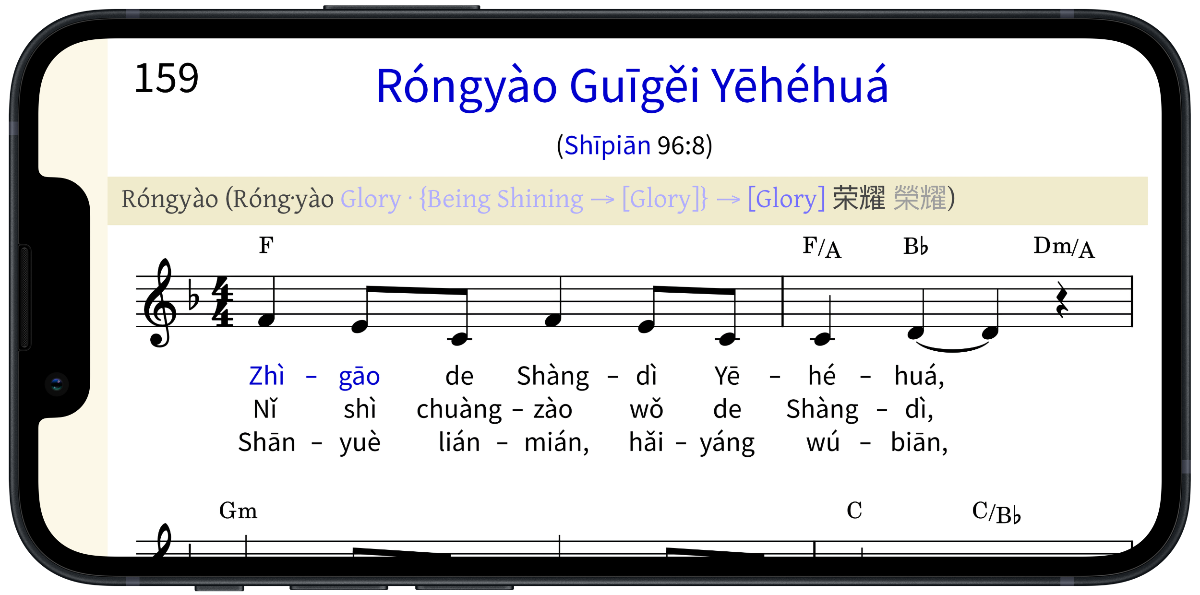
“Give Jehovah Glory”

“Róngyào” _Pīnyīn_ Plus info, Song 159 (music+_Pīnyīn_), on iPhone 13 mini (landscape orientation)

This week’s MEotW in the unofficial Pīnyīn (Pīn·yīn {Piecing Together of} · Sounds → [Pinyin] 拼音) Plus resource “Sing Out Joyfully” Bk. (Pīnyīn+Music, Pīnyīn Plus, Web)

This week’s MEotW, “róngyào (róng·yào glory; honour · {being bright; dazzling; brilliant; shining → [honour; glory]} → [glory; honour] | glorify · {to be bright; dazzling; brilliant; shining → [to be glorious]} → [glorify] | honourable; glorious · {bright; dazzling; brilliant; shining → [glorious]} → [honourable; glorious] 荣耀 榮耀)”, comes from the relatively new song 159, which is entitled “Give Jehovah Glory” in English and “Róngyào (Róng·yào Glory · {Being Shining → [Glory]} → [Glory] 荣耀 榮耀) Guīgěi (Guī·gěi {Give Back} · {to Be Given to} 归给 歸給) Yēhéhuá (Jehovah 耶和华 耶和華) in Mandarin (WOL, Pīnyīn (Pīn·yīn {Piecing Together of} · Sounds → [Pinyin] 拼音) Plus).

“Róngyào (Róng·yào glory; honour · {being bright; dazzling; brilliant; shining → [honour; glory]} → [glory; honour] | glorify · {to be bright; dazzling; brilliant; shining → [to be glorious]} → [glorify] | honourable; glorious · {bright; dazzling; brilliant; shining → [glorious]} → [honourable; glorious] 荣耀 榮耀) is flexible regarding what part of speech it can be—it can mean “glory; honour”, “glorify”, or “honourable; glorious”. In the Mandarin field, what kinds of glory should we be mindful of? Whom should we seek to glorify? What kind of glory is truly glorious?

“Glory from Men” Who Glorify Worldly Human Chinese Culture

Some in the Mandarin field may focus on gaining knowledge of Chinese characters so as to obtain glory from certain humans. Ones who do this are taking a different approach from that of Jesus, who said at John 5:41–44:

I do not accept glory from men, but I well know that you do not have the love of God in you. I have come in the name of my Father, but you do not receive me. If someone else came in his own name, you would receive that one. How can you believe, when you are accepting glory from one another and you are not seeking the glory that is from the only God?

Why do some humans heap praise and glory on those who have acquired extensive knowledge of Chinese characters? For one thing, Chinese characters are famously extraordinarily hard to learn and remember (unnecessarily so, actually), and so there is the natural glory given to those who have been able to accomplish a hard thing. Also, though, Chinese characters are glamourized by many as distinctive symbols of worldly human Chinese culture, and many are proud of them, and proud of worldly human Chinese culture. This is a big reason why traditional Mandarin language instruction and traditional Mandarin language teachers in general focus on Chinese characters so much and encourage Mandarin learners to prioritize them.

It is only natural for a student of Mandarin to want to receive glory from his teacher and others like him. Unfortunately, though, experience has shown that going along with a traditional Mandarin language teacher’s focus on characters may lead to a Mandarin learner actually being diverted into a deep rabbit hole and hindered from actually learning how speak Mandarin well. While such ones may, after many years of intense effort, come to be able to recognize many Chinese characters, they may not be able to, say, glorify Jehovah while speaking powerfully and persuasively to Mandarin-speaking people, the way Jesus spoke to people. (Mark 1:22) That’s because this traditional focus on characters has all along been mainly meant, not to help Mandarin learners actually learn to speak Mandarin, but to perpetuate and glorify worldly human Chinese culture.

Glory for Worldly Chinese Political Systems

In this world, certain aspects of Chinese culture can unfortunately get politicized. For example, Simplified characters and Pīnyīn (Pīn·yīn {Piecing Together of} · Sounds → [Pinyin] 拼音) were created in mainland China, so some may promote these systems so as to glorify the political system of mainland China. On the other hand, Traditional characters and Zhùyīn (Zhù·yīn {Annotating of} · Sounds → [Zhuyin] 注音 註/注音) continued to be used in Taiwan after the mainland pivoted away from them, so some may promote these systems so as to glorify the political system of Taiwan. Even the Mandarin expression that people use to refer to the Mandarin language (Guóyǔ (Guó·yǔ National · Language → [(Modern Standard) Mandarin (term commonly used in Taiwan)] 国语 國語)/pǔtōnghuà (pǔ·tōng·huà common; universal · {through(out) → [common]} · speech → [(Modern Standard) Mandarin (term commonly used in China)] 普通话 普通話)/Huáyǔ (Huá·yǔ {Magnificent; Splendid; Flowery; Florescent → [Chinese]} · Language → [(Modern Standard) Mandarin (term commonly used in Singapore)] 华语 華語)/etc.) can be made to take on political connotations. Of course, as Jehovah’s politically neutral servants, we must avoid doing things just to glorify one human political system over another.

Another thing that we Mandarin field language learners must beware of is the erroneous idea that Mandarin, Cantonese, Shanghainese, etc. are just “dialects” of “Chinese”. This misconception has been widely spread as political propaganda, to bolster the idea that China should be united under one political system. So, if we parrot that erroneous view regarding so-called Chinese “dialects” that in reality function like distinct languages, then we are actually parroting political propaganda that is designed to glorify China’s central government regardless of any confusion or other negative effects that may result from such spreading of falsehood.

Glory for Jehovah

Rather than allowing ourselves to be used to glorify humans or things in this worldly human system, we can show that we seek to glorify Jehovah, the God of truth. (John 17:17; 4:23, 24) One way we can do so in the Chinese language fields is by rejecting the many untruths that have been spread about the Chinese languages. Also, we can do so by seeking to choose and use systems and methods based on what really works best to help us to praise and glorify Jehovah, not based on what serves to glorify ourselves or worldly humans, and not based on what serves to perpetuate and glorify worldly human cultures, traditions, and political systems.

As Jesus’ words above showed, Jehovah gives “the glory that is from the only God” to those who seek to give glory to him, rather than to mere humans. So, let us follow song 159’s simple but profound admonition, and give glory to Jehovah!

Categories
Culture Experiences History Language Learning Technology Theocratic

zìxué‐chéngcái

zìxué‐chéngcái ((zì·xué self · learned; studied 自学 自學)‐(chéng·cái became · {capable person} 成才) [[be] self-taught]) 👈🏼 Tap/click to show/hide the “flashcard”

[Notes: Tap/click on a Pīnyīn (Pīn·yīn {Piecing Together of} · Sounds → [Pinyin] 拼音) expression to reveal its “flashcard”; tap/click on a “flashcard” or its Pīnyīn (Pīn·yīn {Piecing Together of} · Sounds → [Pinyin] 拼音) expression to hide the “flashcard”. 📖 📄 📘 icons mean 📖 Reveal All, 📄 Reveal Advanced, and 📘 Reveal None re all the “flashcards” in the heading, paragraph, etc. that they are placed at the beginning of.]

Recently, jw.org featured the video “Benjamin Boothroyd—A Self-Taught Bible Scholar”. Where the English title of this video uses the expression “self-taught”, the title of the Mandarin version uses this week’s MEotW, “zìxué‐chéngcái ((zì·xué self · learned; studied 自学 自學)‐(chéng·cái became · {capable person} 成才) [[be] self-taught])”:

English:

Benjamin Boothroyd—A Self-Taught Bible Scholar

Mandarin:

📖 📄 📘 Běnjiémíng (Benjamin 本杰明 本傑明) Bùsīluóyīdé (Boothroyd 布思罗伊德 布思羅伊德): Zìxué‐Chéngcái ((Zì·xué Self · Learned 自学 自學)‐(Chéng·cái Became · {Capable Person} 成才) [Self-Taught]) de (’s 的) Shèngjīng (Shèng·jīng Holy · Scriptures → [Bible] 圣经 聖經) Xuézhě (Xué·zhě Studying · Person → [Scholar] 学者 學者)

The Morphemes

The first morpheme in this week’s MEotW, “zì (self | from; since 自)”, here means “self”, as it does in “zìjǐ (self[’s] 自己)”. The next morpheme, “xué (learn/learning | study [→ [imitate]])”, here means “learned; studied”. Another expression in which it appears is “xuésheng (xué·sheng learning · {growing (one) → [student]} → [student; pupil] 学生 學生)”, which means “student”. These first two morphemes, when put together to form “zìxué (zì·xué self · learn; study 自学 自學)”, refer to learning or studying by oneself.

The third morpheme in this week’s MEotW, “chéng (become; {come to be}; {to turn into}; {to complete}; accomplish; succeed; {fully developed/grown}; {assume [the shape of]}; {to fill} | {to completion} 成)”, here means “became”. It also appears in many other expressions, including “chéngwéi (chéng·wéi become · {to be} 成为 成為) and “chénggōng (chéng·gōng {becoming [of]}; {accomplishing [of]} · {meritorious service/deed}; achievement → [succeed | success | successful[ly]] 成功)”. The final morpheme “cái ({only then} | {only (before a number)} | actually; really; very | talent; ability; gift | {capable person} | {person of a certain type}才/纔) in this context means “capable person”. So, “chéngcái (chéng·cái become · {capable person} 成才) here means “became capable person”, and the entire expression “zìxué‐chéngcái ((zì·xué self · learned; studied 自学 自學)‐(chéng·cái became · {capable person} 成才) [[be] self-taught]) literally means “self-learned/studied, became capable person”, and effectively means “self-taught”.

Being Self-Taught in the Mandarin Field

Apart from the introductory organization-sponsored language classes that many of us took, we Mandarin field language learners are pretty much all self-taught with regard to Mandarin, especially when it comes to the somewhat specialized Mandarin that we must use in the Mandarin field. But does being largely self-taught mean that none of us can really be any good at Mandarin? Are we doomed to plateau at a mediocre level at best?

One thing I appreciated from the video mentioned above is that Benjamin Boothroyd, who was self-taught but became a world-class Bible scholar and translator, was motivated only to pursue the truth. As he wrote (as mentioned in the English video starting at the 6:38 mark):

I have no interest to serve but that of truth.

Regarding those with such a focus on the truth, at John 18:37, Jesus said:

For this I have been born, and for this I have come into the world, that I should bear witness to the truth. Everyone who is on the side of the truth listens to my voice.

Those who are “on the side of the truth” and who listen to Jesus’ voice open themselves up to receiving the most important education we can get. This best possible education comes from Jehovah God himself, not any worldly or human source. As Isaiah 54:13 says:

And all your sons will be taught by Jehovah,
And the peace of your sons will be abundant.

Even when it comes to nontrivial technical matters, Jehovah can help certain ones develop the technical knowledge, skills, and expertise that are needed to accomplish his will. For example, as Exodus 35:30–35 tells us, he did so when some specialized technical work needed to be done when Moses and the Israelites were in the wilderness:

30 Then Moses said to the Israelites: “See, Jehovah has chosen Bezʹal·el the son of Uʹri the son of Hur of the tribe of Judah. 31 He has filled him with the spirit of God, giving him wisdom, understanding, and knowledge of every sort of craftsmanship 32 for making artistic designs, for working with gold, silver, and copper, 33 for cutting and setting stones, and for making all kinds of artistic wood products. 34 And he has put it into his heart to teach, he and O·hoʹli·ab the son of A·hisʹa·mach of the tribe of Dan. 35 He has filled them with skill to do all the work of a craftsman, an embroiderer, and a weaver using blue thread, purple wool, scarlet material, and fine linen, and of a loom worker. These men will do every sort of work and prepare every sort of design.

Yes, if we focus on the truth and stay open to Jehovah’s direction, we can make “self-taught” also mean “taught by Jehovah”! And since Jehovah created this universe that human scientists, technicians, artists, musicians, etc. are just trying to figure out and work in, he can, if he wants to, even potentially teach us to become more knowledgeable and skilled in certain fields than many worldly humans are, as he may have done with Bezʹal·el and O·hoʹli·ab.—Psalm 119:98–100.

Modern Resources for Mandarin Self-Learning

In support of our efforts to be successfully self-taught in effectively using Mandarin to praise and serve Jehovah, we today are blessed with many available resources, the likes of which Bezʹal·el, O·hoʹli·ab, and Mr. Boothroyd would undoubtedly have loved to have had access to. For example, one of the basic things that teaching and learning require is the transfer of information to those seeking to learn, and in that regard, we humans today generally have access to, at reasonable cost, computing—i.e., information-processing—devices that can easily be carried by hand, but that are, in some ways, millions of times more capable than the Apollo Guidance Computer (AGC) that guided the Apollo 11 spacecraft to the moon.

In addition to these mobile devices themselves, we should also consider the apps and the text, audio, video, etc. content that they enable us to use to help us learn Mandarin. These include the JW Language app, as well as the JW Library app that now allows for content that displays Pīnyīn (Pīn·yīn {Piecing Together of} · Sounds → [Pinyin] 拼音). Here are a couple of short links listing some of the resources available for Mandarin field language learners:

No Need to Have Impostor Syndrome in the Mandarin Field

In view of the above, if Jehovah has guided us to serve in the Mandarin field, we need not allow ourselves to be burdened with impostor syndrome, even if we haven’t received extensive worldly training in the Mandarin language. If we let ourselves be “taught by Jehovah” instead of just relying on our own talent or abilities or on mere worldly knowledge or human traditions, and if we resolutely make good use of the available resources and apply ourselves to learn whatever we need to learn in order to do Jehovah’s work well, Jehovah can and will bless our efforts and help us succeed. Also, if we follow Boothroyd’s example and pursue truth rather than “glory from men”, then the truth will be able to set us free from the unnecessary burdens imposed by proud but fallacious human traditions such as those involving Chinese characters. (John 5:41–44; 8:32) As the apostle Paul said at 1 Corinthians 1:26–31:

26 For you see his calling of you, brothers, that there are not many wise in a fleshly way, not many powerful, not many of noble birth, 27 but God chose the foolish things of the world to put the wise men to shame; and God chose the weak things of the world to put the strong things to shame; 28 and God chose the insignificant things of the world and the things looked down on, the things that are not, to bring to nothing the things that are, 29 so that no one might boast in the sight of God. 30 But it is due to him that you are in union with Christ Jesus, who has become to us wisdom from God, also righteousness and sanctification and release by ransom, 31 so that it may be just as it is written: “The one who boasts, let him boast in Jehovah.”