Categories
Science Technology Theocratic

xiétiáo

xiétiáo (xié·tiáo {assisting → [jointly; coordinatedly]} · {be regulated; adjusted; mixed → [suit well; fit [in] perfectly]} → [coordinate; harmonize; bring into line; fit together; match] 协调 協調) 👈🏼 Tap/click to show/hide the “flashcard”

[Notes: Tap/click on a Pīnyīn (Pīn·yīn {Piecing Together of} · Sounds → [Pinyin] 拼音) expression to reveal its “flashcard”; tap/click on a “flashcard” or its Pīnyīn (Pīn·yīn {Piecing Together of} · Sounds → [Pinyin] 拼音) expression to hide the “flashcard”. 📖 📄 📘 icons mean 📖 Reveal All, 📄 Reveal Advanced, and 📘 Reveal None re all the “flashcards” in the heading, paragraph, etc. that they are placed at the beginning of.]

The Shēngmìng Láizì Chuàngzào Ma? ((Shēngmìng Life 生命) (Lái·zì Came · From 来自 來自) (Chuàng·zào Initiating · {Making, Creating} → [Creating] 创造 創造) (Ma [? ptcl for “yes/no” questions])? [Was Life Created? (lc)]) (Was Life Created? (lc)) brochure and the Shēngmìng de Qǐyuán—Zhíde Sīkǎo de Wǔ Ge Wèntí ((Shēngmìng Life 生命) (de ’s 的) (Qǐ·yuán {Rising → [Starting]} · Source → [Origin] 起源/原)—(Zhí·de Worth · Getting → [Worth] 值得) (Sī·kǎo {Thinking About} · Examining 思考) (de ’s 的) (Wǔ Five 五) (Ge [mw]個/个) (Wèn·tí Asking · Subjects → [Questions] 问题 問題) [The Origin of Life—Five Questions Worth Asking (lf)]) (The Origin of Life—Five Questions Worth Asking (lf)) brochure were originally published back in 2010, but relatively recently, the English version of the Was Life Created? brochure was updated to the December 2022 Printing, and the Mandarin version of it was updated to the February 2023 Printing. Also, the Was Life Created? brochure and the Origin of Life brochure are now in the Teaching Toolbox section in the JW Library app. So, it would be good to consider some of the expressions used in the Mandarin versions of these publications that can be so helpful when discussing whether life was created.

They’re Coordinated

This week’s MEotW, “xiétiáo (xié·tiáo {assisting → [jointly; coordinatedly]} · {be regulated; adjusted; mixed → [suit well; fit [in] perfectly]} → [coordinate; harmonize; bring into line; fit together; match] 协调 協調)”, occurs in the box at the end of the QUESTION 1 section of the Origin of Life brochure, which section is entitled, in English, “How Did Life Begin?”:

English:

Question: What takes greater faith—to believe that the millions of intricately coordinated parts of a cell arose by chance or to believe that the cell is the product of an intelligent mind?

Mandarin (WOL, Pīnyīn (Pīn·yīn {Piecing Together of} · Sounds → [Pinyin] 拼音) Plus):

📖 📄 📘 Qǐng (please) xiǎngxiang (xiǎng·xiang {think about} · {think about} 想想): Xìbāo (Xì·bāo tiny · womb → [cell] 细胞 細胞) de (’s 的) wúshù (wú·shù without · number 无数 無數) bùfen (parts 部分) cuòzōng (cuò·zōng {are interlocked → [are intricate]} · {are combined → [are composite]} → [are intricate] 错综 錯綜)fùzá (fù·zá {are turned around → [are compound]} · {are mixed} → [are complex] 复杂 複雜), xiānghù ({with each other} 相互) xiétiáo (xié·tiáo {assisting → [coordinatedly]} · {are regulated → [fit in perfectly]} → [coordinate] 协调 協調), (you 你) rènwéi (rèn·wéi {do identify} · {(it) to be} (that) 认为 認為) xìbāo (xì·bāo tiny · womb → [cell] 细胞 細胞) shì (is 是) pèngqiǎo (pèng·qiǎo {having bumped into} · {being coincidental} → [by chance] 碰巧) chǎnshēng (chǎn·shēng {given birth to → [produced]} · {given birth to → [caused to exist]} → [brought into being] 产生 產生) de ({’s (thing)} 的), háishi (hái·shi {still more → [or]} · {is (it)} 还是 還是) zhìhuì (zhì·huì wisdom · intelligence → [wisdom] 智慧) de (’s 的) jiéjīng (jié·jīng {tied (into a knot) → [formed]} · crystal → [crystallization] 结晶 結晶) ne ([? ptcl] 呢)? (which 哪) (one 一) yàng (form → [way]) cái ({only then}才/纔) shì (is 是) bùkě (bù·kě (one) not · can → [(one) cannot] 不可) zhìxìn (zhì·xìn place · {believing in} → [believe (usually used in the negative)] 置信) de ({’s (way)} 的) ne ([? ptcl] 呢)?

They’re Really Coordinated

The MEotW post on “cuòzōng (cuò·zōng {[is] interlocked and jagged → [[is] intricate]} · {[is] combined → [[is] composite]} → [[is] intricate; complex; tangled] 错综 錯綜)fùzá (fù·zá {[is] turned around → [[is] compound; complex]} · {[is] mixed} → [[is] complicated; complex] 复杂 複雜)”, which occurs a bit before this week’s MEotW “xiétiáo (xié·tiáo {assisting → [jointly; coordinatedly]} · {be regulated; adjusted; mixed → [suit well; fit [in] perfectly]} → [coordinate; harmonize; bring into line; fit together; match] 协调 協調) in the above-quoted paragraph, contains this sentence:

In “cuòzōng (cuò·zōng {[being] interlocked and jagged → [[being] intricate]} · {[being] combined → [[being] composite]} → [[being] intricate; complex; tangled | (mental) complex (n)] 错综 錯綜)”, “cuò ({[is] alternating; staggered} [→ [[is] wrong; mistaken; incorrect; erroneous | missed | grinding; rubbing | moving to the side | mistake; error; blunder [→ [fault]]]] | {[is] interlocked and jagged} [→ [intricate]]) literally means “interlocked and jagged”, and it effectively means “intricate”.

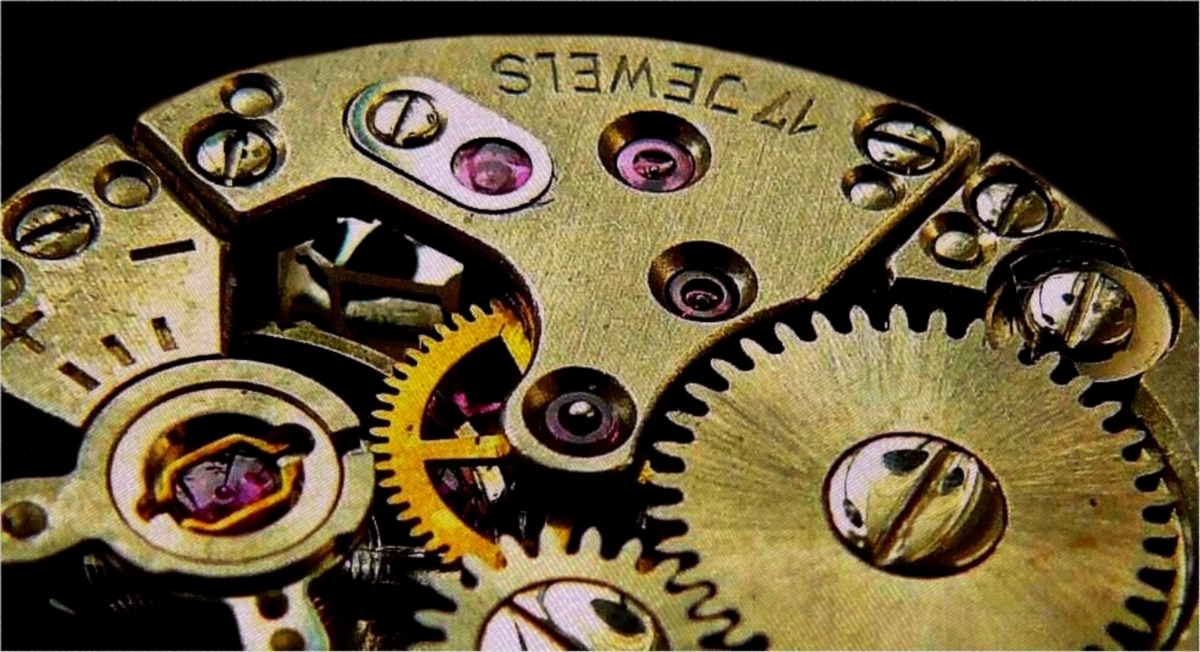
“Interlocked and jagged” and “intricate” may bring to mind a clockwork mechanism, like this:

Closeup of a clockwork mechanism

Such a clockwork mechanism’s many parts are not only interlocked and intricate, they must also be highly coordinated in how they function—especially with mechanical clocks or watches, it’s all in the timing! This well-timed coordination is what “xiétiáo (xié·tiáo {assisting → [jointly; coordinatedly]} · {be regulated; adjusted; mixed → [suit well; fit [in] perfectly]} → [coordinate; harmonize; bring into line; fit together; match] 协调 協調) refers to.

The “xié (assist | assisting → [joint | jointly; coordinatedly]) in “xiétiáo (xié·tiáo {assisting → [jointly; coordinatedly]} · {be regulated; adjusted; mixed → [suit well; fit [in] perfectly]} → [coordinate; harmonize; bring into line; fit together; match] 协调 協調) literally means “assisting”, and in this context it effectively means “jointly” or “coordinatedly”. (This “xié (assist | assisting → [joint | jointly; coordinatedly]) also appears in the relatively well-known expression “xiézhù (xié·zhù assist · help; assist; aid 协助 協助)”.) The other morpheme “tiáo (regulate; adjust; mix; tune [→ [suit well; fit [in] perfectly | mediate | provoke; tease; tantalize | incite; instigate; sow discord]]調) literally means “be regulated; adjusted; mixed”, and here it effectively means “suit well; fit [in] perfectly”. Being put together this way, “xiétiáo (xié·tiáo {assisting → [jointly; coordinatedly]} · {be regulated; adjusted; mixed → [suit well; fit [in] perfectly]} → [coordinate; harmonize; bring into line; fit together; match] 协调 協調) on one level of literalness can mean “coordinatedly fit in perfectly”, and it can effectively mean “coordinate; harmonize; fit together; match”.

These meanings certainly apply to a finely crafted clockwork mechanism like the one pictured above, and they also apply to the many harmoniously functioning parts of a cell. Could the many parts of a clockwork mechanism have evolved separately, and then somehow come together by chance to function in the highly coordinated way that they do? It’s even less likely that the millions of intricately coordinated parts of a cell evolved separately and then somehow came together by chance to function like they do!

To give us an idea of how some of the parts of a cell function, here is a video I came across that uses computer animation to help us visualize how tiny molecular machines (discussed in the MEotW post on “fēnzǐ jùhé‐tǐ ((fēn·zǐ {divided (off)} · {small and hard thing} → [molecular] 分子) (jù·hé assembled · {closed → [combined]} → [polymerized] 聚合)‐(tǐ body體/体/躰) [(protein) molecular machine])”) inside our cells copy DNA:

As we can see, not only are a cell’s millions of parts highly complex and intricate, like the many pieces of a static puzzle, they also dynamically coordinate in real time as they go about their various functions, like the many moving parts of a working factory.

They’re Really, Really Coordinated

The MEotW post on “cuòzōng (cuò·zōng {[is] interlocked and jagged → [[is] intricate]} · {[is] combined → [[is] composite]} → [[is] intricate; complex; tangled] 错综 錯綜)fùzá (fù·zá {[is] turned around → [[is] compound; complex]} · {[is] mixed} → [[is] complicated; complex] 复杂 複雜) goes on to say:

It’s appropriate then, that the Mandarin Origin of Life brochure uses this expression to refer to the “millions of intricately coordinated parts of a cell”. Truly, most who have not specifically looked into the matter have no idea how fantastically complex even a single living cell is, never mind living organisms like us humans that are each made up of tens of trillions of cells, of which there are hundreds of different types.

Yes, not only do the millions of parts inside a single cell coordinate with each other, all of the parts inside the human body’s tens of trillions of cells, of which there are hundreds of different types, also ultimately work together in highly coordinated ways!

Let us, then, not hesitate to make good use of the Origin of Life brochure in the Mandarin field, to help ensure that our loving and wise Creator gets the praise and honour he deserves in this field in which many were taught that there is no Creator.—Revelation 4:11.


For convenience:

The direct link for the current-generation Pīnyīn (Pīn·yīn {Piecing Together of} · Sounds → [Pinyin] 拼音) Plus resource for the Origin of Life brochure is:

The short link for Chinese field language-learning links for the Origin of Life brochure is:

More Pīnyīn (Pīn·yīn {Piecing Together of} · Sounds → [Pinyin] 拼音) and Pīnyīn (Pīn·yīn {Piecing Together of} · Sounds → [Pinyin] 拼音) Plus web material based on the Mandarin Origin of Life brochure will be made available in the Pīnyīn (Pīn·yīn {Piecing Together of} · Sounds → [Pinyin] 拼音) Plus web resource as time allows.

Categories
Culture Current Events Experiences Language Learning Names Science Technology

Lǐ Huá

({Plum (surname)} 李)
Huá (Flower → [Magnificence; Glory; Splendour; Florescence | Best Part; Cream | Times; Years | China] | Flowery → [Magnificent; Splendid; Glorious; Florescent | Prosperous; Flourishing | Flashy; Extravagant | Chinese]) 👈🏼 Tap/click to show/hide the “flashcard”

Citing national security concerns, the American government recently passed a law banning the popular social media app TikTok. Ironically (some would say hilariously), many American TikTok users, whom many are calling “TikTok refugees” (“TikTok nànmín (nàn·mín calamity · {persons of a certain occupation} → [refugees] 难民 難民)”), have defiantly responded in protest by migrating to an even more overtly Chinese social media app, Xiǎohóngshū (Xiǎo·hóng·shū Little · Red · Book → [a Chinese social networking platform, commonly known in English as RedNote] 小红书 小紅書) (also called RedNote), in such numbers (more than 700,000 in just two days) that Xiǎohóngshū (Xiǎo·hóng·shū Little · Red · Book → [a Chinese social networking platform, commonly known in English as RedNote] 小红书 小紅書) became the most-downloaded free app on Apple’s US App Store for a while.

On Xiǎohóngshū (Xiǎo·hóng·shū Little · Red · Book → [a Chinese social networking platform, commonly known in English as RedNote] 小红书 小紅書), many regular Chinese people have found it moving and rewarding to be able to make friends with regular American people, and vice versa. Many Americans have even expressed and shown interest in learning Mandarin to better connect with their new Chinese wǎngyǒu (wǎng·yǒu {net → [network] → [Internet]} · friends 网友 網/网友) (Internet friends).

With all this happening on Xiǎohóngshū (Xiǎo·hóng·shū Little · Red · Book → [a Chinese social networking platform, commonly known in English as RedNote] 小红书 小紅書), the topic of “Lǐ ({Plum (surname)} 李) Huá (Flower → [Magnificence; Glory; Splendour; Florescence | Best Part; Cream | Times; Years | China] | Flowery → [Magnificent; Splendid; Glorious; Florescent | Prosperous; Flourishing | Flashy; Extravagant | Chinese])”, this week’s MEotW, has come up. This expression is a person’s name, with “Lǐ ({Plum (surname)} 李)”, which literally means “Plum”, being the surname, and a very common one at that. “Huá (Flower → [Magnificence; Glory; Splendour; Florescence | Best Part; Cream | Times; Years | China] | Flowery → [Magnificent; Splendid; Glorious; Florescent | Prosperous; Flourishing | Flashy; Extravagant | Chinese]) is an interesting expression that is discussed in the MEotW post on “Huáyǔ (Huá·yǔ {Magnificent; Splendid; Flowery; Florescent → [Chinese]} · Language → [(Modern Standard) Mandarin (term commonly used in Singapore)] 华语 華語)”.

So, why are people on Xiǎohóngshū (Xiǎo·hóng·shū Little · Red · Book → [a Chinese social networking platform, commonly known in English as RedNote] 小红书 小紅書) talking about ({Plum (surname)} 李) Huá (Flower → [Magnificence; Glory; Splendour; Florescence | Best Part; Cream | Times; Years | China] | Flowery → [Magnificent; Splendid; Glorious; Florescent | Prosperous; Flourishing | Flashy; Extravagant | Chinese])?

Imaginary Pen Pals Magically Coming to Life

Here is a TikTok video containing this week’s MEotW, that explains how many Chinese Xiǎohóngshū (Xiǎo·hóng·shū Little · Red · Book → [a Chinese social networking platform, commonly known in English as RedNote] 小红书 小紅書) users feel about all the American people who have recently joined the app:

@jasmeizhang As a Chinese, what do we feel about foreigners joining RedNote? #tiktokrefugee #rednote #xiaohongshu #chinese ♬ original sound – jasmeizhang

(For any who cannot access this video, the gist is that when taking exams, students in China often encounter a question that asks them to assume the role of ({Plum (surname)} 李) Huá (Flower → [Magnificence; Glory; Splendour; Florescence | Best Part; Cream | Times; Years | China] | Flowery → [Magnificent; Splendid; Glorious; Florescent | Prosperous; Flourishing | Flashy; Extravagant | Chinese]) and write a letter in English to an imaginary foreign pen pal, perhaps about Chinese cuisine or some other topic related to China. So, for many Chinese people, encountering so many Americans and their comments on Xiǎohóngshū (Xiǎo·hóng·shū Little · Red · Book → [a Chinese social networking platform, commonly known in English as RedNote] 小红书 小紅書) recently feels like the imaginary foreign pen pals they wrote to so many times over the years as ({Plum (surname)} 李) Huá (Flower → [Magnificence; Glory; Splendour; Florescence | Best Part; Cream | Times; Years | China] | Flowery → [Magnificent; Splendid; Glorious; Florescent | Prosperous; Flourishing | Flashy; Extravagant | Chinese]) magically came to life and finally wrote back. She concludes by saying, “Thank you for coming over, trying to post in our language, talking to us, interacting with everyone. It makes us feel like we’re not alone in this world. After all, we’re all human, and deep down, humans are more alike than we’re different.”)

After a while, I was also able to find the same video on Xiǎohóngshū (Xiǎo·hóng·shū Little · Red · Book → [a Chinese social networking platform, commonly known in English as RedNote] 小红书 小紅書), so here it is coming from there, as a backup in case TikTok really ends up going away and not coming back for users in America or other places:

Here are some of the comments on TikTok in response to this video:

Many of us spent our childhoods “digging to China” in sandboxes, on beaches and in backyards. We were always meant to be friends, Li Hua. 🩵 so much love from all of us

Dear Li Hua, sorry we couldn’t write back sooner! Our bosses are kinda jerks. But we’re working on that! We’re all really happy to see your lives and pets and culture! Love, your American pen pal ❤️

Why am I crying so much at this story 🤧 I felt it would be disrespectful to invade your space but hearing this other side of things, I’m gonna join rednote now and start learning mandarin.

I’m learning mandarin on Duolingo. So far, I can only order hot water and soup. I’m so excited to one day be able to speak your language as beautifully as you speak mine. 🥲

Here is a video I found on Xiǎohóngshū (Xiǎo·hóng·shū Little · Red · Book → [a Chinese social networking platform, commonly known in English as RedNote] 小红书 小紅書), with a reply from the American side to ({Plum (surname)} 李) Huá (Flower → [Magnificence; Glory; Splendour; Florescence | Best Part; Cream | Times; Years | China] | Flowery → [Magnificent; Splendid; Glorious; Florescent | Prosperous; Flourishing | Flashy; Extravagant | Chinese]):

[The original post can be found here.]

As an example of the cross-cultural exchange taking place, here is another video that I found on Xiǎohóngshū (Xiǎo·hóng·shū Little · Red · Book → [a Chinese social networking platform, commonly known in English as RedNote] 小红书 小紅書), by a fellow who very likely had often written letters as ({Plum (surname)} 李) Huá (Flower → [Magnificence; Glory; Splendour; Florescence | Best Part; Cream | Times; Years | China] | Flowery → [Magnificent; Splendid; Glorious; Florescent | Prosperous; Flourishing | Flashy; Extravagant | Chinese]) when he was in school:

[The original post can be found here. Here is a rough translation of the introductory blurb: “40-year-old middle-aged retired military officer’s only post-retirement joy; among family members who understands?”]

Wild Beasts and a Great Wall

Unfortunately, as alluded to above, the politics of this Devil-ruled world, with its bitter and sometimes murderous power struggles, work to divide people, in spite of how people naturally desire to make friends and live in peace (and enjoy music). While many Chinese people on Xiǎohóngshū (Xiǎo·hóng·shū Little · Red · Book → [a Chinese social networking platform, commonly known in English as RedNote] 小红书 小紅書) feel like a ({Plum (surname)} 李) Huá (Flower → [Magnificence; Glory; Splendour; Florescence | Best Part; Cream | Times; Years | China] | Flowery → [Magnificent; Splendid; Glorious; Florescent | Prosperous; Flourishing | Flashy; Extravagant | Chinese]) who after many years actually got replies from foreign pen pals, and while many American people who just joined Xiǎohóngshū (Xiǎo·hóng·shū Little · Red · Book → [a Chinese social networking platform, commonly known in English as RedNote] 小红书 小紅書) feel like they finally got to China and met some really nice, friendly people after digging holes to China as kids, their respective governments are in God’s eyes like wild beasts competing for territory and influence, warily circling each other, and preparing for vicious, bloody battle. (Indeed, even in the world, the USA is often symbolically portrayed as an eagle, and China is often symbolically portrayed as a dragon.)

The proud human cultural tradition mandating the use of the abnormally difficult-to-learn-and-remember Chinese characters to write Mandarin also puts a Great Wall between Chinese people and Mandarin learners in other nations who would like to write text messages to each other, leave comments on social media posts, etc. Many turn to tools like Google Translate for help, but these are really just coping mechanisms, band-aid solutions, while the basic problem of the characters remains.

The Great Wall of China

Chinese characters continue to act as a Great Wall dividing people who naturally want to be friends.

Pīnyīn (Pīn·yīn {Piecing Together of} · Sounds → [Pinyin] 拼音) technically works as a simple, easy-to-learn full writing system for reading and writing Mandarin, so it is technically ideally suited for texting, commenting, etc. Unfortunately, though, the stubbornly embedded traditional cultural primacy of characters and the related cultural prejudice against Pīnyīn (Pīn·yīn {Piecing Together of} · Sounds → [Pinyin] 拼音) will dissuade most people from beneficially using Pīnyīn (Pīn·yīn {Piecing Together of} · Sounds → [Pinyin] 拼音) in these ways. (Question: As Mandarin field language learners who are trying to walk on the narrow road to life, and who are doing a life-saving work to help other people also get on this narrow road, should we always limit ourselves to being like most people?—Matthew 7:13, 14.)

(In my limited time so far on Xiǎohóngshū (Xiǎo·hóng·shū Little · Red · Book → [a Chinese social networking platform, commonly known in English as RedNote] 小红书 小紅書), I have happened to come across a couple of comments containing Pīnyīn (Pīn·yīn {Piecing Together of} · Sounds → [Pinyin] 拼音). One of these comments (from a user in the United States) renders the same message in English on one line, in simplified Chinese characters on another line, and then in Pīnyīn (Pīn·yīn {Piecing Together of} · Sounds → [Pinyin] 拼音) on yet another line, Rosetta Stone-style. The Pīnyīn (Pīn·yīn {Piecing Together of} · Sounds → [Pinyin] 拼音) is even well-formatted, not just as with a pronunciation aid, but as with a full writing system, with tone marks, word separation, and punctuation.)
As shown above, audio and video technology also now enable people to just talk (and sing!) to communicate across distance and time. However, even in this regard, many Mandarin learners have allowed the visually intricate characters to stunt their Mandarin speech skills by distracting them from properly focusing on invisible sound, which is what Mandarin speech (and singing!) is actually made of. As discussed in other MEotW posts, this is effectively linguistic idolatry.

Spiritual Family in the Mandarin Field

As Mandarin field language learners, this whole situation with regular Chinese and American people enjoying meeting and making friends with each other on Xiǎohóngshū (Xiǎo·hóng·shū Little · Red · Book → [a Chinese social networking platform, commonly known in English as RedNote] 小红书 小紅書) may remind us of all the wonderful new friends we made when we joined the Mandarin field. As Jehovah’s people serving in the Mandarin field, or in any congregation or group with people from different cultural backgrounds, we are not only aware of the possibility of making friends with people of other nations and cultures, we also know that every human being is really part of the one human family descended from the same ancestors and created by God. Additionally, we know that Jehovah has assigned us to help people from all the nations to join us in his spiritual paradise, in which they can become our spiritual brothers and sisters and live in peace with us forever on a paradise earth. (Matthew 28:19, 20) Let us, then, not let the world’s politics or human traditions prevent us from doing this life-saving, uniting, God-assigned work as well as we ought to.

Categories
Culture Science Technology Theocratic

yījù

yījù (yī·jù {being depended/relied on} · evidence → [basis; foundation] 依据 依據) 👈🏼 Tap/click to show/hide the “flashcard”

[Notes: Tap/click on a Pīnyīn (Pīn·yīn {Piecing Together of} · Sounds → [Pinyin] 拼音) expression to reveal its “flashcard”; tap/click on a “flashcard” or its Pīnyīn (Pīn·yīn {Piecing Together of} · Sounds → [Pinyin] 拼音) expression to hide the “flashcard”. 📖 📄 📘 icons mean 📖 Reveal All, 📄 Reveal Advanced, and 📘 Reveal None re all the “flashcards” in the heading, paragraph, etc. that they are placed at the beginning of.]

The Shēngmìng Láizì Chuàngzào Ma? ((Shēngmìng Life 生命) (Lái·zì Came · From 来自 來自) (Chuàng·zào Initiating · {Making, Creating} → [Creating] 创造 創造) (Ma [? ptcl for “yes/no” questions])? [Was Life Created? (lc)]) (Was Life Created? (lc)) brochure and the Shēngmìng de Qǐyuán—Zhíde Sīkǎo de Wǔ Ge Wèntí ((Shēngmìng Life 生命) (de ’s 的) (Qǐ·yuán {Rising → [Starting]} · Source → [Origin] 起源/原)—(Zhí·de Worth · Getting → [Worth] 值得) (Sī·kǎo {Thinking About} · Examining 思考) (de ’s 的) (Wǔ Five 五) (Ge [mw]個/个) (Wèn·tí Asking · Subjects → [Questions] 问题 問題) [The Origin of Life—Five Questions Worth Asking (lf)]) (The Origin of Life—Five Questions Worth Asking (lf)) brochure were originally published back in 2010, but relatively recently, the English version of the Was Life Created? brochure was updated to the December 2022 Printing, and the Mandarin version of it was updated to the February 2023 Printing. Also, the Was Life Created? brochure and the Origin of Life brochure are now in the Teaching Toolbox section in the JW Library app. So, it would be good to consider some of the expressions used in the Mandarin versions of these publications that can be so helpful when discussing whether life was created.

Basis

This week’s MEotW, which appears in the section of the Mandarin Was Life Created? brochure entitled “Nǐ (You 你) Xiāngxìn (Xiāng·xìn It · {Do Believe} → [Do Believe] 相信) Shénme (Shén·me What · [suf] 什么 什/甚麼) Ne ([? ptcl] 呢)?” (“What Do You Believe?”), is “yījù (yī·jù {being depended/relied on} · evidence → [basis; foundation] 依据 依據)”:

English:

It is our hope that this brochure will prompt you to examine again the basis for some of your beliefs.

Mandarin (WOL; Pīnyīn (Pīn·yīn {Piecing Together of} · Sounds → [Pinyin] 拼音) Plus)

📖 📄 📘 Wǒmen (Wǒ·men we · [pl] 我们 我們) xīwàng (xī·wàng hope · {gaze (into the distance) at (that) → [hope]} → [hope] 希望) běn ({root or stem of a} → [this] 本) cèzi (cè·zi brochure · [suf for nouns] 册子 冊子) néng ({will be able} 能) qūshǐ (qū·shǐ {to spur on (a horse) → [to urge on]} · {to cause} → [to prompt] 驱使 驅使) (you 你) chóngxīn (chóng·xīn again · newly 重新) xiǎngxiang (xiǎng·xiang {to think about} · {to think about} 想想) zìjǐ (self 自己) de (’s 的) kànfǎ (kàn·fǎ {looking at (some things)} · way 看法) yǒu ({does have} 有) shénme (shén·me what · [suf] 什么 什/甚麼) yījù (yī·jù {being relied on} · evidence → [basis] 依据 依據).

The first morpheme in “yījù (yī·jù {being depended/relied on} · evidence → [basis; foundation] 依据 依據) is also the first morpheme in “yīkào (yī·kào {depend/rely on} · {lean against/on → [depend/rely on]} 依靠)”. As for the second morpheme in “yījù (yī·jù {being depended/relied on} · evidence → [basis; foundation] 依据 依據)”, it’s also the second morpheme in “zhèngjù (zhèng·jù evidence; proof; testimony · evidence; certificate; proof 证据 證/証據)”. When put together in “yījù (yī·jù {being depended/relied on} · evidence → [basis; foundation] 依据 依據)”, these two morphemes literally mean “being depended/relied on evidence”, and effectively mean “basis; foundation”.

What’s Actually Evidence-Based

Those who believe in the supposedly scientific theory of evolution may suppose that much scientific evidence supports it, and some of them refer to the Bible’s creation account as a “creation myth”, or as a “fairy tale”. However, ironically, multiple lines of evidence actually show that the claims of evolution are fairy tales and fantasies, and that creation is more truly evidence-based. In fact, the Was Life Created? brochure has an entire section entitled “Evolution—Myths and Facts” in English, and “Jìnhuà‐Lùn ((Jìn·huà {to Advance} · Transforming → [Evolution] 进化 進化)‐(Lùn Discussing → [Theory]) [Evolution])Jiǎshè (Jiǎ·shè Artificial · {Settings Up} → [Hypotheses] 假设 假設) (and與/与) Shìshí (Shì·shí Matters · {Being Solid} → [Facts] 事实 事實) in Mandarin. (WOL, Pīnyīn (Pīn·yīn {Piecing Together of} · Sounds → [Pinyin] 拼音) Plus). The evolution myths discussed in this section of the Was Life Created? brochure are:

Myth 1. Mutations provide the raw materials needed to create new species.

The facts. …Research shows that mutations cannot transform an original species into an entirely new one.

Myth 2. Natural selection led to the creation of new species.

The facts. …Natural selection may be helping species adapt to the changing demands of existence, but it is not creating anything new.

Myth 3. The fossil record documents macroevolutionary changes.

The facts. …According to the fossil record, all the major groups of animals appeared suddenly and remained virtually unchanged.

Yes, the fossil record and other scientific evidence actually support what the Bible’s creation account says, that God created living things in their full form—they simply didn’t “evolve” gradually through intermediate forms, either on their own or under God’s direction.

As the MEotW post on “chuàngzào (chuàng·zào initiating · {making, creating} → [creating | creation; innovation] 创造 創造) says:

So, “chuàngzào (chuàng·zào initiating · {making, creating} → [creating | creation; innovation] 创造 創造), being made up of “chuàng (initiate; create; start; originate; {achieve (sth. for the first time)}創/刱/剏/剙) and “zào (make; build; create 造), covers the entire process of coming up with the idea for something, and then actually making or building it. This is in contrast with the idea of theistic evolution, that God somehow got the ball rolling and then sat back and let the process of evolution develop all the wonderful living things in the natural world.

Bear Witness to the Creator in Mandarin!

Indeed, it is creation, not evolution, that has a good yījù (yī·jù {being relied on} · evidence → [basis] 依据 依據), or basis in evidence. Let us not be intimidated, then, by the confident but groundless claims of evolutionists. Rather, let us courageously bear witness to the truth that the evidence points to, that Jehovah God deserves to be recognized and honoured as our Creator.—Revelation 4:11 (English WOL, Mandarin WOL, Pīnyīn (Pīn·yīn {Piecing Together of} · Sounds → [Pinyin] 拼音) Plus).

And, since their cultural background predisposes many Mandarin-speaking people to not believe in God, let us Mandarin field language learners especially not hesitate to learn and use the Mandarin expressions required to share the potentially life-altering truth about our Creator with Mandarin-speaking people. The need is great, more tools and resources are available to help us than ever, and Jehovah is sure to appreciate and bless our efforts!


For convenience:

The direct link for the current-generation Pīnyīn (Pīn·yīn {Piecing Together of} · Sounds → [Pinyin] 拼音) Plus resource for the Was Life Created? brochure is:

The short link for Chinese field language-learning links for the Was Life Created? brochure is:

More Pīnyīn (Pīn·yīn {Piecing Together of} · Sounds → [Pinyin] 拼音) and Pīnyīn (Pīn·yīn {Piecing Together of} · Sounds → [Pinyin] 拼音) Plus web material based on the Mandarin Was Life Created? brochure will be made available in the Pīnyīn (Pīn·yīn {Piecing Together of} · Sounds → [Pinyin] 拼音) Plus web resource as time allows.