Categories
Culture Language Learning Science

shíjí

shíjí (shí·jí ten · {(stair)step [→ [level; rank; grade; class]]} [→ [master/expert level (coll)]] 十级 十級) 👈🏼 Tap/click to show/hide the “flashcard”

[Notes: Tap/click on a Pīnyīn (Pīn·yīn {Piecing Together of} · Sounds → [Pinyin] 拼音) expression to reveal its “flashcard”; tap/click on a “flashcard” or its Pīnyīn (Pīn·yīn {Piecing Together of} · Sounds → [Pinyin] 拼音) expression to hide the “flashcard”. 📖 📄 📘 icons mean 📖 Reveal All, 📄 Reveal Advanced, and 📘 Reveal None re all the “flashcards” in the heading, paragraph, etc. that they are placed at the beginning of.]

Recently, I noticed this week’s MEotW, “shíjí (shí·jí ten · {(stair)step [→ [level; rank; grade; class]]} [→ [master/expert level (coll)]] 十级 十級)”, being used colloquially to mean “master/expert level”. For example, I saw a humorous video in which “Zhōngwén (Zhōng·wén {Central → [Chinese]} · Writing 中文) shíjí (shí·jí ten · {(stair)step → [level]} → [expert level (coll)] 十级 十級) was used to mean “Mandarin expert level”.

Morphemic Breakdown

In “shíjí (shí·jí ten · {(stair)step [→ [level; rank; grade; class]]} [→ [master/expert level (coll)]] 十级 十級)”, the first morpheme “shí (ten 十) is the well-known one referring to the number “ten”. The other morpheme, “jí ((stair)step [→ [level; rank; grade; class]])”, has an old meaning of “step”, as in “stairstep”, and is now used to effectively mean “level; rank; grade; class”.

Google Translate says that “shíjí (shí·jí ten · {(stair)step [→ [level; rank; grade; class]]} [→ [master/expert level (coll)]] 十级 十級) means “Level 10”. However, the only dictionary entries referencing “shíjí (shí·jí ten · {(stair)step [→ [level; rank; grade; class]]} [→ [master/expert level (coll)]] 十级 十級) that I could find were those for “shíjí‐fēng ((shí·jí ten · {(stair)step → [level]} 十级 十級)‐(fēng wind) [force 10 wind (Beaufort scale)])”, (“force 10 wind”), which is a reference to the Beaufort wind force scale.

Expert at Speaking? Or Just Writing?

Web searches I have tried have turned up considerable numbers of occurrences of both “Zhōngwén (Zhōng·wén {Central → [Chinese]} · Writing 中文) shíjí (shí·jí ten · {(stair)step → [level]} → [expert level (coll)] 十级 十級) and “Hànyǔ (Hàn·yǔ {Han (Chinese)} · Language → [(Modern Standard) Mandarin] 汉语 漢語) shíjí (shí·jí ten · {(stair)step → [level]} → [expert level (coll)] 十级 十級)”. As discussed in the MEotW post on “Zhōngwén (Zhōng·wén {Central → [Chinese]} · Writing 中文)”, while this term is often used to mean “Chinese language”, including Chinese speech, it really means “Chinese writing”. (Character chauvinism strikes again!) So, to say someone is very good at speaking Mandarin, it would be better to describe them as “Hànyǔ (Hàn·yǔ {Han (Chinese)} · Language → [(Modern Standard) Mandarin] 汉语 漢語) shíjí (shí·jí ten · {(stair)step → [level]} → [expert level (coll)] 十级 十級)”. or perhaps “pǔtōnghuà (pǔ·tōng·huà common · {through(out) → [common]} · speech → [(Modern Standard) Mandarin (term commonly used in China)] 普通话 普通話) shíjí (shí·jí ten · {(stair)step → [level]} → [expert level (coll)] 十级 十級)”:

English:

He is now at expert level in Mandarin!

Mandarin:

📖 📄 📘 (he 他) xiànzài (xiàn·zài {is appearing → [is presently]} · {is (now) at} → [is now at] 现在 現在) Hànyǔ (Hàn·yǔ {Han (Chinese)} · Language → [(Modern Standard) Mandarin] 汉语 漢語) shíjí (shí·jí ten · {(stair)step → [level]} → [expert level (coll)] 十级 十級)!

Keep in mind that a colloquial or slang expression like “Hànyǔ (Hàn·yǔ {Han (Chinese)} · Language → [(Modern Standard) Mandarin] 汉语 漢語) shíjí (shí·jí ten · {(stair)step → [level]} → [expert level (coll)] 十级 十級) may not be familiar to everyone. Also, usages and meanings of such expressions can change and shift over time, and with different situations.

Is Being an Expert Bad?

Speaking of being an expert, is that a bad thing? Some of those around us, perhaps out of insecurity or jealousy, may seek to “keep us in our place” if we get “uppity”, exhibit “pretensions of grandeur”, and actually try to be good at something, perhaps better at it than they are. (Matthew 13:54–58) Also, the scriptures themselves warn us not to be bragging and not to be puffed up with pride.—1 Corinthians 13:4.

However, God’s Word also encourages us to actually give Jehovah the best “sacrifice of praise” that we can. (Malachi 1:6–8; Hebrews 11:4; 13:15) So, ignore any insecure or jealous naysayers around you, and as Jesus said, “let your light shine” in the Mandarin field, even at shíjí (shí·jí ten · {(stair)step → [level]} → [expert level (coll)] 十级 十級) if you can, not to glorify yourself, but to glorify our heavenly Father Jehovah.—Matthew 5:16.

Categories
Culture Current Events Experiences Language Learning Science Technology Theocratic

cōnghuì

cōnghuì (cōng·huì {[is] quick at hearing → [[is] intelligent; bright; clever; sharp-witted]} · {[is] intelligent; bright} → [[is] intelligent; bright; witty] 聪慧 聰慧) 👈🏼 Tap/click to show/hide the “flashcard”

[Notes: Tap/click on a Pīnyīn (Pīn·yīn {Piecing Together of} · Sounds → [Pinyin] 拼音) expression to reveal its “flashcard”; tap/click on a “flashcard” or its Pīnyīn (Pīn·yīn {Piecing Together of} · Sounds → [Pinyin] 拼音) expression to hide the “flashcard”. 📖 📄 📘 icons mean 📖 Reveal All, 📄 Reveal Advanced, and 📘 Reveal None re all the “flashcards” in the heading, paragraph, etc. that they are placed at the beginning of.]

The Shēngmìng Láizì Chuàngzào Ma? ((Shēngmìng Life 生命) (Lái·zì Came · From 来自 來自) (Chuàng·zào Initiating · {Making, Creating} → [Creating] 创造 創造) (Ma [? ptcl for “yes/no” questions])? [Was Life Created? (lc)]) (Was Life Created? (lc)) brochure and the Shēngmìng de Qǐyuán—Zhíde Sīkǎo de Wǔ Ge Wèntí ((Shēngmìng Life 生命) (de ’s 的) (Qǐ·yuán {Rising → [Starting]} · Source → [Origin] 起源/原)—(Zhí·de Worth · Getting → [Worth] 值得) (Sī·kǎo {Thinking About} · Examining 思考) (de ’s 的) (Wǔ Five 五) (Ge [mw]個/个) (Wèn·tí Asking · Subjects → [Questions] 问题 問題) [The Origin of Life—Five Questions Worth Asking (lf)]) (The Origin of Life—Five Questions Worth Asking (lf)) brochure were originally published back in 2010, but relatively recently, the English version of the Was Life Created? brochure was updated to the December 2022 Printing, and the Mandarin version of it was updated to the February 2023 Printing. Also, the Was Life Created? brochure and the Origin of Life brochure are now in the Teaching Toolbox section in the JW Library app. So, it would be good to consider some of the expressions used in the Mandarin versions of these publications that can be so helpful when discussing whether life was created.

“There Is No Intelligent Creator”?

This week’s MEotW, which appears in the section of the Mandarin Was Life Created? brochure entitled “Nǐ (You 你) Xiāngxìn (Xiāng·xìn It · {Do Believe} → [Do Believe] 相信) Shénme (Shén·me What · [suf] 什么 什/甚麼) Ne ([? ptcl] 呢)?” (“What Do You Believe?”), is “cōnghuì (cōng·huì {[is] quick at hearing → [[is] intelligent; bright; clever; sharp-witted]} · {[is] intelligent; bright} → [[is] intelligent; bright; witty] 聪慧 聰慧)”:

English:

Will you trust the claims of those who say that there is no intelligent Creator and that the Bible is unreliable? Or will you examine what the Bible actually says?

Mandarin (WOL; Pīnyīn (Pīn·yīn {Piecing Together of} · Sounds → [Pinyin] 拼音) Plus)

📖 📄 📘 Yǒuxiē (Yǒu·xiē {(there) are having → [(there) are]} · some 有些) rén (people 人) shuō (saying說/説) méiyǒu (méi·yǒu (there) not · {is having → [is]} → [(there) does not exist] 没有 沒有) cōnghuì (cōng·huì {quick at hearing → [intelligent]} · intelligent → [intelligent] 聪慧 聰慧) de (’s 的) Zàowù‐Zhǔ ((Zào·wù Created · Things 造物)‐(Zhǔ Master 主) [Creator]), Shèngjīng (Shèng·jīng (the) Holy · Scriptures → [the Bible] 圣经 聖經) (also 也) (not 不) kěkào (kě·kào {is able} · {to be leaned on → [to be relied on]} → [is reliable] 可靠), (you 你) xiāngxìn (xiāng·xìn them · {do believe} → [do believe] 相信) tāmen de ((tā·men him/her · [pl] → [them] 他们 他們) (de ’s 的) [their]) huà (words) ma ([? ptcl for “yes/no” questions])? Háishi (Hái·shi {still more → [or]} · {is (it) that} 还是 還是) huì ((you) will) qīnzì (qīn·zì {in person} · self 亲自 親自) kànkan (kàn·kan {look at} · {look at} 看看) Shèngjīng (Shèng·jīng (the) Holy · Scriptures → [the Bible] 圣经 聖經) dàodǐ (dào·dǐ to · bottom → [in the final analysis] 到底) zěnme (zěn·me what · [suf] 怎么 怎麼/麽) shuō (says說/説) ne ([? ptcl] 呢)?

As can be seen from the above quotes, the Mandarin Was Life Created? brochure uses “cōnghuì (cōng·huì {[is] quick at hearing → [[is] intelligent; bright; clever; sharp-witted]} · {[is] intelligent; bright} → [[is] intelligent; bright; witty] 聪慧 聰慧) to effectively mean “intelligent”. Related expressions include “cōngming (cōng·ming {[is] quick at hearing → [[is] intelligent; bright; clever; sharp-witted]} · {[is] bright → [[is] understanding]} 聪明 聰明)”, which has the same first morpheme as “cōnghuì (cōng·huì {[is] quick at hearing → [[is] intelligent; bright; clever; sharp-witted]} · {[is] intelligent; bright} → [[is] intelligent; bright; witty] 聪慧 聰慧)”, and “zhìhuì (zhì·huì wisdom · intelligence → [wisdom] 智慧)”, which has the same second morpheme.

Note that the first morpheme in “cōnghuì (cōng·huì {[is] quick at hearing → [[is] intelligent; bright; clever; sharp-witted]} · {[is] intelligent; bright} → [[is] intelligent; bright; witty] 聪慧 聰慧) literally means “quick at hearing”. This may remind us of the scripture at James 1:19:

Know this, my beloved brothers: Everyone must be quick to listen, slow to speak, slow to anger,

Brains and Brawn

These days, people in the world are making a big deal about what artificial intelligence can do, but in many ways, current artificial intelligence is not even as intelligent and sensible as an average human child, so of course it cannot compare with the original Divine Intelligence, the Almighty God Jehovah. Is madly pursuing artificial intelligence—that in many ways is not really that intelligent, that does not love humans back, and that could prove to be beyond humans’ ability to control—really an intelligent thing to be doing? Are the feverish efforts to develop ever more powerful artificial intelligence really about intelligence, or the blind pursuit of power?

Many in this world, including dictators (and wannabe dictators) and their supporters, certain varieties of technology enthusiasts, people intent on climbing the corporate ladder, etc., have shown that they simple-mindedly and hard-heartedly worship power above all else, and that they dismiss the value of intelligence (and also dismiss such vital things as love and justice as being inconsequential).

Regarding how many view knowledge and intelligence, famous science fiction writer and professor Isaac Asimov said this about a common attitude he observed in the USA:

There is a cult of ignorance in the United States, and there has always been. The strain of anti-intellectualism has been a constant thread winding its way through our political and cultural life, nurtured by the false notion that democracy means that “my ignorance is just as good as your knowledge.”

Actually, though, in many situations, sufficient intelligence can make all the difference. What difference can intelligence make? I remember that when I watched the movie Jurassic Park (which is about dinosaurs that humans recreate, and that then prove to be beyond the humans’ ability to control), the time I found the predatory velociraptors most scary was not when they were using their teeth, claws, or speed, or otherwise showing how powerful they were. Rather, it was when one of them showed considerable intelligence and figured out how to turn a door handle to open the door that children it was chasing were hiding behind.

Yes, sufficient intelligence, or wisdom, can be the difference between whether something gets done—even something as simple as opening a door—and if it never gets done. This is so even if much power is involved, and it is so no matter how long random chance is allowed to “work” on it. Jehovah God’s creative wisdom and intelligence, in addition to his almighty power, are certainly evident all around us in the natural world, in things that could never have come into existence without them. As Psalm 104:24 and Jeremiah 10:12 say:

How many your works are, O Jehovah!
You have made all of them in wisdom.
The earth is full of what you have made.

He is the Maker of the earth by his power,
The One who established the productive land by his wisdom
And who stretched out the heavens by his understanding.

Working Hard and Working Smart

Speaking of intelligence, sometimes Mandarin learners who work smart by using Pīnyīn (Pīn·yīn {Piecing Together of} · Sounds → [Pinyin] 拼音) whenever they can are accused by Chinese character chauvinists (masochists?) of being unwilling to work hard. However, does working smart necessarily mean not working hard? The best results actually come from doing both—working hard and working smart—not just doing one or the other.

And really, are we not showing an anti-intelligence and anti-wisdom attitude if we oppose doing God’s work the easy way in order to support doing things the hard way, just for the sake of preserving human tradition? Do we want to be part of the “cult of ignorance”?


For convenience:

The direct link for the current-generation Pīnyīn (Pīn·yīn {Piecing Together of} · Sounds → [Pinyin] 拼音) Plus resource for the Was Life Created? brochure is:

The short link for Chinese field language-learning links for the Was Life Created? brochure is:

More Pīnyīn (Pīn·yīn {Piecing Together of} · Sounds → [Pinyin] 拼音) and Pīnyīn (Pīn·yīn {Piecing Together of} · Sounds → [Pinyin] 拼音) Plus web material based on the Mandarin Was Life Created? brochure will be made available in the Pīnyīn (Pīn·yīn {Piecing Together of} · Sounds → [Pinyin] 拼音) Plus web resource as time allows.

Categories
Culture Current Events Experiences Language Learning Science Technology Theocratic

wúkě‐bǐnǐ

wúkě (wú·kě {there is not} · {being able} 无可 無可)bǐnǐ (bǐ·nǐ {to compare} · {to compare; parallel} → [to compare; match; draw a parallel] 比拟 比擬) 👈🏼 Tap/click to show/hide the “flashcard”

[Notes: Tap/click on a Pīnyīn (Pīn·yīn {Piecing Together of} · Sounds → [Pinyin] 拼音) expression to reveal its “flashcard”; tap/click on a “flashcard” or its Pīnyīn (Pīn·yīn {Piecing Together of} · Sounds → [Pinyin] 拼音) expression to hide the “flashcard”. 📖 📄 📘 icons mean 📖 Reveal All, 📄 Reveal Advanced, and 📘 Reveal None re all the “flashcards” in the heading, paragraph, etc. that they are placed at the beginning of.]

Rather than dismissively thinking to ourselves that the songs produced by the organization are “just songs”, we should remember that the slave class takes seriously its responsibility to provide spiritual food to God’s people, and so it is going to make sure that the lyrics in its songs are spiritually correct, while also being emotionally moving.—Ezekiel 33:32; Matthew 24:45.

Without Compare

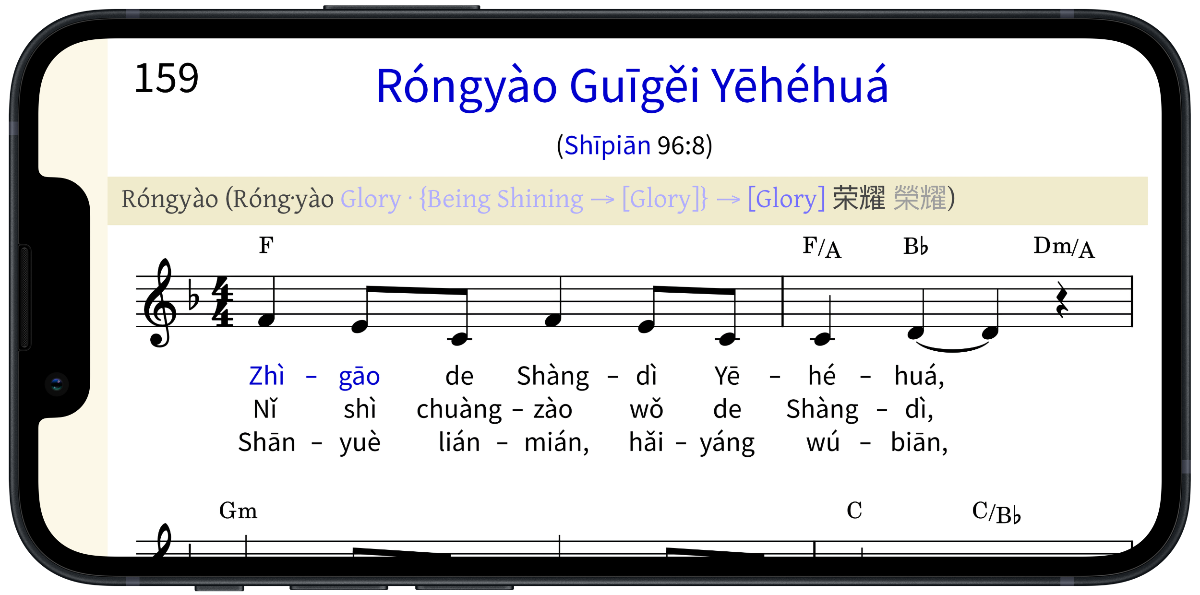
“wúkě‐bǐnǐ” _Pīnyīn_ Plus info, Song 152 (music+_Pīnyīn_), on iPhone 13 mini (landscape orientation)

This week’s MEotW in the unofficial Pīnyīn (Pīn·yīn {Piecing Together of} · Sounds → [Pinyin] 拼音) Plus resource “Sing Out Joyfully” Bk. (Pīnyīn+Music, Pīnyīn Plus, Web)

This week’s MEotW, “wúkě (wú·kě {there is not} · {being able} 无可 無可)bǐnǐ (bǐ·nǐ {to compare} · {to compare; parallel} → [to compare; match; draw a parallel] 比拟 比擬)”, comes from the first verse of song 152, which is entitled “A Place That Will Bring You Praise” in English and “Nǐ de ((Nǐ You 你) (de ’s 的) [Your]) Róngyào (Róng·yào Glorious · {Brilliant → [Glorious]} → [Glorious] 荣耀 榮耀) zhī ( 之) Jiā ([mw for establishments] 家) in Mandarin:

English:

Jehovah, the Maker of heaven,
By heaven you can’t be contained,
Even less an earthly dwelling place.
But your spirit can here remain.

Mandarin (WOL, Pīnyīn (Pīn·yīn {Piecing Together of} · Sounds → [Pinyin] 拼音) Plus):

📖 📄 📘 Yēhéhuá (Jehovah 耶和华 耶和華) yòng (used 用) (big → [great] 大) néng (ability 能) zào ({to make} 造) tiāndì (tiān·dì heavens · earth 天地),
Nǐ de ((Nǐ you 你) (de ’s 的) [your]) róngyào (róng·yào glory · {being brilliant → [glory]} → [glory] 荣耀 榮耀) wúkě (wú·kě {there is not} · {being able} 无可 無可)bǐnǐ (bǐ·nǐ {to compare} · {to parallel} → [to compare] 比拟 比擬).
Xiǎoxiǎo (Xiǎo·xiǎo small · small → [miniscule] 小小) dìqiú (dì·qiú earth · globe 地球) rúhé (rú·hé like · how → [how] 如何) néng (can 能) chéngzài (chéng·zài bear · hold → [bear the weight of] 承载 承載)
Nǐ de ((Nǐ you 你) (de ’s 的) [your]) lìliang (lì·liang power · quantity 力量), nǐ de ((nǐ you 你) (de ’s 的) [your]) hòu’ài (hòu’·ài {thick → [deep]} · love 厚爱 厚愛)?

“Wúkě (Wú·kě {there is not} · {being able} 无可 無可)bǐnǐ (bǐ·nǐ {to compare} · {to compare; parallel} → [to compare; match; draw a parallel] 比拟 比擬) means “there is not being able to compare”. So, the line that it appears in, “Nǐ de ((Nǐ you 你) (de ’s 的) [your]) róngyào (róng·yào glory · {being brilliant → [glory]} → [glory] 荣耀 榮耀) wúkě (wú·kě {there is not} · {being able} 无可 無可)bǐnǐ (bǐ·nǐ {to compare} · {to parallel} → [to compare] 比拟 比擬)”, means “Your glory is without compare”.

People of this world support corrupt, self-seeking politicians, worship the blind chance that they say powers evolution, look for space aliens, place their hopes in artificial intelligence, and so on. However, none of those could accomplish what Jehovah God has accomplished—He alone is the One who actually created the universe and all the living things in it. So, as expressed by this week’s MEotW, Jehovah’s glory truly is without compare, and there is no one and nothing else that people should look to and hope in in these dark times.

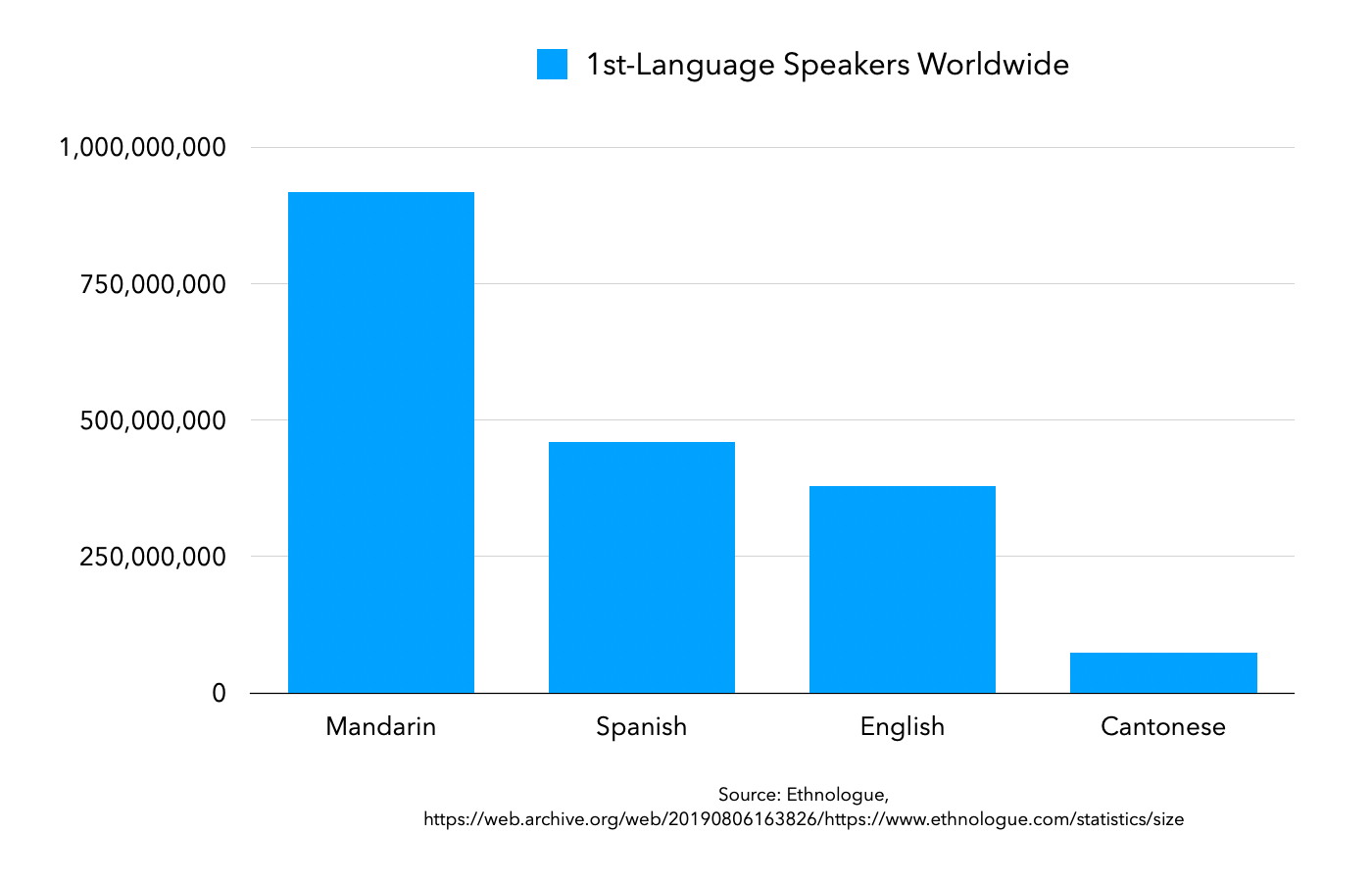
As Mandarin field language learners, let us be determined to keep on doing our best to sing Jehovah’s praises well in this largest of all worldwide language fields. Not only is the Mandarin field the largest one in the world, with about a billion people worldwide for whom Mandarin is their mother tongue, it’s also about 2½ times the size of the worldwide English field. So, it could be said that there should really be about 2½ times as many publishers in the worldwide Mandarin field as there are in the worldwide English field. Yes, “the harvest is great, but the workers are few”, so sing out loud in the Mandarin field, and sing out strong!—Matthew 9:37, 38.

Chart: Languages by First-Language Speakers—2019

Musical Notation 🎼 and the Mandarin Field

In this post about a Mandarin expression found in our songbook, another subject that I want to touch on is: Is musical notation 🎼 too hard to be worth the trouble of producing it and using it? Are fewer and fewer people able to read it? I was fortunate enough to have been taught how to read musical notation in school. I have never thought of musical notation as being particularly difficult to use (it’s much easier to learn than characters, which many unquestioningly try to learn), and I find that it helps me to sing Kingdom songs more correctly (according to the intended melody, message, etc.) and more confidently more of the time. However, I am aware that not everyone in the Mandarin field has the same experience with musical notation. For example, a while ago, an older brother told me that he didn’t know how to read musical notation. Also, some people in the Mandarin field may have been affected by how education systems in this old world have been facing significant challenges relating to providing music education for younger ones.

Regardless of how the world may be failing in many cases to equitably provide good music education, Jehovah’s organization has pointed out that music is important in Jehovah’s worship. For example, not long ago, a Meeting Workbook said:

Music can have a powerful influence on the mind and body. Singing is an important part of our worship of Jehovah.

In accordance with the importance of music in Jehovah’s worship, Mandarin field language learners used to have available to them official material from the organization containing musical notation with Pīnyīn (Pīn·yīn {Piecing Together of} · Sounds → [Pinyin] 拼音) in the lyrics. However, perhaps at least partially because of the technical difficulty and costliness of producing material with musical notation and both Chinese characters and Pīnyīn (Pīn·yīn {Piecing Together of} · Sounds → [Pinyin] 拼音) in the lyrics, as of this writing, early in 2025, there is no official material currently available from the organization that shows Pīnyīn (Pīn·yīn {Piecing Together of} · Sounds → [Pinyin] 拼音) and musical notation on the same page or screen.

The organization continues to publish official songbook material for different languages in general that contains musical notation, so it evidently still considers musical notation to generally be worthwhile to produce. It continues to produce official material for the current songbook that uses musical notation along with lyrics rendered only in Chinese characters, without Pīnyīn (Pīn·yīn {Piecing Together of} · Sounds → [Pinyin] 拼音), and it has even produced official material that uses jiǎnpǔ (jiǎn·pǔ simple · {register or record for reference → [musical notation]} → [numbered musical notation] 简谱 簡譜) (a kind of musical notation also known as numbered musical notation) and Chinese characters.

For those who find it helpful in their Mandarin field activities to put musical notation together with Pīnyīn (Pīn·yīn {Piecing Together of} · Sounds → [Pinyin] 拼音), the unofficial Pīnyīn (Pīn·yīn {Piecing Together of} · Sounds → [Pinyin] 拼音) Plus resource “Sing Out Joyfully” Bk. (Pīnyīn+Music, Pīnyīn Plus, Web) exists and is continuing to be improved. As shown in the screenshot above, this resource aids Mandarin field language learners by breaking with tradition and featuring lyrics in the musical notation that are only in relatively large-print Pīnyīn (Pīn·yīn {Piecing Together of} · Sounds → [Pinyin] 拼音) by default—characters are relegated to Pīnyīn (Pīn·yīn {Piecing Together of} · Sounds → [Pinyin] 拼音) Plus “flashcards” that are added as time allows.

Unlike the traditionally-used but unnecessarily extraordinarily complex characters that need to be accompanied by Pīnyīn (Pīn·yīn {Piecing Together of} · Sounds → [Pinyin] 拼音) before many are able to read them, Pīnyīn (Pīn·yīn {Piecing Together of} · Sounds → [Pinyin] 拼音) itself is a simple, elegant alphabetical full writing system for Mandarin that is easy to learn and remember. Also, it is no harder to typeset than other alphabetical writing systems with diacritics, such as the writing systems now used for French, Czech, Vietnamese, etc.*

In its Tips: section at the bottom of its home page, the “Sing Out Joyfully” Bk. (Pīnyīn+Music, Pīnyīn Plus, Web) resource contains these links that some may find helpful:


For convenience:

The direct link for the Pīnyīn (Pīn·yīn {Piecing Together of} · Sounds → [Pinyin] 拼音) Plus resource for the “Sing Out Joyfully” book is:

The short link for Chinese field language-learning links for the “Sing Out Joyfully” book is:

More Pīnyīn (Pīn·yīn {Piecing Together of} · Sounds → [Pinyin] 拼音) and Pīnyīn (Pīn·yīn {Piecing Together of} · Sounds → [Pinyin] 拼音) Plus web material based on the Mandarin “Sing Out Joyfully” book will be made available in the Pīnyīn (Pīn·yīn {Piecing Together of} · Sounds → [Pinyin] 拼音) Plus web resource as time allows.


* Thanks to ongoing advancements in personal computing hardware and software, producing material that contains things like musical notation and Pīnyīn (Pīn·yīn {Piecing Together of} · Sounds → [Pinyin] 拼音) text at reasonable cost is quicker and easier than ever. At this time, production of the musical notation in the “Sing Out Joyfully” Bk. (Pīnyīn+Music, Pīnyīn Plus, Web) resource begins in free open source software called MuseScore Studio, running on a Mac. Pīnyīn (Pīn·yīn {Piecing Together of} · Sounds → [Pinyin] 拼音) text for the lyrics in the musical notation is entered using macOS’s ABC – Extended input source (keyboard layout). (Just using Pīnyīn (Pīn·yīn {Piecing Together of} · Sounds → [Pinyin] 拼音) text only here simplifies things so much compared to having to somehow input characters with Pīnyīn (Pīn·yīn {Piecing Together of} · Sounds → [Pinyin] 拼音) ruby text!) When it’s ready, the musical notation for a song is exported from MuseScore Studio into SVG format, which is a plain text format that allows for the inclusion of links that activate Pīnyīn (Pīn·yīn {Piecing Together of} · Sounds → [Pinyin] 拼音) Plus flashcards on webpages. The coding for the SVG links is currently mostly done using the text editor BBEdit, in which editing large text files is quite performant. For Pīnyīn (Pīn·yīn {Piecing Together of} · Sounds → [Pinyin] 拼音) Plus web material production in general, my current favourite tool is Nova, but such web material can be produced in any application suitable for web development, such as Visual Studio Code, etc. ^