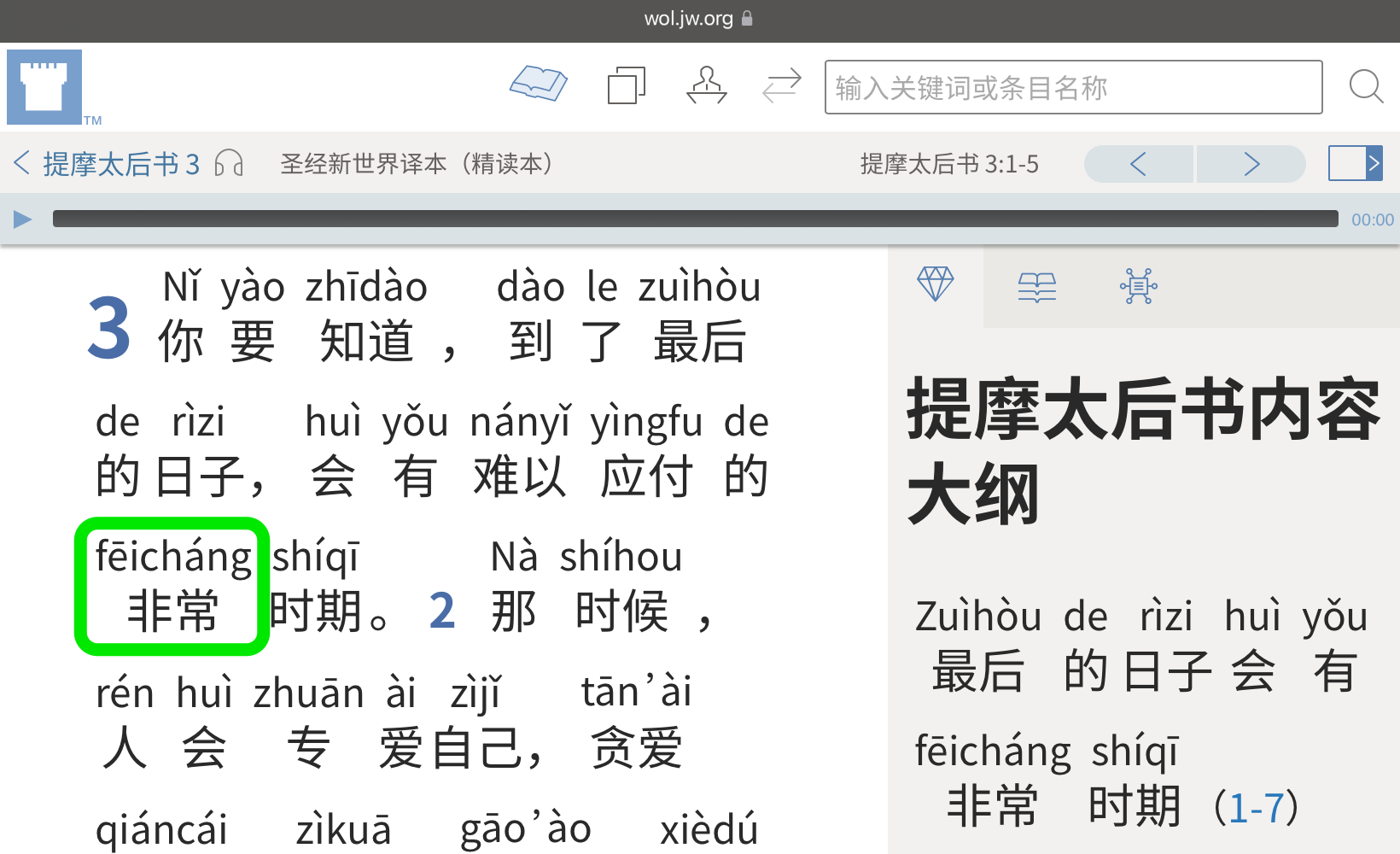
chuàngzào+ (chuàng·zào initiating · {making, creating} → [creating | creation; innovation] 创造 創造) ← Tap/click to show/hide the “flashcard”
The Shēngmìng Láizì Chuàngzào Ma? ((Shēngmìng Life 生命) (Lái·zì Came · From 来自 來自) (Chuàng·zào Initiating · {Making, Creating} → [Creating] 创造 創造) (Ma [? ptcl for “yes/no” questions] 吗 嗎)? → [Was Life Created? (lc)]) (Was Life Created? (lc)) brochure and the Shēngmìng de Qǐyuán—Zhíde Sīkǎo de Wǔ Ge Wèntí ((Shēngmìng Life 生命) (de ’s 的) (Qǐ·yuán {Rising → [Starting]} · Source → [Origin] 起源/原)—(Zhí·de Worth · Getting → [Worth] 值得) (Sī·kǎo {Thinking About} · Examining 思考) (de ’s 的) (Wǔ Five 五) (Ge [mw] 个 個/个) (Wèn·tí Asking · Subjects → [Questions] 问题 問題) → [The Origin of Life—Five Questions Worth Asking (lf)]) (The Origin of Life—Five Questions Worth Asking (lf)) brochure were originally published back in 2010, but recently, the English version of the Was Life Created? brochure was updated to the December 2022 Printing, and the Mandarin version of it was updated to the February 2023 Printing. Also, the Was Life Created? brochure and the Origin of Life brochure are now in the Teaching Toolbox section in the JW Library app. So, it would be good to consider some of the expressions used in the Mandarin versions of these publications that can be so helpful when discussing whether life was created.
How It Started
This week’s MEotW, which appears right in the title of the Mandarin Was Life Created? brochure, is “chuàngzào (chuàng·zào initiating · {making, creating} → [creating | creation; innovation] 创造 創造)”. While this is basically a verb meaning “create”, it can also be used as a noun meaning “creation”. Such verbal/gerundial nouns were discussed in the MEotW post on “jiàodǎo (jiào·dǎo teaching · {guiding [→ [instructing]]} 教导 教導)”:
One interesting thing to note about “jiàodǎo+ (jiào·dǎo teaching · {guiding [→ [instructing]]} 教导 教導)” (and about “jiàoxun+ (teaching → [reprimanding | knowledge gained from an error] 教训 教訓)”, for that matter) is that their component morphemes seem to basically be verbs. In certain contexts, however, they are used as nouns. An example of this being done in English is that “teach” and “teaching” are verbs (e.g. “Jesus was teaching the crowd.”), but in certain contexts, “teaching” is used as a noun (e.g. “The crowd was amazed at the teaching Jesus shared with them.”). When a word is used this way, it’s called a verbal noun, or a gerundial noun. Verbal nouns are quite common in Mandarin.
How It Breaks Down
The “chuàng (initiate; create; start; originate; {achieve (sth. for the first time)} 创 創/刱/剏/剙)” in “chuàngzào (chuàng·zào initiating · {making, creating} → [creating | creation; innovation] 创造 創造)” is also used in “Chuàngshìjì+ (Chuàng·shì·jì {Initiating, Creating of} · {Generation → [World]} · Record → [Genesis] 创世记 創世記)”, and is associated with originality and creativity. For example, this “chuàng (initiate; create; start; originate; {achieve (sth. for the first time)} 创 創/刱/剏/剙)” also occurs in “chuàngzuò (chuàng·zuò initiated; created; originated · {made [→ [written/composed]]} [(thing)] [→ [created; produced; written [(thing)]] [→ [creative work; creation]]] 创作 創作)” and in “chuàngzuò lì ((chuàng·zuò {to initiate/create/originate} · {to make [→ [to write/compose]]} → [to create/produce/write] 创作 創作) (lì power → [ability] 力) → [creative ability; creativity; originality])”, which can respectively mean “creative work” and “creativity”.
As for the “zào (make; build; create 造)” in “chuàngzào (chuàng·zào initiating · {making, creating} → [creating | creation; innovation] 创造 創造)”, it’s more associated with making and building, and it’s the same “zào (make; build; create 造)” that’s in “jiànzào+ (construct; build 建造)”. “Jiànzào (build 建造) fángwū (houses 房屋)”, for example, means “build houses”.
How It Comes Together
So, “chuàngzào (chuàng·zào initiating · {making, creating} → [creating | creation; innovation] 创造 創造)”, being made up of “chuàng (initiate; create; start; originate; {achieve (sth. for the first time)} 创 創/刱/剏/剙)” and “zào (make; build; create 造)”, covers the entire process of coming up with the idea for something, and then actually making or building it. This is in contrast with the idea of theistic evolution (Mandarin: Shéndǎo‐jìnhuà‐lùn ((Shén·dǎo God · guided; led 神导 神導)‐(jìn·huà {to advance} · transforming → [evolution] 进化 進化)‐(lùn discussing → [theory; doctrine] 论 論) → [theistic evolution])), that God somehow got the ball rolling and then sat back and let the process of evolution develop all the wonderful living things in the natural world.
One person in particular whom I remember having such a viewpoint was my grade 7 teacher, who was actually quite smug about how her Catholic/personal beliefs had thus seemingly neatly reconciled the contradictions between the worldly “scientific” theory of evolution and the creation account in the Bible book of Genesis. However, the actual wording of the Genesis account, including how it is often translated into Mandarin, does not really go along with such a seemingly neat reconciliation with evolution.—Genesis 1:27 (English WOL, Mandarin WOL, Pīnyīn (Pīn·yīn {Piecing Together of} · Sounds → [Pinyin] 拼音) Plus).
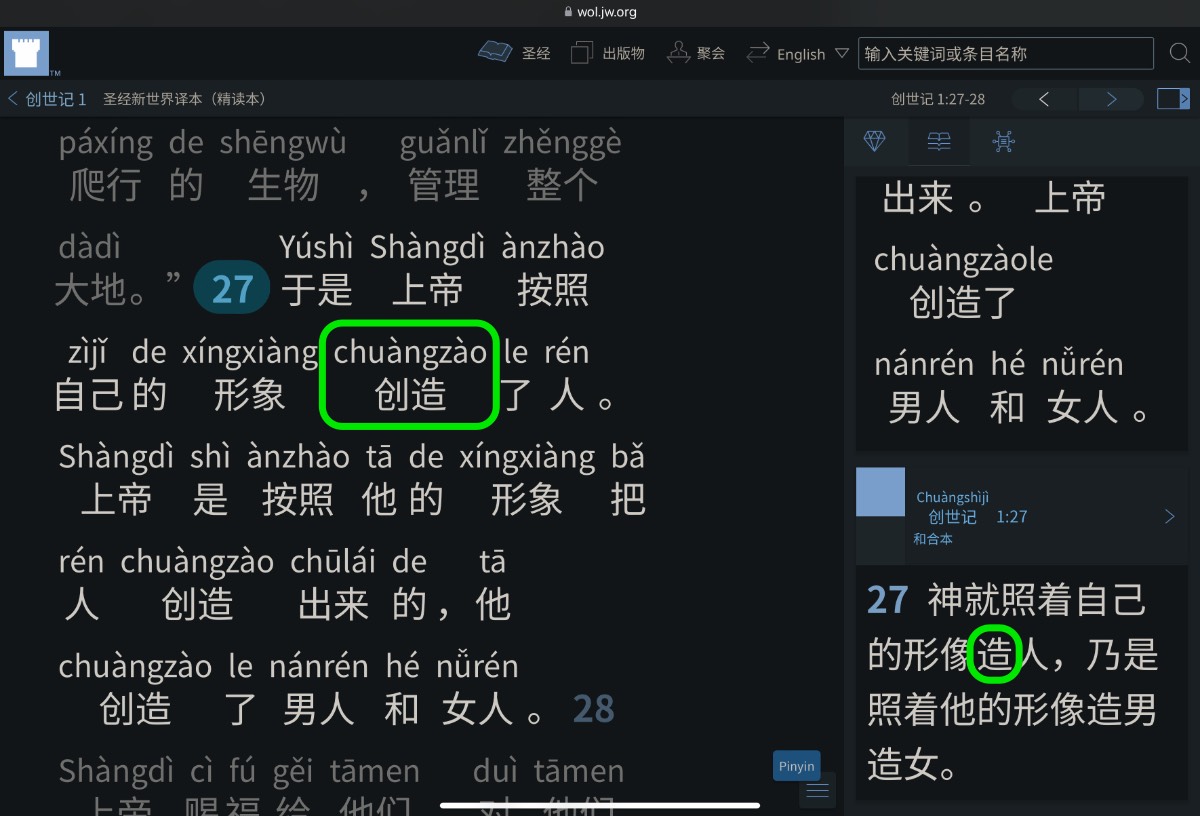
To represent how God caused humans to come into existence, the Mandarin New World Translation Bible uses “chuàngzào (chuàng·zào initiated · {made, created} → [created] 创造 創造)”, and the Héhé Běn+ ((Hé·hé Harmonious · {Closed → [United]} 和合) (Běn {Root or Stem} → [Edition] 本) → [Union Version (Chinese Bible)]) uses “zào (made; built; created 造)”. Both these expressions contain the sense of “made, created”, and perhaps “built”.
How the Py+ Material Is Going
A while ago, I got the feeling that I should shift focus to get to work on producing current-generation Pīnyīn (Pīn·yīn {Piecing Together of} · Sounds → [Pinyin] 拼音) Plus material for the Was Life Created? brochure, which I had last produced older-style material for several years earlier. The official material for this brochure had also not been changed for several years, with the last Mandarin printing of it being dated 2016-12.
However, not long after I had started working on new Pīnyīn (Pīn·yīn {Piecing Together of} · Sounds → [Pinyin] 拼音) Plus material for this brochure, I noticed that a new printing, dated 2022-12, had been put out for the English version of the Was Life Created? brochure, and then, a new printing, dated 2023-02, appeared in the JW Library app for the Mandarin version of this brochure. Also, the Was Life Created? brochure and the Origin of Life brochure were added to the Teaching Toolbox section in the JW Library app at around this time. It seems that Jehovah had decided that the time had come for renewed focus on these brochures, and it seems that the work of producing Pīnyīn (Pīn·yīn {Piecing Together of} · Sounds → [Pinyin] 拼音) Plus material for the Was Life Created? brochure is privileged to be part of this renewed focus.
At the time of this writing, the old 3-line files (iPad-Letter-A4, XLP-iPhone-A5) together with the new Pīnyīn (Pīn·yīn {Piecing Together of} · Sounds → [Pinyin] 拼音) Plus web resource cover the entire Was Life Created? brochure. (The 3-line files were based on an older version of the brochure, though.) Also, the Pīnyīn (Pīn·yīn {Piecing Together of} · Sounds → [Pinyin] 拼音) Plus web resource (which can be used offline in supporting browsers) contains no more Pīnyīn (Pīn·yīn {Piecing Together of} · Sounds → [Pinyin] 拼音)-only material that has only been partially proofread—all the Pīnyīn (Pīn·yīn {Piecing Together of} · Sounds → [Pinyin] 拼音)-only material has now been fully proofread.
For convenience:
The direct link for the current generation Pīnyīn (Pīn·yīn {Piecing Together of} · Sounds → [Pinyin] 拼音) Plus resource for the Was Life Created? brochure is:
The short link for Chinese field language-learning links for the Was Life Created? brochure is:
More Pīnyīn (Pīn·yīn {Piecing Together of} · Sounds → [Pinyin] 拼音) and Pīnyīn (Pīn·yīn {Piecing Together of} · Sounds → [Pinyin] 拼音) Plus web material based on the Mandarin Was Life Created? brochure will be made available in the Pīnyīn (Pīn·yīn {Piecing Together of} · Sounds → [Pinyin] 拼音) Plus web resource as time allows. Work is now underway to produce a Pīnyīn (Pīn·yīn {Piecing Together of} · Sounds → [Pinyin] 拼音) Plus web resource for the Mandarin Origin of Life brochure as well.