Categories
Culture Current Events Language Learning Theocratic

shǔlíng zhànzhēng

shǔlíng (shǔ·líng {(in the) category (of)} · spirit → [spiritual (nwtsty-CHS Appx. A2 notes change from “shǔlíng” to “xīnlíng”, etc.)] 属灵 屬靈)
zhànzhēng (zhàn·zhēng war · contending → [war; warfare] 战争 戰爭) ← Tap/click to show/hide the “flashcard”

Lately, the organzation has often been using “xīnlíng (xīn·líng heart · spirit [→ [spiritual]] 心灵 心靈) (MEotW post) where it used to use “shǔlíng (shǔ·líng {(in the) category (of)} · spirit → [spiritual (nwtsty-CHS Appx. A2 notes change from “shǔlíng” to “xīnlíng”, etc.)] 属灵 屬靈). I noticed that in at least one of the videos presented during this year’s Mandarin convention, for example. However, a recent search on the Watchtower ONLINE LIBRARY for “心灵战争” (“xīnlíng (xīn·líng heart · spirit → [spiritual] 心灵 心靈) zhànzhēng (zhàn·zhēng war · contending → [war] 战争 戰爭), a possible translation for “spiritual war”) returns no results at all. Searching for “心灵 战争”, with a space between the two words, returns some results, but not for the complete expression “xīnlíng (xīn·líng heart · spirit → [spiritual] 心灵 心靈) zhànzhēng (zhàn·zhēng war · contending → [war; warfare] 战争 戰爭). So, it seems like for now at least, “xīnlíng (xīn·líng heart · spirit → [spiritual] 心灵 心靈) zhànzhēng (zhàn·zhēng war · contending → [war; warfare] 战争 戰爭) is not an officially used thing. However, a search on the WOL for this week’s MEotW, “shǔlíng (shǔ·líng {(in the) category (of)} · spirit → [spiritual (nwtsty-CHS Appx. A2 notes change from “shǔlíng” to “xīnlíng”, etc.)] 属灵 屬靈) zhànzhēng (zhàn·zhēng war · contending → [war; warfare] 战争 戰爭), did return some fairly recent results, including one from the May 2018 Watchtower.

It may just be that the English expression “spiritual war” has not come up in the organization’s production pipeline for translation into Mandarin for a while. I suppose time will tell if “xīnlíng (xīn·líng heart · spirit → [spiritual] 心灵 心靈) zhànzhēng (zhàn·zhēng war · contending → [war; warfare] 战争 戰爭) eventually becomes a replacement translation for “shǔlíng (shǔ·líng {(in the) category (of)} · spirit → [spiritual (nwtsty-CHS Appx. A2 notes change from “shǔlíng” to “xīnlíng”, etc.)] 属灵 屬靈) zhànzhēng (zhàn·zhēng war · contending → [war; warfare] 战争 戰爭). For now at least, it seems that “shǔlíng (shǔ·líng {(in the) category (of)} · spirit → [spiritual (nwtsty-CHS Appx. A2 notes change from “shǔlíng” to “xīnlíng”, etc.)] 属灵 屬靈) zhànzhēng (zhàn·zhēng war · contending → [war; warfare] 战争 戰爭) is still a relatively currently used official translation of “spiritual war”.—Ephesians 6:11, 12; 2 Corinthians 10:4, 5.

[Note, 2023-07-26: While searching the WOL for “spiritual war” returned limited post-2018 results, a more advanced search suggested by a reader turned up some more recent results, with some interesting Mandarin translations that are different from “shǔlíng (shǔ·líng {(in the) category (of)} · spirit → [spiritual (nwtsty-CHS Appx. A2 notes change from “shǔlíng” to “xīnlíng”, etc.)] 属灵 屬靈) zhànzhēng (zhàn·zhēng war · contending → [war; warfare] 战争 戰爭). For more information, see the next MEotW post.]

Know the Enemy

Speaking of war, many would agree that there is wisdom in this quote from Sūn Zǐ ((Sūn {Grandson (surname)}) (Zǐ Son’s; Child’s; Offspring’s 子) [Sun Tzu’s]) Bīngfǎ (Bīng·fǎ Soldier’s · Way → [Art of War] 兵法) (孫子兵法, The Art of War):

If you know the enemy and know yourself, you need not fear the result of a hundred battles. If you know yourself but not the enemy, for every victory gained you will also suffer a defeat. If you know neither the enemy nor yourself, you will succumb in every battle.

With that in mind, let us consider a hypothetical scene from the command centre of Satan and the demons for their spiritual war against Jehovah and against the truth, taking place some time in the early part of the 21st century:

***

The Other Side of the Mandarin Front

Satan: Our hated Enemy Jehovah is raising up more workers for the Mandarin field. What is the state of our defences in this largest language field of all?

Demon: There is a useful government in place in China, where about 95% of all the earth’s Chinese people live. This government is intent on and efficient at suppressing all conceivable threats to its power, including religions like that of Jehovah’s people, that refuse to obey it rather than their God. This government even has a project underway to rewrite the Bible so that it serves their interests, those cheeky darlings!

Culturally, many proud, long-standing, personally inhibiting traditions are in place, making it difficult for many Mandarin-speakers to accept the truth, or to progress spiritually or otherwise as individuals if they do. (The well-known English expression “save face” was, after all, derived from a Chinese expression.)

Speaking of defences, one outstanding set of proud Chinese cultural traditions that serves as a highly effective fortification blocking the way to potential Mandarin-speaking sheep is the Great Wall of Chinese characters. This inhumanly complex system imposes extraordinary costs in the time and effort required for the simple, everyday tasks of reading and writing Chinese languages like Mandarin.

The Great Wall of China

Chinese characters even put unnecessarily heavy mental loads on native speakers, causing even them to sometimes be unable to remember how to read or write even certain common characters. Unsurprisingly, then, this delightful ball and chain made of human tradition is especially highly effective at making things difficult for any whom Jehovah raises up from other language fields to work in the Mandarin field, poor unfortunate souls who have not already been learning characters all their lives.

We have observed that only about one in ten of such ones is able to cope well with the unnecessary difficulties imposed by characters. The rest struggle along at greatly reduced spiritual combat effectiveness, and the Great Wall of characters even ends up completely filtering out many who try to serve in the Mandarin field, causing them to eventually leave it and become Mandarin field casualties, as viewed by Jehovah’s side.

Satan: How about these efforts by some in Jehovah’s organization to get through and around the Great Wall of characters by making and using Pīnyīn (Pīn·yīn {Piecing Together of} · Sounds → [Pinyin] 拼音) resources? It seems that Jehovah’s organization now uses Pīnyīn (Pīn·yīn {Piecing Together of} · Sounds → [Pinyin] 拼音) more than any other organization on earth.

Demon: That may be so, but overall, the Great Wall of characters is holding. The traditions around Chinese characters are among the most deeply entrenched human cultural traditions in existence. So, Chinese characters remain the entrenched default writing system for Mandarin-speakers worldwide, and, as you know, the vast majority of humans simply accept the default systems that are presented to them, and don’t bother to think about how it could be worthwhile to find better ways of doing things. This works out great for us when people just unthinkingly adopt the religion of their parents or the morals of their peers, and it works great for us when it comes to the Great Wall of characters too.

As a result, even though Pīnyīn (Pīn·yīn {Piecing Together of} · Sounds → [Pinyin] 拼音) works fine as a simple and easy-to-use full writing system for Mandarin, and even though some in Jehovah’s organization have made extraordinary progress in making advantageous use of Pīnyīn (Pīn·yīn {Piecing Together of} · Sounds → [Pinyin] 拼音), Pīnyīn (Pīn·yīn {Piecing Together of} · Sounds → [Pinyin] 拼音) remains a cultural outlier, and Pīnyīn (Pīn·yīn {Piecing Together of} · Sounds → [Pinyin] 拼音) users continue to be ridiculed and pressured by the great majority whom we have successfully brainwashed regarding characters. Pride, tradition, and peer pressure continue to be highly effective spiritual weapons of mass destruction for us in the Mandarin field, as they are in other fronts of the spiritual war.

Satan: Excellent. There will always be pesky upstarts among Jehovah’s people who challenge the human traditions that serve us so gloriously well, and Jehovah may even help them, but it deeply satisfies my great unholy anger to see that we are keeping them suppressed so effectively. Carry on.

***

Don’t like seeing Satan’s spiritual war plans working out in the Mandarin field? Then fight back with spirit and truth and reject obstructive human traditions that make it much harder than necessary to serve God in the Mandarin field, “so that we may not be overreached by Satan, for we are not ignorant of his designs.”—John 4:23, 24; 2 Corinthians 2:11.
Categories
Culture Current Events History Language Learning Science Technology

xuānchuán

xuānchuán (xuān·chuán declaring; proclaiming; announcing · {passing on}; spreading; transmitting → [conducting propaganda; propagating; disseminating; publicizing | propaganda] 宣传 宣傳) ← Tap/click to show/hide the “flashcard”

Several MEotW posts, including last week’s post on “cì’ěr (cì’·ěr {stabs; pricks → [irritates; pierces]} · ear → [grating on the ear; jarring; ear-piercing] 刺耳), have mentioned propaganda. So, it seems that it’s about time to consider the Mandarin expression “xuānchuán (xuān·chuán declaring; proclaiming; announcing · {passing on}; spreading; transmitting → [conducting propaganda; propagating; disseminating; publicizing | propaganda] 宣传 宣傳)”, which is often used to translate “propaganda”.

Morphemic Breakdown

The “xuān (declare; proclaim; announce 宣) in “xuānchuán (xuān·chuán declaring; proclaiming; announcing · {passing on}; spreading; transmitting → [conducting propaganda; propagating; disseminating; publicizing | propaganda] 宣传 宣傳) means “declare; proclaim; announce”, and it also appears in expressions like “xuānbù (xuān·bù declare; proclaim; announce · declare; spread; announce; publish; proclaim 宣布 宣布/佈)”, “xuānjiǎng (xuān·jiǎng declare; proclaim; announce · {speak of → [explain]} 宣讲 宣講)”, “xuānyáng (xuān·yáng declare; proclaim; announce · {raise → [make known]} 宣扬 宣揚)”, etc.

The “chuán ({pass on}; {hand down}; spread; transmit [→ [summon]]) in “xuānchuán (xuān·chuán declaring; proclaiming; announcing · {passing on}; spreading; transmitting → [conducting propaganda; propagating; disseminating; publicizing | propaganda] 宣传 宣傳) means “pass on; hand down; spread; transmit”, and it also appears in expressions like “chuándào (chuán·dào spreading · way → [preaching] 传道 傳道)”, “Chuándàoshū (Chuán·dào·shū Spreading · Way · Book → [Ecclesiastes] 传道书 傳道書)”, “chuánjiǎng (chuán·jiǎng spread · {speak of; say; tell} [(that)] 传讲 傳講)”, “chuántǒng (chuán·tǒng {passed on} · {gathered together (things) → [interconnected system]} → [tradition | traditional] 传统 傳統)”, etc.

The above-mentioned morphemes in “xuānchuán (xuān·chuán declaring; proclaiming; announcing · {passing on}; spreading; transmitting → [conducting propaganda; propagating; disseminating; publicizing | propaganda] 宣传 宣傳) are both basically verbs, and “xuānchuán (xuān·chuán declaring; proclaiming; announcing · {passing on}; spreading; transmitting → [conducting propaganda; propagating; disseminating; publicizing | propaganda] 宣传 宣傳) itself is also basically a verb. However, it’s also used as a noun, making it a verbal noun, or a gerundial noun, in those cases.

How Bad Is It?

As mentioned in the excellent Referenced Theo. Expressions (RTE) resource, “it seems 宣传 [xuānchuán] is a neutral word in Chinese (can be either positive or negative)”. Indeed, the morphemes that make up “xuānchuán (xuān·chuán declaring; proclaiming; announcing · {passing on}; spreading; transmitting → [conducting propaganda; propagating; disseminating; publicizing | propaganda] 宣传 宣傳), mentioned above, are themselves both morally neutral. Like any technology, whether the things that these morphemes represent result in good or harm depends on how they are used. Unfortunately, we are now living in the last days of a world ruled by Satan the Devil, a world filled with self-seeking people who totally would misuse anything that would potentially enable them to exert influence over other people.—2 Timothy 3:1–5; 1 John 5:19.

It should not be surprising, then, that the worldly Chinese governing authorities may at times disseminate what many would recognize as propaganda—biased, misleading distortions of the truth meant to promote certain viewpoints, political or cultural objectives, etc. Add to that how Eastern culture generally encourages people to conform to the group and not question authority, and it’s not surprising that many who grew up marinated in Chinese culture have come to just accept such propaganda as fact, as just the way things are in the Chinese world.

As for the West, even though it has more of a culture of questioning authority, it, along with the world in general that the Internet can reach, has been experiencing a rise in misinformation and disinformation. Social media and other technologies that have become available have given people more power to select what information they want to take in, and, egged on by engagement-seeking algorithms, many have unfortunately chosen to just focus on information sources that tell them what they want to hear, whether it’s true or not. As the Bible foretold long ago:

For there will be a period of time when they will not put up with the wholesome teaching, but according to their own desires, they will surround themselves with teachers to have their ears tickled. They will turn away from listening to the truth and give attention to false stories.
2 Timothy 4:3, 4.

As Jehovah’s people, we especially need to be wary of any worldly propaganda, because we want to be the true worshippers spoken of by Jesus, ones who “must worship with spirit and truth”.—John 4:23, 24.

Unfortunately, these days, even something as basically human as language gets politicized, so even just being language learners in the Mandarin field, we still need to watch out for worldly propaganda. Below are a couple of commonly accepted beliefs about the Chinese languages that are actually propaganda, not truth.

Propaganda About “Dialects”

“Mandarin, Cantonese, Shanghainese, etc. are just dialects of the one Chinese language.” The truth is that being mutually unintelligible, Mandarin, Cantonese, Shanghainese, etc. are really different languages, like French and English are different languages. The erroneous belief that Mandarin, Cantonese, Shanghainese, etc. are just dialects of the one Chinese language has been promoted by the worldly central governing authorities in China to bolster the idea that China is indeed one big happy political entity that should have a central government—them.

Historically, though, it wasn’t always the case that there was just one government over the land that China now occupies. That didn’t become the case until Qín Shǐhuáng ((Qín {Qin (dynasty)} 秦) (Shǐ·huáng Beginning · Emperor 始皇) (the founder of the Qín dynasty and the first emperor of China)) conquered the other Warring States—which were peers of his own state of Qín ({Qin (one of the Warring States)} 秦)—and became the first emperor of a forcefully unified China. If it wasn’t for this, China could conceivably have become like modern-day Europe, with several peer states which are recognized as having their own distinct languages and cultures.

So, there is no need to allow the idea that Mandarin, Cantonese, etc. are just dialects to sabotage our efforts to learn Mandarin well by making us think that we can just take Cantonese, etc. and twist it a little to get Mandarin—all we would get then is a twisted mess!

Propaganda and the Characters

“Chinese characters are the primary aspect of the Chinese languages.” The truth is that when it comes to human language, speech is primary, not writing.

However, given how so many people around the world are so enchanted with the visually intricate Chinese characters, some may feel that the characters give China a certain amount of cultural—and maybe even political—soft power. Many also feel that characters have a unifying effect on Chinese people, since they use characters to write even if they speak different Chinese languages, as explained above. Thus, many may also feel that there may be some political advantages to characters for China’s worldly central ruling authorities. So, they may thus be motivated to promote Chinese characters over, say, a system like Pīnyīn (Pīn·yīn {Piecing Together of} · Sounds → [Pinyin] 拼音) that doesn’t have the same perceived visual and cultural pizzaz that the characters have, and that is only for Mandarin.

The truth is, though, that there is really no technical requirement for any language, Chinese or otherwise, to be written using Chinese characters—Pīnyīn (Pīn·yīn {Piecing Together of} · Sounds → [Pinyin] 拼音) works fine as a writing system for Mandarin without incurring the extraordinary costs in time and effort that the characters do, and separate but similar alphabetical systems can conceivably be designed and used for other Chinese languages as well.

Re the supposed unifying effect of the Chinese characters, there is not necessarily really much of a unifying effect among the Mandarin-speakers, Cantonese-speakers, Japanese-speakers, Korean-speakers, etc. who may use characters to write, any more than the use of the Latin alphabet unifies English-speakers, French-speakers, Italian-speakers, Mandarin-speakers, etc. who may use it to write. An especially stark current example of the relative insignificance of any unifying effect that a script or writing system may have is that unfortunately, Russia and Ukraine have hardly been unified because of their both using the Cyrillic script.

We who are Jehovah’s people in particular don’t need a product of human culture like the Chinese characters to unite us—we are united by the culture of spirit and truth from Jehovah God himself!—John 4:23, 24.

Don’t Be a Gullible “Tourist”!

As Jehovah’s people, let us make sure we are advancing the interests of God’s Kingdom, and not unwittingly serving the interests of worldly Chinese governments. As missionaries and rescue workers in the Mandarin field, and not just tourists (email me for login information, and include information on who referred you and/or what group/cong. you are in), let us be focused on what really helps us to do our God-honouring and life-saving work better. Let us not be misled by the self-serving xuānchuán (xuān·chuán declaring · spreading → [propaganda] 宣传 宣傳), the propaganda, from Satan’s world.

Categories
Current Events History Theocratic

jūn

jūn ({armed forces}; army; troops [→ [military]]) ← Tap/click to show/hide the “flashcard”

[Notes: Tap/click on a Pīnyīn (Pīn·yīn {Piecing Together of} · Sounds → [Pinyin] 拼音) expression to reveal its “flashcard”; tap/click on a “flashcard” or its Pīnyīn (Pīn·yīn {Piecing Together of} · Sounds → [Pinyin] 拼音) expression to hide the “flashcard”. 📖 📄 📘 icons mean 📖 Reveal All, 📄 Reveal Advanced, and 📘 Reveal None re all the “flashcards” in the heading, paragraph, etc. that they are placed at the beginning of.]

At the time of this writing, jw.org was featuring the article “World Military Spending Surpasses $2 Trillion—What Does the Bible Say?”. Interestingly, the Mandarin version of this article uses a few different expressions to translate the sense of “military spending”:

  • jūnshì (jūn·shì {armed forces → [military]} · affairs 军事 軍事) zhīchū (zhī·chū supporting · out → [spending] 支出)
  • jūnfèi (jūn·fèi {armed forces → [military]} · {expending → [expenditures]} 军费 軍費) kāizhī (kāi·zhī {opening → [paying]} · supporting → [spending] 开支 開支)
  • jūnshì (jūn·shì {armed forces → [military]} · affairs 军事 軍事) kāizhī (kāi·zhī {opening → [paying]} · supporting → [spending] 开支 開支)
  • jūnshì (jūn·shì {armed forces → [military]} · affairs 军事 軍事) huāfèi (huā·fèi {flowering of → [spending of]} · {expendings → [expenditures]} → [spending] 花费 花費)
  • jūnfèi (jūn·fèi {armed forces → [military]} · {expending → [expenditures]} 军费 軍費) zhīchū (zhī·chū supporting · out → [spending] 支出)

These all have in common the morpheme “jūn ({armed forces}; army; troops [→ [military]]), which is this week’s MEotW.

Usage Examples

Here are a couple of examples of how the above expressions are used in the above-mentioned article:

English:

World military spending reached a record high of 2.24 trillion dollars (U.S.) in 2022, largely in response to Russia’s invasion of Ukraine.

Mandarin:

📖 📄 📘 2022 nián (year年/秊) quánqiú (quán·qiú whole · globe → [worldwide] 全球) jūnfèi (jūn·fèi {armed forces → [military]} · {expending → [expenditures]} 军费 軍費) kāizhī (kāi·zhī {opening → [paying]} · supporting → [spending] 开支 開支) (already 已) chuàng ({achieved (for the first time)}創/刱/剏/剙) 2.24 wàn ({ten thousand}萬/万) ({hundred million} 亿 ) (2.24 zhào ({trillion (traditional/Taiwan)} 兆)) Měiyuán (Měi·yuán American · {yuan’s (monetary unit of China) → [dollars’]} 美国 美國) xīn (new 新) gāo (high 高); zuì (most最/㝡) zhíjiē (zhí·jiē {being straight} · connecting → [direct] 直接) de (’s 的) yuányīn (yuán·yīn origin · reason 原因) shì (was 是) Éluósī (Russia 俄罗斯 俄羅斯) rùqīn (rù·qīn entering · invading → [invading] 入侵) Wūkèlán (Ukraine 乌克兰 烏克蘭).

English:

“The continuous rise in global military expenditure in recent years is a sign that we are living in an increasingly insecure world”

Mandarin:

📖 📄 📘Jìnnián (Jìn·nián {close → [recent]} · years 近年) lái ({coming from} → [since] (them)), quánqiú (quán·qiú whole · globe → [worldwide] 全球) jūnshì (jūn·shì {armed forces → [military]} · affairs 军事 軍事) kāizhī (kāi·zhī {opening → [paying]} · supporting → [spending] 开支 開支) chíxù (chí·xù {has held} · {has continued} 持续 持續) zēngzhǎng (zēng·zhǎng increasing · growing 增长 增長), biǎomíng (biǎo·míng showing · {to be clear} 表明) wǒmen (wǒ·men we · [pl] 我们 我們) shēnghuó ({are living} 生活) zài (in 在) (one 一) ge ([mw]個/个) yuè‐lái‐yuè ((yuè {jumping over} 越) (lái coming) (yuè {jumping over} 越)) [more and more]) (not 不) ānquán (ān·quán safe · whole → [secure] 安全) de (’s 的) shìjiè (shì·jiè {generation → [world]} · extent → [world] 世界) zhōng (within 中).”

Jehovah of Armies

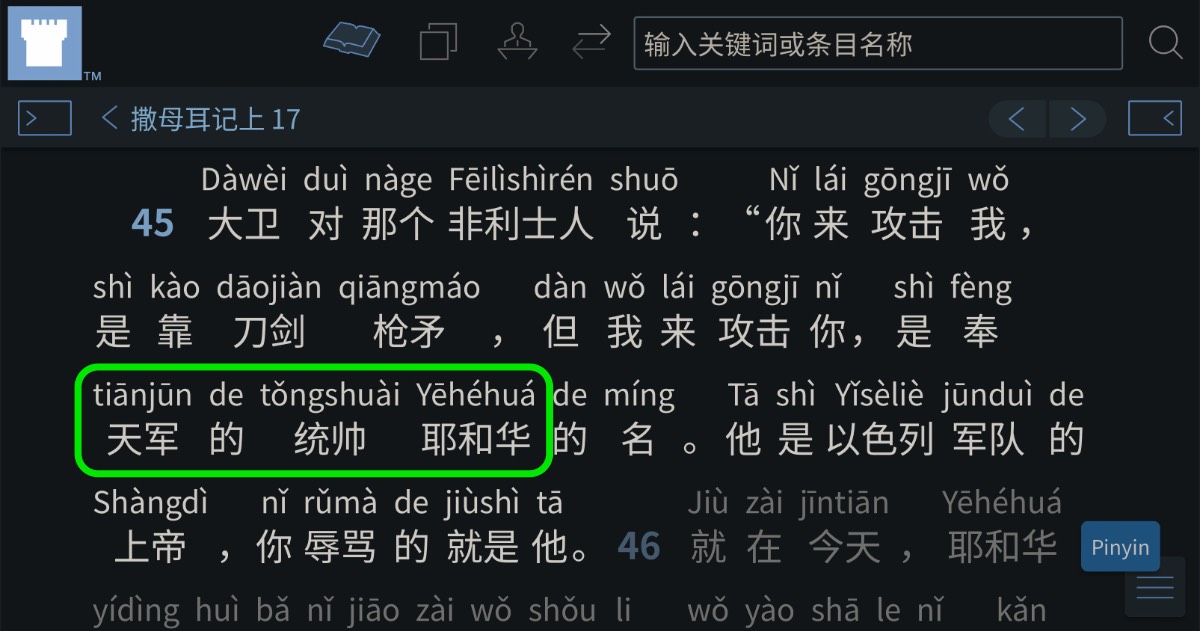
In the Bible, Jehovah God is sometimes called “tiānjūn (tiān·jūn heaven’s · armies 天军 天軍) de ( 的) Tǒngshuài (Tǒng·shuài {Gathered Together (Things) → [Whole System]} · Commander-in-Chief 统帅 統帥) Yēhéhuá (Jehovah 耶和华 耶和華) (“Jehovah of armies”), which incorporates the “jūn ({armed forces}; army; troops [→ [military]]) used in the expressions listed above. For example, when he faced Goliath, David used this expression to show that he trusted in Jehovah God, not in human weapons.—1 Samuel 17:45 (English, Mandarin).

“tiānjūn de Tǒngshuài Yēhéhuá” in 1 Samuel 17:45 (NWT (nwtsty), WOL CHS+Pinyin)

Jehovah causes himself to become what he needs to be, and when he needs to lead his armies of angels into battle, he is invincible. In fact, the Bible records that one time, just one of Jehovah’s angels wiped out 185,000 enemy soldiers in one night. (2 Kings 19:35) When the time comes for “the war of the great day of God the Almighty”, all the prodigious military spending of all the human nations will not prevent them from being destroyed to clear the way for God’s Kingdom to make the earth into a peaceful paradise.—Revelation 16:14.