wú‐suǒwèi+
((wú
{[(considers that)] there is not}
无
無/无)‐(suǒ·wèi
{that which} · {is said to be}
所谓
所謂)
→[does not matter | is indifferent; does not care]) 👈🏼 Tap/click to show/hide the “flashcard”
[Notes:Tap/click on a Pīnyīn
(Pīn·yīn
{Piecing Together of} · Sounds →[Pinyin]
拼音) expression to reveal its “flashcard”; tap/click on a “flashcard”or its Pīnyīn
(Pīn·yīn
{Piecing Together of} · Sounds →[Pinyin]
拼音) expression to hide the“flashcard”. 📖📄 ➕ icons mean 📖Reveal All, 📄Reveal Advanced, and ➕ Reveal + Symbols re all the “flashcards” in the heading, paragraph, etc. that they are placed at the beginning of.]
One of the publications that is now recommended to be used on Bible studies is the Yǒngyuǎn Xiǎngshòu Měihǎo de Shēngmìng—Hùdòng Shì Shèngjīng Kèchéng
((Yǒng·yuǎn
Eternally · {Far (in Time)}
永远
永遠)
(Xiǎng·shòu
Enjoy · Receive
享受)
(Měi·hǎo
Beautiful · Good
美好)
(de
’s
的)
(Shēngmìng
Life
生命)—(Hù·dòng
{Each Other} · Moving → [Interactive]
互动
互動)
(Shì
(Type
式)
(Shèng·jīng
Holy · Scriptures → [Bible]
圣经
聖經)
(Kè·chéng
Lessons · Procedure → [Course]
课程
課程)
→[Enjoy Life Forever!—An Interactive Bible Course (lff)]) (Enjoy Life Forever! (lff)) book. This week’s MEotW, “wú‐suǒwèi
((wú
{[(considers that)] there is not}
无
無/无)‐(suǒ·wèi
{that which} · {is said to be}
所谓
所謂)
→[does not matter | is indifferent; does not care])”, appears in lesson 14 of this book, in the “SOME PEOPLE SAY” section:
📖📄➕RÚGUǑ
(RÚ·GUǑ
IF · {FRUIT → [IF INDEED]}
如果)YǑURÉN
(YǑU·RÉN
{(THERE) ARE HAVING → [(THERE) ARE]} · PEOPLE
有人)SHUŌ
(SAYING
说
說/説):
“Zhǐyào
(Zhǐ·yào
only · {requiring (that)} → [so long as]
只要)xīnli
(xīn·li
hearts · inside
心里
心裡/裏)yǒu
({(we) have}
有)Shàngdì
(Shàng·dì
Above’s · {Emperor → [God]} →[God]
上帝)jiù
(then
就)xíng+
({(it) goes} → [it’s alright]
行),
zěnme
(zěn·me
however · [suf]
怎么
怎麼/麽)chóngbài
(chóng·bài
(we) {esteem → [worship]} · {do obeisance to → [worship]} →[(we) worship]
崇拜)Shàngdì
(Shàng·dì
Above’s · {Emperor → [God]} →[God]
上帝)dōu
({in all those cases}
都)wú‐suǒwèi+
((wú
{there is not}
无
無/无)‐(suǒ·wèi
{that which} · {is said to be}
所谓
所謂)
→[it does not matter]).”
As can be seen from the above, the English and Mandarin versions of this section of lesson 14 express different meanings—the Mandarin version actually means something like “As long as we have God in our hearts it’s alright, it doesn’t matter how we worship God.” Apparently, it was decided that the English and Mandarin fields have different needs in this regard. Anyway, in the above example, this week’s MEotW “wú‐suǒwèi
((wú
{[(considers that)] there is not}
无
無/无)‐(suǒ·wèi
{that which} · {is said to be}
所谓
所謂)
→[does not matter | is indifferent; does not care])” effectively means “it does not matter”.
How do this expression’s morphemes work together to produce this effective meaning? The literal meaning of the morphemes is “{there is not} {that which} {is said to be}”, which kind of has the flavour of “there is nothing to speak of”. It’s not hard to see then, why this expression effectively means “does not matter | is indifferent; does not care”.
Playing It Cool?
Another place where I have seen “wú‐suǒwèi
((wú
{[(considers that)] there is not}
无
無/无)‐(suǒ·wèi
{that which} · {is said to be}
所谓
所謂)
→[does not matter | is indifferent; does not care])” used is in the Faye Wong song “Shìyán
(Shì·yán
Pledging · Words →[Pledge]
誓言)”:
Mandarin:
📖📄➕Rúguǒ
(Rú·guǒ
if · {fruit → [if indeed]}
如果)nǐ
(you
你)néng
(could
能)gěi
(give
给
給)wǒ
(me
我)yí
(one
一)ge([mw]
个
個/个)zhēnchéng+
(zhēn·chéng
true · sincere
真诚
真誠)de
(’s
的)juéduì
(jué·duì
{being cut off → [absolutely]} · {facing → [being compared]} →[being definite]
绝对
絕對)…
Wú‐suǒwèi
((Wú
{(I consider that) there is not}
无
無/无)‐(suǒ·wèi
{that which} · {is said to be}
所谓
所謂)
→[(I) don’t care]),
wǒ
(I
我)shénme
(shén·me
{(about) what → [(about) anything]} · [suf]
什么
什/甚麼)dōu
({in all those cases}
都)wú‐suǒwèi
((wú
{(consider that) there is not}
无
無/无)‐(suǒ·wèi
{that which} · {is said to be}
所谓
所謂)
→[don’t care]).
English:
If you could give me a sincere certainty… I don’t care,I don’t care about anything.
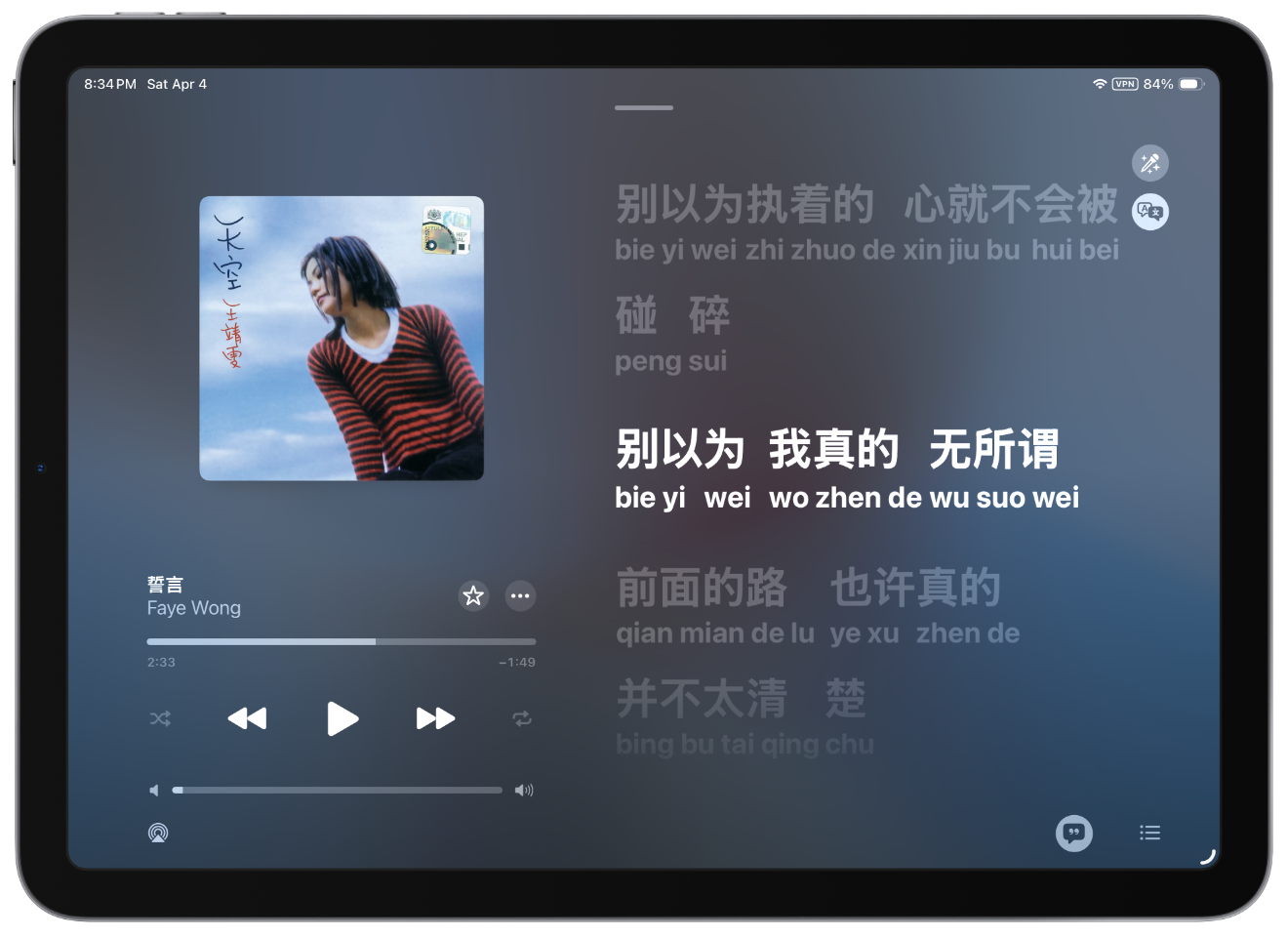
In this part of the song, she is trying to “play it cool,” saying that whatever he says or does doesn’t matter to her, that she doesn’t care. Ironically, though, those who tell such things to others and to themselves often do so precisely because they do care. Later in the song, she sings:
Mandarin:
📖📄➕Bié
(don’t
别
別)yǐwéi
(yǐ·wéi
consider · {(the case) to be} (that)
以为
以為)zhízhuó+
(zhí·zhuó
persisting · applying →[persevering]
执着
執著)de
(’s
的)xīn
(heart
心)jiù
(then
就)búhuì
(bú·huì
not · can →[cannot]
不会
不會)bèi
({be covered by being → [passive signifier]} →[be]
被)pèngsuì
(pèng·suì
knocked · {to be broken to pieces}
碰碎).
Bié
(don’t
别
別)yǐwéi
(yǐ·wéi
consider · {(the case) to be} (that)
以为
以為)wǒ
(I
我)zhēnde
(zhēn·de
really · ’s
真的)wú‐suǒwèi
((wú
{(consider that) there is not}
无
無/无)‐(suǒ·wèi
{that which} · {is said to be}
所谓
所謂)
→[don’t care]).
English:
Don’t think that a persevering heart can’t be shattered.
Don’t think that I really don’t care.
Lyrics for the Faye Wong song “Shìyán
(Shì·yán
Pledging · Words →[Pledge]
誓言)” (“Pledge”) in Apple Music, on an iPad (It’s great that they give the option of showing the Pīnyīn
(Pīn·yīn
{Piecing Together of} · Sounds →[Pinyin]
拼音), but it would have been even better if they included tone marks, even if the tones are not heard during singing.)
For convenience:
The direct link for the Pīnyīn
(Pīn·yīn
{Piecing Together of} · Sounds →[Pinyin]
拼音) Plus resource for the Enjoy Life Forever! book is:
More Pīnyīn
(Pīn·yīn
{Piecing Together of} · Sounds →[Pinyin]
拼音) and Pīnyīn
(Pīn·yīn
{Piecing Together of} · Sounds →[Pinyin]
拼音) Plus web material based on the Mandarin Enjoy Life Forever! book will be made available in the Pīnyīn
(Pīn·yīn
{Piecing Together of} · Sounds →[Pinyin]
拼音)Plus web resource as time allows.
Citing national security concerns, the American government recently passed a law banning the popular social media app TikTok. Ironically (some would say hilariously), many American TikTok users, whom many are calling “TikTok refugees” (“TikTok nànmín+
(nàn·mín
calamity · {persons of a certain occupation} →[refugees]
难民
難民)”), have defiantly responded in protest by migrating to an even more overtly Chinese social media app, Xiǎohóngshū
(Xiǎo·hóng·shū
Little · Red · Book →[a Chinese social networking platform, commonly known in English as RedNote]
小红书
小紅書) (also called RedNote), in such numbers (more than 700,000 in just two days) that Xiǎohóngshū
(Xiǎo·hóng·shū
Little · Red · Book →[a Chinese social networking platform, commonly known in English as RedNote]
小红书
小紅書) became the most-downloaded free app on Apple’s US App Store for a while.
On Xiǎohóngshū
(Xiǎo·hóng·shū
Little · Red · Book →[a Chinese social networking platform, commonly known in English as RedNote]
小红书
小紅書), many regular Chinese people have found it moving and rewarding to be able to make friends with regular American people, and vice versa. Many Americans have even expressed and shown interest in learning Mandarin to better connect with their new Chinese wǎngyǒu+
(wǎng·yǒu
{net → [network] → [Internet]} · friends
网友
網/网友) (Internet friends).
With all this happening on Xiǎohóngshū
(Xiǎo·hóng·shū
Little · Red · Book →[a Chinese social networking platform, commonly known in English as RedNote]
小红书
小紅書), the topic of “Lǐ
({Plum (surname)}
李)Huá
(Flower →[Magnificence; Glory; Splendour; Florescence | Best Part; Cream | Times; Years | China] | Flowery →[Magnificent; Splendid; Glorious; Florescent | Prosperous; Flourishing | Flashy; Extravagant | Chinese]
华
華)”, this week’s MEotW, has come up. This expression is a person’s name, with “Lǐ
({Plum (surname)}
李)”, which literally means “Plum”, being the surname, and a very common one at that. “Huá
(Flower →[Magnificence; Glory; Splendour; Florescence | Best Part; Cream | Times; Years | China] | Flowery →[Magnificent; Splendid; Glorious; Florescent | Prosperous; Flourishing | Flashy; Extravagant | Chinese]
华
華)” is an interesting expression that is discussed in the MEotW post on “Huáyǔ
(Huá·yǔ
{Magnificent; Splendid; Flowery; Florescent → [Chinese]} · Language →[(Modern Standard) Mandarin (term commonly used in Singapore)]
华语
華語)”.
So, why are people on Xiǎohóngshū
(Xiǎo·hóng·shū
Little · Red · Book →[a Chinese social networking platform, commonly known in English as RedNote]
小红书
小紅書) talking about Lǐ
({Plum (surname)}
李)Huá
(Flower →[Magnificence; Glory; Splendour; Florescence | Best Part; Cream | Times; Years | China] | Flowery →[Magnificent; Splendid; Glorious; Florescent | Prosperous; Flourishing | Flashy; Extravagant | Chinese]
华
華)?
Imaginary Pen Pals Magically Coming to Life
Here is a TikTok video containing this week’s MEotW, that explains how many Chinese Xiǎohóngshū
(Xiǎo·hóng·shū
Little · Red · Book →[a Chinese social networking platform, commonly known in English as RedNote]
小红书
小紅書) users feel about all the American people who have recently joined the app:
(For any who cannot access this video, the gist is that when taking exams, students in China often encounter a question that asks them to assume the role of Lǐ
({Plum (surname)}
李)Huá
(Flower →[Magnificence; Glory; Splendour; Florescence | Best Part; Cream | Times; Years | China] | Flowery →[Magnificent; Splendid; Glorious; Florescent | Prosperous; Flourishing | Flashy; Extravagant | Chinese]
华
華) and write a letter in English to an imaginary foreign pen pal, perhaps about Chinese cuisine or some other topic related to China. So, for many Chinese people, encountering so many Americans and their comments on Xiǎohóngshū
(Xiǎo·hóng·shū
Little · Red · Book →[a Chinese social networking platform, commonly known in English as RedNote]
小红书
小紅書) recently feels like the imaginary foreign pen pals they wrote to so many times over the years as Lǐ
({Plum (surname)}
李)Huá
(Flower →[Magnificence; Glory; Splendour; Florescence | Best Part; Cream | Times; Years | China] | Flowery →[Magnificent; Splendid; Glorious; Florescent | Prosperous; Flourishing | Flashy; Extravagant | Chinese]
华
華) magically came to life and finally wrote back. She concludes by saying, “Thank you for coming over, trying to post in our language, talking to us, interacting with everyone. It makes us feel like we’re not alone in this world. After all, we’re all human, and deep down, humans are more alike than we’re different.”)
After a while, I was also able to find the same video on Xiǎohóngshū
(Xiǎo·hóng·shū
Little · Red · Book →[a Chinese social networking platform, commonly known in English as RedNote]
小红书
小紅書), so here it is coming from there, as a backup in case TikTok really ends up going away and not coming back for users in America or other places:
Here are some of the comments on TikTok in response to this video:
Many of us spent our childhoods “digging to China” in sandboxes, on beaches and in backyards. We were always meant to be friends, Li Hua. 🩵 so much love from all of us
Dear Li Hua, sorry we couldn’t write back sooner! Our bosses are kinda jerks. But we’re working on that! We’re all really happy to see your lives and pets and culture! Love, your American pen pal ❤️
Why am I crying so much at this story 🤧 I felt it would be disrespectful to invade your space but hearing this other side of things, I’m gonna join rednote now and start learning mandarin.
I’m learning mandarin on Duolingo. So far, I can only order hot water and soup. I’m so excited to one day be able to speak your language as beautifully as you speak mine. 🥲
Here is a video I found on Xiǎohóngshū
(Xiǎo·hóng·shū
Little · Red · Book →[a Chinese social networking platform, commonly known in English as RedNote]
小红书
小紅書), with a reply from the American side to Lǐ
({Plum (surname)}
李)Huá
(Flower →[Magnificence; Glory; Splendour; Florescence | Best Part; Cream | Times; Years | China] | Flowery →[Magnificent; Splendid; Glorious; Florescent | Prosperous; Flourishing | Flashy; Extravagant | Chinese]
华
華):
As an example of the cross-cultural exchange taking place, here is another video that I found on Xiǎohóngshū
(Xiǎo·hóng·shū
Little · Red · Book →[a Chinese social networking platform, commonly known in English as RedNote]
小红书
小紅書), by a fellow who very likely had often written letters as Lǐ
({Plum (surname)}
李)Huá
(Flower →[Magnificence; Glory; Splendour; Florescence | Best Part; Cream | Times; Years | China] | Flowery →[Magnificent; Splendid; Glorious; Florescent | Prosperous; Flourishing | Flashy; Extravagant | Chinese]
华
華) when he was in school:
[The original post can be found here. Here is a rough translation of the introductory blurb: “40-year-old middle-aged retired military officer’s only post-retirement joy; among family members who understands?”]
Wild Beasts and a Great Wall
Unfortunately, as alluded to above, the politics of this Devil-ruled world, with its bitter and sometimes murderous power struggles, work to divide people, in spite of how people naturally desire to make friends and live in peace (and enjoy music). While many Chinese people on Xiǎohóngshū
(Xiǎo·hóng·shū
Little · Red · Book →[a Chinese social networking platform, commonly known in English as RedNote]
小红书
小紅書) feel like a Lǐ
({Plum (surname)}
李)Huá
(Flower →[Magnificence; Glory; Splendour; Florescence | Best Part; Cream | Times; Years | China] | Flowery →[Magnificent; Splendid; Glorious; Florescent | Prosperous; Flourishing | Flashy; Extravagant | Chinese]
华
華) who after many years actually got replies from foreign pen pals, and while many American people who just joined Xiǎohóngshū
(Xiǎo·hóng·shū
Little · Red · Book →[a Chinese social networking platform, commonly known in English as RedNote]
小红书
小紅書) feel like they finally got to China and met some really nice, friendly people after digging holes to China as kids, their respective governments are in God’s eyes like wild beasts competing for territory and influence, warily circling each other, and preparing for vicious, bloody battle. (Indeed, even in the world, the USA is often symbolically portrayed as an eagle, and China is often symbolically portrayed as a dragon.)
The proud human cultural tradition mandating the use of the abnormally difficult-to-learn-and-remember Chinese characters to write Mandarin also puts a Great Wall between Chinese people and Mandarin learners in other nations who would like to write text messages to each other, leave comments on social media posts, etc. Many turn to tools like Google Translate for help, but these are really just coping mechanisms, band-aid solutions, while the basic problem of the characters remains.
Chinese characters continue to act as a Great Wall dividing people who naturally want to be friends.
Pīnyīn
(Pīn·yīn
{Piecing Together of} · Sounds →[Pinyin]
拼音) technically works as a simple, easy-to-learn full writing system for reading and writing Mandarin, so it is technically ideally suited for texting, commenting, etc. Unfortunately, though, the stubbornly embedded traditional cultural primacy of characters and the related cultural prejudice against Pīnyīn
(Pīn·yīn
{Piecing Together of} · Sounds →[Pinyin]
拼音) will dissuade most people from beneficially using Pīnyīn
(Pīn·yīn
{Piecing Together of} · Sounds →[Pinyin]
拼音) in these ways. (Question: As Mandarin field language learners who are trying to walk on the narrow road to life, and who are doing a life-saving work to help other people also get on this narrow road, should we always limit ourselves to being like most people?—Matthew 7:13, 14.)
(In my limited time so far on Xiǎohóngshū
(Xiǎo·hóng·shū
Little · Red · Book →[a Chinese social networking platform, commonly known in English as RedNote]
小红书
小紅書), I have happened to come across a couple of comments containing Pīnyīn
(Pīn·yīn
{Piecing Together of} · Sounds →[Pinyin]
拼音). One of these comments (from a user in the United States) renders the same message in English on one line, in simplified Chinese characters on another line, and then in Pīnyīn
(Pīn·yīn
{Piecing Together of} · Sounds →[Pinyin]
拼音) on yet another line, Rosetta Stone-style. The Pīnyīn
(Pīn·yīn
{Piecing Together of} · Sounds →[Pinyin]
拼音) is even well-formatted, not just as with a pronunciation aid, but as with a full writing system, with tone marks, word separation, and punctuation.)
As shown above, audio and video technology also now enable people to just talk (and sing!) to communicate across distance and time. However, even in this regard, many Mandarin learners have allowed the visually intricate characters to stunt their Mandarin speech skills by distracting them from properly focusing on invisible sound, which is what Mandarin speech (and singing!) is actually made of. As discussed in other MEotW posts, this is effectively linguistic idolatry.
Spiritual Family in the Mandarin Field
As Mandarin field language learners, this whole situation with regular Chinese and American people enjoying meeting and making friends with each other on Xiǎohóngshū
(Xiǎo·hóng·shū
Little · Red · Book →[a Chinese social networking platform, commonly known in English as RedNote]
小红书
小紅書) may remind us of all the wonderful new friends we made when we joined the Mandarin field. As Jehovah’s people serving in the Mandarin field, or in any congregation or group with people from different cultural backgrounds, we are not only aware of the possibility of making friends with people of other nations and cultures, we also know that every human being is really part of the one human family descended from the same ancestors and created by God. Additionally, we know that Jehovah has assigned us to help people from all the nations to join us in his spiritual paradise, in which they can become our spiritual brothers and sisters and live in peace with us forever on a paradise earth. (Matthew 28:19, 20) Let us, then, not let the world’s politics or human traditions prevent us from doing this life-saving, uniting, God-assigned work as well as we ought to.