wú‐suǒwèi+ ((wú {[(considers that)] there is not} 无 無/无)‐(suǒ·wèi {that which} · {is said to be} 所谓 所謂) → [does not matter | is indifferent; does not care]) 👈🏼 Tap/click to show/hide the “flashcard”
[Notes: Tap/click on a Pīnyīn (Pīn·yīn {Piecing Together of} · Sounds → [Pinyin] 拼音) expression to reveal its “flashcard”; tap/click on a “flashcard” or its Pīnyīn (Pīn·yīn {Piecing Together of} · Sounds → [Pinyin] 拼音) expression to hide the “flashcard”. 📖 📄 ➕ icons mean 📖 Reveal All, 📄 Reveal Advanced, and ➕ Reveal + Symbols re all the “flashcards” in the heading, paragraph, etc. that they are placed at the beginning of.]
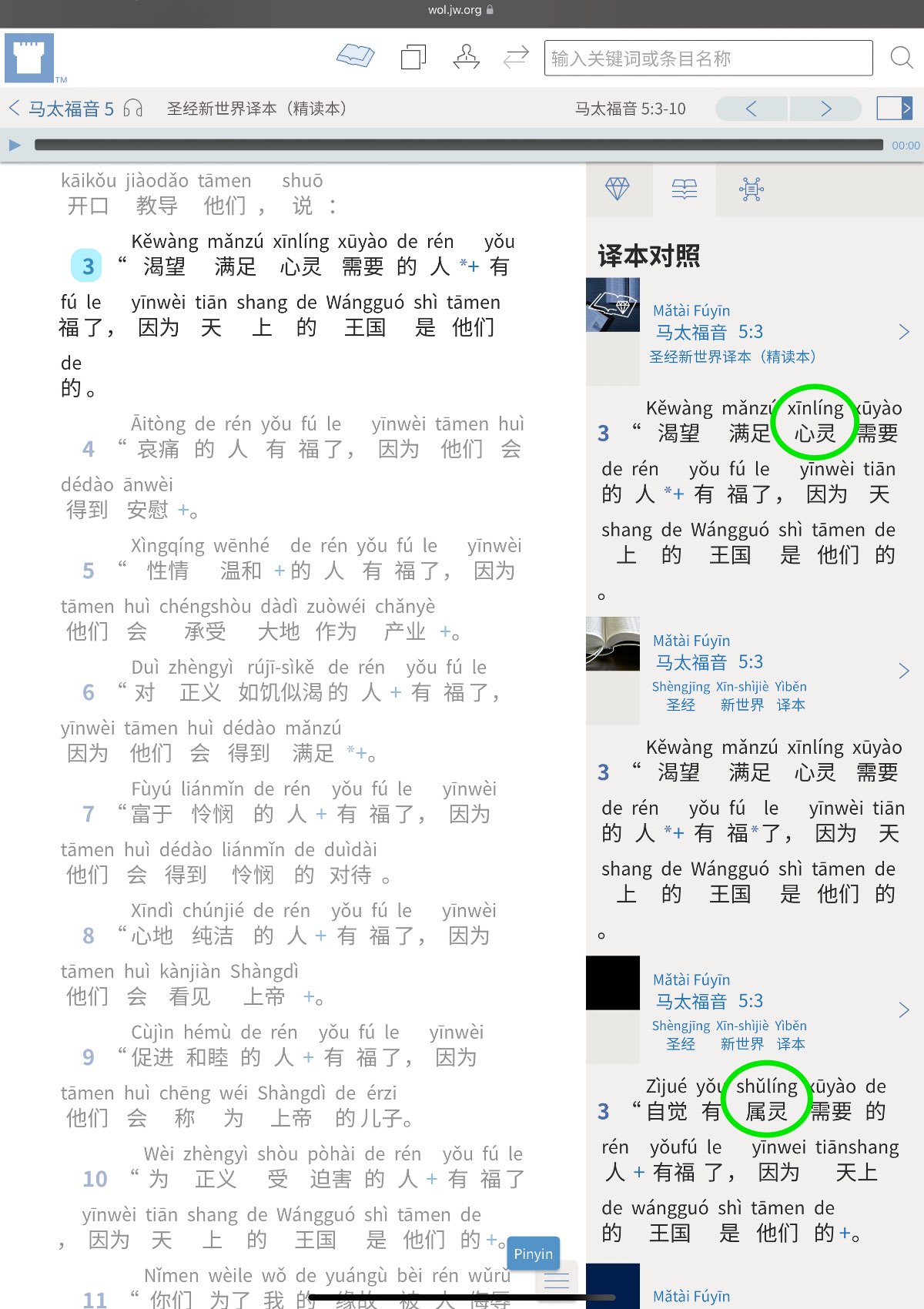
One of the publications that is now recommended to be used on Bible studies is the Yǒngyuǎn Xiǎngshòu Měihǎo de Shēngmìng—Hùdòng Shì Shèngjīng Kèchéng ((Yǒng·yuǎn Eternally · {Far (in Time)} 永远 永遠) (Xiǎng·shòu Enjoy · Receive 享受) (Měi·hǎo Beautiful · Good 美好) (de ’s 的) (Shēngmìng Life 生命)—(Hù·dòng {Each Other} · Moving → [Interactive] 互动 互動) (Shì (Type 式) (Shèng·jīng Holy · Scriptures → [Bible] 圣经 聖經) (Kè·chéng Lessons · Procedure → [Course] 课程 課程) → [Enjoy Life Forever!—An Interactive Bible Course (lff)]) (Enjoy Life Forever! (lff)) book. This week’s MEotW, “wú‐suǒwèi ((wú {[(considers that)] there is not} 无 無/无)‐(suǒ·wèi {that which} · {is said to be} 所谓 所謂) → [does not matter | is indifferent; does not care])”, appears in lesson 14 of this book, in the “SOME PEOPLE SAY” section:
SOME PEOPLE SAY: “It’s impossible to please God.”
Mandarin (WOL, Pīnyīn (Pīn·yīn {Piecing Together of} · Sounds → [Pinyin] 拼音) Plus):
📖 📄 ➕ RÚGUǑ (RÚ·GUǑ IF · {FRUIT → [IF INDEED]} 如果) YǑURÉN (YǑU·RÉN {(THERE) ARE HAVING → [(THERE) ARE]} · PEOPLE 有人) SHUŌ (SAYING 说 說/説): “Zhǐyào (Zhǐ·yào only · {requiring (that)} → [so long as] 只要) xīnli (xīn·li hearts · inside 心里 心裡/裏) yǒu ({(we) have} 有) Shàngdì (Shàng·dì Above’s · {Emperor → [God]} → [God] 上帝) jiù (then 就) xíng+ ({(it) goes} → [it’s alright] 行), zěnme (zěn·me however · [suf] 怎么 怎麼/麽) chóngbài (chóng·bài (we) {esteem → [worship]} · {do obeisance to → [worship]} → [(we) worship] 崇拜) Shàngdì (Shàng·dì Above’s · {Emperor → [God]} → [God] 上帝) dōu ({in all those cases} 都) wú‐suǒwèi+ ((wú {there is not} 无 無/无)‐(suǒ·wèi {that which} · {is said to be} 所谓 所謂) → [it does not matter]).”
As can be seen from the above, the English and Mandarin versions of this section of lesson 14 express different meanings—the Mandarin version actually means something like “As long as we have God in our hearts it’s alright, it doesn’t matter how we worship God.” Apparently, it was decided that the English and Mandarin fields have different needs in this regard. Anyway, in the above example, this week’s MEotW “wú‐suǒwèi ((wú {[(considers that)] there is not} 无 無/无)‐(suǒ·wèi {that which} · {is said to be} 所谓 所謂) → [does not matter | is indifferent; does not care])” effectively means “it does not matter”.
How do this expression’s morphemes work together to produce this effective meaning? The literal meaning of the morphemes is “{there is not} {that which} {is said to be}”, which kind of has the flavour of “there is nothing to speak of”. It’s not hard to see then, why this expression effectively means “does not matter | is indifferent; does not care”.
Playing It Cool?
Another place where I have seen “wú‐suǒwèi ((wú {[(considers that)] there is not} 无 無/无)‐(suǒ·wèi {that which} · {is said to be} 所谓 所謂) → [does not matter | is indifferent; does not care])” used is in the Faye Wong song “Shìyán (Shì·yán Pledging · Words → [Pledge] 誓言)”:
Mandarin:
📖 📄 ➕ Rúguǒ (Rú·guǒ if · {fruit → [if indeed]} 如果) nǐ (you 你) néng (could 能) gěi (give 给 給) wǒ (me 我) yí (one 一) ge ([mw] 个 個/个) zhēnchéng+ (zhēn·chéng true · sincere 真诚 真誠) de (’s 的) juéduì (jué·duì {being cut off → [absolutely]} · {facing → [being compared]} → [being definite] 绝对 絕對)…
Wú‐suǒwèi ((Wú {(I consider that) there is not} 无 無/无)‐(suǒ·wèi {that which} · {is said to be} 所谓 所謂) → [(I) don’t care]), wǒ (I 我) shénme (shén·me {(about) what → [(about) anything]} · [suf] 什么 什/甚麼) dōu ({in all those cases} 都) wú‐suǒwèi ((wú {(consider that) there is not} 无 無/无)‐(suǒ·wèi {that which} · {is said to be} 所谓 所謂) → [don’t care]).
English:
If you could give me a sincere certainty…
I don’t care, I don’t care about anything.
In this part of the song, she is trying to “play it cool,” saying that whatever he says or does doesn’t matter to her, that she doesn’t care. Ironically, though, those who tell such things to others and to themselves often do so precisely because they do care. Later in the song, she sings:
Mandarin:
📖 📄 ➕ Bié (don’t 别 別) yǐwéi (yǐ·wéi consider · {(the case) to be} (that) 以为 以為) zhízhuó+ (zhí·zhuó persisting · applying → [persevering] 执着 執著) de (’s 的) xīn (heart 心) jiù (then 就) búhuì (bú·huì not · can → [cannot] 不会 不會) bèi ({be covered by being → [passive signifier]} → [be] 被) pèngsuì (pèng·suì knocked · {to be broken to pieces} 碰碎).
Bié (don’t 别 別) yǐwéi (yǐ·wéi consider · {(the case) to be} (that) 以为 以為) wǒ (I 我) zhēnde (zhēn·de really · ’s 真的) wú‐suǒwèi ((wú {(consider that) there is not} 无 無/无)‐(suǒ·wèi {that which} · {is said to be} 所谓 所謂) → [don’t care]).
English:
Don’t think that a persevering heart can’t be shattered.
Don’t think that I really don’t care.
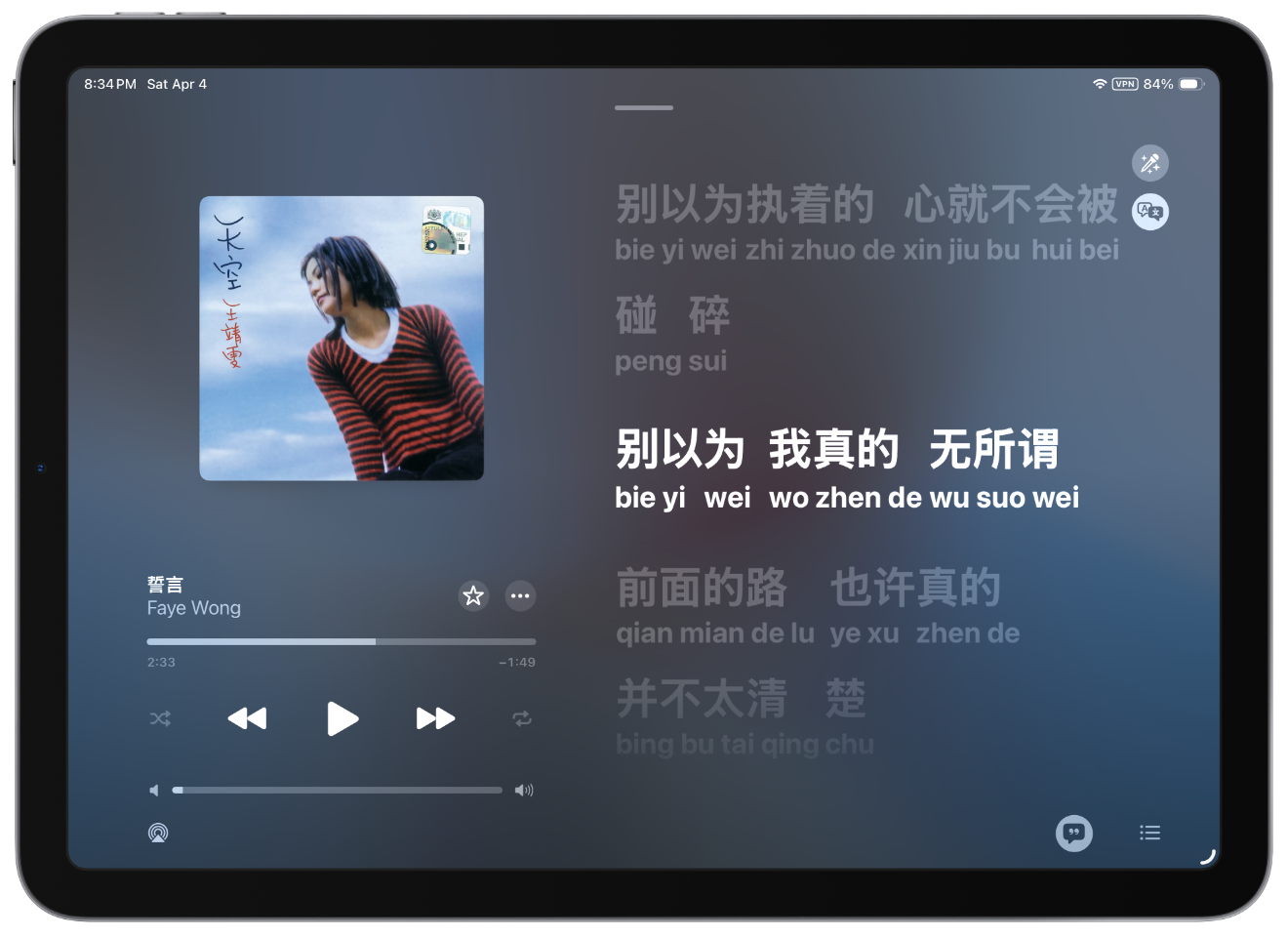
Lyrics for the Faye Wong song “Shìyán (Shì·yán Pledging · Words → [Pledge] 誓言)” (“Pledge”) in Apple Music, on an iPad (It’s great that they give the option of showing the Pīnyīn (Pīn·yīn {Piecing Together of} · Sounds → [Pinyin] 拼音), but it would have been even better if they included tone marks, even if the tones are not heard during singing.)
For convenience:
The direct link for the Pīnyīn (Pīn·yīn {Piecing Together of} · Sounds → [Pinyin] 拼音) Plus resource for the Enjoy Life Forever! book is:
The short link for Chinese field language-learning links for the Enjoy Life Forever! book is:
More Pīnyīn (Pīn·yīn {Piecing Together of} · Sounds → [Pinyin] 拼音) and Pīnyīn (Pīn·yīn {Piecing Together of} · Sounds → [Pinyin] 拼音) Plus web material based on the Mandarin Enjoy Life Forever! book will be made available in the Pīnyīn (Pīn·yīn {Piecing Together of} · Sounds → [Pinyin] 拼音) Plus web resource as time allows.