Categories
Theocratic

tǐyàn

tǐyàn (tǐ·yàn {bodily → [personally]} · test; examine; check; verify → [learn through practice/personal experience] 体验 體驗) ← Tap/click to show/hide the “flashcard”

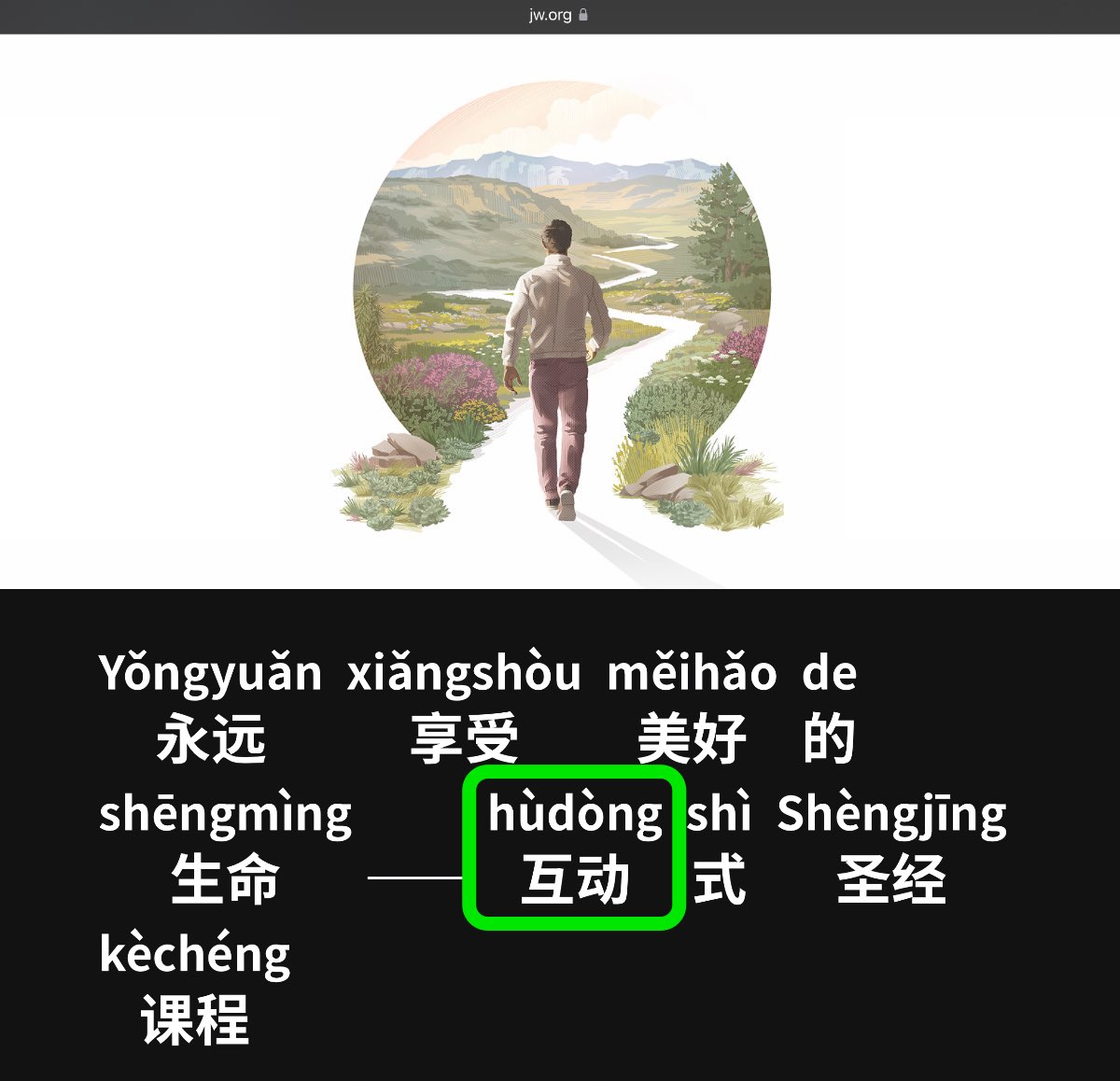
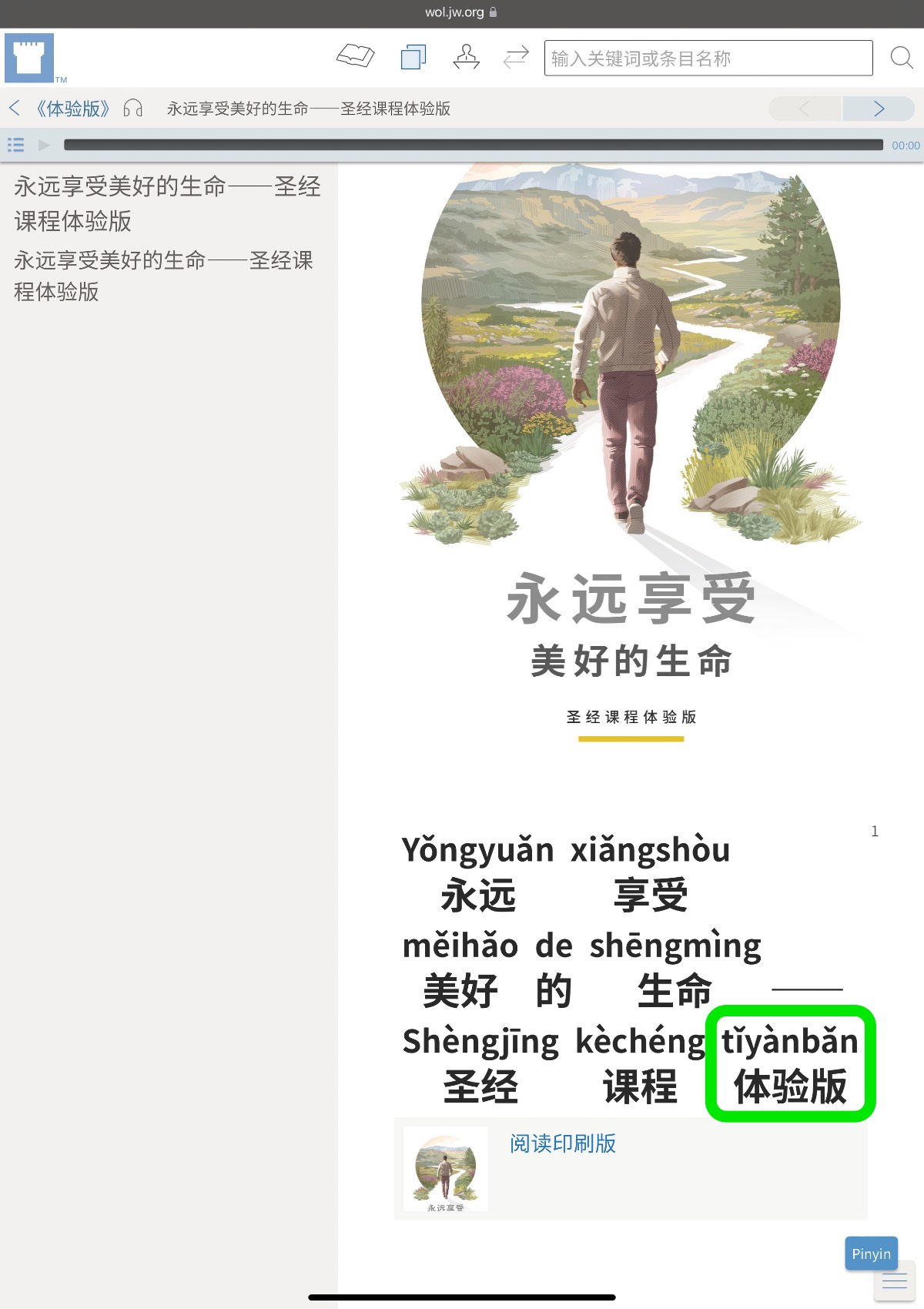
One of the publications that is now recommended to be used on Bible studies is the Yǒngyuǎn Xiǎngshòu Měihǎo de Shēngmìng—Shèngjīng Kèchéng Tǐyàn Bǎn ((Yǒng·yuǎn Eternally · {Far (in Time)} 永远 永遠) (Xiǎng·shòu Enjoy · Receive 享受) (Měi·hǎo Beautiful · Good 美好) (de ’s 的) (Shēngmìng Life 生命)—(Shèng·jīng Holy · Scriptures → [Bible] 圣经 聖經) (Kè·chéng Lessons · Procedure → [Course] 课程 課程) (Tǐ·yàn {Bodily → [Personally]} · Testing → [Learning Through Personal Experience] 体验 體驗) (Bǎn ({Printing Plate (or Block)} → [Edition] 版) [Enjoy Life Forever!—Introductory Bible Lessons (lffi)]) (Enjoy Life Forever! (lffi)) brochure. Looking at the Mandarin title of this brochure, you may have wondered: What does “tǐyàn (tǐ·yàn {bodily → [personally]} · test; examine; check; verify → [learn through practice/personal experience] 体验 體驗)” mean?

_Enjoy Life Forever!_ br. title page (WOL CHS+Pinyin)

You may surmise that “tǐyàn (tǐ·yàn {bodily → [personally]} · test; examine; check; verify → [learn through practice/personal experience] 体验 體驗)” roughly corresponds with the “Introductory” in Enjoy Life Forever!​—Introductory Bible Lessons, and you would be right. The match isn’t exact, though, and a look into the literal meanings of the morphemes in “tǐyàn (tǐ·yàn {bodily → [personally]} · test; examine; check; verify → [learn through practice/personal experience] 体验 體驗)” will help us to understand why, and to gain some insight into how the components of “tǐyàn (tǐ·yàn {bodily → [personally]} · test; examine; check; verify → [learn through practice/personal experience] 体验 體驗)” and of similar Mandarin words work together.

Morphemic Breakdown

As the Pīnyīn (Pīn·yīn {Piecing Together of} · Sounds → [Pinyin] 拼音) Plus information for “tǐyàn (tǐ·yàn {bodily → [personally]} · test; examine; check; verify → [learn through practice/personal experience] 体验 體驗)” shows us, its first morpheme “ (body | {bodily [→ [personally]]}體/体/躰)”, which literally means “body”, here means “in body” or “bodily”, or as we might say in English, “in person” or “personally”. The other morpheme “yàn (test; examine; check; verify驗/騐)” means “test; examine; check; verify”. The word “tǐyàn (tǐ·yàn {bodily → [personally]} · test; examine; check; verify → [learn through practice/personal experience] 体验 體驗)” that these morphemes form together effectively means “personally test”, or “learn from practical/personal experience”.

Kèchéng (Kè·chéng Lessons · Procedure → [Course] 课程 課程) Tǐyàn (Tǐ·yàn {Bodily → [Personally]} · Testing → [Learning Through Personal Experience] 体验 體驗) Bǎn ({Printing Plate (or Block)} → [Edition] 版)” in the title of the Mandarin Enjoy Life Forever! brochure does correspond to “Introductory…Lessons” in the title of the English Enjoy Life Forever! brochure, but a more exact English translation might be “Course Trial Edition” or something like that.

Representing the Self in Some Mandarin Words

The way “ (body | {bodily [→ [personally]]}體/体/躰)” is used in “tǐyàn (tǐ·yàn {bodily → [personally]} · test; examine; check; verify → [learn through practice/personal experience] 体验 體驗)” is an example of how in some Mandarin words, the physical body is used to represent the whole self. “Tǐhuì (Tǐ·huì {bodily → [personally]} · understand; know 体会 體會)” and “tǐtiē (tǐ·tiē {bodily → [personally]} · {stick to → [keep close to]} → [show consideration for; be thoughtful towards] 体贴 體貼)” are two fairly well-known Mandarin words that also use “ (body | {bodily [→ [personally]]}體/体/躰)” this way.

Another example of a Mandarin word in which the physical body is used to represent the whole self is a word that we as Jehovah’s people are quite familiar with: “xiànshēn (xiàn·shēn {offer → [dedicate]} · {body → [self]} | {offering of → [dedicating of]} · {body → [self]} → [dedication] 献身 獻身)”. This word literally means “offer body”, and effectively means “dedicate self”.


For convenience:

The direct link for the current generation Pīnyīn (Pīn·yīn {Piecing Together of} · Sounds → [Pinyin] 拼音) Plus resource for the Enjoy Life Forever! brochure is:

The direct link for the current generation Pīnyīn (Pīn·yīn {Piecing Together of} · Sounds → [Pinyin] 拼音) Plus resource for the Enjoy Life Forever! book is:

The short link for Chinese field language-learning links for the Enjoy Life Forever! brochure is:

The short link for Chinese field language-learning links for the Enjoy Life Forever! book is:

More Pīnyīn (Pīn·yīn {Piecing Together of} · Sounds → [Pinyin] 拼音) and Pīnyīn (Pīn·yīn {Piecing Together of} · Sounds → [Pinyin] 拼音) Plus web material based on the Mandarin Enjoy Life Forever! brochure and the Mandarin Enjoy Life Forever! book will be made available in the above-mentioned Pīnyīn (Pīn·yīn {Piecing Together of} · Sounds → [Pinyin] 拼音) Plus web resources as time allows.

Categories
Culture Science Technology Theocratic

diǎnliàng

diǎnliàng (diǎn·liàng {dot → [light (v); ignite]} · {to be bright} [→ [illuminate; shine light on]] 点亮 點亮) ← Tap/click to show/hide the “flashcard”

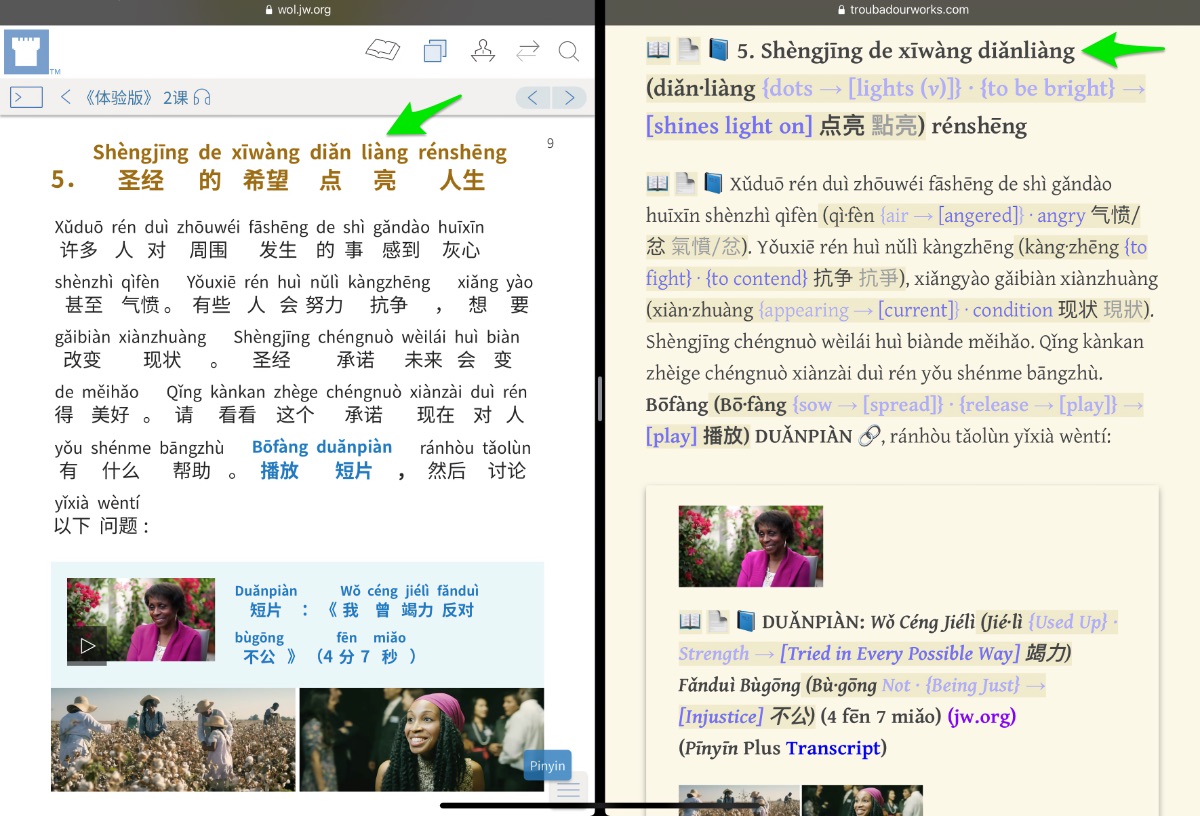
This week’s MEotW, “diǎnliàng (diǎn·liàng {dot → [light (v); ignite]} · {to be bright} [→ [illuminate; shine light on]] 点亮 點亮)”, is used to good effect in lesson 02 point 5 (WOL, Pīnyīn (Pīn·yīn {Piecing Together} · Sounds → [Pinyin] 拼音) Plus) of the Mandarin Enjoy Life Forever! (lffi) brochure (and of the Mandarin Enjoy Life Forever! (lff) book).

“Diǎnliàng” in _Enjoy Life Forever!_ br., lesson 02 point 5 (WOL CHS+Pinyin, _Pīnyīn_ Plus)

Translating the English text “The Bible’s hope can make a difference”, the Mandarin text means ‘The Bible’s hope shines a light on human life’.

What’s a Word?

Note that the Watchtower ONLINE LIBRARY currently renders the morphemes “”diǎn (dots → [lights (v)])” and “liàng ({to be bright} 亮)” as two separate words, whereas the unofficial Pīnyīn (Pīn·yīn {Piecing Together} · Sounds → [Pinyin] 拼音) Plus resource renders them together as one word, as many past official Pīnyīn (Pīn·yīn {Piecing Together} · Sounds → [Pinyin] 拼音) publications would likely have done. Is one of these renderings “right” and the other “wrong”? Is one better and the other worse? How much does it matter?

These seemingly simple questions turn out to actually be not that simple to answer. Especially in languages like Mandarin that have historically been written using the Chinese characters writing system—a system that probably for traditional stylistic reasons neglects to clearly and conveniently put spaces between words like alphabetic writing systems generally do—there is not always a consensus regarding the answers to the questions of “What’s a word?” and “What morphemes should be put together as words?” As the Wikipedia article on “Word” says:

There still remains no consensus among linguists about the proper definition of “word” in a spoken language that is independent of its writing system, nor about the precise distinction between it and “morpheme”.[source] This issue is particularly debated for Chinese and other languages of East Asia,[source]

Standards and Conventions

Unlike the Chinese characters writing system, the Pīnyīn (Pīn·yīn {Piecing Together} · Sounds → [Pinyin] 拼音) alphabetic writing system does clearly and conveniently put spaces between words—such word separation is in fact a big advantage of Pīnyīn (Pīn·yīn {Piecing Together} · Sounds → [Pinyin] 拼音) compared to the Chinese characters writing system. However, the question of what constitutes a word that is to be separated from other words by spaces remains one that may be answered differently by different people.

The technical linguistic term that relates to such matters is orthography. The Wikipedia article on that provides this summary of what that means:

An orthography is a set of conventions for writing a language, including norms of spelling, hyphenation, capitalization, word breaks, emphasis, and punctuation.

One might wonder whether there are official rules and standards regarding Pīnyīn (Pīn·yīn {Piecing Together} · Sounds → [Pinyin] 拼音) orthography, and indeed there are. In fact, the PRC government has an official national standard for Pīnyīn (Pīn·yīn {Piecing Together} · Sounds → [Pinyin] 拼音) orthography, with the designation GB/T 16159-2012. (A convenient annotated web version (rendered in Simplified Chinese characters) has been made available here on the independent website Pīnyīn.info.)

What the letters “GB/T” stand for is significant. Wikipedia provides this summary:

GB stands for Guobiao (simplified Chinese: 国标; traditional Chinese: 國標; pinyin: Guóbiāo), Chinese for national standard.

Mandatory standards are prefixed “GB”. Recommended standards are prefixed “GB/T” (T from Chinese language 推荐; tuījiàn; ‘recommended’).

(The above summary is confirmed elsewhere on the web, e.g. here on legal analysis website Lexology.)

So, while the PRC’s GB/T 16159-2012 provides many basic rules regarding Pīnyīn (Pīn·yīn {Piecing Together} · Sounds → [Pinyin] 拼音) orthography, even within China it is not a mandatory standard—the “T” in “GB/T 16159-2012” indicates that even within China, it is at most a set of recommendations.

(An interesting contrast is the mandatory PRC standard GB 18030, which relates to software support for the PRC’s Chinese characters, both simplified and traditional, and which, for example, Microsoft makes its Windows software comply with.)

Regarding standards and conventions, even officially recommended ones, for things like language and writing, views and practices vary in different places, and at different times. For example, Chinese writing in the past didn’t have punctuation, and now it has punctuation largely modeled after European punctuation. (For reference: Chinese punctuation – Wikipedia, Q&A: When were punctuation marks first used? – HistoryExtra, history – When was punctuation introduced into Chinese? – Chinese Language Stack Exchange)

Even today, within the same time frame, there are differing views and practices regarding how things should be written. For example, in English, there are differing views and practices regarding British vs. American spellings, whether or not to use the Oxford (serial) comma, how titles should be capitalized, what should be italicized/bolded/underlined, etc.

When it comes to Pīnyīn (Pīn·yīn {Piecing Together} · Sounds → [Pinyin] 拼音), another factor to keep in mind is that due primarily to cultural prejudice, Pīnyīn (Pīn·yīn {Piecing Together} · Sounds → [Pinyin] 拼音) has simply not been used much overall, relatively speaking, especially as a full writing system on its own. So, it has not really gone through much of the process of receiving the widely agreed upon tweaks and refinements that a system typically receives as it gets tried out and put to extensive use by many people.

Verb-Complement Togetherness

Getting back to the MEotW “diǎnliàng (diǎn·liàng {dot → [light (v); ignite]} · {to be bright} [→ [illuminate; shine light on]] 点亮 點亮)”, the PRC national standard GB/T 16159-2012 recommends that, being made up of a single-syllable verb and its single-syllable complement, this expression should be written together. Recent official Pīnyīn (Pīn·yīn {Piecing Together} · Sounds → [Pinyin] 拼音) publications such as those on the Watchtower ONLINE LIBRARY often do not follow this recommendation regarding single-syllable verbs and their single-syllable complements, whereas older official Pīnyīn (Pīn·yīn {Piecing Together} · Sounds → [Pinyin] 拼音) publications did follow this recommendation, and as do the unofficial Pīnyīn (Pīn·yīn {Piecing Together} · Sounds → [Pinyin] 拼音) Plus resources.

On the other hand, the unofficial Pīnyīn (Pīn·yīn {Piecing Together} · Sounds → [Pinyin] 拼音) Plus resources join the official Pīnyīn (Pīn·yīn {Piecing Together} · Sounds → [Pinyin] 拼音) publications, old and new, in explicitly indicating tone sandhi for “ (not 不)” and “ (one 一)” (e.g., “zài (bú·zài not · again; further; continuing; anymore 不再)” instead of the standard “zài (bù·zài not · again; further; continuing; anymore 不再)”) to make things easier for readers, even though this practice is not included in the GB/T 16159-2012 standard’s recommendations.

In the end, what matters most re how anything is written is not just what is officially recommended or what happens to be popular among changing, imperfect humans. Rather, what matters most is what really works best to accomplish the goal of writing: To communicate to readers. This is especially true when God-honouring and life-saving Bible truths need to be communicated. So, this blog and the other Pīnyīn (Pīn·yīn {Piecing Together} · Sounds → [Pinyin] 拼音) Plus resources will continue to seek to render Pīnyīn (Pīn·yīn {Piecing Together} · Sounds → [Pinyin] 拼音) in ways that maximize how clearly, easily, effectively, and appropriately it communicates with readers.


For convenience:

The direct link for the current generation Pīnyīn (Pīn·yīn {Piecing Together of} · Sounds → [Pinyin] 拼音) Plus resource for the Enjoy Life Forever! brochure is:

The direct link for the current generation Pīnyīn (Pīn·yīn {Piecing Together of} · Sounds → [Pinyin] 拼音) Plus resource for the Enjoy Life Forever! book is:

The short link for Chinese field language-learning links for the Enjoy Life Forever! brochure is:

The short link for Chinese field language-learning links for the Enjoy Life Forever! book is:

More Pīnyīn (Pīn·yīn {Piecing Together of} · Sounds → [Pinyin] 拼音) and Pīnyīn (Pīn·yīn {Piecing Together of} · Sounds → [Pinyin] 拼音) Plus web material based on the Mandarin Enjoy Life Forever! brochure and the Mandarin Enjoy Life Forever! book will be made available in the above-mentioned Pīnyīn (Pīn·yīn {Piecing Together of} · Sounds → [Pinyin] 拼音) Plus web resources as time allows.

Categories
Culture History Language Learning

Zhùyīn

Zhùyīn (Zhù·yīn {Annotating of} · Sounds → [Zhuyin] 注音 註/注音) 👈🏼 Tap/click to show/hide the “flashcard”

The last imperial dynasty of China was the Qing dynasty. We call it the last dynasty, though, because it ended, and it was not followed by another dynasty. Towards the end of the Qing dynasty’s rule, China was in a bad way. Wikipedia provides this summary of the situation:

The dynasty reached its high point in the late 18th century, then gradually declined in the face of challenges from abroad, internal revolts, population growth, disruption of the economy, corruption, and the reluctance of ruling elites to change their mindsets.

One of the ways in which some sought to help with the deteriorating situation in China is described by American linguist, sinologist, author of Chinese language textbooks, lexicographer of Chinese dictionaries, and Professor Emeritus of Chinese Studies at the University of Hawaiʻi at Mānoa John DeFrancis, in his book The Chinese Language: Fact and Fantasy:

…toward the end of the nineteenth century…The obvious disintegration of Chinese society and the inability to cope with foreign aggressors led some reformers in contact with missionaries to conceive of carrying out a reform of the writing as part of a general educational reform that would help revitalize the country and save it from extinction.1

Professor DeFrancis goes on the describe the development and naming of an early result of the efforts of these reformers:

Official resolution of these issues was effected by the decisions reached by the Conference on Unification of Pronunciation that was held under government auspices in 1913. …The majority members of the conference reached the decision to adopt a set of thirty-nine phonetic symbols derived from Chinese characters, to use them as an adjunct to the characters, and to confine their scope to representing the Mandarin pronunciation as the national standard. The symbols were initially called Zhùyīn Zìmǔ (“Phonetic Alphabet”); later they were also called Guóyīn Zìmǔ (“National Phonetic Alphabet”). The fear that they might be considered an alphabetic system of writing independent of characters led in 1930 to their being renamed Zhùyīn Fúhào (“Phonetic Symbols”).2

Bopomofo in Regular, Handwritten Regular, & Cursive formats

Zhùyīn (Zhù·yīn {Annotating of} · Sounds → [Zhuyin] 注音 註/注音), or Bopomofo, in regular, handwritten regular, and cursive formats

This week’s MEotW, “Zhùyīn (Zhù·yīn {Annotating of} · Sounds → [Zhuyin] 注音 註/注音)”, is a commonly used name for this system. It’s also commonly called “Bopomofo (ㄅㄆㄇㄈ)”, after the first four symbols of the system. This is similar to how in English we use “ABCs” to refer to the alphabet, and to how the word “alphabet” itself comes from alpha and bēta, the first two letters of the Greek alphabet.

The Zhùyīn (Zhù·yīn {Annotating of} · Sounds → [Zhuyin] 注音 註/注音) system continues to be used in elementary schools in Taiwan for teaching reading and writing, with the system’s symbols often appearing as ruby characters over Chinese characters in textbooks.

Zhùyīn (Zhù·yīn {Annotating of} · Sounds → [Zhuyin] 注音 註/注音) / Pīnyīn (Pīn·yīn {Piecing Together of} · Sounds → [Pinyin] 拼音)

ㄓㄨ`ㄧㄣ? Pīnyīn?

In mainland China, Zhùyīn (Zhù·yīn {Annotating of} · Sounds → [Zhuyin] 注音 註/注音) has largely been replaced by Pīnyīn (Pīn·yīn {Piecing Together of} · Sounds → [Pinyin] 拼音), which was adopted by the mainland Chinese government in 1958. This was possible because Zhùyīn (Zhù·yīn {Annotating of} · Sounds → [Zhuyin] 注音 註/注音) and Pīnyīn (Pīn·yīn {Piecing Together of} · Sounds → [Pinyin] 拼音) both do the same job of representing in alphabetic writing the sounds of Mandarin speech—they just use different symbols.

Around the time that Pīnyīn (Pīn·yīn {Piecing Together of} · Sounds → [Pinyin] 拼音) was introduced, Premier of the People’s Republic of China Zhōu Ēnlái ((Zhōu {Circumference (surname)}周/週) (Ēn·lái Kindness · Comes 恩来 恩來) (the first Premier of the People’s Republic of China)) wrote the following comparing the different practical effects of using these different sets of symbols:

Although [Zhùyīn (Zhù·yīn {Annotating of} · Sounds → [Zhuyin] 注音 註/注音)] has been in existence for forty years and was popularized in primary schools by governments in the past, it has been forgotten by most of its students. Now only a few people know the phonetic transcript. In future, we shall adopt the Latin alphabet for the Chinese phonetic alphabet. Being in wide use in scientific and technological fields and in constant day-to-day usage, it will be easily remembered.

Some Mandarin field language learners prefer not to use the Latin alphabet-based Pīnyīn (Pīn·yīn {Piecing Together of} · Sounds → [Pinyin] 拼音) system, claiming that it makes them think of English sounds rather than Mandarin sounds. Perhaps those who feel this way could instead get the benefits of a phonetic alphabet by using Zhùyīn (Zhù·yīn {Annotating of} · Sounds → [Zhuyin] 注音 註/注音). However, they would first have to learn and remember the rarely-used symbols of Zhùyīn (Zhù·yīn {Annotating of} · Sounds → [Zhuyin] 注音 註/注音), which for almost everyone these days is going to be significantly harder than remembering the familiar Latin alphabet letters of Pīnyīn (Pīn·yīn {Piecing Together of} · Sounds → [Pinyin] 拼音).

Regarding associating language sounds with a writing system (which both Zhùyīn (Zhù·yīn {Annotating of} · Sounds → [Zhuyin] 注音 註/注音) and Pīnyīn (Pīn·yīn {Piecing Together of} · Sounds → [Pinyin] 拼音) qualify as), once a Mandarin learner passes the very beginning stage and gets familiar with Mandarin sounds and gets used to the Pīnyīn (Pīn·yīn {Piecing Together of} · Sounds → [Pinyin] 拼音) system, he or she will actually have no more problem associating Pīnyīn (Pīn·yīn {Piecing Together of} · Sounds → [Pinyin] 拼音) with Mandarin sounds than an English-speaking non-beginner student of French has associating French words with French sounds.

For more information on how Zhùyīn (Zhù·yīn {Annotating of} · Sounds → [Zhuyin] 注音 註/注音) compares to Pīnyīn (Pīn·yīn {Piecing Together of} · Sounds → [Pinyin] 拼音) for Mandarin field language learners, please see the tiandi.info post “Pinyin and Zhuyin”. (If you need login information for the parts of tiandi.info that require it, request it by email, and include information on who referred you and/or what group/cong. you are in.)

1. John DeFrancis, The Chinese Language: Fact and Fantasy (Honolulu: University of Hawaii Press, 1984), p. 241. ^

2. Ibid., p. 242. ^