Categories
Culture Language Learning Science Technology Theocratic

tiānzhēn

tiānzhēn (tiān·zhēn {(of) heaven → [natural]} · {(following) natural instincts} → [innocent; naive; simple and unaffected | (human) nature] 天真) ← Tap/click to show/hide the “flashcard”

[Notes: Tap/click on a Pīnyīn (Pīn·yīn {Piecing Together of} · Sounds → [Pinyin] 拼音) expression to reveal its “flashcard”; tap/click on a “flashcard” or its Pīnyīn (Pīn·yīn {Piecing Together of} · Sounds → [Pinyin] 拼音) expression to hide the “flashcard”. 📖 📄 📘 icons mean 📖 Reveal All, 📄 Reveal Advanced, and 📘 Reveal None re all the “flashcards” in the heading, paragraph, etc. that they are placed at the beginning of.]

The Shēngmìng Láizì Chuàngzào Ma? ((Shēngmìng Life 生命) (Lái·zì Came · From 来自 來自) (Chuàng·zào Initiating · {Making, Creating} → [Creating] 创造 創造) (Ma [? ptcl for “yes/no” questions])? [Was Life Created? (lc)]) (Was Life Created? (lc)) brochure and the Shēngmìng de Qǐyuán—Zhíde Sīkǎo de Wǔ Ge Wèntí ((Shēngmìng Life 生命) (de ’s 的) (Qǐ·yuán {Rising → [Starting]} · Source → [Origin] 起源/原)—(Zhí·de Worth · Getting → [Worth] 值得) (Sī·kǎo {Thinking About} · Examining 思考) (de ’s 的) (Wǔ Five 五) (Ge [mw]個/个) (Wèn·tí Asking · Subjects → [Questions] 问题 問題) [The Origin of Life—Five Questions Worth Asking (lf)]) (The Origin of Life—Five Questions Worth Asking (lf)) brochure were originally published back in 2010, but recently, the English version of the Was Life Created? brochure was updated to the December 2022 Printing, and the Mandarin version of it was updated to the February 2023 Printing. Also, the Was Life Created? brochure and the Origin of Life brochure are now in the Teaching Toolbox section in the JW Library app. So, it would be good to consider some of the expressions used in the Mandarin versions of these publications that can be so helpful when discussing whether life was created.

Only Natural?

This week’s MEotW, “tiānzhēn (tiān·zhēn {(of) heaven → [natural]} · {(following) natural instincts} → [innocent; naive; simple and unaffected | (human) nature] 天真)”, occurs in Proverbs 14:15, which is quoted in the introductory section of the Origin of Life brochure, entitled, in English, “A Student’s Dilemma”. While the Origin of Life brochure, published in 2010, quotes older versions of the New World Translation Bible in its text, let us consider how this scripture is rendered in the current English and Mandarin translations of the NWT Bible:

English:

The naive person believes every word,
But the shrewd one ponders each step.

Mandarin (WOL, Pīnyīn (Pīn·yīn {Piecing Together of} · Sounds → [Pinyin] 拼音) Plus):

📖 📄 📘 Tiānzhēn (Tiān·zhēn {(of) heaven → [natural]} · {(following) natural instincts} → [naive] 天真) wúzhī (wú·zhī without · {knowing → [knowledge]} → [ignorant] 无知 無知) de (’s 的) rén (person 人), fán (every凡/凢) huà (word) dōu ({every one} 都) xìn (believes 信);
Jīngmíng (Jīng·míng shrewd · {bright → [understanding]} → [shrewd] 精明) shěnshèn (shěn·shèn {examining → [careful]} · cautious 审慎 審慎) de ( 的) rén (person 人), bùbù (bù·bù step · step → [at every step] 步步) liúxīn (liú·xīn {makes to stay} · {heart} → [is careful] 留心).

Looking at the morphemes in “tiānzhēn (tiān·zhēn {(of) heaven → [natural]} · {(following) natural instincts} → [innocent; naive; simple and unaffected | (human) nature] 天真)”, “tiān ({[(of)] heaven [→ [nature | natural; inborn; innate]]} | {heavenly → [celestial]} | {sky [→ [day | overhead | weather]]} 天) literally means “heaven”, but it can also have a derived meaning of “natural”, as it seems to in the context of “tiānzhēn (tiān·zhēn {(of) heaven → [natural]} · {(following) natural instincts} → [innocent; naive; simple and unaffected | (human) nature] 天真)”. As for “zhēn (true; real; genuine | truly; really | {natural instincts/character/disposition; nature; inherent quality (literary)} 真)”, these days it’s generally used to mean “true; real; genuine”, but in the context of “tiānzhēn (tiān·zhēn {(of) heaven → [natural]} · {(following) natural instincts} → [innocent; naive; simple and unaffected | (human) nature] 天真)”, it seems to have its literary meaning of “(following) natural instincts”. Taken together then, the morphemes in “tiānzhēn (tiān·zhēn {(of) heaven → [natural]} · {(following) natural instincts} → [innocent; naive; simple and unaffected | (human) nature] 天真) are used to effectively mean “innocent; naive; simple and unaffected | (human) nature”.

What’s Natural?

Speaking of natural, different people have different views on what is natural, especially in this world of ever-changing technology. I am reminded of this Douglas Adams quote:

I’ve come up with a set of rules that describe our reactions to technologies:

  1. Anything that is in the world when you’re born is normal and ordinary and is just a natural part of the way the world works.
  2. Anything that’s invented between when you’re fifteen and thirty-five is new and exciting and revolutionary and you can probably get a career in it.
  3. Anything invented after you’re thirty-five is against the natural order of things.

As an example, I remember a brother who, a few years ago, felt that exchanging email addresses with brothers and sisters one meets at a convention is ‘not natural’, unlike, say, exchanging mailing addresses or phone numbers. Actually, of course, phones and houses, apartments, PO boxes, etc. don’t exist in nature any more than email inboxes do—these are all just human technologies that came along at different times in history, and thus at different times in people’s lives, causing younger ones to find them natural and older ones to find them unnatural.

If we can maintain balanced, open minds, though, we can eventually get used to new technologies that come along, benefit from them, and perhaps find them useful—and occasionally even invaluable—in Jehovah’s service. A recent outstanding example is that Zoom videoconferencing, a relatively new development at the time, enabled many of us to attend meetings during the recent pandemic when we were stuck at home. Many of us may have found it unnatural at first, but over time, we eventually got used to it, and even came to appreciate the spiritual benefits that it enables in certain situations.

What’s Naive?

Getting back to the matter of being naive, as referred to in the above-mentioned scripture, the Origin of Life brochure quotes this scripture to make the following point:

[Students] need to examine the evidence for evolution and for creation and then decide for themselves which they will believe.

In fact, the Bible warns against blindly believing what others teach.

Supporters of evolution will say that people need to not unthinkingly believe the Bible’s creation account, but at the same time, it would also be naive of people to ‘believe every word’ that evolutionists say.

As Mandarin field language learners, we may have been told certain things by well-meaning Mandarin teachers, who were probably just passing on what they had learned. However, it would be naive to unthinkingly accept everything told to us that ultimately originates in the cultures and traditions of the world of imperfect humans that is under Satan’s influence. Instead, we should educate ourselves about the first principles involved with what it really takes to learn the Mandarin language and to use it in Jehovah’s service in the best way that we can.

What’s New with Py+ Material?

A while ago, I got the feeling that I should shift focus to get to work on producing current-generation Pīnyīn (Pīn·yīn {Piecing Together of} · Sounds → [Pinyin] 拼音) Plus material for the Was Life Created? brochure, which I had last produced older-style material for several years earlier. The official material for this brochure had also not been changed for several years, with the last Mandarin printing of it being dated 2016-12. However, not long after I had started working on new Pīnyīn (Pīn·yīn {Piecing Together of} · Sounds → [Pinyin] 拼音) Plus material for this brochure, I noticed that a new printing, dated 2022-12, had been put out for the English version of the Was Life Created? brochure, and then, a new printing, dated 2023-02, appeared in the JW Library app for the Mandarin version of this brochure. Also, the Was Life Created? brochure and the Origin of Life brochure were added to the Teaching Toolbox section in the JW Library app at around this time. It seems that Jehovah had decided that the time had come for renewed focus on these brochures, and it seems that the work of producing Pīnyīn (Pīn·yīn {Piecing Together of} · Sounds → [Pinyin] 拼音) Plus material for the Was Life Created? brochure is privileged to be part of this renewed focus.

Now, I am happy to be able to report that, after much ongoing effort, Pīnyīn (Pīn·yīn {Piecing Together of} · Sounds → [Pinyin] 拼音) Plus material for the Origin of Life brochure has become available as well. (Links can found below.) Hopefully, this material, along with the Pīnyīn (Pīn·yīn {Piecing Together of} · Sounds → [Pinyin] 拼音) Plus material for the Was Life Created? brochure, will help us to help our Mandarin-speaking Bible students to thoughtfully consider the evidence regarding how life came to exist, rather than just naively accepting what the world tells them about this.


For convenience:

The direct link for the current generation Pīnyīn (Pīn·yīn {Piecing Together of} · Sounds → [Pinyin] 拼音) Plus resource for the Origin of Life brochure is:

The short link for Chinese field language-learning links for the Origin of Life brochure is:

More Pīnyīn (Pīn·yīn {Piecing Together of} · Sounds → [Pinyin] 拼音) and Pīnyīn (Pīn·yīn {Piecing Together of} · Sounds → [Pinyin] 拼音) Plus web material based on the Mandarin Origin of Life brochure will be made available in the Pīnyīn (Pīn·yīn {Piecing Together of} · Sounds → [Pinyin] 拼音) Plus web resource as time allows.
Categories
Culture Experiences History Science Technology Theocratic

chuàngzào

chuàngzào (chuàng·zào initiating · {making, creating} → [creating | creation; innovation] 创造 創造) ← Tap/click to show/hide the “flashcard”

The Shēngmìng Láizì Chuàngzào Ma? ((Shēngmìng Life 生命) (Lái·zì Came · From 来自 來自) (Chuàng·zào Initiating · {Making, Creating} → [Creating] 创造 創造) (Ma [? ptcl for “yes/no” questions])? [Was Life Created? (lc)]) (Was Life Created? (lc)) brochure and the Shēngmìng de Qǐyuán—Zhíde Sīkǎo de Wǔ Ge Wèntí ((Shēngmìng Life 生命) (de ’s 的) (Qǐ·yuán {Rising → [Starting]} · Source → [Origin] 起源/原)—(Zhí·de Worth · Getting → [Worth] 值得) (Sī·kǎo {Thinking About} · Examining 思考) (de ’s 的) (Wǔ Five 五) (Ge [mw]個/个) (Wèn·tí Asking · Subjects → [Questions] 问题 問題) [The Origin of Life​—Five Questions Worth Asking (lf)]) (The Origin of Life​—Five Questions Worth Asking (lf)) brochure were originally published back in 2010, but recently, the English version of the Was Life Created? brochure was updated to the December 2022 Printing, and the Mandarin version of it was updated to the February 2023 Printing. Also, the Was Life Created? brochure and the Origin of Life brochure are now in the Teaching Toolbox section in the JW Library app. So, it would be good to consider some of the expressions used in the Mandarin versions of these publications that can be so helpful when discussing whether life was created.

How It Started

This week’s MEotW, which appears right in the title of the Mandarin Was Life Created? brochure, is “chuàngzào (chuàng·zào initiating · {making, creating} → [creating | creation; innovation] 创造 創造). While this is basically a verb meaning “create”, it can also be used as a noun meaning “creation”. Such verbal/gerundial nouns were discussed in the MEotW post on “jiàodǎo (jiào·dǎo teaching · {guiding [→ [instructing]]} 教导 教導)”:

One interesting thing to note about “jiàodǎo (jiào·dǎo teaching · {guiding [→ [instructing]]} 教导 教導)” (and about “jiàoxun (teaching → [reprimanding | knowledge gained from an error] 教训 教訓)”, for that matter) is that their component morphemes seem to basically be verbs. In certain contexts, however, they are used as nouns. An example of this being done in English is that “teach” and “teaching” are verbs (e.g. “Jesus was teaching the crowd.”), but in certain contexts, “teaching” is used as a noun (e.g. “The crowd was amazed at the teaching Jesus shared with them.”). When a word is used this way, it’s called a verbal noun, or a gerundial noun. Verbal nouns are quite common in Mandarin.

How It Breaks Down

The “chuàng (initiate; create; start; originate; {achieve (sth. for the first time)}創/刱/剏/剙) in “chuàngzào (chuàng·zào initiating · {making, creating} → [creating | creation; innovation] 创造 創造) is also used in “Chuàngshìjì (Chuàng·shì·jì {Initiating, Creating of} · {Generation → [World]} · Record → [Genesis] 创世记 創世記), and is associated with originality and creativity. For example, this “chuàng (initiate; create; start; originate; {achieve (sth. for the first time)}創/刱/剏/剙) also occurs in “chuàngzuò (chuàng·zuò initiated; created; originated · {made [→ [written/composed]]} [(thing)] [→ [created; produced; written [(thing)]] [→ [creative work; creation]]] 创作 創作) and in “chuàngzuò lì ((chuàng·zuò {to initiate/create/originate} · {to make [→ [to write/compose]]} → [to create/produce/write] 创作 創作) (lì power → [ability] 力) [creative ability; creativity; originality]), which can respectively mean “creative work” and “creativity”.

As for the “zào (make; build; create 造) in “chuàngzào (chuàng·zào initiating · {making, creating} → [creating | creation; innovation] 创造 創造), it’s more associated with making and building, and it’s the same “zào (make; build; create 造) that’s in “jiànzào (construct; build 建造). “Jiànzào (build 建造) fángwū (houses 房屋), for example, means “build houses”.

How It Comes Together

So, “chuàngzào (chuàng·zào initiating · {making, creating} → [creating | creation; innovation] 创造 創造), being made up of “chuàng (initiate; create; start; originate; {achieve (sth. for the first time)}創/刱/剏/剙) and “zào (make; build; create 造), covers the entire process of coming up with the idea for something, and then actually making or building it. This is in contrast with the idea of theistic evolution (Mandarin: Shéndǎo‐jìnhuà‐lùn ((Shén·dǎo God · guided; led 神导 神導)‐(jìn·huà {to advance} · transforming → [evolution] 进化 進化)‐(lùn discussing → [theory; doctrine]) [theistic evolution])), that God somehow got the ball rolling and then sat back and let the process of evolution develop all the wonderful living things in the natural world.

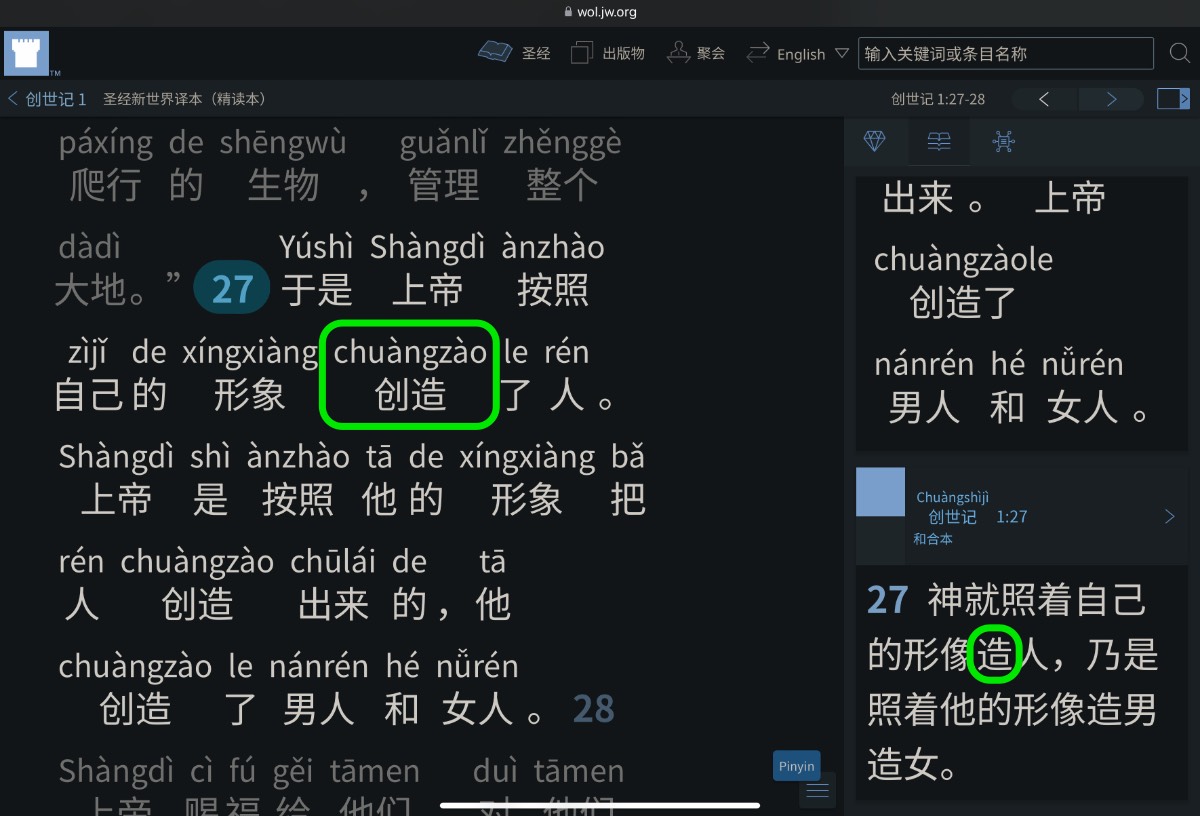
One person in particular whom I remember having such a viewpoint was my grade 7 teacher, who was actually quite smug about how her Catholic/personal beliefs had thus seemingly neatly reconciled the contradictions between the worldly “scientific” theory of evolution and the creation account in the Bible book of Genesis. However, the actual wording of the Genesis account, including how it is often translated into Mandarin, does not really go along with such a seemingly neat reconciliation with evolution.—Genesis 1:27 (English WOL, Mandarin WOL, Pīnyīn (Pīn·yīn {Piecing Together of} · Sounds → [Pinyin] 拼音) Plus).

“_Chuàngzào_” in Genesis 1:27 (NWT (nwtsty), WOL CHS+Pinyin), with “_zào_” in _Héhé Běn_

To represent how God caused humans to come into existence, the Mandarin New World Translation Bible uses “chuàngzào (chuàng·zào initiated · {made, created} → [created] 创造 創造), and the Héhé Běn ((Hé·hé Harmonious · {Closed → [United]} 和合) (Běn {Root or Stem} → [Edition] 本) [Union Version (Chinese Bible)]) uses “zào (made; built; created 造). Both these expressions contain the sense of “made, created”, and perhaps “built”.

How the Py+ Material Is Going

A while ago, I got the feeling that I should shift focus to get to work on producing current-generation Pīnyīn (Pīn·yīn {Piecing Together of} · Sounds → [Pinyin] 拼音) Plus material for the Was Life Created? brochure, which I had last produced older-style material for several years earlier. The official material for this brochure had also not been changed for several years, with the last Mandarin printing of it being dated 2016-12.

However, not long after I had started working on new Pīnyīn (Pīn·yīn {Piecing Together of} · Sounds → [Pinyin] 拼音) Plus material for this brochure, I noticed that a new printing, dated 2022-12, had been put out for the English version of the Was Life Created? brochure, and then, a new printing, dated 2023-02, appeared in the JW Library app for the Mandarin version of this brochure. Also, the Was Life Created? brochure and the Origin of Life brochure were added to the Teaching Toolbox section in the JW Library app at around this time. It seems that Jehovah had decided that the time had come for renewed focus on these brochures, and it seems that the work of producing Pīnyīn (Pīn·yīn {Piecing Together of} · Sounds → [Pinyin] 拼音) Plus material for the Was Life Created? brochure is privileged to be part of this renewed focus.

At the time of this writing, the old 3-line files (iPad-Letter-A4, XLP-iPhone-A5) together with the new Pīnyīn (Pīn·yīn {Piecing Together of} · Sounds → [Pinyin] 拼音) Plus web resource cover the entire Was Life Created? brochure. (The 3-line files were based on an older version of the brochure, though.) Also, the Pīnyīn (Pīn·yīn {Piecing Together of} · Sounds → [Pinyin] 拼音) Plus web resource (which can be used offline in supporting browsers) contains no more Pīnyīn (Pīn·yīn {Piecing Together of} · Sounds → [Pinyin] 拼音)-only material that has only been partially proofread—all the Pīnyīn (Pīn·yīn {Piecing Together of} · Sounds → [Pinyin] 拼音)-only material has now been fully proofread.


For convenience:

The direct link for the current generation Pīnyīn (Pīn·yīn {Piecing Together of} · Sounds → [Pinyin] 拼音) Plus resource for the Was Life Created? brochure is:

The short link for Chinese field language-learning links for the Was Life Created? brochure is:

More Pīnyīn (Pīn·yīn {Piecing Together of} · Sounds → [Pinyin] 拼音) and Pīnyīn (Pīn·yīn {Piecing Together of} · Sounds → [Pinyin] 拼音) Plus web material based on the Mandarin Was Life Created? brochure will be made available in the Pīnyīn (Pīn·yīn {Piecing Together of} · Sounds → [Pinyin] 拼音) Plus web resource as time allows. Work is now underway to produce a Pīnyīn (Pīn·yīn {Piecing Together of} · Sounds → [Pinyin] 拼音) Plus web resource for the Mandarin Origin of Life brochure as well.
Categories
Culture History Theocratic

Shàngtiān

Shàngtiān (Shàng·tiān Above’s · {Heaven [→ [God]]} → [Heaven; Providence; God] 上天) ← Tap/click to show/hide the “flashcard”

[Notes: Tap/click on a Pīnyīn (Pīn·yīn {Piecing Together of} · Sounds → [Pinyin] 拼音) expression to reveal its “flashcard”; tap/click on a “flashcard” or its Pīnyīn (Pīn·yīn {Piecing Together of} · Sounds → [Pinyin] 拼音) expression to hide the “flashcard”. 📖 📄 📘 icons mean 📖 Reveal All, 📄 Reveal Advanced, and 📘 Reveal None re all the “flashcards” in the heading, paragraph, etc. that they are placed at the beginning of.]

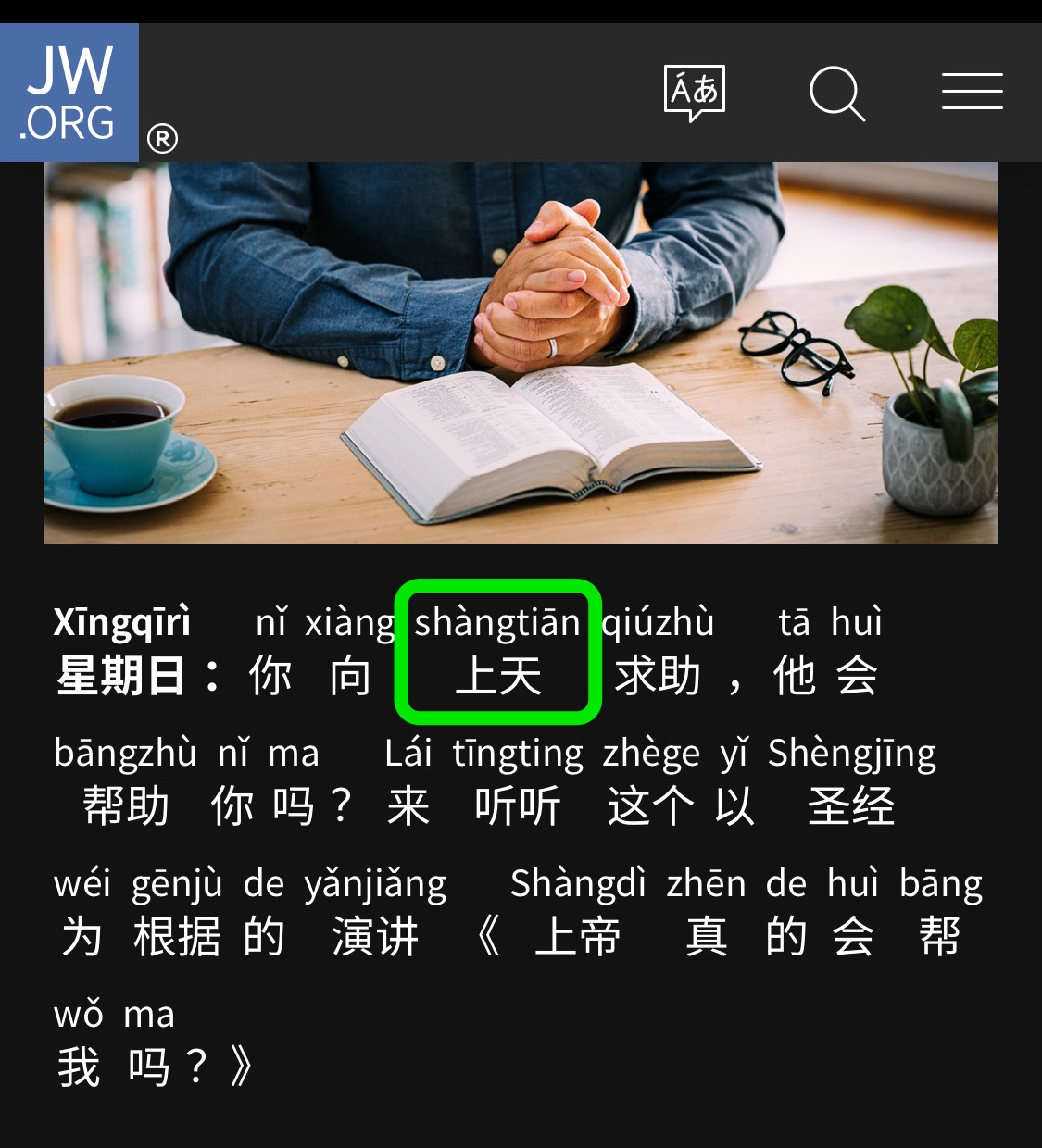
At the time of this writing, jw.org was featuring an invitation to attend an “Exercise Patience”! 2023 convention of Jehovah’s Witnesses. In one of the places where the English version of this invitation uses the word “God”, the Mandarin version uses this week’s MEotW, “Shàngtiān (Shàng·tiān Above’s · {Heaven [→ [God]]} → [Heaven; Providence; God] 上天), which literally means “Above’s Heaven”:

“Shàngtiān” used on jw.org, on the page inviting people to attend the 2023 convention

English:

If you pray to God for help, what can you expect?

Mandarin:

📖 📄 📘 ((if) you 你) xiàng (to向/曏/嚮) Shàngtiān (Shàng·tiān Above’s · {Heaven → [God]} → [God] 上天) qiúzhù (qiú·zhù request · {helping → [help]} 求助), (he 他) huì (will) bāngzhù (help 帮助 幫助) (you 你) ma ([? ptcl for “yes/no” questions])?

Note that this jw.org web page uses the personal pronoun “tā (he 他) (“he”) to refer to “Shàngtiān (Shàng·tiān Above’s · {Heaven → [God]} → [God] 上天), showing that “Shàngtiān (Shàng·tiān Above’s · {Heaven → [God]} → [God] 上天) here refers to a person, not to an abstract concept or to a place like heaven. Also, the wording shown in the above screenshot indicates that “Shàngtiān (Shàng·tiān Above’s · {Heaven → [God]} → [God] 上天) here refers to “Shàngdì (Shàng·dì Above’s · {Emperor → [God]} → [God] 上帝), that is, God.

Addressing People Who Don’t Know God Well

Note also that this web page written using Chinese characters and invitating people to the convention is largely directed towards the Chinese people of the world, who may know God only as an abstract concept, and not so much as a person.

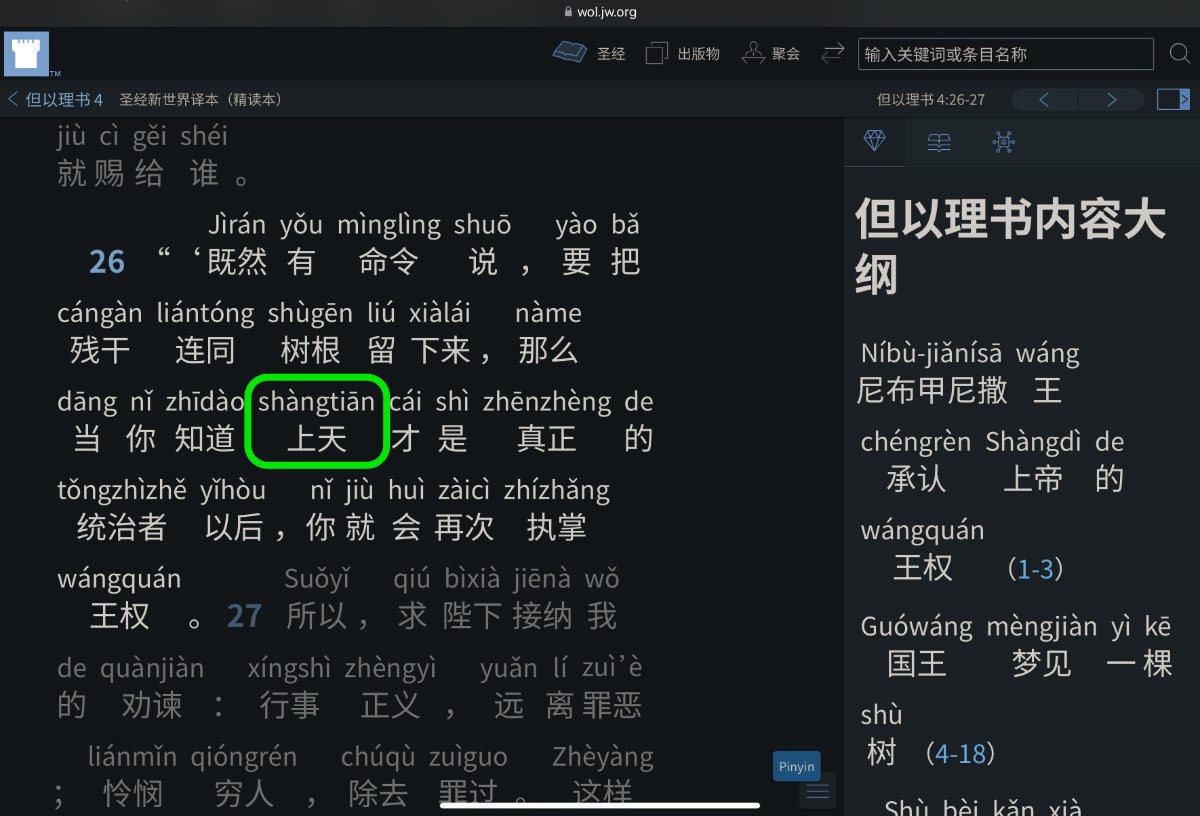
Another example of official material that uses “Shàngtiān (Shàng·tiān Above’s · {Heaven [→ [God]]} → [Heaven; Providence; God] 上天) when addressing someone who did not know God well is the Mandarin New World Translation Bible’s rendering of Daniel’s words to Babylonian King Nebuchadnezzar in Daniel 4:26:

“Shàngtiān” in Daniel 4:26 (NWT (nwtsty), WOL CHS+Pinyin)

Here, “Shàngtiān (Shàng·tiān Above’s · {Heaven [→ [God]]} → [Heaven; Providence; God] 上天) corresponds with the English expression “the heavens” in the phrase “after you come to know that the heavens are ruling”.—Daniel 4:26 (English).

The Chinese People’s View of God Over Time

As mentioned in the MEotW post on “Shàngdì (Shàng·dì Above’s · {Emperor → [God]} → [God] 上帝):

The Lasting Peace brochure has a box explaining how the concept of Shàngdì (Shàng·dì Above’s · {Emperor → [God]} → [God] 上帝) has been viewed in China throughout its history.

Here is a quote from that box that relates how the Chinese came to view the “Tiān (Heaven [→ [God]] 天) in “Shàngtiān (Shàng·tiān Above’s · {Heaven [→ [God]]} → [Heaven; Providence; God] 上天), and how that affected their understanding of Shàngdì (Shàng·dì Above’s · {Emperor → [God]} → [God] 上帝):

…according to Chinese historical records, between three and four thousand years ago, during the Xia and Shang dynasties, the Chinese were already worshipping one supreme deity. The book The Religious History of China explains that they “reckoned that between heaven and earth there was a principal God who stood supreme and had absolute control over all things. . . . This supreme deity came to be called Di, or Shang-di, during the Shang Dynasty, and was known as Tien [heaven], or Tien-di [Emperor in Heaven], during the Zhou Dynasty [11th century to 256 B.C.E.].” Thus, the ancient Chinese believed in the existence of a Supreme Sovereign of the universe.

During the Spring and Autumn period (c. 722-481 B.C.E.) and the Warring States period (c. 480-221 B.C.E.), Confucianism and Taoism gained ascendancy. Influenced by these two schools of thought, the worship of Shang-di was gradually replaced by the abstract idea of reverence for Tien. By the Han dynasty (202 B.C.E.–221 C.E.), under the dominance of Confucianism, the Chinese became engrossed in moral culture and social order, and the concept of Shang-di suffered another setback. With the spread of Buddhism into China, the Chinese no longer held to the belief of a Creator who is in control of the universe, but they accepted Heaven, or Providence, as the first cause of all things. Since then, the concept of God, or Shang-di, has become something completely foreign to most Chinese.

Since Chinese people in the world have this historical and cultural background that stretches back for millennia, it is understandable why the organization uses “Shàngtiān (Shàng·tiān Above’s · {Heaven → [God]} → [God] 上天) to refer to God when addressing them. Perhaps we can think of “Shàngtiān (Shàng·tiān Above’s · {Heaven → [God]} → [God] 上天) as an acceptable stepping stone between the impersonal “Tiān (Heaven [→ [God]] 天) and “Shàngdì (Shàng·dì Above’s · {Emperor → [God]} → [God] 上帝). Hopefully, we will be able to help many more Chinese people to get to know and appreciate Jehovah God as a person, and to eventually get accustomed to referring to him as “Shàngdì (Shàng·dì Above’s · {Emperor → [God]} → [God] 上帝), and as “Yēhéhuá (Jehovah 耶和华 耶和華).