jī‐tóng‐yā‐jiǎng+
((jī
chicken
鸡
雞/鷄)‐(tóng
{together with}
同
同/仝)‐(yā
duck
鸭
鴨)‐(jiǎng
speaking
讲
講)
→ [people not understanding each other because of speaking different languages (from Cantonese)])
← Tap/click to show/hide the “flashcard”
[Yes, this expression comes from Cantonese, but the above Mandarin version does appear in Mandarin dictionaries, so it qualifies as a Mandarin expression!]
Recently, while out to dinner with one of the first families to serve in the local Cantonese congregation, along with the circuit overseer serving the local Chinese circuit and his wife, the subject came up of how Mandarin and Cantonese are actually different languages, not just dialects of the same language.
Chickens Talking with Ducks
The wife of the circuit overseer asked what the difference is between a language and a dialect. So, I proceeded to explain something that is emphasized by American sinologist and University of Pennsylvania Professor of East Asian Languages and Civilizations Victor H. Mair, that a primary way accepted by most linguists to distinguish a language from a dialect is mutual intelligibility, as is discussed in this excerpt from the MEotW post on “fāngyán
(fāng·yán
{direction → [place]} · speech → [topolect; dialect (common but misleading translation)]
方言)”:
It has been said that “a language is a dialect with an army and navy”, but in his article Professor Mair gives us a more linguistically correct and useful way to distinguish between a language and a dialect:
Regardless of the imprecision of lay usage, we should strive for a consistent means of distinguishing between language and dialect. Otherwise we might as well use the two terms interchangeably. That way lies chaos and the collapse of rational discourse. Mutual intelligibility [emphasis added] is normally accepted by most linguists as the only plausible criterion for making the distinction between language and dialect in the vast majority of cases. Put differently, no more suitable, workable device for distinguishing these two levels of speech has yet been proposed. If there are to be exceptions to the useful principle of mutual intelligibility, there should be compelling reasons for them. Above all, exceptions should not be made the rule.
What is mutual intelligibility? Simply put, in linguistics, two or more speech varieties are said to be mutually intelligible if they are “able to be understood by one another’s speakers”. For example, if one person only knows English, and another person only knows Spanish, they can’t really understand each other if they try to talk to each other—English and Spanish are not mutually intelligible, and are suitably recognized as being different languages, not just different dialects of “European”.
Similarly, if one person only knows Mandarin, and another person only knows Cantonese, they can’t really understand each other if they try to talk to each other—Mandarin and Cantonese are not mutually intelligible. So, while they may be “fāngyán+
(fāng·yán
{direction → [place]} · {(patterns of) speech}
方言)”, linguistically, Mandarin and Cantonese should really be considered to be different languages, not just different dialects of “Chinese”.
Indeed, I have heard people use this week’s MEotW, “jī‐tóng‐yā‐jiǎng+
((jī
chicken
鸡
雞/鷄)‐(tóng
{together with}
同
同/仝)‐(yā
duck
鸭
鴨)‐(jiǎng
speaking
讲
講)
→ [people not understanding each other because of speaking different languages (from Cantonese)])”, to specifically describe Mandarin-speakers and Cantonese-speakers trying to talk to each other, and not understanding each other. 🐓 🦆
After I explained the gist of the above, one of the daughters of the family at the dinner—who had been labouring for decades under the misconception that Mandarin and Cantonese are just dialects and that someone who knows one can easily learn the other—said, “Now I don’t feel like an idiot.”
Uncommon Knowledge?
It could be said that ones such as this family and this circuit overseer and his wife, who have all worked so hard and served for so long in the Chinese language fields, should already have known such a basic thing about the Chinese languages. However, the following things are unfortunately true:
- Even publishers who are learning a language to serve in that language’s field generally consider such linguistic (language science) knowledge to be specialized technical knowledge that is beyond what they need to learn, and possibly beyond what they could even comprehend.
- Western-educated publishers learning a Chinese language may unwittingly go along with the Western worldly tendency to exoticize things related to China. (John DeFrancis, in his book The Chinese Language: Fact and Fantasy (p. 37), calls this “Exotic East Syndrome”.) They may be content with—or even enjoy—the alluring veil of mystery and mystique surrounding certain things related to China and Chinese culture. Thus, they don’t seek to learn about and understand deeper truths about such things, that may pierce through this obscuring veil, and burst this bubble.—Compare 2 Corinthians 3:14, including the margin note.
- The central ruling authorities of China have long actively promoted the scientifically incorrect idea that the different varieties of speech in China are just dialects of the one Chinese language. This idea is political propaganda supporting the idea that it’s good for there to be central ruling authorities in China.
- Traditional worldly Chinese language instructors and others who are knowledgeable about Chinese languages and Chinese characters are eager to promote and perpetuate the traditional thinking about Chinese languages and characters, that they have invested so much time and effort in, and that they are so proud of.
- Chinese-educated publishers who are already steeped in the traditional ideas about Chinese languages, Chinese characters, etc., and who are thus lauded and deferred to as experts by other publishers, may be eager to simply unquestioningly pass on the cultural knowledge and ideas that they were taught, and that they are lauded and respected for.
- With so much misinformation “in the air”, including from trusted authority figures, “everyone knows” that there is one Chinese language, with dialects that include Mandarin, Cantonese, etc. Since “everyone knows” this, it’s easy to just go along with it, especially in an Eastern culture like the Chinese culture that emphasizes conforming to the group. As Eastern cultures, Japanese, Korean, etc. cultures are similar in this respect, so publishers from those cultural backgrounds may also tend to just go along with what “everyone knows” about there being just one Chinese language that has various dialects.—Ephesians 2:2.
- The Bible makes it clear that Satan the Devil is “a liar and the father of the lie”. It also describes him as “the great dragon…who is misleading the entire inhabited earth”. So, while we can only speculate about the details of what strings are purposely pulled in the spirit realm by Satan and his demons as opposed to what human folly they simply passively observe, we can be sure that Satan is delighted with all the ways in which people are misled in and about the Chinese culture, in which the dragon is considered a positive, revered symbol.—John 8:44; Revelation 12:9.
So, for reasons such as the above, even the basic linguistic truth that Mandarin, Cantonese, Shanghainese, etc. actually function as different languages is unfortunately not yet common knowledge among those serving in the Chinese fields. As the saying goes, which some say is a Chinese proverb, “error will travel over half the globe, while truth is pulling on her boots”.
Jesus said, though, that true worshippers worship “with spirit and truth”, and that “the truth will set you free”. With regard to Chinese languages, Chinese characters, etc., the truth about them can even set one free from unnecessarily feeling like an “idiot”, as the sister mentioned above so eloquently put it, because of labouring under all the political propaganda, traditions, and other kinds of misinformation and wrong thinking that unfortunately surround Chinese languages, Chinese characters, etc.—John 4:23; 8:32.
Huge Worldwide Effects
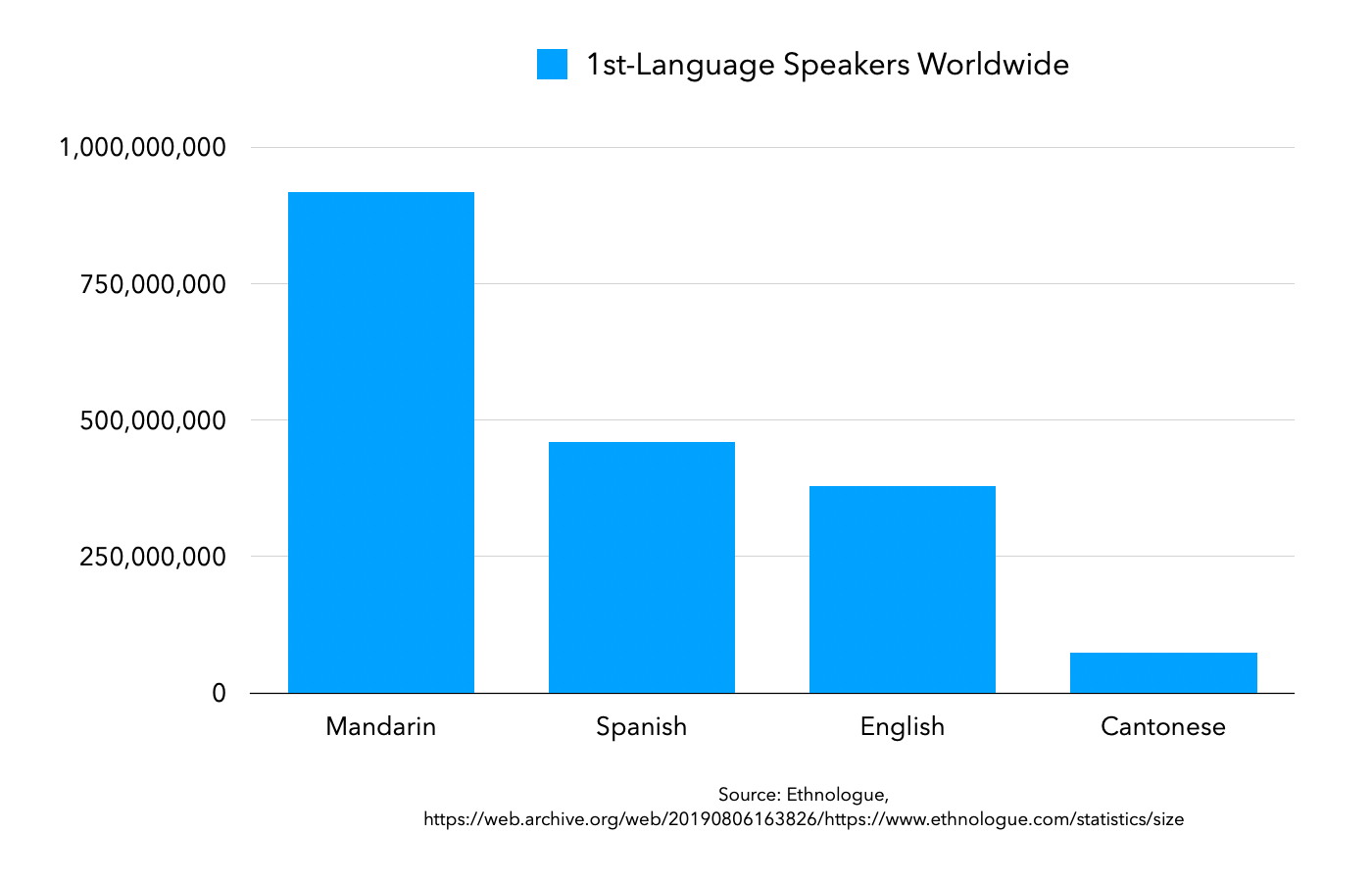
In addition to being hugely freeing for individual language learners, spreading the truth about the Chinese languages, Chinese characters, etc. is also important on a larger scale, since the worldwide Mandarin field, for one, is the largest language field in the world, and probably the largest language field that has ever existed in human history. For comparison, according to Ethnologue, a resource on world languages, the worldwide Mandarin field (those worldwide whose mother tongue is Mandarin) is about twice the size of the second largest worldwide language field, the Spanish field, and it’s about two and a half times the size of the third largest worldwide language field, the English field. Allowing various untruths to continue to divert and bog down the language-learning efforts of those who come to help in the worldwide Mandarin field can have incalculable overall negative effects on the preaching work in this enormous field.

So, even as we hang on to Bible truth, let us also hang on to the linguistic truths that we learn, and let us do what we can to share them with our fellow workers in the vast worldwide Chinese fields.