Categories
Culture Language Learning Science

gòngtōng

gòngtōng+ (gòng·tōng shared · {through → [connecting | [in] common]} [→ [applicable to both/all; shared; common; universal]] 共通) 👈🏼 Tap/click to show/hide the “flashcard”

As part of a series of posts about some common myths about Chinese characters, this post discusses the Universality Myth. So, this week’s MEotW is “gòngtōng (gòng·tōng shared · {through → [connecting | [in] common]} [→ [applicable to both/all; shared; common; universal]] 共通)”, an expression that seems to express well the supposed universality that is the subject of this myth.

In “gòngtōng (gòng·tōng shared · {through → [connecting | [in] common]} [→ [applicable to both/all; shared; common; universal]] 共通)”, “gòng (share | common | together | altogether 共) means “share | common | together | altogether”. This morpheme also appears in other well-known expressions such as “gòngtóng+ (gòng·tóng shared · {same | together} 共同)”, “gònghé‐guó ((gòng·hé shared · harmony → [republic] 共和)‐(guó country; nation; state) [republic])”, and “Gòngchǎn+ (Gòng·chǎn {Commonly Possessing} · {Produced (Things) → [Property]} → [Communist] 共产 共產)Dǎng (Party黨/党)”.

As for “tōng ({[(going)] through[(out)]; open [to]} [→ [common; general | connecting/communicating [to/with] [→ [logical; coherent]]]] 通)”, it here literally means “through”, and effectively means “connecting” or “in common”. It also appears in well-known expressions such as “gōutōng+ (gōu·tōng {(through) channel} · {(going) through → [communicating]} → [communicating; communication | linking up] 沟通 溝通)”, “jiāotōng+ (jiāo·tōng crossing; intersecting; meeting; joining · {(going) through → [connecting; communicating]} → [traffic; communications; transportation] 交通)”, “pǔtōng (pǔ·tōng common; general; universal; widespread · {through(out) → [general; common]} → [ordinary; common; average; general] 普通)”, and “tōngguò (tōng·guò through · passing → [passing through] → [through] 通过 通過)”.

When put together, the morphemes in “gòngtōng (gòng·tōng shared · {through → [connecting | [in] common]} [→ [applicable to both/all; shared; common; universal]] 共通) can effectively mean “shared; common; universal”, which in itself can generally be good. In fact, in our ministry, we look for “gòngtōng (gòng·tōng shared · {through → [in common]} → [common] 共通) diǎn (points) (common ground) with those with whom we speak. How universal, though, are Chinese characters? Are they really more universal than, say, alphabets?

Basis and Beliefs

In the book The Chinese Language: Fact and Fantasy, linguist and sinologist John DeFrancis writes the following in the chapter entitled “The Universality Myth”:

The Universality Myth is the logical extension of the Ideographic Myth. It is based on the threefold belief that:

1. Chinese characters enable a speaker from Beijing and another from Canton to communicate in writing even though they cannot understand each other’s speech. …
2. Chinese characters make it possible to read today’s newspapers as well as poems written a thousand years ago and philosophical essays written long before Christ. …
3. Chinese characters can function as a universal means of communication among people speaking totally unrelated languages. …

Implicitly or explicitly, the statements are meant to contrast Chinese characters with the familiar alphabetic scripts of the West. Chinese characters, it is believed, can do all these things, whereas alphabetic scripts cannot.

In other words, the Universality Myth regarding Chinese characters is that these visible, supposedly ideographic (representing meaning visually, without dependence on speech sounds) symbols of worldly Chinese culture can function across barriers of space, time, and language as universal enablers of communication. That seems amazing, if true. But, is it true? And, is it any more true for Chinese characters than it is for alphabets?

Testing the Relative Universality

DeFrancis goes on to test the Universality Myth by examining what it would take for an illiterate Mandarin speaker and an illiterate Cantonese speaker to learn how to communicate with each other by writing in characters, compared to what it would take for an illiterate French speaker and an illiterate Spanish speaker to learn how to communicate with each other by writing in French (which, as is widely known, is written using the Latin alphabet):

My Chinese colleagues estimate on the basis of their own experience and direct contact with the Chinese educational system that it takes seven to eight years for a Mandarin speaker to learn how to read and write three thousand characters and another year or two for a speaker of Cantonese to reach the same level in Standard Chinese. …My colleagues in French and Spanish estimate it would take the two imagined European illiterates less than half the time to reach a comparable level of proficiency in French.

…The overall picture is clear. It seems incontestable that both Europeans will find it easier to learn to read and write French than it be for either Cantonese or Mandarin speakers to learn to read and write Chinese. If we could add up the combined number of hours needed for the two members of each group to accomplish the same thing, the total would be enormously greater in the case of Chinese written in characters than in the case of French written in an alphabetic script. Even more significant, it would also be enormously greater for Chinese written in characters than for Chinese written in Pinyin. That is to say, it would be much easier for illiterates from Peking and those from Canton, even if the latter remain incapable of speaking Mandarin, to acquire the ability to communicate with each other by learning to read and write Standard Chinese written in Pinyin rather than in characters. Where, then, is the vaunted marvel of tongue-tied Chinese o’er-leaping barriers in speech by communicating with each other by means of those magical Chinese characters?

So, it’s possible for speakers of Mandarin, Cantonese, Japanese, Korean, English, French, Spanish, etc. to learn Chinese characters and use these as a means of communication. However, they could also do this with Pīnyīn (Pīn·yīn {Piecing Together of} · Sounds → [Pinyin] 拼音)! Also, it would actually be much faster and easier to do this with Pīnyīn (Pīn·yīn {Piecing Together of} · Sounds → [Pinyin] 拼音) than it would be to do it with the crazy complex characters!

Going Back in Time

What about the claim that characters allow us to still be able to read Chinese writings from long ago? Concerning this, DeFrancis writes:

Apart from learning the characters in their current meanings, Chinese must also learn the frequently different meanings of characters in earlier usage and the definitely different syntactical structures of classical versus contemporary written Chinese. This ability involves considerable training in tasks notorious for their difficulty—tasks that involve mastering differences at least as great as those between current English and the language of Chaucer. Without going into great detail, it should be readily apparent that an illiterate Chinese, regardless of whether he speaks Cantonese or Mandarin, will have a much greater task in learning to read classical Chinese than will an illiterate European, regardless of whether he speaks Spanish or French, in learning to read Latin. In the case of those already literate in current Chinese or French, it is doubtful that Chinese readers would enjoy any advantage over Europeans in respect to the amount of additional effort required to read classical Chinese in contrast to Latin.

So, it would probably be harder for a Chinese person to learn characters and then learn classical Chinese, than it would be for a European person to learn the Latin alphabet, and then learn Latin!

For us Mandarin field language learners specifically, since Jehovah’s organization is continually moving forward with ever broader, deeper, and clearer understandings of various truths, we in contrast seek to use the newest, most up-to-date writings from the organization whenever possible. Even with regard to the Bible itself, first written long ago, we seek, as a rule, to use the most up-to-date translations available. For specific examples in this regard, Appendix A2 (English, Mandarin) of the New World Translation Bible lists ways in which the current version of this Bible has been carefully revised to be more beneficial for modern readers.

It’s worth noting that the Chinese versions of the organization’s publications used to be written only in Chinese characters, but the most recent versions of the organization’s important writings generally have Pīnyīn (Pīn·yīn {Piecing Together of} · Sounds → [Pinyin] 拼音) available for them as well now.

Sunk Costs and Future Investments

Of course, those who have already spent years of hard work learning characters wouldn’t have to start that particular long and difficult process from zero (although, tíbǐ (tí·bǐ {carry (hanging down from the hand) → [raise; lift]} · pen; pencil; {writing brush} [→ [start writing; write]] 提笔 提筆)wàng (forget 忘) (character 字) (character amnesia) is real thing that takes constant ongoing effort to ward off). And, if they happen to meet others, even others who don’t speak the same language, who have also already spent years of hard work learning characters, then, yes, they might be able to use characters to imperfectly communicate with these others, to a limited extent—that is indeed one imperfect benefit arising from the massive sunk costs they have incurred in the process of learning characters.

However, those who have not already poured enormous amounts of time and effort into learning characters still have the opportunity to objectively weigh how much time and effort it is reasonable and worthwhile to sink into the characters going forward. As they consider this, they can keep in mind the inescapable reality that, due to the inherent extraordinary complexity of the characters, and due to the way that Jehovah actually designed us humans to use language, Pīnyīn (Pīn·yīn {Piecing Together of} · Sounds → [Pinyin] 拼音) and other sound-prioritizing writing systems (like Hangul, for those learning Korean) offer much greater ROI (return on investment) than characters do for those considering investing time and effort into learning how to actually communicate with others. Dedicated servants of Jehovah should also keep in mind that the time and energy they have are not theirs alone to spend or waste—their time, energy, etc. actually belong to Jehovah, and should thus be used and invested accordingly.

Anyway, to summarize, the Universality Myth regarding Chinese characters is…BUSTED!
Categories
Culture History Language Learning Names Technology

jiǎntǐ‐zì

jiǎntǐ+ (jiǎn·tǐ simplified · {body → [style] → [typeface; font]} → [simplified Chinese] 简体 簡體)+ (characters 字) 👈🏼 Tap/click to show/hide the “flashcard”

[This is a reposting of a post that was originally posted on December 7, 2020. I took the opportunity to flesh out the original post and this repost with additional material.]

For a long, long, long time, Chinese characters were just Chinese characters. Then, in 1956, the Communist government of mainland China issued what came to be known as the First Chinese Character Simplification Scheme (a second round of Chinese character simplification was later attempted and ultimately rescinded), and official simplified Chinese characters came into the world. (Some characters had been unofficially simplified and used for various purposes, both everyday and artistic, before that.)

On the matter of what simplified Chinese characters are called in Mandarin, Wikipedia provides this summary:

Simplified Chinese characters may be referred to by their official name above [(简化字; jiǎnhuàzì)[source]] or colloquially (简体字; jiǎntǐzì). In its broadest sense, the latter term refers to all characters that have undergone simplifications of character “structure” or “body”[source], some of which have existed for millennia alongside regular, more complicated forms. On the other hand, the official name refers to the modern systematically simplified character set, which (as stated by then-Chairman Mao Zedong in 1952) includes not only structural simplification but also substantial reduction in the total number of standardized Chinese characters.[source]

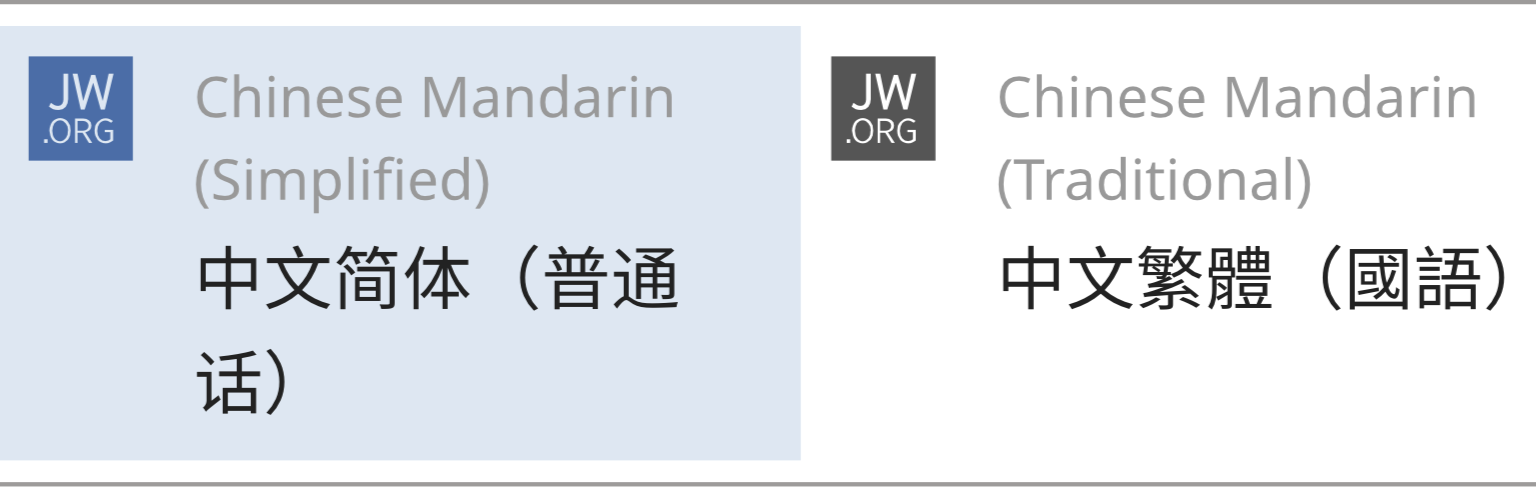
For reference, this is the term used on jw.org when referring to Mandarin written using simplified Chinese characters:

jw.org referring to Mandarin written using simplified Chinese characters

jw.org refers to simplified Chinese characters as “jiǎntǐ+ (jiǎn·tǐ simplified · {body → [style] → [typeface; font]} → [simplified Chinese] 简体 簡體) characters.

The Great Simplified vs. Traditional Debate

While it seems obvious that simpler is generally better, there is actually much, much debate about the pros and cons of simplified characters vs. traditional characters, as discussed in these articles:

The following posts summarize how many feel about traditional and simplified characters:

Standards and Compromises

While the simplified characters themselves are indeed easier to learn and remember compared to the traditional characters, for many, they have become another set of characters in addition to the traditional characters that has to be learned and remembered. (There is, at least, some overlap between the two systems. Where do they overlap? That is yet more information that has to be learned and remembered…) And while simplified characters have been simplified, they are still characters, and characters are inherently extraordinarily complex and hard to learn and remember.

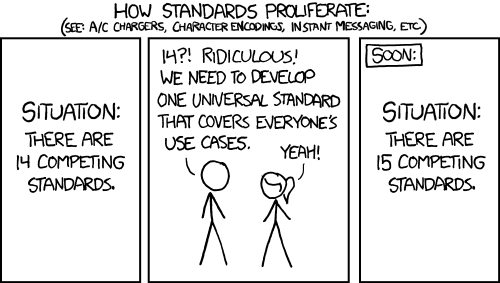
xkcd: Standards

Creative Commons Attribution-NonCommercial Licence logo Randall Munroe [source]

The simplified characters became a new standard that many have had to learn in addition to that of the traditional characters.

While Pīnyīn (Pīn·yīn {Piecing Together of} · Sounds → [Pinyin] 拼音) is also a different system to be learned and remembered, it is in a whole different league compared to any system of Chinese characters when it comes to ease of learning and remembering. One of the scholars who helped create Hangul (or Hankul), the Korean alphabet, said of it: “The wise can learn it in one morning, and even the unwise can learn it in ten days.” Being also a phonetic alphabet, Pīnyīn (Pīn·yīn {Piecing Together of} · Sounds → [Pinyin] 拼音) can be reasonably said to be in the same ballpark (with the added advantage that the Latin alphabet letters used in Pīnyīn (Pīn·yīn {Piecing Together of} · Sounds → [Pinyin] 拼音) are already familiar to many people)—downright revolutionary compared to the years (decades?) required to learn even simplified characters.

Simplified characters are thus a compromise that mainland China, Singapore, etc. have settled on—simpler than traditional characters, but perhaps thus not as good at being characters. Meanwhile, they are still characters, still having many of the complexities and vagaries of characters. They fall short of the fundamental reform envisioned by Máo Zédōng+ ((Máo Hair (surname) 毛) (Zé·dōng Marsh · East 泽东 澤東) (the founder of the People’s Republic of China)) (Wikipedia article), Lǔ Xùn+ ((Lǔ Stupid; Rash (surname)) (Xùn Fast; Quick; Swift 迅) (pen name of Zhōu Shùrén, the greatest Chinese writer of the 20th cent. and a strong advocate of alphabetic writing)) (Wikipedia article), and others, that would have involved eventually moving on from any kind of characters to alphabetic writing.

Letter from Máo Zédōng endorsing a transition from Chinese characters to alphabetic writing

A letter written by Máo Zédōng ((Máo Hair (surname) 毛) (Zé·dōng Marsh · East 泽东 澤東) (the founder of the People’s Republic of China)) endorsing “a basic reform” involving a transition from Chinese characters to alphabetic writing1


1. John DeFrancis, The Chinese Language: Fact and Fantasy (Honolulu: University of Hawaii Press, 1984), p. ii. ^

Categories
Culture Current Events History Science Technology Theocratic

app

app (a-p-p)

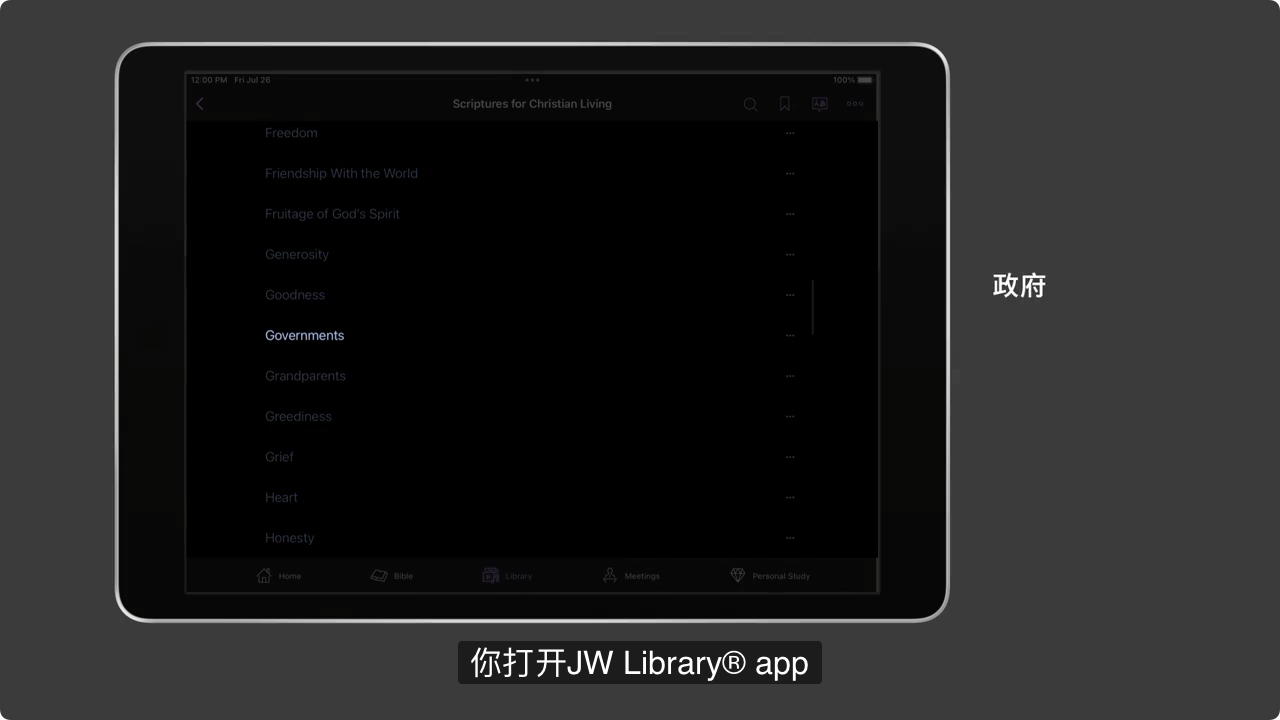
This week’s MEotW, “app” (sometimes written as “APP”), is now the organization’s official way to translate “app” in Mandarin, as much as there is an official way to do so. For example, it’s used in the Mandarin version of the 2024 Governing Body Update #5 video, at around the 11:06 mark—the subtitles say “app”, while the narrator says what sounds like “ay pee pee”.

“app” used in the Mandarin version of the 2024 Governing Body Update #5 video

(By the way, note that in this screenshot, the JW Library app is shown in Dark Mode—afters many years of people being used to using computer displays with white backgrounds that mimick paper, the organization is showing that there is nothing objectionable about the dark or black backgrounds enabled by computing device displays, backgrounds which can be easier on the eyes in some situations. After all, the default mode of the universe that Jehovah created is dark mode!)

An Unexpected Pronunciation

Yes, interestingly, as we can hear from the aforementioned video, when one refers to the JW Library app in Mandarin, in addition to using the English app name “JW Library” instead of a corresponding native Mandarin expression, one spells out the letters of “app” instead of just saying the English word “app”.

Why use three syllables to pronounce this exceedingly simple one-syllable English word in such an unusual and unexpected way? An Internet search turned up a Quora page discussing this question, which page contains the following excerpt that seems to summarize the points made in many of the replies:

Since the the original form “application” is not widely known, app is thought to be an acronym. In the aspect of pronunciation, closed syllables ending with p do not meet the Chinese pronunciation habit.

So, in other words, some believe that:

  • Being unfamiliar with the English word “application” that “app” is an abbreviation for, many Mandarin-speaking people erroneously thought that “app” is an acronym/initialism like “USA” or “PRC”, and acronyms are pronounced by saying the names of the letters in them. [2024-08-21: Thanks to reader SB for bringing up the matter of acronyms vs. initialisms. It seems that there is agreement that initialisms are, or can be, pronounced letter by letter, like “USA” and the Mandarin “app” are. However, there is not agreement about whether expressions pronounced that way count as acronyms, since some hold that only expressions like “NASA” that are pronounced as words should be considered acronyms.]
    • The fact that the Mandarin “app” is sometimes written in all upper case letters as “APP”, like an acronym/initialism would be written, lends credence to this theory.
  • Because Mandarin does not have words that end with a “p” sound, people who have only ever spoken Mandarin are not used to saying such words, and thus were naturally inclined to not just pronounce “app” like it is pronounced in English.
    • Some drag Chinese characters and Pīnyīn (Pīn·yīn {Piecing Together of} · Sounds → [Pinyin] 拼音) into discussion of this question, but these writing systems are just secondary visual representations of the actual primary factor relating to this issue, which is the system of sounds used in Mandarin speech. (I believe that technically, this is referred to as Mandarin phonology.)
    • Personally, I have doubts about this proposed factor, since other one-syllable English words ending with a “p” sound, like “jeep” (“jípǔ (jeep 吉普)”) and “Trump” (“Tèlǎngpǔ (Trump 特朗普)/Chuānpǔ (Trump (Tw) 川普)”), have been borrowed by Mandarin without requiring Mandarin-speakers to spell out their letters. I suppose it’s possible, as some have said, that putting “app” through this process results in a Mandarin expression that sounds confusingly similar to other expressions.

It’s also interesting that “app”, with its spelled-out letters, is used in Mandarin to correspond with the English word “app”, including in official media published by the organization, even though a native Mandarin expression meaning “app” does indeed exist. As shown in dictionaries, “yìngyòng (yìng·yòng apply · use | applied · used [(instance/etc.)] [→ [applied; for practical application; practical | application; practical use | (computing) app]] 应用 應用) may be used to mean “app”, and just as “app” is short for “application”, “yìngyòng (yìng·yòng apply · use | applied · used [(instance/etc.)] [→ [applied; for practical application; practical | application; practical use | (computing) app]] 应用 應用) is short for “yìngyòng chéngxù+ ((yìng·yòng applied · used (instance) → [application] 应用 應用) (chéng·xù {journey → [procedure]} · order; sequence → [(computer) programme] 程序) [application programme]) (or “yìngyòng chéngshì ((yìng·yòng applied · used (instance) → [application] 应用 應用) (chéng·shì {journey → [procedure]} · pattern → [(computer) programme (Tw)] 程式) [application programme (Tw)]) in Taiwan).

“Resistance Is Futile”

While Chinese traditionalists may futilely carry on about keeping Chinese culture “pure”, the common use of “app” in Mandarin is yet another example of Chinese culture naturally being influenced by Western culture, since the phenomenon of the modern mobile app followed on from the Western invention of the iPhone. Regarding the influence of Western culture on Chinese people, I have also noticed that some Chinese people seem to consider it “cool” to sprinkle in some English words here and there when they are speaking Mandarin, Cantonese, etc., even when they know the corresponding native Mandarin, Cantonese, etc. expressions.

Speaking of “cool”, a recent Language Log blog post written by Victor Mair and entitled “The Englishization of Chinese enters a new phase” said the following about “cool”, and about our MEotW “app”:

He takes the well-known example of “cool” (I’ll summarize what he says here). Before the year 2000, if somebody mentioned in a praiseworthy way that something was “kù 酷”, which at that time literally meant “cruel; ruthless; brutal; oppressive; savage”, people would consider that he was mixing English “coo[l]” in his Chinese speech, because at that time English “cool” was still in the early stages of being absorbed into Chinese. Standard dictionaries listed only the negative, pejorative meanings of “kù 酷”; there was not a trace of the positive meaning of “neat; nifty” and so forth. However, with the passage of time and with more and more saying “coo[l]” in a positive, approbatory sense, it gradually became a Chinese word. Now, if you say that someone or something is “kù 酷” (i.e., “cool”), no one would think that you’re mixing English in your speech. The positive meanings “cool; neat; nifty” have now become the primary definitions for “kù 酷”.

…people are no longer feeling the need to syllabize, much less hanziize, English words. They just say them flat out, and nobody blinks an eye that they are English words in Chinese. They have already instantly become Chinese terms — at least in speech. Nobody has cared to figure out how they should be written in hanzi [Chinese characters]. Even if you write them, you write them with roman letters…the roman alphabet has become an integral part of the Chinese writing system

There are hundreds of such words in current Chinese discourse, and they are at diverse stages of absorption into Chinese, e.g., “app”, “logo”, and “Ptú P图” (lit. “P picture/image”).

Yes, along with the “JW Library” app name, “app” is yet another example of how English words and Latin alphabet letters—like those used in Pīnyīn (Pīn·yīn {Piecing Together of} · Sounds → [Pinyin] 拼音)—are being incorporated into how people speak and write Mandarin Chinese “in the wild”, in the real world.

Anyway, as discussed in the 2024 Governing Body Update #5 video mentioned above, we stay neutral with regard to the world’s conflicts. While this obviously includes the world’s wars and political conflicts, in principle, this also applies to the world’s culture wars and its cultural conflicts and competitions. Our focus should be on how we can advance the interests of God’s Kingdom, and promote God’s righteous ways of doing things.—Matthew 6:33.