jūn+ ({armed forces}; army; troops [→ [military]] 军 軍) ← Tap/click to show/hide the “flashcard”
[Notes: Tap/click on a Pīnyīn (Pīn·yīn {Piecing Together of} · Sounds → [Pinyin] 拼音) expression to reveal its “flashcard”; tap/click on a “flashcard” or its Pīnyīn (Pīn·yīn {Piecing Together of} · Sounds → [Pinyin] 拼音) expression to hide the “flashcard”. 📖 📄 ➕ icons mean 📖 Reveal All, 📄 Reveal Advanced, and ➕ Reveal + Symbols re all the “flashcards” in the heading, paragraph, etc. that they are placed at the beginning of.]
At the time of this writing, jw.org was featuring the article “World Military Spending Surpasses $2 Trillion—What Does the Bible Say?”. Interestingly, the Mandarin version of this article uses a few different expressions to translate the sense of “military spending”:
- jūnshì (jūn·shì {armed forces → [military]} · affairs 军事 軍事) zhīchū (zhī·chū supporting · out → [spending] 支出)
- jūnfèi (jūn·fèi {armed forces → [military]} · {expending → [expenditures]} 军费 軍費) kāizhī (kāi·zhī {opening → [paying]} · supporting → [spending] 开支 開支)
- jūnshì (jūn·shì {armed forces → [military]} · affairs 军事 軍事) kāizhī (kāi·zhī {opening → [paying]} · supporting → [spending] 开支 開支)
- jūnshì (jūn·shì {armed forces → [military]} · affairs 军事 軍事) huāfèi (huā·fèi {flowering of → [spending of]} · {expendings → [expenditures]} → [spending] 花费 花費)
- jūnfèi (jūn·fèi {armed forces → [military]} · {expending → [expenditures]} 军费 軍費) zhīchū (zhī·chū supporting · out → [spending] 支出)
These all have in common the morpheme “jūn+ ({armed forces}; army; troops [→ [military]] 军 軍)”, which is this week’s MEotW.
Usage Examples
Here are a couple of examples of how the above expressions are used in the above-mentioned article:
English:
World military spending reached a record high of 2.24 trillion dollars (U.S.) in 2022, largely in response to Russia’s invasion of Ukraine.
Mandarin:
📖 📄 ➕ 2022 nián (year 年 年/秊) quánqiú (quán·qiú whole · globe → [worldwide] 全球) jūnfèi (jūn·fèi {armed forces → [military]} · {expending → [expenditures]} 军费 軍費) kāizhī (kāi·zhī {opening → [paying]} · supporting → [spending] 开支 開支) yǐ (already 已) chuàng ({achieved (for the first time)} 创 創/刱/剏/剙) 2.24 wàn ({ten thousand} 万 萬/万) yì ({hundred million} 亿 億) (2.24 zhào+ ({trillion (traditional/Taiwan)} 兆)) Měiyuán (Měi·yuán American · {yuan’s (monetary unit of China) → [dollars’]} 美国 美國) xīn (new 新) gāo (high 高); zuì (most 最 最/㝡) zhíjiē (zhí·jiē {being straight} · connecting → [direct] 直接) de (’s 的) yuányīn (yuán·yīn origin · reason 原因) shì (was 是) Éluósī (Russia 俄罗斯 俄羅斯) rùqīn+ (rù·qīn entering · invading → [invading] 入侵) Wūkèlán (Ukraine 乌克兰 烏克蘭).
English:
“The continuous rise in global military expenditure in recent years is a sign that we are living in an increasingly insecure world”
Mandarin:
📖 📄 ➕ “Jìnnián (Jìn·nián {close → [recent]} · years 近年) lái ({coming from} → [since] (them) 来 來), quánqiú (quán·qiú whole · globe → [worldwide] 全球) jūnshì (jūn·shì {armed forces → [military]} · affairs 军事 軍事) kāizhī (kāi·zhī {opening → [paying]} · supporting → [spending] 开支 開支) chíxù+ (chí·xù {has held} · {has continued} 持续 持續) zēngzhǎng (zēng·zhǎng increasing · growing 增长 增長), biǎomíng (biǎo·míng showing · {to be clear} 表明) wǒmen (wǒ·men we · [pl] 我们 我們) shēnghuó ({are living} 生活) zài (in 在) yí (one 一) ge ([mw] 个 個/个) yuè‐lái‐yuè+ ((yuè {jumping over} 越) (lái coming 来 來) (yuè {jumping over} 越)) → [more and more]) bù (not 不) ānquán (ān·quán safe · whole → [secure] 安全) de (’s 的) shìjiè (shì·jiè {generation → [world]} · extent → [world] 世界) zhōng (within 中).”
Jehovah of Armies
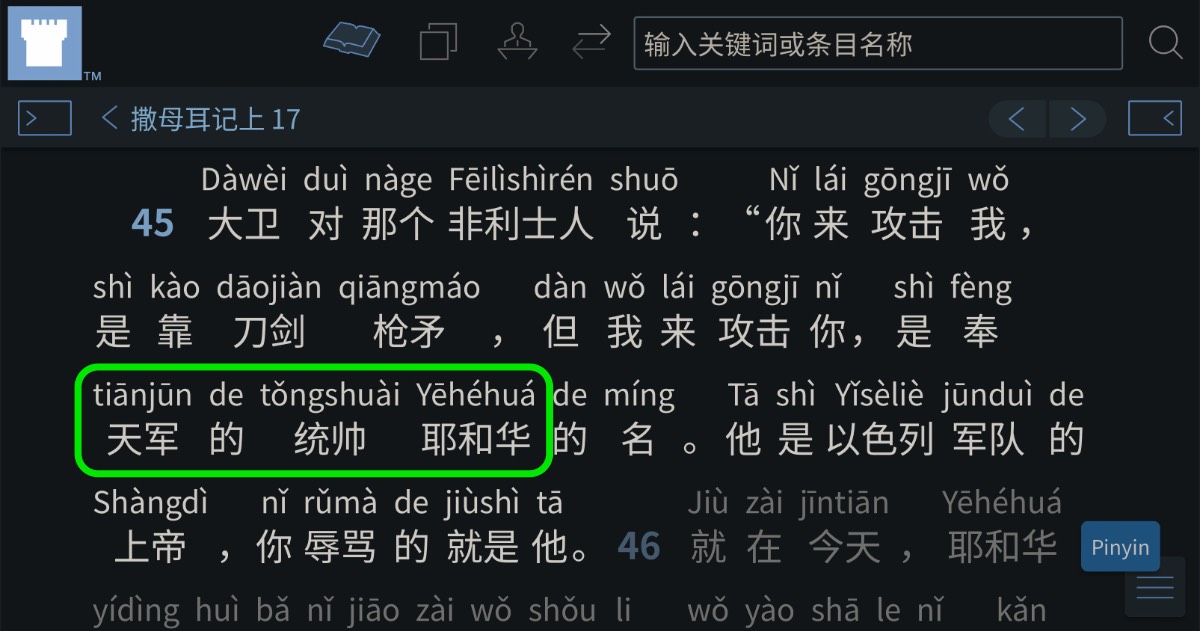
In the Bible, Jehovah God is sometimes called “tiānjūn (tiān·jūn heaven’s · armies 天军 天軍) de (’ 的) Tǒngshuài+ (Tǒng·shuài {Gathered Together (Things) → [Whole System]} · Commander-in-Chief 统帅 統帥) Yēhéhuá (Jehovah 耶和华 耶和華)” (“Jehovah of armies”), which incorporates the “jūn ({armed forces}; army; troops [→ [military]] 军 軍)” used in the expressions listed above. For example, when he faced Goliath, David used this expression to show that he trusted in Jehovah God, not in human weapons.—1 Samuel 17:45 (English, Mandarin).
Jehovah causes himself to become what he needs to be, and when he needs to lead his armies of angels into battle, he is invincible. In fact, the Bible records that one time, just one of Jehovah’s angels wiped out 185,000 enemy soldiers in one night. (2 Kings 19:35) When the time comes for “the war of the great day of God the Almighty”, all the prodigious military spending of all the human nations will not prevent them from being destroyed to clear the way for God’s Kingdom to make the earth into a peaceful paradise.—Revelation 16:14.