Categories
Culture History Language Learning Technology Theocratic

jiùsuàn

jiùsuàn+ (jiù·suàn {even if} · {figuring → [considering]} 就算) ← Tap/click to show/hide the “flashcard”

I have long especially liked 1 Corinthians 13. It contains counsel on what really does and doesn’t matter in life, an extensive description and definition of the most important kind of love, and a sublime discussion about the need to become complete, mature, as a person. As these apply to life in general, so too do they apply to our lives as Mandarin field language learners.

As Mandarin field language learners, it can benefit us greatly to consider what we can learn from 1 Corinthians 13, and along the way, we can also consider some of the Mandarin expressions used in that chapter in the current version of the Mandarin New World Translation Bible (nwtsty).

“If…”

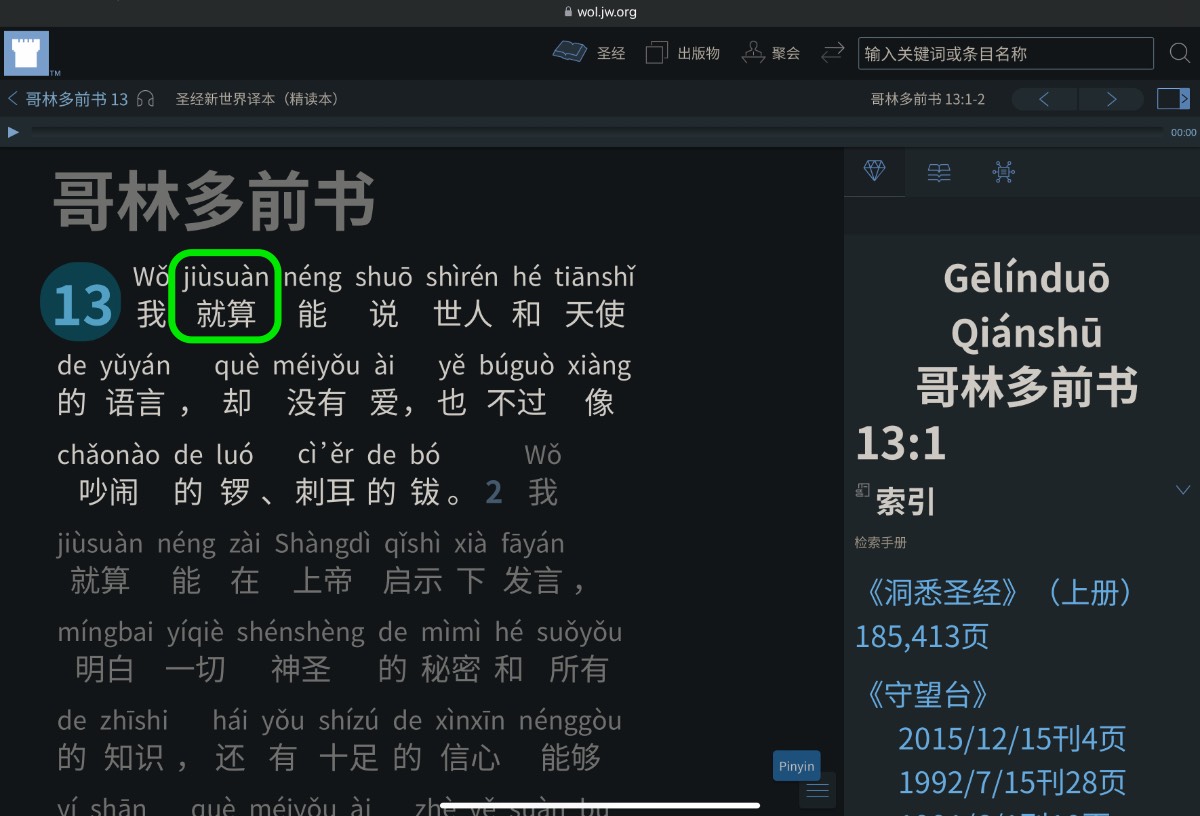
The second Mandarin expression that occurs in verse 1 (WOL, Pīnyīn (Pīn·yīn {Piecing Together of} · Sounds → [Pinyin] 拼音) Plus) of 1 Corinthians 13 (after “Wǒ (I 我)) is this week’s MEotW, “jiùsuàn (jiù·suàn {even if} · {figuring → [considering]} 就算).

Screenshot of “jiùsuàn” in 1 Co. 13:1 (nwtsty, CHS+_Pīnyīn_ WOL)

(Dark mode for the Watchtower ONLINE LIBRARY (WOL) website, as shown in the above image, can be enabled in the Safari web browser by using the Noir Safari extension.)

“Jiù+ (then; already | exactly | regarding | immediately | merely | {move towards} | {engage in} | accomplish; make | accommodate | {go with} | {even if} 就) can mean many different things, as can be seen from its Pīnyīn (Pīn·yīn {Piecing Together of} · Sounds → [Pinyin] 拼音) Plus information. The meaning that seems to apply in “jiùsuàn (jiù·suàn {even if} · {figuring → [considering]} 就算) is “even if”.

Calculating…

As for “suàn+ (calculate; compute; figure | count (v) [→ [consider/regard as]] 算), one of its meanings is “calculate”. (In fact, a “jìsuàn jī ((jì·suàn computing · calculating 计算 計算) (jī machine機/机) [computer | calculator (Taiwan)]) is a computer, or a calculator.)

There certainly is a long history of calculating done in the long history of China, such as all the calculating done to save face, advance ambitions, and acquire status in the official bureaucracy and in the imperial court. Perhaps because of Chinese cultural tradition or out of habit inherited from the world, some may have a tendency to do similar calculating in the Mandarin field. Rather than focusing on the work of praising Jehovah and preaching to and teaching Mandarin-speaking ones, some might be focusing on ways to receive “glory from one another”.—John 5:44.

1 Corinthians 13:1–3 admonishes us though, that jiùsuàn (jiù·suàn {even if} · {figuring → [considering]} 就算) this is done, even if such calculating is done to figure in things like ‘speaking in the tongues of men and of angels’, ‘understanding…all knowledge’ (perhaps, for example, knowledge of Chinese characters), various boastworthy deeds, etc., if one does not have love, then all those other things mean nothing:

If I speak in the tongues of men and of angels but do not have love, I have become a clanging gong or a clashing cymbal. 2 And if I have the gift of prophecy and understand all the sacred secrets and all knowledge, and if I have all the faith so as to move mountains, but do not have love, I am nothing. 3 And if I give all my belongings to feed others, and if I hand over my body so that I may boast, but do not have love, I do not benefit at all.

Let us, then, examine our hearts to make sure that we avoid letting pride be our motivation. Instead, let us cultivate love for Jehovah and for our Mandarin-speaking neighbours, so that love is what motivates us in our efforts to learn the language and serve in the Mandarin field.

Categories
Science Technology Theocratic

huídào

huídào+ (huí·dào {circle back}; return; {go/come back} · {to arrive [at]}; to 回到 回/迴/逥/廻到) ← Tap/click to show/hide the “flashcard”

Appendix A2 of the English New World Translation of the Holy Scriptures (Study Edition), entitled “Features of This Revision”, discusses vocabulary changes that have been made in the current revision, words that have been translated differently than before. As noted in various entries in the excellent resource Referenced Theo. Expressions (RTE), Appendix A2 of the current Mandarin version of the New World Translation Bible (nwtsty) correspondingly discusses words that have been translated differently in the current revision of the Mandarin NWT Bible, compared to how they had been translated before.

Since we base what we say in Jehovah’s service on his Word the Bible, the vocabulary used in it—and the way those vocabulary words are translated—should be reflected in how we speak in our ministry, at our meetings, etc. So, it is beneficial for us Mandarin field language learners to be familiar with the latest thinking from the organization on how Bible terms should be translated into Mandarin.

Mandarin “Presence”

The Greek word pa·rou·siʹa has often been translated less than ideally into English, as the Insight book thus explains:

Many translations vary their renderings of this word. While translating pa·rou·siʹa as “presence” in some texts, they more frequently render it as “coming.” This has been the basis for the expression “second coming” or “second advent” (adventus [“advent” or “coming”] being the Latin Vulgate translation of pa·rou·siʹa at Mt 24:3) with regard to Christ Jesus. While Jesus’ presence of necessity implies his arrival at the place where he is present, the translation of pa·rou·siʹa by “coming” places all the emphasis on the arrival and obscures the subsequent presence that follows the arrival. Though allowing for both “arrival” and “presence” as translations of pa·rou·siʹa, lexicographers generally acknowledge that the presence of the person is the principal idea conveyed by the word.

It is not surprising, then, that attention was paid to how pa·rou·siʹa should be translated into Mandarin for the current Mandarin version of the New World Translation Bible (nwtsty).

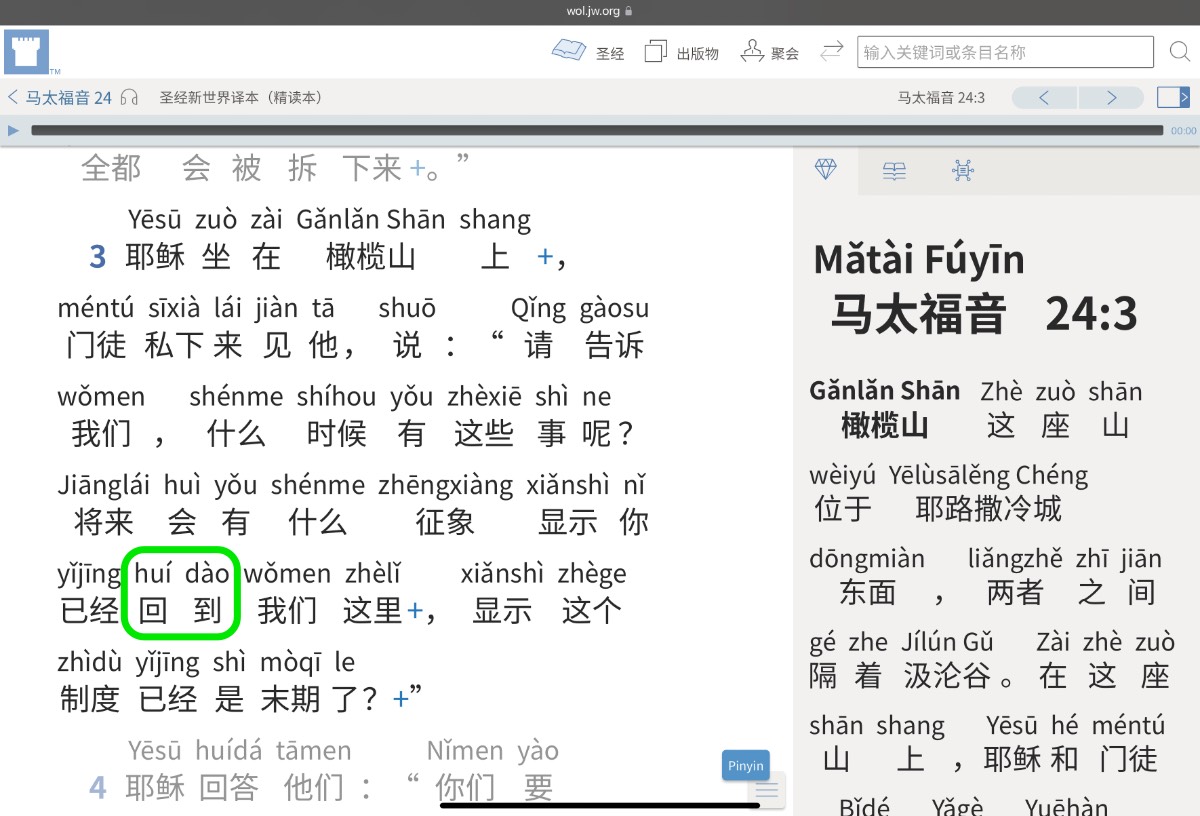
The older Mandarin NWT Bible generally translated pa·rou·siʹa as “línzài+ (lín·zài arriving · {being present} 临在 臨在)”. However, many people find this word to be relatively unfamiliar. So, the current Mandarin version of the NWT Bible (nwtsty) usually translates Christ’s pa·rou·siʹa as “huídào+ (huí·dào {circling back} · {to arrive at} 回到 回/迴/逥/廻到) wǒmen (wǒ·men us · [pl] 我们 我們) zhèlǐ (zhè·lǐ this · inside → [here] 这里 這裡/裏)”. This should help to avoid unnecessarily obstructing beginning Bible readers from understanding the meanings of scriptures that use pa·rou·siʹa in the original Greek text. At Matthew 24:3, to further clarify the meaning, the current Mandarin version of the NWT Bible (nwtsty) uses the expression “yǐjing+ (yǐ·jing already · {have gone through} 已经 已經) huídào (huí·dào {circling back} · {to arrive at} 回到 回/迴/逥/廻到)”, to emphasize that it is referring to the situation in which Jesus has already gone through the process of arriving, and thus is present.

Matthew 24:3 (WOL CHS+Pinyin)

Verb-Complement Togetherness

Note that in the scripture in the Watchtower ONLINE LIBRARY linked to above, “huídào (huí·dào {circling back} · {to arrive at} 回到 回/迴/逥/廻到)” is rendered as “huí ({circling back}回/迴/逥/廻) dào ({to arrive at} 到)”, with a space. The post on this blog on “diǎnliàng (diǎn·liàng {dot → [light (v); ignite]} · {to be bright} [→ [illuminate; shine light on]] 点亮 點亮)” discussed such differing renderings:

Getting back to the MEotW “diǎnliàng+ (diǎn·liàng {dot → [light (v); ignite]} · {to be bright} [→ [illuminate; shine light on]] 点亮 點亮)”, the PRC national standard GB/T 16159-2012 recommends that, being made up of a single-syllable verb and its single-syllable complement, this expression should be written together. Recent official Pīnyīn (Pīn·yīn {Piecing Together} · Sounds → [Pinyin] 拼音) publications such as those on the Watchtower ONLINE LIBRARY often do not follow this recommendation regarding single-syllable verbs and their single-syllable complements, whereas older official Pīnyīn (Pīn·yīn {Piecing Together} · Sounds → [Pinyin] 拼音) publications did follow this recommendation, and as do the unofficial Pīnyīn (Pīn·yīn {Piecing Together} · Sounds → [Pinyin] 拼音) Plus resources.

On the other hand, the unofficial Pīnyīn (Pīn·yīn {Piecing Together} · Sounds → [Pinyin] 拼音) Plus resources join the official Pīnyīn (Pīn·yīn {Piecing Together} · Sounds → [Pinyin] 拼音) publications, old and new, in explicitly indicating tone sandhi for “ (not 不)” and “ (one 一)” (e.g., “zài (bú·zài not · again; further; continuing; anymore 不再)” instead of the standard “zài (bù·zài not · again; further; continuing; anymore 不再)”) to make things easier for readers, even though this practice is not included in the GB/T 16159-2012 standard’s recommendations.

In the end, what matters most re how anything is written is not just what is officially recommended or what happens to be popular among changing, imperfect humans. Rather, what matters most is what really works best to accomplish the goal of writing: To communicate to readers. This is especially true when God-honouring and life-saving Bible truths need to be communicated. So, this blog and the other Pīnyīn (Pīn·yīn {Piecing Together} · Sounds → [Pinyin] 拼音) Plus resources will continue to seek to render Pīnyīn (Pīn·yīn {Piecing Together} · Sounds → [Pinyin] 拼音) in ways that maximize how clearly, easily, effectively, and appropriately it communicates with readers.

Categories
Theocratic

zīyǎng

zīyǎng+ (zī·yǎng grow · support → [nourish] 滋养 滋養) ← Tap/click to show/hide the “flashcard”

With last week’s MEotW being “xīnlíng+ (xīn·líng heart · spirit [→ [spiritual]] 心灵 心靈)”, which the organization is now using as a more understandable translation for “spiritual” compared to “shǔlíng (shǔ·líng {(in the) category (of)} · spirit → [spiritual (nwtsty-CHS Appx. A2 notes change from “shǔlíng” to “xīnlíng”, etc.)] 属灵 屬靈)”, one may wonder how the organization now chooses to translate “spiritual food”, which before was translated as “shǔlíng (shǔ·líng {(in the) category (of)} · spirit → [spiritual (nwtsty-CHS Appx. A2 notes change from “shǔlíng” to “xīnlíng”, etc.)] 属灵 屬靈) shíwù (shí·wù eating · matter → [food] 食物)” or “língliáng (líng·liáng spirit · {grain → [food]} → [spiritual food (old translation, no longer used in nwt-CHS)] 灵粮 靈糧)”.

A bit of digging reveals that the organization now seems to mainly translate “spiritual food” as “zīyǎng+ (zī·yǎng grows · supports → [nourishes] 滋养 滋養) xìnxīn (xìn·xīn believing · heart → [faith] 信心) de (’s 的) shíwù (shí·wù eating · matter → [food] 食物)”.

For example, that is how “spiritual food” is translated in Lesson 54 of the Enjoy Life Forever! book, which is now the main publication officially recommended for use on Bible studies. We can see this when we compare the English and the Mandarin versions of this Lesson:

“spiritual food” in _Enjoy Life Forever!_ bk. Lesson 54 (WOL Eng and CHS+Pinyin)

[Update, 2026-07-25: Pīnyīn (Pīn·yīn {Piecing Together of} · Sounds → [Pinyin] 拼音)+ material for Lesson 54 of the Enjoy Life Forever! book is now available as well.]

The translation “zīyǎng+ (zī·yǎng grows · supports → [nourishes] 滋养 滋養) xìnxīn (xìn·xīn believing · heart → [faith] 信心) de (’s 的) shíwù (shí·wù eating · matter → [food] 食物)” is also used in these recent issues of The Watchtower:

(The Watchtower ONLINE LIBRARY’s Synchronization feature can be used to quickly change the language of the currently loaded material, or you may want to open two separate browser windows to see the same material in two different languages side by side.)

Alternately…

Interestingly, “spiritual food” is sometimes now translated in other ways as well. For example, “mǎnzú (mǎn·zú fills · {to be sufficient} → [satisfies] 满足 滿足) xīnlíng (xīn·líng heart · spirit → [spiritual] 心灵 心靈) xūyào ({(things) needed} 需要) de (’s 的)shíwù (shí·wù eating · matter → [food] 食物)’ ” is used in the following issue of The Watchtower:

Also, the current version of the Mandarin New World Translation Bible (nwtsty) uses the expression “Shàngdì (Shàng·dì Above’s · God → [God] 上帝) cìxia (cì·xia gives · down 赐下 賜下) de (’s 的) shíwù (shí·wù eating · matter → [food] 食物)” to translate “spiritual food” at 1 Corinthians 10:3.