bǐyù+
(bǐ·yù
comparing · {explaining → [analogy; metaphor; simile]} [→ [illustration]]
比喻)
xìng+
(nature
性)
de+
(’s
的)
zhànzhēng+
(zhàn·zhēng
war · contending → [war; warfare]
战争
戰爭)
← Tap/click to show/hide the “flashcard”
After reading last week’s MEotW post on “shǔlíng (shǔ·líng {(in the) category (of)} · spirit → [spiritual (nwtsty-CHS Appx. A2 notes change from “shǔlíng” to “xīnlíng”, etc.)] 属灵 屬靈) zhànzhēng (zhàn·zhēng war · contending → [war; warfare] 战争 戰爭)”, one reader sent me an email with some informed and expert input. I especially appreciated the power-user searching example that he shared.
Supercharging WOL Searching
One of the suggestions that this user made was that when looking for official Mandarin translations for an English expression, it can be better to search for the English expression and then use the Watchtower ONLINE LIBRARY’s (WOL’s) Synchronization feature to see what Mandarin translations turn up, rather than to search for specific possible Mandarin expressions that may or may not be used to translate that English expression.
Looking back at the browser tabs I had opened during my research for the MEotW post on “shǔlíng (shǔ·líng {(in the) category (of)} · spirit → [spiritual (nwtsty-CHS Appx. A2 notes change from “shǔlíng” to “xīnlíng”, etc.)] 属灵 屬靈) zhànzhēng (zhàn·zhēng war · contending → [war; warfare] 战争 戰爭)”, I noticed that I did try searching for “spiritual war” and comparing any English results with their corresponding Mandarin translations, which is how I found the May 2018 Watchtower example. However, the reader’s email provided an example that improves upon the simple search string “spiritual war” by using search operators, which include logical operators, wildcards, etc.
I tried looking up related information in jw.org’s Help section, but their section on using the Search feature doesn’t mention such search operators. I was, though, able to find a JWTalk forum post on WOL search operators, in which someone shared the following information from the Watchtower Library program’s Help section:
*** wtlib-help section 4 ***
Search Operators
&			And operation

+			And operation

Space		As specified in the Search menu

|			Or operation

/			Or operation

ˆ			Exclusive Or operation

%			Exclusive Or operation

!			Not operation

&!, +!	Not operation

&-, +-	Not operation

&&			Adjacent And operation

++			Adjacent And operation

"..."		Searches for the phrase that is enclosed in quotes

*			Represents one or more characters (including nothing)

?			Represents one character in a word

#number	Allows searching for words using their word ID number

\			Forces the following operator to be a literal character

(...)		Allow for setting precedence
Examples:
Jesus & Christ

Finds all documents that contain both words within the specified scope.


Jesus | Christ

Finds all documents that contain either word.


Jesus && Christ

Finds all documents that contain the word Jesus followed by the word Christ.


"Jesus Christ"

Finds all documents that contain the exact phrase Jesus Christ.


Jesus ˆ Christ

Finds all documents that contain either word, but not where both words occur in the specified scope.


Christian*

Finds all documents that contain words that begin with “Christian” followed by any additional characters (words such as Christian, Christians, Christianity).


Organi?ation

Finds all documents that contain words with 12 letters, where the first 6 letters are “Organi” and the last 5 letters are “ation” (words such as Organization, Organisation).


Jesus | Christ & Jehovah

Finds all documents that contain either Jesus or Christ, and then further limits the results by finding only the documents in that group that also include Jehovah in the specified scope.


Jesus | (Christ & Jehovah)

Finds all documents that contain Christ and Jehovah in the specified scope. It then searches again for all documents that contain Jesus and adds them to the results.


Jesus ! Christ

Finds all documents that contain the word Jesus without the word Christ in the specified scope.
From testing so far, it seems that the WOL uses the same search operators that the Watchtower Library does, which makes sense, since the WOL was created to be the online version of the Watchtower Library.
Using this knowledge of the WOL’s search operators, I tried searching the WOL for “spiritual & (war | warfare)” (not including the quotation marks), which returns documents that contain both “spiritual” and “war”, or that contain both “spiritual” and “warfare”, with no restriction on which word occurs first.
Some Noteworthy Results
Did searching the WOL for “spiritual & (war | warfare)” point me to more results of note than searching for “spiritual war” did? Yes! Here are some of them that are more recent than the May 2018 Watchtower result that I had found when searching for “spiritual war”:
From the October 2022 Watchtower:
English:
In our spiritual warfare,
Mandarin:
📖 📄 ➕ Zài (at 在) gēn (with 跟) Sādàn (Satan 撒但) zuòzhàn+ (zuò·zhàn {engaging in} · {fighting (a war)} 作战 作戰) shí ({(particular) times} 时 時),
From the September 2020 Watchtower:
English:
That warfare was, not literal, but spiritual.
Mandarin:
📖 📄 ➕ Bǎoluó (Paul 保罗 保羅) shuō ({was speaking of} 说 說/説) de (’s 的) zhànzhēng (zhàn·zhēng war · contending → [warfare] 战争 戰爭) bìng (actually 并 並/竝/并) bú (not 不) shì (was 是) shíjì+ (shí·jì {being solid → [reality]} · {boundaries → [inside]} → [real] 实际 實際) de (’s 的) zhànzhēng (zhàn·zhēng war · contending → [warfare] 战争 戰爭), …
From the Organized (od) book, © 2005, 2015, 2019:
English (November 2021 Printing):
This puts us at the battle lines of the spiritual warfare
Mandarin (December 2021 Printing):
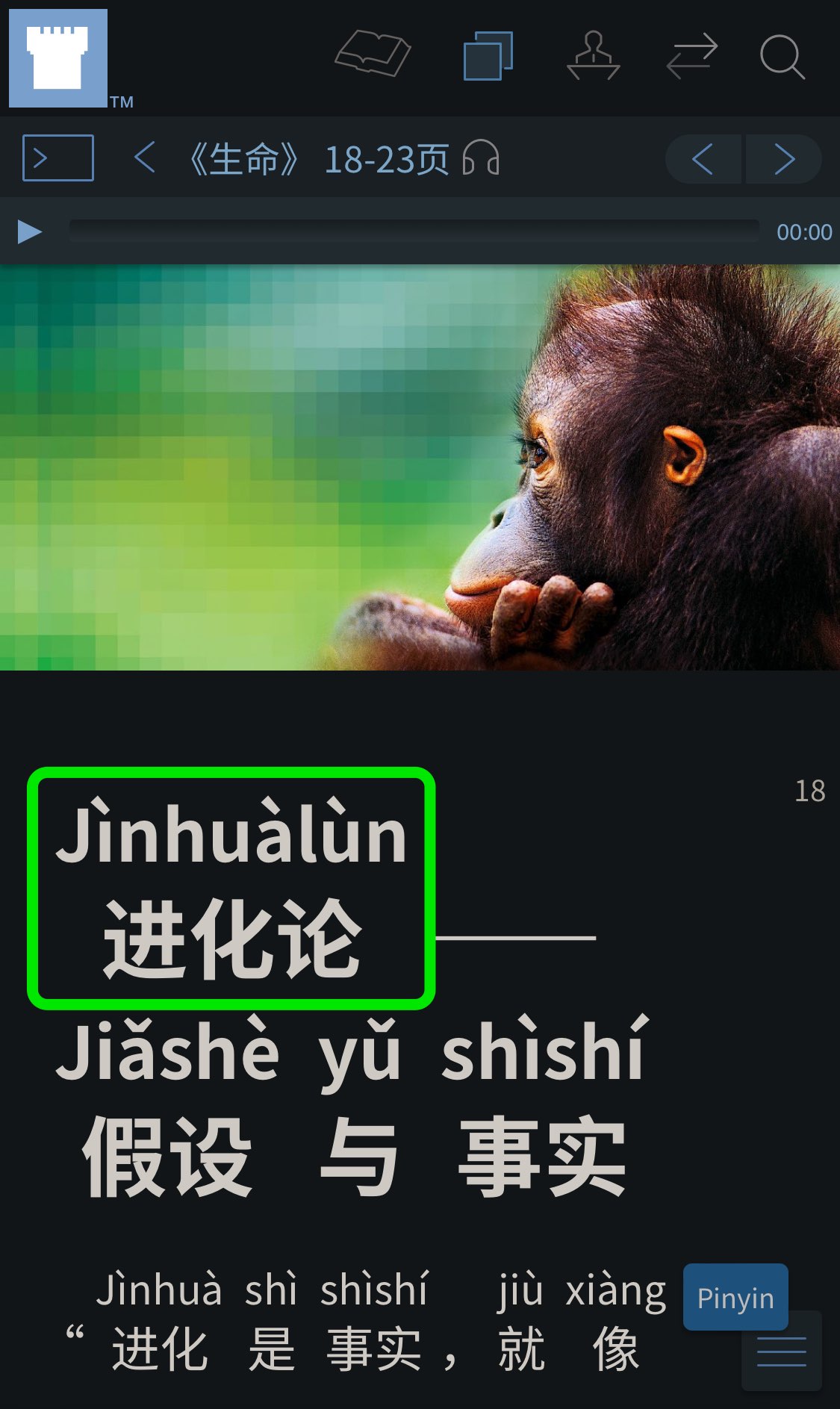
📖 📄 ➕ Yīncǐ (Yīn·cǐ {because of} · this 因此), wǒmen (wǒ·men we · [pl] 我们 我們) dōu (all 都) yào (must 要) dǎ (strike → [fight] 打) yì (one 一) chǎng ({large gathering place of} → [mw for recreational, sports, or other activities] 场 場/塲) bǐyù+ (bǐ·yù comparing · {explaining → [analogy]} → [illustration] 比喻) xìng (nature 性) de (’s 的) zhànzhēng (zhàn·zhēng war · contending → [warfare] 战争 戰爭).
Not Being Direct
One thing that sticks out about the above-mentioned search results is that these don’t seem to be direct translations, but rather, cases of translating around “spiritual war/warfare/…”, to get to the desired result. They seem like cases of “we don’t commonly say this expression directly in everyday Mandarin, so let’s express the meaning indirectly instead”. However, it would seem that “spiritual war” is not really in particularly common use in English either, but nevertheless, the organization does use this English expression. Maybe the original writers of the English material felt more free to exercise a sort of “creative licence” than the translators of the Mandarin material did (perhaps because of organizational hierarchy, culture, etc.), in using a particular fitting expression even if it’s not in common usage. Maybe these recent indirect Mandarin translations, which are all different from each other, are the results of the Mandarin translators feeling their way towards eventually coming up with a consistent direct translation of “spiritual war/warfare/…” that they can feel good about. I suppose time will tell.
Looking at the above-mentioned search results in more detail, “gēn (with 跟) Sādàn (Satan 撒但) zuòzhàn+ (zuò·zhàn {engaging in} · {fighting (a war)} 作战 作戰)”, when used in relation to us humans, implies warfare limited to that of a spiritual kind, since we humans have no means to actually injure, kill, or restrain Satan’s actual spirit body. However, Jesus and loyal angels do have such means, or can be given such means by Jehovah, so when they “gēn (with 跟) Sādàn (Satan 撒但) zuòzhàn (zuò·zhàn {engage in} · {fighting (a war)} 作战 作戰)” in what we could call “spirit warfare” or “spirit realm warfare”, it’s different from the kind of spiritual warfare that we humans are limited to fighting against Satan, unless we humans are one day given fighting abilities like those of angels. (Daniel 10:12, 13, 20; Revelation 12:7–9; 20:1–3) However, with so many actual angels already in Jehovah’s service, there doesn’t seem to be any need or reason for Jehovah to ever do this. Anyway, what “gēn (with 跟) Sādàn (Satan 撒但) zuòzhàn (zuò·zhàn {engaging in} · {fighting (a war)} 作战 作戰)” means will, strictly speaking, continue to be a superset of what “spiritual war/warfare/…” currently means for us humans, not a direct translation of it.
As for the result from the September 2020 Watchtower, it translated the “that warfare was, not literal,” part, and then it translated the “but spiritual” part by not translating it! (Well, computer programmers do say that the best code is the code that you don’t have to write.)
“Bǐyù+ (Bǐ·yù comparing · {explaining → [analogy]} → [illustration] 比喻) xìng (nature 性) de (’s 的) zhànzhēng (zhàn·zhēng war · contending → [warfare] 战争 戰爭)”, this week’s MEotW, is a correct translation, as far as it goes, and close to being a direct translation, but since “bǐyù (bǐ·yù comparing · {explaining → [analogy; metaphor; simile]} [→ [illustration]] | compare · {explain → [draw an analogy]} [→ [illustrate]] 比喻)” means “analogy” or “metaphor”, and since an analogy or a metaphor compares two things, something is still missing—the Bible uses physical warfare as an analogy or metaphor for x warfare, and sometimes it might be nice to be able to directly refer to that x.
Do We Need to Be Direct?
For now, it seems correct to say that “shǔlíng (shǔ·líng {(in the) category (of)} · spirit → [spiritual (nwtsty-CHS Appx. A2 notes change from “shǔlíng” to “xīnlíng”, etc.)] 属灵 屬靈) zhànzhēng (zhàn·zhēng war · contending → [war; warfare] 战争 戰爭)” is the most recent official direct translation for “spiritual war/warfare/…” that can be found, for what that’s worth. Besides the May 2018 Watchtower example that I found, I have also found examples in the Mandarin Insight book, e.g. here, and this WOL page tells us that that publication is currently dated 2022.
Should we expect, though, that the Insight book is too big to keep completely updated with all the latest translation preferences? In a follow-up email, the reader mentioned above provided an example showing that even though revised printings of official publications do contain relatively minor revisions, they may leave in relatively major passages that really should also be corrected. This is undoubtedly because of time/manpower/etc. constraints. From my own efforts producing this blog, other Pīnyīn (Pīn·yīn {Piecing Together of} · Sounds → [Pinyin] 拼音) Plus resources, etc., I can certainly understand that even the official production teams may often be faced with simply not being able to do all the work that they wish they could do.
At the least, when the Mandarin NWT’s Appendix A2 explains why the revised Mandarin NWT doesn’t use “shǔlíng (shǔ·líng {(in the) category (of)} · spirit → [spiritual (nwtsty-CHS Appx. A2 notes change from “shǔlíng” to “xīnlíng”, etc.)] 属灵 屬靈)” anymore, it says that “shǔlíng (shǔ·líng {(in the) category (of)} · spirit → [spiritual (nwtsty-CHS Appx. A2 notes change from “shǔlíng” to “xīnlíng”, etc.)] 属灵 屬靈)” is hard to understand for many people, not that it is actually wrong or misleading like some other expressions are.
Of course, even if my analyses above are completely correct, it could also be that the organization will continue to be satisfied that indirectly translating “spiritual war” is good enough, or maybe even better, for native Mandarin speakers, and that it is not necessary to contort common Mandarin usage to come up with a new direct Mandarin translation for “spiritual war”. Again, time will tell, but this seems to be the approach that the organization’s Mandarin translators have been taking since about 2018.
As is probably becoming obvious, translating is hard, and doing it as well as possible is an ongoing process, as is monitoring and documenting some of the organization’s Mandarin translations, as this blog, the other Pīnyīn (Pīn·yīn {Piecing Together of} · Sounds → [Pinyin] 拼音) Plus resources, the Referenced Theo. Expressions (RTE) resource, etc. try to do.