Categories
Culture Language Learning Technology Theocratic

jìjiào

jìjiào (jì·jiào count; calculate · {dispute [about]} [→ [haggle over; fuss about; bother about; bicker]] 计较 計較) 👈🏼 Tap/click to show/hide the “flashcard”

[Notes: Tap/click on a Pīnyīn (Pīn·yīn {Piecing Together of} · Sounds → [Pinyin] 拼音) expression to reveal its “flashcard”; tap/click on a “flashcard” or its Pīnyīn (Pīn·yīn {Piecing Together of} · Sounds → [Pinyin] 拼音) expression to hide the “flashcard”. 📖 📄 📘 icons mean 📖 Reveal All, 📄 Reveal Advanced, and 📘 Reveal None re all the “flashcards” in the heading, paragraph, etc. that they are placed at the beginning of.]

I have long especially liked 1 Corinthians 13. It contains counsel on what really does and doesn’t matter in life, an extensive description and definition of the most important kind of love, and a sublime discussion about the need to become complete, mature, as a person. As these apply to life in general, so too do they apply to our lives as Mandarin field language learners.

As Mandarin field language learners, it can benefit us greatly to consider what we can learn from 1 Corinthians 13, and along the way, we can also consider some of the Mandarin expressions used in that chapter in the current version of the Mandarin New World Translation Bible (nwtsty).

‘Keeping Account of the Injury’

This week’s MEotW, “jìjiào (jì·jiào count; calculate · {dispute [about]} [→ [haggle over; fuss about; bother about; bicker]] 计较 計較)”, is used in verse 5 (WOL) of 1 Corinthians 13:

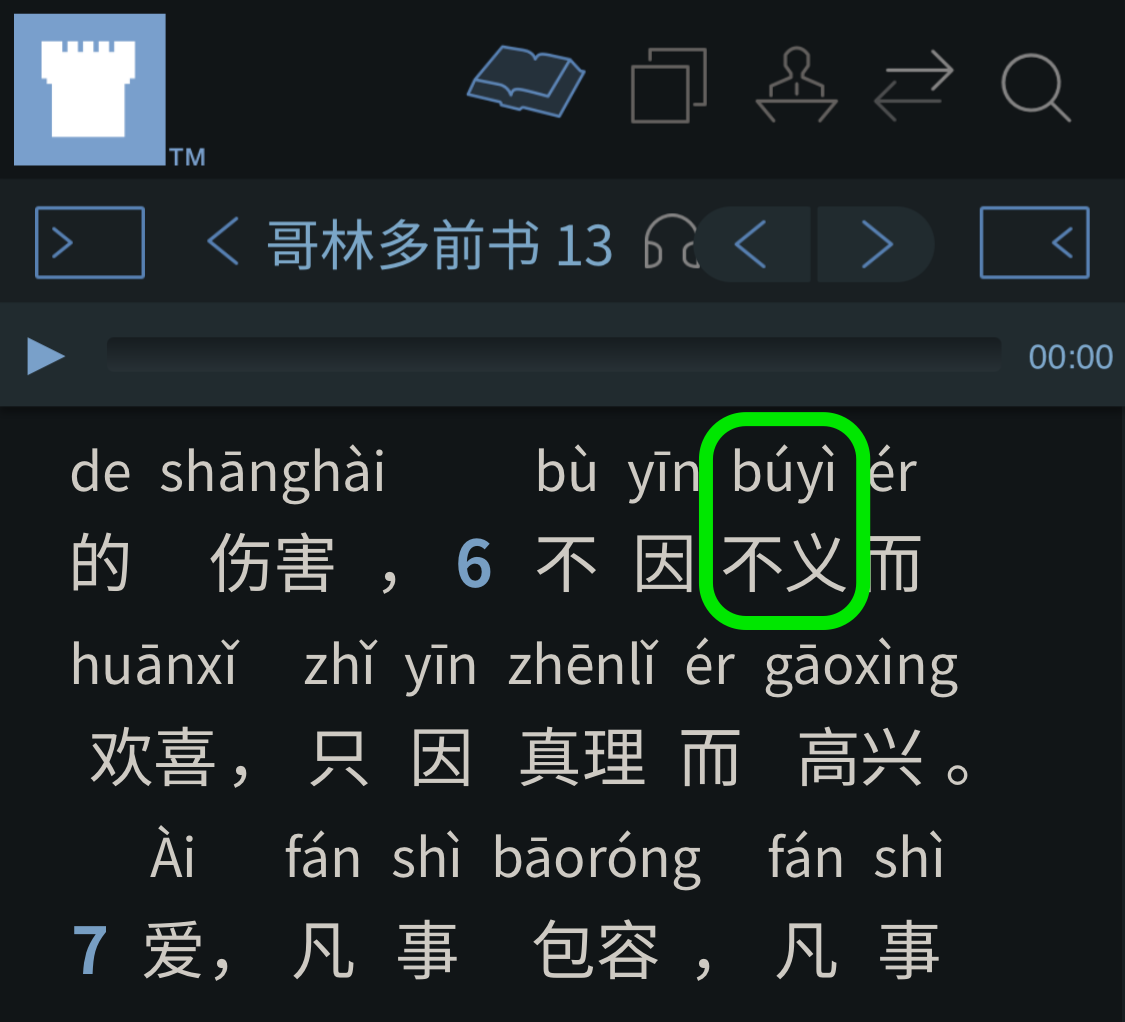
Screenshot of “_jìjiào_” in 1 Co. 13:5 (nwtsty, CHS+_Pīnyīn_ WOL)

(Dark mode for the Watchtower ONLINE LIBRARY (WOL) website, as shown in the above image, can be enabled in the Safari web browser by using the Noir Safari extension. Other web browsers may also have extensions with similar functionality.)

For comparison, here are the current English and Pīnyīn (Pīn·yīn {Piecing Together of} · Sounds → [Pinyin] 拼音) Plus renderings of 1 Corinthians 13:5:

English:

does not behave indecently, does not look for its own interests, does not become provoked. It does not keep account of the injury.

Pīnyīn (Pīn·yīn {Piecing Together of} · Sounds → [Pinyin] 拼音) Plus:

📖 📄 📘 (not 不) zuò ({does do} 做) (not 不) guīju (guī·ju (following) {dividers → [rules]} · {carpenter’s squares → [regulations]} → [following established standards] 规矩 規矩) de ( 的) shì (things 事), (not 不) qiú ({does seek} 求) zìjǐ (self 自己) de (’s 的) lìyì (lì·yì {sharpening → [advantage]} · benefit → [benefit] 利益), (not 不) qīngyì (qīng·yì lightly · easily 轻易 輕易) dòngnù (dòng·nù {does have moved} · anger → [does get angry] 动怒 動怒), (not 不) jìjiào (jì·jiào {does count} · {does dispute about} 计较 計較) biéren (bié·ren other · people 别人 別人) zàochéng (zào·chéng {have created} · {to come to be} 造成) de (’s 的) shānghài (injuring → [injury] 伤害 傷害),

The “jì (counting; computing; calculating; numbering [→ [plot; plan (n or v)]]) in “jìjiào (jì·jiào count; calculate · {dispute [about]} [→ [haggle over; fuss about; bother about; bicker]] 计较 計較) can mean “count; calculate”, and it also appears in “jìsuàn (jì·suàn counting; computing; calculating · computing; calculating; figuring 计算 計算)”. As for the “jiào (compare; contrast | dispute | {being compared} → [comparatively; relatively; fairly; quite; rather | clear[ly]; obvious[ly]]) in “jìjiào (jì·jiào count; calculate · {dispute [about]} [→ [haggle over; fuss about; bother about; bicker]] 计较 計較)”, while it means “compare; contrast” in “bǐjiào (compare; contrast | {being compared} → [comparatively; relatively; fairly; quite; rather] | comparing → [comparison] 比较 比較)”, in “jìjiào (jì·jiào count; calculate · {dispute [about]} [→ [haggle over; fuss about; bother about; bicker]] 计较 計較) it has its older meaning of “dispute”.

Interestingly, besides its morphemes’ literal meanings of “count; calculate · dispute”, “jìjiào (jì·jiào count; calculate · {dispute [about]} [→ [haggle over; fuss about; bother about; bicker]] 计较 計較) can also mean “haggle over; fuss about; bother about; bicker” in some settings. In 1 Corinthians 13:5 in the current English and Mandarin versions of the New World Translation Bible, it corresponds with the English expression “keep account of”.

Nitpicking…

Every human-designed system has its shortcomings and negative aspects, including Pīnyīn (Pīn·yīn {Piecing Together of} · Sounds → [Pinyin] 拼音). However, is it advantageous or helpful to harp on or “fuss about” its potentially negative aspects without considering the whole picture?

For example, some make a fuss about the many homophones (different words that sound the same) in Mandarin, saying that they make Pīnyīn (Pīn·yīn {Piecing Together of} · Sounds → [Pinyin] 拼音) unsuitable to be a full writing system for Mandarin. In the overall picture of reality, though, since Pīnyīn (Pīn·yīn {Piecing Together of} · Sounds → [Pinyin] 拼音) is just a relatively simple representation of Mandarin speech, homophones are no more a problem when people use Pīnyīn (Pīn·yīn {Piecing Together of} · Sounds → [Pinyin] 拼音) than they are when people speak Mandarin. People have learned to deal with the challenge of homophones when speaking Mandarin by using sufficient clarifying context, and so people can similarly understand Pīnyīn (Pīn·yīn {Piecing Together of} · Sounds → [Pinyin] 拼音), homophones and all.

(People who say they have trouble understanding Pīnyīn (Pīn·yīn {Piecing Together of} · Sounds → [Pinyin] 拼音) because of homophones may actually be showing that the texts they are reading were written without sufficient context, and were relying on characters as a crutch rather than accurately representing Mandarin speech like they should. Or, these people may be showing that they themselves don’t actually understand spoken Mandarin very well, rather than that Pīnyīn (Pīn·yīn {Piecing Together of} · Sounds → [Pinyin] 拼音) has some inherent shortcoming, when it just simply and directly represents spoken Mandarin.)

Conversely, in the overall picture, characters have the parallel problem of homographs, characters that could represent multiple different words. So, making an anti-Pīnyīn (Pīn·yīn {Piecing Together of} · Sounds → [Pinyin] 拼音) fuss over Mandarin homophones amounts to jìjiào (jì·jiào counting · {disputing about} (things) → [fussing about (things)] 计较 計較), nitpicking over a problem that’s being adequately handled, while offering a solution in the characters that has its own corresponding problem.

Another objection to Pīnyīn (Pīn·yīn {Piecing Together of} · Sounds → [Pinyin] 拼音) that I have heard is that it makes some English-speaking Mandarin learners think of English sounds, so the Mandarin they speak doesn’t sound like native Mandarin. For this reason, some say, it would be better to use Chinese characters or Zhùyīn (Zhù·yīn {Annotating of} · Sounds → [Zhuyin] 注音 註/注音), which would not similarly remind people of English. Is this a real thing? Or, is it just an excuse used by some who are infected by Exotic East Syndrome to focus on “exotic” Eastern systems rather than the “mundane” Latin alphabet used by English and Pīnyīn (Pīn·yīn {Piecing Together of} · Sounds → [Pinyin] 拼音)?

I do not doubt that some, even many, English-speaking Mandarin learners think of English sounds when they see Pīnyīn (Pīn·yīn {Piecing Together of} · Sounds → [Pinyin] 拼音), but this is actually not a shortcoming of Pīnyīn (Pīn·yīn {Piecing Together of} · Sounds → [Pinyin] 拼音) itself, but rather, a rookie mistake on the part of these English-speaking Mandarin learners, who have not yet trained themselves to recognize Pīnyīn (Pīn·yīn {Piecing Together of} · Sounds → [Pinyin] 拼音) as a system that actually represents Mandarin sounds, not English sounds. It may also indicate that these Mandarin learners still need to become more familiar with and used to the sounds of Mandarin in the first place. The article Pīnyīn Is a Good, Workable Writing System on Its Own has an entire section on this, part of which says:

As English-speaking Mandarin-learners get more familiar with the sounds of correct Mandarin speech, they can come to get used to correctly mentally connecting Pīnyīn to correct Mandarin sounds, rather than to English sounds. Then, they can regularly and reliably use Pīnyīn to help them speak Mandarin-sounding Mandarin, just like people regularly and reliably use written French to help them speak French-sounding French.

…While Ignoring White Elephants

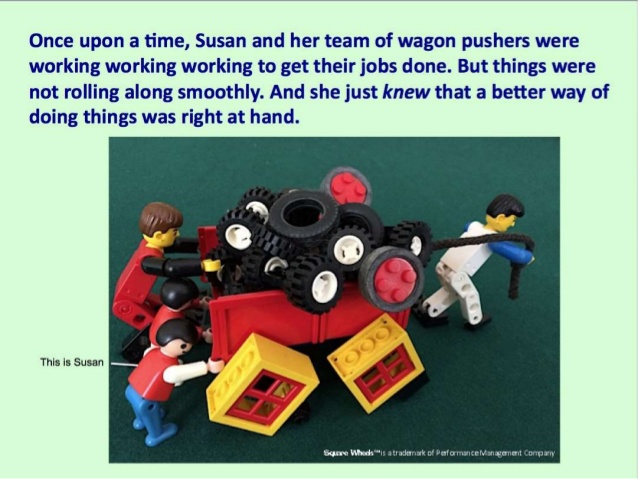
Rather than just nitpicking and harping on the real or perceived shortcomings of Pīnyīn (Pīn·yīn {Piecing Together of} · Sounds → [Pinyin] 拼音) in order to support the traditionally imposed Chinese characters, let us not overlook the white elephant in the room regarding the inhumanly and inhumanely complex characters—learning and remembering them is extremely difficult and costly in terms of time and effort, especially compared to comparatively simple and elegant Pīnyīn (Pīn·yīn {Piecing Together of} · Sounds → [Pinyin] 拼音). Let us not “strain out the gnat but gulp down the camel” like the scribes and Pharisees of Jesus’ day did. (Matthew 23:24) Yes, let us not incorrectly look down on Pīnyīn (Pīn·yīn {Piecing Together of} · Sounds → [Pinyin] 拼音) as merely being training wheels when it is really regular wheels, and let us also not just swallow the reality that Chinese characters are actually more like square wheels than regular wheels!

Lego diorama of people pushing a cart with square wheels, when the cart is filled with round wheels

The problem is not that Pīnyīn (Pīn·yīn {Piecing Together of} · Sounds → [Pinyin] 拼音) is like training wheels, because Pīnyīn (Pīn·yīn {Piecing Together of} · Sounds → [Pinyin] 拼音) is actually like regular wheels. The real problem is that characters are like square wheels!

Categories
Culture Experiences Language Learning Science Technology Theocratic

dòngnù

dòngnù (dòng·nù {have moved} · anger; rage; fury → [get angry; lose temper; fly into a rage] 动怒 動怒) 👈🏼 Tap/click to show/hide the “flashcard”

[Notes: Tap/click on a Pīnyīn (Pīn·yīn {Piecing Together of} · Sounds → [Pinyin] 拼音) expression to reveal its “flashcard”; tap/click on a “flashcard” or its Pīnyīn (Pīn·yīn {Piecing Together of} · Sounds → [Pinyin] 拼音) expression to hide the “flashcard”. 📖 📄 📘 icons mean 📖 Reveal All, 📄 Reveal Advanced, and 📘 Reveal None re all the “flashcards” in the heading, paragraph, etc. that they are placed at the beginning of.]

I have long especially liked 1 Corinthians 13. It contains counsel on what really does and doesn’t matter in life, an extensive description and definition of the most important kind of love, and a sublime discussion about the need to become complete, mature, as a person. As these apply to life in general, so too do they apply to our lives as Mandarin field language learners.

As Mandarin field language learners, it can benefit us greatly to consider what we can learn from 1 Corinthians 13, and along the way, we can also consider some of the Mandarin expressions used in that chapter in the current version of the Mandarin New World Translation Bible (nwtsty).

Moved to Anger

This week’s MEotW, “dòngnù (dòng·nù {have moved} · anger; rage; fury → [get angry; lose temper; fly into a rage] 动怒 動怒)”, is used in verse 5 (WOL) of 1 Corinthians 13:

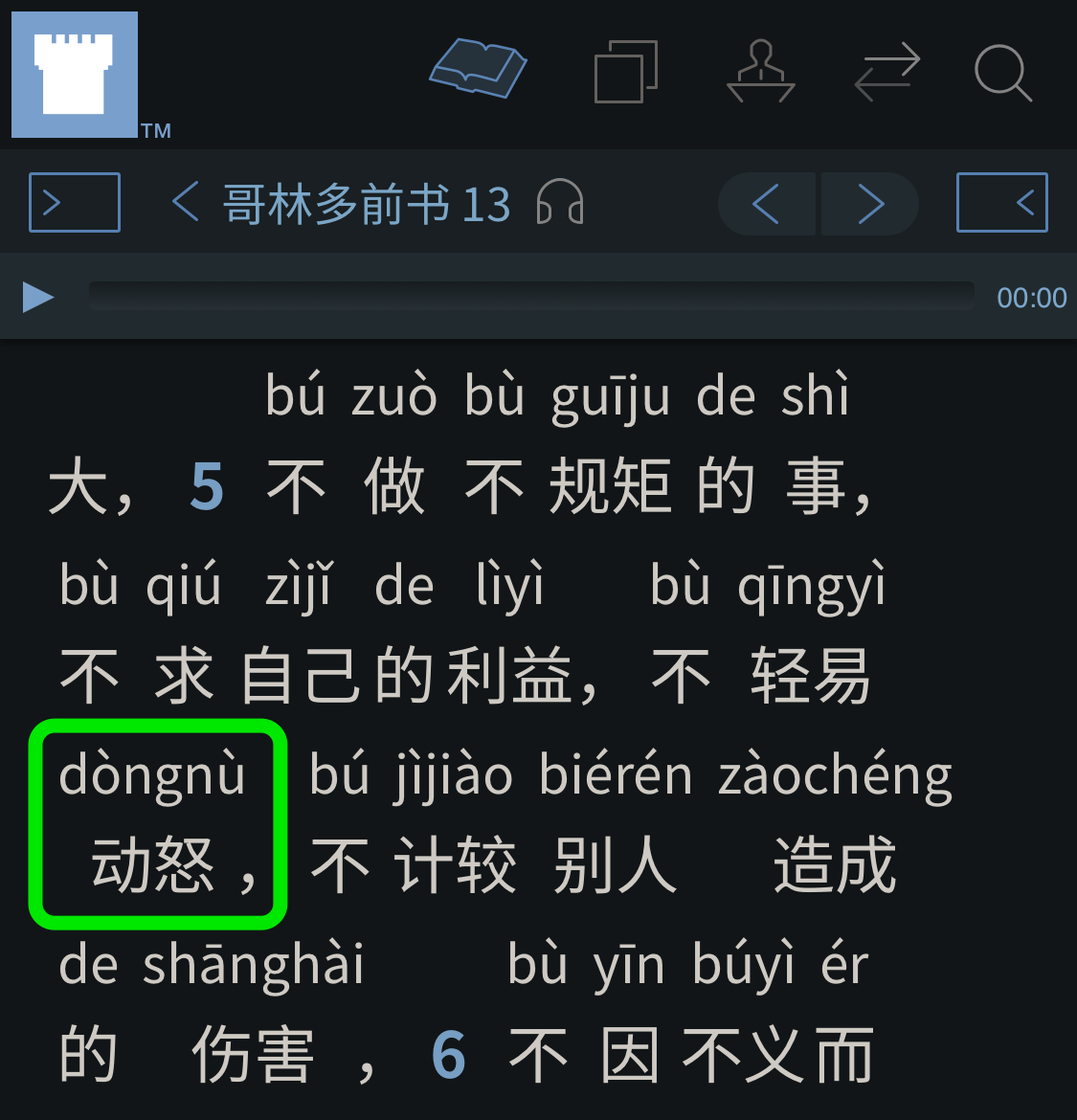
Screenshot of “_dòngnù_” in 1 Co. 13:5 (nwtsty, CHS+_Pīnyīn_ WOL)

(Dark mode for the Watchtower ONLINE LIBRARY (WOL) website, as shown in the above image, can be enabled in the Safari web browser by using the Noir Safari extension. Other web browsers may also have extensions with similar functionality.)

For comparison, here are the current English and Pīnyīn (Pīn·yīn {Piecing Together of} · Sounds → [Pinyin] 拼音) Plus renderings of 1 Corinthians 13:5:

English:

does not behave indecently, does not look for its own interests, does not become provoked. It does not keep account of the injury.

Pīnyīn (Pīn·yīn {Piecing Together of} · Sounds → [Pinyin] 拼音) Plus:

📖 📄 📘 (not 不) zuò ({does do} 做) (not 不) guīju (guī·ju (following) {dividers → [rules]} · {carpenter’s squares → [regulations]} → [following established standards] 规矩 規矩) de ( 的) shì (things 事), (not 不) qiú ({does seek} 求) zìjǐ (self 自己) de (’s 的) lìyì (lì·yì {sharpening → [advantage]} · benefit → [benefit] 利益), (not 不) qīngyì (qīng·yì lightly · easily 轻易 輕易) dòngnù (dòng·nù {does have moved} · anger → [does get angry] 动怒 動怒), (not 不) jìjiào (jì·jiào {does count} · {does dispute about} 计较 計較) biéren (bié·ren other · people 别人 別人) zàochéng (zào·chéng {have created} · {to come to be} 造成) de (’s 的) shānghài (injuring → [injury] 伤害 傷害),

In the example above, the Mandarin phrase “bù (not 不) qīngyì (qīng·yì lightly · easily 轻易 輕易) dòngnù (dòng·nù {does have moved} · anger → [does get angry] 动怒 動怒) corresponds with the English phrase “does not become provoked”. As for the morphemes in “dòngnù (dòng·nù {have moved} · anger; rage; fury → [get angry; lose temper; fly into a rage] 动怒 動怒)”, they literally mean “have moved anger/rage/fury”, and effectively mean “get angry; lose one’s temper; fly into a rage”.

Angrily Holding On to Tradition

I remember more than one Mandarin field language learner who reacted angrily when I suggested that using Pīnyīn (Pīn·yīn {Piecing Together of} · Sounds → [Pinyin] 拼音) more and deemphasizing characters would help them progress in learning Mandarin. Rather than appreciating the evident truth of what I was saying, or being thankful that I was trying to help them, they seemed offended and upset that I had dared to suggest something so out of step with the human traditions that they had been taught all their lives, and, perhaps, indignant that I had, in their estimation, dismissed and invalidated the blood, sweat, and tears that they had personally invested for years and years into the long, hard, bitter struggle that is learning characters.

On the one hand, some may say that such reactions are only human, but on the other hand, the words of 1 Corinthians 13:5 that love “does not become provoked” show that actually, such ones are not completely acting out of Christian love when they react that way. As the Insight book says:

Love “does not become provoked.” It does not look for an occasion or an excuse for provocation. It is not moved to outbursts of anger, which is a work of the flesh. (Ga 5:19, 20) One having love is not easily offended by what others say or do. He is not afraid that his personal “dignity” may be injured.

Happily, not all Mandarin field language learners react as mentioned above. Rather than reacting out of personal indignation, cultural pride, traditionalism, and chauvinism, or the tribalism of the embattled few in “the club” who have long endured together the difficult burdens of dealing with the unnecessarily extraordinarily complex characters, even some long-time Mandarin field language learners who have worked hard for a long time to learn characters listen humbly to the information I share with them about the linguistic truths that apply to our Mandarin field language learning, and are appreciative that these truths help to set them free from the unnecessary burdens imposed by mere human tradition.—John 8:32.

Categories
Culture Language Learning Technology Theocratic

lìyì

lìyì (lì·yì {sharpening → [advantage; benefit; gain | profit; interest]} · benefit; advantage; profit → [benefit; profit] 利益) 👈🏼 Tap/click to show/hide the “flashcard”

[Notes: Tap/click on a Pīnyīn (Pīn·yīn {Piecing Together of} · Sounds → [Pinyin] 拼音) expression to reveal its “flashcard”; tap/click on a “flashcard” or its Pīnyīn (Pīn·yīn {Piecing Together of} · Sounds → [Pinyin] 拼音) expression to hide the “flashcard”. 📖 📄 📘 icons mean 📖 Reveal All, 📄 Reveal Advanced, and 📘 Reveal None re all the “flashcards” in the heading, paragraph, etc. that they are placed at the beginning of.]

I have long especially liked 1 Corinthians 13. It contains counsel on what really does and doesn’t matter in life, an extensive description and definition of the most important kind of love, and a sublime discussion about the need to become complete, mature, as a person. As these apply to life in general, so too do they apply to our lives as Mandarin field language learners.

As Mandarin field language learners, it can benefit us greatly to consider what we can learn from 1 Corinthians 13, and along the way, we can also consider some of the Mandarin expressions used in that chapter in the current version of the Mandarin New World Translation Bible (nwtsty).

“Lookin’ Out for #1”?

This week’s MEotW, “lìyì (lì·yì {sharpening → [advantage; benefit; gain | profit; interest]} · benefit; advantage; profit → [benefit; profit] 利益)”, is used in verse 5 (WOL) of 1 Corinthians 13:

Screenshot of “_lìyì_” in 1 Co. 13:5 (nwtsty, CHS+_Pīnyīn_ WOL)

(Dark mode for the Watchtower ONLINE LIBRARY (WOL) website, as shown in the above image, can be enabled in the Safari web browser by using the Noir Safari extension. Other web browsers may also have extensions with similar functionality.)

For comparison, here are the current English and Pīnyīn (Pīn·yīn {Piecing Together of} · Sounds → [Pinyin] 拼音) Plus renderings of 1 Corinthians 13:5:

English:

does not behave indecently, does not look for its own interests, does not become provoked. It does not keep account of the injury.

Pīnyīn (Pīn·yīn {Piecing Together of} · Sounds → [Pinyin] 拼音) Plus:

📖 📄 📘 (not 不) zuò ({does do} 做) (not 不) guīju (guī·ju (following) {dividers → [rules]} · {carpenter’s squares → [regulations]} → [following established standards] 规矩 規矩) de ( 的) shì (things 事), (not 不) qiú ({does seek} 求) zìjǐ (self 自己) de (’s 的) lìyì (lì·yì {sharpening → [advantage]} · benefit → [benefit] 利益), (not 不) qīngyì (qīng·yì lightly · easily 轻易 輕易) dòngnù (dòng·nù {does have moved} · anger → [does get angry] 动怒 動怒), (not 不) jìjiào (jì·jiào {does count} · {does dispute} 计较 計較) biéren (bié·ren other · people 别人 別人) zàochéng (zào·chéng {have created} · {to come to be} 造成) de (’s 的) shānghài (injuring → [injury] 伤害 傷害),

The “lì (sharpen [→ [do good [for/to]; be beneficial [for/to]]] | sharpened [→ [sharp | favourable; advantageous; good; beneficial; smooth; convenient]] | sharpening [→ [advantage; benefit; gain | profit; interest]] 利) in “lìyì (lì·yì {sharpening → [advantage; benefit; gain | profit; interest]} · benefit; advantage; profit → [benefit; profit] 利益) literally means “sharpening”, and can effectively mean “advantage; benefit; gain”. Similarly, the “yì (benefit; good; advantage; profit; increase | beneficial; profitable | {to increase; to benefit} 益) in “lìyì (lì·yì {sharpening → [advantage; benefit; gain | profit; interest]} · benefit; advantage; profit → [benefit; profit] 利益) means “benefit; advantage; profit”. We can see then, why in 1 Corinthians 13:5 in the current English and Mandarin versions of the New World Translation Bible, “bù (not 不) qiú ({does seek} 求) zìjǐ (self 自己) de (’s 的) lìyì (lì·yì {sharpening → [advantage]} · benefit → [benefit] 利益) corresponds with the English phrase “does not look for its own interests”.

In this regard, true Christian love is completely opposite from the norm in Satan’s world, which is the kind of self-interest and lovelessness that’s expressed by this excerpt from the lyrics of the song “Lookin’ Out for #1”:

Every night is a different game
We gotta work for our fortune and fame
Success is a ladder, take a step at a time
And the people will remember your name

Yes, I found out all the tricks of the trade
And that’s there’s only one way you’re gonna get things done
I found out the only way to the top
Is looking out for number one
And that’s me, I’m looking out for number one

Not Looking For Our Own Interests in the Mandarin Field

Unlike the self-seeking people of Satan’s world, Mandarin field language learners who seek to show Christian love must not view their language learning and ministry as just a game, nor should they be seeking fortune and fame, or success as defined by the world. And rather than wanting people to remember their names, they seek to proclaim Jehovah’s name. Rather than trying to get to the top, they try to help Mandarin-speaking people to get everlasting life. Yes, rather than looking out for number one (themselves), they exert themselves and make sacrifices to help others as spiritual rescue workers, and they seek to glorify, not themselves, but rather, Jehovah, as admonished by our recently introduced song “Give Jehovah Glory”.

To help us gain insight on how well we are doing when it comes to not looking for our own interests in the Mandarin field, we could consider the following:

  • If we are exerting ourselves to learn the traditionally used but exceedingly complex Chinese characters, how much of our motivation is to be more able to help Mandarin-speaking people more effectively and glorify Jehovah more clearly and eloquently, and how much is it to glorify ourselves in the eyes of tradition-loving advocates of worldly Chinese culture?
  • Are we resistant to Pīnyīn (Pīn·yīn {Piecing Together of} · Sounds → [Pinyin] 拼音) because it doesn’t have the same worldly cultural glamour and prestige as the characters do, or do we value it because of how it can help us to more quickly, easily, and effectively glorify Jehovah and give spiritual help to Mandarin-speaking people?
  • This year’s convention program helps us to further appreciate the kind of person Jesus showed himself to be when he was on earth. As Jesus’ Christian followers, we seek to follow his example, including his example in showing love that “does not look for its own interests”.
    • From what we have learned about Jesus, if he were on earth today and serving in the Mandarin field, would he be impressed by the glorious, prestigious traditions of worldly Chinese culture, such as those involving Chinese characters? Would he be okay with allowing such human traditions to make it much more difficult than necessary to glorify Jehovah in Mandarin and give spiritual help to Mandarin-speaking people? Considering how he viewed the Sabbath traditions of the first-century Jews, which only unnecessarily oppressively burdened people one day a week, how would he view today’s human-mandated traditions involving Chinese characters, which unnecessarily oppressively burden his followers in the Mandarin field every single day?John 5:16, 17; 41–44.