Categories
Culture Language Learning Languages Science Technology

fā yǔyīn

({send out})
yǔyīn (yǔ·yīn {language → [speech]} · sounds → [voice message] 语音 語音) ← Tap/click to show/hide the “flashcard”

While doing research for the MEotW post on “tíbǐ (tí·bǐ {carry (hanging down from the hand) → [raise; lift]} · pen; pencil; {writing brush} [→ [start writing; write]] 提笔 提筆)wàng (forget 忘) (character 字), I came across the web article “Why is character amnesia in China considered problematic?”. One of the points it makes involves this week’s MEotW, “fā ({send out}) yǔyīn (yǔ·yīn {language → [speech]} · sounds → [voice message] 语音 語音) (send voice message):

Another feature that has gained huge popularity in China recently is that of ‘sending voice messages’ (发语音, fā yǔyīn). Chinese Whatsapp equivalent ‘WeChat’ was the first in the world to introduce this feature in its app. Social media research by University College London has shown that Chinese WeChat users find voice messaging convenient because it eliminates the need to text. Informants have reported that sending written messages always takes more time, and that inputting Chinese characters was a struggle (Wang & McDonald, 2013). With voice messaging, or even with pinyin input, people do not need to memorize the exact order of each stroke of a character when typing a text. They can just rely on knowing the pronunciation and recognizing the character. The prevalence of typing and texting on cellular devices has been correlated to reduced active-character knowledge by Chinese natives, leading to the tibiwangzi-phenomenon (Williams, 2016).

Sending, Language, Sounds

The “fā ({send out}; issue; emit [→ [deliver | utter; express | become rich]]) in “fā ({send out}) yǔyīn (yǔ·yīn {language → [speech]} · sounds → [voice message] 语音 語音) literally means “send out; issue; emit”, and it can also be used to mean various things such as “deliver”, “utter; express”, and “become rich”. With such a variety of meanings, it shows up in various expressions, such as:

  • fāchū (fā·chū issue; send; emit · out 发出 發出)
  • fāchòu (fā·chòu emit · {being stinking} → [smell bad; stink] 发臭 發臭)
  • fāshēng (fā·shēng {issue forth} · {come to life} → [happen] 发生 發生)
  • fācái (fā·cái {issue forth} · wealth; riches → [get rich; make a fortune] 发财 發財) (“Fā ({issue forth (riches)} → [become rich]) used on its own to mean “become rich” is probably an abbreviation of this expression.)
  • fāyīn (fā·yīn {sending out; issuing → [uttering] [of]} · sound → [pronouncing/articulating/enunciating | pronunciation; articulation; enunciation] 发音 發音)
  • etc.

The “yǔ (language; speech; tongue | saying; proverb | words; expression | speak; say) in “fā ({send out}) yǔyīn (yǔ·yīn {language → [speech]} · sounds → [voice message] 语音 語音) basically means “language”. It can also particularly mean “speech”—according to a basic principle of linguistics, speech is the primary aspect of human language. This “yǔ (language; speech; tongue | saying; proverb | words; expression | speak; say) is used in:

  • yǔyán (yǔ·yán language; tongue · {(type of) speech} 语言 語言)
  • Guóyǔ (Guó·yǔ National · Language → [(Modern Standard) Mandarin (term commonly used in Taiwan)] 国语 國語)
  • Hànyǔ (Hàn·yǔ {Han (Chinese)} · Language [→ [(Modern Standard) Mandarin]] 汉语 漢語)
  • Hányǔ (Hán·yǔ Korean · Language 韩语 韓語)
  • Yīngyǔ (Yīng·yǔ English · Language 英语 英語)
  • etc.

(Note that while “Yīngyǔ (Yīng·yǔ English · Language 英语 英語), for example, refers to English language speech, “Yīngwén (Yīng·wén English · Writing 英文) refers, not to English speech, but to English language writing.)

The “yīn (sound [→ [musical note/sound; tone; pronunciation | syllable | news; tidings]] 音) in “fā ({send out}) yǔyīn (yǔ·yīn {language → [speech]} · sounds → [voice message] 语音 語音) basically means “sound”, and it can also be used to mean “musical note/sound”, “tone”, “pronunciation”, “syllable”, and “news; tidings”. It is used in:

  • shēngyīn (shēng·yīn sound; voice · sound 声音 聲音)
  • yīnyuè (yīn·yuè {(musical) sound} · music → [music] 音乐 音樂)
  • Pīnyīn (Pīn·yīn {Piecing Together of} · Sounds → [Pinyin] 拼音)
  • Zhùyīn (Zhù·yīn {Annotating of} · Sounds → [Zhuyin] 注音 註/注音)
  • Mǎtài (Matthew 马太 馬太) Fúyīn (Fú·yīn Blessings · News 福音)
  • etc.

Speech is Natural, Characters, Not So Much

Writing is by now an age-old technology for recording and transmitting human speech. Now, in 2023, audio recording and transmitting technology has been available for a long time that actually allows one to directly hear the recorded speech pretty much as it originally sounded. Additionally, such technology is getting more and more common and accessible, to the point that many are finding that it often is faster and easier to send audio voice messages than to write and send written messages, especially when using as complex and cumbersome a writing system as Chinese characters.

True, in some situations, writing has some advantages over speech, but overall, the linguistic principle remains true that when it comes to human language, speech is primary and writing is secondary. Indeed, if God had meant for us humans to mainly use writing to communicate, then he could easily have designed our bodies with built-in screens that are able to dynamically display writing, like even humans know how to make. Instead, God designed our brains and bodies such that parts of them are specialized for directly understanding and producing speech.

Thus, it is quite natural that people would often take advantage of technology that has become available that allows one to actually hear recorded speech, instead of always settling for the visual abstractions of writing. And, when writing is appropriate, it is similarly relatively natural for people to make use of writing systems like Pīnyīn (Pīn·yīn {Piecing Together of} · Sounds → [Pinyin] 拼音) that are primarily phonetic, that is, focusing on directly representing the sounds of speech.

The National, the Political, the Universal(?), the Individual, the Rituals

On the other hand, rather than naturally reflecting divine wisdom, the attachment of many to Chinese characters instead reflects some human shortcomings. On a national level, the justification that characters are helpful in politically unifying China in spite of it being comprised of groups speaking different languages is yet another example of a human ruling authority prioritizing its own political power and survival over what’s actually good for the people. Besides, there’s actually nothing special about characters when it comes to being usable by people who speak different languages. As John DeFrancis put it in his book The Chinese Language: Fact and Fantasy, in the chapter entitled “The Universality Myth” (p. 159),

Chinese characters used by Asians speaking different languages are no more universal than are Latin letters used by Europeans who also speak different languages.

For example, while it’s true that the character “台” is recognized by both Mandarin-speakers and Cantonese-speakers as meaning “table”, it’s also true that “table”, written in Latin alphabet letters, is recognized by both English-speakers and French-speakers as meaning “table”.

(In China specifically, rather than characters, say, allowing Mandarin-speakers who don’t know Cantonese to understand written-out Cantonese speech, with its unique vocabulary and characters, and vice versa, what has actually happened is that the politically dominant Mandarin-speakers have basically forced speakers of Cantonese, Shanghainese, etc. to learn and use written Mandarin instead of actual written Cantonese, Shanghainese, etc.)

On a more individual level, many who are attached to characters show that they cling to what is old and familiar, even if it is problematic, instead of reaching out for and embracing positive change and progress. Also, many who cling to characters and the intricate procedures required to handwrite them show that they prioritize traditions, rituals, and procedures over what really brings better results. As Jesus said, though, “wisdom is proved righteous by its works”, not by its traditions, rituals, and procedures.—Matthew 11:19.

Categories
Culture Experiences History Language Learning Languages

jī‐tóng‐yā‐jiǎng

jī‐tóng‐yā‐jiǎng ((jī chicken雞/鷄)‐(tóng {together with}同/仝)‐(yā duck)‐(jiǎng speaking) [people not understanding each other because of speaking different languages (from Cantonese)]) ← Tap/click to show/hide the “flashcard”

[Yes, this expression comes from Cantonese, but the above Mandarin version does appear in Mandarin dictionaries, so it qualifies as a Mandarin expression!]

Recently, while out to dinner with one of the first families to serve in the local Cantonese congregation, along with the circuit overseer serving the local Chinese circuit and his wife, the subject came up of how Mandarin and Cantonese are actually different languages, not just dialects of the same language.

Chickens Talking with Ducks

The wife of the circuit overseer asked what the difference is between a language and a dialect. So, I proceeded to explain something that is emphasized by American sinologist and University of Pennsylvania Professor of East Asian Languages and Civilizations Victor H. Mair, that a primary way accepted by most linguists to distinguish a language from a dialect is mutual intelligibility, as is discussed in this excerpt from the MEotW post on “fāngyán (fāng·yán {direction → [place]} · speech → [topolect; dialect (common but misleading translation)] 方言)”:

It has been said that “a language is a dialect with an army and navy”, but in his article Professor Mair gives us a more linguistically correct and useful way to distinguish between a language and a dialect:

Regardless of the imprecision of lay usage, we should strive for a consistent means of distinguishing between language and dialect. Otherwise we might as well use the two terms interchangeably. That way lies chaos and the collapse of rational discourse. Mutual intelligibility [emphasis added] is normally accepted by most linguists as the only plausible criterion for making the distinction between language and dialect in the vast majority of cases. Put differently, no more suitable, workable device for distinguishing these two levels of speech has yet been proposed. If there are to be exceptions to the useful principle of mutual intelligibility, there should be compelling reasons for them. Above all, exceptions should not be made the rule.

What is mutual intelligibility? Simply put, in linguistics, two or more speech varieties are said to be mutually intelligible if they are “able to be understood by one another’s speakers”. For example, if one person only knows English, and another person only knows Spanish, they can’t really understand each other if they try to talk to each other—English and Spanish are not mutually intelligible, and are suitably recognized as being different languages, not just different dialects of “European”.

Similarly, if one person only knows Mandarin, and another person only knows Cantonese, they can’t really understand each other if they try to talk to each other—Mandarin and Cantonese are not mutually intelligible. So, while they may be “fāngyán (fāng·yán {direction → [place]} · {(patterns of) speech} 方言)”, linguistically, Mandarin and Cantonese should really be considered to be different languages, not just different dialects of “Chinese”.

Indeed, I have heard people use this week’s MEotW, “jī‐tóng‐yā‐jiǎng ((jī chicken雞/鷄)‐(tóng {together with}同/仝)‐(yā duck)‐(jiǎng speaking) [people not understanding each other because of speaking different languages (from Cantonese)])”, to specifically describe Mandarin-speakers and Cantonese-speakers trying to talk to each other, and not understanding each other. 🐓 🦆

After I explained the gist of the above, one of the daughters of the family at the dinner—who had been labouring for decades under the misconception that Mandarin and Cantonese are just dialects and that someone who knows one can easily learn the other—said, “Now I don’t feel like an idiot.”

Uncommon Knowledge?

It could be said that ones such as this family and this circuit overseer and his wife, who have all worked so hard and served for so long in the Chinese language fields, should already have known such a basic thing about the Chinese languages. However, the following things are unfortunately true:

  • Even publishers who are learning a language to serve in that language’s field generally consider such linguistic (language science) knowledge to be specialized technical knowledge that is beyond what they need to learn, and possibly beyond what they could even comprehend.
  • Western-educated publishers learning a Chinese language may unwittingly go along with the Western worldly tendency to exoticize things related to China. (John DeFrancis, in his book The Chinese Language: Fact and Fantasy (p. 37), calls this “Exotic East Syndrome”.) They may be content with—or even enjoy—the alluring veil of mystery and mystique surrounding certain things related to China and Chinese culture. Thus, they don’t seek to learn about and understand deeper truths about such things, that may pierce through this obscuring veil, and burst this bubble.—Compare 2 Corinthians 3:14, including the margin note.
  • The central ruling authorities of China have long actively promoted the scientifically incorrect idea that the different varieties of speech in China are just dialects of the one Chinese language. This idea is political propaganda supporting the idea that it’s good for there to be central ruling authorities in China.
  • Traditional worldly Chinese language instructors and others who are knowledgeable about Chinese languages and Chinese characters are eager to promote and perpetuate the traditional thinking about Chinese languages and characters, that they have invested so much time and effort in, and that they are so proud of.
  • Chinese-educated publishers who are already steeped in the traditional ideas about Chinese languages, Chinese characters, etc., and who are thus lauded and deferred to as experts by other publishers, may be eager to simply unquestioningly pass on the cultural knowledge and ideas that they were taught, and that they are lauded and respected for.
  • The Bible makes it clear that Satan the Devil is “a liar and the father of the lie”. It also describes him as “the great dragon…who is misleading the entire inhabited earth”. So, while we can only speculate about the details of what strings are purposely pulled in the spirit realm by Satan and his demons as opposed to what human folly they simply passively observe, we can be sure that Satan is delighted with all the ways in which people are misled in and about the Chinese culture, in which the dragon is considered a positive, revered symbol.—John 8:44; Revelation 12:9.

So, for reasons such as the above, even the basic linguistic truth that Mandarin, Cantonese, Shanghainese, etc. actually function as different languages is unfortunately not yet common knowledge among those serving in the Chinese fields. As the saying goes, which some say is a Chinese proverb, “error will travel over half the globe, while truth is pulling on her boots”.

Jesus said, though, that true worshippers worship “with spirit and truth”, and that “the truth will set you free”. With regard to Chinese languages, Chinese characters, etc., the truth about them can even set one free from unnecessarily feeling like an “idiot”, as the sister mentioned above so eloquently put it, because of labouring under all the political propaganda, traditions, and other kinds of misinformation and wrong thinking that unfortunately surround Chinese languages, Chinese characters, etc.—John 4:23; 8:32.

Huge Worldwide Effects

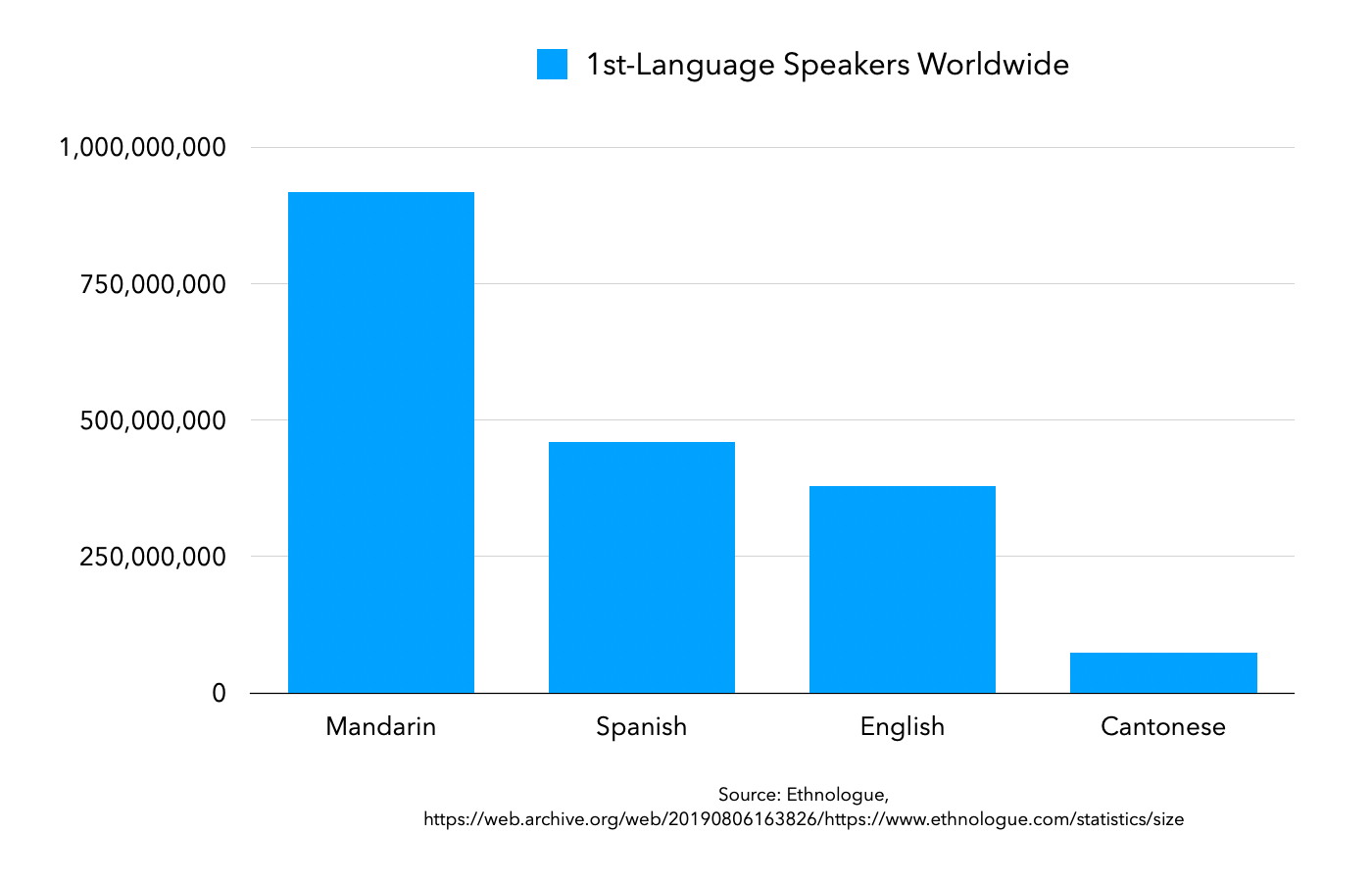
In addition to being hugely freeing for individual language learners, spreading the truth about the Chinese languages, Chinese characters, etc. is also important on a larger scale, since the worldwide Mandarin field, for one, is the largest language field in the world, and probably the largest language field that has ever existed in human history. For comparison, according to Ethnologue, a resource on world languages, the worldwide Mandarin field (those worldwide whose mother tongue is Mandarin) is about twice the size of the second largest worldwide language field, the Spanish field, and it’s about two and a half times the size of the third largest worldwide language field, the English field. Allowing various untruths to continue to divert and bog down the language-learning efforts of those who come to help in the worldwide Mandarin field can have incalculable overall negative effects on the preaching work in this enormous field.

Chart: Languages by First-Language Speakers—2019

So, even as we hang on to Bible truth, let us also hang on to the linguistic truths that we learn, and let us do what we can to share them with our fellow workers in the vast worldwide Chinese fields.

Categories
Culture Current Events Language Learning

tǎngpíng

tǎngpíng (tǎng·píng lie; recline · {[to be] flat} 躺平) ← Tap/click to show/hide the “flashcard”

I recently came across an interesting article on the website Sixth Tone*, about this week’s MEotW, “tǎngpíng (tǎng·píng lie; recline · {[to be] flat} 躺平)”.

Screenshot of the article “Tired of Running in Place, Young Chinese ‘Lie Down’ ”, on the Sixth Tone website

This Sixth Tone article is about how some cool cats are dropping out of the Chinese rat race.

The article briefly describes how this word is being used now by people in China:

China’s young people have coined yet another neologism to reflect their growing disillusionment with the country’s often oppressive work culture. Rather than trying to keep up with society’s expectations or fight them, many are resolving to simply “lie down.”

The new lifestyle buzzword, tang ping, stems from a now-deleted post on forum site Tieba. Unlike similar, previous terms to have had their time in the spotlight in recent years, tang ping is an action rather than a feeling — resolving to just scrape by, exerting the bare minimum effort at an unfulfilling job, as opposed to the futility of raging against the capitalist machine.

Chinese “Rat Race”

The above reference to China’s “often oppressive work culture” may remind one of the English term “rat race”, which is referred to later in the above-mentioned article. The Online Etymology Dictionary tells us about an early application of “rat race”:

A rat race is … a simple game of “follow the leader” in fighter planes. The leader does everything he can think of — Immelmanns, loops, snap rolls, and turns, always turns, tighter and tighter. [Popular Science, May 1941]

Of course, “rat race” also went on to refer to “fiercely competitive struggle”. Wikipedia describes it this way:

A rat race is an endless, self-defeating, or pointless pursuit. The phrase equates humans to rats attempting to earn a reward such as cheese, in vain. It may also refer to a competitive struggle to get ahead financially or routinely.

The term is commonly associated with an exhausting, repetitive lifestyle that leaves no time for relaxation or enjoyment.

The Most Rational Choice?

Continuing on, the Sixth Tone article goes into an interview with Huang Ping, a literature professor at East China Normal University who researches youth culture:

“The state is worried about what would happen if everyone stopped working,” said Huang. But he doesn’t necessarily agree with the media reactions. “Humans aren’t merely tools for making things,” he said.

To lie down is a rational choice rather than a negative attitude, Huang explained. For some young people, it’s a way for them to unburden themselves. “When you can’t catch up with society’s development — say, skyrocketing home prices — tang ping is actually the most rational choice,” he said.

According to Professor Huang, lying down can be seen as the opposite of involution — a decades-old academic term referring to societies becoming trapped in ceaseless cycles of competition that resurfaced last year as an online buzzword in China. [“Nèijuǎn (Nèi·juǎn inner · rolling → [involution] 内卷 內卷/捲)”, the Mandarin word for this, is a past MEotW.] “In a relatively good social environment, people may feel involuted, but at least they’re trying,” he said. “If it’s worse, people will tang ping.”

A Rational Reaction of Mandarin-Learners to Chinese Characters?

Many who are learning Mandarin to help in the Mandarin language field find the Chinese characters writing system to be unreasonably difficult to learn and use for regular human beings in their situation. So, kind of like the people mentioned above who are faced with China’s “often oppressive work culture”, they stop trying to deal with Chinese characters and tǎngpíng (tǎng·píng lie; recline · {[to be] flat} 躺平), some even ultimately leaving the Mandarin field because of this.

Is this a rational reaction? Besides just toughing it out, is there another alternative to just quitting the Mandarin field because of the extraordinary difficulties associated with Chinese characters?

Chinese characters are indeed so complex and haphazardly designed that trying to learn them (and also remember them) is an unachievably difficult ordeal for all but a talented/stubborn minority. So, for many, it may indeed be rational to tǎngpíng (tǎng·píng lie; recline · {[to be] flat} 躺平) when it comes to the traditionally mandated Chinese characters.

Thankfully, though, the simple, elegant Pīnyīn (Pīn·yīn {Piecing Together} · Sounds → [Pinyin] 拼音) writing system for Mandarin offers a reasonable alternative to Chinese characters in many situations. Some may be reluctant to use it because of being concerned about miànzi (miàn·zi face · [suf for nouns] [→ [reputation; prestige; esteem; honor]] 面子) (a past MEotW) in the eyes of character-loving Chinese traditionalists, but really, as ones who seek to walk on the narrow road Jesus spoke of, the approval of the tradition-loving majority should not be something we are overly concerned about.—Matthew 7:13, 14.

With the help of Pīnyīn (Pīn·yīn {Piecing Together} · Sounds → [Pinyin] 拼音) and a proper focus on Mandarin speech instead of on the traditionally mandated Chinese characters (while just learning as many characters as they reasonably can), many who in all rationality have chosen to tǎngpíng (tǎng·píng lie; recline · {[to be] flat} 躺平) with regard to focusing on Chinese characters can still make a go of it in the Mandarin field.—1 Corinthians 14:8–11.

“Everything Was Futile”

Those caught up in getting ahead in this human world ruled by Satan indeed experience the truth of Solomon’s words at Ecclesiastes 1:14:

I saw all the works that were done under the sun,
And look! everything was futile, a chasing after the wind.

Thankfully, God also inspired Solomon to record these words at Ecclesiastes 12:13 that tell us what actually does give meaning and purpose to our lives:

The conclusion of the matter, everything having been heard, is: Fear the true God and keep his commandments, for this is the whole obligation of man.


* According to Wikipedia,

Sixth Tone is an online magazine owned by the Shanghai United Media Group, a state media company controlled by the Shanghai committee of the Chinese Communist Party (CCP). It is published in English from China, and its readership is intended for people in Western countries.

It appears, though, that Sixth Tone is not purely China-boosting political propaganda. Vincent Ni, a senior journalist at the BBC World Service in London, commented as follows:

Mainstream outlets such as the BBC often cite Sixth Tone as their source when reporting on Chinese social stories… For foreign journalists, it has also shown a diverse and authentic side of China that rarely received much attention elsewhere.

The success of Sixth Tone might be explained by the bigger change happening in China’s media scene over the past few years. Although the Communist Party has intensified its control, it has also allowed many forms of media entrepreneurship. Anecdotally, this is, in part, because of a lack of impact overseas by traditional Chinese party-owned newspapers.

Nowadays, an investment in media is not something that can solely be done by the government. Private capital has also joined the game, and these firms are making profits.

This is a significant change in China’s media scene. While few would be able to fight the Communist Party’s stringent and increasingly sophisticated censorship rules, the abundance of funding has liberated Chinese journalists who have long been complaining about a lack of freedom and resources. These days, journalists working in start-ups say they have greater freedom to report on topics that would not be possible in well-established traditional media

I have found information on Sixth Tone that helps us to understand some of the things that people in China are concerned about. Perhaps such information can help us as we talk to people from China in our ministry.


Update, 2026-03-15: While the above may have been true when it was posted in 2021, it seems that the situation for Sixth Tone has changed since then. The Wikipedia page for Sixth Tone now says:

In 2022, following the sudden lifting of China’s prolonged zero-COVID measures, Sixth Tone published a year-in-review feature highlighting key terms like “baby bust,” “housing crisis,” “gender violence,” and “COVID”.[source] [source] This feature, deemed as being critical to the country’s COVID policy, faced criticism from China nationalists who accused the outlet of having an editorial bias akin to Western media, citing its frequent reception of international awards from The Society of Publishers in Asia (SOPA) as proof. In response, Shanghai authorities requested senior editors to engage in self-reflection. Consequently, the outlet stopped submitting entries for international awards like SOPA due to fear of repercussions.[source]

In 2023, the publication had new management installed following repeated attacks by nationalists on Weibo.[source]

So, while the Sixth Tone article mentioned and quoted in this post is still online and apparently unchanged, readers may want to keep in mind that Sixth Tone has more recently been forced to project ‘the image of a lovable China.’ ^