Categories
Culture Current Events History Theocratic

tiānxià

tiānxià+ (tiān·xià heaven · under → [all under heaven; the whole world] 天下) ← Tap/click to show/hide the “flashcard”

[Notes: Tap/click on a Pīnyīn (Pīn·yīn {Piecing Together of} · Sounds → [Pinyin] 拼音) expression to reveal its “flashcard”; tap/click on a “flashcard” or its Pīnyīn (Pīn·yīn {Piecing Together of} · Sounds → [Pinyin] 拼音) expression to hide the “flashcard”. 📖 📄 ➕ icons mean 📖 Reveal All, 📄 Reveal Advanced, and ➕ Reveal + Symbols re all the “flashcards” in the heading, paragraph, etc. that they are placed at the beginning of.]

At the time of this writing, the main page of jw.org was featuring the following headline in support of a global campaign:

English

Will War Ever End?

Mandarin:

📖 📄 ➕ Tiānxià (Tiān·xià Heaven · Under → [the Whole World] 天下) Huì (Will 会 會) Tàipíng (Tài·píng Supremely · {Be Flat, Level, Even → [Be Peaceful]} 太平) Ma ([? ptcl for “yes/no” questions] 吗 嗎)?
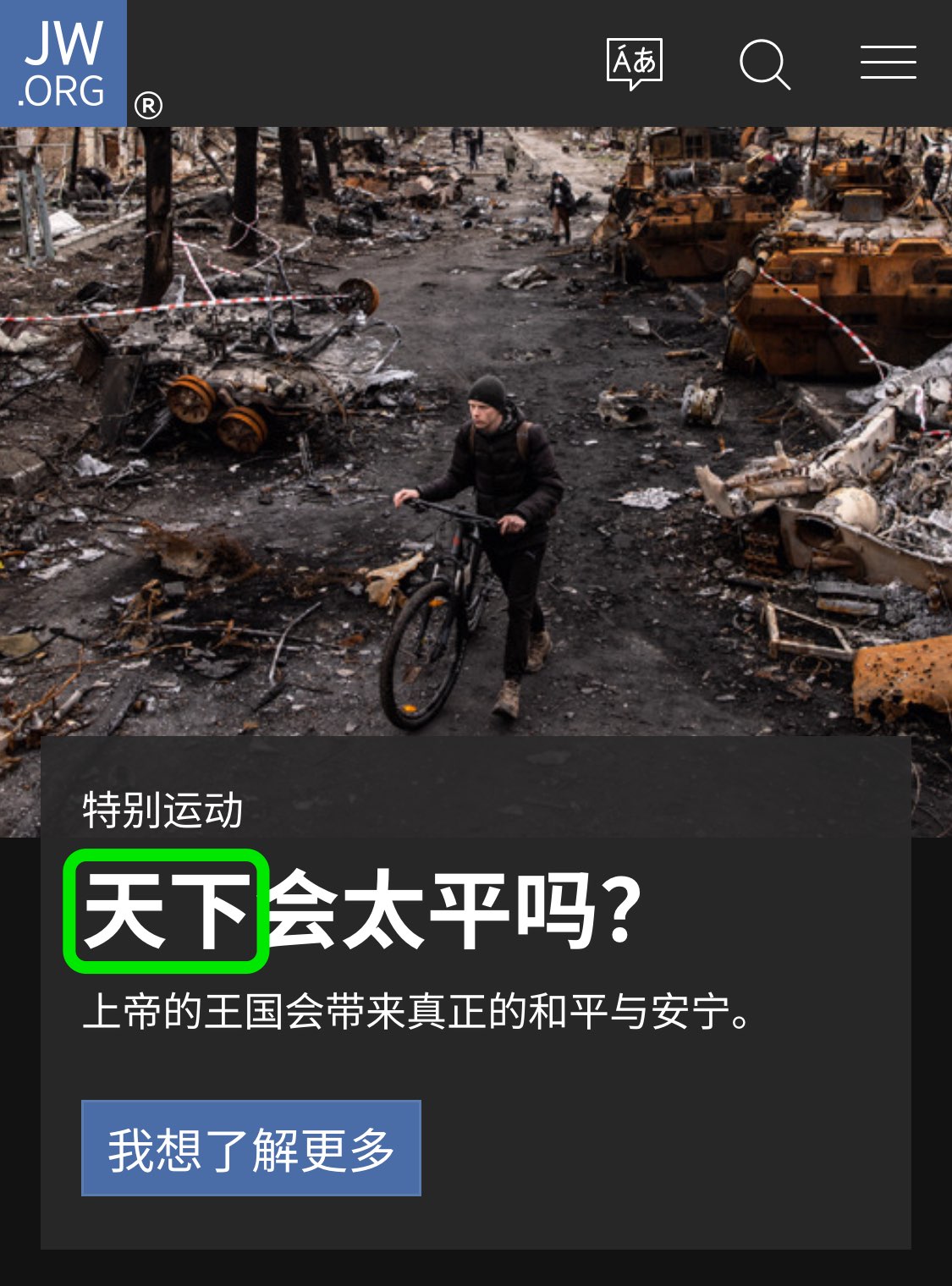
Screenshot of jw.org (CHS) on 2023-09-05, with _“天下 (Tiānxià)”_ circled

The Mandarin headline shown above is derived from the common expression “tiānxià (tiān·xià heaven · under → [all under heaven; the whole world] 天下)‐tàipíng (tài·píng supreme · {being flat, level, even → [being peaceful]} → [peace; tranquility] | supremely · {[be] flat, level, even → [[be] peaceful]} 太平)”, which basically means “peace on earth”. Note that the expression “tiānxià (tiān·xià heaven · under → [all under heaven; the whole world] 天下)”, this week’s MEotW, may also be capitalized, since it may be used in reference to “Tiān (Heaven [→ [God]] 天)” (the Chinese mythological concept of Heaven), which should really be capitalized for a similar reason to why “Shàngdì (Shàng·dì Above’s · {Emperor → [God]} → [God] 上帝)” (also a term used by the ancient Chinese) is capitalized.

Heaven…

This excerpt from the MEotW post on “Shàngtiān (Shàng·tiān Above’s · {Heaven [→ [God]]} → [Heaven; Providence; God] 上天)” recounts how the Chinese concept of Heaven developed:

As mentioned in the MEotW post on “Shàngdì+ (Shàng·dì Above’s · {Emperor → [God]} → [God] 上帝)”:

The Lasting Peace brochure has a box explaining how the concept of Shàngdì (Shàng·dì Above’s · {Emperor → [God]} → [God] 上帝) has been viewed in China throughout its history.

Here is a quote from that box that relates how the Chinese came to view the “Tiān+ (Heaven [→ [God]] 天)” in “Shàngtiān (Shàng·tiān Above’s · {Heaven [→ [God]]} → [Heaven; Providence; God] 上天)”, and how that affected their understanding of Shàngdì (Shàng·dì Above’s · {Emperor → [God]} → [God] 上帝):

…according to Chinese historical records, between three and four thousand years ago, during the Xia and Shang dynasties, the Chinese were already worshipping one supreme deity. The book The Religious History of China explains that they “reckoned that between heaven and earth there was a principal God who stood supreme and had absolute control over all things. . . . This supreme deity came to be called Di, or Shang-di, during the Shang Dynasty, and was known as Tien [heaven], or Tien-di [Emperor in Heaven], during the Zhou Dynasty [11th century to 256 B.C.E.].” Thus, the ancient Chinese believed in the existence of a Supreme Sovereign of the universe.

During the Spring and Autumn period (c. 722-481 B.C.E.) and the Warring States period (c. 480-221 B.C.E.), Confucianism and Taoism gained ascendancy. Influenced by these two schools of thought, the worship of Shang-di was gradually replaced by the abstract idea of reverence for Tien. By the Han dynasty (202 B.C.E.–221 C.E.), under the dominance of Confucianism, the Chinese became engrossed in moral culture and social order, and the concept of Shang-di suffered another setback. With the spread of Buddhism into China, the Chinese no longer held to the belief of a Creator who is in control of the universe, but they accepted Heaven, or Providence, as the first cause of all things. Since then, the concept of God, or Shang-di, has become something completely foreign to most Chinese.

…and All Under Heaven

What about when “Tiān (Heaven [→ [God]] 天)” is combined with the common and seemingly simple morpheme “xià (below; under; underneath [→ [next; later; following]] | downward; down | {go/come/put/set/bring down}; descend | fall | {be less/lower than} | lower; inferior | {times going/coming/putting/setting/bringing down} 下)”, which here means “under”? Wikipedia provides this summary of what “Tiānxià+ (Tiān·xià Heaven · under → [all under Heaven; the whole world | the whole of China] 天下)” came to mean in Chinese culture:

Tianxia (Chinese: 天下), literally meaning “(all) under Heaven”, is a Chinese term for a historical Chinese cultural concept that denoted either the entire geographical world or the metaphysical realm of mortals, and later became associated with political sovereignty. In ancient China and imperial China, tianxia denoted the lands, space, and area divinely appointed to the Chinese sovereign by universal and well-defined principles of order. The center of this land was directly apportioned to the Chinese court, forming the center of a world view that centered on the Chinese court and went concentrically outward to major and minor officials and then the common subjects, tributary states, and finally ending with fringe “barbarians”.

The center of this world view was not exclusionary in nature, and outer groups, such as ethnic minorities and foreign people, who accepted the mandate of the Chinese Emperor were themselves received and included into the Chinese tianxia. In classical Chinese political thought, the “Son of Heaven”, having received the Mandate of Heaven, would nominally be the ruler of the entire world.

In passing, we can note that the above describes Sinocentrism, the view of China as the centre of the world, as discussed in the MEotW post on “Zhōngguó (Zhōng·guó Central · Nation → [China | Chinese] 中国 中國)”. Anyway, what is this “Mandate of Heaven” that’s mentioned above? Wikipedia provides this summary:

The Mandate of Heaven (Chinese: 天命; pinyin: Tiānmìng; Wade–Giles: T’ien-ming; lit. ‘Heaven’s command’) is a Chinese political philosophy that was used in ancient and imperial China to legitimize the rule of the King or Emperor of China.[source] According to this doctrine, heaven (天, Tian) bestows its mandate[source] on a virtuous ruler. This ruler, the Son of Heaven, was the supreme universal monarch, who ruled Tianxia (天下; “all under heaven”, the world).[source] If a ruler was overthrown, this was interpreted as an indication that the ruler was unworthy and had lost the mandate.[source] It was also a common belief that natural disasters such as famine and flood were divine retributions bearing signs of Heaven’s displeasure with the ruler, so there would often be revolts following major disasters as the people saw these calamities as signs that the Mandate of Heaven had been withdrawn.[source]

“The Most High is Ruler”

As seen from its usage on jw.org, as shown above, “Tiānxià+ (Tiān·xià Heaven · under → [all under Heaven; the whole world | the whole of China] 天下)” (or “tiānxià+ (tiān·xià heaven · under → [all under heaven; the whole world] 天下)” with a lowercase “t”, corresponding to an uncapitalized “heaven”) is now often used just to mean “the whole world”, or “throughout the earth”. However, some continue to seek to apply the concept of “Tiānxià (Tiān·xià Heaven · under → [all under Heaven; the whole world | the whole of China] 天下)” to the contemporary world by connecting it to China’s current political influence, which some aspire to spread to the whole world. In this regard, it would be good to bear in mind the lesson referred to in Daniel 4:25, 26 that Babylon’s King Nebuchadnezzar had to learn, that really, “the Most High is Ruler in the kingdom of mankind”, and that “the heavens are ruling”, not him, a mere human king.

Also, as the article linked to by the above-mentioned headline on jw.org says:

English:

[The Bible] says that “the God of heaven will set up a kingdom that will never be destroyed.” (Daniel 2:44) Under that Kingdom, or government, God will bring “an end to wars throughout the earth.”—Psalm 46:9.

Mandarin:

📖 📄 ➕ Shèngjīng (Shèng·jīng (the) Holy · Scriptures → [the Bible] 圣经 聖經) shuō (says 说 說/説): “Tiānshang (Tiān·shang heaven · upon 天上) de (’s 的) Shàngdì (Shàng·dì Above’s · {Emperor → [God]} → [God] 上帝) yào (will 要) shèlì (shè·lì {set up} · {make to stand} 设立 設立) yí (one 一) ge ([mw] 个 個/箇/个) yǒngbú (yǒng·bú forever · not 永不) mièwáng (miè·wáng {will be extinguished} · {will die} 灭亡 滅亡) de (’s 的) wángguó (wáng·guó king’s · nation → [kingdom] 王国 王國).” (Dànyǐlǐshū (Dànyǐlǐ·shū Daniel · Book 但以理书 但以理書) 2:44) Shàngdì (Shàng·dì Above’s · {Emperor → [God]} → [God] 上帝) huì (will 会 會) tōngguò (tōng·guò through · passing → [passing through] → [through] 通过 通過) zhèige (zhèi·ge this · [mw] 这个 這個) Wángguó (Wáng·guó King’s · Nation → [Kingdom] 王国 王國) “zhōngzhǐ (zhōng·zhǐ end · halt 终止 終止) zhànzhēng (zhàn·zhēng wars · contendings → [wars] 战争 戰爭), píngdìng+ (píng·dìng {make to be flat, level, even → [make to be peaceful]} · {make to be settled → [make to be calm]} 平定) tiānxià (tiān·xià heaven · under → [the whole world] 天下)”. (Shīpiān (Shī·piān {Sacred Song} · {Piece of Writing} → [Psalm] 诗篇 詩篇) 46:9)

(For reference, here are the Pīnyīn (Pīn·yīn {Piecing Together of} · Sounds → [Pinyin] 拼音) Plus links for the scriptures cited above: Dànyǐlǐshū (Dànyǐlǐ·shū Daniel · Book 但以理书 但以理書) 2:44; Shīpiān (Shī·piān {Sacred Song} · {Piece of Writing} → [Psalm] 诗篇 詩篇) 46:9.)
Categories
Culture Language Learning

piānjiàn

piānjiàn+ (piān·jiàn {inclined; slanting; leaning → [partial; prejudiced]} · seeing → [prejudice; bias] 偏见 偏見) ← Tap/click to show/hide the “flashcard”

[Notes: Tap/click on a Pīnyīn (Pīn·yīn {Piecing Together of} · Sounds → [Pinyin] 拼音) expression to reveal its “flashcard”; tap/click on a “flashcard” or its Pīnyīn (Pīn·yīn {Piecing Together of} · Sounds → [Pinyin] 拼音) expression to hide the “flashcard”. 📖 📄 ➕ icons mean 📖 Reveal All, 📄 Reveal Advanced, and ➕ Reveal + Symbols re all the “flashcards” in the heading, paragraph, etc. that they are placed at the beginning of.]

At the time of this writing, jw.org was featuring the article “Prejudice​—Are You Infected?”. The Mandarin version uses this week’s MEotW, “piānjiàn (piān·jiàn {inclined; slanting; leaning → [partial; prejudiced]} · seeing → [prejudice; bias] 偏见 偏見)”, to translate “prejudice”.

The “piān (incline; slant; lean [→ [insist on | diverge; deviate]] | inclined; slanting; leaning [→ [partial; prejudiced | stubbornly; wilfully; insistently; persistently; contrarily]] 偏)” in “piānjiàn (piān·jiàn {inclined; slanting; leaning → [partial; prejudiced]} · seeing → [prejudice; bias] 偏见 偏見)” literally means “inclined; slanting; leaning”, and the “jiàn (see | seeing → [view (opinion)] 见 見)” used here is a well-known expression that means “seeing”. So, “piānjiàn (piān·jiàn {inclined; slanting; leaning → [partial; prejudiced]} · seeing → [prejudice; bias] 偏见 偏見)” literally refers to a way of seeing that’s not on the level—an accurate way of describing prejudice. The “piān (incline; slant; lean [→ [insist on | diverge; deviate]] | inclined; slanting; leaning [→ [partial; prejudiced | stubbornly; wilfully; insistently; persistently; contrarily]] 偏)” in “piānjiàn (piān·jiàn {inclined; slanting; leaning → [partial; prejudiced]} · seeing → [prejudice; bias] 偏见 偏見)” literally meaning “inclined; slanting; leaning” is an interesting contrast to the “píng ({[being] flat, level, even} [→ [[being] peaceful; calm | peace | [being] equal; fair; just | standard; level]] | {make [to be] flat, level, even} [→ [make peace; pacify; calm down]] 平)” in “gōngpíng ({[is] just; fair; impartial} · {[is] flat, level, even → [[is] equal; fair; just; objective]} → [[is] fair; just; impartial; equitable | fairly; justly] 公平)” (“fair; just; impartial; equitable”) literally meaning “flat, level, even”.

Buried Prejudice Illustrated

Of course, we who are Jehovah’s people especially consciously avoid having and displaying prejudice. However, as it happens, last week’s MEotW post on “Dōng+ (East 东 東)‐Xī+ (West 西)” mentioned that scientists have observed that there is such a thing as buried prejudice (prejudice that we may unconsciously have and act on), while the above-mentioned article (which originally appeared in Awake!) being featured on jw.org applies the following interesting illustration to prejudice:

English:

Prejudice is like a virus. It harms its victims, and people can be unaware that they are infected.

Mandarin:

📖 📄 ➕ Piānjiàn (Piān·jiàn {inclined → [prejudiced]} · seeing → [prejudice] 偏见 偏見) jiù (exactly 就) xiàng (like 像/象) bìngdú+ (bìng·dú disease · {poison → [virus]} → [virus] 病毒) yíyàng (yí·yàng {(of) one} · {pattern → [way]} → [the same way] 一样 一樣) huì (will 会 會) duì (towards 对 對) rén (people 人) zàochéng (zào·chéng make · {to come to be} 造成) shānghài (shāng·hài {hurting → [harming]} · harming → [harm] 伤害 傷害), érqiě (ér·qiě and · moreover 而且) yí (one 一) ge ([mw] 个 個/个) rén (person 人) wǎngwǎng (wǎng·wǎng {going towards} · {going towards} → [often] 往往) chájué budào ((chá·jué scrutinizes · {to wake to → [to become aware of]} → [is aware of] 察/查觉 察/查覺) (bu·dào not · {arriving at} 不到) → [is not aware]) zìjǐ (self 自己) yǐ (already 已) bèi ([passive signifier] → [is] 被) gǎnrǎn (gǎn·rǎn {feeling → [being affected by]} · {having caught (disease)} → [infected] 感染) le ([indicates a change] 了).

We Don’t Have Time for This!

As also mentioned in last week’s MEotW post on “Dōng+ (East 东 東)‐Xī+ (West 西)”, the Mandarin field is one in which East often meets West, and while people can find the differences interesting, differences can also pose spiritual challenges, since something being different than what we are used to means that we are not used to it, and it generally means that we do not deeply know or understand it.

Will we respond to the unknown with fear of the unknown? Let us make good use of the above-mentioned Awake! article and other provisions from Jehovah and his organization, to help us rise to the spiritual challenges posed by the people and things we encounter in the Mandarin field that are different from what we have been used to. That way, we can focus on contributing positively to all the important God-honouring and life-saving work we still have to do in this field.

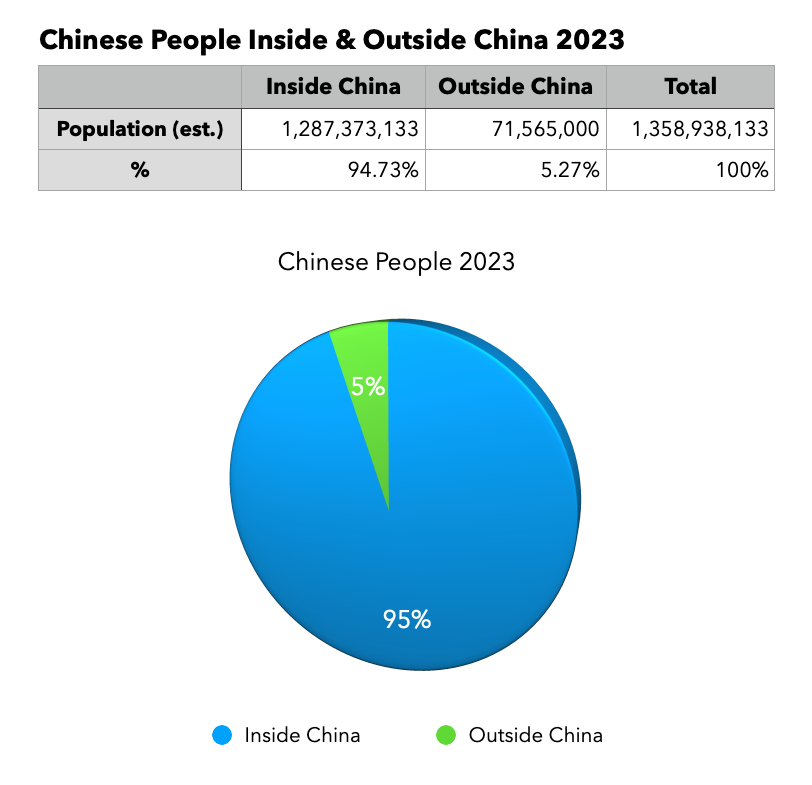
The worldwide Mandarin field may in fact be the largest language field that has ever existed in human history, and with about 95% of the planet’s Chinese people living in China itself, all the government opposition there has been to our work, all the traditions-based encumbrances and propaganda-fueled confusion that Mandarin field language learners have had to deal with, etc., we may just have scratched the surface of the work that still needs to be done in this massive worldwide field. So, we really don’t have time for the problems that can be caused by prejudice, buried or otherwise.

Screenshot of spreadsheet table and chart showing the estimated numbers of Chinese people inside & outside China in 2023

(The above is from a spreadsheet which contains source links. A PDF file (with working source links) for that spreadsheet can be downloaded here.)

Categories
Language Learning Science Technology Theocratic

wùzhǒng

wùzhǒng+ (wù·zhǒng {thing → [creature]} · species → [species] 物种 物種) ← Tap/click to show/hide the “flashcard”

The Shēngmìng Láizì Chuàngzào Ma? ((Shēngmìng Life 生命) (Lái·zì Came · From 来自 來自) (Chuàng·zào Initiating · {Making, Creating} → [Creating] 创造 創造) (Ma [? ptcl for “yes/no” questions] 吗 嗎)? → [Was Life Created? (lc)]) (Was Life Created? (lc)) brochure and the Shēngmìng de Qǐyuán—Zhíde Sīkǎo de Wǔ Ge Wèntí ((Shēngmìng Life 生命) (de ’s 的) (Qǐ·yuán {Rising → [Starting]} · Source → [Origin] 起源/原)—(Zhí·de Worth · Getting → [Worth] 值得) (Sī·kǎo {Thinking About} · Examining 思考) (de ’s 的) (Wǔ Five 五) (Ge [mw] 个 個/个) (Wèn·tí Asking · Subjects → [Questions] 问题 問題) → [The Origin of Life​—Five Questions Worth Asking (lf)]) (The Origin of Life​—Five Questions Worth Asking (lf)) brochure were originally published back in 2010, but recently, the English version of the Was Life Created? brochure was updated to the December 2022 Printing, and the Mandarin version of it was updated to the February 2023 Printing. Also, the Was Life Created? brochure and the Origin of Life brochure are now in the Teaching Toolbox section in the JW Library app. So, it would be good to consider some of the expressions used in the Mandarin versions of these publications that can be so helpful when discussing whether life was created.

Feeling Unqualified?

Whether or not a Creator exists is one of the first questions that needs to be settled in order for one to make spiritual progress, and these days, much scientific or technical information, both accurate and inaccurate, is available in connection with this question. So, it would be good for us to try our best to get conversant with such scientific or technical information.

However, perhaps some hesitate to discuss scientific or technical subjects in their ministry (especially in their Mandarin ministry), because of feeling unqualified, or not “smart” enough. Even practising professionals in technical industries such as web or app development, etc., sometimes talk about being affected by impostor syndrome, so it wouldn’t be surprising if some of us in the Mandarin field who have neither been highly educated about science nor systematically trained on Mandarin may feel like impostors when confronting the prospect of speaking to people in Mandarin about scientific subjects.

The Bible contains many examples of ones who similarly felt unqualified to do what Jehovah directed them to do, such as Moses, Gideon, Amos, Jeremiah, etc. However, despite them feeling unqualified, Jehovah provided them with the help and support required for them to ultimately accomplish what he wanted them to accomplish. Also, David coming off victorious against Goliath is a classic example of someone who, because of Jehovah’s help, succeeded in spite of appearing unqualified from a human viewpoint.

The article “Do Not Limit Yourself​—Overcoming Feelings of Inadequacy”, from the November 2012 Kingdom Ministry, makes some good points that can help us if we feel unqualified to participate in some aspect of our God-given ministry. It’s focused on the Bible study activity in general, but the points it makes can also apply to, say, speaking to people in Mandarin about evolution and creation.

Related Mandarin Resources

Speaking of speaking to people in Mandarin about evolution and creation, helping us to do so is the official Pīnyīn (Pīn·yīn {Piecing Together of} · Sounds → [Pinyin] 拼音) material for the Shēngmìng Láizì Chuàngzào Ma? ((Shēngmìng Life 生命) (Lái·zì Came · From 来自 來自) (Chuàng·zào Initiating · {Making, Creating} → [Creating] 创造 創造) (Ma [? ptcl for “yes/no” questions] 吗 嗎)? → [Was Life Created? (lc)]) (Was Life Created? (lc)) brochure and for the Shēngmìng de Qǐyuán—Zhíde Sīkǎo de Wǔ Ge Wèntí ((Shēngmìng Life 生命) (de ’s 的) (Qǐ·yuán {Rising → [Starting]} · Source → [Origin] 起源/原)—(Zhí·de Worth · Getting → [Worth] 值得) (Sī·kǎo {Thinking About} · Examining 思考) (de ’s 的) (Wǔ Five 五) (Ge [mw] 个 個/个) (Wèn·tí Asking · Subjects → [Questions] 问题 問題) → [The Origin of Life​—Five Questions Worth Asking (lf)]) (The Origin of Life​—Five Questions Worth Asking (lf)) brochure that Jehovah’s organization has made available. Also, some related unofficial 3-line and Pīnyīn (Pīn·yīn {Piecing Together of} · Sounds → [Pinyin] 拼音) Plus material is also available, as detailed at the tiandi.info/lc short link for Chinese language-learning resources for the Was Life Created? brochure. (Pīnyīn (Pīn·yīn {Piecing Together of} · Sounds → [Pinyin] 拼音) Plus material and a short link for the Origin of Life brochure are also in the works.)

This blog will also seek to help out by occasionally discussing expressions that appear in the Mandarin versions of the Was Life Created? brochure and the Origin of Life brochure. One such expression is this week’s MEotW, “wùzhǒng (wù·zhǒng {thing → [creature]} · species → [species] 物种 物種)”, which is used to translate the English word “species”.

Species and Kinds in Mandarin

First, what does “species” even mean in English? One dictionary gives this definition:

Biology A group of closely related organisms that are very similar to each other and are usually capable of interbreeding and producing fertile offspring.

Now, consider this footnote in the Was Life Created? brochure that discusses how “species” compares to the term “kind” that’s used in the Bible’s Genesis account:

While the word “species” is used frequently in this section, it should be noted that this term is not found in the Bible book of Genesis. There we find the term “kind,” which is much broader in meaning. Often, what scientists choose to call the evolution of a new species is simply a matter of variation within a “kind,” as the word is used in the Genesis account.

With the above in mind, note that the Was Life Created? brochure (Mandarin version © 2010, 2023-02 Printing) uses “wùzhǒng (wù·zhǒng {thing → [creature]} · species → [species] 物种 物種)” to translate “species”, and it uses the “lèi ({kind; type; class; category; genus [of]} | {resemble; be similar to} 类 類)” in “rénlèi+ (rén·lèi human/man·kind 人类 人類)” to translate “kinds”, as referred to in the Bible book of Genesis.

In comparison, worldly dictionaries like those that can be viewed in the Pleco app join the Was Life Created? brochure in presenting “Wùzhǒng Qǐyuán+ ((Wù·zhǒng {Thing → [Creature]} · Species’ → [Species’] 物种 物種) (Qǐ·yuán {Rising → [Starting]} · Source → [Origin] 起源/原) → [Origin of Species])” as the Mandarin translation of “Origin of Species”, the famous book by Charles Darwin. Also, note that in the Mandarin translation of this passage:

The Bible word “kinds” is not a scientific term, but it seems to refer to broad divisions of life-forms. Thus, a single “kind” may include many species or varieties.

the 2021 Awake, No. 3 uses “zhǒnglèi+ (zhǒng·lèi {{species [of]} | {seed; strain; breed [of]} | {type [of]}; {kind [of]}} · {kind; type; class; category; genus [of]} 种类 種類)” to translate “species”, and it follows the current Mandarin New World Translation Bible (nwtsty) in using “lèibié (lèi·bié kind; type; class; category; genus · differentiated → [classification; category; kind] 类别 類別)” to translate “kinds”. (Compare Genesis 1:24, 25 in English and Mandarin.) Also, in case you ever encounter “pǐnzhǒng (pǐn·zhǒng product · variety → [breed; strain; variety] 品种 品種)”, that’s what this issue of Awake! uses to translate “varieties”.


For convenience:

The direct link for the current generation Pīnyīn (Pīn·yīn {Piecing Together of} · Sounds → [Pinyin] 拼音) Plus resource for the Was Life Created? brochure is:

The short link for Chinese field language-learning links for the Was Life Created? brochure is:

More Pīnyīn (Pīn·yīn {Piecing Together of} · Sounds → [Pinyin] 拼音) and Pīnyīn (Pīn·yīn {Piecing Together of} · Sounds → [Pinyin] 拼音) Plus web material based on the Mandarin Was Life Created? brochure will be made available in the Pīnyīn (Pīn·yīn {Piecing Together of} · Sounds → [Pinyin] 拼音) Plus web resource as time allows. Work is now underway to produce a Pīnyīn (Pīn·yīn {Piecing Together of} · Sounds → [Pinyin] 拼音) Plus web resource for the Mandarin Origin of Life brochure as well.