Categories
Culture Current Events History Technology

rèlàng

rèlàng+ (rè·làng heat · wave 热浪 熱浪) ← Tap/click to show/hide the “flashcard”

Currently, many around the world are being affected by heat waves, which scientists say is part of a pattern of global warming caused by human activity. As of this writing, jw.org is featuring the article “Climate Change and Our Future—What the Bible Says”. The Mandarin version of this article uses the expression “rèlàng (rè·làng heat · wave 热浪 熱浪)”, this week’s MEotW, to translate the English expression “heat wave”.

It seems that “rèlàng (rè·làng heat · wave 热浪 熱浪)” is just a simple, straightforward exact translation of “heat wave”. While sometimes, like with “zhǐnán‐zhēn+ ((zhǐ·nán {(points with) finger → [points]} · south 指南)‐(zhēn needle) [compass])” (a previous MEotW), the Mandarin expression for “compass”, East and West approached the same thing from opposite directions, other times, like with “rèlàng (rè·làng heat · wave 热浪 熱浪)” and “heat wave”, the reality referred to is so simple and the applicable metaphors are so obvious that East and West settled on the same linguistic solution.

While “rèlàng+ (rè·làng heat · wave 热浪 熱浪)” is definitely not a loanword (like previous MEotWkǎlā’OK (karaoke 卡拉OK)” is), which is a word that’s adopted from one language into another language without translation, it seems possible that it’s a calque, or loan translation, which is “a word or phrase in a language formed by word-for-word or morpheme-by-morpheme translation of a word in another language”, according to one of the definitions of “calque” listed by Wordnik.

Wordnik—Chinese Field Connections

By the way, while this blog is mainly about Mandarin expressions, it’s written in English, mainly for English-speakers, and often it will compare Mandarin expressions to English expressions. Of course, it will use English words—like “loanword” and “calque”—to discuss Mandarin expressions. So, it’s good for it to have a resource to refer to like Wordnik, which claims to be “the world’s biggest online English dictionary, by number of words”. Being online, it is not constrained by the limitations imposed by the millennia-old medium of paper, as delightfully explained in this TED talk given by Erin McKean, the founder of Wordnik:

Here are a few quotes from the above video:

Why are you blaming the ham for being too big for the pan? You can’t get a smaller ham—the English language is as big as it is. So if you have a ham butt problem and you’re thinking about the ham butt problem, the conclusion that it leads you to is inexorable and counter-intuitive—paper is the enemy of words.

They’re like, “Oh my, people are going to take away my beautiful paper dictionaries?” No, there will still be paper dictionaries. When we had cars, when cars became the dominant mode of transportation, we didn’t round up all the horses and shoot them. You know, there’re still going to be paper dictionaries but it’s not going to be the dominant dictionary. The book-shaped dictionary is not going to be the only shape dictionaries come in, and it’s not going to be the prototype for the shapes dictionaries come in.

[I still use the illustration about cars and horses when talking to people who worry about what would happen to Chinese characters if Pīnyīn (Pīn·yīn {Piecing Together} · Sounds → [Pinyin] 拼音) were ever to get widely adopted.]

Lexicography [the practice of compiling dictionaries] is not rocket science, but even if it were, rocket science is being done by dedicated amateurs these days. You know, it can’t be that hard to find some words.

This is a little-known technological fact about the Internet, but the Internet is actually made up of words and enthusiasm, and words and enthusiasm actually happen to be the recipe for lexicography. Isn’t that great?

If we get a bigger pan, then we can put all the words in. We can put in all the meanings. Doesn’t everyone want more meaning in their lives?

The web page for this TED talk says it was part of the TED2007 conference. I remember that after I saw it, it influenced my thinking as I subsequently contributed to some of the projects for Chinese-field unofficial language-learning resources. (E.g., “We can do this, whether or not it’s rocket science!” “We can transcend paper now!” “Including the meanings is good! Doesn’t everyone want more meaning in their lives?”) Many such resources, like the Pīnyīn (Pīn·yīn {Piecing Together} · Sounds → [Pinyin] 拼音) Plus Expressions (Web) resource, the Referenced Theocratic Expressions (RTE) resource, and even, in a way, the 3-line, Pīnyīn (Pīn·yīn {Piecing Together} · Sounds → [Pinyin] 拼音) Plus, etc. material resources can be thought of as specialized dictionaries. (In 3-line, Pīnyīn (Pīn·yīn {Piecing Together} · Sounds → [Pinyin] 拼音) Plus, etc. material resources, you can look up Mandarin words in the order in which they appear in certain official Mandarin publications!)

Making Good Use of Bigger Pans

Years ago, there was one project that was discussed, for creating an unofficial pocket-sized paper dictionary for Chinese theocratic terms that was to be…about the size of what we now call a smartphone, except, of course, thicker. Looking back, it’s not surprising that that project never came to fruition, partly because of the limitations of paper. Those limitations would have necessitated selecting for inclusion in the proposed pocket-sized dictionary a subset of the full dictionary also being worked on (which we now have in the form of the RTE), and they also would have led to difficulties regarding formatting and printing out for such a small form factor—it was just too small a pan.

Also, note that 2007, the year that the above-mentioned TED talk was given, was also the year that the iPhone came out. The iPad followed not long after in 2010, and pretty soon, smartphones and tablets proliferated among those in the Chinese fields, along with resources like apps, websites, digital publications, etc. that were designed for such mobile devices. When entire libraries can be contained in one’s smartphone or tablet, one is probably not usually inclined to seek out paper equivalents. Indeed, to many who grew up with touchscreen mobile devices, paper publications that don’t allow things like resizing of text or looking up information on words seem broken.
Categories
Technology Theocratic

hùdòng

hùdòng+ (hù·dòng mutually; {[(with)] each other} · moving → [interacting; interaction; interactive] 互动 互動) ← Tap/click to show/hide the “flashcard”

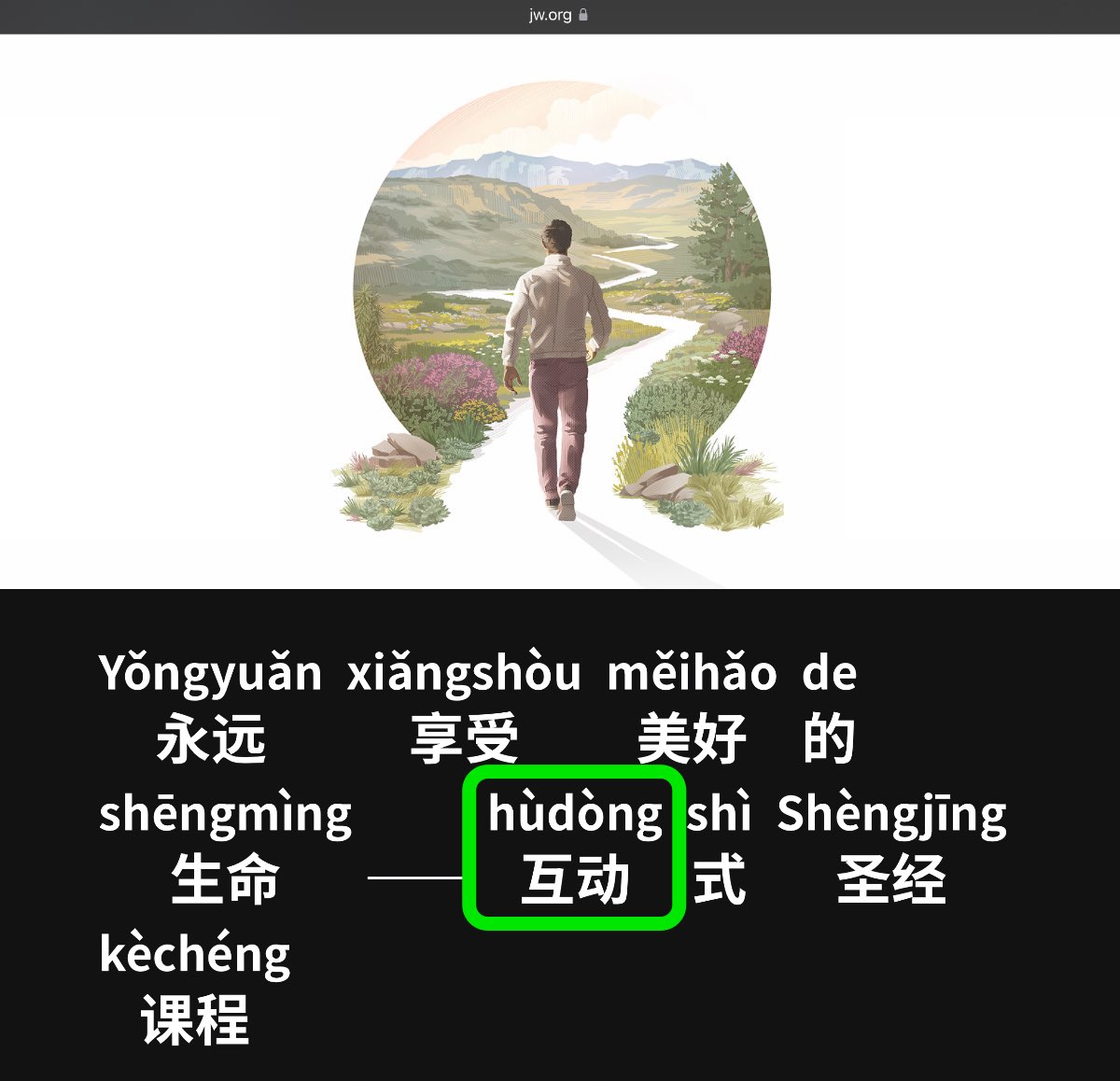
One of the publications that is now recommended to be used on Bible studies is the Yǒngyuǎn Xiǎngshòu Měihǎo de Shēngmìng—Hùdòng‐Shì Shèngjīng Kèchéng ((Yǒng·yuǎn Eternally · {Far (in Time)} 永远 永遠) (Xiǎng·shòu Enjoy · Receive 享受) (Měi·hǎo Beautiful · Good 美好) (de ’s 的) (Shēngmìng Life 生命)—(Hù·dòng {Each Other} · Moving → [Interactive] 互动 互動)‐(Shì (Type 式) (Shèng·jīng Holy · Scriptures → [Bible] 圣经 聖經) (Kè·chéng Lessons · Procedure → [Course] 课程 課程) [Enjoy Life Forever!—An Interactive Bible Course (lff)]) (Enjoy Life Forever! (lff)) book. Looking at the Mandarin title of this book, you may have wondered: What does “hùdòng (hù·dòng mutually; {[(with)] each other} · moving → [interacting; interaction; interactive] 互动 互動)” mean?

_Enjoy Life Forever!_ bk. title page (jw.org CHS+Pinyin)

(The above screenshot from jw.org shows light-coloured text on a dark background because I have set jw.org’s relatively new Appearance Settings to do so. As the related JW News article says, “some users prefer this setting because the screen is less bright. This may help reduce eyestrain, especially at night or in other low-light environments.” Most Pīnyīn (Pīn·yīn {Piecing Together} · Sounds → [Pinyin] 拼音) Plus web resources (short link: tiandi.info/pyp) also have a Night Theme available, that can be turned on or off using the ☀️/🌙 button on their web pages.)

You may surmise that “hùdòng (hù·dòng mutually; {[(with)] each other} · moving → [interacting; interaction; interactive] 互动 互動)” corresponds with the “Interactive” in Enjoy Life Forever!​—An Interactive Bible Course, and you would be right. Now, let’s take a closer look at the morphemes in “hùdòng (hù·dòng mutually; {[(with)] each other} · moving → [interacting; interaction; interactive] 互动 互動)” to see how they work in a way that makes “hùdòng (hù·dòng mutually; {[(with)] each other} · moving → [interacting; interaction; interactive] 互动 互動)” correspond as well as it does with the English word “interactive”, which means “acting upon or influencing each other”.

Morphemic Breakdown

As the Pīnyīn (Pīn·yīn {Piecing Together} · Sounds → [Pinyin] 拼音) Plus information for “hùdòng+ (hù·dòng mutually; {[(with)] each other} · moving → [interacting; interaction; interactive] 互动 互動)” shows us, its first morpheme “hù- (mutually; {[(with)] each other} 互)” means “mutually; [(with)] each other”. It’s the “hù- (mutually; {[(with)] each other} 互)” in “hùxiāng ({each other} 互相) gǔlì (gǔ·lì {drum → [rouse]} · encourage → [encourage] 鼓励 鼓勵)”, which means “encourage one another”.

The other morpheme “dòng (move [→ [stir | arouse | change; alter]])” basically means “move”. In some contexts, it means to move physically, as it does in “dòngwù (dòng·wù moving · thing → [animal] 动物 動物)”, which literally means “moving thing”, and is used to mean “animal”. (Interestingly, the English word “animal” is related to the word “animate”, which can mean “bring into action or movement”.) In other contexts, “dòng (move [→ [stir | arouse | change; alter]])” means to move emotionally, as it does in “gǎndòng+ (gǎn·dòng feeling · moved | {make to feel} · move 感动 感動)”. In yet other contexts, “dòng (move [→ [stir | arouse | change; alter]])” is used to effectively mean “change; alter”.

Breaking down “hùdòng (hù·dòng mutually; {[(with)] each other} · moving → [interacting; interaction; interactive] 互动 互動)” into its morphemes helps us to see that “hù- (mutually; {[(with)] each other} 互)” corresponds with the “inter-” part of “interactive”, and that “dòng (move [→ [stir | arouse | change; alter]])” corresponds with the “active” (“acting [up]on”) part.

Interactive Indeed

The English word “interactive” has a particular meaning in the world of computing, which is “responds to user activity”.

Interestingly, the Enjoy Life Forever! book even has some interactivity in its paper form, with its “Lesson completed on:” and “Goal” sections allowing room for a user to write in them with a pencil or pen. This is in addition to the limited interactivity that any paper publication offers a user, such as being able to write notes in the margins or to highlight or underline text.

The Enjoy Life Forever! book in the PDF file format—a computer file format that is conceptually rooted in the world of paper—adds the ability for a user to tap/click on links to load the web pages on which the videos mentioned in the book can be played. As we move on to more computer-native formats, we find that on the jw.org website and in the JW Library app, where of course links are available for playing the videos, a user can tap/click on text fields in the “Lesson completed on:” and “Goal” sections and type text into them that will be “remembered”. Also, a user can tap/click on the checkboxes in the “Goal” section, and those checkboxes will “remember” and show whether they are checked or unchecked.

As discussed in the JW Broadcasting—January 2021 program, when it comes to the more general meaning of the English word “interactive”, “acting upon or influencing each other”, the Enjoy Life Forever! book in every format is designed to engage and involve people more than past Bible study textbooks did. It indeed qualifies as “interactive”, or as we say in Mandarin, “hùdòng+ (hù·dòng {each other} · moving → [interactive] 互动 互動)shì+ (type 式)”.

(By the way, just as is possible on this blog, in the unofficial Pīnyīn (Pīn·yīn {Piecing Together} · Sounds → [Pinyin] 拼音) Plus material for the Enjoy Life Forever! book, users can interactively tap/click on Pīnyīn (Pīn·yīn {Piecing Together} · Sounds → [Pinyin] 拼音) expressions to show/hide, as desired, flashcards showing English meanings, Simplified character(s), Traditional character(s) (if they’re different), etc. for these expressions.)


For convenience:

The direct link for the current generation Pīnyīn (Pīn·yīn {Piecing Together of} · Sounds → [Pinyin] 拼音) Plus resource for the Enjoy Life Forever! book is:

The short link for Chinese field language-learning links for the Enjoy Life Forever! book is:

More Pīnyīn (Pīn·yīn {Piecing Together of} · Sounds → [Pinyin] 拼音) and Pīnyīn (Pīn·yīn {Piecing Together of} · Sounds → [Pinyin] 拼音) Plus web material based on the Mandarin Enjoy Life Forever! book will be made available in the Pīnyīn (Pīn·yīn {Piecing Together of} · Sounds → [Pinyin] 拼音) Plus web resource as time allows.