Categories
Language Learning Technology Theocratic

qǐshì

qǐshì (qǐ·shì {opening → [enlightening]} · showing → [inspiring; revealing] 启示 啟示) ← Tap/click to show/hide the “flashcard”

I have long especially liked 1 Corinthians 13. It contains counsel on what really does and doesn’t matter in life, an extensive description and definition of the most important kind of love, and a sublime discussion about the need to become complete, mature, as a person. As these apply to life in general, so too do they apply to our lives as Mandarin field language learners.

As Mandarin field language learners, it can benefit us greatly to consider what we can learn from 1 Corinthians 13, and along the way, we can also consider some of the Mandarin expressions used in that chapter in the current version of the Mandarin New World Translation Bible (nwtsty).

Inspiration

This week’s MEotW, “qǐshì (qǐ·shì {opening → [enlightening]} · showing → [inspiring; revealing] 启示 啟示), is used in verse 2 (WOL, Pīnyīn (Pīn·yīn {Piecing Together of} · Sounds → [Pinyin] 拼音) Plus) of 1 Corinthians 13:
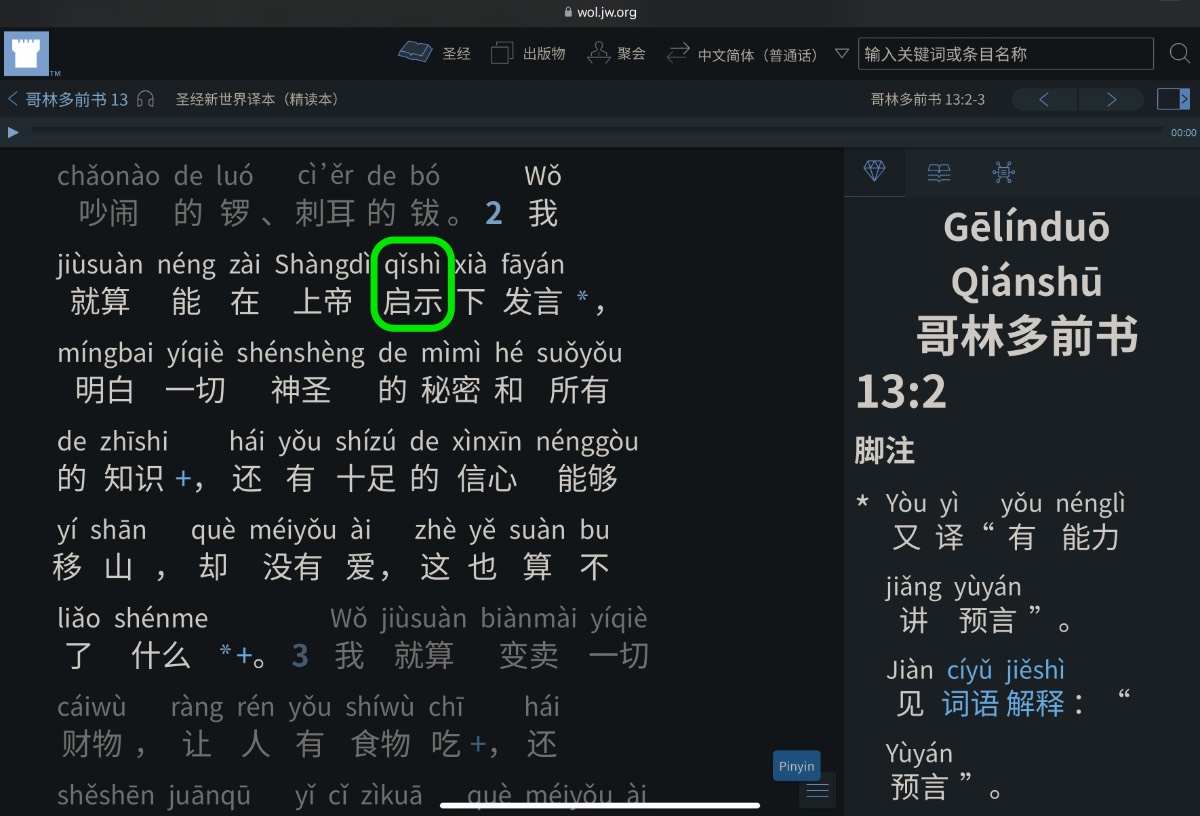
Screenshot of “_qǐshì_” in 1 Co. 13:2 (nwtsty, CHS+_Pīnyīn_ WOL)

(Dark mode for the Watchtower ONLINE LIBRARY (WOL) website, as shown in the above image, can be enabled in the Safari web browser by using the Noir Safari extension.)

“Qǐshì (Qǐ·shì {opening → [enlightening]} · showing → [inspiring; revealing] 启示 啟示) can be used to mean “to inspire” or “to reveal”, and as you may be suspecting, this is indeed the same “qǐshì (qǐ·shì {opening → [enlightening]} · showing → [inspiring; revealing] 启示 啟示) that is used in “Qǐshìlù (Qǐ·shì·lù {Opening → [Enlightening]} · Showing · Record → [Revelation] 启示录 啟示錄), the Mandarin translation for the name of the Bible book of Revelation. (A revelation is basically something that is revealed.)

The “qǐ (open [→ [enlighten; awaken; explain; expound | state; inform | start; initiate]]) in “qǐshì (qǐ·shì {opening → [enlightening]} · showing → [inspiring; revealing] 启示 啟示) basically means “to open”, and in “qǐshì (qǐ·shì {opening → [enlightening]} · showing → [inspiring; revealing] 启示 啟示), it effectively means “to enlighten”. The “shì (show; indicate; notify; instructing; reveal; manifest; demonstrate 示) in “qǐshì (qǐ·shì {opening → [enlightening]} · showing → [inspiring; revealing] 启示 啟示) means “to show”, and it also appears in expressions like “biǎoshì (biǎo·shì indicate; express · show 表示) and “shìfàn (shì·fàn {showing; demonstrating [of]} · pattern; model; example → [demonstrating; setting an example | demonstration] 示范 示範/范).

The above-mentioned morphemes in “qǐshì (qǐ·shì {opening → [enlightening]} · showing → [inspiring; revealing] 启示 啟示) are both basically verbs, and “qǐshì (qǐ·shì {opening → [enlightening]} · showing → [inspiring; revealing] 启示 啟示) itself is also basically a verb. However, it’s also used as a noun, making it a verbal noun, or a gerundial noun, in those cases.

A Really Big Deal, But…

And if I have the gift of prophecy and understand all the sacred secrets and all knowledge, and if I have all the faith so as to move mountains, but do not have love, I am nothing.
1 Corinthians 13:2.

The expression “the gift of prophecy” appears in the English New World Translation Bible’s rendering of 1 Corinthians 13:2, quoted above, and for any human servant of Jehovah God, having what this expression represents would be A REALLY BIG DEAL. The corresponding Mandarin expression “néng ({am able} 能) zài (at 在) Shàngdì (Shàng·dì Above’s · {Emperor’s → [God’s]} → [God’s] 上帝) qǐshì (qǐ·shì {opening → [enlightening]} · showing → [inspiring] 启示 啟示) xià (under 下) fāyán (fā·yán {to issue forth} · speech → [to speak] 发言 發言) more literally means something like “am able to speak under God’s inspiration”, and the organization has also used “qǐshì (qǐ·shì {opening → [enlightening]} · showing → [inspiring; revealing] 启示 啟示) in relation to how the Bible writers were inspired to write what they did in the Bible. (E.g., compare this English paragraph in the Bearing Witness (bt) book to the corresponding Mandarin paragraph (February 2023 Printing).) Today, even the slave class does not claim to be inspired, like the prophets of old and the Bible writers were.—Matthew 24:45–47.

However, 1 Corinthians 13:2 tells us that even if we somehow did have the gift of prophecy, or of inspiration from God, we would still be nothing if we do not have love. Indeed, the one whom God used to write this part of the Bible, the apostle Paul, actually was an inspired Bible writer, so he was speaking under inspiration and from some personal experience when he effectively said in this verse that even such a rarefied status would mean nothing if he did not have love.

So, no, for God’s people, having love is not a mere secondary, touchy-feely “soft” skill that women are especially good at, as the human corporate world might think of it. On the contrary, having love as our foundational motivation is, in fact, a hard requirement—even more of a hard requirement than the gift of prophecy or inspiration would be—for all of God’s people, including us Mandarin field language learners.

Categories
Current Events

xǐshǒu

xǐshǒu (xǐ·shǒu wash · hands [→ [go to the washroom/lavatory/toilet/restroom]] 洗手) ← Tap/click to show/hide the “flashcard”

[Note: Tap/click on a Pīnyīn (Pīn·yīn {Piecing Together} · Sounds → [Pinyin] 拼音) expression to reveal its “flashcard”, tap/click on a “flashcard” or its Pīnyīn (Pīn·yīn {Piecing Together} · Sounds → [Pinyin] 拼音) expression to hide the “flashcard”.]

As of this writing, nearing the middle of the year 2022, the subject of the COVID-19 pandemic has been, to say the least, on people’s minds now for a while. So, it would be good to be able to refer to things related to it in Mandarin when speaking to people in the Mandarin field, or when speaking to our brothers and sisters in the truth.

electron microscope image of SARS-CoV-2—also known as 2019-nCoV, the virus that causes COVID-19

An electron microscope image of SARS-CoV-2—also known as 2019-nCoV, the virus that causes COVID-19
Creative Commons Attribution License logo NIAID

This week’s MEotW, “xǐshǒu (xǐ·shǒu wash · hands [→ [go to the washroom/lavatory/toilet/restroom]] 洗手)”, literally means “wash hands”, something that has taken on even more importance than before after the COVID-19-causing coronavirus got added to the list of disease-causing things that washing our hands can help protect us from.

Xǐshǒu (Xǐ·shǒu wash · hands [→ [go to the washroom/lavatory/toilet/restroom]] 洗手)” can also effectively mean “go to the washroom/lavatory/toilet/restroom”. Indeed, “xǐshǒu jiān ((xǐ·shǒu washing · hands 洗手) (jiān {space in between} → [room]) [washroom; lavatory; toilet; restroom])” is a commonly used Mandarin expression which literally means “washing hands space in between”, and which effectively means “washroom; lavatory; toilet; restroom”.

Verb-Object Construction

Xǐshǒu (Xǐ·shǒu wash · hands [→ [go to the washroom/lavatory/toilet/restroom]] 洗手)”, with the verb “ (wash; bathe; rinse 洗)” (“wash”) and its object “shǒu (hand | personally | [→ [mw for skill]] 手)” (“hands”), is an example of a Mandarin expression with verb-object construction.

The ABC Chinese-English Dictionary, edited by John DeFrancis and Victor H. Mair, among others, tells us the following about the entries in it that are marked as having verb-object construction:

V.O. (Verb-Object Construction, Dòng-Bīn Jiégòu 动宾结构).

Many English verbs get translated into natural Chinese as a verb plus an object noun, e.g. chīfàn for ‘eat’, shuōhuà for ‘speak’, etc. It is important for two reasons to know what is merely a verb in Chinese and what is actually a verb-object construction.

First, verb-object constructions can never take a second object, i.e. chīfàn can never be followed directly by something else to be eaten.

Second, a verb and its object can be separated from one another, thus allowing

(i) aspect particles to be placed directly after the verb, e.g. chīle fàn ‘after finishing eating’;

(ii) modification of the object, e.g. chī Zhōngguófàn ‘eat Chinese food’; and (iii) quantification of the noun, e.g. chīle sān wǎn fàn ‘ate three bowls of rice’.

One Word? Not Two Words?

While “wash hands” is two words in the English writing system, the Pīnyīn (Pīn·yīn {Piecing Together} · Sounds → [Pinyin] 拼音) writing system typically renders “xǐshǒu (xǐ·shǒu wash · hands [→ [go to the washroom/lavatory/toilet/restroom]] 洗手)” as one word. The MEotW post on “Jìniàn Jùhuì ((Jì·niàn Remembering · {Thinking Of} → [Commemorating] 记/纪念 記/紀念) (Jùhuì Meeting 聚会 聚會) [[the] Memorial])” (including a recently added comment there) went into some reasons why it can be good for the relatively “young” Pīnyīn (Pīn·yīn {Piecing Together} · Sounds → [Pinyin] 拼音) writing system to at times emulate the relatively “experienced” English writing system, but in cases like the relatively digestible two-syllable “xǐshǒu (xǐ·shǒu wash · hands [→ [go to the washroom/lavatory/toilet/restroom]] 洗手)”, there is little practical reason relating to readability to impose English word separation conventions.

On the other hand, while “xǐshǒu jiān ((xǐ·shǒu washing · hands 洗手) (jiān {space in between} → [room]) [washroom; lavatory; toilet; restroom])” is generally rendered in the world as one three-syllable word, this blog and other Pīnyīn (Pīn·yīn {Piecing Together} · Sounds → [Pinyin] 拼音) Plus resources will generally render such expressions as two separate words, to make them easier to read. This is similar to how in English, “changeroom” is a single two-syllable word, but “changing room” is separated into two words, rather than being rendered as the single three-syllable word “changingroom”.

“Melting” Away the Pounds Viruses

While researching the subject of washing hands in this age of COVID-19, I found the following interesting information:

…soap — all sorts of it: liquid, solid, honeysuckle-scented, the versions inexplicably only marketed to men or women — is…even more routinely effective than hand sanitizer. …

That’s because when you wash your hands with soap and water, you’re not just wiping viruses off your hands and sending them down the drain. You’re actually annihilating the viruses, rendering them harmless. Soap “is almost like a demolition team breaking down a building and taking all the bricks away,” says Palli Thordarson, a chemistry professor at the University of New South Wales…

…coronaviruses are…bits of genetic information — encoded by RNA — surrounded by a coat of fat and protein. Thordarson likes to call viruses “nano-sized grease balls.” And grease balls, no matter the size, are the exact type of thing soap loves to annihilate.

The soap takes care of the virus much like it takes care of the oil in the water. “It’s almost like a crowbar; it starts to pull all the things apart,” Thordarson says.

One side of the soap molecule (the one that’s attracted to fat and repelled by water) buries its way into the virus’s fat and protein shell. Fortunately, the chemical bonds holding the virus together aren’t very strong, so this intrusion is enough to break the virus’s coat. “You pull the virus apart, you make it soluble in water, and it disintegrates,” he says.

Then the harmless shards of virus get flushed down the drain. And even if it the soap doesn’t destroy every virus, you’ll still rid them from your hands with soap and water, as well as any grease or dirt they may be clinging to.

So, while technically soap and water disintegrates and dissolves coronaviruses, if a coronavirus subjected to soap and water could talk, it might say, “I’m melting!”

Categories
Current Events

bàofā

bàofā (bào·fā exploding; bursting · {sending out}; issuing → [erupting; bursting/breaking out | explosion; eruption] 爆发 爆發) ← Tap/click to show/hide the “flashcard”

On February 24, 2022, Russia sent significant military forces into Ukraine, resulting in the largest scale open warfare in Europe since World War II. Knowing certain Mandarin expressions will help us in the Mandarin field as we hear about and talk about Ukraine in the time ahead.

The Mandarin version of the article “Russia Invades Ukraine”, recently featured on the home page of jw.org, twice uses the expression “bàofā (bào·fā exploding; bursting · {sending out}; issuing → [erupting; bursting/breaking out | explosion; eruption] 爆发 爆發)”, this week’s MEotW. As can be seen from the Pīnyīn (Pīn·yīn {Piecing Together} · Sounds → [Pinyin] 拼音) Plus information above, saying “zhànzhēng (zhàn·zhēng war · contending → [war] 战争 戰爭) bàofā (bào·fā exploding · issuing → [erupting; breaking out] 爆发 爆發)” in Mandarin is like saying “war erupting/breaking out” in English.

A Verb That Can Be a Noun

While the morphemes making up “bàofā (bào·fā exploding; bursting · {sending out}; issuing → [erupting; bursting/breaking out | explosion; eruption] 爆发 爆發)” are literally verbs, “bàofā (bào·fā exploding; bursting · {sending out}; issuing → [erupting; bursting/breaking out | explosion; eruption] 爆发 爆發)” can also at times be used as a noun. For example, saying “zhànzhēng (zhàn·zhēng war · contending → [war] 战争 戰爭) de (’s 的) bàofā (bào·fā exploding · issuing → [erupting/eruption; breaking out] 爆发 爆發)” in Mandarin is like saying “the eruption of war” in English.

Such verbal/gerundial nouns were discussed in the MEotW post on “jiàodǎo (jiào·dǎo teaching · {guiding [→ [instructing]]} 教导 教導)”:

One interesting thing to note about “jiàodǎo (jiào·dǎo teaching · {guiding [→ [instructing]]} 教导 教導)” (and about “jiàoxun (teaching → [reprimanding | knowledge gained from an error] 教训 教訓)”, for that matter) is that their component morphemes seem to basically be verbs. In certain contexts, however, they are used as nouns. An example of this being done in English is that “teach” and “teaching” are verbs (e.g. “Jesus was teaching the crowd.”), but in certain contexts, “teaching” is used as a noun (e.g. “The crowd was amazed at the teaching Jesus shared with them.”). When a word is used this way, it’s called a verbal noun, or a gerundial noun. Verbal nouns are quite common in Mandarin.

Backwards and Forward

Another interesting thing to note is that in the article mentioned above, the first occurrence of “bàofā (bào·fā exploding; bursting · {sending out}; issuing → [erupting; bursting/breaking out | explosion; eruption] 爆发 爆發)” has it coming after the word “zhànzhēng (zhàn·zhēng war · contending → [war; warfare] 战争 戰爭)” (“zǔzhǐ (zǔ·zhǐ {to prevent} · {to stop} 阻止) zhànzhēng (zhàn·zhēng war · contending → [war] 战争 戰爭) bàofā (bào·fā exploding · issuing → [erupting] 爆发 爆發)”), but in the second occurrence, “bàofā (bào·fā exploding; bursting · {sending out}; issuing → [erupting; bursting/breaking out | explosion; eruption] 爆发 爆發)” comes beforezhànzhēng (zhàn·zhēng war · contending → [war; warfare] 战争 戰爭)” (“rúguǒ (rú·guǒ if · {fruit → [if indeed]} 如果) bàofā (bào·fā explodes · issues → [erupts] 爆发 爆發) zhànzhēng (zhàn·zhēng war · contending → [war] 战争 戰爭)”). The first occurrence, with some context, is like saying “to prevent war (from) erupting” in English, while the second, with some context, is like saying “if erupts war” in English.

This reminds us that while word order is sometimes reversed in Mandarin compared to English, there is also a certain elasticity, or flexibility, in how words can be ordered in Mandarin, as indeed there also is in English. (While “if erupts war” isn’t quite idiomatic (natural to a native speaker) in English, I don’t think it’s actually wrong, word order-wise—I’m pretty sure constructs with similar word order can be found in English poetry or song lyrics, for example.)