Categories
Culture Language Learning Science Technology Theocratic

cì’ěr

cì’ěr (cì’·ěr {stabs; pricks → [irritates; pierces]} · ear → [grating on the ear; jarring; ear-piercing] 刺耳) ← Tap/click to show/hide the “flashcard”

I have long especially liked 1 Corinthians 13. It contains counsel on what really does and doesn’t matter in life, an extensive description and definition of the most important kind of love, and a sublime discussion about the need to become complete, mature, as a person. As these apply to life in general, so too do they apply to our lives as Mandarin field language learners.

As Mandarin field language learners, it can benefit us greatly to consider what we can learn from 1 Corinthians 13, and along the way, we can also consider some of the Mandarin expressions used in that chapter in the current version of the Mandarin New World Translation Bible (nwtsty).

“Clashing”

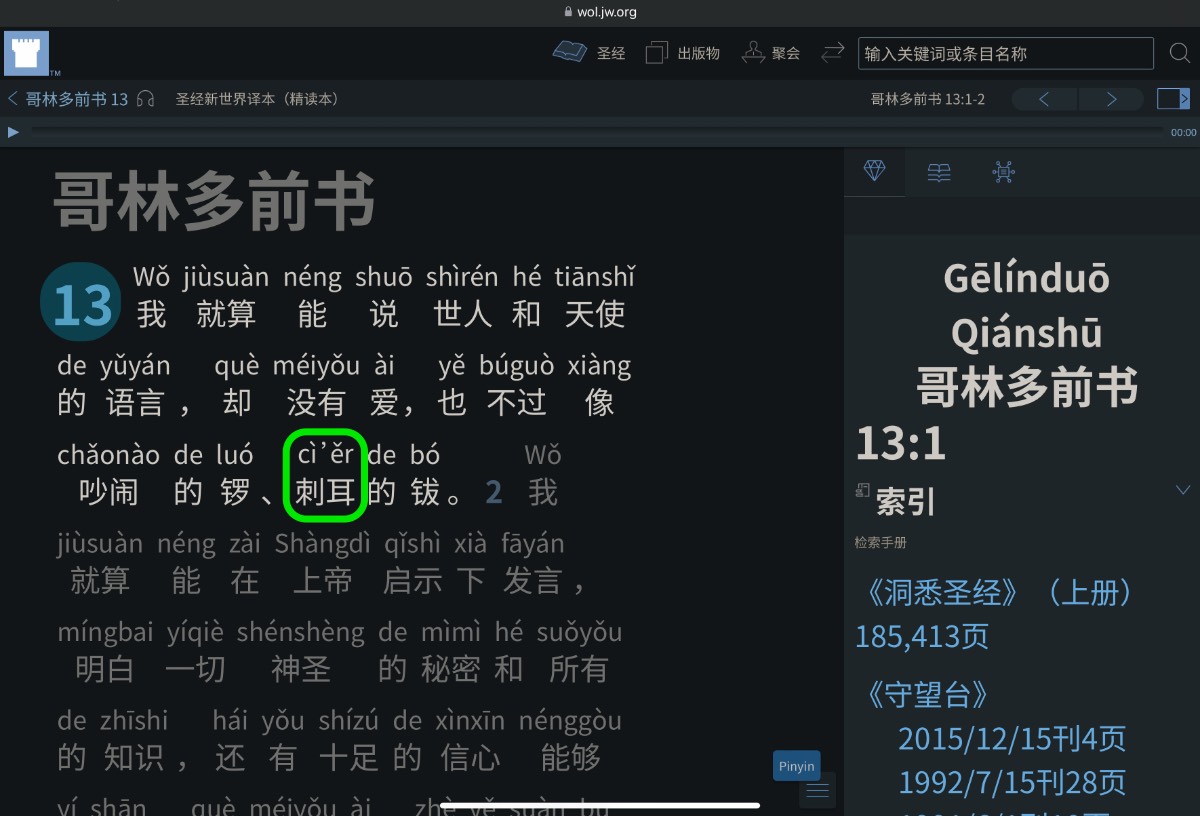
This week’s MEotW, “cì’ěr (cì’·ěr {stabs; pricks → [irritates; pierces]} · ear → [grating on the ear; jarring; ear-piercing] 刺耳), occurs in verse 1 (WOL, Pīnyīn (Pīn·yīn {Piecing Together of} · Sounds → [Pinyin] 拼音) Plus) of 1 Corinthians 13:

Screenshot of “cì’ěr” in 1 Co. 13:1 (nwtsty, CHS+_Pīnyīn_ WOL)

(Dark mode for the Watchtower ONLINE LIBRARY (WOL) website, as shown in the above image, can be enabled in the Safari web browser by using the Noir Safari extension.)

“Cì’ěr (Cì’·ěr {stabs; pricks → [irritates; pierces]} · ear → [grating on the ear; jarring; ear-piercing] 刺耳) literally means “stabs ear”, and is used in the Mandarin New World Translation Bible’s rendering of 1 Corinthians 13:1 to translate the “clashing” in “clashing cymbal”. In this context, “cì’ěr (cì’·ěr {stabs; pricks → [irritates; pierces]} · ear → [grating on the ear; jarring; ear-piercing] 刺耳) effectively means “grating on the ear; jarring; ear-piercing”.

Mandarin Field Need-Greater? Or Ear-Grater 😬?

First, let me establish that of course Jehovah and we who are in the Mandarin field deeply appreciate those who have been moved by love to come and try to learn Mandarin and help out in the Mandarin field. Given that, sometimes things do happen that can literally and figuratively grate on the ears of those who truly serve in this field out of love, and who have become acquainted with what good Mandarin sounds like.

The Tone Beast…

One time, a brother I know whose mother tongue is English gave a Mandarin talk during which so many of his tones were off that at times I was genuinely having trouble making out what words he was saying, even when I was listening closely. After that meeting, when I tried to kindly advise him that this was the case, he jokingly quipped something like ‘Well, at least I made you listen closely!’

Maybe this brother really did try his best, and maybe his reply was just an attempt to lighten the mood with some humour. He may also have felt safe using some humour because we know each other and generally get along fairly well. However, his words in this case might also be taken to show that he took his responsibility to give a good Mandarin talk a bit lightly. If so, things said with such a flippant attitude could grate on the ears of someone who views with appropriate seriousness the God-honouring and life-saving work that needs to be done in the Mandarin field.

It is true that especially for those whose mother tongue is, say, English, the tones can be one of the most difficult aspects of Mandarin for them to master, since that way of using pitch (how high or low a “note” is) is so different from how they use pitch in English. The sincere efforts of Mandarin field language learners in this regard are much appreciated!

…And How to Tame It

For those of us who are trying to learn Mandarin for the Mandarin field, it should help if we keep the following points in mind regarding Mandarin tones:

  • Tones are just as important to conveying meaning in Mandarin as vowels are to conveying meaning in English. In English, if someone says a wrong vowel, that person is not actually saying the word that person meant to say, and that person is not expressing the meaning that person meant to express. For example, there’s a world of difference between “I love you” and “I leave you”, even though it’s “only” the matter of a single vowel. Similarly, in Mandarin, if someone uses a wrong tone, that person is saying a whole different word from what that person meant to say, as shown by the classic example of “mā (ma; mom; mummy; mother)/ (hemp; flax; linen | (surname) | {[is] pocked; pockmarked; pitted; spotty} [→ [[is] rough; coarse]] | numbed; tingling | sesame麻/蔴)/ (horse [(surname)] [→ [knight chess piece; horse piece in Chinese chess | [is] big; large]])/ ({verally abuse}; curse; swear; {call names} [→ [condemn; rebuke; reprove; scold]]罵/駡)/ma ([? ptcl for “yes/no” questions]).
  • In languages like English, we may change the pitch of what we are saying to do things like add emphasis, ask a question, etc. In Mandarin, though, as explained above, the tone of a syllable—which involves how pitch is used while saying it—is an essential part of how that syllable represents meaning. So, while in English the way we use pitch while saying a word may be negotiable based on how we want to emphasize it, etc., in Mandarin, tones are non-negotiable, like our stand on blood transfusions is non-negotiable. A first tone, for example, must always be recognizable as a first tone and must not be changed into a fourth tone or something, no matter how much we want to emphasize a Mandarin word with a first tone in it!
    • How can we add emphasis in Mandarin, then? Study 10 of the Teaching (th) brocure, entitled “Modulation”, tells us that ‘we can convey ideas clearly and stir emotion by varying our volume, pitch, and pace’. So, while the pitches of Mandarin tones are non-negotiable, we can still add emphasis in Mandarin by varying volume—by speaking softer or louder—and/or by varying pace—by speaking slower or faster.
  • Wrong tones can be really cì’ěr (cì’·ěr {stabbing → [irritating]} · ear → [grating on the ear] 刺耳) because, as mentioned above, tones are made of pitch, and when one speaks with wrong pitches, it’s a lot like singing off-key—very grating to the ears of those who know how the music of the language should sound! 🎵

With the above points in mind, do the following:

  • Practise recognizing the different tones and telling them apart when listening to Mandarin speech. This is especially important if you have just recently started to learn Mandarin, and are not used to what Mandarin tones sound like yet. Such practice is needed to gradually train your hearing. As it is with determining if a musical instrument is in tune or not, eventually, with focus and practice, recognizing Mandarin tones will become easier, even second nature.
    • As you get better at being able to recognize good Mandarin tones when you hear them, that will in turn help you to make sure you speak with good Mandarin tones. Speaking of which…
  • Practise speaking with correct Mandarin tones. This is also especially important if you have just recently started to learn Mandarin, and are not used to speaking with Mandarin tones yet. Such practice is needed to gradually train your body’s system for producing speech. Beware: If you let yourself get into bad habits early on involving the tones, then you’ll have to walk a long, hard road to get rid of these bad habits later. As it is with playing a musical instrument well, eventually, with focus, study, and practice, speaking with correct Mandarin tones will become easier, even second nature. 🎸

The Cantonese Twist

As discussed in the MEotW post on “fāngyán (fāng·yán {direction → [place]} · speech → [topolect; dialect (common but misleading translation)] 方言), to those who know Mandarin well, Cantonese that is twisted to try to make it sound like Mandarin sounds awful:

Well, as someone who along with many others has come to the Mandarin field from the Cantonese field, I have had the dubious pleasure of observing how some have tried to speak Mandarin by just taking the Cantonese they knew and twisting it a little, since they were relying on the conventional wisdom that Mandarin and Cantonese are just different dialects of the same language. As well-meaning as they may have been, the results were often just as bad as when someone sings badly off-key, or as Star Trek fans may say, they often sounded like the language equivalent of a transporter accident 🙀. Even after decades in the Mandarin field, some publishers who had come over from the Cantonese field still say some Mandarin words with Cantonese-y pronunciations.

Any Cantonese-speakers who help out in the Mandarin field are very much appreciated, but it would be good for everyone involved if they realized that, contrary to worldly political propaganda, Mandarin and Cantonese are not just different dialects of the same Chinese language. Rather, as linguists recognize, Mandarin and Cantonese, being mutually unintelligible, are really different languages, like French and English are different languages. So, we should all understand and expect that as different languages, Mandarin and Cantonese have different phonologies. That is, they basically sound different, not just like slightly twisted versions of each other. Some, in fact, have compared how different Mandarin and Cantonese sound to how different chickens and ducks sound.

Avoiding Being “a Clashing Cymbal”

If I speak in the tongues of men and of angels but do not have love, I have become a clanging gong or a clashing cymbal.
1 Corinthians 13:1.

Chinese people are known for being very appreciative of Westerners who try to speak Mandarin or one of the other Chinese languages, and for often praising the spoken results of such efforts as being much better than they actually are. Beginning Chinese language learners especially are often given lots of leeway when it comes to how they sound.

After a few years or even decades, though, does our Mandarin speech, for example, still sound not much better than it did when we started learning Mandarin? Some have observed that those who focus on Chinese characters and pay relatively little attention to Mandarin speech often—unsurprisingly—don’t speak Mandarin very well. Some may say that their focusing on Chinese characters shows their love for Chinese culture, but is it not more important for Christians especially to show love for Chinese people by learning to actually understand what they say and learning to speak to them understandably? And as Witnesses of Jehovah, is it not more important to show love for Jehovah by being able to speak clearly, understandably, and movingly in Mandarin about him and the good news of his Kingdom?

While a lot of leeway is rightly given to beginning Mandarin language leaners, one not progressing after learning Mandarin for a long time might in some cases give at least the impression of a lack of caring, a lack of love on the part of that one. (Hebrews 5:12) As humans, we can often tell if something has not been made, done, or said lovingly, with care, for example, if not much attention to “details” like tones is evident. On the other hand, even if some music is performed or something is said in a way that may show only a modest amount of skill or talent, but that does show a lot of love, people often appreciate that more than if one is displaying great skill or talent, but is only doing so to show off or something. Such a one would indeed seem like “a clanging gong or a clashing cymbal”, or, as the Mandarin NWT Bible says, a “chǎonào ({(disturbing by) making noise} 吵闹 吵鬧) de (’s 的) luó (gong), cì’ěr (cì’·ěr {stabbing → [irritating]} · ear → [grating on the ear] 刺耳) de (’s 的) (cymbal)”.—1 Corinthians 13:1 (English, Mandarin).

Categories
Culture Language Learning Languages Science

yǔzú

yǔzú (yǔ·zú language · {ethnic group → [group of things with common characteristics] → [group]} 语族 語族) ← Tap/click to show/hide the “flashcard”

While “language family” seems to be a commonly accepted linguistic term, there does not seem to be universal consensus on what terms to use for subdivisions of language families. This is suggested by the wording used in the Wikipedia article on language families, under the subheading “Structure of a family”:

Language families can be divided into smaller phylogenetic units, conventionally referred to as branches of the family because the history of a language family is often represented as a tree diagram. A family is a monophyletic unit; all its members derive from a common ancestor, and all attested descendants of that ancestor are included in the family. …

Some taxonomists restrict the term family to a certain level, but there is little consensus in how to do so. Those who affix such labels also subdivide branches into groups, and groups into complexes.

So, it seems that one common—but not universal—language classification scheme is:

  • family > branch > group > complex…

In contrast, noted American sinologist and University of Pennsylvania Professor of East Asian Languages and Civilizations Victor H. Mair, in his article “The Classification of Sinitic Languages: What Is ‘Chinese’?” (p. 749), sets out a slightly different language classification scheme:

  • family > group > branch > language > dialect

The Mandarin Word for “Language Group”

Regardless of whether we consider language families to be first subdivided into branches or into groups, an accepted and acceptable Mandarin translation for “language group” is this week’s MEotW, “yǔzú (yǔ·zú language · {ethnic group → [group of things with common characteristics] → [group]} 语族 語族)”, as Prof. Mair confirms in the article (p. 747) mentioned above.

If “ (clan; race; tribe; {ethnic group}; nationality [→ [class or group of things or people with common characteristics]] 族)” seems familiar, perhaps that is because it occurs in some fairly well-known scriptures. For example, the 2019 Edition of the Mandarin New World Translation Bible translates “every nation and tribe and tongue and people” in Revelation 14:6 as “měi (every 每) ge ([mw]個/箇/个) guózú (guó·zú national · {ethnic group} → [nation] 国族 國族), bùzú (bù·zú sectional · {ethnic group} → [tribe] 部族), yǔyán (yǔ·yán language · {(type of) speech} 语言 語言), (and 和) mínzú (mín·zú {(of) people} · {ethnic group} → [people] 民族)”.

The Mandarin Word for “Language Branch”

For reference, the Mandarin word for “language branch” is “yǔzhī (yǔ·zhī language · branch 语支 語支)”, as Prof. Mair confirms in the article (p. 747) mentioned above.

It’s interesting to note that according to Prof. Mair’s article (p. 737) mentioned above, not only are Mandarin and Cantonese separate languages (not just “dialects”), it would be more accurate to consider them to be in separate language branches, as defined by the language classisification scheme he uses:

Cantonese and Mandarin are separate languages. Cantonese is not a ‘dialect’ of Mandarin or of Hanyu, and it is grossly erroneous to refer to it as such. Since Cantonese and Mandarin are separate languages (or, perhaps more accurately, separate branches), it is wrong to refer to them as ‘dialects.’ The same holds for Hokkien, Shanghainese, and so forth.

That Mandarin and Cantonese should really be considered to be in separate language branches emphasizes to us politically neutral Mandarin field language learners that we must not repeat or be misled by the politically motivated erroneous assertion that Mandarin, Cantonese, Shanghainese, etc. are just dialects of “Chinese”. That might be even more wrong than saying that English, French, Spanish, etc. are just dialects of “European”!

Categories
Culture History Language Learning

Zhùyīn

Zhùyīn (Zhù·yīn {Annotating of} · Sounds → [Zhuyin] 注音 註/注音) 👈🏼 Tap/click to show/hide the “flashcard”

The last imperial dynasty of China was the Qing dynasty. We call it the last dynasty, though, because it ended, and it was not followed by another dynasty. Towards the end of the Qing dynasty’s rule, China was in a bad way. Wikipedia provides this summary of the situation:

The dynasty reached its high point in the late 18th century, then gradually declined in the face of challenges from abroad, internal revolts, population growth, disruption of the economy, corruption, and the reluctance of ruling elites to change their mindsets.

One of the ways in which some sought to help with the deteriorating situation in China is described by American linguist, sinologist, author of Chinese language textbooks, lexicographer of Chinese dictionaries, and Professor Emeritus of Chinese Studies at the University of Hawaiʻi at Mānoa John DeFrancis, in his book The Chinese Language: Fact and Fantasy:

…toward the end of the nineteenth century…The obvious disintegration of Chinese society and the inability to cope with foreign aggressors led some reformers in contact with missionaries to conceive of carrying out a reform of the writing as part of a general educational reform that would help revitalize the country and save it from extinction.1

Professor DeFrancis goes on the describe the development and naming of an early result of the efforts of these reformers:

Official resolution of these issues was effected by the decisions reached by the Conference on Unification of Pronunciation that was held under government auspices in 1913. …The majority members of the conference reached the decision to adopt a set of thirty-nine phonetic symbols derived from Chinese characters, to use them as an adjunct to the characters, and to confine their scope to representing the Mandarin pronunciation as the national standard. The symbols were initially called Zhùyīn Zìmǔ (“Phonetic Alphabet”); later they were also called Guóyīn Zìmǔ (“National Phonetic Alphabet”). The fear that they might be considered an alphabetic system of writing independent of characters led in 1930 to their being renamed Zhùyīn Fúhào (“Phonetic Symbols”).2

Bopomofo in Regular, Handwritten Regular, & Cursive formats

Zhùyīn (Zhù·yīn {Annotating of} · Sounds → [Zhuyin] 注音 註/注音), or Bopomofo, in regular, handwritten regular, and cursive formats

This week’s MEotW, “Zhùyīn (Zhù·yīn {Annotating of} · Sounds → [Zhuyin] 注音 註/注音)”, is a commonly used name for this system. It’s also commonly called “Bopomofo (ㄅㄆㄇㄈ)”, after the first four symbols of the system. This is similar to how in English we use “ABCs” to refer to the alphabet, and to how the word “alphabet” itself comes from alpha and bēta, the first two letters of the Greek alphabet.

The Zhùyīn (Zhù·yīn {Annotating of} · Sounds → [Zhuyin] 注音 註/注音) system continues to be used in elementary schools in Taiwan for teaching reading and writing, with the system’s symbols often appearing as ruby characters over Chinese characters in textbooks.

Zhùyīn (Zhù·yīn {Annotating of} · Sounds → [Zhuyin] 注音 註/注音) / Pīnyīn (Pīn·yīn {Piecing Together of} · Sounds → [Pinyin] 拼音)

ㄓㄨ`ㄧㄣ? Pīnyīn?

In mainland China, Zhùyīn (Zhù·yīn {Annotating of} · Sounds → [Zhuyin] 注音 註/注音) has largely been replaced by Pīnyīn (Pīn·yīn {Piecing Together of} · Sounds → [Pinyin] 拼音), which was adopted by the mainland Chinese government in 1958. This was possible because Zhùyīn (Zhù·yīn {Annotating of} · Sounds → [Zhuyin] 注音 註/注音) and Pīnyīn (Pīn·yīn {Piecing Together of} · Sounds → [Pinyin] 拼音) both do the same job of representing in alphabetic writing the sounds of Mandarin speech—they just use different symbols.

Around the time that Pīnyīn (Pīn·yīn {Piecing Together of} · Sounds → [Pinyin] 拼音) was introduced, Premier of the People’s Republic of China Zhōu Ēnlái ((Zhōu {Circumference (surname)}周/週) (Ēn·lái Kindness · Comes 恩来 恩來) (the first Premier of the People’s Republic of China)) wrote the following comparing the different practical effects of using these different sets of symbols:

Although [Zhùyīn (Zhù·yīn {Annotating of} · Sounds → [Zhuyin] 注音 註/注音)] has been in existence for forty years and was popularized in primary schools by governments in the past, it has been forgotten by most of its students. Now only a few people know the phonetic transcript. In future, we shall adopt the Latin alphabet for the Chinese phonetic alphabet. Being in wide use in scientific and technological fields and in constant day-to-day usage, it will be easily remembered.

Some Mandarin field language learners prefer not to use the Latin alphabet-based Pīnyīn (Pīn·yīn {Piecing Together of} · Sounds → [Pinyin] 拼音) system, claiming that it makes them think of English sounds rather than Mandarin sounds. Perhaps those who feel this way could instead get the benefits of a phonetic alphabet by using Zhùyīn (Zhù·yīn {Annotating of} · Sounds → [Zhuyin] 注音 註/注音). However, they would first have to learn and remember the rarely-used symbols of Zhùyīn (Zhù·yīn {Annotating of} · Sounds → [Zhuyin] 注音 註/注音), which for almost everyone these days is going to be significantly harder than remembering the familiar Latin alphabet letters of Pīnyīn (Pīn·yīn {Piecing Together of} · Sounds → [Pinyin] 拼音).

Regarding associating language sounds with a writing system (which both Zhùyīn (Zhù·yīn {Annotating of} · Sounds → [Zhuyin] 注音 註/注音) and Pīnyīn (Pīn·yīn {Piecing Together of} · Sounds → [Pinyin] 拼音) qualify as), once a Mandarin learner passes the very beginning stage and gets familiar with Mandarin sounds and gets used to the Pīnyīn (Pīn·yīn {Piecing Together of} · Sounds → [Pinyin] 拼音) system, he or she will actually have no more problem associating Pīnyīn (Pīn·yīn {Piecing Together of} · Sounds → [Pinyin] 拼音) with Mandarin sounds than an English-speaking non-beginner student of French has associating French words with French sounds.

For more information on how Zhùyīn (Zhù·yīn {Annotating of} · Sounds → [Zhuyin] 注音 註/注音) compares to Pīnyīn (Pīn·yīn {Piecing Together of} · Sounds → [Pinyin] 拼音) for Mandarin field language learners, please see the tiandi.info post “Pinyin and Zhuyin”. (If you need login information for the parts of tiandi.info that require it, request it by email, and include information on who referred you and/or what group/cong. you are in.)

1. John DeFrancis, The Chinese Language: Fact and Fantasy (Honolulu: University of Hawaii Press, 1984), p. 241. ^

2. Ibid., p. 242. ^