hé
({pit (of a fruit)} → [nuclear]
核
核/覈)‐zhànzhēng
(zhàn·zhēng
war · contending →[war; warfare]
战争
戰爭) 👈🏼 Tap/click to show/hide the “flashcard”
[Notes:Tap/click on a Pīnyīn
(Pīn·yīn
{Piecing Together of} · Sounds →[Pinyin]
拼音) expression to reveal its “flashcard”; tap/click on a “flashcard”or its Pīnyīn
(Pīn·yīn
{Piecing Together of} · Sounds →[Pinyin]
拼音) expression to hide the“flashcard”. 📖📄 📘 icons mean 📖Reveal All, 📄Reveal Advanced, and 📘 Reveal None re all the “flashcards” in the heading, paragraph, etc. that they are placed at the beginning of.]
At the time of this writing, jw.org was featuring the article “What Does the Bible Say About Nuclear War?”. Corresponding to the expression “nuclear war” that’s used in the English version of this article, the Mandarin version uses this week’s MEotW, “hé
({pit (of a fruit)} → [nuclear]
核
核/覈)‐zhànzhēng
(zhàn·zhēng
war · contending →[war; warfare]
战争
戰爭)”:
English:
What Does the Bible Say About Nuclear War?
Mandarin:
📖📄📘Guānyú
(Guān·yú
{Closing → [Relating]} · to
关于
關於)Hé
({Pit (of a Fruit)} → [Nuclear]
核
核/覈)‐Zhànzhēng
(zhàn·zhēng
War · Contending →[War]
战争
戰爭),
Shèngjīng
(Shèng·jīng
(the) Holy · Scriptures →[the Bible]
圣经
聖經)de
(’s
的)Guāndiǎn
(Guān·diǎn
{Looking at → [View]} · Point →[Viewpoint]
观点
觀點)Shì
(Is
是)Shénme
(shén·me
What · [suf]
什么
什/甚麼)?
The literal meaning of the “hé
({pit (of a fruit)} [→ [nucleus | nuclear]]
核
核/覈)” in “hé
({pit (of a fruit)} → [nuclear]
核
核/覈)‐zhànzhēng
(zhàn·zhēng
war · contending →[war; warfare]
战争
戰爭)” is “pit (of a fruit)”, so it is not hard to see why this expression can be used to effectively mean “nucleus”, such as that of an atom. In turn, “nuclear” means “relating to the nucleus of an atom”.
Another place that we in the Mandarin field encounter this “hé
({pit (of a fruit)} [→ [nucleus | nuclear]]
核
核/覈)” is when it is used in the Origin of Life brochure, etc. to refer to the nuclei of living cells, like those in our own bodies. For example, in the Question 2 section of the Origin of Life brochure (“Is Any Form of Life Really Simple?”) can be found this sentence:
Short “Nuclear War”, No More Threat of Nuclear War
A shortened form of “hé
({pit (of a fruit)} → [nuclear]
核
核/覈)‐zhànzhēng
(zhàn·zhēng
war · contending →[war; warfare]
战争
戰爭)” that we may encounter is “hézhàn
(hé·zhàn
{pit (of a fruit) → [nuclear]} · war; warfare
核战
核戰)”. This is used, for example, in one of the subheadings of the Mandarin version of the above-mentioned jw.org article:
English:
Does the Bible prophesy a nuclear Armageddon?
Mandarin:
📖📄📘Shèngjīng
(Shèng·jīng
(the) Holy · Scriptures →[the Bible]
圣经
聖經)yùgào
(yù·gào
fore·tells
预/豫告
預/豫告)de
(’
的)shìjiè
(shì·jiè
{generation → [world]} · extent’s →[world’s]
世界)mòrì
(mò·rì
end · {sun → [day]}
末日)shì
(is
是)yì
(one
一)chǎng
({large gathering place of a} →[mw for recreational, sports, or other activities]
场
場/塲)hézhàn
(hé·zhàn
{pit (of a fruit) → [nuclear]} · war
核战
核戰)ma([? ptcl for “yes/no” questions]
吗
嗎)?
cùnbù
(cùn·bù
{Ch. inch (3⅓ cm) → [tiny]} · step
寸步)‐bù
(not
不)‐lí
(leave; {part/depart [from]}; {[is] away/apart/distant/far apart from}
离
離/离) 👈🏼 Tap/click to show/hide the “flashcard”
[Notes:Tap/click on a Pīnyīn
(Pīn·yīn
{Piecing Together of} · Sounds →[Pinyin]
拼音) expression to reveal its “flashcard”; tap/click on a “flashcard”or its Pīnyīn
(Pīn·yīn
{Piecing Together of} · Sounds →[Pinyin]
拼音) expression to hide the“flashcard”. 📖📄 📘 icons mean 📖Reveal All, 📄Reveal Advanced, and 📘 Reveal None re all the “flashcards” in the heading, paragraph, etc. that they are placed at the beginning of.]
Rather than dismissively thinking to ourselves that the songs produced by the organization are “just songs”, we should remember that the slave class takes seriously its responsibility to provide spiritual food to God’s people, and so it is going to make sure that the lyrics in its songs are spiritually correct, while also being emotionally moving.—Ezekiel 33:32; Matthew 24:45.
This week’s MEotW, “cùnbù
(cùn·bù
{Ch. inch (3⅓ cm) → [tiny]} · step
寸步)‐bù
(not
不)‐lí
(leave; {part/depart [from]}; {[is] away/apart/distant/far apart from}
离
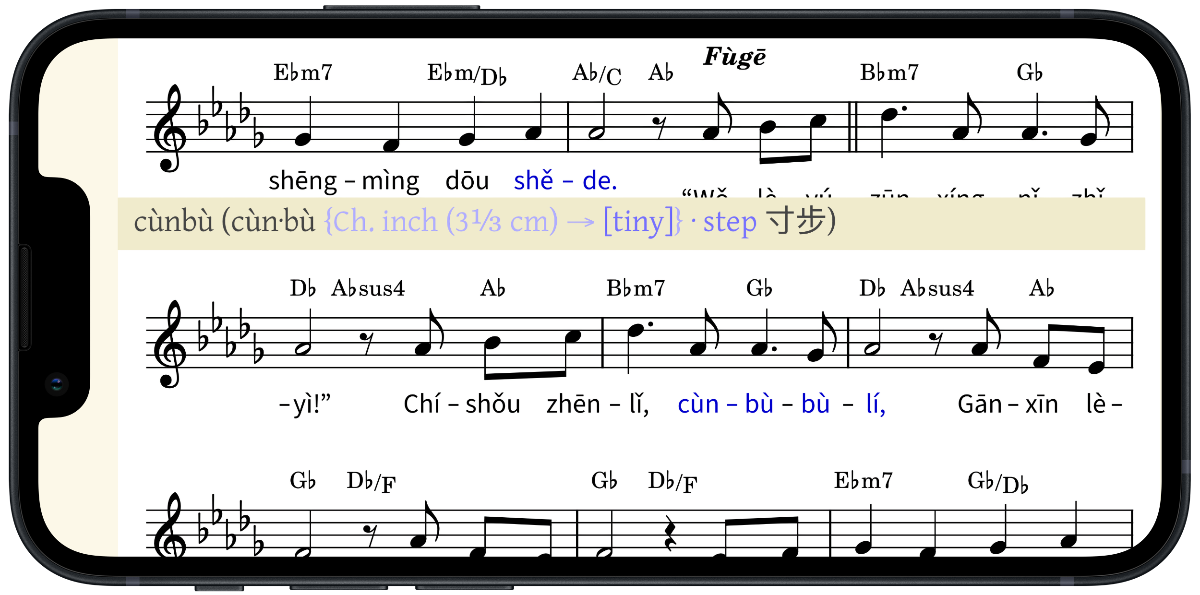
離/离)”, comes from the chorus of song 161, which is entitled “To Do Your Will Is My Delight” in English and “Wǒ
(I
我)Lèyú
(Lè·yú
{Am Happy} · to
乐于
樂於)Zūnxíng
(Zūn·xíng
{Abide by} · {Walk → [Do]}
遵行)Nǐ de
((Nǐ
You
你)
(de
’s
的)
→[Your])Zhǐyì
(Zhǐ·yì
Will · {Meaning → [Will]} →[Will]
旨意)” in Mandarin:
📖📄📘
“Wǒ
(I
我)lèyú
(lè·yú
{am happy} · to
乐于
樂於)zūnxíng
(zūn·xíng
{abide by} · {walk → [do]}
遵行)nǐ
(your
你)zhǐyì
(zhǐ·yì
will · {meaning → [will]} →[will]
旨意)!”
Chíshǒu
(Chí·shǒu
{to hold → [to support]} · {to defend → [to abide by]} → [to hold fast to]
持守)zhēnlǐ
(zhēn·lǐ
true · reasoning →[the truth]
真理),
cùnbù
(cùn·bù
{Ch. inch (3⅓ cm) → [tiny]} · step
寸步)‐bù
(not
不)‐lí
({to depart}
离
離/离),
Gānxīn
(Gān·xīn
{to be (of) sweet → [to be of willing]} · heart →[to be willing]
甘心)lèyì
(lè·yì
{to be (of) happy} · {meaning → [intention]} →[to be willing]
乐意
樂意),
wúwèi
(wú·wèi
{to be without} · {fearing of}
无畏
無畏)jiānxīn
(jiān·xīn
{(things being) arduous} · {(things being) hot (in taste) → [(things being) hard]} → [hardships]
艰辛
艱辛),
Jìn
({to expend to the limit}
尽
盡)quánlì
(quán·lì
whole · strength
全力),
zài‐suǒ‐bùxī
((zài
in
在)‐(suǒ
place
所)‐(bù·xī
not · {to cherish → [to stint]}
不惜)
→[not to balk]).
While not being a direct translation, “Chíshǒu
(Chí·shǒu
{to hold → [to support]} · {to defend → [to abide by]} → [to hold fast to]
持守)zhēnlǐ
(zhēn·lǐ
true · reasoning →[the truth]
真理),
cùnbù
(cùn·bù
{Ch. inch (3⅓ cm) → [tiny]} · step
寸步)‐bù
(not
不)‐lí
({to depart}
离
離/离)” seems to correspond with “I will walk on in your light” in the above example. For those who are interested, a more literal translation of “Chíshǒu
(Chí·shǒu
{to hold → [to support]} · {to defend → [to abide by]} → [to hold fast to]
持守)zhēnlǐ
(zhēn·lǐ
true · reasoning →[the truth]
真理),
cùnbù
(cùn·bù
{Ch. inch (3⅓ cm) → [tiny]} · step
寸步)‐bù
(not
不)‐lí
({to depart}
离
離/离)” would be “to hold fast to the truth, (even) a step of an inch not to depart (from it)”. To get even further into the weeds, while the expression “cùn
({Ch. inch (3⅓ cm)} [→ [inch | very little/short; small; tiny]]
寸)” that is used above is now often used to mean the British Imperial inch (2.54 cm), it actually originally referred to the Chinese inch (3⅓ cm). Either way, a “cùnbù
(cùn·bù
{Ch. inch (3⅓ cm) → [tiny]} · step
寸步)” is a tiny step indeed.
Regarding the other morphemes in “cùnbù
(cùn·bù
{Ch. inch (3⅓ cm) → [tiny]} · step
寸步)‐bù
(not
不)‐lí
(leave; {part/depart [from]}; {[is] away/apart/distant/far apart from}
离
離/离)”, it may be helpful to note that the “bù”
(step; pace (v or n) [→ [condition; situation; state]]
步) in “cùnbù”
(cùn·bù
{Ch. inch (3⅓ cm) → [tiny]} · step
寸步) also appears in the well-known expressions “bùzhòu”
(bù·zhòu
step · {to be trotted} →[step; move; measure; phase]
步骤
步驟) and “jìnbù
(jìn·bù
{advancing [of]} · steps →[progress[ing]; advancing; improvement]
进步
進步)”, and that this “lí”
(leave; {part from}; {[is] away/apart/distant/far apart from}
离
離/离) is the one in “líkāi
(lí·kāi
leave · {to be opened [from] → [away [from]; apart [from]; clear [of]]}
离开
離開).”
Musical Notation 🎼 and the Mandarin Field
In this post about a Mandarin expression found in our songbook, another subject that I want to touch on is: Is musical notation 🎼 too hard to be worth the trouble of producing it and using it? Are fewer and fewer people able to read it? I was fortunate enough to have been taught how to read musical notation in school. I have never thought of musical notation as being particularly difficult to use (it’s much easier to learn than characters, which many unquestioningly try to learn), and I find that it helps me to sing Kingdom songs more correctly (according to the intended melody, message, etc.) and more confidently more of the time. However, I am aware that not everyone in the Mandarin field has the same experience with musical notation. For example, a while ago, an older brother told me that he didn’t know how to read musical notation. Also, some people in the Mandarin field may have been affected by how education systems in this old world have been facing significantchallenges relating to providing music education for younger ones.
Regardless of how the world may be failing in many cases to equitably provide good music education, Jehovah’s organization has pointed out that music is important in Jehovah’s worship. For example, not long ago, a Meeting Workbook said:
Music can have a powerful influence on the mind and body. Singing is an important part of our worship of Jehovah.
In accordance with the importance of music in Jehovah’s worship, Mandarin field language learners used to have available to them official material from the organization containing musical notation with Pīnyīn
(Pīn·yīn
{Piecing Together of} · Sounds →[Pinyin]
拼音) in the lyrics. However, perhaps at least partially because of the technical difficulty and costliness of producing material with musical notation and both Chinese characters and Pīnyīn
(Pīn·yīn
{Piecing Together of} · Sounds →[Pinyin]
拼音) in the lyrics, as of this writing, there is no official material currently available from the organization that shows Pīnyīn
(Pīn·yīn
{Piecing Together of} · Sounds →[Pinyin]
拼音) and musical notation on the same page or screen.
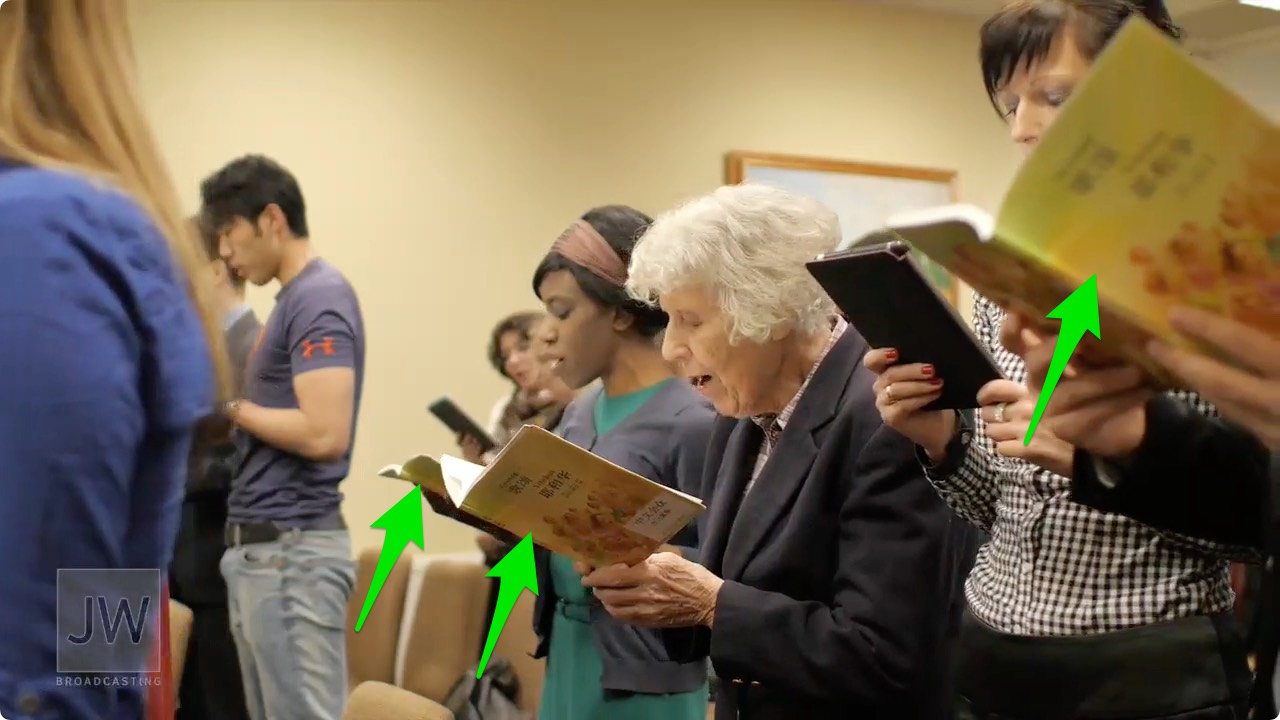
A screenshot from an official video, of Sis. Margarita Königer and others using official Pīnyīn
(Pīn·yīn
{Piecing Together of} · Sounds →[Pinyin]
拼音)Sing to Jehovah songbooks with musical notation
The organization continues to publish official songbook material for different languages in general that contains musical notation, so it evidently still considers musical notation to generally be worthwhile to produce. It continues to produce official material for the current songbook that uses musical notation along with lyrics rendered only in Chinese characters, without Pīnyīn
(Pīn·yīn
{Piecing Together of} · Sounds →[Pinyin]
拼音), and it has even produced official material that uses jiǎnpǔ
(jiǎn·pǔ
simple · {register or record for reference → [musical notation]} →[numbered musical notation]
简谱
簡譜) (a kind of musical notation also known as numbered musical notation) and Chinese characters.
For those who find it helpful in their Mandarin field activities to put musical notation together with Pīnyīn
(Pīn·yīn
{Piecing Together of} · Sounds →[Pinyin]
拼音), the unofficial Pīnyīn
(Pīn·yīn
{Piecing Together of} · Sounds →[Pinyin]
拼音) Plus resource “Sing Out Joyfully” Bk. (Pīnyīn+Music, Pīnyīn Plus, Web) exists and is continuing to be improved. As shown in the screenshot near the beginning of this post, this resource aids Mandarin field language learners by breaking with tradition and featuring lyrics in the musical notation that are only in relatively large-print Pīnyīn
(Pīn·yīn
{Piecing Together of} · Sounds →[Pinyin]
拼音) by default—characters are relegated to Pīnyīn
(Pīn·yīn
{Piecing Together of} · Sounds →[Pinyin]
拼音) Plus “flashcards” that are added as time allows.
Unlike the traditionally-used but unnecessarily extraordinarily complex characters that need to be accompanied by Pīnyīn
(Pīn·yīn
{Piecing Together of} · Sounds →[Pinyin]
拼音) before many are able to read them, Pīnyīn
(Pīn·yīn
{Piecing Together of} · Sounds →[Pinyin]
拼音) itself is a simple, elegant alphabetical full writing system for Mandarin that is easy to learn and remember. Also, it is no harder to typeset than other alphabetical writing systems with diacritics, such as the writing systems now used for French, Czech, Vietnamese, etc.*
More Pīnyīn
(Pīn·yīn
{Piecing Together of} · Sounds →[Pinyin]
拼音) and Pīnyīn
(Pīn·yīn
{Piecing Together of} · Sounds →[Pinyin]
拼音) Plus web material based on the Mandarin “Sing Out Joyfully” book will be made available in the Pīnyīn
(Pīn·yīn
{Piecing Together of} · Sounds →[Pinyin]
拼音)Plus web resource as time allows.
* Thanks to ongoing advancements in personal computing hardware and software, producing material that contains things like musical notation and Pīnyīn
(Pīn·yīn
{Piecing Together of} · Sounds →[Pinyin]
拼音) text at reasonable cost is quicker and easier than ever. At this time, production of the musical notation in the “Sing Out Joyfully” Bk. (Pīnyīn+Music, Pīnyīn Plus, Web) resource begins in free open source software called MuseScore Studio, running on a Mac. Pīnyīn
(Pīn·yīn
{Piecing Together of} · Sounds →[Pinyin]
拼音) text for the lyrics in the musical notation is entered using macOS’s ABC – Extended input source (keyboard layout). (Just using Pīnyīn
(Pīn·yīn
{Piecing Together of} · Sounds →[Pinyin]
拼音) text only here simplifies things so much compared to having to somehow input characters with Pīnyīn
(Pīn·yīn
{Piecing Together of} · Sounds →[Pinyin]
拼音)ruby text!) When it’s ready, the musical notation for a song is exported from MuseScore Studio into SVG format, which is a plain text format that allows for the inclusion of links that activate Pīnyīn
(Pīn·yīn
{Piecing Together of} · Sounds →[Pinyin]
拼音) Plus flashcards on webpages. The coding for the SVG links is currently done using the text editor BBEdit, in which editing large text files is quite performant. For Pīnyīn
(Pīn·yīn
{Piecing Together of} · Sounds →[Pinyin]
拼音) Plus web material production in general, my current favourite tool is Nova, but such web material can be produced in any application suitable for web development, such as Visual Studio Code, etc. ^
zháole huǒ
((zháo·le
{having caught} · {to completion}
着了
著了)
(huǒ
fire
火)
→[having caught fire; burning; being on fire]) 👈🏼 Tap/click to show/hide the “flashcard”
[Notes:Tap/click on a Pīnyīn
(Pīn·yīn
{Piecing Together of} · Sounds →[Pinyin]
拼音) expression to reveal its “flashcard”; tap/click on a “flashcard”or its Pīnyīn
(Pīn·yīn
{Piecing Together of} · Sounds →[Pinyin]
拼音) expression to hide the“flashcard”. 📖📄 📘 icons mean 📖Reveal All, 📄Reveal Advanced, and 📘 Reveal None re all the “flashcards” in the heading, paragraph, etc. that they are placed at the beginning of.]
A few years back, I wrote up a brief web page listing reasons for producing Pīnyīn
(Pīn·yīn
{Piecing Together of} · Sounds →[Pinyin]
拼音), etc. material for the Imitate (ia) book. Some, especially some who grew up in the West, may have felt that this book is made up of “just stories”, and ones that they were already quite familiar with, at that. However, we must remember that Chinese Bible students may often have a different perspective regarding the Bible accounts that are made to come to life in the Imitate book. As that web page said:
Many Chinese people in the world have not been exposed to Bible accounts the way many Westerners have.
Also, I have heard that some, perhaps many, Chinese Bible students tend to approach their Bible studies like intellectual exercises for accumulating chōuxiàng (abstract) head knowledge as if for a school exam, rather than as training for their hearts for their own real lives.
The actress Natalie Portman once said, “I love acting. I think it’s the most amazing thing to be able to do. Your job is practicing empathy. You walk down the street imagining every person’s life.”
The Imitate book helps build Bible students’ empathy towards Bible characters, which in turn helps Bible students realize that others would feel empathy towards them as well if they imitated these Bible characters—not everyone will just think they’re crazy, like many worldly friends or family members might think.
While even fictional stories can have the benefits described in the links and the quote above, true stories from the Bible can have even greater benefits, including spiritual ones.
Besides the Imitate book, another book from Jehovah’s organization that relates Bible accounts is the Learn From the Bible (lfb) book. The letter from the Governing Body in this book says that, similarly to the Imitate book, the Learn From the Bible book also “brings the Bible accounts to life and captures the feelings of those depicted”, while, unlike the Imitate book, it “tells the story of the human family from creation onward”. While the Learn From the Bible book is especially suitable for children, the letter from the Governing Body in this book says that “it can also be used to help adults who desire to learn more about the Bible”. So, it would be good to consider on this blog some of the expressions used in the Mandarin Learn From the Bible book.
On Fire 🔥
This week’s MEotW, “zháole huǒ
((zháo·le
{having caught} · {to completion}
着了
著了)
(huǒ
fire
火)
→[having caught fire; burning; being on fire])”, appears in the first paragraph of Lesson 18 of the Mandarin Learn From the Bible book, which is entitled “Ránshāo
(Rán·shāo
Ignited · {to Be Burning}
燃烧
燃燒)de
(’s
的)Jīngjí‐Cóng
((Jīng·jí
Brambles · Thorns
荆棘
荊棘)‐(Cóng
Clump
丛
叢)
→[Bush])” (“The Burning Bush”):
English:
A thornbush was on fire, but it was not burning up!
Mandarin:
📖📄📘Móxī
(Moses
摩西)kànjian
(kàn·jian
{looked at} · {to be seeing} →[saw]
看见
看見)jīngjí‐cóng
((jīng·jí
brambles · thorns
荆棘
荊棘)‐(cóng
clump
丛
叢)
→[bush])zháole huǒ
((zháo·le
{having caught} · {to completion}
着了
著了)
(huǒ
fire
火)
→[being on fire]),
dàn
(but
但)yìzhí
(yì·zhí
one · {being straight} →[all the while]
一直)méiyǒu
(méi·yǒu
(it) not · {was having → [was]} → [(it) was not]
没有
沒有)shāodiào
(shāo·diào
{being burned} · {to be falling → [up]}
烧掉
燒掉).
The Mandarin Learn From the Bible book here uses “zháole huǒ
((zháo·le
{having caught} · {to completion}
着了
著了)
(huǒ
fire
火)
→[having caught fire; burning; being on fire])” to correspond with the English expression “on fire”. “Zháole huǒ
((zháo·le
{having caught} · {to completion}
着了
著了)
(huǒ
fire
火)
→[having caught fire; burning; being on fire])” is the past participle of “zháohuǒ
(zháo·huǒ
catch; ignite; light · fire
着火
著火)”, which corresponds to “catch fire” in English.
Morphemic Breakdown
Going in reverse order, the “huǒ
(fire [→ [fiery anger/temper | get fiery with anger]] | fiery; flaming
火)” in “zháole huǒ
((zháo·le
{having caught} · {to completion}
着了
著了)
(huǒ
fire
火)
→[having caught fire; burning; being on fire])” is a well-known expression that means “fire”. As for “le
(-ed | {to completion} | [(at the end of a phrase/sentence) indicates a change]
了)”, when it’s used as it is in this week’s MEotW, it’s considered an aspect marker, as was discussed extensively in the MEotW post for “jiéle hūn
((jié·le
{tied (a knot of)} · {to completion}
结了
結了)
(hūn
marrying → [marriage]
婚)
→[[got] married])”. That brings us to “zháo
({touch; come in contact with} [→ [feel; be affected by]] | {catch; ignite; light (fire)}; burn | {hitting the mark}; accomplishing; succeeding
着
著)”, the pronunciation and meaning of which are obvious in Pīnyīn
(Pīn·yīn
{Piecing Together of} · Sounds →[Pinyin]
拼音), but not so much when one just sees “着” (Simplified) or “著” (Traditional), the characters used to write it.
The Many Faces of “着/著”
According to the dictionaries loaded in my Pleco app, the characters “着/著” can represent 5 different expressions, each with its own pronunciation and set of meanings:
zhāo – add; put in | measure word for tricks, devices, moves in chess or martial arts, etc.
zháo – touch; come in contact with [→ [feel; be affected by]] | catch; ignite; light (fire); burn | hitting the mark; accomplishing; succeeding (This is the one used in this week’s MEotW.)
zhe – being (indicating continuing progress/state)
zhù – prominent; outstanding | book; work
zhuó – apply | put on/wear (clothes)
While advocates of characters complain about the homophones (different words with the same pronunciation) in Mandarin that Pīnyīn
(Pīn·yīn
{Piecing Together of} · Sounds →[Pinyin]
拼音) would write the same way, the above illustrates the corresponding problem of homographs (different words that are written the same way) that plagues the characters.
Don’t Fall For the FUD!
How can we deal with homophones and homographs? For both of these contrasting linguistic challenges, the best solution is that which is used in speech, the original, primary aspect of human language, as created by Jehovah God: Use sufficient clarifying context. Contrary to the unjustified FUD (Fear, Uncertainty, and Doubt) spread by many advocates of characters, many millions of people have been speaking modern Mandarin to each other for decades, homophones and all, and because people have learned to use sufficient clarifying context when speaking it, it’s been fine! Similarly, so long as one gives oneself a chance to get used to it, using Pīnyīn
(Pīn·yīn
{Piecing Together of} · Sounds →[Pinyin]
拼音) to write Mandarin is also fine, since Pīnyīn
(Pīn·yīn
{Piecing Together of} · Sounds →[Pinyin]
拼音) is just a simple way to represent Mandarin speech.
Many claim that _Pīnyīn_ shouldn’t be used as a writing system because characters are required to avoid confusion from all the homophones (different words that sound the same) in Mandarin.
If that’s true, then people shouldn’t SPEAK Mandarin either! But many do, and it’s fine. pic.twitter.com/1MK0ERuFjc
Of course, if one has a poor understanding of Mandarin speech, then one will thus also have a poor understanding of Pīnyīn
(Pīn·yīn
{Piecing Together of} · Sounds →[Pinyin]
拼音). Unfortunately, experience has shown that Mandarin learners who just go along with traditional imperfect human culture and focus on the visible, visually elaborate characters often end up neglecting invisible Mandarin speech. The thing is, though, according to both the science of linguistics and the Bible itself, speech is actually the primary aspect of human language, and no matter how exceptional worldly Chinese people may think they are, that applies to Mandarin and all the other Chinese languages as well.—1 Corinthians 14:8–11.
For convenience:
The direct link for the Pīnyīn
(Pīn·yīn
{Piecing Together of} · Sounds →[Pinyin]
拼音) Plus resource for the Learn From the Bible book is:
More Pīnyīn
(Pīn·yīn
{Piecing Together of} · Sounds →[Pinyin]
拼音) and Pīnyīn
(Pīn·yīn
{Piecing Together of} · Sounds →[Pinyin]
拼音) Plus web material based on the Mandarin Learn From the Bible book will be made available in the Pīnyīn
(Pīn·yīn
{Piecing Together of} · Sounds →[Pinyin]
拼音)Plus web resource as time allows.