Categories
Culture Theocratic

chéngfá

chéngfá (punishing; penalizing 惩罚 懲罰) ← Tap/click to show/hide the “flashcard”

Appendix A2 of the English New World Translation of the Holy Scriptures (Study Edition), entitled “Features of This Revision”, discusses vocabulary changes that have been made in the current revision, words that have been translated differently than before. As noted in various entries in the excellent resource Referenced Theo. Expressions (RTE), Appendix A2 of the current Mandarin version of the New World Translation Bible (nwtsty) correspondingly discusses words that have been translated differently in the current revision of the Mandarin NWT Bible, compared to how they had been translated before.

Since we base what we say in Jehovah’s service on his Word the Bible, the vocabulary used in it—and the way those vocabulary words are translated—should be reflected in how we speak in our ministry, at our meetings, etc. So, it is beneficial for us Mandarin field language learners to be familiar with the latest thinking from the organization on how Bible terms should be translated into Mandarin.

‘Punishing’ Differently in Mandarin

As Appendix A2 of the current Mandarin version of the New World Translation Bible (nwtsty) points out, this current version builds on the previous version’s efforts to avoid expressions that could easily be associated with false religious concepts.

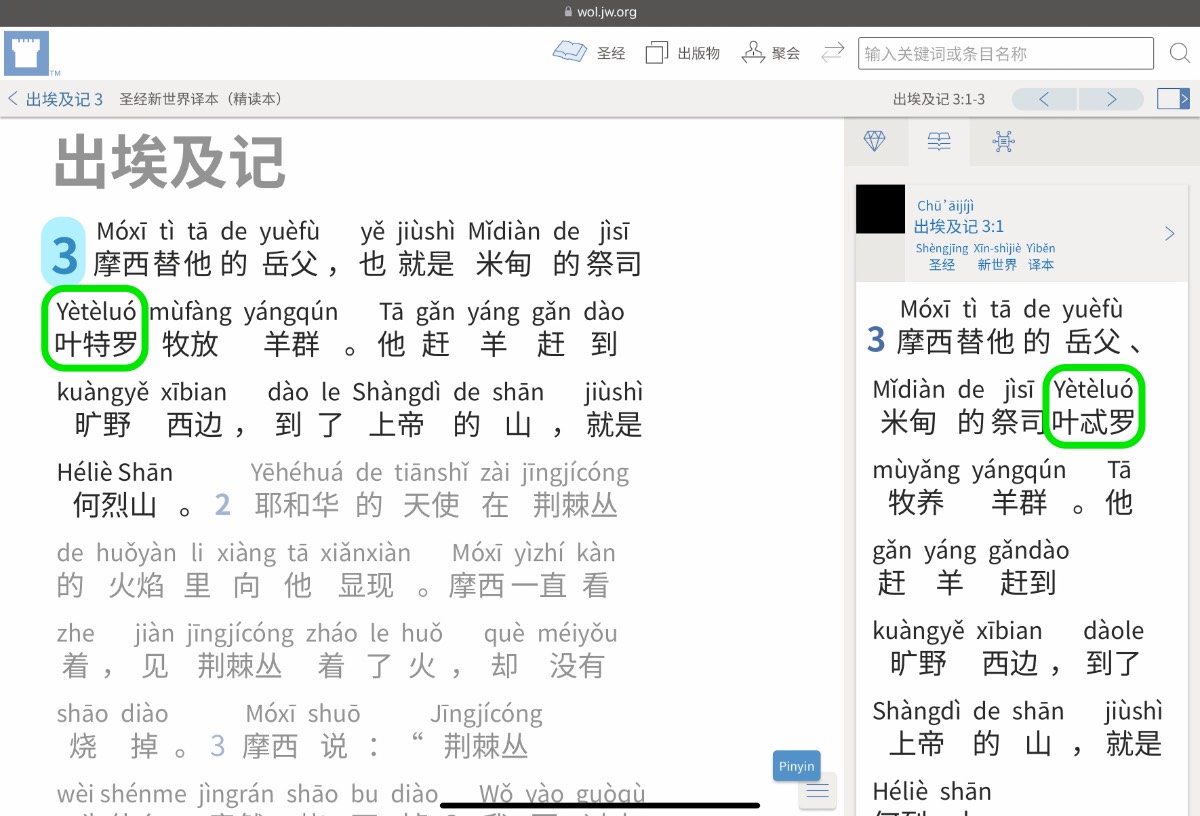
One example that it points to is that in scriptures such as Psalm 103:10 (English, Mandarin), “bàoyìng (bào·yìng retribution · responding 报应 報應)” has been changed to “chéngfá (punishing; penalizing 惩罚 懲罰)”:

Psalm 103:10 (WOL CHS+Pinyin Parallel Translations)

Is It Karma?

So, what’s the deal with “bàoyìng (bào·yìng retribution · responding 报应 報應)”? The entries for “bàoyìng (bào·yìng retribution · responding 报应 報應)” in a couple of the dictionaries that are available to be installed in the Pleco app give us some clues. First, consider the entry for this expression in the Referenced Theo. Expressions (RTE) Chinese-English dictionary:

retribution (old translation); Insight article heading in Watchtower Library 2011 CHS. NWT-2019’s Appendix A2 notes 报应 changed to 应得的惩罚 or similar, to avoid conveying false-religious concepts (in this case perhaps the Buddhist concept of karma, see 因果报应, although that is not stated).

In partial confirmation, the CC-CEDICT dictionary contains these definitions for “bàoyìng (bào·yìng retribution · responding 报应 報應)”:

1 (Buddhism) divine retribution
2 karma

For reference, Wikipedia provides this summary regarding karma:

Karma…in Sanskrit means an action, work, or deed, and its effect or consequences.[source] In Indian religions, the term more specifically refers to a principle of cause and effect, often descriptively called the principle of karma, wherein intent and actions of an individual (cause) influence the future of that individual (effect):[source] Good intent and good deeds contribute to good karma and happier rebirths, while bad intent and bad deeds contribute to bad karma and bad rebirths.[source][source]

The concept of karma is closely associated with the idea of rebirth in many schools of Indian religions (particularly Hinduism, Buddhism, Jainism and Sikhism),[source] as well as Taoism.[source] In these schools, karma in the present affects one’s future in the current life, as well as the nature and quality of future lives—one’s saṃsāra.[source][source] This concept has also been adopted in Western popular culture, in which the events which happen after a person’s actions may be considered natural consequences.

Indeed, we definitely would not want people to think that any part of God’s Word the Bible is referring to the false religious concept of karma!

Categories
Current Events History Theocratic

āijiā‐āihù

āijiā‐āihù ((āi·jiā {one after another} · households 挨家)‐(āi·hù {one after another} · doors 挨户 挨戶) [door[-/ ]to[-/ ]door; house[-/ ]to[-/ ]house]) ← Tap/click to show/hide the “flashcard”

[Notes: Tap/click on a Pīnyīn (Pīn·yīn {Piecing Together} · Sounds → [Pinyin] 拼音) expression to reveal its “flashcard”; tap/click on a “flashcard” or its Pīnyīn (Pīn·yīn {Piecing Together} · Sounds → [Pinyin] 拼音) expression to hide the “flashcard”. 📖 📄 📘 icons mean 📖 Reveal All, 📄 Reveal Advanced, and 📘 Reveal None re all the “flashcards” in the heading, paragraph, etc. that they are placed at the beginning of.]

As of this writing, the English version of jw.org is featuring this announcement:

BREAKING NEWS | House-to-House Preaching Will Resume on September 1, 2022

The Mandarin version of jw.org renders this announcement this way:

📖 📄 📘 JÍSHÍ (JÍ·SHÍ {(IMMEDIATELY) APPROACHING} · {(PARTICULAR) TIME} → [(OF NEWS) LIVE] 即时 即時) XĪNWÉN (XĪN·WÉN NEW · {(THAT WHICH) IS HEARD} → [NEWS] 新闻 新聞) | 2022 Nián (Year年/秊) 9 Yuè (Moon → [Month] 月) 1 (Sun → [Day] 日) Huīfù ({(There) Will Be Restored} → [(There) Will Be Resumed] 恢复 恢復) Āijiā‐Āihù ((Āi·jiā {One After Another} · Households 挨家)‐(Āi·hù {One After Another} · Doors 挨户 挨戶) [House-to-House]) Chuándào (Chuán·dào Spreading · Way → [Preaching] 传道 傳道)

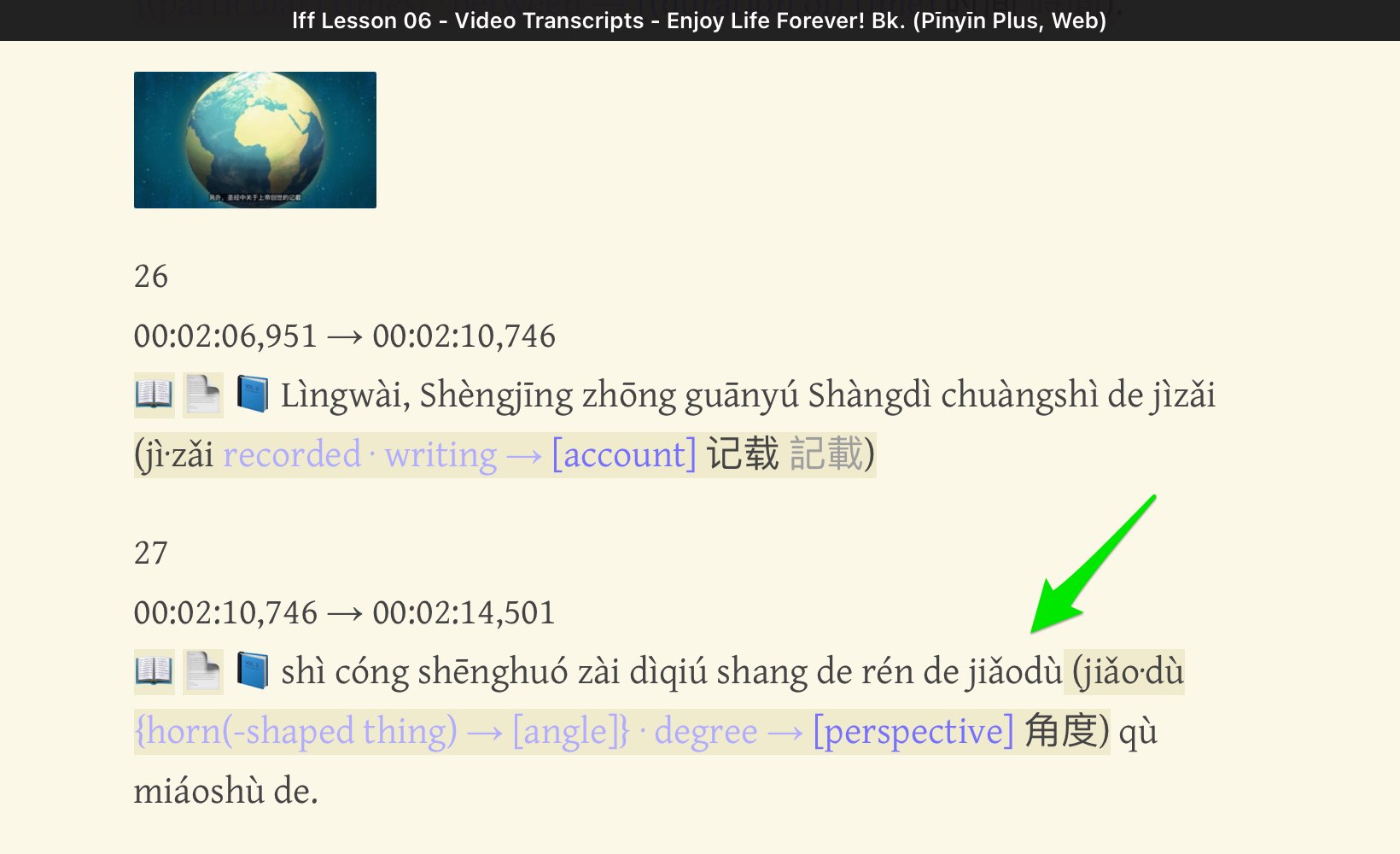
As can be seen from the above Pīnyīn (Pīn·yīn {Piecing Together} · Sounds → [Pinyin] 拼音) Plus information, the organization is currently translating “house-to-house” into Mandarin as “āijiā‐āihù ((āi·jiā {one after another} · households 挨家)‐(āi·hù {one after another} · doors 挨户 挨戶) [house-to-house])”, which literally means “one after another households one after another doors”.

Blasts from the Past

Chinese field “old-timers” may remember that this wasn’t always the expression used to translate “house-to-house”. Here are some expressions that have been used to do so in the past:

  • āijiā‐zhúhù ((āi·jiā {one after another} · households 挨家)‐(zhú·hù {one by one} · doors 逐户 逐戶) [door[-/ ]to[-/ ]door; house[-/ ]to[-/ ]house (old translation)])

    • Regarding this expresison, the Referenced Theocratic Expressions (RTE) resource says: “from house to house (old translation); Acts 5:42 NWT(2001-C 1984-E, 2013 not checked) +pinyin “from house to house”; w11 2/1 p.13 ∼传道 “door-to-door preaching”. Without the hanzi, it seems this is not recognisable to most Chinese; one suggested 每家都去 (měi jiā dōu qù); 2019-NWT uses 挨家挨户 āijiā’āihù (which is in ABC [the ABC Chinese-English Dictionary])”
    • Zhúhù (Zhú·hù {one by one} · doors → [door[-/ ]to[-/ ]door] 逐户 逐戶)” on its own has been used in the past.
      • RTE says about this expression: “house-to-house; w08 7/15 1st std article title (dict.cn “door to door”). See also 挨家逐户. Without the hanzi, it seems this is not recognisable to most Chinse, so try using 每家都去 instead.”
  • zhújiā‐zhúhù ((zhú·jiā {one by one} · households 逐家)‐(zhú·hù {one by one} · doors 逐户 逐戶) [door[-/ ]to[-/ ]door; house[-/ ]to[-/ ]house (old translation)])

    • RTE: “house-to-house; 2009 songbook song 101; g00 7/8 p.30. See also 逐户, 挨家逐户, 挨家挨户 (ABC dictionary), and 逐家.”
    • As with “zhúhù (zhú·hù {one by one} · doors → [door[-/ ]to[-/ ]door] 逐户 逐戶)”, “zhújiā (zhú·jiā {one by one} · households → [house[-/ ]to[-/ ]house (old translation)] 逐家)” has also been used on its own in the past.

      • RTE: “house-by-house; my 108 (Paul entering one house after another to persecute). In 2009 songbook song 101 as part of 逐家逐户 (hence wtl09 doesn’t find this occurrence if you search for just 逐家)”

Sticking with False “Perfection” vs. Progress

While the older expressions mentioned above are not technically wrong or incorrect, the currently used expression “āijiā‐āihù ((āi·jiā {one after another} · households 挨家)‐(āi·hù {one after another} · doors 挨户 挨戶) [door[-/ ]to[-/ ]door; house[-/ ]to[-/ ]house])” is the best one the organization knows of at this time for translating the English expression “house-to-house”.

Some criticize Jehovah’s organization for sometimes changing rather than somehow being completely perfect from the beginning, but change is required for progress. The alternative for any imperfect humans in this system of things is to continue being less correct, less good than they could be, e.g. continuing to believe in hellfire, the Trinity, etc., and continuing to meddle in politics, to support the wars of human nations, etc. We can be thankful then that Jehovah’s organization continues to pursue better and better ways of thinking, speaking (and translating), and doing. As the Bible says at Proverbs 4:18:

But the path of the righteous is like the bright morning light
That grows brighter and brighter until full daylight.

Categories
Current Events Theocratic

bàolì

bàolì (bào·lì [(is employing)] violent · force → [violence | [is] violent] 暴力) 👈🏼 Tap/click to show/hide the “flashcard”

[Notes: This blog uses “Pīnyīn (Pīn·yīn {Piecing Together of} · Sounds → [Pinyin] 拼音) Plus” technology. Tap/click on a Pīnyīn (Pīn·yīn {Piecing Together of} · Sounds → [Pinyin] 拼音) expression to reveal its “flashcard”, tap/click on a “flashcard” or its Pīnyīn (Pīn·yīn {Piecing Together of} · Sounds → [Pinyin] 拼音) expression to hide the “flashcard”. 📖 📄 📘 icons mean 📖 Reveal All, 📄 Reveal Advanced, and 📘 Reveal None re all the “flashcards” in the paragraph, etc. that they are placed at the beginning of.]

Unfortunately, gun violence has been in the news a lot lately. As of this writing, jw.org is featuring the article “Shocking Gun Violence Worldwide—What Does the Bible Say?”. Also, the article “School Shootings—What Does the Bible Say?” was recently featured. The Mandarin versions of both these articles both use the expression “bàolì (bào·lì violent · force → [violence | violent] 暴力)”, which means “violence” or “violent”.

Usage Examples

Here are some examples of how “bàolì (bào·lì violent · force → [violence | violent] 暴力)” is used in the above-mentioned articles:

English:

Why is the world becoming more violent?

Mandarin:

📖 📄 📘 Wèi‐shénme ((Wèi for)‐(shén·me what · [suf] 什么 什/甚麼) [why]) rén (people 人) yuè‐lái‐yuè ((yuè {jumping over} 越) (lái coming) (yuè {jumping over} 越)) [more and more]) bàolì (bào·lì violent · force → [are violent] 暴力)?

English:

Is there any hope that the violence will end?

Mandarin:

📖 📄 📘 Zhèyàng (Zhè·yàng this · kind 这样 這樣) de (’s 的) bàolì (bào·lì violent · force → [violent] 暴力) shìjiàn (shì·jiàn incidents · [mw] 事件) huì (will) yǒu (have 有) zhōngzhǐ (zhōng·zhǐ ending · stopping 终止 終止) de (’s 的) (one 一) tiān (sky → [day] 天) ma ([? ptcl for “yes/no” questions])?

English:

The Bible promises a time when violence will end.

Mandarin:

📖 📄 📘 Shèngjīng (Shèng·jīng (the) Holy · Scriptures → [the Bible] 圣经 聖經)shuō (says說/説), bàolì (bào·lì violent · force → [violence] 暴力) huì (will) yǒu (have 有) zhōngzhǐ (zhōng·zhǐ ending · stopping 终止 終止) de (’s 的) (one 一) tiān (sky → [day] 天).

English:

God will eliminate the root causes of violent acts by teaching people to live in peace.

Mandarin:

📖 📄 📘 Shàngdì (Shàng·dì Above’s · {Emperor → [God]} → [God] 上帝) huì (will) jiàodǎo (jiào·dǎo teach · instruct 教导 教導) rén (people 人) zěnyàng (zěn·yàng (in) what · {form → [way]} → [how] 怎样 怎樣) hémù ({to be harmonious} 和睦)xiāngchǔ (xiāng·chǔ {with each other} · {to get along} 相处 相處), cóng (from) gēnběn (gēn·běn {root (of a plant)} · {root or stem of a plant} → [root] 根本) shang (upon 上) xiāochú (xiāo·chú eliminate · {get rid of} 消除) dǎozhì (dǎo·zhì lead · {to extend to} 导致 導致) bàolì (bào·lì violent · force → [violence] 暴力) de (’s 的) yuányīn (yuán·yīn origins · causes 原因).

Some Related Mandarin Expressions

Here are some other Mandarin expressions that also include the morphemebào ({[sudden] [and] [violent]} [→ [cruel; savage; fierce]] | {stick/stand out}; bulge 暴)”:

  • bàofā (bào·fā exploding; bursting · {sending out}; issuing → [erupting; bursting/breaking out | explosion; eruption] 爆发 爆發) (a past MEotW)
  • bàofā‐hù ((bào·fā exploded; burst · {sent out}; issued 爆发 爆發)‐(hù door → [household; family | person of a certain status]) [upstart | nouveau riche; newly rich])
  • bàofēng (bào·fēng violent · wind → [storm wind; gale; windstorm; storm] 暴风 暴風)
  • bàoliè (bào·liè violent · intense; fierce 暴烈)
  • bàolóng (bào·lóng {violent → [savage]} · dragon → [Tyrannosaurus species (esp. Tyrannosaurus rex)] 暴龙 暴龍)
  • bàoxíng (bào·xíng {violent [→ [savage]]} · {walking → [doing; deed; act]} → [savage act; outrage; atrocity] 暴行)
  • cánbào (cán·bào {injuring; damaging → [cruel; savage; ferocious]} · violent; brutal 残暴 殘暴)
  • fēngbào (fēng·bào wind · {being violent} → [windstorm; tempest; storm] 风暴 風暴)
  • wǎngbào (wǎng·bào {net → [network] → [Internet]} · {being violent} → [cyberbullying (abbr. for wǎngluò bàolì)] 网暴 網暴)
  • xiōngbào (xiōng·bào {[is] fierce}; {[is] ferocious} · {[is] sudden and violent → [[is] cruel; savage; brutal]} 凶暴 凶/兇暴)