Categories
Culture Experiences History Language Learning Names Science Theocratic

Lǎhé

Lǎhé+ (Raʹhab 喇合) 👈🏼 Tap/click to show/hide the “flashcard”

[Notes: Tap/click on a Pīnyīn (Pīn·yīn {Piecing Together of} · Sounds → [Pinyin] 拼音) expression to reveal its “flashcard”; tap/click on a “flashcard” or its Pīnyīn (Pīn·yīn {Piecing Together of} · Sounds → [Pinyin] 拼音) expression to hide the “flashcard”. 📖 📄 ➕ icons mean 📖 Reveal All, 📄 Reveal Advanced, and ➕ Reveal + Symbols re all the “flashcards” in the heading, paragraph, etc. that they are placed at the beginning of.]

A few years back, I wrote up a brief web page listing reasons for producing Pīnyīn (Pīn·yīn {Piecing Together of} · Sounds → [Pinyin] 拼音), etc. material for the Imitate (ia) book. Some, especially some who grew up in the West, may have felt that this book is made up of “just stories”, and ones that they were already quite familiar with, at that. However, we must remember that Chinese Bible students may often have a different perspective regarding the Bible accounts that are made to come to life in the Imitate book. As that web page said:

  • Many Chinese people in the world have not been exposed to Bible accounts the way many Westerners have.
  • Also, I have heard that some, perhaps many, Chinese Bible students tend to approach their Bible studies like intellectual exercises for accumulating chōuxiàng (abstract) head knowledge as if for a school exam, rather than as training for their hearts for their own real lives.

Later, the web page touches on how some of the real-world benefits of good storytelling like that found in the Imitate book involve empathy:

    • The actress Natalie Portman once said, “I love acting. I think it’s the most amazing thing to be able to do. Your job is practicing empathy. You walk down the street imagining every person’s life.”
  • The Imitate book helps build Bible students’ empathy towards Bible characters, which in turn helps Bible students realize that others would feel empathy towards them as well if they imitated these Bible characters—not everyone will just think they’re crazy, like many worldly friends or family members might think.

While even fictional stories can have the benefits described in the links and the quote above, true stories from the Bible can have even greater benefits, including spiritual ones.

Besides the Imitate book, another book from Jehovah’s organization that relates Bible accounts is the Learn From the Bible (lfb) book. The letter from the Governing Body in this book says that, similarly to the Imitate book, the Learn From the Bible book also “brings the Bible accounts to life and captures the feelings of those depicted”, while, unlike the Imitate book, it “tells the story of the human family from creation onward”. While the Learn From the Bible book is especially suitable for children, the letter from the Governing Body in this book says that “it can also be used to help adults who desire to learn more about the Bible”. So, it would be good to consider on this blog some of the expressions used in the Mandarin Learn From the Bible book.

Same Characters, Different Pronunciations

This week’s MEotW, “Lǎhé (Raʹhab 喇合)”, appears in the title of Lesson 30 of the Mandarin Learn From the Bible book:

English:

Rahab Hid the Spies

Mandarin (WOL, Pīnyīn (Pīn·yīn {Piecing Together of} · Sounds → [Pinyin] 拼音) Plus):

📖 📄 Lǎhé (Raʹhab 喇合) Ràng (Made) Tànzi+ (Tàn·zi {(Ones) Trying to Find Sth. Out → [Spies]} · [suf for nouns] 探子) Cáng ({to Be Hidden} 藏) Qilai (Qi·lai Up · {to Come} 起来 起來)

The Mandarin Learn From the Bible book here uses “Lǎhé (Raʹhab 喇合) to correspond with “Rahab” in English. The current Mandarin version of the New World Translation Bible (Study Edition) also uses “Lǎhé (Raʹhab 喇合) this way. For example, here is how it renders Joshua 2:1, which mentions Rahab:
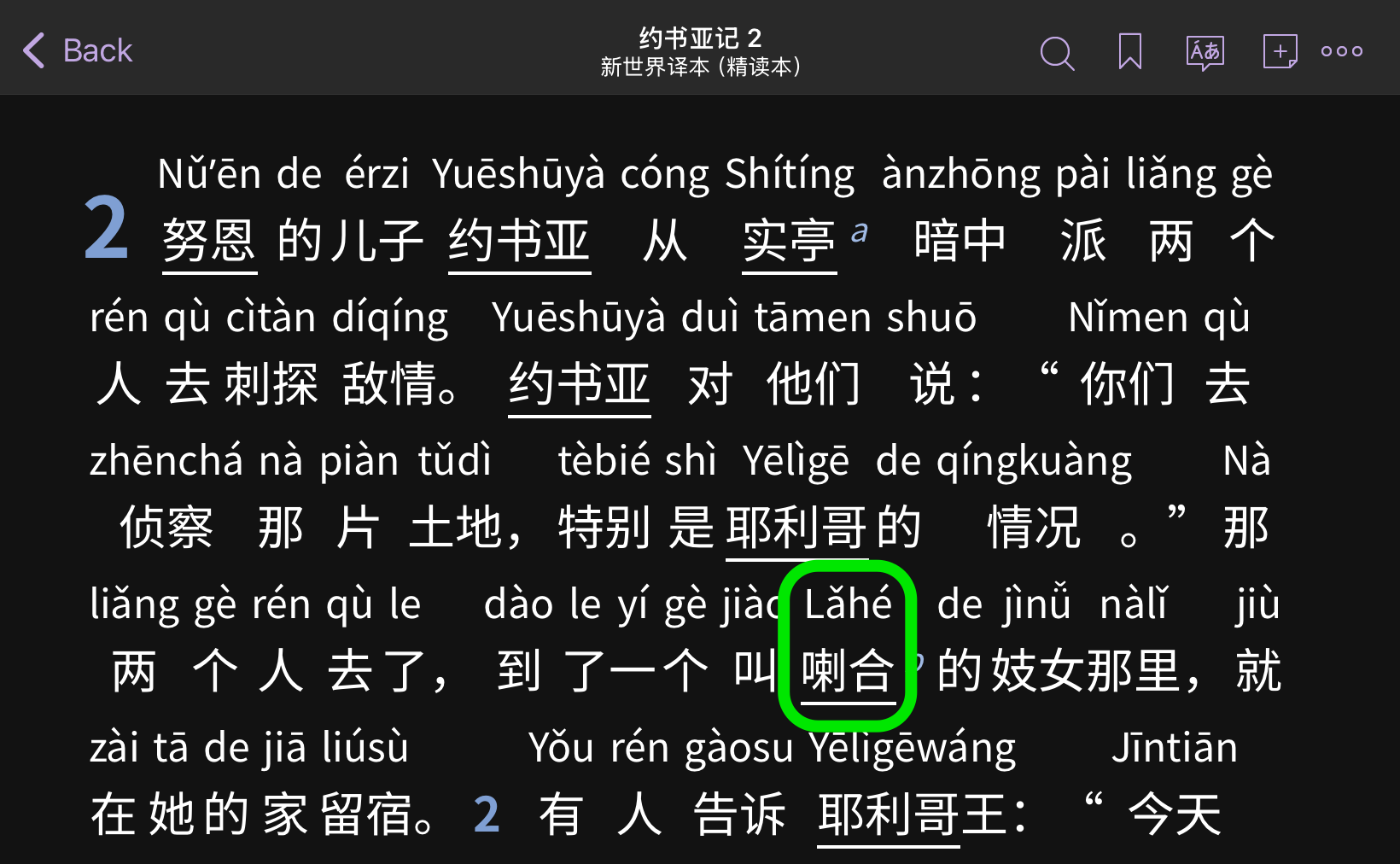
Joshua 2:1 in the Mandarin _NWT_ Study Bible, in the JW Library app

Joshua 2:1 in the Mandarin NWT Study Bible, in the JW Library app

Note, though, that the Pīnyīn (Pīn·yīn {Piecing Together of} · Sounds → [Pinyin] 拼音) for this used to be “Lāhé (Raʹhab (old pronunciation) 喇合)”, with the same characters, as can be seen in this screenshot of Joshua 2:1 in the PDF for the old printed Pīnyīn (Pīn·yīn {Piecing Together of} · Sounds → [Pinyin] 拼音) NWT Bible:
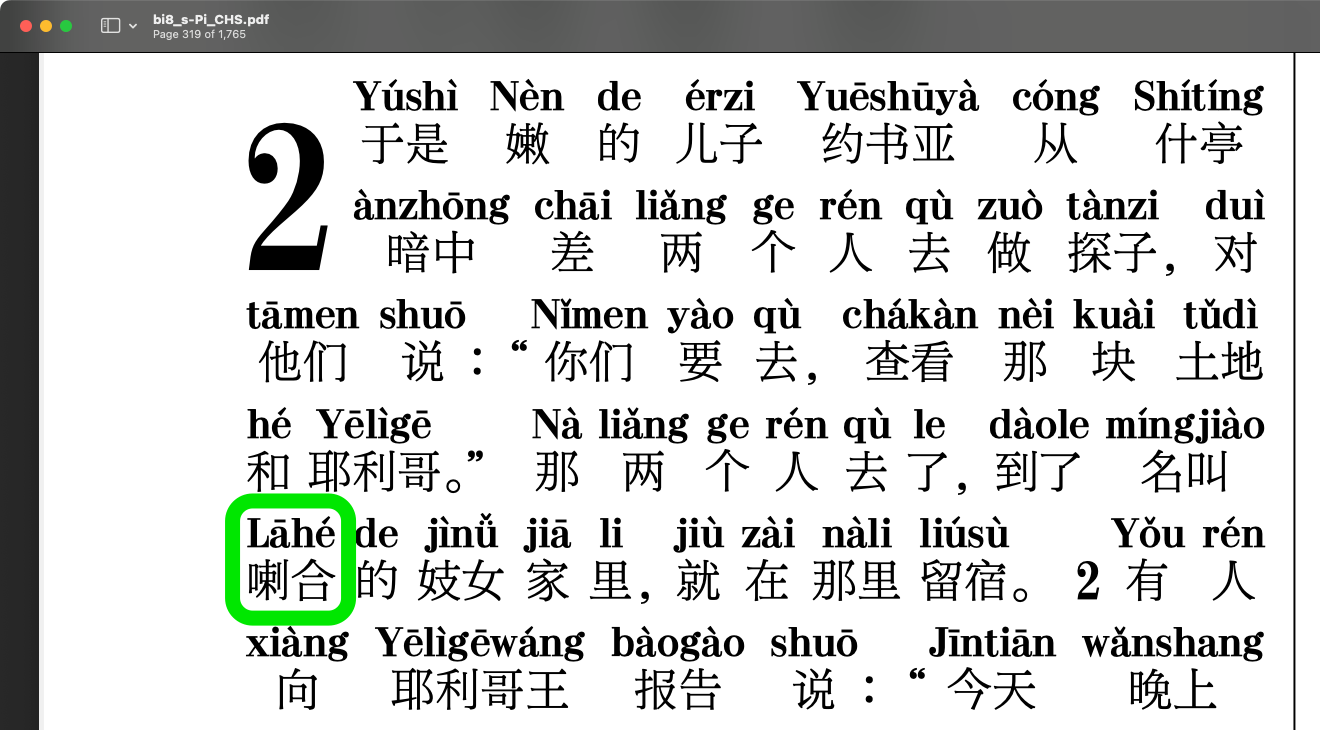
Joshua 2:1 in the PDF for the old printed _Pīnyīn_ _NWT_ Bible

Joshua 2:1 in the PDF for the old printed Pīnyīn (Pīn·yīn {Piecing Together of} · Sounds → [Pinyin] 拼音) NWT Bible

Why was this pronunciation changed, even though the same characters are used? Perhaps this was done to align with the common pronunciation of this name. For example, in CC-CEDICT, a public-domain Chinese-English dictionary, the entry for this expression says that the Pīnyīn (Pīn·yīn {Piecing Together of} · Sounds → [Pinyin] 拼音) for it is “Lǎhé (Raʹhab 喇合)”, and that the definition is “(Protestantism) Rahab, mother of Boaz”. In turn, perhaps there is some connection with the ABC Dictionary’s definition of “lǎ ({prostitute (slang)} | horn; bugle; trumpet; loudspeaker | lama 喇) as “(slang) prostitute”, which, as many know, is what Rahab worked as before she joined Jehovah’s people.

Context Is King, Not Characters

Anyway, what we have here are homographs, different expressions that are written the same way. In fact, my dictionaries say that the character “喇” that’s used in “Lǎhé+ (Raʹhab 喇合) can represent different expressions which can be pronounced “lā”, “lá”, “lǎ”, or “la”. If one encounters the character “喇” then, which of its multiple possible pronunciations is the right one? And, which of its multiple possible meanings is the right one? It depends on the context, which is the same as the situation with homophones written in Pīnyīn (Pīn·yīn {Piecing Together of} · Sounds → [Pinyin] 拼音). (Actually, in a way, a character like “喇” is more ambiguous than a Pīnyīn (Pīn·yīn {Piecing Together of} · Sounds → [Pinyin] 拼音) expression like “lǎ ({prostitute (slang)} | horn; bugle; trumpet; loudspeaker | lama 喇)”, because at least the Pīnyīn (Pīn·yīn {Piecing Together of} · Sounds → [Pinyin] 拼音) expression literally spells out its pronunciation, whereas with a character like “喇”, both its meaning and its pronunciation are ambiguous, even if one knows and can remember the character.)

So, while advocates of characters often make a fuss about the homophones in Mandarin that Pīnyīn (Pīn·yīn {Piecing Together of} · Sounds → [Pinyin] 拼音) would write the same way, the corresponding problem of homographs plagues the characters!


For convenience:

The direct link for the Pīnyīn (Pīn·yīn {Piecing Together of} · Sounds → [Pinyin] 拼音) Plus resource for the Learn From the Bible book is:

The short link for Chinese field language-learning links for the Learn From the Bible book is:

More Pīnyīn (Pīn·yīn {Piecing Together of} · Sounds → [Pinyin] 拼音) and Pīnyīn (Pīn·yīn {Piecing Together of} · Sounds → [Pinyin] 拼音) Plus web material based on the Mandarin Learn From the Bible book will be made available in the Pīnyīn (Pīn·yīn {Piecing Together of} · Sounds → [Pinyin] 拼音) Plus web resource as time allows.

Categories
Culture Current Events Language Learning Names Technology Theocratic

Mòrì Shízhōng

Mòrì+ (Mò·rì End · {Sun → [Day]} → [Doomsday] 末日)
Shízhōng+ (Shí·zhōng {(Particular) Times} · Clock → [Clock] 时钟 時鐘) 👈🏼 Tap/click to show/hide the “flashcard”

[Notes: Tap/click on a Pīnyīn (Pīn·yīn {Piecing Together of} · Sounds → [Pinyin] 拼音) expression to reveal its “flashcard”; tap/click on a “flashcard” or its Pīnyīn (Pīn·yīn {Piecing Together of} · Sounds → [Pinyin] 拼音) expression to hide the “flashcard”. 📖 📄 ➕ icons mean 📖 Reveal All, 📄 Reveal Advanced, and ➕ Reveal + Symbols re all the “flashcards” in the heading, paragraph, etc. that they are placed at the beginning of.]

At the time of this writing, jw.org was featuring the article “Doomsday Clock Moves Closer to Midnight”. Where the English version of this article uses the expression “Doomsday Clock”, the Mandarin version uses this week’s MEotW, “Mòrì (Mò·rì End · {Sun → [Day]} → [Doomsday] 末日) Shízhōng (Shí·zhōng {(Particular) Times} · Clock → [Clock] 时钟 時鐘)”.

(Incidentally, “wǔyè (wǔ·yè {7th of the 12 Earthly Branches → [south (placed at the midnight position of Chinese directions charts)]} · night → [midnight] 午夜)”, the Mandarin word for “midnight”, was the subject of a past MEotW post.)

The End

The “ (tip; end [→ [last/final stage]] 末)” in “mòrì (mò·rì end · {sun → [day]} → [doomsday] 末日)” was discussed in the MEotW post on “shìjiè (shì·jiè {generation → [world]} · extent → [world] 世界) mòrì (mò·rì end · {sun → [day]} 末日)”:

The “ (tip; end [→ [last/final stage]] 末)” in “mòrì (mò·rì end · {sun → [day]} 末日)” also appears in “mòqī (mò·qī end · period 末期)”, and indeed, in “mòshì+ (mò·shì {end of → [last stage/phase of]} · {generation → [world | age; era]} 末世)”. Some who have been in the Mandarin field for a while may also remember the expression “mòhòu (mò·hòu end · last 末后 末後) de (’s 的) rìzi (rì·zi {suns → [days]} · [suf for nouns] 日子)”. However, note that in the current version of the Mandarin New World Translation Bible (nwtsty), this expression has been replaced with “zuìhòu (zuì·hòu most · afterwards → [final] 最后 最後) de (’s 的) shíqī (shí·qī {(particular) time} · period 时期 時期)” in scriptures such as Ezekiel 38:16.

Ezekiel 38:16 (WOL CHS+Pinyin Parallel Translations)

What Is the Doomsday Clock?

The above-mentioned article contains the following footnote explaining what the Doomsday Clock is:

English:

“The Doomsday Clock is a design that warns the public about how close we are to destroying our world with dangerous technologies of our own making. It is a metaphor, a reminder of the perils we must address if we are to survive on the planet.”—Bulletin of the Atomic Scientists.

Mandarin:

📖 📄 “Mòrì (Mò·rì End · {Sun → [Day]} → [Doomsday] 末日) Shízhōng (Shí·zhōng {(Particular) Times} · Clock → [Clock] 时钟 時鐘) shì (is 是) (one 一) ge ([mw]個/个) xūgòu+ (xū·gòu {being empty → [falsely]} · {constructed → [made up]} → [imaginary] 虚构 虛構) de (’s 的) zhōngmiàn (zhōng·miàn clock · face 钟面 鐘面), yònglái (yòng·lái used · {to come} 用来 用來) jǐngshì+ (jǐng·shì {to warn} · {to show} 警示) rénmen (rén·men person · [pl] [people] 人们 人們) yīn ({because of} 因) lànyòng (làn·yòng {overflowingly → [indiscriminately]} · using → [misusing] 滥用 濫用) kējì (kē·jì {branches of study → [science]} · {skills → [technology]} → [technology] 科技), jùlí (jù·lí {being apart from → [distance from]} · {leaving from → [being at a distance from]} → [distance from] 距离 距離) zìwǒ (zì·wǒ self · {me → [self]} 自我) huǐmiè (huǐ·miè destroying · extinguishing → [destruction] 毁灭 毀滅) yǒu ({is having} → [is] 有) duō ({(how) much} 多) jìn ({being close} 近), (also 也) tíxǐng (tí·xǐng {to carry (hanging down from the hand) → [to raise]} · {being awake} of → [to remind] 提醒) rénlèi (rén·lèi human·kind 人类 人類) rúguǒ (rú·guǒ if · {fruit → [if indeed]} 如果) yào ({(we) want} 要) bìkāi (bì·kāi {to avoid} · {to be opened from → [to be clear of]} 避开 避開) zhèyàng (zhè·yàng this · kind 这样 這樣) de (’s 的) hàojié+ (hào·jié great · {plundering → [catastrophe]} 浩劫), jiù (then 就) yào (must 要) jiějué (jiě·jué {untie → [solve]} · decide → [solve] 解决 解決) něixiē (něi·xiē which · {indefinite number of} → [which] 哪些) wèntí (wèn·tí asking · problems → [problems] 问题 問題).”—Yuánzǐ Kēxué‐jiā Gōngbào+ ((Yuán·zǐ Original · {Small and Hard Things} → [Atomic] 原子) ((Kē·xué {Branches of Study} · Learning → [Science] 科学 科學)‐(jiā -ists’ 家) → [Scientists’]) (Gōng·bào Public · Bulletin → [Bulletin] 公报 公報) [Bulletin of the Atomic Scientists]) (Yīngyǔ (Yīng·yǔ English · Language 英语 英語)).

“The Closest It Has Ever Been”

It’s noteworthy that the above-mentioned article says that as of January 27, 2026,

English:

“The Bulletin of the Atomic Scientists Science and Security Board today sets the Doomsday Clock at 85 seconds to midnight, the closest it has ever been to catastrophe.”—Bulletin of the Atomic Scientists.

Mandarin:

📖 📄 Yuánzǐ Kēxué‐jiā Gōngbào ((Yuán·zǐ Original · {Small and Hard Things} → [Atomic] 原子) ((Kē·xué {Branches of Study} · Learning → [Science] 科学 科學)‐(jiā -ists’ 家) → [Scientists’]) (Gōng·bào Public · Bulletin → [Bulletin] 公报 公報) [Bulletin of the Atomic Scientists]) Kēxué (Kē·xué {Branches of Study} · Learning → [Science] 科学 科學) (and與/与) Ānquán (Ān·quán {Being Safe} · {Being Whole} → [Security] 安全) Wěiyuán‐Huì+ ((Wěi·yuán Entrusted · Members 委员 委員)‐(Huì Gathering) [Board]) jiāng (takes) Mòrì (Mò·rì End · {Sun → [Day]} → [Doomsday] 末日) Shízhōng (Shí·zhōng {(Particular) Times} · Clock → [Clock] 时钟 時鐘) tiáokuài+ (tiáo·kuài {to be adjusted} · {to be fast(er) → [to be farther ahead]} 调快 調快) le ([(at the end of a phrase/sentence) indicates a change] 了), jùlí (jù·lí {to be apart from} · {to be leaving from → [to be at a distance from]} 距离 距離) wǔyè (wǔ·yè {7th of the 12 Earthly Branches → [south (placed at the midnight position of Chinese directions charts)]} · night → [midnight] 午夜) zhǐ (just只/秖/衹/祇) shèng ({having remaining}剩/賸) 85 miǎo (seconds 秒), shì ((which) is 是) rénlèi (rén·lèi human·kind’s 人类 人類) shǐ (history 史) shang (upon 上) zuì (most最/㝡) jiējìn (jiē·jìn {has come close to} · {has been near} 接近) shìjiè (shì·jiè {generation → [world]} · extent’s → [world’s] 世界) mòrì (mò·rì end · {sun → [day]} → [doomsday] 末日) de (’s 的) shíkè+ (shí·kè {(particular) time} · {carving → [moment]} 时刻 時刻).”—Yuánzǐ Kēxué‐jiā Gōngbào ((Yuán·zǐ Original · {Small and Hard Things} → [Atomic] 原子) ((Kē·xué {Branches of Study} · Learning → [Science] 科学 科學)‐(jiā -ists’ 家) → [Scientists’]) (Gōng·bào Public · Bulletin → [Bulletin] 公报 公報) [Bulletin of the Atomic Scientists]) (Yīngyǔ (Yīng·yǔ English · Language 英语 英語)).

What’s Ahead?

Naturally, many will have questions like those below, that are asked in the above-mentioned article:

English:

Is the end of humanity and the end of our planet approaching? Do we need to fear what the future holds? What does the Bible say?

Mandarin:

📖 📄 Rénlèi (Rén·lèi human·kind 人类 人類) ({(together) with} → [and]和/龢) dìqiú (dì·qiú earth · globe → [the earth] 地球) zhēnde (zhēn·de really · ’s 真的) bīnlín+ (bīn·lín {are close to (the sea/river/lake/etc.) → [are on the brink of]} · {are approaching} 濒临 瀕臨) huǐmiè (huǐ·miè destroying · extinguishing → [destruction] 毁灭 毀滅) ma ([? ptcl for “yes/no” questions])? Wǒmen (Wǒ·men we · [pl] 我们 我們) xūyào ({do need} 需要) dānxīn (dān·xīn {to carry on shoulder poles → [to take on (heavy)]} · hearts (about) → [to feel anxious about] 担/耽心 擔/耽心) wèilái (wèi·lái (what) {has not yet} · come → [the future] 未来 未來) ma ([? ptcl for “yes/no” questions])? Shèngjīng (Shèng·jīng (the) Holy · Scriptures → [the Bible] 圣经 聖經) de (’s 的) guāndiǎn+ (guān·diǎn {looking at → [view]} · point → [viewpoint] 观点 觀點) shì (is 是) shénme (shén·me what · [suf] 什么 什/甚麼)?

It is our privilege to share the answers to those questions with honest-hearted ones in the Mandarin field, if we have learned well enough how to understand Mandarin speech and speak the required Mandarin understandably.—1 Corinthians 14:8–11.

Categories
Culture Current Events History Language Learning Names Science Technology

Hāmǐjíduōdùn

Hāmǐjíduōdùn+ (Armageddon 哈米吉多顿 哈米吉多頓) 👈🏼 Tap/click to show/hide the “flashcard”

[Notes: Tap/click on a Pīnyīn (Pīn·yīn {Piecing Together of} · Sounds → [Pinyin] 拼音) expression to reveal its “flashcard”; tap/click on a “flashcard” or its Pīnyīn (Pīn·yīn {Piecing Together of} · Sounds → [Pinyin] 拼音) expression to hide the “flashcard”. 📖 📄 ➕ icons mean 📖 Reveal All, 📄 Reveal Advanced, and ➕ Reveal + Symbols re all the “flashcards” in the heading, paragraph, etc. that they are placed at the beginning of.]

[As part of a series of posts about some common myths about Chinese characters, this reposting of the post on “Hāmǐjíduōdùn (Armageddon 哈米吉多顿 哈米吉多頓) discusses the Ideographic Myth.]

[The first time this post was posted], jw.org was featuring an article with the following title:

English:

Will Armageddon Begin in Israel?—What Does the Bible Say?

Mandarin:

📖 📄 📘 Hāmǐjíduōdùn (Armageddon 哈米吉多顿 哈米吉多頓) Dàzhàn (Dà·zhàn {Big → [Great]} · War 大战 大戰) Huì (Will) zài (in 在) Yǐsèliè (Israel 以色列) Bàofā+ (Bào·fā Explode · {Issue Forth} → [Erupt] 爆发 爆發) ma ([? ptcl for “yes/no” questions])? Shèngjīng (Shèng·jīng (the) Holy · Scriptures → [the Bible] 圣经 聖經) de (’s 的) Guāndiǎn (Guān·diǎn {Looking At → [View]} · Point → [Viewpoint] 观点 觀點) Shì (Is 是) Shénme (Shén·me What · [suf] 什么 什/甚麼)?

This week’s MEotW is “Hāmǐjíduōdùn (Armageddon 哈米吉多顿 哈米吉多頓)”, the Mandarin syllables of which were obviously chosen first because of how much they sound like the English word “Armageddon” (and perhaps the original Hebrew word from which that came), not because of the meanings of the supposedly ideographic Chinese characters used to write them out (“Exhale Rice Lucky Much Pausing”??? 🤷🏻).

This emphasizes to us that when it comes to human language, SPEECH is primary—SOUNDS are the primary medium for transmitting meaning, and a writing system that transmits meaning purely with its visual symbols, without any dependency on speech sounds, is not a thing. However, this erroneous concept is so prevalent that there’s a name for it: The Ideographic Myth.

Several past MEotW posts have mentioned in passing the Ideographic Myth concerning Chinese characters, so it’s about time this blog took a deeper dive into this subject. Below are some selected excerpts from the chapter “The Ideographic Myth”, of the book The Chinese Language: Fact and Fantasy, by John DeFrancis, along with some commentary.


the concept of written symbols conveying their message directly to our minds, thus bypassing the restrictive intermediary of speech

This is a definition of the concept of “ideographic” writing.

Aren’t Chinese characters a sophisticated system of symbols that similarly convey meaning without regard to sound? Aren’t they an ideographic system of writing?

The answer to these questions is no. Chinese characters are a phonetic, not an ideographic, system of writing…There never has been, and never can be, such a thing as an ideographic system of writing.

Indeed, Chinese characters are always used to represent some language’s speech, are they not? They can be used to represent the speech of multiple languages, but they are not used in any way in which they do not represent the speech of any language, are they? There are no Chinese characters that have no spoken pronunciation in any language, are there? So, while some may find the idea of Chinese characters being an ideographic writing system fascinating, in real-life, actual use, Chinese characters are a phonetic writing system representing a language’s speech sounds (which do the actual representing of meanings)—Chinese characters are not an ideographic writing system directly representing meanings.

Origin of the Myth

The concept of Chinese writings as a means of conveying ideas without regard to speech took hold as part of the chinoiserie fad among Western intellectuals that was stimulated by the generally highly laudatory writings of Catholic missionaries from the sixteenth to the eighteenth centuries.

It was not acquaintance with Chinese but decipherment of Egyptian hieroglyphic writing following Napoleon’s conquests in North Africa that led to the coining of several expressions related to the ideographic idea.

Decipherment of this script had long been impeded by the notion that it was symbolic of ideas, particularly mystical or spiritual ones. It was not just the discovery of the famous Rosetta Stone, with its bilingual text in three scripts (Hieroglyphic Egyptian, Demotic Egyptian, and Greek) that made this possible. As Gordon (1968:24) stresses: “The decipherment of Hieroglyphic Egyptian required the replacement of the deep-seated notion of symbolism by the correct view that the main (though not the only) feature of the script is phonetic.”

Champollion’s success in deciphering the Egyptian script was due to his recognition of its phonetic aspect.

The rebus idea seems obvious to us since we use it in children’s games, but it actually constitutes a stupendous invention, an act of intellectual creation of the highest order—a quantum leap forward beyond the stage of vague and imprecise pictures to a higher stage that leads into the ability to represent all the subtleties and precision expressible in spoken language. Writing is now directly, clearly, firmly related to language: to speech. If there was ever any question whether a symbol had a sound attached to it, this now receives a positive answer. In the earliest form known to us, the character for “wheat” was borrowed to represent the word “come” precisely because both were pronounced in the same way.

What is crucial is to recognize that the diverse forms perform the same function in representing sound. To see that writing has the form of pictures and to conclude that it is pictographic is correct in only one sense—that of the form, but not the function, of the symbols. We can put it this way:

QUESTION: When is a pictograph not a pictograph?

ANSWER: When it represents a sound.

The use of the pictograph for “wheat” to represent the homophonous word ləg (“come”) transformed the function of the symbol from pictographic depiction of an object to syllabic representation of a sound. This change in function has been the essential development marking the emergence of all true systems of writing, including Chinese.

Sinological Contribution to the Myth

The fact that some Chinese pictographs have not undergone a change in form parallel to the change in function has tended to obscure the significance of the change that did take place. As a result, the phonetic aspect of Chinese writing is minimized by many people, even specialists in the field.

The error of exaggerating the pictographic and hence semantic aspect of Chinese characters and minimizing if not totally neglecting the phonetic aspect tends to fix itself very early in the minds of many people, both students of Chinese and the public at large, because their first impression of the characters is likely to be gained by being introduced to the Chinese writing system via some of the simplest and most interesting pictographs…. Unless a determined effort is made to correct this initial impression, it is likely to remain as an article of faith not easily shaken by subsequent exposure to different kinds of graphs.

Myth vs. Reality

A limited number of pictographic or semantic characters…cannot be considered indicative of full systems of nonphonetic writing that can function like ordinary orthographies to express nearly everything we can express in spoken language. The fact is that such a full system of nonphonetic writing has never existed. The system of Chinese characters, the Sumerian, Accadian, and Hittite cuneiform systems, and the Egyptian hieroglyphic system were none of them complete systems of semantic writing.

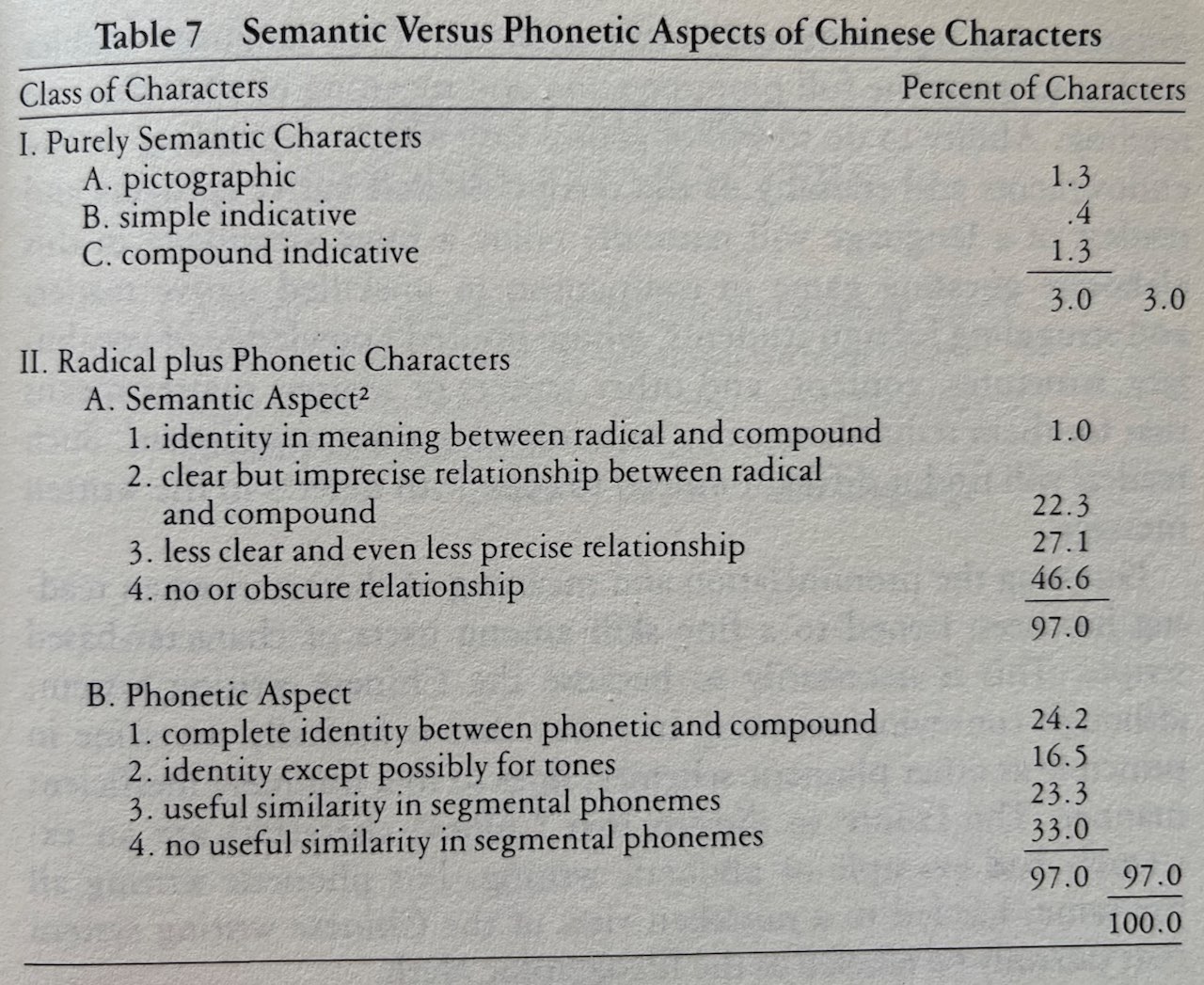
How limited is the number of pictographic or semantic characters, like “人”, “口”, “山”, etc., as opposed to the number of characters with some phonetic component related to pronunciation? This table from p. 129 of the book The Chinese Language: Fact and Fantasy says that only about 3% of all Chinese characters are purely pictographic or semantic:

Table 7 Semantic Versus Phonetic Aspects of Chinese Characters, p. 129, _The Chinese Language: Fact and Fantasy_

This myth, it is apparent, exists in two aspects. Both must be rejected. The first is that the Chinese characters constitute an existing system of ideographic writing. This has been shown to be factually untrue. The second aspect is the validity of the ideographic concept itself. I believe it to be completely untenable because there is no evidence that people have the capacity to master the enormous number of symbols that would be needed in a written system that attempts to convey thought without regard to sound, which means divorced from spoken language. …But while it is possible for a writing system to have many individual “ideographs” or “ideograms”, it is not possible to have a whole writing system based on the ideographic principle. Alphabetic writing requires mastery of several dozen symbols that are needed for phonemic representation. Syllabic writing requires mastery of what may be several hundred or several thousand symbols that are needed for syllabic representation. Ideographic writing, however, requires mastery of the tens of thousands or hundreds of thousands of symbols that would be needed for ideographic representation of words or concepts without regard to sound. A bit of common sense should suggest that unless we supplement our brains with computer implants, ordinary mortals are incapable of such memory feats.

Indeed, how many concepts exist, or could potentially come into existence as they get invented? That’s how many symbols an actual ideographic writing system would need to have. Obviously, even if such a system could be made to exist, it would be unusable by actual imperfect humans. Even Chinese characters, which “only” number somewhere over 100,000, are not numerous enough to be an actual ideographic writing system, and Chinese characters are already inhumanly complex and numerous.

Objections to the Term “Ideographic”

We need to go further and throw out the term itself.

Chinese characters represent words (or better, morphemes), not ideas, and they represent them phonetically, for the most part, as do all real writing systems despite their diverse techniques and differing effectiveness in accomplishing the task.

Both terms [“logographic” and “ideographic”] are inadequate and misleading because they fail to indicate that the process of getting from graph to word/morpheme involves the phonetic aspect of the latter and because this failure leaves the way open to the idea that we get from graph to word/morpheme by means of some nonphonetic, in a word, “ideographic”, approach. Only the adoption of some such term as “morphosyllabic”, which calls attention to the phonetic aspect, can contribute to dispelling the widespread misunderstanding of the nature of Chinese writing.

Chinese characters being a “morphosyllabic” writing system means that “each character is pronounced as a single syllable and represents a single morpheme* (smallest unit of language SOUND with meaning)—a Chinese character does NOT bypass language sounds to directly represent an idea.


So, every time you hear in Mandarin a name like “Hāmǐjíduōdùn (Armageddon 哈米吉多顿 哈米吉多頓) that came from another language, and is made up in Mandarin of syllables that make no sense except that they sound like the name in the original language, remember that the Ideographic Myth is just that—a myth!

As worshippers of the one true God Jehovah, we carefully avoid spiritual idolatry, realizing that no visible idol or image can be allowed to replace the invisible, almighty Spirit Jehovah as the object of our worship. Similarly, us Chinese field language learners must also carefully avoid the linguistic idolatry of considering visible Chinese characters to be direct representations of meaning in Chinese languages, when the truth is that in human languages, including Chinese languages, meaning is primarily transmitted via invisible speech.


* John DeFrancis, The Chinese Language: Fact and Fantasy (Honolulu: University of Hawaii Press, 1984), p. 125. ^