Categories
Culture Current Events

wǔyè

wǔyè+ (wǔ·yè {7th of the 12 Earthly Branches → [south (placed at the midnight position of Chinese directions charts)]} · night → [midnight] 午夜) ← Tap/click to show/hide the “flashcard”

[Notes: Tap/click on a Pīnyīn (Pīn·yīn {Piecing Together} · Sounds → [Pinyin] 拼音) expression to reveal its “flashcard”; tap/click on a “flashcard” or its Pīnyīn (Pīn·yīn {Piecing Together} · Sounds → [Pinyin] 拼音) expression to hide the “flashcard”. 📖 📄 ➕ icons mean 📖 Reveal All, 📄 Reveal Advanced, and ➕ Reveal + Symbols re all the “flashcards” in the heading, paragraph, etc. that they are placed at the beginning of.]

At the time of this writing, jw.org was featuring the article “Scientists Move the Doomsday Clock Forward—What Does the Bible Say?”. The Mandarin version of this article uses “Mòrì (Mò·rì End · {Sun → [Day]} → [Doomsday] 末日) Shízhōng (Shí·zhōng {(Particular) Times} · Clock → [Clock] 时钟 時鐘)” to translate “Doomsday Clock” (see the MEotW post on “shìjiè (shì·jiè {generation → [world]} · extent’s → [world’s] 世界) mòrì (mò·rì end · {sun → [day]} 末日)” for some info on “mòrì (mò·rì end · {sun → [day]} [→ [doomsday]] 末日)”), and it uses this week’s MEotW, “wǔyè (wǔ·yè {7th of the 12 Earthly Branches → [south (placed at the midnight position of Chinese directions charts)]} · night → [midnight] 午夜)” to translate “midnight”. Many Mandarin field language learners will be familiar with “ (night; evening夜/亱)”, which means “night” or “evening”, but what does “ ({7th of the 12 Earthly Branches} [→ [noon | midnight | south]] 午)” mean?

Earthly Branches

As shown in the Pīnyīn (Pīn·yīn {Piecing Together} · Sounds → [Pinyin] 拼音) Plus information for “+ ({7th of the 12 Earthly Branches} [→ [noon | midnight | south]] 午)”, its literal meaning is “7th of the 12 Earthly Branches”. What in the world are the “Earthly Branches”? Wikipedia summarizes for us that:

The twelve Earthly Branches or Terrestrial Branches[source] are a Chinese ordering system used throughout East Asia in various contexts

One of those contexts in which the Earthly Branches are traditionally used by the Chinese is to name the twelve two-hour periods that they divided each day into. In this system, the seventh Earthly Branch “ ({7th of the 12 Earthly Branches} [→ [noon | midnight | south]] 午)” is the name of the two-hour period from 11 am to 1 pm, which has noon at its centre. Thus, “ ({7th of the 12 Earthly Branches} [→ [noon | midnight | south]] 午)” is associated with “noon”, and we get expressions such as “wǔcān (wǔ·cān {7th of the 12 Earthly Branches → [noon]} · meal → [lunch] 午餐)”, meaning “noon meal”, or “lunch”.

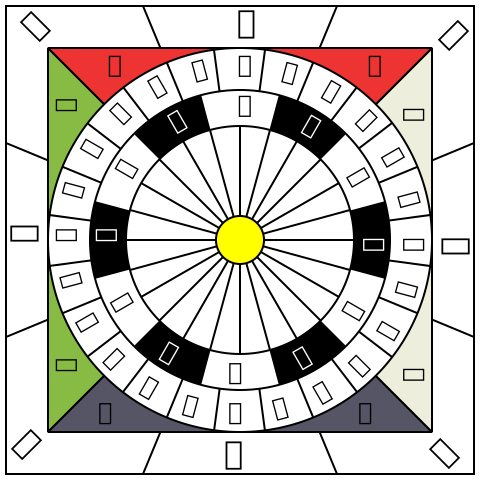
Wait a minute…how did an expression that’s associated with “noon” end up getting used in an expression that means “midnight”? This apparently happened because of a different context in which the Earthly Branches are also used, that of directions. In this context, “ ({7th of the 12 Earthly Branches} [→ [noon | midnight | south]] 午)” is used to mean “south”. Wait a minute…again…isn’t south at the bottom of a compass, while midnight is at the top of a clock? Well, check out this chart of the Chinese directions:

Directions used by Chinese mariners, astronomers, etc.

Directions used by Chinese mariners, astronomers, etc. By ancient Chinese convention, south, named “+ ({7th of the 12 Earthly Branches} → [south] 午)”, is placed at the top, in the midnight position.
Creative Commons Attribution-ShareAlike License logo Locoluis

Indeed, the Mandarin word for “compass”, “zhǐnán‐zhēn+ ((zhǐ·nán {(points with) finger → [points]} · south 指南)‐(zhēn needle) [compass])” (a past MEotW), which actually means “points south needle”, embodies that the ancient Chinese viewed north and south from the opposite viewpoint compared to modern Westerners, whose convention is that a compass needle points north. (Of course, as one end of a compass needle is pointing north, the other end is simultaneously pointing south, so both viewpoints are correct—they’re just coming from different directions.) Thus, on a compass marked with the Chinese directions, south is placed at the top, where a clock puts midnight. This, apparently, is how we get “wǔyè (wǔ·yè {7th of the 12 Earthly Branches → [south (placed at the midnight position of Chinese directions charts)]} · night → [midnight] 午夜)”, which means “south night” and is used to mean “midnight”.

Heavenly Stems

By the way, often used with the Earthly Branches are the Heavenly Stems. Anyone who’s been in the Mandarin field for a while will have already seen some of them, albeit probably without knowing it—if, say, a paragraph in an English Watchtower study article has more than one study question, the questions would be labelled with the ordinals “a”, “b”, “c”, etc., and the corresponding study questions in the Mandarin version would be labelled with the ordinals “Jiǎ ({1st of the 10 Heavenly Stems} → [a] 甲)”, “ ({2nd of the 10 Heavenly Stems} → [b] 乙) ”, “Bǐng ({3rd of the 10 Heavenly Stems} → [c] 丙)”, etc., which are part of the Heavenly Stems Chinese system of ordinals.

Usage Example

Here is an example of “wǔyè (wǔ·yè {7th of the 12 Earthly Branches → [south (placed at the midnight position of Chinese directions charts)]} · night → [midnight] 午夜)” in use, taken from the above-mentioned jw.org article:

English:

“Scientists revealed on Tuesday that the ‘Doomsday Clock’ has been moved up to 90 seconds before midnight—the closest humanity has ever been to armageddon.”—ABC News.

Mandarin:

📖 📄 📘Kēxuéjiā+ (Kē·xué·jiā {branches of study · learning → [science]} · -ists → [scientists] 科学家 科學家) zài (on 在) Zhōu’èr (Zhōu’·èr {Circle → [Week(day)]} · Two → [Tuesday] 周二 周/週二) de (’s 的) shíhou ({(particular) time} 时候 時候), jiāng (took) Mòrì (Mò·rì End · {Sun → [Day]} → [Doomsday] 末日) Shízhōng (Shí·zhōng {(Particular) Times} · Clock → [Clock] 时钟 時鐘) tiáokuài (tiáo·kuài {to be adjusted} · {to be fast(er) → [to be farther ahead]} 调快 調快) le ([indicates a change] 了), jùlí (jù·lí {to be apart from} · {to be leaving from → [to be at a distance from]} 距离 距離) wǔyè (wǔ·yè {7th of the 12 Earthly Branches → [south (placed at the midnight position of Chinese directions charts)]} · night → [midnight] 午夜) zhǐ (just只/秖/衹/祇) shèng ({having remaining}剩/賸) 90 miǎo (seconds 秒), shì ((this) is 是) rénlèi (rén·lèi human·kind’s 人类 人類) shǐ (history 史) shang (upon 上) zuì (most最/㝡) jiējìn (jiē·jìn {coming close to} · {to be near} 接近) shìjiè (shì·jiè {generation → [world]} · extent’s → [world’s] 世界) mòrì (mò·rì end · {sun → [day]} 末日) de (’s 的) shíkè+ (shí·kè {(particular) time} · {carving → [moment]} 时刻 時刻).”—ABC Xīnwén (Xīn·wén New · {(That Which) Is Heard} → [News] 新闻 新聞) (Yīngyǔ (Yīng·yǔ English · language 英语 英語))

Categories
Culture Current Events Language Learning Science

bǎilàn

bǎilàn+ (bǎi·làn {place; arrange → [assume; put on (air of) | exhibit; display]} · {being rotten; decayed; spoiled | worn out; broken; ragged; crappy | mushy} 摆烂 擺爛) ← Tap/click to show/hide the “flashcard”

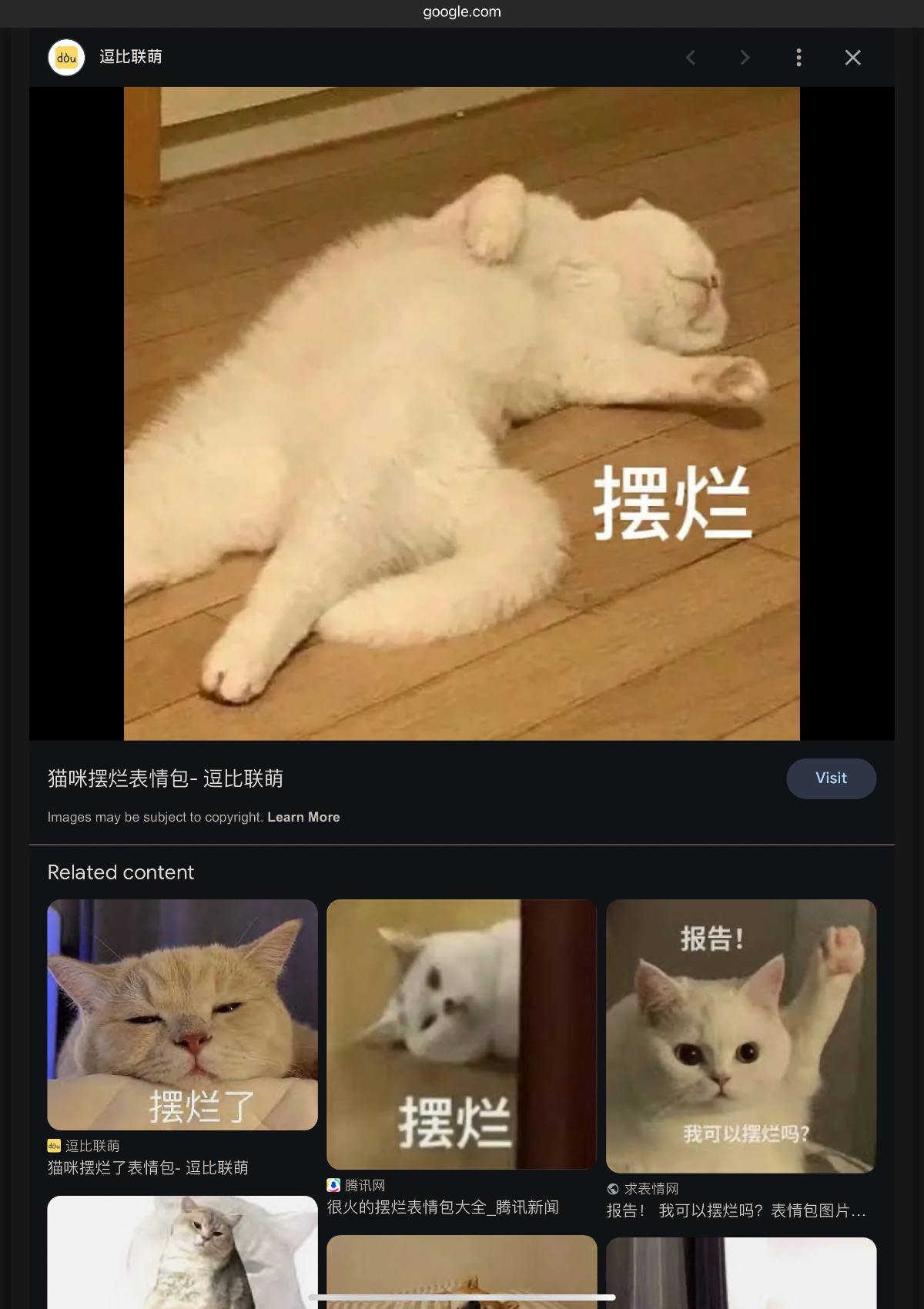
In 2022, this week’s MEotW, “bǎilàn (bǎi·làn {place; arrange → [assume; put on (air of) | exhibit; display]} · {being rotten; decayed; spoiled | worn out; broken; ragged; crappy | mushy} 摆烂 擺爛)”, gained popularity among some young people in China as an expression that represents their approach to life in view of the difficult, even seemingly hopeless work culture, societal expectations, etc. that they are faced with. “Bǎilàn (Bǎi·làn {place; arrange → [assume; put on (air of) | exhibit; display]} · {being rotten; decayed; spoiled | worn out; broken; ragged; crappy | mushy} 摆烂 擺爛)” represents a progression beyond “tǎngpíng (tǎng·píng lie; recline · {[to be] flat} 躺平)”, a past MEotW—just compare the cats!

Screenshot of some image results from searching for “摆烂” (“bǎilàn”) on Google

Some image results from searching for “摆烂” (bǎilàn (bǎi·làn {place; arrange → [assume; put on (air of) | exhibit; display]} · {being rotten; decayed; spoiled | worn out; broken; ragged; crappy | mushy} 摆烂 擺爛)) on Google

Reports from Around the Internet

Here are some of the many media reports about this expression:

The rise of ‘bai lan’: why China’s frustrated youth are ready to ‘let it rot’ | China | The Guardian

Here are some quotes from the above article:

In recent days, this phrase – and more previously ‘tang ping’ (lying flat, 躺平), which means rejecting gruelling competition for a low desire life – gained popularity as severe competition and high social expectations prompted many young Chinese to give up on hard work.

But bai lan has a more worrying layer in the way it is being used by young people in China: to actively embrace a deteriorating situation, rather than trying to turn it around.

Prof Mary Gallagher, director of the Centre for Chinese Studies at the University of Michigan, says ‘bai lan’ is not necessarily a sentiment unique to China. “It is a bit like the ‘slacker’ generation in America in the 1990s. And like ‘tang ping’ last year, it is also a rejection against the ultra-competitiveness of today’s Chinese society.”

More than 18% of young Chinese people aged between 16 and 24 were jobless in April – the highest since the official record began. “Hard to find a job after graduation this year? Fine, I’ll just bai lan – stay at home and watch TV all day,” wrote one netizen who struggled to find work, despite China’s top leader urged young people to fight for the future.

Language Log » “Let it rot”

For a really deep dive into “bǎilàn (bǎi·làn {place; arrange → [assume; put on (air of) | exhibit; display]} · {being rotten; decayed; spoiled | worn out; broken; ragged; crappy | mushy} 摆烂 擺爛)”, check out this extended video news report from CNA, an English language news network based in Singapore:

“Letting It Rot” in the Mandarin Field?

Perhaps we can apply “bǎilàn (bǎi·làn {place; arrange → [assume; put on (air of) | exhibit; display]} · {being rotten; decayed; spoiled | worn out; broken; ragged; crappy | mushy} 摆烂 擺爛)” to how some may be resigned to being “crappy”, or at best mediocre, at the language-related aspects of being in the Mandarin field.

Some Mandarin field language learners have noticed that after an initial period of progress, they—and perhaps some/many of their fellow workers—may have plateaued, or leveled out in how good they are with the Mandarin language. Instead of moving on to a reasonable level of fluency or mastery, they may have gotten stuck for a long time at a “crappy” or at best mediocre level.

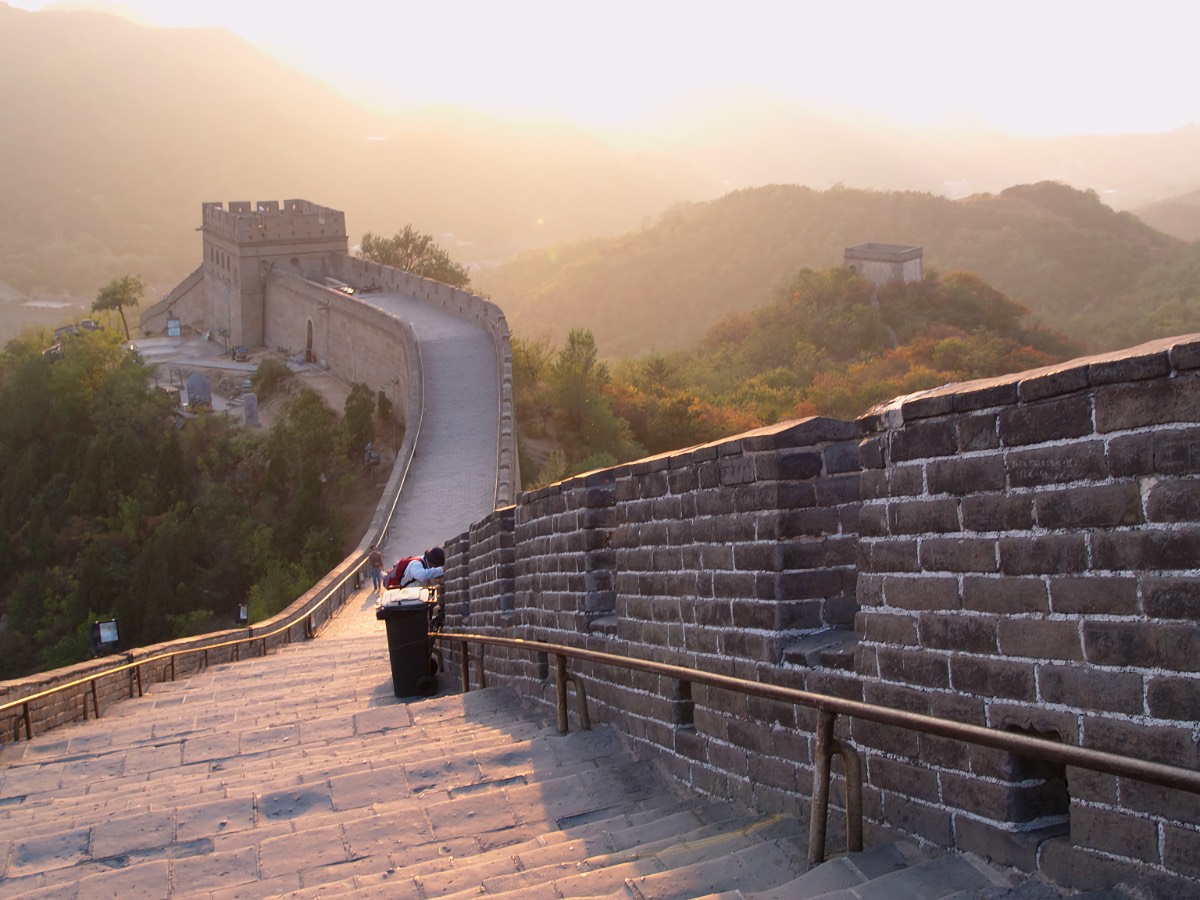
They may be resigned to this situation, or they may even actively embrace it, perhaps reasoning that the Great Wall of Characters is what it is, or that Mandarin just sounds too different from what they’re used to (e.g., with its tones), or that they personally just don’t have the intelligence or the talent to do any better. They may thus quit trying to do any better, or they may even quit the Mandarin field altogether. Such ones have effectively chosen to “bǎilàn+ (bǎi·làn {arrange → [exhibit]} · {being crappy} 摆烂 擺爛)” with regard to their Mandarin and their service in the Mandarin field.

The Great Wall of China

Can we do better than to bǎilàn (bǎi·làn {arrange → [exhibit]} · {being crappy} 摆烂 擺爛) when faced with the Great Wall of Characters?

Note, though, that changing to focus on first principles of language rather than sticking to played out traditional learning methods can provide fuel and energy for progress beyond being “crappy” or just mediocre at using the Mandarin language in your service to Jehovah God and your Mandarin-speaking neighbours. For example, while traditional Chinese culture dictates that Mandarin learners must focus on learning the extraordinarily and unnecessarily complex Chinese characters, first principles of language–as illuminated by linguistics, the scientific study of language—hold that SPEECH is actually the primary aspect of any human language, not writing, even if that writing is as traditionally and culturally entrenched as Chinese characters are. Indeed, I can personally testify that I have found that changing focus from the traditionally mandated crazy-complex characters to Mandarin SPEECH, with the help of the simple and elegant Pīnyīn (Pīn·yīn {Piecing Together} · Sounds → [Pinyin] 拼音) writing system, is working to help me make noticeable ongoing progress in how much Mandarin I understand, and in how much I speak and sound like a native speaker of Mandarin.

Of course, such progress is personally satisfying, but as Jehovah’s dedicated servants and fellow workers, we should be even more concerned about how Jehovah views our efforts. Here are a couple of scriptures that may help us to understand Jehovah’s view of unnecessarily “crappy” or mediocre ‘sacrifices of praise’ (Hebrews 13:15) that some may offer in the Mandarin field:

6 “‘A son honors a father, and a servant his master. So if I am a father, where is the honor due me? And if I am a master, where is the fear due me?’ Jehovah of armies says to you priests who are despising my name.

“‘But you say: “How have we despised your name?”’

7 “‘By presenting polluted food on my altar.’

“‘And you say: “How have we polluted you?”’

“‘By saying: “The table of Jehovah is something to be despised.” 8 And when you present a blind animal as a sacrifice, you say: “It is nothing bad.” And when you present a lame animal or a sick one: “It is nothing bad.”’”

“Try presenting them, please, to your governor. Will he be pleased with you or receive you with favor?” says Jehovah of armies.

9 “And now, please, appeal to God, that he may show us favor. With such offerings from your own hand, will he receive any of you with favor?” says Jehovah of armies.

Malachi 1:6–9.

15 ‘I know your deeds, that you are neither cold nor hot. I wish you were cold or else hot. 16 So because you are lukewarm and neither hot nor cold, I am going to vomit you out of my mouth. 17 Because you say, “I am rich and have acquired riches and do not need anything at all,” but you do not know that you are miserable and pitiful and poor and blind and naked, 18 I advise you to buy from me gold refined by fire so that you may become rich, and white garments so that you may become dressed and that the shame of your nakedness may not be exposed, and eyesalve to rub in your eyes so that you may see.

Revelation 3:15–18.

We should also remember that moving beyond “crappiness” or mediocrity in our Mandarin can help us to be more able to give spiritual help to the people in the Mandarin field who looking for something beyond the crappiness and mediocrity of this old system of things, something beyond the selfish, materialistic, and ultimately meaningless rat race promoted by Satan’s world. These people need the good news of God’s Kingdom, and they need people like us to share it with them in a language that they will understand and respond to from the heart.—Mark 6:34.

Categories
Current Events

dòngdàng‐bù’ān

dòngdàng+ (dòng·dàng {[is] moving} · {[is] swinging; shaking; swaying} → [[is] suffering unrest/upheaval/turmoil; unstable; turbulent; chaotic] 动荡 動蕩/盪)bù’ān+ (bù’·ān not · {[is] peaceful; tranquil; calm} 不安) ← Tap/click to show/hide the “flashcard”

[Notes: Tap/click on a Pīnyīn (Pīn·yīn {Piecing Together} · Sounds → [Pinyin] 拼音) expression to reveal its “flashcard”; tap/click on a “flashcard” or its Pīnyīn (Pīn·yīn {Piecing Together} · Sounds → [Pinyin] 拼音) expression to hide the “flashcard”. 📖 📄 ➕ icons mean 📖 Reveal All, 📄 Reveal Advanced, and ➕ Reveal + Symbols re all the “flashcards” in the heading, paragraph, etc. that they are placed at the beginning of.]

At the time of this writing, jw.org was featuring the article “2022: A Year of Turmoil—What Does the Bible Say?”. Although we do not participate in New Year’s celebrations, we may find it beneficial to talk to people who are looking back on the past year at around this time, and who may be a little more contemplative than usual about the significance of the things that happened over the course of that tumultuous year.

To correspond with the sense of the English word “turmoil” (a noun), the Mandarin version of the above-mentioned article uses this week’s MEotW, “dòngdàng (dòng·dàng {[is] moving} · {[is] swinging; shaking; swaying} → [[is] suffering unrest/upheaval/turmoil; unstable; turbulent; chaotic] 动荡 動蕩/盪)bù’ān (bù’·ān not · {[is] peaceful; tranquil; calm} 不安)” (an adjective phrase which can mean “suffered turmoil”), to describe the year 2022.

Related Expressions

The “dòng (move [→ [stir | arouse | change; alter]])” in “dòngdàng (dòng·dàng {[is] moving} · {[is] swinging; shaking; swaying} → [[is] suffering unrest/upheaval/turmoil; unstable; turbulent; chaotic] 动荡 動蕩/盪)bù’ān (bù’·ān not · {[is] peaceful; tranquil; calm} 不安)” literally means “moving”, and is used in a wide variety of other expressions. These include expressions as different as “dòngcí+ (dòng·cí moving · word → [verb] 动词 動詞)”, “dònglì+ (dòng·lì moving · force 动力 動力)”, “gǎndòng+ (gǎn·dòng feeling · moved | {make to feel} · move 感动 感動)”, and “dòngwù+ (dòng·wù moving · thing → [animal] 动物 動物)”.

The “ān+ ({set (sb.’s mind) at ease; calm} | {rest content; be satisfied} | {place in a suitable position [→ [install; fix; fit; set up]]} | {[is] peaceful; tranquil; calm; quiet [→ [[is] safe; secure; in good health]]} 安)” in “dòngdàng (dòng·dàng {[is] moving} · {[is] swinging; shaking; swaying} → [[is] suffering unrest/upheaval/turmoil; unstable; turbulent; chaotic] 动荡 動蕩/盪)bù’ān (bù’·ān not · {[is] peaceful; tranquil; calm} 不安)” has several different meanings, and it appears in well-known expressions such as “ānníng ({being peaceful}; {being tranquil} [→ [peace; tranquillity]] 安宁 安寧)”, “píng’ān (píng’·ān {[is] flat, level, even → [[is] peaceful]} · {[is] safe, secure} (nwtsty-CHS Appx. A2 says this term mainly refers to things being smooth and stable, safe and secure, free of danger) 平安)”, “ānquán (ān·quán {[being] safe} · {[being] whole} → [[being] safe; secure | safety; security] 安全)”, and “ānpái (ān·pái {placing in a suitable position} · {arranging; putting in order; sequencing; lining up} → [arranging | arrangement] 安排)”. It was also chosen to be included in the Mandarin version of the name “Anna”, “Ānnà (Anna 安娜)”, which is a past MEotW.

Neeta introduces herself to Jade (with Mandarin subtitle)
(I 我) jiào ({am called}叫/呌) Ānnà+ (Anna 安娜)

Usage Example

Here is an example of “dòngdàng (dòng·dàng {[is] moving} · {[is] swinging; shaking; swaying} → [[is] suffering unrest/upheaval/turmoil; unstable; turbulent; chaotic] 动荡 動蕩/盪)bù’ān (bù’·ān not · {[is] peaceful; tranquil; calm} 不安)” in use, adapted from the above-mentioned article:

English:

2022 was a year of turmoil. During 2022, war, economic hardship, and environmental disasters have dominated the news.

Mandarin:

📖 📄 📘 Dòngdàng (Dòng·dàng moved · swayed → [suffered turmoil] 动荡 動蕩/盪)bù’ān (bù’·ān not · peaceful 不安) de (’s 的) 2022 nián (year年/秊), zhànzhēng (zhàn·zhēng war · contending → [war] 战争 戰爭), jīngjì (jīng·jì {(of) managing of} · {crossing of a river → [helping]} → [economic] 经济 經濟) wēijī (wēi·jī {(for) ridge of a roof → [(for) danger]} · occasions → [crises] 危机 危機), huánjìng (huán·jìng surrounding · {boundaries → [(bounded) place] → [situation]} → [environmental] 环境 環境) wèntí (wèn·tí asking · problems → [problems] 问题 問題) zhī ( 之) lèi (kind) de (’s 的) bàodǎo (bào·dǎo reporting · instructing (things) → [news reports] 报导 報導) zhànjùle (zhàn·jù·le seized · occupied · [indicates a change] 占据了 占/佔據了) xīnwén (xīn·wén new · {(that which) is heard} → [news] 新闻 新聞) tóutiáo+ (tóu·tiáo head · {strips → [articles]} → [lead news stories] 头条 頭條).