Categories
Culture Current Events Language Learning Science

bǎilàn

bǎilàn (bǎi·làn {place; arrange → [assume; put on (air of) | exhibit; display]} · {being rotten; decayed; spoiled | worn out; broken; ragged; crappy | mushy} 摆烂 擺爛) ← Tap/click to show/hide the “flashcard”

In 2022, this week’s MEotW, “bǎilàn (bǎi·làn {place; arrange → [assume; put on (air of) | exhibit; display]} · {being rotten; decayed; spoiled | worn out; broken; ragged; crappy | mushy} 摆烂 擺爛)”, gained popularity among some young people in China as an expression that represents their approach to life in view of the difficult, even seemingly hopeless work culture, societal expectations, etc. that they are faced with. “Bǎilàn (Bǎi·làn {place; arrange → [assume; put on (air of) | exhibit; display]} · {being rotten; decayed; spoiled | worn out; broken; ragged; crappy | mushy} 摆烂 擺爛)” represents a progression beyond “tǎngpíng (tǎng·píng lie; recline · {[to be] flat} 躺平)”, a past MEotW—just compare the cats!
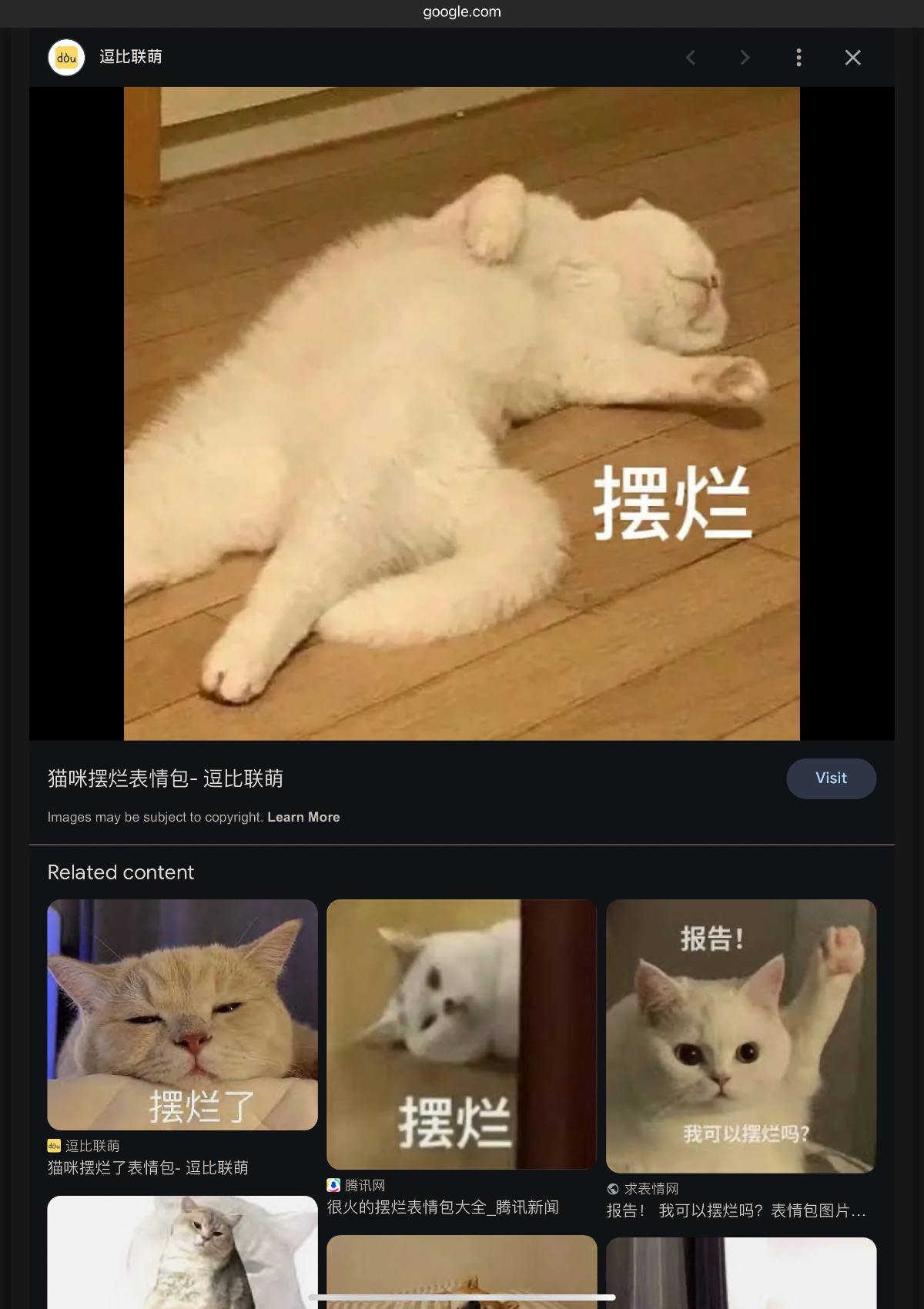
Screenshot of some image results from searching for “摆烂” (“bǎilàn”) on Google

Some image results from searching for “摆烂” (bǎilàn (bǎi·làn {place; arrange → [assume; put on (air of) | exhibit; display]} · {being rotten; decayed; spoiled | worn out; broken; ragged; crappy | mushy} 摆烂 擺爛)) on Google

Reports from Around the Internet

Here are some of the many media reports about this expression:

The rise of ‘bai lan’: why China’s frustrated youth are ready to ‘let it rot’ | China | The Guardian

Here are some quotes from the above article:

In recent days, this phrase – and more previously ‘tang ping’ (lying flat, 躺平), which means rejecting gruelling competition for a low desire life – gained popularity as severe competition and high social expectations prompted many young Chinese to give up on hard work.

But bai lan has a more worrying layer in the way it is being used by young people in China: to actively embrace a deteriorating situation, rather than trying to turn it around.

Prof Mary Gallagher, director of the Centre for Chinese Studies at the University of Michigan, says ‘bai lan’ is not necessarily a sentiment unique to China. “It is a bit like the ‘slacker’ generation in America in the 1990s. And like ‘tang ping’ last year, it is also a rejection against the ultra-competitiveness of today’s Chinese society.”

More than 18% of young Chinese people aged between 16 and 24 were jobless in April – the highest since the official record began. “Hard to find a job after graduation this year? Fine, I’ll just bai lan – stay at home and watch TV all day,” wrote one netizen who struggled to find work, despite China’s top leader urged young people to fight for the future.

Language Log » “Let it rot”

For a really deep dive into “bǎilàn (bǎi·làn {place; arrange → [assume; put on (air of) | exhibit; display]} · {being rotten; decayed; spoiled | worn out; broken; ragged; crappy | mushy} 摆烂 擺爛)”, check out this extended video news report from CNA, an English language news network based in Singapore:

“Letting It Rot” in the Mandarin Field?

Perhaps we can apply “bǎilàn (bǎi·làn {place; arrange → [assume; put on (air of) | exhibit; display]} · {being rotten; decayed; spoiled | worn out; broken; ragged; crappy | mushy} 摆烂 擺爛)” to how some may be resigned to being “crappy”, or at best mediocre, at the language-related aspects of being in the Mandarin field.

Some Mandarin field language learners have noticed that after an initial period of progress, they—and perhaps some/many of their fellow workers—may have plateaued, or leveled out in how good they are with the Mandarin language. Instead of moving on to a reasonable level of fluency or mastery, they may have gotten stuck for a long time at a “crappy” or at best mediocre level.

They may be resigned to this situation, or they may even actively embrace it, perhaps reasoning that the Great Wall of Characters is what it is, or that Mandarin just sounds too different from what they’re used to (e.g., with its tones), or that they personally just don’t have the intelligence or the talent to do any better. They may thus quit trying to do any better, or they may even quit the Mandarin field altogether. Such ones have effectively chosen to “bǎilàn (bǎi·làn {arrange → [exhibit]} · {being crappy} 摆烂 擺爛)” with regard to their Mandarin and their service in the Mandarin field.

The Great Wall of China

Can we do better than to bǎilàn (bǎi·làn {arrange → [exhibit]} · {being crappy} 摆烂 擺爛) when faced with the Great Wall of Characters?

Note, though, that changing to focus on first principles of language rather than sticking to played out traditional learning methods can provide fuel and energy for progress beyond being “crappy” or just mediocre at using the Mandarin language in your service to Jehovah God and your Mandarin-speaking neighbours. For example, while traditional Chinese culture dictates that Mandarin learners must focus on learning the extraordinarily and unnecessarily complex Chinese characters, first principles of language–as illuminated by linguistics, the scientific study of language—hold that SPEECH is actually the primary aspect of any human language, not writing, even if that writing is as traditionally and culturally entrenched as Chinese characters are. Indeed, I can personally testify that I have found that changing focus from the traditionally mandated crazy-complex characters to Mandarin SPEECH, with the help of the simple and elegant Pīnyīn (Pīn·yīn {Piecing Together} · Sounds → [Pinyin] 拼音) writing system, is working to help me make noticeable ongoing progress in how much Mandarin I understand, and in how much I speak and sound like a native speaker of Mandarin.

Of course, such progress is personally satisfying, but as Jehovah’s dedicated servants and fellow workers, we should be even more concerned about how Jehovah views our efforts. Here are a couple of scriptures that may help us to understand Jehovah’s view of unnecessarily “crappy” or mediocre ‘sacrifices of praise’ (Hebrews 13:15) that some may offer in the Mandarin field:

6 “‘A son honors a father, and a servant his master. So if I am a father, where is the honor due me? And if I am a master, where is the fear due me?’ Jehovah of armies says to you priests who are despising my name.

“‘But you say: “How have we despised your name?”’

7 “‘By presenting polluted food on my altar.’

“‘And you say: “How have we polluted you?”’

“‘By saying: “The table of Jehovah is something to be despised.” 8 And when you present a blind animal as a sacrifice, you say: “It is nothing bad.” And when you present a lame animal or a sick one: “It is nothing bad.”’”

“Try presenting them, please, to your governor. Will he be pleased with you or receive you with favor?” says Jehovah of armies.

9 “And now, please, appeal to God, that he may show us favor. With such offerings from your own hand, will he receive any of you with favor?” says Jehovah of armies.

Malachi 1:6–9.

15 ‘I know your deeds, that you are neither cold nor hot. I wish you were cold or else hot. 16 So because you are lukewarm and neither hot nor cold, I am going to vomit you out of my mouth. 17 Because you say, “I am rich and have acquired riches and do not need anything at all,” but you do not know that you are miserable and pitiful and poor and blind and naked, 18 I advise you to buy from me gold refined by fire so that you may become rich, and white garments so that you may become dressed and that the shame of your nakedness may not be exposed, and eyesalve to rub in your eyes so that you may see.

Revelation 3:15–18.

We should also remember that moving beyond “crappiness” or mediocrity in our Mandarin can help us to be more able to give spiritual help to the people in the Mandarin field who looking for something beyond the crappiness and mediocrity of this old system of things, something beyond the selfish, materialistic, and ultimately meaningless rat race promoted by Satan’s world. These people need the good news of God’s Kingdom, and they need people like us to share it with them in a language that they will understand and respond to from the heart.—Mark 6:34.
Categories
Culture Current Events Language Learning

sàng

sàng ({lost (by death)} [→ [lost (sth. important) | bereaved | dejected; frustrated; disappointed; discouraged]]) ← Tap/click to show/hide the “flashcard”

The post about past MEotW “tǎngpíng (tǎng·píng lie; recline · {[to be] flat} 躺平)” refers to this article:

Screenshot of the article “Tired of Running in Place, Young Chinese ‘Lie Down’ ”, on the Sixth Tone website

This article in turn refers to an article about the culture of “sàng ({lost (by death)} [→ [lost (sth. important) | bereaved | dejected; frustrated; disappointed; discouraged]])”, this week’s MEotW.

What is sàng ({lost (by death)} [→ [lost (sth. important) | bereaved | dejected; frustrated; disappointed; discouraged]]) culture, or, in Mandarin, sàng ({lost (by death)} [→ [lost (sth. important) | bereaved | dejected; frustrated; disappointed; discouraged]]) wénhuà (wén·huà {(with) writing} · transformed (system) → [culture] 文化)?

Another article that I found provides this nice, simple description: (Note: The rest of the article contains some good information, but has a couple of curse words.)

A little Mandarin lesson here-

The character 丧 is a polyphone in mandarin Chinese. When it is pronounced sāng, it loosely translates to funeral or mourning. When as sàng, it could be referring to either losing certain things or people (“丧失”), or a conglomeration of negative emotions such as feeling depressed, angry, disappointed and vexed.

And the sàng culture we are talking about here really takes both meanings: it is, very vaguely, the idea that you’ve lost something and are feeling horrible about it.

Manifestations

This article also goes on to mention some ways in which sàng ({lost (by death)} [→ [lost (sth. important) | bereaved | dejected; frustrated; disappointed; discouraged]]) wénhuà (wén·huà {(with) writing} · transformed (system) → [culture] 文化) has been manifested:

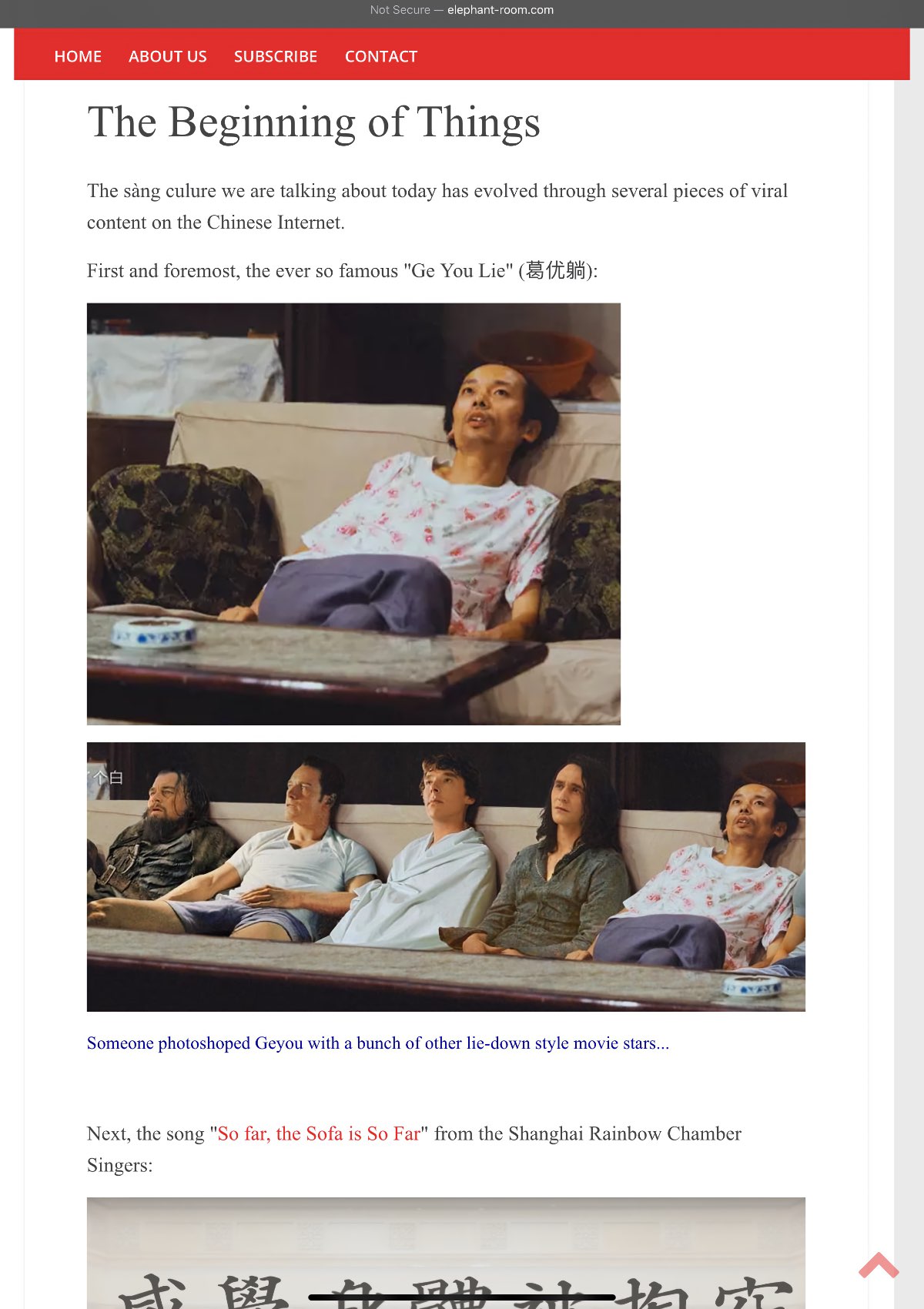
Screenshot of the article “The Culture of sàng: a Generation Lying-down? | China Buzz Report”, on the Elephant Room website

As the above article mentions, and as shown in the above screenshot, one of the first manifestations of sàng ({lost (by death)} [→ [lost (sth. important) | bereaved | dejected; frustrated; disappointed; discouraged]]) wénhuà (wén·huà {(with) writing} · transformed (system) → [culture] 文化) was the “Gě Yōu ((Gě [surname] 葛) (Yōu Ample; Abundant [→ [Excellent; Superior]] | Actor; Actress優/优) (a Chinese actor)) tǎng ({lies down} 躺)” set of memes, viral content on the Chinese Internet. (Gě Yōu ((Gě [surname] 葛) (Yōu Ample; Abundant [→ [Excellent; Superior]] | Actor; Actress優/优) (a Chinese actor)) is a well-known Chinese actor, and the picture in the above screenshot is from the 1993 TV show (I 我) Ài (Love) (My 我) Jiā (Family 家), in which he plays the role of “a parasitical freeloader who was unemployed and broke and consistently failed in his filial responsibilities”, as one academic article put it.)

A translation of a Chinese article on sàng ({lost (by death)} [→ [lost (sth. important) | bereaved | dejected; frustrated; disappointed; discouraged]]) wénhuà (wén·huà {(with) writing} · transformed (system) → [culture] 文化) contains these comments about the image that the “Gě Yōu ((Gě [surname] 葛) (Yōu Ample; Abundant [→ [Excellent; Superior]] | Actor; Actress優/优) (a Chinese actor)) tǎng ({lies down} 躺)” memes are based on:

This image runs contrary to the positive, healthy and upwardly mobile mainstream views that people of all generations favor. It does, however, fit in well with the youth culture of today. His decadence, despair, pessimism and hopelessness are exactly the inner state of this group of masses who work overtime, eat overtime, are under constant pressure and are having a hard time making a living.

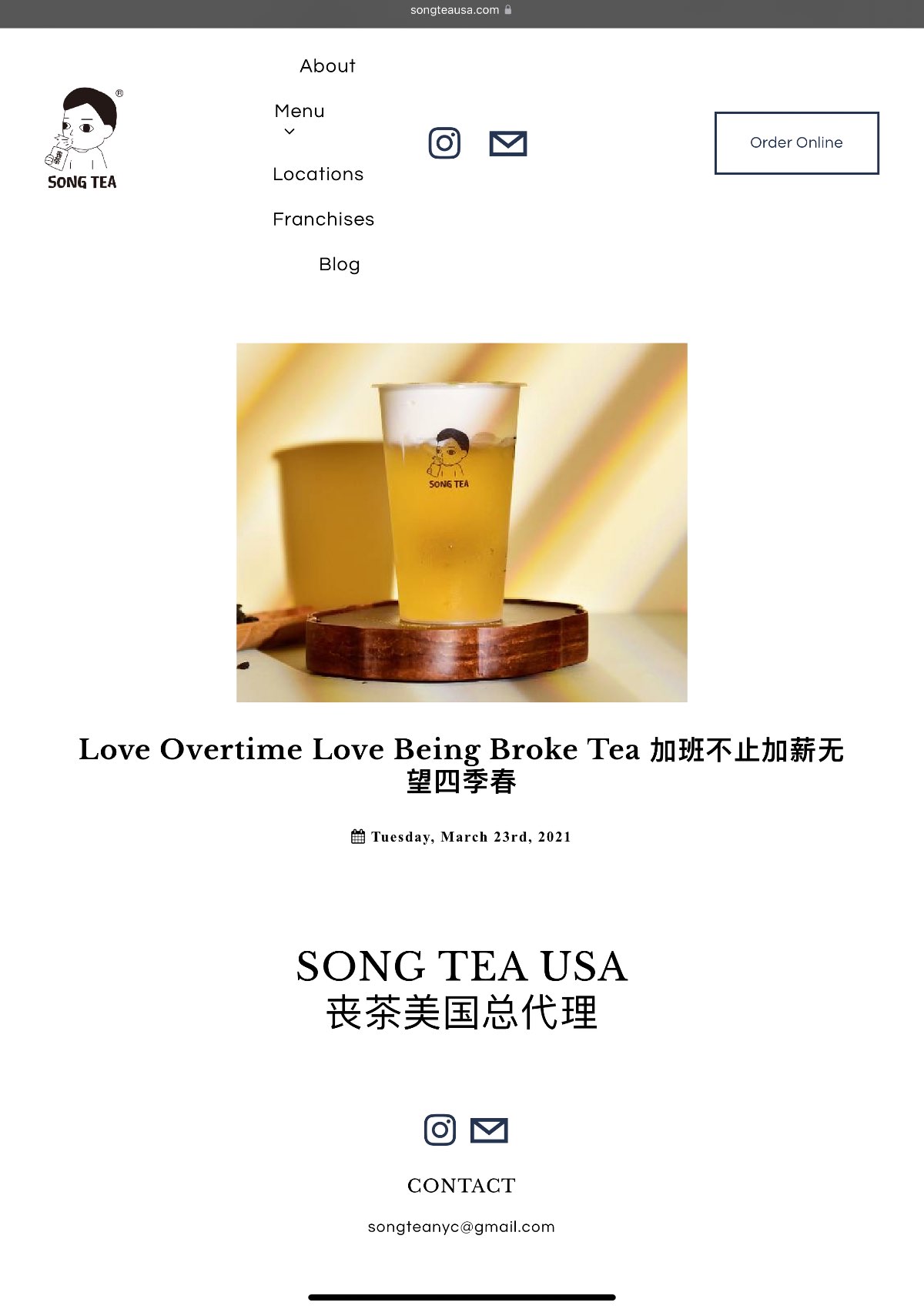
Speaking of making a living, one business named Sàng ({Lost (by Death)} [→ [Lost (Sth. Important) | Bereaved | Dejected; Frustrated; Disappointed; Discouraged]]) Chá (Tea 茶) (English name: Song Tea) is opportunistically riding the wave of sàng ({lost (by death)} [→ [lost (sth. important) | bereaved | dejected; frustrated; disappointed; discouraged]]) culture with a chain of tea shops that uses tongue-in-cheek black humour in the names of its drinks, such as this one featured on its USA blog:

Screenshot of the blog post “Love Overtime Love Being Broke Tea 加班不止加薪无望四季春 - 丧茶美国总代理Song Tea”, on the Song Tea USA website

From Feeling Bereaved to Lying Flat

The “tǎng ({lies down} 躺)” used in “Gě Yōu ((Gě [surname] 葛) (Yōu Ample; Abundant [→ [Excellent; Superior]] | Actor; Actress優/优) (a Chinese actor)) tǎng ({lies down} 躺)” is the same one as the one in “tǎngpíng (tǎng·píng lie; recline · {[to be] flat} 躺平)”, and “sàng ({lost (by death)} [→ [lost (sth. important) | bereaved | dejected; frustrated; disappointed; discouraged]])” is indeed related to “tǎngpíng (tǎng·píng lie; recline · {[to be] flat} 躺平)”. Perhaps it can be said that the feeling of sàng ({lost (by death)} [→ [lost (sth. important) | bereaved | dejected; frustrated; disappointed; discouraged]]) moves many of those experiencing it to take the action of tǎngpíng (tǎng·píng lying; reclining · {[to be] flat} 躺平). As an above-mentioned article on tǎngpíng (tǎng·píng lie; recline · {[to be] flat} 躺平) says:

Unlike similar, previous terms to have had their time in the spotlight in recent years, tang ping is an action rather than a feeling — resolving to just scrape by, exerting the bare minimum effort at an unfulfilling job, as opposed to the futility of raging against the capitalist machine.

Echoing the West?

The title of one of the articles mentioned above, “Turn Off, Drop Out: Why Young Chinese Are Abandoning Ambition”, appears to be a play on the Western counterculture-era phrase “turn on, tune in, drop out”. In the 1960s, while the West was going through its counterculture era, China was in contrast undergoing its Cultural Revolution—a very different thing! Perhaps, similarly to how China is now racing off into space, and even to the moon, as the West did decades ago, it is now also in some ways changing in its popular culture, as the West did decades ago.

Stand Strong for These “Sheep Without a Shepherd”

If you are mourning your lack of progress in learning Mandarin despite your strenuous efforts to learn the traditionally mandated but extraordinarily and unnecessarily complex Chinese characters, please be assured that there is an alternative to just quitting the Mandarin field. Focusing on Mandarin SPEECH with the help of the simple and elegant Pīnyīn (Pīn·yīn {Piecing Together} · Sounds → [Pinyin] 拼音) writing system can help you get a grip on understanding Mandarin speech, and on using it to give meaningful spiritual help to those in the worldwide field whose mother tongue is Mandarin.

As this look at sàng ({lost (by death)} [→ [lost (sth. important) | bereaved | dejected; frustrated; disappointed; discouraged]]) culture shows us, many of them are feeling the need for something beyond the selfish, materialistic, and ultimately meaningless rat race promoted by Satan’s world—they need the good news of God’s Kingdom, and they need people like us to share it with them in a language that they will understand and respond to from the heart.—Mr. 6:34.

Categories
Culture Current Events Language Learning

tǎngpíng

tǎngpíng (tǎng·píng lie; recline · {[to be] flat} 躺平) ← Tap/click to show/hide the “flashcard”

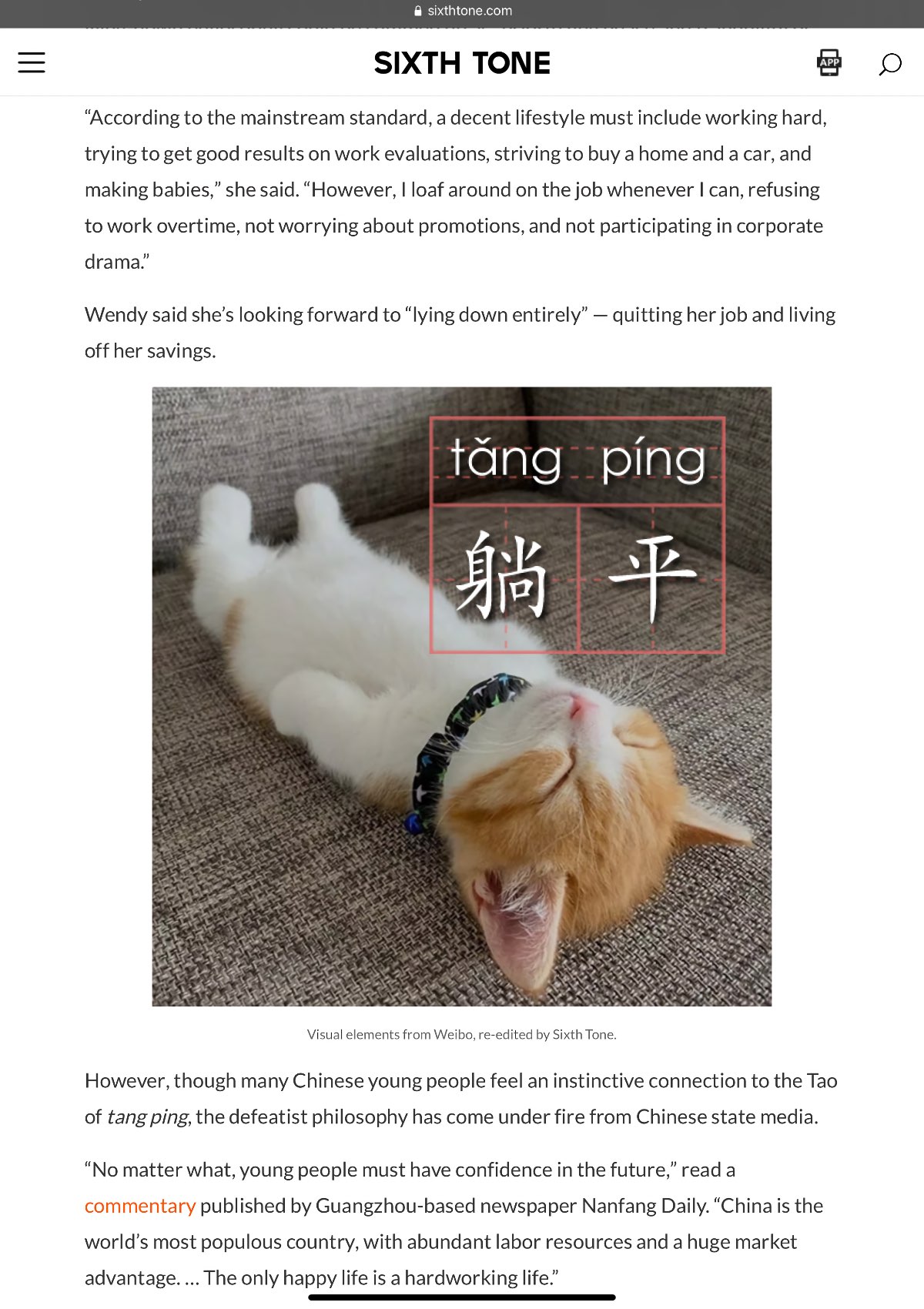
I recently came across an interesting article on the website Sixth Tone*, about this week’s MEotW, “tǎngpíng (tǎng·píng lie; recline · {[to be] flat} 躺平)”.

Screenshot of the article “Tired of Running in Place, Young Chinese ‘Lie Down’ ”, on the Sixth Tone website

This Sixth Tone article is about how some cool cats are dropping out of the Chinese rat race.

The article briefly describes how this word is being used now by people in China:

China’s young people have coined yet another neologism to reflect their growing disillusionment with the country’s often oppressive work culture. Rather than trying to keep up with society’s expectations or fight them, many are resolving to simply “lie down.”

The new lifestyle buzzword, tang ping, stems from a now-deleted post on forum site Tieba. Unlike similar, previous terms to have had their time in the spotlight in recent years, tang ping is an action rather than a feeling — resolving to just scrape by, exerting the bare minimum effort at an unfulfilling job, as opposed to the futility of raging against the capitalist machine.

Chinese “Rat Race”

The above reference to China’s “often oppressive work culture” may remind one of the English term “rat race”, which is referred to later in the above-mentioned article. The Online Etymology Dictionary tells us about an early application of “rat race”:

A rat race is … a simple game of “follow the leader” in fighter planes. The leader does everything he can think of — Immelmanns, loops, snap rolls, and turns, always turns, tighter and tighter. [Popular Science, May 1941]

Of course, “rat race” also went on to refer to “fiercely competitive struggle”. Wikipedia describes it this way:

A rat race is an endless, self-defeating, or pointless pursuit. The phrase equates humans to rats attempting to earn a reward such as cheese, in vain. It may also refer to a competitive struggle to get ahead financially or routinely.

The term is commonly associated with an exhausting, repetitive lifestyle that leaves no time for relaxation or enjoyment.

The Most Rational Choice?

Continuing on, the Sixth Tone article goes into an interview with Huang Ping, a literature professor at East China Normal University who researches youth culture:

“The state is worried about what would happen if everyone stopped working,” said Huang. But he doesn’t necessarily agree with the media reactions. “Humans aren’t merely tools for making things,” he said.

To lie down is a rational choice rather than a negative attitude, Huang explained. For some young people, it’s a way for them to unburden themselves. “When you can’t catch up with society’s development — say, skyrocketing home prices — tang ping is actually the most rational choice,” he said.

According to Professor Huang, lying down can be seen as the opposite of involution — a decades-old academic term referring to societies becoming trapped in ceaseless cycles of competition that resurfaced last year as an online buzzword in China. [“Nèijuǎn (Nèi·juǎn inner · rolling → [involution] 内卷 內卷/捲)”, the Mandarin word for this, is a past MEotW.] “In a relatively good social environment, people may feel involuted, but at least they’re trying,” he said. “If it’s worse, people will tang ping.”

A Rational Reaction of Mandarin-Learners to Chinese Characters?

Many who are learning Mandarin to help in the Mandarin language field find the Chinese characters writing system to be unreasonably difficult to learn and use for regular human beings in their situation. So, kind of like the people mentioned above who are faced with China’s “often oppressive work culture”, they stop trying to deal with Chinese characters and tǎngpíng (tǎng·píng lie; recline · {[to be] flat} 躺平), some even ultimately leaving the Mandarin field because of this.

Is this a rational reaction? Besides just toughing it out, is there another alternative to just quitting the Mandarin field because of the extraordinary difficulties associated with Chinese characters?

Chinese characters are indeed so complex and haphazardly designed that trying to learn them (and also remember them) is an unachievably difficult ordeal for all but a talented/stubborn minority. So, for many, it may indeed be rational to tǎngpíng (tǎng·píng lie; recline · {[to be] flat} 躺平) when it comes to the traditionally mandated Chinese characters.

Thankfully, though, the simple, elegant Pīnyīn (Pīn·yīn {Piecing Together} · Sounds → [Pinyin] 拼音) writing system for Mandarin offers a reasonable alternative to Chinese characters in many situations. Some may be reluctant to use it because of being concerned about miànzi (miàn·zi face · [suf for nouns] [→ [reputation; prestige; esteem; honor]] 面子) (a past MEotW) in the eyes of character-loving Chinese traditionalists, but really, as ones who seek to walk on the narrow road Jesus spoke of, the approval of the tradition-loving majority should not be something we are overly concerned about.—Matthew 7:13, 14.

With the help of Pīnyīn (Pīn·yīn {Piecing Together} · Sounds → [Pinyin] 拼音) and a proper focus on Mandarin speech instead of on the traditionally mandated Chinese characters (while just learning as many characters as they reasonably can), many who in all rationality have chosen to tǎngpíng (tǎng·píng lie; recline · {[to be] flat} 躺平) with regard to focusing on Chinese characters can still make a go of it in the Mandarin field.—1 Corinthians 14:8–11.

“Everything Was Futile”

Those caught up in getting ahead in this human world ruled by Satan indeed experience the truth of Solomon’s words at Ecclesiastes 1:14:

I saw all the works that were done under the sun,
And look! everything was futile, a chasing after the wind.

Thankfully, God also inspired Solomon to record these words at Ecclesiastes 12:13 that tell us what actually does give meaning and purpose to our lives:

The conclusion of the matter, everything having been heard, is: Fear the true God and keep his commandments, for this is the whole obligation of man.


* According to Wikipedia,

Sixth Tone is an online magazine owned by the Shanghai United Media Group, a state media company controlled by the Shanghai committee of the Chinese Communist Party (CCP). It is published in English from China, and its readership is intended for people in Western countries.

It appears, though, that Sixth Tone is not purely China-boosting political propaganda. Vincent Ni, a senior journalist at the BBC World Service in London, commented as follows:

Mainstream outlets such as the BBC often cite Sixth Tone as their source when reporting on Chinese social stories… For foreign journalists, it has also shown a diverse and authentic side of China that rarely received much attention elsewhere.

The success of Sixth Tone might be explained by the bigger change happening in China’s media scene over the past few years. Although the Communist Party has intensified its control, it has also allowed many forms of media entrepreneurship. Anecdotally, this is, in part, because of a lack of impact overseas by traditional Chinese party-owned newspapers.

Nowadays, an investment in media is not something that can solely be done by the government. Private capital has also joined the game, and these firms are making profits.

This is a significant change in China’s media scene. While few would be able to fight the Communist Party’s stringent and increasingly sophisticated censorship rules, the abundance of funding has liberated Chinese journalists who have long been complaining about a lack of freedom and resources. These days, journalists working in start-ups say they have greater freedom to report on topics that would not be possible in well-established traditional media

I have found information on Sixth Tone that helps us to understand some of the things that people in China are concerned about. Perhaps such information can help us as we talk to people from China in our ministry.


Update, 2026-03-15: While the above may have been true when it was posted in 2021, it seems that the situation for Sixth Tone has changed since then. The Wikipedia page for Sixth Tone now says:

In 2022, following the sudden lifting of China’s prolonged zero-COVID measures, Sixth Tone published a year-in-review feature highlighting key terms like “baby bust,” “housing crisis,” “gender violence,” and “COVID”.[source] [source] This feature, deemed as being critical to the country’s COVID policy, faced criticism from China nationalists who accused the outlet of having an editorial bias akin to Western media, citing its frequent reception of international awards from The Society of Publishers in Asia (SOPA) as proof. In response, Shanghai authorities requested senior editors to engage in self-reflection. Consequently, the outlet stopped submitting entries for international awards like SOPA due to fear of repercussions.[source]

In 2023, the publication had new management installed following repeated attacks by nationalists on Weibo.[source]

So, while the Sixth Tone article mentioned and quoted in this post is still online and apparently unchanged, readers may want to keep in mind that Sixth Tone has more recently been forced to project ‘the image of a lovable China.’ ^