Categories
Culture Current Events History Theocratic

tiānxià

tiānxià (tiān·xià heaven · under → [all under heaven; the whole world] 天下) ← Tap/click to show/hide the “flashcard”

[Notes: Tap/click on a Pīnyīn (Pīn·yīn {Piecing Together of} · Sounds → [Pinyin] 拼音) expression to reveal its “flashcard”; tap/click on a “flashcard” or its Pīnyīn (Pīn·yīn {Piecing Together of} · Sounds → [Pinyin] 拼音) expression to hide the “flashcard”. 📖 📄 📘 icons mean 📖 Reveal All, 📄 Reveal Advanced, and 📘 Reveal None re all the “flashcards” in the heading, paragraph, etc. that they are placed at the beginning of.]

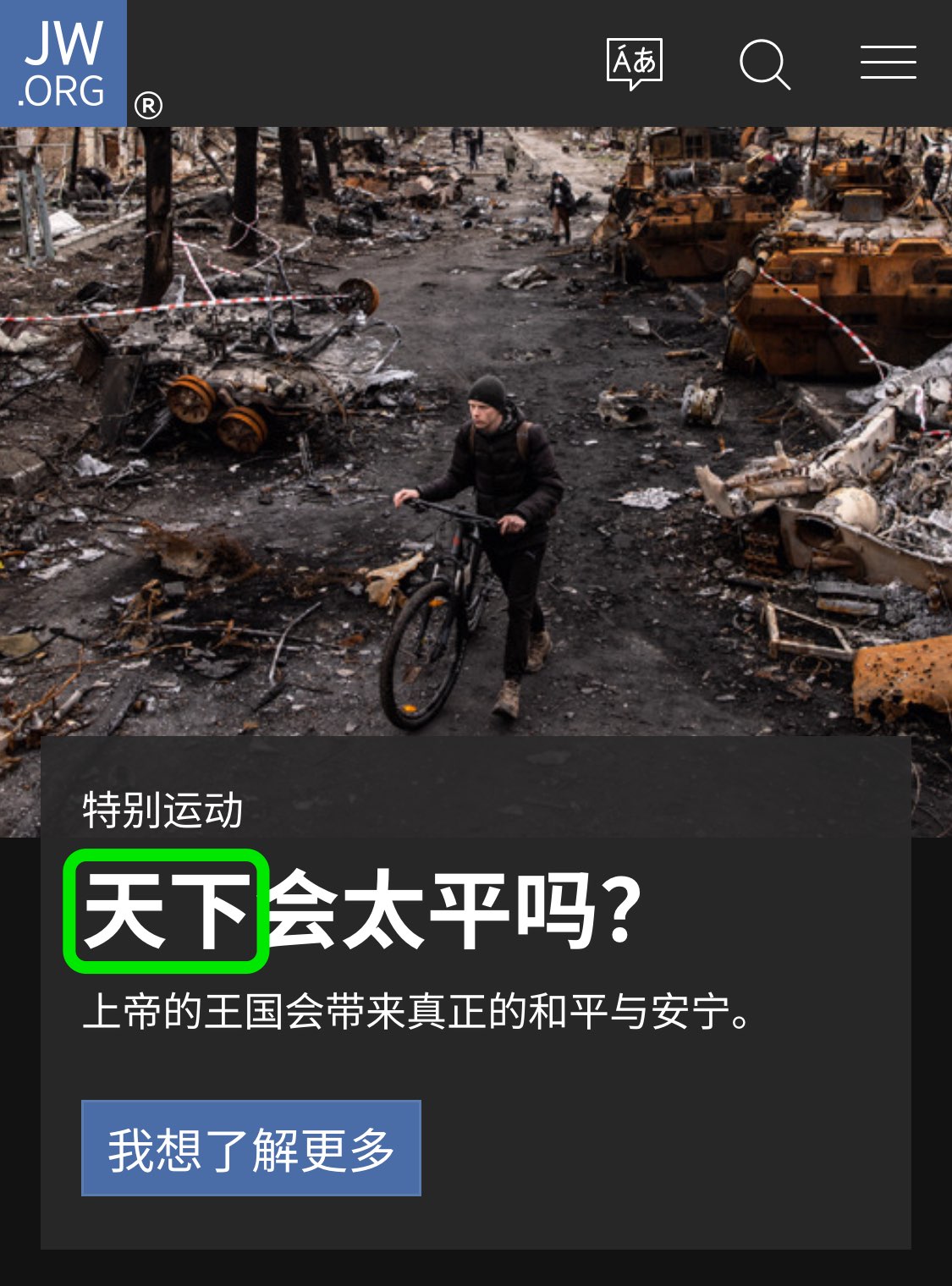
At the time of this writing, the main page of jw.org was featuring the following headline in support of a global campaign:

English

Will War Ever End?

Mandarin:

📖 📄 📘 Tiānxià (Tiān·xià Heaven · Under → [the Whole World] 天下) Huì (Will) Tàipíng (Tài·píng Supremely · {Be Flat, Level, Even → [Be Peaceful]} 太平) Ma ([? ptcl for “yes/no” questions])?

Screenshot of jw.org (CHS) on 2023-09-05, with _“天下 (Tiānxià)”_ circled

The Mandarin headline shown above is derived from the common expression “tiānxià (tiān·xià heaven · under → [all under heaven; the whole world] 天下)tàipíng (tài·píng supreme · {being flat, level, even → [being peaceful]} → [peace; tranquility] | supremely · {[be] flat, level, even → [[be] peaceful]} 太平)”, which basically means “peace on earth”. Note that the expression “tiānxià (tiān·xià heaven · under → [all under heaven; the whole world] 天下)”, this week’s MEotW, may also be capitalized, since it may be used in reference to “Tiān (Heaven [→ [God]] 天) (the Chinese mythological concept of Heaven), which should really be capitalized for a similar reason to why “Shàngdì (Shàng·dì Above’s · {Emperor → [God]} → [God] 上帝) (also a term used by the ancient Chinese) is capitalized.

Heaven…

This excerpt from the MEotW post on “Shàngtiān (Shàng·tiān Above’s · {Heaven [→ [God]]} → [Heaven; Providence; God] 上天) recounts how the Chinese concept of Heaven developed:

As mentioned in the MEotW post on “Shàngdì (Shàng·dì Above’s · {Emperor → [God]} → [God] 上帝):

The Lasting Peace brochure has a box explaining how the concept of Shàngdì (Shàng·dì Above’s · {Emperor → [God]} → [God] 上帝) has been viewed in China throughout its history.

Here is a quote from that box that relates how the Chinese came to view the “Tiān (Heaven [→ [God]] 天) in “Shàngtiān (Shàng·tiān Above’s · {Heaven [→ [God]]} → [Heaven; Providence; God] 上天), and how that affected their understanding of Shàngdì (Shàng·dì Above’s · {Emperor → [God]} → [God] 上帝):

…according to Chinese historical records, between three and four thousand years ago, during the Xia and Shang dynasties, the Chinese were already worshipping one supreme deity. The book The Religious History of China explains that they “reckoned that between heaven and earth there was a principal God who stood supreme and had absolute control over all things. . . . This supreme deity came to be called Di, or Shang-di, during the Shang Dynasty, and was known as Tien [heaven], or Tien-di [Emperor in Heaven], during the Zhou Dynasty [11th century to 256 B.C.E.].” Thus, the ancient Chinese believed in the existence of a Supreme Sovereign of the universe.

During the Spring and Autumn period (c. 722-481 B.C.E.) and the Warring States period (c. 480-221 B.C.E.), Confucianism and Taoism gained ascendancy. Influenced by these two schools of thought, the worship of Shang-di was gradually replaced by the abstract idea of reverence for Tien. By the Han dynasty (202 B.C.E.–221 C.E.), under the dominance of Confucianism, the Chinese became engrossed in moral culture and social order, and the concept of Shang-di suffered another setback. With the spread of Buddhism into China, the Chinese no longer held to the belief of a Creator who is in control of the universe, but they accepted Heaven, or Providence, as the first cause of all things. Since then, the concept of God, or Shang-di, has become something completely foreign to most Chinese.

…and All Under Heaven

What about when “Tiān (Heaven [→ [God]] 天) is combined with the common and seemingly simple morpheme “xià (below; under; underneath [→ [next; later; following]] | downward; down | {go/come/put/set/bring down}; descend | fall | {be less/lower than} | lower; inferior | {times going/coming/putting/setting/bringing down} 下)”, which here means “under”? Wikipedia provides this summary of what “Tiānxià (Tiān·xià Heaven · under → [all under Heaven; the whole world | the whole of China] 天下) came to mean in Chinese culture:

Tianxia (Chinese: 天下), literally meaning “(all) under Heaven”, is a Chinese term for a historical Chinese cultural concept that denoted either the entire geographical world or the metaphysical realm of mortals, and later became associated with political sovereignty. In ancient China and imperial China, tianxia denoted the lands, space, and area divinely appointed to the Chinese sovereign by universal and well-defined principles of order. The center of this land was directly apportioned to the Chinese court, forming the center of a world view that centered on the Chinese court and went concentrically outward to major and minor officials and then the common subjects, tributary states, and finally ending with fringe “barbarians”.

The center of this world view was not exclusionary in nature, and outer groups, such as ethnic minorities and foreign people, who accepted the mandate of the Chinese Emperor were themselves received and included into the Chinese tianxia. In classical Chinese political thought, the “Son of Heaven”, having received the Mandate of Heaven, would nominally be the ruler of the entire world.

In passing, we can note that the above describes Sinocentrism, the view of China as the centre of the world, as discussed in the MEotW post on “Zhōngguó (Zhōng·guó Central · Nation → [China | Chinese] 中国 中國). Anyway, what is this “Mandate of Heaven” that’s mentioned above? Wikipedia provides this summary:

The Mandate of Heaven (Chinese: 天命; pinyin: Tiānmìng; Wade–Giles: T’ien-ming; lit. ‘Heaven’s command’) is a Chinese political philosophy that was used in ancient and imperial China to legitimize the rule of the King or Emperor of China.[source] According to this doctrine, heaven (天, Tian) bestows its mandate[source] on a virtuous ruler. This ruler, the Son of Heaven, was the supreme universal monarch, who ruled Tianxia (天下; “all under heaven”, the world).[source] If a ruler was overthrown, this was interpreted as an indication that the ruler was unworthy and had lost the mandate.[source] It was also a common belief that natural disasters such as famine and flood were divine retributions bearing signs of Heaven’s displeasure with the ruler, so there would often be revolts following major disasters as the people saw these calamities as signs that the Mandate of Heaven had been withdrawn.[source]

“The Most High is Ruler”

As seen from its usage on jw.org, as shown above, “Tiānxià (Tiān·xià Heaven · under → [all under Heaven; the whole world | the whole of China] 天下) (or “tiānxià (tiān·xià heaven · under → [all under heaven; the whole world] 天下) with a lowercase “t”, corresponding to an uncapitalized “heaven”) is now often used just to mean “the whole world”, or “throughout the earth”. However, some continue to seek to apply the concept of “Tiānxià (Tiān·xià Heaven · under → [all under Heaven; the whole world | the whole of China] 天下) to the contemporary world by connecting it to China’s current political influence, which some aspire to spread to the whole world. In this regard, it would be good to bear in mind the lesson referred to in Daniel 4:25, 26 that Babylon’s King Nebuchadnezzar had to learn, that really, “the Most High is Ruler in the kingdom of mankind”, and that “the heavens are ruling”, not him, a mere human king.

Also, as the article linked to by the above-mentioned headline on jw.org says:

English:

[The Bible] says that “the God of heaven will set up a kingdom that will never be destroyed.” (Daniel 2:44) Under that Kingdom, or government, God will bring “an end to wars throughout the earth.”—Psalm 46:9.

Mandarin:

📖 📄 📘 Shèngjīng (Shèng·jīng (the) Holy · Scriptures → [the Bible] 圣经 聖經) shuō (says說/説): “Tiānshang (Tiān·shang heaven · upon 天上) de (’s 的) Shàngdì (Shàng·dì Above’s · {Emperor → [God]} → [God] 上帝) yào (will 要) shèlì (shè·lì {set up} · {make to stand} 设立 設立) (one 一) ge ([mw]個/箇/个) yǒngbú (yǒng·bú forever · not 永不) mièwáng (miè·wáng {will be extinguished} · {will die} 灭亡 滅亡) de (’s 的) wángguó (wáng·guó king’s · nation → [kingdom] 王国 王國).” (Dànyǐlǐshū (Dànyǐlǐ·shū Daniel · Book 但以理书 但以理書) 2:44) Shàngdì (Shàng·dì Above’s · {Emperor → [God]} → [God] 上帝) huì (will) tōngguò (tōng·guò through · passing → [passing through] → [through] 通过 通過) zhèige (zhèi·ge this · [mw] 这个 這個) Wángguó (Wáng·guó King’s · Nation → [Kingdom] 王国 王國)zhōngzhǐ (zhōng·zhǐ end · halt 终止 終止) zhànzhēng (zhàn·zhēng wars · contendings → [wars] 战争 戰爭), píngdìng (píng·dìng {make to be flat, level, even → [make to be peaceful]} · {make to be settled → [make to be calm]} 平定) tiānxià (tiān·xià heaven · under → [the whole world] 天下)”. (Shīpiān (Shī·piān {Sacred Song} · {Piece of Writing} → [Psalm] 诗篇 詩篇) 46:9)

(For reference, here are the Pīnyīn (Pīn·yīn {Piecing Together of} · Sounds → [Pinyin] 拼音) Plus links for the scriptures cited above: Dànyǐlǐshū (Dànyǐlǐ·shū Daniel · Book 但以理书 但以理書) 2:44; Shīpiān (Shī·piān {Sacred Song} · {Piece of Writing} → [Psalm] 诗篇 詩篇) 46:9.)
Categories
Culture History Theocratic

rénkǒu

rénkǒu (rén·kǒu people · {mouths of} → [population; number of people in a family] 人口) ← Tap/click to show/hide the “flashcard”

Lesson 05, point 6 of the Yǒngyuǎn Xiǎngshòu Měihǎo de Shēngmìng—Hùdòng Shì Shèngjīng Kèchéng ((Yǒng·yuǎn Eternally · {Far (in Time)} 永远 永遠) (Xiǎng·shòu Enjoy · Receive 享受) (Měi·hǎo Beautiful · Good 美好) (de ’s 的) (Shēngmìng Life 生命)—(Hù·dòng {Each Other} · Moving → [Interactive] 互动 互動) (Shì (Type 式) (Shèng·jīng Holy · Scriptures → [Bible] 圣经 聖經) (Kè·chéng Lessons · Procedure → [Course] 课程 課程) [Enjoy Life Forever!—An Interactive Bible Course (lff)]) (Enjoy Life Forever! (lff)) book contains an illustration depicting the unparalleled availability of God’s Word the Bible. One of the illustration’s captions says the following:

English:

Nearly 100% of the world’s population have access to the Bible in a language they understand

Mandarin:

📖 📄 📘 Chà‐bu‐duō ((Chà {falling short of by} 差)‐(bu not 不)‐(duō much 多) [nearly]) 100% ((bǎi {(one) hundred} 百) (fēn dividings → [parts] 分) (zhī {(among) them} 之) (bǎi {(one) hundred} 百) [one hundred percent (of)]) shìjiè (shì·jiè {generation → [world]} · extent’s → [world’s] 世界) rénkǒu (rén·kǒu people · {mouths of} → [population] 人口) dōu (even 都) néng (can 能) yòng (use 用) tāmen (tā·men he/she · [pl] → [they] 他们 他們) míngbai (míng·bai understand · clearly 明白) de (’s 的) yǔyán (yǔ·yán language · {(type of) speech} 语言 語言) dúdào (dú·dào {to read} · {arriving at} 读到 讀到) Shèngjīng (Shèng·jīng (the) Holy · Scriptures → [the Bible] 圣经 聖經)

While “rénkǒu (rén·kǒu people · {mouths of} → [population; number of people in a family] 人口)”, this week’s MEotW, is used above to mean “population”, as it is often used, one of the definitions for this expression in the highly regarded ABC Chinese-English Dictionary is “mouths to feed”. This lends credence to the hypothesis that perhaps the morphemes included in “rénkǒu (rén·kǒu people · {mouths of} → [population; number of people in a family] 人口)” reflect that historically the governments of China have viewed their population as mouths that need to be fed, since this has often been a big challenge, to the point of famine. Contrast this view to the perhaps more Western and modern cultural focus of a nation’s population as its potential human assets. (Of course, humans who are assets also need to be fed, so a balanced approach would give sufficient weight to both aspects.)

Eating or Being “Eaten”?

It may be that historically the governments of China have had feeding the people as one of their primary concerns, however, ironically, it’s also the case that archaeologists have found evidence of human sacrifice in ancient China, which involves ancient Chinese society “eating” individual members of its population. How much human sacrifice are we talking about? One web article that I found speaks of exceptionally large scale human sacrifice in ancient China, comparable in scale to the human sacrifice practiced in the ancient Mayan culture:

While the phenomenon of ritual human killings have been present in many societies throughout history [source], the types of human sacrifice that were practiced by ancient Chinese and pre-Colombian Mesoamerican cultures…were exceptional in terms of the sheer number of people sacrificed, the frequency at which it was done, and the high degree of formalization of their sacrificial rituals. Large-scale, systematic human sacrifice functioned as important political and religious spectacles in [the] Shang dynasty.[source]

Another web article that I found gives us some estimated numbers:

Prior worked revealed an extraordinary number of ritual human sacrifices were conducted during the Shang dynasty, which spanned from the 16th century B.C. to the 11th century B.C. It is the earliest dynasty in China for which archaeologists have evidence. For instance, sacrificial pits are common across the entire site of the last Shang capital, Yinxu, which researchers discovered in 1928 in central China’s Henan Province. Scientists have estimated that over the course of about 200 years, more than 13,000 people were sacrificed in Yinxu, usually males ages 15 to 35, and that on average, each sacrificial ritual there likely claimed at least 50 human victims. The biggest sacrifice found so far killed at least 339 people.

As the MEotW post on “xīshēng (xī·shēng {sacrifice (n or v) | sacrificial} · {[(as with a)] domestic animal} → [sacrifice] 牺牲 犧牲)” noted:

It’s interesting to note, though, that an Internet search for “ancient China sacrifices” will turn up many references to human sacrifices in ancient China, as there were in ancient Canaan—let us be careful not to think more highly of worldly Chinese history and culture than they actually deserve!

A Metaphorically Cannibalistic Society

Speaking of Chinese society “eating” people, Lǔ Xùn ((Lǔ Stupid; Rash (surname)) (Xùn Fast; Quick; Swift 迅) (pen name of Zhōu Shùrén, the greatest Chinese writer of the 20th cent. and a strong advocate of alphabetic writing)), recognized as China’s greatest 20th century writer, wrote a short story called “Kuángrén Rìjì ((Kuáng·rén Mad·man’s 狂人) (Rì·jì {Sun’s → [Day’s]} · Record → [Diary] 日记 日記) [Diary of a Madman (short story by Lǔ Xùn)])” (“Diary of a Madman”) which uses this as a metaphor. Wikipedia provides the following summary concerning this metaphor:

The story is not just a depiction of a man suffering from mental illness with the delusion of being eaten but rather a symbol of the cannibalistic nature of Chinese customs and society wrapped up in the veneer of Confucianism. The story progresses with the appearance of imagery such as that of a dog, which symbolizes cannibalism and a certain “slave mentality”.[source]

The metaphor of “eating people” symbolises the oppressive and feudalistic social structure and values entrenched within Chinese culture.[source] The madman represents the “awakened” individual who re-gains his individuality and refuses to abide by the traditional and harmful cultural norms society,[source] with the neighbors whom he believes to want to devour him representing Chinese society in general. …

Because China was built upon and continued to be informed by Confucian morality and principles over long stretches of history, concepts such as democracy, individualism, natural rights and freedom of thought did not exist and were therefore difficult to take root within the Chinese psyche. Lu Xun remarked that “[we] Chinese have always been a bit arrogant –unfortunately it is never “individual arrogance” but without exception “collective and patriotic arrogance”.[source]

Lǔ Xùn ((Lǔ Stupid; Rash (surname)) (Xùn Fast; Quick; Swift 迅) (pen name of Zhōu Shùrén, the greatest Chinese writer of the 20th cent. and a strong advocate of alphabetic writing)) ends “Kuángrén Rìjì ((Kuáng·rén Mad·man’s 狂人) (Rì·jì {Sun’s → [Day’s]} · Record → [Diary] 日记 日記) [Diary of a Madman (short story by Lǔ Xùn)])” (“Diary of a Madman”) with this appeal:

📖 📄 📘 Jiùjiù (Jiù·jiù save · save 救救 救/捄救/捄) háizi (hái·zi (the) children · [suf for nouns] 孩子)

(Save the children…)

(The original text of “Kuángrén Rìjì ((Kuáng·rén Mad·man’s 狂人) (Rì·jì {Sun’s → [Day’s]} · Record → [Diary] 日记 日記) [Diary of a Madman (short story by Lǔ Xùn)])” (“Diary of a Madman”) can be found here. An English translation can be found here.)

Chinese Characters and Life and Death

Besides being one of China’s greatest writers, Lǔ Xùn ((Lǔ Stupid; Rash (surname)) (Xùn Fast; Quick; Swift 迅) (pen name of Zhōu Shùrén, the greatest Chinese writer of the 20th cent. and a strong advocate of alphabetic writing)) was also a strong proponent of alphabetic writing over Chinese characters. An English translation of an article he wrote on this subject can be found here. In this article, he wrote:

Latinization has another advantage: one can write fast. The Americans say, “Time is money.” But I think that time is life. To squander other people’s time for no reason is, in fact, no different than robbing and murdering them.

Indeed, since time is life, by unnecessarily taking such extraordinary amounts of time to learn and remember, Chinese characters make themselves part of the Chinese traditions that take away life from people. In this regard, one of the web articles quoted above mentioned a connection that’s been found between the earliest Chinese characters and human sacrifice:

Yinxu is also home to the earliest known writing in China, in the form of oracle bone inscriptions. Diviners carved these questions on turtle shells or ox bones, addressing the king’s concerns and ranging from personal issues such as unsettling toothaches to state matters such as crop failures. These inscriptions also recorded the king’s ritual activities, such as human sacrifices to the ruler’s ancestors or the gods.

Yes, it’s literally true that Chinese characters have been involved with taking life away from Chinese people since their very beginning! Additionally, regarding our life-saving preaching and teaching work today, my article “Pīnyīn (Pīn·yīn {Piecing Together} · Sounds → [Pinyin] 拼音) Was Plan A says:

Concerning the obstacles presented by Chinese characters, the great Chinese writer Lǔ Xùn, who passed away in 1936, reportedly said, “Hànzì bú miè, Zhōngguó bì wáng.” (“汉字不灭,中国必亡。/ 漢字不滅,中國必亡。” “If Chinese characters are not abolished, China will certainly die.”) True, with the simplification of the characters, the assistance of Pīnyīn, and the extra hard work put forth by the Chinese people to “tough out” the extra technical burdens presented by the characters, it now seems unlikely from a worldly viewpoint that the use of characters will cause the nation of China to die (although we know it will die at Armageddon, and its culture’s influence will eventually fade away completely after that). However, how sad it would be if many Chinese people died unnecessarily because the ongoing obstacles presented by Chinese characters hindered our efforts to reach their hearts with the life-saving message from God’s Word.

Indeed, how many Chinese people will ultimately end up getting sacrificed on the altar of worldly Chinese culture and tradition?

Who’s a Madman?

Speaking of madmen and Chinese writing, today, many would consider it mad to use an alphabetical system like Pīnyīn (Pīn·yīn {Piecing Together} · Sounds → [Pinyin] 拼音) to write Mandarin Chinese, instead of the traditionally entrenched Chinese characters. However, remember that Jesus’ relatives thought that he had “gone out of his mind”, when in fact their minds were stuck in their traditional worldview while Jesus was showing people the way forward. (Mark 3:21) Now, we look back and think the people who had the opportunity to be taught by Jesus in person but passed on it were crazy!

A couple of million years or so into the new system, if we ever think about it at all, we’ll also undoubtedly think it was crazy that so many people thought that a writing system that had been around for just a few millennia was impressively old, and we’ll also undoubtedly think it was crazy that so many people thought that everyone involved should always use an unnecessarily convoluted and time-consuming writing system like Chinese characters for an urgent life-saving work when a much easier-to-learn and much easier-to-use writing system like Pīnyīn (Pīn·yīn {Piecing Together} · Sounds → [Pinyin] 拼音) was available.


For convenience:

The direct link for the current generation Pīnyīn (Pīn·yīn {Piecing Together of} · Sounds → [Pinyin] 拼音) Plus resource for the Enjoy Life Forever! book is:

The short link for Chinese field language-learning links for the Enjoy Life Forever! book is:

More Pīnyīn (Pīn·yīn {Piecing Together of} · Sounds → [Pinyin] 拼音) and Pīnyīn (Pīn·yīn {Piecing Together of} · Sounds → [Pinyin] 拼音) Plus web material based on the Mandarin Enjoy Life Forever! book will be made available in the Pīnyīn (Pīn·yīn {Piecing Together of} · Sounds → [Pinyin] 拼音) Plus web resource as time allows.

Categories
Culture History Language Learning Names Technology

Hànzì

Hànzì (Hàn·zì {Han (Chinese)} · Characters 汉字 漢字) ← Tap/click to show/hide the “flashcard”

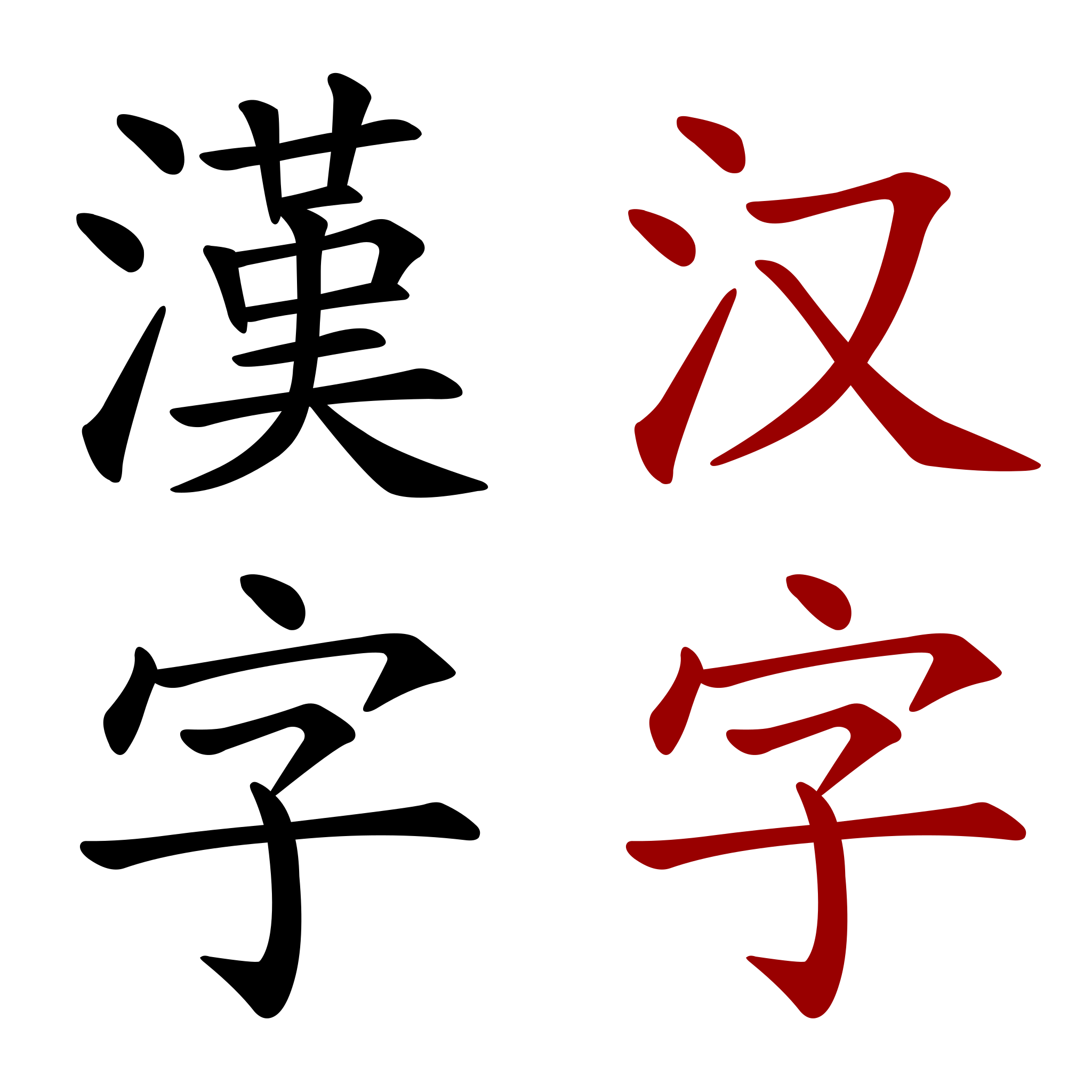
Hànzì (Hàn·zì {Han (Chinese)} · Characters 汉字 漢字)” is what Chinese characters are called in Mandarin. Actually, “Hànzì (Hàn·zì {Han (Chinese)} · Characters 汉字 漢字)” literally means “Han characters”, but as discussed in the MEotW post on “Hànyǔ (Hàn·yǔ {Han (Chinese)} · Language [→ [(Modern Standard) Mandarin]] 汉语 漢語)”, the Han are by far the largest ethnic group in China, and they are the dominant cultural force in China. Thus, Han characters are, in effect, Chinese characters.

漢字 汉字

Han culture has affected not only China, but also many of the surrounding nations. The words used by some of these nations to refer to “Chinese characters” are obvious echoes of “Hànzì (Hàn·zì {Han (Chinese)} · Characters 汉字 漢字)”:

  • Japanese: kanji
  • Korean: Hanja
  • Vietnamese: hán tự

Hànzì (Hàn·zì {Han (Chinese)} · Characters 汉字 漢字) are still used a lot in modern Japanese writing. However, although Hànzì (Hàn·zì {Han (Chinese)} · Characters 汉字 漢字) used to be the dominant writing system in Korea and in Vietnam, those nations have moved on to mainly use alphabetic writing systems.

The Korean Connection

Regarding the situation in Korea, the Awake! article “Let’s Try Writing in Hankul!” says:

BEFORE Hankul [or Hangul] was created, the Korean language did not have its own script. For more than a thousand years, educated Koreans wrote their language using Chinese characters. Over the years, however, various attempts were made to devise a better writing system. But since all of them were based on Chinese characters, only the well-educated could use them.

King Sejong spearheaded the creation of an alphabet that would both suit spoken Korean and be easy to learn and use.

Sadly, some scholars opposed Hankul, precisely because it was so easy to learn! They derisively called it Amkul, meaning “women’s letters.” They disdained a system that could be learned even by women, who back then were not taught to read in the schools. This prejudice against Hankul persisted among upper-class Koreans for some time. In fact, more than 400 years elapsed before the Korean government declared that Hankul could be used in official documents.

The Chinese Conundrum

How about the writing system situation in China itself? Do the Chinese languages need to be written using Hànzì (Hàn·zì {Han (Chinese)} · Characters 汉字 漢字)? Chinese traditionalists have influenced many people to assume so, but there is actually no technical linguistic requirement that any Chinese language be written using Hànzì (Hàn·zì {Han (Chinese)} · Characters 汉字 漢字)—writing Chinese languages using Hànzì (Hàn·zì {Han (Chinese)} · Characters 汉字 漢字) is purely and merely a deeply embedded tradition.

Proof that the use of Hànzì (Hàn·zì {Han (Chinese)} · Characters 汉字 漢字) is merely a tradition and not a technical requirement comes from the fact that Pīnyīn (Pīn·yīn {Piecing Together of} · Sounds → [Pinyin] 拼音), a phonetic alphabetic system designed by a Chinese government team, is a good, workable full writing system for Modern Standard Mandarin.

Why has China held on to its traditional use of Hànzì (Hàn·zì {Han (Chinese)} · Characters 汉字 漢字) when other nations have moved on to alphabetic writing systems? As mentioned in the MEotW post on “Zhōngguó (Zhōng·guó Central · Nation → [China | Chinese] 中国 中國)”,

Some wonder why China has held on to its archaic characters writing system instead of moving on to using a modern alphabetic writing system like almost every other nation does, even though outstanding native sons like Lǔ Xùn ((Lǔ Stupid; Rash (surname)) (Xùn Fast; Quick; Swift 迅) (pen name of Zhōu Shùrén, the greatest Chinese writer of the 20th cent. and a strong advocate of alphabetic writing)) have advocated strongly for that. Perhaps the proud self-centredness of the only nation to name itself the centre of the world provides a clue….

When the Communists took over China a few years after World War II, their Plan A for China’s writing system situation actually did involve eventually moving on from the characters to an alphabetic writing system that would be developed, which turned out to be Pīnyīn (Pīn·yīn {Piecing Together of} · Sounds → [Pinyin] 拼音). However, the government needed the help of the people already educated in Hànzì (Hàn·zì {Han (Chinese)} · Characters 汉字 漢字), and many of these people opposed this plan that they feared would involve leaving behind, or at least de-emphasizing, a cultural tradition that they were very proud of, that they had invested very much time and effort into mastering, and that gave them much prestige in the existing environment.1 In other words, the pride and prejudice of those who had already been educated in the Hànzì (Hàn·zì {Han (Chinese)} · Characters 汉字 漢字) caused them to disparage and oppose the idea of a simpler alternative writing system, just as had been the case in Korea, as noted above. So, the simplification of the Hànzì (Hàn·zì {Han (Chinese)} · Characters 汉字 漢字) is the farthest China has gotten so far with regard to official writing system reform, and even that has only been achieved in the face of much criticism and opposition.

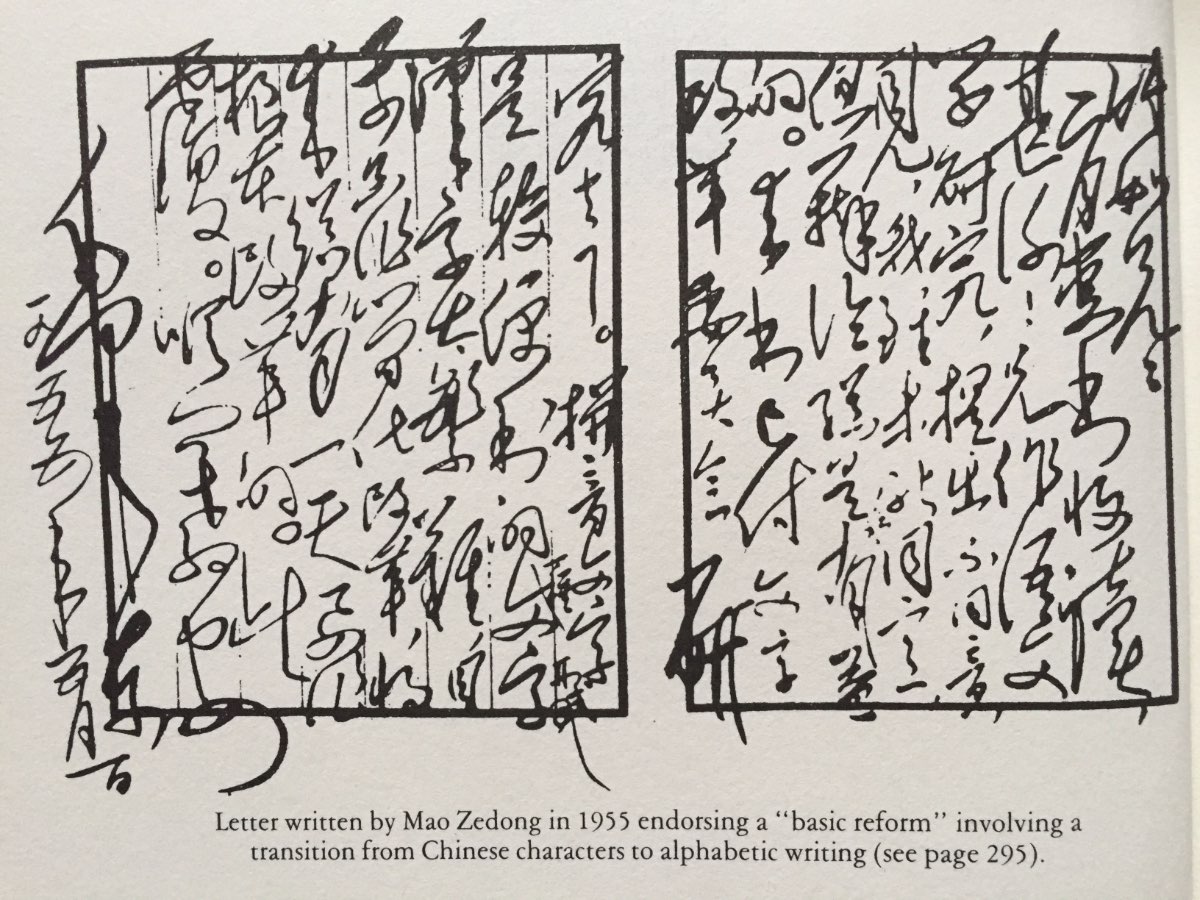
Chairman Máo Zédōng ((Máo Hair (surname) 毛) (Zé·dōng Marsh · East 泽东 澤東) (the founder of the People’s Republic of China)) (Wikipedia article) himself supported continuing to move on, from simplification of the characters to actually adopting Pīnyīn (Pīn·yīn {Piecing Together of} · Sounds → [Pinyin] 拼音) as a writing system. In a letter to an old schoolmate, he wrote:

…Pinyin writing is a form of writing that is relatively convenient. Chinese characters are too complicated and difficult. At present we are only engaged in reform along the lines of simplification, but some day in the future we must inevitably carry out a basic reform.2

Letter from Mao endorsing a transition from Chinese characters to alphabetic writing

(The above picture is from near the beginning of the book The Chinese Language: Fact and Fantasy, by John DeFrancis.)

While obviously what Máo ((Máo Hair (surname) 毛) (abbr. for Máo Zédōng, the founder of the People’s Republic of China)) foresaw regarding a writing system “basic reform” in China has not yet come true, American sinologist and University of Pennsylvania Professor of East Asian Languages and Civilizations Victor H. Mair wrote in a blog post:

So, those who are in favor of HP [Hànyǔ (Hàn·yǔ {Han (Chinese)} · Language → [(Modern Standard) Mandarin] 汉语 漢語) Pīnyīn (Pīn·yīn {Piecing Together of} · Sounds → [Pinyin] 拼音)] don’t need to be concerned, and those who are opposed to HP don’t need to be frightened. HP is ineluctably playing a greater and greater role in the educational, cultural, social, political, and every other aspect of the lives of Chinese citizens, and this is occurring without regard to anyone pushing it as a governmental program. It is happening because of the wishes of those who actually use it for a wide variety of helpful purposes.

Digraphia [the use of more than one writing system for the same language, in this case the use of both Hànzì (Hàn·zì {Han (Chinese)} · Characters 汉字 漢字) and Pīnyīn (Pīn·yīn {Piecing Together of} · Sounds → [Pinyin] 拼音) for writing Modern Standard Mandarin] is emerging before our very eyes, enabling people to use the alphabet and the characters for whatever purposes they deem suitable. Nobody needs to take a vote or carry out a survey for this to happen.

Tourists or Missionaries?

Regardless of how worldly Chinese people view the Hànzì (Hàn·zì {Han (Chinese)} · Characters 汉字 漢字), how should we dedicated Mandarin field language-learners view them? It would be easy to fall back on the commonly accepted view, the tourist’s view, that the Hànzì (Hàn·zì {Han (Chinese)} · Characters 汉字 漢字) are an integral and fascinating part of China’s precious cultural heritage that we should duly respect and even heap adulation upon.

However, as Mandarin field language-learners, we are not in the Mandarin field to be tourists just enjoying the exotic foreign culture. On the contrary, we must be more like missionaries or spiritual rescue workers involved in an urgent life-saving work, because lives are indeed involved. As ones involved in an urgent, life-saving work, we need tools, technologies, and systems that efficiently and effectively help us to get this work done without wasting time and effort when people’s everlasting lives are at stake. From this sober and pragmatic angle, the extraordinarily difficult-to-learn-and-remember Hànzì (Hàn·zì {Han (Chinese)} · Characters 汉字 漢字) are far from ideal. Thus, while there is obviously value in learning as many Hànzì (Hàn·zì {Han (Chinese)} · Characters 汉字 漢字) as one is reasonably able to, it is fortunate that Pīnyīn (Pīn·yīn {Piecing Together of} · Sounds → [Pinyin] 拼音) exists and is available as a simple, effective alternative writing system for Mandarin, for the many times when it is not necessary to use Hànzì (Hàn·zì {Han (Chinese)} · Characters 汉字 漢字).


1. John DeFrancis, The Chinese Language: Fact and Fantasy (Honolulu: University of Hawaii Press, 1984), p. 258. ^

2. Ibid., p. 295. ^