Categories
Culture History Language Learning Theocratic

yíyì‐gūxíng

yíyì (yí·yì {(having) one} · intention → [stubbornly] 一意)gūxíng (gū·xíng {orphaned → [alone]} · {go; walk → [do]} → [cling to one’s own course; insist on having one’s own way] 孤行) ← Tap/click to show/hide the “flashcard”

Appendix A2 of the English New World Translation of the Holy Scriptures (Study Edition), entitled “Features of This Revision”, discusses vocabulary changes that have been made in the current revision, words that have been translated differently than before. As noted in various entries in the excellent resource Referenced Theo. Expressions (RTE), Appendix A2 of the current Mandarin version of the New World Translation Bible (nwtsty) correspondingly discusses words that have been translated differently in the current revision of the Mandarin NWT Bible, compared to how they had been translated before.

Since we base what we say in Jehovah’s service on his Word the Bible, the vocabulary used in it—and the way those vocabulary words are translated—should be reflected in how we speak in our ministry, at our meetings, etc. So, it is beneficial for us Mandarin field language learners to be familiar with the latest thinking from the organization on how Bible terms should be translated into Mandarin.

Communication and Love

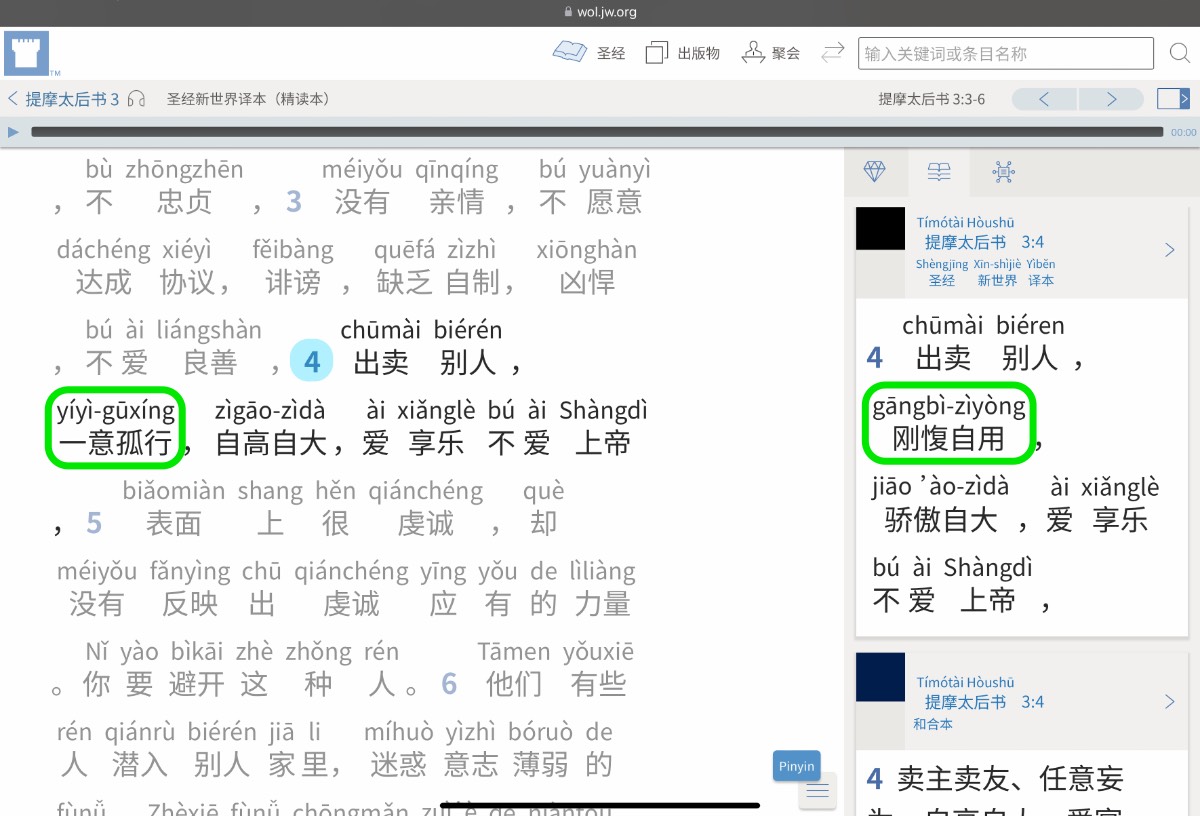
Appendix A2 of the current Mandarin version of the New World Translation Bible (nwtsty) mentions that one of the goals for this version was to reduce the number of hard-to-recognize, hard-to-read Chinese characters used, and to replace them with more commonly used characters. One example it provides is that “gāngbì (gāng·bì {[is] firm} · {[is] wilful} 刚愎 剛愎)zìyòng (zì·yòng {[is] self-·applying} → [[is] opinionated] 自用) was changed to this week’s MEotW, “yíyì (yí·yì {(having) one} · intention → [stubbornly] 一意)gūxíng (gū·xíng {orphaned → [alone]} · {go; walk → [do]} → [cling to one’s own course; insist on having one’s own way] 孤行).—2 Timothy 3:4.

2 Timothy 3:4 (WOL CHS+Pinyin Parallel Translations)

In this case, a relatively unfamiliar, hard-to-parse expression was replaced with a different one that conveys the intended meaning, while being more familiar and easier to understand. This helpful simplification reminds us that the ultimate goal of language should be to communicate, not to show off one’s knowledge of hard words or whatever. And, as the September 1, 1991 Watchtower emphasizes, good communication is motivated by unselfish love:

Christian communication especially needs to be effective because it has as its goal the reaching of people’s hearts with the truth from God’s Word so that, hopefully, they will act on what they learn. Uniquely, it is motivated by unselfishness, by love.

Yes, as 1 Corinthians 8:1 says:

Knowledge puffs up, but love builds up.

More Understandable Alternate Expressions

As discussed in the article “Pīnyīn (Pīn·yīn {Piecing Together of} · Sounds → [Pinyin] 拼音) Was Plan A”, Zhōu Yǒuguāng ((Zhōu {Circumference; Circle (surname)}周/週) (Yǒu·guāng Has · Light 有光) (Chinese linguist, etc., known as “the father of Pīnyīn”)) (Wikipedia article), who led the team that designed Pīnyīn (Pīn·yīn {Piecing Together of} · Sounds → [Pinyin] 拼音), pointed out that assigning alternate expressions with different pronunciations is a good way to address Mandarin’s so-called homophone problem. (Homophones are words that have the same pronunciation, but different meanings.)

From the examples referred to in the Mandarin NWT Appendix A2, we can see that assigning alternate expressions can also be a good way to address the problem of excessively hard-to-recognize or hard-to-understand expressions. Rather than being attached to the idea that particular characters are required to represent certain meanings, as perhaps suggested by the Ideographic Myth, the translators of the Mandarin NWT Bible recognized that representing easily understandable speech is the true priority for God’s people.—1 Corinthians 14:8–11.

So, let us not be yíyì (yí·yì {(having) one} · intention → [stubbornly] 一意)gūxíng (gū·xíng {orphaned → [alone]} · {walking → [doing]} → [clinging to one’s own course] 孤行), insisting that the new translated expressions in the current Mandarin NWT are not as good as the old expressions, or clinging to old, erroneous ideas like “Pīnyīn (Pīn·yīn {Piecing Together of} · Sounds → [Pinyin] 拼音) could never work as a writing system for Mandarin because characters are needed to deal with all the homophones in Mandarin.”

Categories
Culture Language Learning Science Theocratic

Yètèluó

Yètèluó (Jethʹro 叶特罗 葉特羅) ← Tap/click to show/hide the “flashcard”

Appendix A2 of the English New World Translation of the Holy Scriptures (Study Edition), entitled “Features of This Revision”, discusses vocabulary changes that have been made in the current revision, words that have been translated differently than before. As noted in various entries in the excellent resource Referenced Theo. Expressions (RTE), Appendix A2 of the current Mandarin version of the New World Translation Bible (nwtsty) correspondingly discusses words that have been translated differently in the current revision of the Mandarin NWT Bible, compared to how they had been translated before.

Since we base what we say in Jehovah’s service on his Word the Bible, the vocabulary used in it—and the way those vocabulary words are translated—should be reflected in how we speak in our ministry, at our meetings, etc. So, it is beneficial for us Mandarin field language learners to be familiar with the latest thinking from the organization on how Bible terms should be translated into Mandarin.

Avoiding Rarely‐Used, Hard‐to‐Recognize Characters

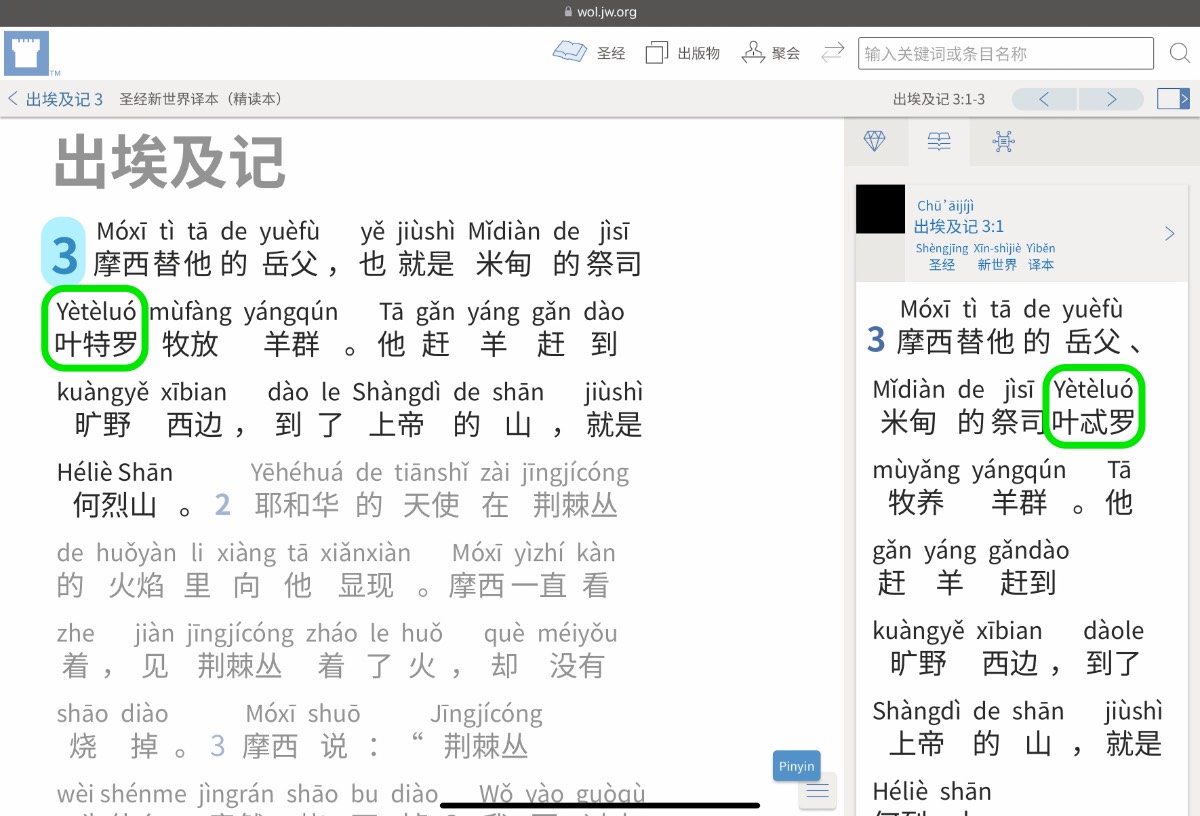
Appendix A2 of the current Mandarin version of the New World Translation Bible (nwtsty) mentions that one of the goals for this version was to reduce the number of hard-to-recognize, hard-to-read Chinese characters used, and to replace them with more commonly used characters. The first example it provides is that “Yètèluó (Jethʹro (old way of writing with characters) 叶忒罗 葉忒羅) was changed to this week’s MEotW, “Yètèluó (Jethʹro 叶特罗 葉特羅).—Exodus 3:1.

Exodux 3:1 (WOL CHS+Pinyin Parallel Translations)

While the pronunciation and the Pīnyīn (Pīn·yīn {Piecing Together of} · Sounds → [Pinyin] 拼音) were kept the same, a relatively rarely-used, hard-to-recognize character (“忒”) was replaced with a different, more common and recognizable character (“特”). As we can see, the translators who worked on the current version of the Mandarin NWT recognized that it was good to preserve the spoken pronunciation of the expression, an expression that as a whole was not changed. At the same time, they did not consider the particular character that was replaced to be sacred. This reinforces to us the basic principle of linguistics (language science) that SPEECH is primary, not writing, which shows up the traditional and ongoing Chinese cultural emphasis on characters as being fundamentally misplaced.

A Real-Life Example

The importance of avoiding unnecessarily hard-to-recognize characters was well demonstrated by the incident discussed in the tiandi.info blog post “An Avoidable Minefield of Human Tradition and Cultural Pride” (Email me if you need login information, and include information on who referred you and/or what group/cong. you are in.):

A few nights ago, my Mandarin congregation had a Memorial meeting that went well overall. However, there was a momentary hiccup that I think we Chinese field publishers can learn from.

The speaker who gave the talk is a fluent, eloquent native Mandarin speaker originally from mainland China, and he is one of the best Mandarin speakers in a city of several Mandarin congregations. In fact, he was one of the instructors in the very first official Mandarin class ever held in this country. However, while reading a scripture from his paper Bible as he was giving the Memorial talk, he, of all people, just…got…stuck…on…a…Chinese…character…. He struggled with it for what felt like quite a while, and eventually, a young brother who was serving as an attendant at the side of the stage approached and gave him a hint, and he was able to carry on.

While not a showstopper, this unfortunate incident was indeed an awkward showpauser, during the very meeting, out of all the meetings in the entire service year, at which the highest proportion of interested ones from the field was present—truly a nightmare scenario for anyone who gives Chinese talks!

FYI, in this case, the character that the brother couldn’t read was the “虺” in “虺蛇”, which has been replaced in the current version of the Mandarin NWT with “眼镜蛇”. (Isaiah 11:8) (While not being especially visually complex compared to some other Chinese characters, “虺” is relatively rarely used, ranking way down at #5543 on Prof. Dá Jùn (Dá {Tow Rope} (surname) 笪) ((Jùn {Fine Horse}駿) (Associate Professor of Linguistics, Director of the Media Center for Language Acquisition Department of Foreign Languages and Literatures, Middle Tennessee State University))’s character frequency list of Modern Chinese. “眼” is #281 on that list, and “镜” is #1251.)

Mitigations and Alternatives

In a way, though, even such fine efforts on the part of the NWT translators, working with what they have, are mere mitigations. On a more basic level, the incident mentioned above also highlights the problematic nature of the Chinese characters writing system itself, which makes it all too possible for such hard-to-recognize characters to exist, without any reasonable, consistent, and reliable system to work out their pronunciations. This makes any block of Chinese characters a potential minefield that can blow up in the face of even the most knowledgeable and experienced native speaker, because even such a one is still a mere imperfect human contending with the inhumanly complex and numerous Chinese characters, of which there are over 100,000.

In contrast, Pīnyīn (Pīn·yīn {Piecing Together of} · Sounds → [Pinyin] 拼音), with its Latin alphabet letters and four tone symbols, is a simple, elegant full writing system for Modern Standard Mandarin that is eminently learnable by mere imperfect humans. Thus, it is an eminently good thing that Jehovah, through his organization, has made official Pīnyīn (Pīn·yīn {Piecing Together of} · Sounds → [Pinyin] 拼音) available for the current version of the Mandarin NWT Bible, unlikely and uncommon though such a provision is from a worldly, human viewpoint. (Work is also ongoing to provide unofficial Pīnyīn (Pīn·yīn {Piecing Together of} · Sounds → [Pinyin] 拼音) Plus material for the current version of the Mandarin NWT, as language-learning material, not as spiritual food.)

Categories
Culture Current Events History

zhōunián

zhōunián (zhōu·nián {circle → [whole; cycle] of} · year → [anniversary] 周年 周/週年) ← Tap/click to show/hide the “flashcard”

[Notes: Tap/click on a Pīnyīn (Pīn·yīn {Piecing Together} · Sounds → [Pinyin] 拼音) expression to reveal its “flashcard”; tap/click on a “flashcard” or its Pīnyīn (Pīn·yīn {Piecing Together} · Sounds → [Pinyin] 拼音) expression to hide the “flashcard”. 📖 📄 📘 icons mean 📖 Reveal All, 📄 Reveal Advanced, and 📘 Reveal None re all the “flashcards” in the heading, paragraph, etc. that they are placed at the beginning of.]

February 24, 2023, a few days before the date of this post, was the one year anniversary of Russia’s sending of significant military forces into Ukraine, resulting in the largest scale open warfare in Europe since World War II. So, as of this writing jw.org is featuring the article “Ukraine War Enters Second Year—What Hope Does the Bible Offer?”, and this week’s MEotW is “zhōunián (zhōu·nián {circle → [whole; cycle] of} · year → [anniversary] 周年 周/週年)”, the Mandarin word used in the Mandarin version of that article to translate the sense of “anniversary”.

Circles

Zhōunián (Zhōu·nián {circle → [whole; cycle] of} · year → [anniversary] 周年 周/週年)” literally means “circle (or whole; cycle) of a year”, and can be thought of as a year having gone full circle. Another use of the “zhōu (circumference; circle; ring; periphery [→ [whole; cycle] [→ [week]]] | {to circle; to make a circuit}周/週)” in “zhōunián (zhōu·nián {circle → [whole; cycle] of} · year → [anniversary] 周年 周/週年)”, that also involves circles/cycles and time, is to mean “week”. Extending from that, “Zhōu’èr (Zhōu’·èr {Circle → [Cycle] → [Week(day)]} · Two → [Tuesday] 周二 周/週二)” means “Week(day) Two”, or “Tuesday”.

Note, though, that in this pattern, “Sunday” is notZhōuqī (Zhōu·qī {Circle → [Week(day)]} · Seven → [not used to mean “Sunday”] 周七 周/週七)”, but rather, “Zhōurì (Zhōu·rì {Circle → [Cycle] → [Week]} · {Sun → [Day]} → [Sunday] 周日 周/週日)”. Note also that regarding “Zhōurì (Zhōu·rì {Circle → [Cycle] → [Week]} · {Sun → [Day]} → [Sunday | weekday] 周日 周/週日)”, the excellent resource Referenced Theo. Expressions (RTE) says:

weekday; Sunday; Apparently 周日 can mean either “weekday” or “Sunday”; it was used in w07 7/1 p.17 to mean “Sunday” (周六和周日 “Saturday and Sunday”; the Traditional version of wtl07 uses the variant 週 for 周) but in w95 7/15 p.29 and w93 11/1 p.31 it was used to translate “weekday” (i.e. non-Sabbath day in Israel), and g02 4/8 p.7 (5/8 in zh) uses 在周日 to translate “during the workweek”.

In addition to “Zhōurì (Zhōu·rì {Circle → [Cycle] → [Week]} · {Sun → [Day]} → [Sunday] 周日 周/週日)”, Mandarin dictionaries also list several other ways to say “Sunday”, some of which originated from Catholicism.

Not Regular Joes

The “zhōu (circumference; circle; ring; periphery [→ [whole; cycle] [→ [week]]] | {to circle; to make a circuit}周/週)” in “zhōunián (zhōu·nián {circle → [whole; cycle] of} · year → [anniversary] 周年 周/週年)” is also used as a surname. For example, for hundreds of years, China was ruled by the Zhōu ({Circumference; Circle (surname)}周/週) dynasty.

A famous Zhōu ({Circumference; Circle (surname)}周/週) of more recent times was Zhōu Ēnlái ((Zhōu {Circumference; Circle (surname)}周/週) (Ēn·lái Kindness · Comes 恩来 恩來) (the first Premier of the People’s Republic of China)) (Wikipedia article), the first Premier of the People’s Republic of China, who served from October 1, 1949 until his death on January 8, 1976. An English translation of an interesting speech he gave in 1958 regarding some of the tasks that the PRC government faced relating to reforming the written language—such as simplification of the characters, popularization of pǔtōnghuà (pǔ·tōng·huà common; universal · {through(out) → [common]} · speech → [(Modern Standard) Mandarin (term commonly used in China)] 普通话 普通話), and the creation and implementation of Pīnyīn (Pīn·yīn {Piecing Together} · Sounds → [Pinyin] 拼音)—can be found here, on the Pīnyīn.info website.

Usage Examples

In the above-mentioned jw.org Mandarin article, “zhōunián (zhōu·nián {circle → [whole; cycle] of} · year → [anniversary] 周年 周/週年)” is used as follows:

📖 📄 📘 2023 Nián (Year年/秊) 2 Yuè (Moon → [Month] 月) 24 (Sun → [Day] 日) Xīngqīwǔ (Xīng·qī·wǔ {Star · {Period of Time} → [Week (Day)]} · Five → [Friday] 星期五) shì (is 是) (one 一) ge ([mw]個/个) cǎndàn (cǎn·dàn tragic · tasteless → [dismal] 惨淡 慘淡/澹) de (’s 的) rìzi (rì·zi {sun → [day]} · [suf for nouns] 日子), biāozhìzhe (biāo·zhì·zhe {marking (with)} · mark (that) · being → [marking that] 标志着 標志/誌/識着/著) Wūkèlán (Ukraine 乌克兰 烏克蘭) zhànzhēng (zhàn·zhēng war · contending → [war] 战争 戰爭) mǎn ({had filled}滿) (one 一) zhōunián (zhōu·nián {circle → [cycle] of} · year → [anniversary] 周年 周/週年).

The Pleco app’s built-in dictionary provides these usage examples:

wǔshí zhōunián jìniàn ((wǔ·shí five · tens → [fifty] 五十) (zhōu·nián {circle → [cycle] of} · year → [anniversary] 周年 周/週年) (jì·niàn remembering · {thinking of} → [commemoration] 记/纪念 記/紀念) [golden jubilee])

yìbǎi zhōunián ((yì·bǎi one · hundred 一百) (zhōu·nián {circle → [cycle] of} · year → [anniversary] 周年 周/週年) [centenary])

Will There Be Another Anniversary?

For now, it seems uncertain how much longer Russia and Ukraine will continue to battle for. While many experts, including some Western experts, initially expected Russia might succeed in its initial plan to topple the Ukraine government in a few days, Ukraine has succeeded in holding out, and, with much Western support, has even conducted some successful counteroffensives in the last year. Russia continues to have significant combat power, however, and seems intent on continuing to pursue its goals in this war. Recently, the director of the CIA said the USA believes that China is considering providing lethal aid to Russia, perhaps in the forms of drones and ammunition. Meanwhile, Ukraine remains intent on completely driving out the Russian invaders, and many nations, including many Western nations, continue to provide it with ever more significant military support, now including advanced Western main battle tanks.

Regardless of how long this war may drag on, may we keep our brothers and sisters in the affected areas in our prayers to Jehovah, the only true God and the “God of all comfort”—John 17:3, 2 Corinthians 1:3.