Categories
Culture Language Learning Science Technology Theocratic

guāngyīn

guāngyīn (guāng·yīn light · {female/passive/negative principle in nature (Chinese philosophy) → [shade]} → [time [available]] 光阴 光陰) ← Tap/click to show/hide the “flashcard”

[Notes: Tap/click on a Pīnyīn (Pīn·yīn {Piecing Together of} · Sounds → [Pinyin] 拼音) expression to reveal its “flashcard”; tap/click on a “flashcard” or its Pīnyīn (Pīn·yīn {Piecing Together of} · Sounds → [Pinyin] 拼音) expression to hide the “flashcard”. 📖 📄 📘 icons mean 📖 Reveal All, 📄 Reveal Advanced, and 📘 Reveal None re all the “flashcards” in the heading, paragraph, etc. that they are placed at the beginning of.]

Rather than dismissively thinking to ourselves that the songs produced by the organization are “just songs”, we should remember that the slave class takes seriously its responsibility to provide spiritual food to God’s people, and so it is going to make sure that the lyrics in its songs are spiritually correct, while also being emotionally moving.—Ezekiel 33:32; Matthew 24:45.

Light and Shade

This week’s MEotW, “guāngyīn (guāng·yīn light · {female/passive/negative principle in nature (Chinese philosophy) → [shade]} → [time [available]] 光阴 光陰)”, comes from the second verse of song 56, which is entitled “Make the Truth Your Own” in English and “Jiāng (Take) Zhēnlǐ (Zhēn·lǐ True · Reasoning → [the Truth] 真理) Zhēncáng (Zhēn·cáng {to Be Treasured} · {to Be Stored Up} 珍藏) zài (in 在) Xīnli (Xīn·li Heart · Inside 心里 心裡/裏) in Mandarin:

English:

The effort you make and the time you are spending
In service to God and his Kingdom

Mandarin (WOL, Pīnyīn (Pīn·yīn {Piecing Together of} · Sounds → [Pinyin] 拼音) Plus):

📖 📄 📘 (you 你) (not 不) ({do take your leave from} → [do shrink from]辭/辤)xīnláo (xīn·láo {pungently → [labouriously]} · working 辛劳 辛勞), jìn ({expend to the limit}) quánlì (quán·lì whole · strength 全力) shànyòng (shàn·yòng {(for) good} · {to be using} 善用) guāngyīn (guāng·yīn light · {female/passive/negative principle in nature (Chinese philosophy) → [shade]} → [time available] 光阴 光陰),
Nǔlì (Nǔ·lì exert · strength 努力) xuānyáng (xuān·yáng {to declare} · {to raise → [to make known]} 宣扬 宣揚) Wángguó (Wáng·guó King’s · Nation → [Kingdom] 王国 王國) hǎo (good 好) xiāoxi (xiāo·xi disappearing · news → [news] 消息).

Yin and Yang

While “guāng (light | {[is] bare}; {[is] naked} | {[is] used up} | only 光) is a well-known Mandarin expression that means “light”, the situation with the other morpheme in this week’s MEotW is a little more complicated. “Yīn ({female/passive/negative principle in nature (Chinese philosophy)} [→ [the moon | covert; concealed; hidden; secret | implicit | negative (electric charge) | [is] overcast; dull; gloomy | shade | [is] sinister; treacherous | of the netherworld | genitalia]陰/隂) is now used to effectively mean such common, everyday things as “overcast”, “shade”, or “negative (electric charge, etc.)”, but the meaning of “yīn ({female/passive/negative principle in nature (Chinese philosophy)} [→ [the moon | covert; concealed; hidden; secret | implicit | negative (electric charge) | [is] overcast; dull; gloomy | shade | [is] sinister; treacherous | of the netherworld | genitalia]陰/隂) originally comes from Chinese philosophy—it’s the “yīn ({female/passive/negative principle in nature (Chinese philosophy)} [→ [the moon | covert; concealed; hidden; secret | implicit | negative (electric charge) | [is] overcast; dull; gloomy | shade | [is] sinister; treacherous | of the netherworld | genitalia]陰/隂) in “yīnyáng (yīn·yáng {female/passive/negative principle in nature (Chinese philosophy)} · {positive/active/male principle in nature (Chinese philosophy)} [→ [yin and yang; opposites]] 阴阳 陰陽) (Wikipedia article).

The “yáng ({positive/active/male principle in nature (Chinese philosophy)} [→ [sun | solar | open; overt | belonging to this world | positive (electric charge) | male]]) in “yīnyáng (yīn·yáng {female/passive/negative principle in nature (Chinese philosophy)} · {positive/active/male principle in nature (Chinese philosophy)} [→ [yin and yang; opposites]] 阴阳 陰陽) also appears in “tàiyáng (tài·yáng highest · {positive/active/male principle in nature (Chinese philosophy)} → [sun] 太阳 太陽)”, the Mandarin word for “sun”. The examples of this week’s MEotW and of “tàiyáng (tài·yáng highest · {positive/active/male principle in nature (Chinese philosophy)} → [sun] 太阳 太陽) show us how much Chinese philosophy is woven through the Chinese languages like Mandarin, to the extent that it may be practically impossible to completely avoid using in everyday speech words with allusions to Chinese philosophy. Of course, we know that Chinese philosophy as a whole, having originated with mere humans, is inevitably going to clash at least in some ways with God’s truth, but in this linguistic situation, in which people in general hardly ever think of the connections to Chinese philosophy that some everyday Mandarin words have, the organization has decided that it’s acceptable, or at least tolerable, to use a word like “guāngyīn (guāng·yīn light · {female/passive/negative principle in nature (Chinese philosophy) → [shade]} → [time [available]] 光阴 光陰) in the lyrics of one of its songs.

A Distracting “Easter Egg”

In one of those cute “easter egg”-type indulgences connecting visual design with meaning that many seem to enjoy, the Simplified characters for “yīnyáng (yīn·yáng {female/passive/negative principle in nature (Chinese philosophy)} · {positive/active/male principle in nature (Chinese philosophy)} [→ [yin and yang; opposites]] 阴阳 陰陽)”, “阴阳”, employ the radicals/character components representing the moon (月) and the sun (日) respectively. This relates to “yīn ({female/passive/negative principle in nature (Chinese philosophy)} [→ [the moon | covert; concealed; hidden; secret | implicit | negative (electric charge) | [is] overcast; dull; gloomy | shade | [is] sinister; treacherous | of the netherworld | genitalia]陰/隂) literally meaning “female/passive/negative principle in nature (Chinese philosophy)” and sometimes being used to mean “moon”, and “yáng ({positive/active/male principle in nature (Chinese philosophy)} [→ [sun | solar | open; overt | belonging to this world | positive (electric charge) | male]]) literally meaning “positive/active/male principle in nature (Chinese philosophy)” and sometimes being used to mean “sun”.

To try to be the adult in the room, though, here I need to remind everyone that the way Jehovah created us, the primary focus of human language involves using invisible speech—not visible visual elements—to directly represent meaning. As linguists hold, speech is primary, and writing is secondary. Cute “easter egg”-type indulgences involving the visual designs of some characters may be delightful to some on a mental, “that’s clever” level, but unfortunately, they can and do distract people from the basic linguistic truth that speech is primary, similarly to how visible idols distract people from the basic truth that God is actually a powerful but invisible Spirit, not a physical statue or image.—1 Corinthians 14:8–11.

The Time Available

Anyway, on one level of literalness, “guāngyīn (guāng·yīn light · {female/passive/negative principle in nature (Chinese philosophy) → [shade]} → [time [available]] 光阴 光陰) means “light-shade”. This apparently refers to the alternating lightenings and darkenings of the skies as each day—along with its time—passes. The result is that “guāngyīn (guāng·yīn light · {female/passive/negative principle in nature (Chinese philosophy) → [shade]} → [time [available]] 光阴 光陰) is used to effectively mean “time”, or “time available”. (This may be an echo of the truth spoken of at Genesis 1:14, that God set up “luminaries in the expanse of the heavens” to “serve as signs for seasons and for days and years”.) Regardless of the origin of part of “guāngyīn (guāng·yīn light · {female/passive/negative principle in nature (Chinese philosophy) → [shade]} → [time [available]] 光阴 光陰)”, let us be determined to spend well in God’s service whatever time we have available to us. We should especially be careful to do so, since, as dedicated ones, our limited time belongs, not just to ourselves, but to Jehovah.—1 Corinthians 10:31.

In this regard, one thing that we should especially keep in mind as Mandarin field language learners is that the unnecessary, self-indulgent complexities and vagaries of Chinese characters can use up much of our precious available time—which, for us dedicated ones, belongs to Jehovah—if we allow them to. With the above-mentioned linguistic and scriptural information in mind, make sure to only spend whatever time is necessary to spend on Chinese characters, which originated with mere humans and which are imposed merely by tradition. (Hebrews 12:1) Let us focus instead on cultivating God’s gift of speech in the Mandarin field, perhaps with the assistance of the modern, elegant, and efficient Pīnyīn (Pīn·yīn {Piecing Together of} · Sounds → [Pinyin] 拼音) writing system.

SVG Technology and Lyrics Links
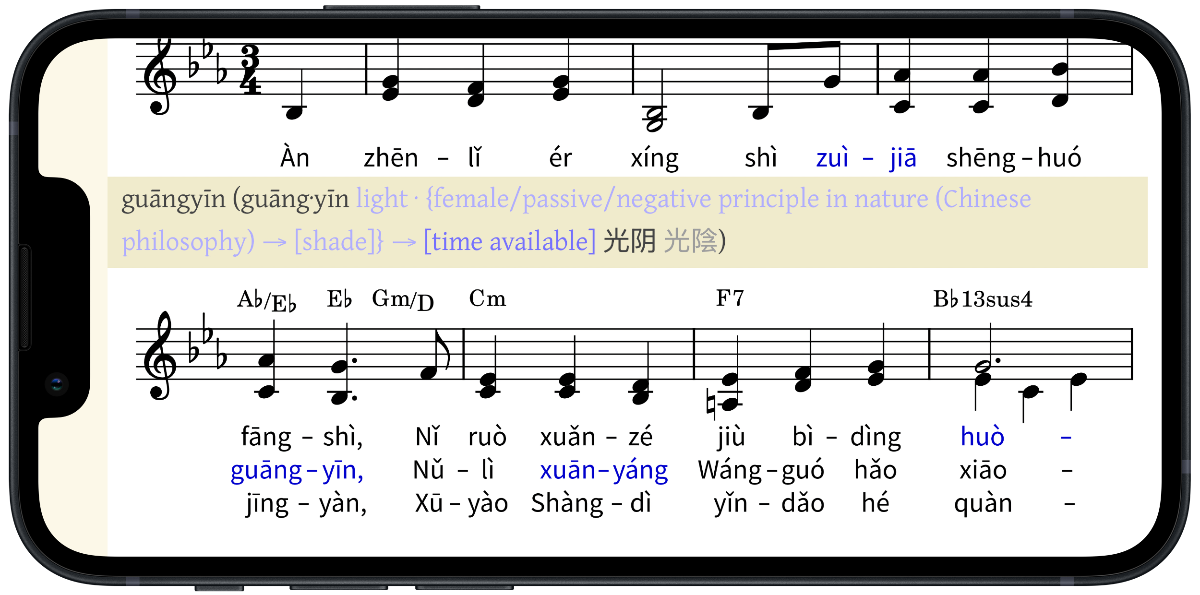
“guāngyīn” _Pīnyīn_ Plus info, Song 56 (music+_Pīnyīn_), on iPhone 13 mini (landscape orientation)

In the unofficial “Sing Out Joyfully” Bk. (Pīnyīn+Music, Pīnyīn Plus, Web) language-learning resource, some songs now use SVG technology to enable links (rendered in blue) in the musical notation’s Pīnyīn (Pīn·yīn {Piecing Together of} · Sounds → [Pinyin] 拼音) lyrics. When tapped/clicked, these will display Pīnyīn (Pīn·yīn {Piecing Together of} · Sounds → [Pinyin] 拼音) Plus “flashcards”. For example, as shown above, this resource’s rendition of song 56, from which this week’s MEotW comes, uses this technology. More such links will gradually be added as time allows.


For convenience:

The direct link for the Pīnyīn (Pīn·yīn {Piecing Together of} · Sounds → [Pinyin] 拼音) Plus resource for the “Sing Out Joyfully” book is:

The short link for Chinese field language-learning links for the “Sing Out Joyfully” book is:

More Pīnyīn (Pīn·yīn {Piecing Together of} · Sounds → [Pinyin] 拼音) and Pīnyīn (Pīn·yīn {Piecing Together of} · Sounds → [Pinyin] 拼音) Plus web material based on the Mandarin “Sing Out Joyfully” book will be made available in the Pīnyīn (Pīn·yīn {Piecing Together of} · Sounds → [Pinyin] 拼音) Plus web resource as time allows.
Categories
Culture Language Learning Names Nations

chūshēng rìqī

chūshēng rìqī ((chū·shēng {had coming out of} · {being born} → [was born] 出生) (rì·qī {sun → [day]} · {scheduled time} → [date] 日期) [date of birth; birth date]) ← Tap/click to show/hide the “flashcard”

[Notes: Tap/click on a Pīnyīn (Pīn·yīn {Piecing Together} · Sounds → [Pinyin] 拼音) expression to reveal its “flashcard”; tap/click on a “flashcard” or its Pīnyīn (Pīn·yīn {Piecing Together} · Sounds → [Pinyin] 拼音) expression to hide the “flashcard”. 📖 📄 📘 icons mean 📖 Reveal All, 📄 Reveal Advanced, and 📘 Reveal None re all the “flashcards” in the heading, paragraph, etc. that they are placed at the beginning of.]

At the time of this writing, jw.org was featuring the article “When Was Jesus Born?”. Considering that it’s getting to be the middle of December, that’s not surprising—while we Jehovah’s Witnesses don’t celebrate Christmas, this relatively unusual stand means that we sometimes need to explain why we don’t celebrate this holiday that many in the world like so much. Knowing a bit about “chūshēng rìqī ((chū·shēng {had coming out of} · {being born} → [was born] 出生) (rì·qī {sun → [day]} · {scheduled time} → [date] 日期) [date of birth; birth date])”, this week’s MEotW that’s used in the Mandarin version of the above-mentioned article, will help us to do so to Mandarin-speaking Bible students, etc.

One thing we should note is that “chūshēng rìqī ((chū·shēng {had coming out of} · {being born} → [was born] 出生) (rì·qī {sun → [day]} · {scheduled time} → [date] 日期) [date of birth; birth date])” is subtly different from “shēngri (shēng·ri {given birth to} · {sun → [day]} → [birthday] 生日)”, a common expression that many Mandarin field language learners likely have heard of. Comparing the English and Mandarin versions of the above-mentioned article, “chūshēng rìqī ((chū·shēng {had coming out of} · {being born} → [was born] 出生) (rì·qī {sun → [day]} · {scheduled time} → [date] 日期) [date of birth; birth date])” corresponds with “birth date” or “date of birth”, while the one occurrence of “shēngri (shēng·ri {given birth to} · {sun → [day]} → [birthday] 生日)” corresponds with “birthday”. The dictionaries I checked confirm this distinction.

Morphemes and Related Expressions

The morphemes in “chūshēng rìqī ((chū·shēng {had coming out of} · {being born} → [was born] 出生) (rì·qī {sun → [day]} · {scheduled time} → [date] 日期) [date of birth; birth date])” are relatively commonly used, but interesting.

Besides just meaning “out”, the “chū ({go/come/put… out}; out 出)” in “chūshēng rìqī ((chū·shēng {had coming out of} · {being born} → [was born] 出生) (rì·qī {sun → [day]} · {scheduled time} → [date] 日期) [date of birth; birth date])” can also mean “[a verb] out”, e.g., “go/come out”, “put out”, etc. For example, check out the literal meanings in these Mandarin expressions that contain this “chū ({go/come/put out}; out 出)” (Tap/click on the Pīnyīn (Pīn·yīn {Piecing Together} · Sounds → [Pinyin] 拼音) expression if the Pīnyīn (Pīn·yīn {Piecing Together} · Sounds → [Pinyin] 拼音) Plus “flashcard” is not already visible.):

  • Chū‐Āijí‐Jì ((Chū {Going Out from} 出)‐(Āijí Egypt 埃及)‐(Jì Record) [The Book of Exodus])
  • chūbǎn (chū·bǎn {put out} · {printing block [of] → [edition [of]]} → [publish] 出版)

The “shēng ({give birth to}/{was given birth to}; {give life to} | grow | exist; live | {[is] living}; {[is] alive} | {[is] unripe} | {[is] raw}; {[is] uncooked} | {[is] unfamiliar}; {[is] strange} | {[is] unprocessed}; {[is] crude} | existence; life; living | {be afflicted with}; get; have | very; keenly; much | pupil; student; scholar | [n suf used in names of occupations] 生)” in “chūshēng rìqī ((chū·shēng {had coming out of} · {being born} → [was born] 出生) (rì·qī {sun → [day]} · {scheduled time} → [date] 日期) [date of birth; birth date])” is highly polysemous (having multiple meanings), as can be seen from its Pīnyīn (Pīn·yīn {Piecing Together} · Sounds → [Pinyin] 拼音) Plus “flashcard”. Some notable expressions that contain it are:

  • shēngmìng (life (both life in general and the life of an individual) 生命)
  • yǒngshēng (yǒng·shēng eternal; everlasting · life 永生)
  • xuésheng (xué·sheng learning · {growing (one) → [student]} → [student; pupil] 学生 學生)
  • fāshēng (fā·shēng {issue forth} · {come to life} → [happen] 发生 發生)
  • mòshēng (mò·shēng {(from) footpath between fields → [strange; unfamiliar; foreign]} · {unripe → [unfamiliar; strange]} → [strang; unfamiliar] 陌生)

Heavenly Bodies, Times, Radicals, and Japan

As for the “ ({sun [→ [day]]} | {suns → [daily | daytime]} 日)” in “chūshēng rìqī ((chū·shēng {had coming out of} · {being born} → [was born] 出生) (rì·qī {sun → [day]} · {scheduled time} → [date] 日期) [date of birth; birth date])”, it literally means “sun”, but it is often used to mean “day”, since to us here on Earth it looks like the sun travels across the sky once a day. Similarly, “yuè (moon [→ [month | monthly]] 月)” literally means “moon”, but is often used to mean “month”, because we here on Earth see the moon go through all its phases in a month.

Speaking of “yuè (moon [→ [month | monthly]] 月)”, the character for it (月) is a radical that’s used in the character for the “ ({period of time}; phase; stage [→ [issue (of a periodical); term (of a training class, etc.) | time]] | {scheduled time}期/朞)” in “chūshēng rìqī ((chū·shēng {had coming out of} · {being born} → [was born] 出生) (rì·qī {sun → [day]} · {scheduled time} → [date] 日期) [date of birth; birth date])”. (Radicals are components of Chinese characters, that are a not very systematic system within the not very systematic system that is the characters. Thus, they can be justly thought of as a rabbit hole within a rabbit hole. Those who love characters often really love radicals, but otherwise, consider yourself warned!)

Changing the subject back to “ ({sun [→ [day]]} | {suns → [daily | daytime]} 日)”, this morpheme appears in the Mandarin name for Japan, “Rìběn (Rì·běn Sun’s · {Root → [Origin]} → [Japan] 日本)”. This name literally means “Sun’s Root” (or “Sun’s Origin”), since from the point of view of China, the sun rises where Japan is, to the east. In turn, the English expression “Land of the Rising Sun” comes from this meaning.

Usage Examples

Here are a couple of examples of “chūshēng rìqī ((chū·shēng {had coming out of} · {being born} → [was born] 出生) (rì·qī {sun → [day]} · {scheduled time} → [date] 日期) [date of birth; birth date])” in use, taken from the above-mentioned article:

English:

The Bible does not give a specific date for the birth of Jesus Christ…

Mandarin:

📖 📄 📘 Shèngjīng (Shèng·jīng (the) Holy · Scriptures → [the Bible] 圣经 聖經) bìng (actually並/竝/并) méiyǒu (méi·yǒu not · has 没有 沒有) jìzǎi (jì·zǎi recorded · {written down} 记载 記載) Yēsū (Jesus 耶稣 耶穌) Jīdū (Christ’s 基督) jùtǐ (jù·tǐ having · body → [specific] 具体 具體) de (’s 的) chūshēng rìqī ((chū·shēng {had coming out of} · {being born} → [was born] 出生) (rì·qī {sun → [day]} · {scheduled time} → [date] 日期) [date of birth])

English:

“The exact date of Christ’s birth is not known.”—Encyclopedia of Early Christianity.

Mandarin:

📖 📄 📘Méiyǒu (Méi·yǒu (there) not · {is having} 没有 沒有) rén (person 人) quèzhī (què·zhī truly · knowing 确知 確知) Jīdū (Christ 基督) de (’s 的) chūshēng rìqī ((chū·shēng {had coming out of} · {being born} → [was born] 出生) (rì·qī {sun → [day]} · {scheduled time} → [date] 日期) [date of birth]).”—Zǎoqī Jīdū‐Jiào Bǎikē‐Quánshū ((Zǎo·qī Early · Period 早期) {(Jīdū Christ 基督)‐(Jiào Teaching → [Religion] 教) → [Christianity]} {(Bǎi·kē {Hundred → [Numerous]} · {Branches of Study} → [Encyclopedic] 百科)‐(Quán·shū Complete · Book 全书 全書) → [Encyclopedia]} [Encyclopedia of Early Christianity]) (Yīngyǔ (Yīng·yǔ English · language 英语 英語)).

Categories
Culture History Language Learning Names Technology

fántǐ‐zì

fántǐ (fán·tǐ complicated; complex; difficult · {body → [style] → [typeface; font]} → [traditional Chinese] 繁体 繁體) (characters 字) 👈🏼 Tap/click to show/hide the “flashcard”

For a long, long, long time, Chinese characters were just Chinese characters. Then, in 1956, the Communist government of mainland China issued what came to be known as the First Chinese Character Simplification Scheme (a second round of Chinese character simplification was later attempted and ultimately rescinded), and official simplified Chinese characters came into the world. (Some characters had been unofficially simplified and used for various purposes, both everyday and artistic, before that.)

Name?

To distinguish these newfangled official simplified Chinese characters from the Chinese characters that had existed before, and that continue to be used by many people in many parts of the world, retronyms were coined to refer to these pre-existing Chinese characters, just as the term “acoustic guitar” was coined to refer to a regular non-electric guitar after electric guitars came along.

In the English-speaking world, the pre-official simplification characters have come to be called “traditional Chinese characters”, as opposed to the “simplified Chinese characters”. In the Chinese-speaking world, as is true of many things regarding Chinese characters, the situation is…complicated. Wikipedia summarizes the situation thusly:

Traditional Chinese characters (the standard characters) are called several different names within the Chinese-speaking world. The government of Taiwan officially calls traditional Chinese characters standard characters or orthodox characters (traditional Chinese: 正體字; simplified Chinese: 正体字; pinyin: zhèngtǐzì; Zhuyin Fuhao: ㄓㄥˋ ㄊㄧˇ ㄗˋ).[source] However, the same term is used outside Taiwan to distinguish standard, simplified and traditional characters from variant and idiomatic characters.[source]

In contrast, users of traditional characters outside Taiwan, such as those in Hong Kong, Macau and overseas Chinese communities, and also users of simplified Chinese characters, call them complex characters (traditional Chinese: 繁體字; simplified Chinese: 繁体字; pinyin: fántǐzì; Zhuyin Fuhao: ㄈㄢˊ ㄊㄧˇ ㄗˋ). Users of simplified characters sometimes informally refer to them as “old characters” (Chinese: 老字; pinyin: lǎozì; Zhuyin Fuhao: ㄌㄠˇ ㄗˋ).

Users of traditional characters also sometimes call them “full Chinese characters” (traditional Chinese: 全體字; simplified Chinese: 全体字; pinyin: quántǐ zì; Zhuyin Fuhao: ㄑㄩㄢˊ ㄊㄧˇ ㄗˋ) to distinguish them from simplified Chinese characters.

In my experience in the Chinese fields in Canada, I have always heard traditional Chinese characters referred to using this week’s MEotW, “fántǐ (fán·tǐ complicated; complex; difficult · {body → [style] → [typeface; font]} → [traditional Chinese] 繁体 繁體) (characters 字)”. For reference, this is also the term used on jw.org when referring to Mandarin written using traditional Chinese characters:

jw.org referring to Mandarin written using traditional Chinese characters

jw.org refers to traditional Chinese characters as “fántǐ (fán·tǐ complicated; complex; difficult · {body → [style] → [typeface; font]} → [traditional Chinese] 繁体 繁體)” characters.

Beloved by Traditionalists and Purists, But Complicated

Many feel that traditional characters are the best characters of all, since, in their estimation, the official simplified characters have lost some of the heart and soul of characters. As a symbolic example, some point to how the simplified character for “love”, “爱”, omits the “heart” radical (“心”), which is appropriately in the traditional character for “love”, “愛”.

Yes, as the above post mentions, the obvious, glaring issue with traditional characters is—aggravated by the fact that there are tens of thousands of them—their extreme, extraordinary complexity, the result of their problematically complex basic nature, along with thousands of years of accumulated occasionally arbitrary design decisions and developmental cruft. For example, note the below excerpt from p. 82 of the book The Chinese Language: Fact and Fantasy, by John DeFrancis:

In the case of the rendition for the huáng meaning “sturgeon” we have two variants, one written with the “yellow” phonetic and the other with the “emperor” phonetic, both combined with the semantic element for “fish”:

魚 “fish”
鱑 “fish” + huáng “yellow” = huáng “sturgeon”
鰉 “fish” + huáng “emperor” = huáng “sturgeon”

While etymological research might succeed in clarifying the basis for some of the variation, in many cases, as one specialist in Chinese paleography concludes, “it is simply a matter of the whim of the writer” (Barnard 1978:203).

Scribal whim goes far to explain a diversity bordering on chaos in the forms of the Chinese characters as they evolved in the Shang dynasty and during the long years of political and administrative disunity in the Zhou dynasty (ca. 1028–221 B.C.). The situation was aggravated by the fact that characters were created by writers living in different historical periods, which inevitably meant changes in sounds over the years, and speaking different dialects, which inevitably affected their choice of phonetic elements in the creation of new characters.

Their inherent extraordinary complexity, exacerbated by an accumulated millennia-long history of design decisions made on a whim, out-of-date phonetic elements, etc., causes especially the traditional characters, and even the (moderately) simplified characters, to be extremely difficult for us imperfect humans to learn and to remember. This has lead to character amnesia and the Great Wall of unfamiliar characters being real things, even among those who have been studying characters for decades. How complex can traditional characters get? Theoretically, there is no upper limit!

The extreme, extraordinary complexity of traditional characters undoubtedly contributed greatly to illiteracy having been widespread in China for much of its history. Even for those who are privileged to be able to devote the extraordinary amount of time and effort needed to learn traditional characters, it’s a long, hard slog, compared to learning a comparatively simple and compact alphabetical writing system. It’s little wonder, then, that there have been serious, concerted efforts to simplify and even replace traditional Chinese characters.