Categories
Culture Language Learning

miànzi

miànzi (miàn·zi face · [suf for nouns] [→ [reputation; prestige; esteem; honor]] 面子) ← Tap/click to show/hide the “flashcard”

Many who are reading this English-language blog are undoubtedly familiar with the English expression “lose face”. What many may not know, though, is that this English expression is actually a semantic loan translation from the Mandarin expression “diūliǎn (diū·liǎn lose · face 丢脸 丟臉)”. In support of this, Wikipedia cites no less an authority than the Oxford English Dictionary (OED):

8f. to save one’s face: to avoid being disgraced or humiliated. Similarly, to save (another’s) face. Hence save-face adj. = face-saving … Originally used by the English community in China, with reference to the continual devices among the Chinese to avoid incurring or inflicting disgrace. The exact phrase appears not to occur in Chinese, but ‘to lose face’ (diu lien), and ‘for the sake of his face’, are common.

Some of the Many Chinese Faces of “Face”

Besides “liǎn ({face (n)} [→ [[self-]respect; reputation]])”, as used in the expression “diūliǎn (diū·liǎn lose · face 丢脸 丟臉)” mentioned above, another Mandarin word used to mean “face” is “miàn (face [→ [surface; top | cover; outside | side; aspect | personal esteem; reputation | superficial | face-to-face]] | {[wheat] flour} | {noodles (made with wheat flour)} 面/靣)”, as used in this week’s MEotW, “miànzi (miàn·zi face · [suf for nouns] [→ [reputation; prestige; esteem; honor]] 面子)”. Yet another Mandarin word used to mean “face” is “yán (face; countenance [→ [prestige; dignity; reputation; honour]]顏/顔)”.

In its article on “Face (sociological concept)”, Wikipedia lists several Mandarin expressions based on the above-mentioned words.

Another way to see expressions based on the above-mentioned words is to use Pleco’s Wildcard Search. The excellent Sinosplice blog has a recent post about this handy feature of Pleco.

Face with Regard to Chinese Characters

Preoccupation with “miànzi (miàn·zi face · [suf for nouns] [→ [reputation; prestige; esteem; honor]] 面子)” in the eyes of worldly Chinese people can lead to a preoccupation with Chinese characters, since worldly Chinese people are so proud of these quintessential symbols of worldly Chinese culture, and many of them look down on those who don’t share this proud view of theirs. However, is focusing on Chinese characters really the key to glorifying Jehovah in the Mandarin field, as opposed to glorifying worldly human Chinese culture, or glorifying ourselves in the eyes of proud worldly Chinese people?

The Bible itself actually shows us that the key to glorifying Jehovah and reaching hearts in any language field, including the Chinese language fields, is actually understandable speech:

8 For if the trumpet sounds an indistinct call, who will get ready for battle? 9 In the same way, unless you with the tongue use speech that is easily understood, how will anyone know what is being said? You will, in fact, be speaking into the air. 10 It may be that there are many kinds of speech in the world, and yet no kind is without meaning. 11 For if I do not understand the sense of the speech, I will be a foreigner to the one speaking, and the one speaking will be a foreigner to me.
1 Corinthians 14:8–11

In accordance with long-established Chinese tradition, many may assume that focusing on Chinese characters is the way to eventually master Mandarin speech. Actually, though, as a writing system, Chinese characters are technically one of the most difficult conceivable ways to represent Mandarin speech. True, Chinese characters are “everywhere”, but this ubiquity and cultural prevalence of theirs does not change the reality that they are so inherently complex and haphazardly designed, and thus exceptionally difficult and time-consuming to learn and remember.

As a tool for learning, reading, and writing modern Mandarin speech, simple and elegant Pīnyīn (Pīn·yīn {Piecing Together} · Sounds → [Pinyin] 拼音) obviously works much better compared to the complex, convoluted Chinese characters. Historically, Plan A for modern mainland China was actually to eventually replace Chinese characters with Pīnyīn (Pīn·yīn {Piecing Together} · Sounds → [Pinyin] 拼音). Of course, that has not happened, but that’s not because Pīnyīn (Pīn·yīn {Piecing Together} · Sounds → [Pinyin] 拼音) doesn’t work well as a writing system for modern Mandarin—it does. The reasons why modern mainland China has continued to mainly use Chinese characters have more to do with human pride, prejudice, apathy, and tradition than with the actual relative merits of Chinese characters compared to Pīnyīn (Pīn·yīn {Piecing Together} · Sounds → [Pinyin] 拼音).

As for Chinese characters being “everywhere” in the Chinese world, this cultural dominance of Chinese characters in the wider Chinese world makes the current relative abundance of official and unofficial Pīnyīn (Pīn·yīn {Piecing Together} · Sounds → [Pinyin] 拼音)-containing material based on the publications of Jehovah’s organization seem kind of miraculous. Considering the way that Jehovah and Jesus have directed the development of the worldwide Mandarin field, perhaps it is not so far-fetched to think that extensive practical benefits to the preaching work in the worldwide Mandarin field have been allowed to outweigh mere human pride, prejudice, apathy, and tradition.
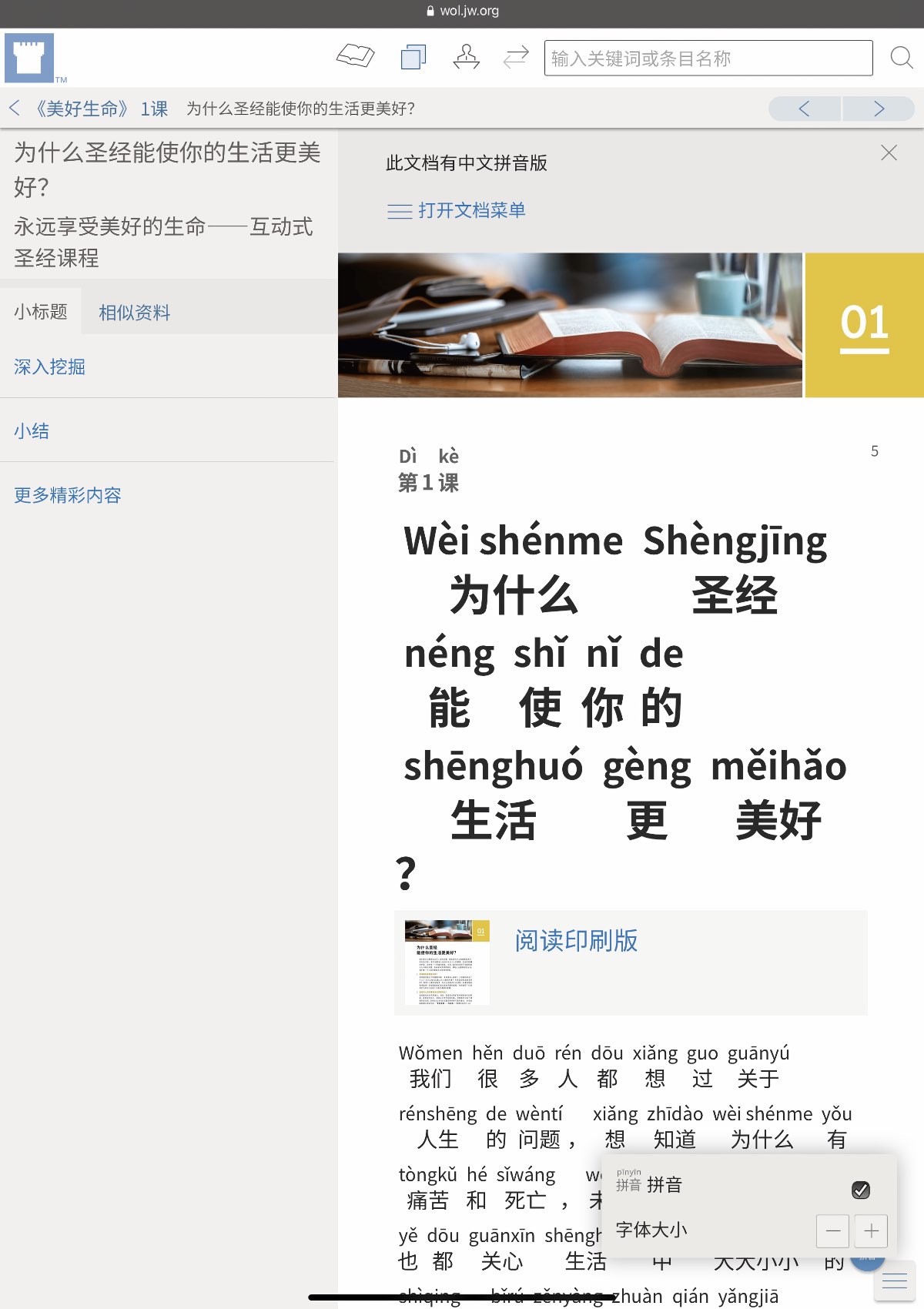
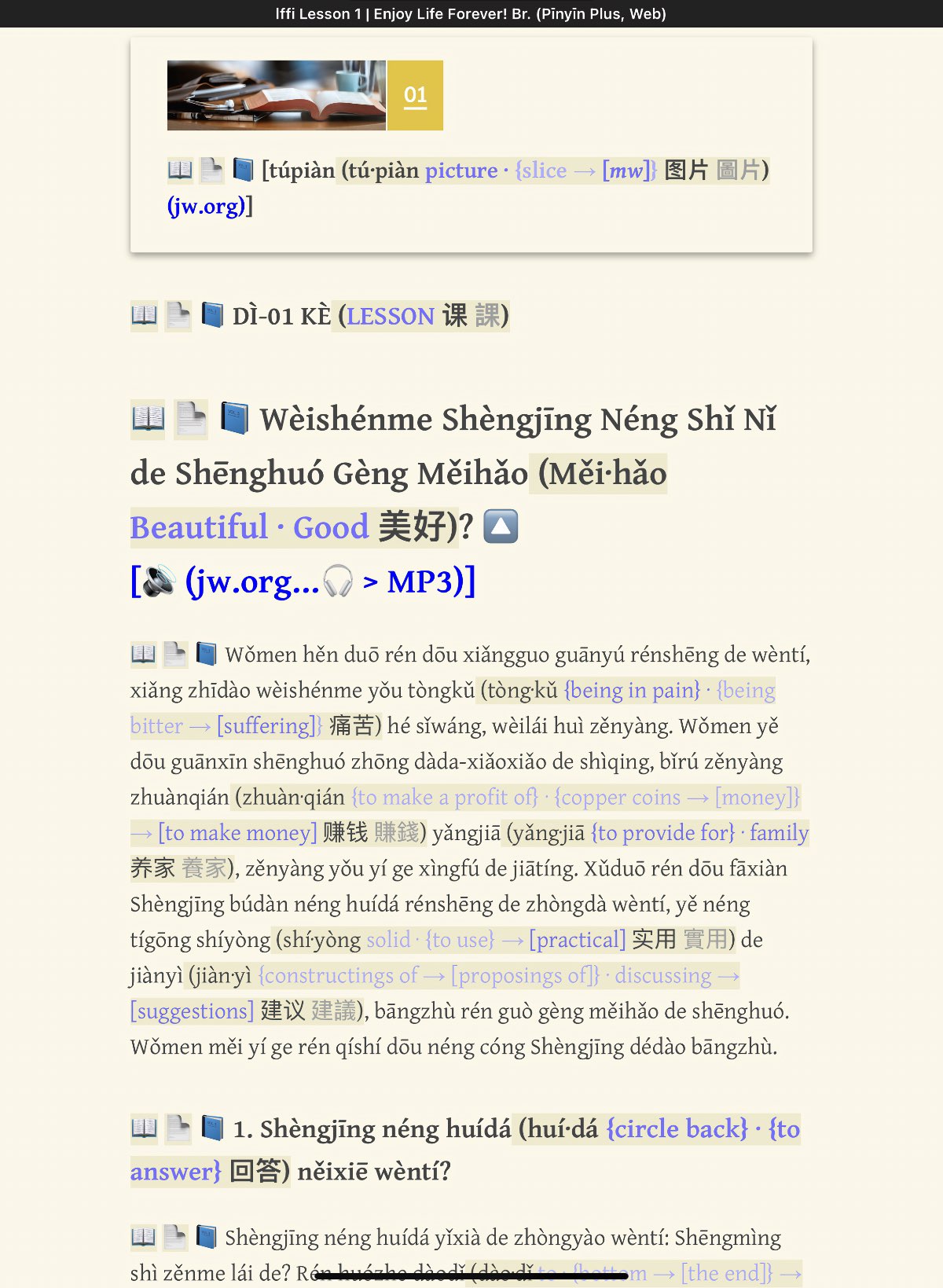
_Enjoy Life Forever!_ Bk., Lesson 1 (WOL CHS+Pinyin)

_Enjoy Life Forever!_ Br., Lesson 1 (Pīnyīn Plus)

Considering the cultural dominance of Chinese characters in the Chinese world, it’s kind of miraculous that there is now so much official and unofficial Pīnyīn (Pīn·yīn {Piecing Together} · Sounds → [Pinyin] 拼音)-containing material based on the publications of Jehovah’s organization.

(The official material shown above is spiritual food for helping people learn spiritual things; the unofficial material shown above is not spiritual food, but rather, language-learning material for helping people learn the Mandarin language, so that they can be more effective in the Mandarin field.)

Don’t Follow the Pharisees

Like many worldly Chinese people throughout history and down to the present day, many of the Jews in Jesus’ day were excessively concerned with what Jesus called “glory from men”:

41 I do not accept glory from men, 42 but I well know that you do not have the love of God in you. 43 I have come in the name of my Father, but you do not receive me. If someone else came in his own name, you would receive that one. 44 How can you believe, when you are accepting glory from one another and you are not seeking the glory that is from the only God?
John 5:41–44.

As Jesus pointed out, unfortunately for those Jews, their preoccupation with “glory from men”, “glory from one another”, prevented them from ‘having the love of God in them’, and it prevented them from “seeking the glory that is from the only God”. So, rather than being preoccupied with miànzi (miàn·zi face · [suf for nouns] [→ [reputation; prestige; esteem; honor]] 面子) like many in Satan’s world are, let us instead be like Jesus in pursuing, not “glory from men”, but rather, glory from, and for, Jehovah God himself.
Categories
Culture History Language Learning Science

Pīnyīn

Pīnyīn (Pīn·yīn {Piecing Together} · Sounds → [Pinyin] 拼音) ← Tap/click to show/hide the “flashcard”

Pīnyīn (Pīn·yīn {Piecing Together} · Sounds → [Pinyin] 拼音)” is the expression commonly used to refer to the phonetic alphabet introduced by China in 1958. This system is also known by longer, more official names:

  • Hànyǔ (Hàn·yǔ {Han (Chinese)} · Language → [(Modern Standard) Mandarin] 汉语 漢語) Pīnyīn (Pīn·yīn {Piecing Together} · Sounds → [Pinyin] 拼音)
  • Hànyǔ (Hàn·yǔ {Han (Chinese)} · Language → [(Modern Standard) Mandarin] 汉语 漢語) Pīnyīn (Pīn·yīn {Piecing Together} · Sounds → [Pinyin] 拼音) Fāng’àn (Fāng’·àn {Direction → [Method]} · {Long, Narrow Table or Desk → [Plan]} 方案)

When thinking of Pīnyīn (Pīn·yīn {Piecing Together} · Sounds → [Pinyin] 拼音) and its predecessor Zhùyīn (Zhù·yīn Annotating · Sounds → [Zhuyin] 注音 註/注音) (last week’s MEotW), some focus on the superficial differences between them. However, it’s perhaps even more important to note what they have in common, as indicated by the fact that the names of both systems end in “yīn (sound [→ [musical note/sound; tone; pronunciation | syllable | news; tidings]] 音)”: Both systems focus on representing the sounds of Mandarin, sounds which make up Mandarin speech and thus represent meanings. In fact, Pīnyīn (Pīn·yīn {Piecing Together} · Sounds → [Pinyin] 拼音)’s literal meaning tells us that this system helps people to “piece together sounds” to make up Mandarin speech, and thus convey the meanings that Mandarin speech represents.

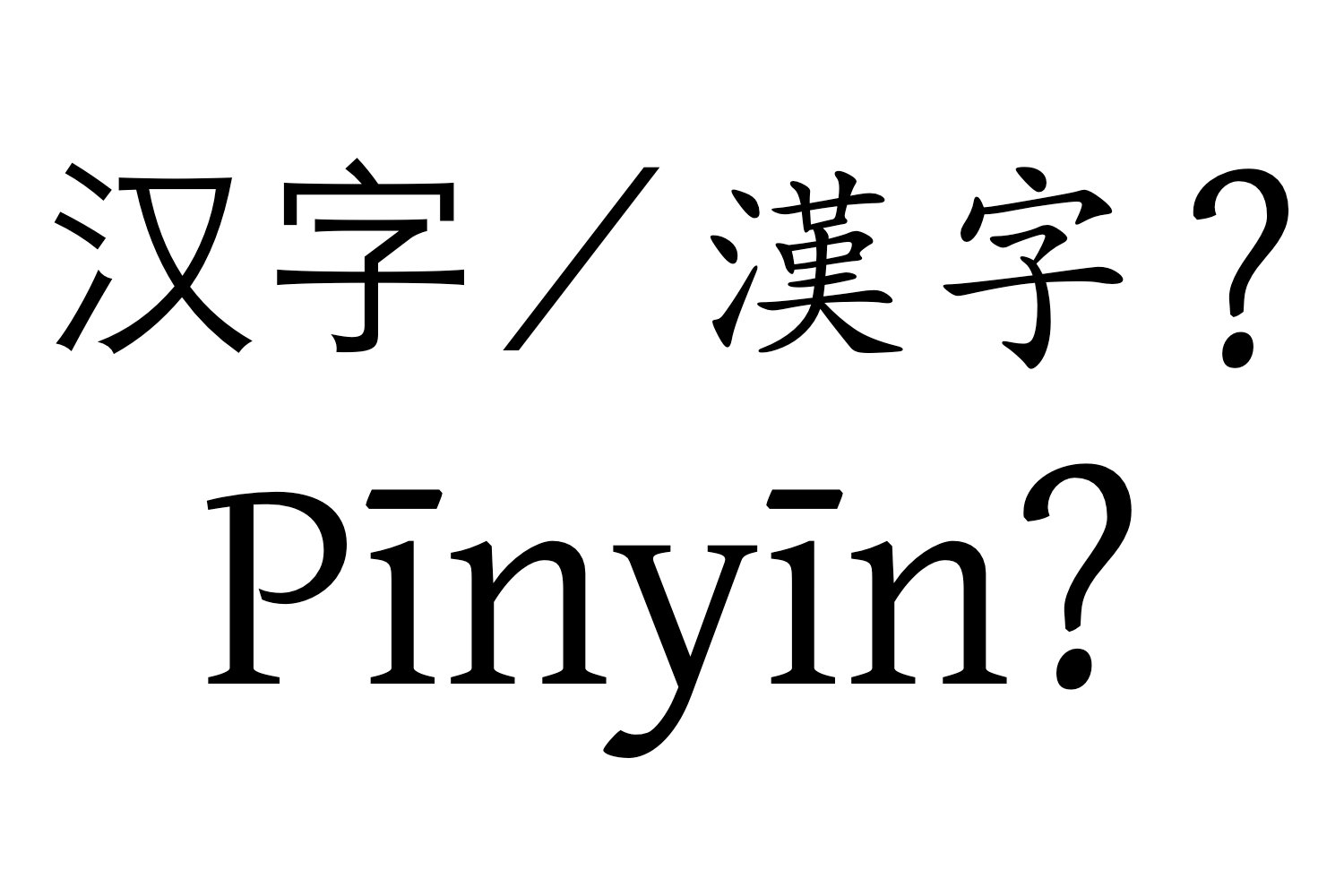
汉字 / 漢字? Pīnyīn?

In contrast, many people believe that the Hànzì (Hàn·zì {Han (Chinese)} · Characters 汉字 漢字), the Chinese characters, represent meanings more directly through their own visual design, as opposed to primarily being a system that represents Mandarin, Cantonese, etc., speech sounds which represent meaning. This view of Chinese characters, however, is actually a myth, which has been called the ideographic myth—God designed our brains and bodies to primarily represent meaning through speech, some humans in their hubris presumed that it would be better for us humans to represent meaning directly through visual symbols, and of course God was right and these humans were wrong.

There are actually many myths and misconceptions that people believe regarding Chinese characters, and sadly, that is also the case regarding Pīnyīn (Pīn·yīn {Piecing Together} · Sounds → [Pinyin] 拼音).

Common Myths and Misconceptions

  • Pīnyīn (Pīn·yīn {Piecing Together} · Sounds → [Pinyin] 拼音) is just a pronunciation aid. It’s not really a writing system like the characters are.”
    • But, is Pīnyīn even really a writing system? Interestingly, the Chinese national standard Zhōngguó Mángwén (中国盲文/中國盲文, Chinese Braille) is basically a transliteration or conversion of Pīnyīn into braille letters. Braille is obviously a writing system, so Pīnyīn must also be a writing system, not just a pronunciation aid.

  • Pīnyīn (Pīn·yīn {Piecing Together} · Sounds → [Pinyin] 拼音) is just training wheels. Characters are real wheels.”
    • Since Pīnyīn is not just a pronunciation aid, but a full writing system, it is not “training wheels”—it’s regular wheels. On the other hand, Chinese characters are like non-round wheels—more difficult than necessary.

  • Pīnyīn (Pīn·yīn {Piecing Together} · Sounds → [Pinyin] 拼音) on its own can’t be understood because there are too many homophones (words that sound the same, but have different meanings) in Mandarin.”
    • When people are just speaking Mandarin, with no characters in sight to help them, do they have problems understanding each other because of all the homophones? Can blind Mandarin-speakers, who cannot see characters, still “see” what people mean when those people speak Mandarin? Native Mandarin-speakers have confirmed to me that no, homophones are not a significant problem in spoken Mandarin—people can use the context and understand each other okay. So, people can use the context and understand each other okay when using Pīnyīn too, since Pīnyīn directly represents the sound of spoken Mandarin.

      • The above quote is from the article “Pīnyīn Was Plan A”. Check it out for more on this subject.
  • Pīnyīn (Pīn·yīn {Piecing Together} · Sounds → [Pinyin] 拼音) is less accurate than Zhùyīn (Zhù·yīn Annotating · Sounds → [Zhuyin] 注音 註/注音).”
    • Some people say that Zhuyin is more accurate or correct than Pinyin. Actually, both Zhuyin and Pinyin represent the same Mandarin sounds, just with different symbols. In fact, it’s not difficult to find tables that directly map the corresponding Zhuyin and Pinyin expressions to each other—a simple Google search for “pinyin zhuyin table” turns up many, many results. Pinyin and Zhuyin are just like different codes for encoding the same Mandarin message, so basically, neither is more accurate or correct than the other.

      • The above quote is from the tiandi.info post “Pinyin and Zhuyin”. (If you need login information for the parts of tiandi.info that require it, request it by email, and include information on who referred you and/or what group/cong. you are in.)
  • Pīnyīn (Pīn·yīn {Piecing Together} · Sounds → [Pinyin] 拼音) makes your Mandarin sound like English.”
    • This is only true if you are using it wrong. For example, if you read a French word and you make it sound like English when you read it out, the problem is not that the French word is written using the Latin alphabet like English is—the problem is that you are thinking of English sounds when you see the French word, when you should be thinking of French sounds. Similarly, you shouldn’t blame Pīnyīn (Pīn·yīn {Piecing Together} · Sounds → [Pinyin] 拼音) if you are thinking of English sounds when you see it, because it’s up to you to understand that Pīnyīn (Pīn·yīn {Piecing Together} · Sounds → [Pinyin] 拼音) represents Mandarin sounds, not English sounds.
    • Don’t worry, it becomes second nature to properly associate Pīnyīn (Pīn·yīn {Piecing Together} · Sounds → [Pinyin] 拼音) with Mandarin sounds after you get familiar with Mandarin sounds and used to the Pīnyīn (Pīn·yīn {Piecing Together} · Sounds → [Pinyin] 拼音) system. However, if you, say, prematurely stop using Pīnyīn (Pīn·yīn {Piecing Together} · Sounds → [Pinyin] 拼音) and instead turn to characters in an effort to avoid the baggage of English sounds, you may actually never really get the hang of Mandarin sounds. Seriously, I’ve seen people who focus on characters remain in this speech Twilight Zone for years and years! That’s because while characters do represent Mandarin speech sounds, they’re just bad at it—it’s just not what characters focus on. In stark contrast, Pīnyīn (Pīn·yīn {Piecing Together} · Sounds → [Pinyin] 拼音) is all about the sounds of Mandarin. It literally spells out in a simple way how a Mandarin syllable sounds at the beginning, at the end, and in between. Characters, though, represent the complex sound of a Mandarin syllable as one coarse lump, in a complex and often unrelated way—you either get it or you don’t, and many don’t.
      • Yes, characters are like a conceited jerk who convinces you with grand promises to jump from a high place, doesn’t bother to catch you, and then makes you think it’s your fault that you can’t fly. Pīnyīn (Pīn·yīn {Piecing Together} · Sounds → [Pinyin] 拼音), though, is like a modest and straightforward person who clearly explains each step for you so that you can dependably and confidently get to where you want to go.

For more information regarding Pīnyīn (Pīn·yīn {Piecing Together} · Sounds → [Pinyin] 拼音) and how we in the Mandarin field should view it, check out these articles:

Pīnyīn is a Good, Workable Writing System On Its Own”
This article is a brief overview of why it’s important for those of us in the Mandarin field to recognize that Pīnyīn (Pīn·yīn {Piecing Together} · Sounds → [Pinyin] 拼音) is a full writing system, not just a pronunciation aid.

Pīnyīn Was Plan A”
This extensively researched in-depth article discusses how we in the Mandarin field should view Pīnyīn (Pīn·yīn {Piecing Together} · Sounds → [Pinyin] 拼音).

(Short link: tiandi.info/articles)

Categories
Culture History Language Learning Names Technology

fántǐ‐zì

fántǐ (fán·tǐ complicated; complex; difficult · {body → [style] → [typeface; font]} → [traditional Chinese] 繁体 繁體) (characters 字) 👈🏼 Tap/click to show/hide the “flashcard”

For a long, long, long time, Chinese characters were just Chinese characters. Then, in 1956, the Communist government of mainland China issued what came to be known as the First Chinese Character Simplification Scheme (a second round of Chinese character simplification was later attempted and ultimately rescinded), and official simplified Chinese characters came into the world. (Some characters had been unofficially simplified and used for various purposes, both everyday and artistic, before that.)

Name?

To distinguish these newfangled official simplified Chinese characters from the Chinese characters that had existed before, and that continue to be used by many people in many parts of the world, retronyms were coined to refer to these pre-existing Chinese characters, just as the term “acoustic guitar” was coined to refer to a regular non-electric guitar after electric guitars came along.

In the English-speaking world, the pre-official simplification characters have come to be called “traditional Chinese characters”, as opposed to the “simplified Chinese characters”. In the Chinese-speaking world, as is true of many things regarding Chinese characters, the situation is…complicated. Wikipedia summarizes the situation thusly:

Traditional Chinese characters (the standard characters) are called several different names within the Chinese-speaking world. The government of Taiwan officially calls traditional Chinese characters standard characters or orthodox characters (traditional Chinese: 正體字; simplified Chinese: 正体字; pinyin: zhèngtǐzì; Zhuyin Fuhao: ㄓㄥˋ ㄊㄧˇ ㄗˋ).[source] However, the same term is used outside Taiwan to distinguish standard, simplified and traditional characters from variant and idiomatic characters.[source]

In contrast, users of traditional characters outside Taiwan, such as those in Hong Kong, Macau and overseas Chinese communities, and also users of simplified Chinese characters, call them complex characters (traditional Chinese: 繁體字; simplified Chinese: 繁体字; pinyin: fántǐzì; Zhuyin Fuhao: ㄈㄢˊ ㄊㄧˇ ㄗˋ). Users of simplified characters sometimes informally refer to them as “old characters” (Chinese: 老字; pinyin: lǎozì; Zhuyin Fuhao: ㄌㄠˇ ㄗˋ).

Users of traditional characters also sometimes call them “full Chinese characters” (traditional Chinese: 全體字; simplified Chinese: 全体字; pinyin: quántǐ zì; Zhuyin Fuhao: ㄑㄩㄢˊ ㄊㄧˇ ㄗˋ) to distinguish them from simplified Chinese characters.

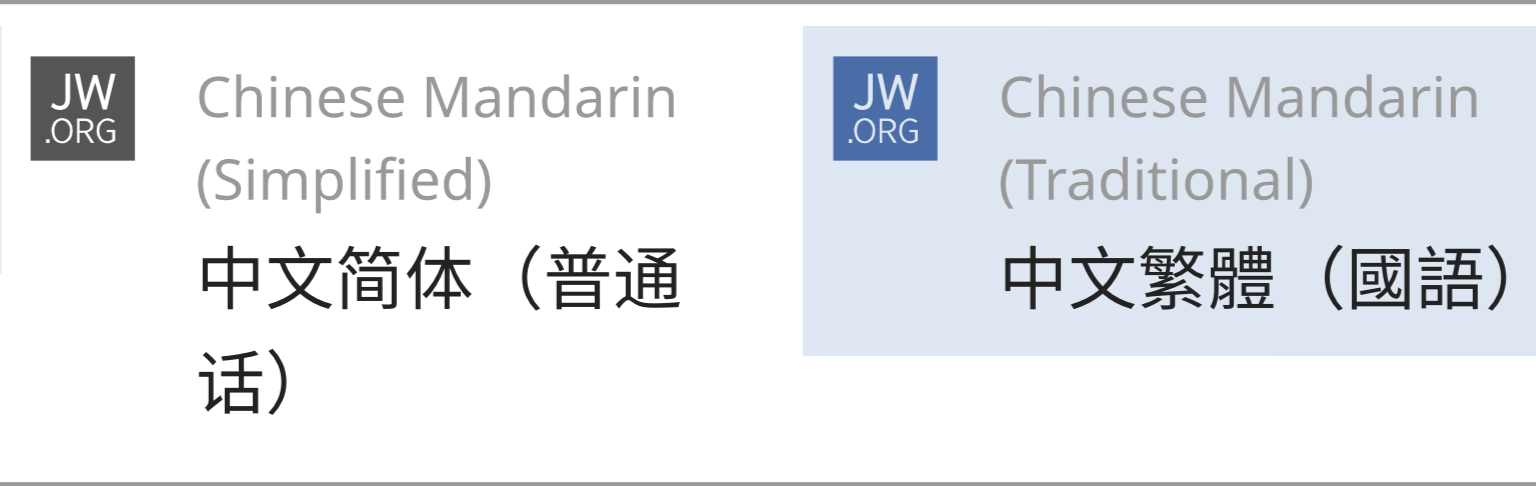
In my experience in the Chinese fields in Canada, I have always heard traditional Chinese characters referred to using this week’s MEotW, “fántǐ (fán·tǐ complicated; complex; difficult · {body → [style] → [typeface; font]} → [traditional Chinese] 繁体 繁體) (characters 字)”. For reference, this is also the term used on jw.org when referring to Mandarin written using traditional Chinese characters:

jw.org referring to Mandarin written using traditional Chinese characters

jw.org refers to traditional Chinese characters as “fántǐ (fán·tǐ complicated; complex; difficult · {body → [style] → [typeface; font]} → [traditional Chinese] 繁体 繁體)” characters.

Beloved by Traditionalists and Purists, But Complicated

Many feel that traditional characters are the best characters of all, since, in their estimation, the official simplified characters have lost some of the heart and soul of characters. As a symbolic example, some point to how the simplified character for “love”, “爱”, omits the “heart” radical (“心”), which is appropriately in the traditional character for “love”, “愛”.

Yes, as the above post mentions, the obvious, glaring issue with traditional characters is—aggravated by the fact that there are tens of thousands of them—their extreme, extraordinary complexity, the result of their problematically complex basic nature, along with thousands of years of accumulated occasionally arbitrary design decisions and developmental cruft. For example, note the below excerpt from p. 82 of the book The Chinese Language: Fact and Fantasy, by John DeFrancis:

In the case of the rendition for the huáng meaning “sturgeon” we have two variants, one written with the “yellow” phonetic and the other with the “emperor” phonetic, both combined with the semantic element for “fish”:

魚 “fish”
鱑 “fish” + huáng “yellow” = huáng “sturgeon”
鰉 “fish” + huáng “emperor” = huáng “sturgeon”

While etymological research might succeed in clarifying the basis for some of the variation, in many cases, as one specialist in Chinese paleography concludes, “it is simply a matter of the whim of the writer” (Barnard 1978:203).

Scribal whim goes far to explain a diversity bordering on chaos in the forms of the Chinese characters as they evolved in the Shang dynasty and during the long years of political and administrative disunity in the Zhou dynasty (ca. 1028–221 B.C.). The situation was aggravated by the fact that characters were created by writers living in different historical periods, which inevitably meant changes in sounds over the years, and speaking different dialects, which inevitably affected their choice of phonetic elements in the creation of new characters.

Their inherent extraordinary complexity, exacerbated by an accumulated millennia-long history of design decisions made on a whim, out-of-date phonetic elements, etc., causes especially the traditional characters, and even the (moderately) simplified characters, to be extremely difficult for us imperfect humans to learn and to remember. This has lead to character amnesia and the Great Wall of unfamiliar characters being real things, even among those who have been studying characters for decades. How complex can traditional characters get? Theoretically, there is no upper limit!

The extreme, extraordinary complexity of traditional characters undoubtedly contributed greatly to illiteracy having been widespread in China for much of its history. Even for those who are privileged to be able to devote the extraordinary amount of time and effort needed to learn traditional characters, it’s a long, hard slog, compared to learning a comparatively simple and compact alphabetical writing system. It’s little wonder, then, that there have been serious, concerted efforts to simplify and even replace traditional Chinese characters.