Categories
Science Technology Theocratic

xiétiáo

xiétiáo (xié·tiáo {assisting → [jointly; coordinatedly]} · {be regulated; adjusted; mixed → [suit well; fit [in] perfectly]} → [coordinate; harmonize; bring into line; fit together; match] 协调 協調) 👈🏼 Tap/click to show/hide the “flashcard”

[Notes: Tap/click on a Pīnyīn (Pīn·yīn {Piecing Together of} · Sounds → [Pinyin] 拼音) expression to reveal its “flashcard”; tap/click on a “flashcard” or its Pīnyīn (Pīn·yīn {Piecing Together of} · Sounds → [Pinyin] 拼音) expression to hide the “flashcard”. 📖 📄 📘 icons mean 📖 Reveal All, 📄 Reveal Advanced, and 📘 Reveal None re all the “flashcards” in the heading, paragraph, etc. that they are placed at the beginning of.]

The Shēngmìng Láizì Chuàngzào Ma? ((Shēngmìng Life 生命) (Lái·zì Came · From 来自 來自) (Chuàng·zào Initiating · {Making, Creating} → [Creating] 创造 創造) (Ma [? ptcl for “yes/no” questions])? [Was Life Created? (lc)]) (Was Life Created? (lc)) brochure and the Shēngmìng de Qǐyuán—Zhíde Sīkǎo de Wǔ Ge Wèntí ((Shēngmìng Life 生命) (de ’s 的) (Qǐ·yuán {Rising → [Starting]} · Source → [Origin] 起源/原)—(Zhí·de Worth · Getting → [Worth] 值得) (Sī·kǎo {Thinking About} · Examining 思考) (de ’s 的) (Wǔ Five 五) (Ge [mw]個/个) (Wèn·tí Asking · Subjects → [Questions] 问题 問題) [The Origin of Life—Five Questions Worth Asking (lf)]) (The Origin of Life—Five Questions Worth Asking (lf)) brochure were originally published back in 2010, but relatively recently, the English version of the Was Life Created? brochure was updated to the December 2022 Printing, and the Mandarin version of it was updated to the February 2023 Printing. Also, the Was Life Created? brochure and the Origin of Life brochure are now in the Teaching Toolbox section in the JW Library app. So, it would be good to consider some of the expressions used in the Mandarin versions of these publications that can be so helpful when discussing whether life was created.

They’re Coordinated

This week’s MEotW, “xiétiáo (xié·tiáo {assisting → [jointly; coordinatedly]} · {be regulated; adjusted; mixed → [suit well; fit [in] perfectly]} → [coordinate; harmonize; bring into line; fit together; match] 协调 協調)”, occurs in the box at the end of the QUESTION 1 section of the Origin of Life brochure, which section is entitled, in English, “How Did Life Begin?”:

English:

Question: What takes greater faith—to believe that the millions of intricately coordinated parts of a cell arose by chance or to believe that the cell is the product of an intelligent mind?

Mandarin (WOL, Pīnyīn (Pīn·yīn {Piecing Together of} · Sounds → [Pinyin] 拼音) Plus):

📖 📄 📘 Qǐng (please) xiǎngxiang (xiǎng·xiang {think about} · {think about} 想想): Xìbāo (Xì·bāo tiny · womb → [cell] 细胞 細胞) de (’s 的) wúshù (wú·shù without · number 无数 無數) bùfen (parts 部分) cuòzōng (cuò·zōng {are interlocked → [are intricate]} · {are combined → [are composite]} → [are intricate] 错综 錯綜)fùzá (fù·zá {are turned around → [are compound]} · {are mixed} → [are complex] 复杂 複雜), xiānghù ({with each other} 相互) xiétiáo (xié·tiáo {assisting → [coordinatedly]} · {are regulated → [fit in perfectly]} → [coordinate] 协调 協調), (you 你) rènwéi (rèn·wéi {do identify} · {(it) to be} (that) 认为 認為) xìbāo (xì·bāo tiny · womb → [cell] 细胞 細胞) shì (is 是) pèngqiǎo (pèng·qiǎo {having bumped into} · {being coincidental} → [by chance] 碰巧) chǎnshēng (chǎn·shēng {given birth to → [produced]} · {given birth to → [caused to exist]} → [brought into being] 产生 產生) de ({’s (thing)} 的), háishi (hái·shi {still more → [or]} · {is (it)} 还是 還是) zhìhuì (zhì·huì wisdom · intelligence → [wisdom] 智慧) de (’s 的) jiéjīng (jié·jīng {tied (into a knot) → [formed]} · crystal → [crystallization] 结晶 結晶) ne ([? ptcl] 呢)? (which 哪) (one 一) yàng (form → [way]) cái ({only then}才/纔) shì (is 是) bùkě (bù·kě (one) not · can → [(one) cannot] 不可) zhìxìn (zhì·xìn place · {believing in} → [believe (usually used in the negative)] 置信) de ({’s (way)} 的) ne ([? ptcl] 呢)?

They’re Really Coordinated

The MEotW post on “cuòzōng (cuò·zōng {[is] interlocked and jagged → [[is] intricate]} · {[is] combined → [[is] composite]} → [[is] intricate; complex; tangled] 错综 錯綜)fùzá (fù·zá {[is] turned around → [[is] compound; complex]} · {[is] mixed} → [[is] complicated; complex] 复杂 複雜)”, which occurs a bit before this week’s MEotW “xiétiáo (xié·tiáo {assisting → [jointly; coordinatedly]} · {be regulated; adjusted; mixed → [suit well; fit [in] perfectly]} → [coordinate; harmonize; bring into line; fit together; match] 协调 協調) in the above-quoted paragraph, contains this sentence:

In “cuòzōng (cuò·zōng {[being] interlocked and jagged → [[being] intricate]} · {[being] combined → [[being] composite]} → [[being] intricate; complex; tangled | (mental) complex (n)] 错综 錯綜)”, “cuò ({[is] alternating; staggered} [→ [[is] wrong; mistaken; incorrect; erroneous | missed | grinding; rubbing | moving to the side | mistake; error; blunder [→ [fault]]]] | {[is] interlocked and jagged} [→ [intricate]]) literally means “interlocked and jagged”, and it effectively means “intricate”.

“Interlocked and jagged” and “intricate” may bring to mind a clockwork mechanism, like this:
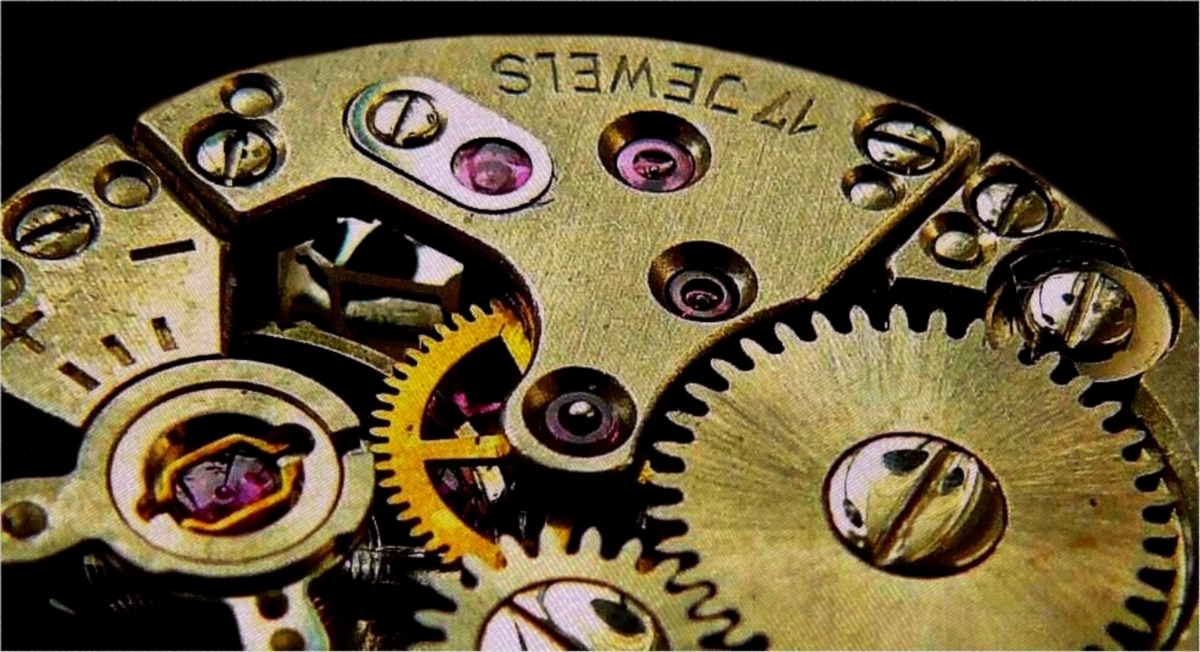
Closeup of a clockwork mechanism

Such a clockwork mechanism’s many parts are not only interlocked and intricate, they must also be highly coordinated in how they function—especially with mechanical clocks or watches, it’s all in the timing! This well-timed coordination is what “xiétiáo (xié·tiáo {assisting → [jointly; coordinatedly]} · {be regulated; adjusted; mixed → [suit well; fit [in] perfectly]} → [coordinate; harmonize; bring into line; fit together; match] 协调 協調) refers to.

The “xié (assist | assisting → [joint | jointly; coordinatedly]) in “xiétiáo (xié·tiáo {assisting → [jointly; coordinatedly]} · {be regulated; adjusted; mixed → [suit well; fit [in] perfectly]} → [coordinate; harmonize; bring into line; fit together; match] 协调 協調) literally means “assisting”, and in this context it effectively means “jointly” or “coordinatedly”. (This “xié (assist | assisting → [joint | jointly; coordinatedly]) also appears in the relatively well-known expression “xiézhù (xié·zhù assist · help; assist; aid 协助 協助)”.) The other morpheme “tiáo (regulate; adjust; mix; tune [→ [suit well; fit [in] perfectly | mediate | provoke; tease; tantalize | incite; instigate; sow discord]]調) literally means “be regulated; adjusted; mixed”, and here it effectively means “suit well; fit [in] perfectly”. Being put together this way, “xiétiáo (xié·tiáo {assisting → [jointly; coordinatedly]} · {be regulated; adjusted; mixed → [suit well; fit [in] perfectly]} → [coordinate; harmonize; bring into line; fit together; match] 协调 協調) on one level of literalness can mean “coordinatedly fit in perfectly”, and it can effectively mean “coordinate; harmonize; fit together; match”.

These meanings certainly apply to a finely crafted clockwork mechanism like the one pictured above, and they also apply to the many harmoniously functioning parts of a cell. Could the many parts of a clockwork mechanism have evolved separately, and then somehow come together by chance to function in the highly coordinated way that they do? It’s even less likely that the millions of intricately coordinated parts of a cell evolved separately and then somehow came together by chance to function like they do!

To give us an idea of how some of the parts of a cell function, here is a video I came across that uses computer animation to help us visualize how tiny molecular machines (discussed in the MEotW post on “fēnzǐ jùhé‐tǐ ((fēn·zǐ {divided (off)} · {small and hard thing} → [molecular] 分子) (jù·hé assembled · {closed → [combined]} → [polymerized] 聚合)‐(tǐ body體/体/躰) [(protein) molecular machine])”) inside our cells copy DNA:

As we can see, not only are a cell’s millions of parts highly complex and intricate, like the many pieces of a static puzzle, they also dynamically coordinate in real time as they go about their various functions, like the many moving parts of a working factory.

They’re Really, Really Coordinated

The MEotW post on “cuòzōng (cuò·zōng {[is] interlocked and jagged → [[is] intricate]} · {[is] combined → [[is] composite]} → [[is] intricate; complex; tangled] 错综 錯綜)fùzá (fù·zá {[is] turned around → [[is] compound; complex]} · {[is] mixed} → [[is] complicated; complex] 复杂 複雜) goes on to say:

It’s appropriate then, that the Mandarin Origin of Life brochure uses this expression to refer to the “millions of intricately coordinated parts of a cell”. Truly, most who have not specifically looked into the matter have no idea how fantastically complex even a single living cell is, never mind living organisms like us humans that are each made up of tens of trillions of cells, of which there are hundreds of different types.

Yes, not only do the millions of parts inside a single cell coordinate with each other, all of the parts inside the human body’s tens of trillions of cells, of which there are hundreds of different types, also ultimately work together in highly coordinated ways!

Let us, then, not hesitate to make good use of the Origin of Life brochure in the Mandarin field, to help ensure that our loving and wise Creator gets the praise and honour he deserves in this field in which many were taught that there is no Creator.—Revelation 4:11.


For convenience:

The direct link for the current-generation Pīnyīn (Pīn·yīn {Piecing Together of} · Sounds → [Pinyin] 拼音) Plus resource for the Origin of Life brochure is:

The short link for Chinese field language-learning links for the Origin of Life brochure is:

More Pīnyīn (Pīn·yīn {Piecing Together of} · Sounds → [Pinyin] 拼音) and Pīnyīn (Pīn·yīn {Piecing Together of} · Sounds → [Pinyin] 拼音) Plus web material based on the Mandarin Origin of Life brochure will be made available in the Pīnyīn (Pīn·yīn {Piecing Together of} · Sounds → [Pinyin] 拼音) Plus web resource as time allows.

Categories
Current Events Science Theocratic

jíduān tiānqì

jíduān (jí·duān extreme · extremity → [extreme] 极端 極端)
tiānqì (tiān·qì {sky → [weather]} · {air → [weather]} → [weather] 天气 天氣) 👈🏼 Tap/click to show/hide the “flashcard”

[Notes: Tap/click on a Pīnyīn (Pīn·yīn {Piecing Together of} · Sounds → [Pinyin] 拼音) expression to reveal its “flashcard”; tap/click on a “flashcard” or its Pīnyīn (Pīn·yīn {Piecing Together of} · Sounds → [Pinyin] 拼音) expression to hide the “flashcard”. 📖 📄 📘 icons mean 📖 Reveal All, 📄 Reveal Advanced, and 📘 Reveal None re all the “flashcards” in the heading, paragraph, etc. that they are placed at the beginning of.]

At the time of this writing, jw.org was featuring the article “Extreme Weather—Can the Bible Help You to Cope?”. To correspond with the English expression “extreme weather”, the Mandarin version uses this week’s MEotW, “jíduān (jí·duān extreme · extremity → [extreme] 极端 極端) tiānqì (tiān·qì {sky → [weather]} · {air → [weather]} → [weather] 天气 天氣)”.

Interesingly, the “jí (extremity | extreme (adj) | extremely; {to the extreme}) in “jíduān (jí·duān {[is] extreme} · end; extremity → [[is] extreme; exceedingly; absolute | extreme; extremity | exceedingly; extremely] 极端 極端) is also used in “Běijí (Běi·jí North · {Extremity → [Pole]} 北极 北極) (“North Pole”) and in “Nánjí (Nán·jí South · {Extremity → [Pole]} 南极 南極) (“South Pole”).

Extreme Weather Expressions in Context

Here are the English and Mandarin versions of the above-mentioned article’s first paragraph, which contains many expressions related to the topic of extreme weather:

English:

Are you one of the millions who have been affected by extreme weather? Dangerous weather and its damaging effects come in many forms. Hurricanes, typhoons, cyclones, and tornadoes often cause storm surges, flooding, or wind damage. Heavy rain may trigger landslides, and storms can bring lightning strikes that start destructive wildfires. Droughts, heat waves, and winter storms can be equally devastating.

Mandarin:

📖 📄 📘 Quánqiú (Quán·qiú (across) entire · globe → [worldwide] 全球) chéngqiān (chéng·qiān {coming to be} · {thousands} 成千)shàngwàn (shàng·wàn {up to} · {tens of thousands} 上万 上萬) de ( 的) rén (people 人) shòudào (shòu·dào {have been subjected to} · {arriving at} 受到) jíduān (jí·duān extreme · extremity → [extreme] 极端 極端) tiānqì (tiān·qì {sky → [weather]} · {air → [weather]} → [weather] 天气 天氣) yǐngxiǎng (yǐng·xiǎng relfections · sounds → [affecting] 影响 影響), (you 你) (also 也) shì (are 是) qízhōng (qí·zhōng them · among 其中) zhī (’s 之) (one 一) ma ([? ptcl for “yes/no” questions])? Jíduān (Jí·duān extreme · extremity → [extreme] 极端 極端) tiānqì (tiān·qì {sky → [weather]} · {air → [weather]} → [weather] 天气 天氣) kěyǐ (kě·yǐ can · [suf] 可以) dàilái (dài·lái bring · {to come} 带来 帶來) gèzhǒng (gè·zhǒng various · {kinds of} 各种 各種) zāihài (zāi·hài calamities · harm 灾害 災害), zàochéng (zào·chéng make · {to come to be} 造成) yánzhòng (yán·zhòng {tight → [severe]} · {weighty → [serious]} → [severe] 严重 嚴重) de (’s 的) pòhuài (pò·huài damaging · {to be ruined} 破坏 破壞). Lìrú (Lì·rú examples · like → [for example] 例如), jùfēng (jù·fēng hurricane · winds → [hurricanes] 飓风 颶風), táifēng (tái·fēng typhoon · winds → [typhoons] 台风 颱風), qìxuán (qì·xuán air · circlings → [cyclones] 气旋 氣旋), ({(together) with} → [and]和/龢) lóngjuǎn‐fēng ((lóng·juǎn dragon · spool → [tornado] 龙卷 龍捲)‐(fēng winds) [tornadoes]) jīngcháng (jīng·cháng regularly · often 经常 經常) huì (will) zàochéng (zào·chéng make · {to come to be} 造成) fēngbào‐cháo ((fēng·bào wind · {being violent} → [storm] 风暴 風暴)‐(cháo tides 潮) [storm surges]), hóngshuǐ (hóng·shuǐ flood · waters → [floods] 洪水), ({(together) with} → [and]和/龢) fēngzāi (fēng·zāi wind · disasters → [wind damage] 风灾 風災); dàyǔ (dà·yǔ {big → [heavy]} · rain 大雨) kěnéng (kě·néng maybe · {being able} → [possibly] 可能) yǐnfā (yǐn·fā {will draw (out)} · {to send out} → [will trigger] 引发 引發) ní‐shí‐liú ((ní mud 泥)‐(shí rock 石)‐(liú flows 流) [landslides]) (tǔ‐shí‐liú ((tǔ soil 土)‐(shí rock 石)‐(liú flows 流) [debris flows (Tw)])); léidiàn (léi·diàn thunder · {electricity → [lightning]} 雷电 雷電) kěnéng (kě·néng maybe · {being able} → [possibly] 可能) yǐnfā (yǐn·fā {will draw (out)} · {to send out} → [will spark] 引发 引發) yánzhòng (yán·zhòng {tight → [severe]} · {weighty → [serious]} → [severe] 严重 嚴重) de (’s 的) huǒzāi (huǒ·zāi fire · disasters → [wildfires] 火灾 火災); hànzāi (hàn·zāi drought · disasters → [droughts] 旱灾 旱災), rèlàng (rè·làng heat · waves 热浪 熱浪), yǐjí ({as well as} 以及) bàofēng‐xuě ((bào·fēng violent · wind → [storm] 暴风 暴風)‐(xuě snows 雪) [snowstorms]) (also 也) kěyǐ (kě·yǐ can · [suf] 可以) dàilái (dài·lái bring · {to come} 带来 帶來) yánzhòng (yán·zhòng {tight → [severe]} · {heavy → [serious]} → [serious] 严重 嚴重) de ( 的) pòhuài (pò·huài damaging · {to be ruined} 破坏 破壞).

Individual Extreme Weather Expressions

While the above paragraphs show several English and Mandarin expressions related to extreme weather used in context, below is a table of several of the individual English expressions used above, along with their corresponding Mandarin expressions:

English Mandarin
extreme weather jíduān (jí·duān extreme · extremity → [extreme] 极端 極端) tiānqì (tiān·qì {sky → [weather]} · {air → [weather]} → [weather] 天气 天氣)
hurricanes jùfēng (jù·fēng cyclone; hurricane; typhoon · winds → [hurricanes; typhoons] 飓风 颶風)
typhoons táifēng (tái·fēng typhoon · winds → [typhoons] 台风 颱風)
cyclones qìxuán (qì·xuán air · circlings → [cyclones] 气旋 氣旋)
tornadoes lóngjuǎn‐fēng ((lóng·juǎn dragon · spool → [tornado; waterspout] 龙卷 龍捲)‐(fēng winds) [tornadoes; twisters | cyclones; hurricanes])
storm surges fēngbào‐cháo ((fēng·bào wind · {being violent} → [storm] 风暴 風暴)‐(cháo tides 潮) [storm surges])
flooding hóngshuǐ (hóng·shuǐ flood · waters [→ [floods]] 洪水)
wind damage fēngzāi (fēng·zāi wind · disaster; calamity [→ [wind damage]] 风灾 風災)
heavy rain dàyǔ (dà·yǔ {big → [heavy]} · rain 大雨)
landslides ní‐shí‐liú ((ní mud 泥)‐(shí rock 石)‐(liú flows 流) [mud-rock flows; rockslides; mudslides; landslides]) (tǔ‐shí‐liú ((tǔ soil [→ [land]] 土)‐(shí rock 石)‐(liú flows 流) [debris flows (Tw); mud-rock flows; rockslides; mudslides; landslides]))
lightning léidiàn (léi·diàn thunder · {electricity → [lightning]} 雷电 雷電)
wildfires huǒzāi (huǒ·zāi fire · calamities; disasters [→ [wildfires]] 火灾 火災)
droughts hànzāi (hàn·zāi drought · disasters; calamities → [droughts] 旱灾 旱災)
heat waves rèlàng (rè·làng heat · waves 热浪 熱浪)
winter storms bàofēng‐xuě ((bào·fēng violent · wind → [storm] 暴风 暴風)‐(xuě snows 雪) [snowstorms; blizzards])

Hopefully, the information in this post will help you to be better equipped to speak with Mandarin-speaking people who are concerned about climate change (qìhòu (qì·hòu {air → [weather]} · conditions → [climate] 气候 氣候) biànhuà (biàn·huà changing · transforming 变化 變化)) and about the increasingly frequent and extreme extreme weather we are seeing in these last days.

Categories
Culture Current Events Science Technology Theocratic

ǒurán

ǒurán (ǒu·rán {[is] by chance/accident [→ [occasionally]]} · {so | -ly} [(thing/event/occurrence/etc.) → [accident]] 偶然) 👈🏼 Tap/click to show/hide the “flashcard”

[Notes: Tap/click on a Pīnyīn (Pīn·yīn {Piecing Together of} · Sounds → [Pinyin] 拼音) expression to reveal its “flashcard”; tap/click on a “flashcard” or its Pīnyīn (Pīn·yīn {Piecing Together of} · Sounds → [Pinyin] 拼音) expression to hide the “flashcard”. 📖 📄 📘 icons mean 📖 Reveal All, 📄 Reveal Advanced, and 📘 Reveal None re all the “flashcards” in the heading, paragraph, etc. that they are placed at the beginning of.]

One of the publications that is now recommended to be used on Bible studies is the Yǒngyuǎn Xiǎngshòu Měihǎo de Shēngmìng—Hùdòng Shì Shèngjīng Kèchéng ((Yǒng·yuǎn Eternally · {Far (in Time)} 永远 永遠) (Xiǎng·shòu Enjoy · Receive 享受) (Měi·hǎo Beautiful · Good 美好) (de ’s 的) (Shēngmìng Life 生命)—(Hù·dòng {Each Other} · Moving → [Interactive] 互动 互動) (Shì (Type 式) (Shèng·jīng Holy · Scriptures → [Bible] 圣经 聖經) (Kè·chéng Lessons · Procedure → [Course] 课程 課程) [Enjoy Life Forever!—An Interactive Bible Course (lff)]) (Enjoy Life Forever! (lff)) book. This week’s MEotW, “ǒurán (ǒu·rán {[is] by chance/accident [→ [occasionally]]} · {so | -ly} [(thing/event/occurrence/etc.) → [accident]] 偶然)”, appears in the first paragraph of lesson 6 of this book:

English:

Some people think that life came from random, undirected events. If that is true, then we exist only because of an accident.

Mandarin (WOL, Pīnyīn (Pīn·yīn {Piecing Together of} · Sounds → [Pinyin] 拼音) Plus):

📖 📄 📘 Yǒuxiē (Yǒu·xiē {(there) are having → [(there) are]} · some 有些) rén (people 人) rènwéi (rèn·wéi identifying · {(it) to be} 认为 認為), shēngmìng (life 生命) shì (was 是) pèngqiǎo (pèng·qiǎo {having bumped into} · {being coincidental} → [by chance/coincidence] 碰巧) chǎnshēng (chǎn·shēng {given birth to → [produced]} · {given birth to → [caused to exist]} → [brought into being] 产生 產生) de ({’s (thing)} 的). Rúguǒ (Rú·guǒ if · {fruit → [if indeed]} 如果) zhè (this) shì (is 是) zhēn (true 真) de ({’s (thing)} 的), wǒmen de ((wǒ·men us · [pl] 我们 我們) (de ’s 的) [our]) cúnzài (cún·zài existing · {being present} 存在) jiùshì (jiù·shì exactly · is 就是) ge ([mw]個/个) ǒurán (ǒu·rán {by accident} · so (thing) → [accident] 偶然).

Idols, Accidents, and Implications

Interestingly, the first morpheme in “ǒurán (ǒu·rán {[is] by chance/accident [→ [occasionally]]} · {so | -ly} [(thing/event/occurrence/etc.) → [accident]] 偶然) is also the first morpheme in “ǒuxiàng (ǒu·xiàng idol · {(instance of) being like → [image]} 偶像)”, where it means “idol”. However, in “ǒurán (ǒu·rán {[is] by chance/accident [→ [occasionally]]} · {so | -ly} [(thing/event/occurrence/etc.) → [accident]] 偶然)”, it has an apparently unrelated meaning of “by chance” or “by accident”. (I guess one perhaps accidental connection between “idol” and “by accident” is that “by accident” is about the only way that an idol can actually do anything, unless one allows belief in an idol to influence one’s own thoughts and actions.—Psalm 115:4–8.)

The second morpheme in “ǒurán (ǒu·rán {[is] by chance/accident [→ [occasionally]]} · {so | -ly} [(thing/event/occurrence/etc.) → [accident]] 偶然) means “so” or “like that”, and it can act like “-ly” in English, marking adverbs. Usually, then, “ǒurán (ǒu·rán {[is] by chance/accident [→ [occasionally]]} · {so | -ly} [(thing/event/occurrence/etc.) → [accident]] 偶然) means “by chance”, “accidental”, or “accidentally”. Occasionally, it can also mean “occasionally” or “incidentally”. Thus, according to dictionaries, this expression is a stative verb, an adjective, or an adverb.

In the example from the Enjoy Life Forever! book shown above, though, “ǒurán (ǒu·rán {[is] by chance/accident [→ [occasionally]]} · {so | -ly} [(thing/event/occurrence/etc.) → [accident]] 偶然) is used as a noun. In such cases, there’s an implied “thing/event/occurrence/etc.” after this expression’s morphemes’ literal meanings of “by accident so”. This works out to “by accident so (thing/event/occurrence/etc.)”, or “accident”. In cases like this, Pīnyīn (Pīn·yīn {Piecing Together of} · Sounds → [Pinyin] 拼音) Plus material puts the implied word or words in parentheses.

A Meaningless Accident?

Was it just an accident that life came to exist? That would be the case if the claims of evolutionists are correct. Yes, spiritually, that emptiness and meaninglessness are all that evolution has to offer. In stark contrast, the Bible’s creation account speaks of an origin springing from loving intention. As the Enjoy Life Forever! book goes on to say after the passage quoted above:

If Jehovah God created life, it would have a purpose, would it not?

While many people in this world are desperately looking around for meaning from outside themselves from things like artificial general intelligence and artificial superintelligence, aliens, etc., we Mandarin field language learners have the privilege of sharing a positive, heartening, evidence-based message with the Mandarin-speaking people we meet: Jehovah God is the Divine Superintelligence who created the universe, including us, and he loves us and has a wonderful future in store for us!—Jeremiah 29:11.


For convenience:

The direct link for the Pīnyīn (Pīn·yīn {Piecing Together of} · Sounds → [Pinyin] 拼音) Plus resource for the Enjoy Life Forever! book is:

The short link for Chinese field language-learning links for the Enjoy Life Forever! book is:

More Pīnyīn (Pīn·yīn {Piecing Together of} · Sounds → [Pinyin] 拼音) and Pīnyīn (Pīn·yīn {Piecing Together of} · Sounds → [Pinyin] 拼音) Plus web material based on the Mandarin Enjoy Life Forever! book will be made available in the Pīnyīn (Pīn·yīn {Piecing Together of} · Sounds → [Pinyin] 拼音) Plus web resource as time allows.