Categories
Culture Language Learning Science

gòngtōng

gòngtōng (gòng·tōng shared · {through → [connecting | [in] common]} [→ [applicable to both/all; shared; common; universal]] 共通) 👈🏼 Tap/click to show/hide the “flashcard”

As part of a series of posts about some common myths about Chinese characters, this post discusses the Universality Myth. So, this week’s MEotW is “gòngtōng (gòng·tōng shared · {through → [connecting | [in] common]} [→ [applicable to both/all; shared; common; universal]] 共通)”, an expression that seems to express well the supposed universality that is the subject of this myth.

In “gòngtōng (gòng·tōng shared · {through → [connecting | [in] common]} [→ [applicable to both/all; shared; common; universal]] 共通)”, “gòng (share | common | together | altogether 共) means “share | common | together | altogether”. This morpheme also appears in other well-known expressions such as “gòngtóng (gòng·tóng shared · {same | together} 共同)”, “gònghé‐guó ((gòng·hé shared · harmony → [republic] 共和)‐(guó country; nation; state) [republic])”, and “Gòngchǎn (Gòng·chǎn {Commonly Possessing} · {Produced (Things) → [Property]} → [Communist] 共产 共產)Dǎng (Party黨/党)”.

As for “tōng ({[(going)] through[(out)]; open [to]} [→ [common; general | connecting/communicating [to/with] [→ [logical; coherent]]]] 通)”, it here literally means “through”, and effectively means “connecting” or “in common”. It also appears in well-known expressions such as “gōutōng (gōu·tōng {(through) channel} · {(going) through → [communicating]} → [communicating; communication | linking up] 沟通 溝通)”, “jiāotōng (jiāo·tōng crossing; intersecting; meeting; joining · {(going) through → [connecting; communicating]} → [traffic; communications; transportation] 交通)”, “pǔtōng (pǔ·tōng common; general; universal; widespread · {through(out) → [general; common]} → [ordinary; common; average; general] 普通)”, and “tōngguò (tōng·guò through · passing → [passing through] → [through] 通过 通過)”.

When put together, the morphemes in “gòngtōng (gòng·tōng shared · {through → [connecting | [in] common]} [→ [applicable to both/all; shared; common; universal]] 共通) can effectively mean “shared; common; universal”, which in itself can generally be good. In fact, in our ministry, we look for “gòngtōng (gòng·tōng shared · {through → [in common]} → [common] 共通) diǎn (points) (common ground) with those with whom we speak. How universal, though, are Chinese characters? Are they really more universal than, say, alphabets?

Basis and Beliefs

In the book The Chinese Language: Fact and Fantasy, linguist and sinologist John DeFrancis writes the following in the chapter entitled “The Universality Myth”:

The Universality Myth is the logical extension of the Ideographic Myth. It is based on the threefold belief that:

1. Chinese characters enable a speaker from Beijing and another from Canton to communicate in writing even though they cannot understand each other’s speech. …
2. Chinese characters make it possible to read today’s newspapers as well as poems written a thousand years ago and philosophical essays written long before Christ. …
3. Chinese characters can function as a universal means of communication among people speaking totally unrelated languages. …

Implicitly or explicitly, the statements are meant to contrast Chinese characters with the familiar alphabetic scripts of the West. Chinese characters, it is believed, can do all these things, whereas alphabetic scripts cannot.

In other words, the Universality Myth regarding Chinese characters is that these visible, supposedly ideographic (representing meaning visually, without dependence on speech sounds) symbols of worldly Chinese culture can function across barriers of space, time, and language as universal enablers of communication. That seems amazing, if true. But, is it true? And, is it any more true for Chinese characters than it is for alphabets?

Testing the Relative Universality

DeFrancis goes on to test the Universality Myth by examining what it would take for an illiterate Mandarin speaker and an illiterate Cantonese speaker to learn how to communicate with each other by writing in characters, compared to what it would take for an illiterate French speaker and an illiterate Spanish speaker to learn how to communicate with each other by writing in French (which, as is widely known, is written using the Latin alphabet):

My Chinese colleagues estimate on the basis of their own experience and direct contact with the Chinese educational system that it takes seven to eight years for a Mandarin speaker to learn how to read and write three thousand characters and another year or two for a speaker of Cantonese to reach the same level in Standard Chinese. …My colleagues in French and Spanish estimate it would take the two imagined European illiterates less than half the time to reach a comparable level of proficiency in French.

…The overall picture is clear. It seems incontestable that both Europeans will find it easier to learn to read and write French than it be for either Cantonese or Mandarin speakers to learn to read and write Chinese. If we could add up the combined number of hours needed for the two members of each group to accomplish the same thing, the total would be enormously greater in the case of Chinese written in characters than in the case of French written in an alphabetic script. Even more significant, it would also be enormously greater for Chinese written in characters than for Chinese written in Pinyin. That is to say, it would be much easier for illiterates from Peking and those from Canton, even if the latter remain incapable of speaking Mandarin, to acquire the ability to communicate with each other by learning to read and write Standard Chinese written in Pinyin rather than in characters. Where, then, is the vaunted marvel of tongue-tied Chinese o’er-leaping barriers in speech by communicating with each other by means of those magical Chinese characters?

So, it’s possible for speakers of Mandarin, Cantonese, Japanese, Korean, English, French, Spanish, etc. to learn Chinese characters and use these as a means of communication. However, they could also do this with Pīnyīn (Pīn·yīn {Piecing Together of} · Sounds → [Pinyin] 拼音)! Also, it would actually be much faster and easier to do this with Pīnyīn (Pīn·yīn {Piecing Together of} · Sounds → [Pinyin] 拼音) than it would be to do it with the crazy complex characters!

Going Back in Time

What about the claim that characters allow us to still be able to read Chinese writings from long ago? Concerning this, DeFrancis writes:

Apart from learning the characters in their current meanings, Chinese must also learn the frequently different meanings of characters in earlier usage and the definitely different syntactical structures of classical versus contemporary written Chinese. This ability involves considerable training in tasks notorious for their difficulty—tasks that involve mastering differences at least as great as those between current English and the language of Chaucer. Without going into great detail, it should be readily apparent that an illiterate Chinese, regardless of whether he speaks Cantonese or Mandarin, will have a much greater task in learning to read classical Chinese than will an illiterate European, regardless of whether he speaks Spanish or French, in learning to read Latin. In the case of those already literate in current Chinese or French, it is doubtful that Chinese readers would enjoy any advantage over Europeans in respect to the amount of additional effort required to read classical Chinese in contrast to Latin.

So, it would probably be harder for a Chinese person to learn characters and then learn classical Chinese, than it would be for a European person to learn the Latin alphabet, and then learn Latin!

For us Mandarin field language learners specifically, since Jehovah’s organization is continually moving forward with ever broader, deeper, and clearer understandings of various truths, we in contrast seek to use the newest, most up-to-date writings from the organization whenever possible. Even with regard to the Bible itself, first written long ago, we seek, as a rule, to use the most up-to-date translations available. For specific examples in this regard, Appendix A2 (English, Mandarin) of the New World Translation Bible lists ways in which the current version of this Bible has been carefully revised to be more beneficial for modern readers.

It’s worth noting that the Chinese versions of the organization’s publications used to be written only in Chinese characters, but the most recent versions of the organization’s important writings generally have Pīnyīn (Pīn·yīn {Piecing Together of} · Sounds → [Pinyin] 拼音) available for them as well now.

Sunk Costs and Future Investments

Of course, those who have already spent years of hard work learning characters wouldn’t have to start that particular long and difficult process from zero (although, tíbǐ (tí·bǐ {carry (hanging down from the hand) → [raise; lift]} · pen; pencil; {writing brush} [→ [start writing; write]] 提笔 提筆)wàng (forget 忘) (character 字) (character amnesia) is real thing that takes constant ongoing effort to ward off). And, if they happen to meet others, even others who don’t speak the same language, who have also already spent years of hard work learning characters, then, yes, they might be able to use characters to imperfectly communicate with these others, to a limited extent—that is indeed one imperfect benefit arising from the massive sunk costs they have incurred in the process of learning characters.

However, those who have not already poured enormous amounts of time and effort into learning characters still have the opportunity to objectively weigh how much time and effort it is reasonable and worthwhile to sink into the characters going forward. As they consider this, they can keep in mind the inescapable reality that, due to the inherent extraordinary complexity of the characters, and due to the way that Jehovah actually designed us humans to use language, Pīnyīn (Pīn·yīn {Piecing Together of} · Sounds → [Pinyin] 拼音) and other sound-prioritizing writing systems (like Hangul, for those learning Korean) offer much greater ROI (return on investment) than characters do for those considering investing time and effort into learning how to actually communicate with others. Dedicated servants of Jehovah should also keep in mind that the time and energy they have are not theirs alone to spend or waste—their time, energy, etc. actually belong to Jehovah, and should thus be used and invested accordingly.

Anyway, to summarize, the Universality Myth regarding Chinese characters is…BUSTED!
Categories
Culture History Language Learning Names Technology

fántǐ‐zì

fántǐ (fán·tǐ complicated; complex; difficult · {body → [style] → [typeface; font]} → [traditional Chinese] 繁体 繁體) (characters 字) 👈🏼 Tap/click to show/hide the “flashcard”

[This is a reposting of a post that was originally posted on November 30, 2020. I took the opportunity to flesh out the original post and this repost with additional material.]

For a long, long, long time, Chinese characters were just Chinese characters. Then, in 1956, the Communist government of mainland China issued what came to be known as the First Chinese Character Simplification Scheme (a second round of Chinese character simplification was later attempted and ultimately rescinded), and official simplified Chinese characters came into the world. (Some characters had been unofficially simplified and used for various purposes, both everyday and artistic, before that.)

Name?

To distinguish these newfangled official simplified Chinese characters from the Chinese characters that had existed before, and that continue to be used by many people in many parts of the world, retronyms were coined to refer to these pre-existing Chinese characters, just as the term “acoustic guitar” was coined to refer to a regular non-electric guitar after electric guitars came along.

In the English-speaking world, the pre-official simplification characters have come to be called “traditional Chinese characters”, as opposed to the “simplified Chinese characters”. In the Chinese-speaking world, as is true of many things regarding Chinese characters, the situation is…complicated. Wikipedia summarizes the situation thusly:

Traditional Chinese characters (the standard characters) are called several different names within the Chinese-speaking world. The government of Taiwan officially calls traditional Chinese characters standard characters or orthodox characters (traditional Chinese: 正體字; simplified Chinese: 正体字; pinyin: zhèngtǐzì; Zhuyin Fuhao: ㄓㄥˋ ㄊㄧˇ ㄗˋ).[source] However, the same term is used outside Taiwan to distinguish standard, simplified and traditional characters from variant and idiomatic characters.[source]

In contrast, users of traditional characters outside Taiwan, such as those in Hong Kong, Macau and overseas Chinese communities, and also users of simplified Chinese characters, call them complex characters (traditional Chinese: 繁體字; simplified Chinese: 繁体字; pinyin: fántǐzì; Zhuyin Fuhao: ㄈㄢˊ ㄊㄧˇ ㄗˋ). Users of simplified characters sometimes informally refer to them as “old characters” (Chinese: 老字; pinyin: lǎozì; Zhuyin Fuhao: ㄌㄠˇ ㄗˋ).

Users of traditional characters also sometimes call them “full Chinese characters” (traditional Chinese: 全體字; simplified Chinese: 全体字; pinyin: quántǐ zì; Zhuyin Fuhao: ㄑㄩㄢˊ ㄊㄧˇ ㄗˋ) to distinguish them from simplified Chinese characters.

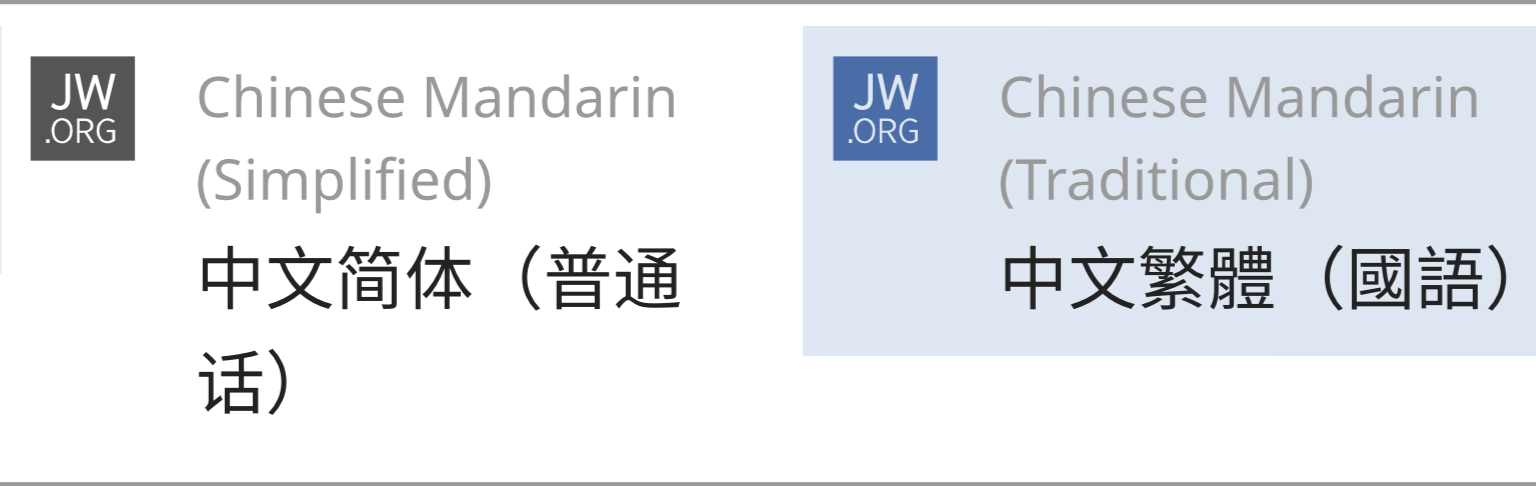
In my experience in the Chinese fields in Canada, I have always heard traditional Chinese characters referred to using this week’s MEotW, “fántǐ (fán·tǐ complicated; complex; difficult · {body → [style] → [typeface; font]} → [traditional Chinese] 繁体 繁體) (characters 字)”. For reference, this is also the term used on jw.org when referring to Mandarin written using traditional Chinese characters:

jw.org referring to Mandarin written using traditional Chinese characters

jw.org refers to traditional Chinese characters as “fántǐ (fán·tǐ complicated; complex; difficult · {body → [style] → [typeface; font]} → [traditional Chinese] 繁体 繁體)” characters.

Beloved by Traditionalists and Purists, But Complicated

Many feel that traditional characters are the best characters of all, since, in their estimation, the official simplified characters have lost some of the heart and soul of characters. As a symbolic example, some point to how the simplified character for “love”, “爱”, omits the “heart” radical (“心”), which is appropriately in the traditional character for “love”, “愛”.

Yes, as the above post mentions, the obvious, glaring issue with traditional characters is—aggravated by the fact that there are tens of thousands of them—their extreme, extraordinary complexity, the result of their problematically complex basic nature, along with thousands of years of accumulated occasionally arbitrary design decisions and developmental cruft. For example, note the below excerpt from p. 82 of the book The Chinese Language: Fact and Fantasy, by John DeFrancis:

In the case of the rendition for the huáng meaning “sturgeon” we have two variants, one written with the “yellow” phonetic and the other with the “emperor” phonetic, both combined with the semantic element for “fish”:

魚 “fish”
鱑 “fish” + huáng “yellow” = huáng “sturgeon”
鰉 “fish” + huáng “emperor” = huáng “sturgeon”

While etymological research might succeed in clarifying the basis for some of the variation, in many cases, as one specialist in Chinese paleography concludes, “it is simply a matter of the whim of the writer” (Barnard 1978:203).

Scribal whim goes far to explain a diversity bordering on chaos in the forms of the Chinese characters as they evolved in the Shang dynasty and during the long years of political and administrative disunity in the Zhou dynasty (ca. 1028–221 B.C.). The situation was aggravated by the fact that characters were created by writers living in different historical periods, which inevitably meant changes in sounds over the years, and speaking different dialects, which inevitably affected their choice of phonetic elements in the creation of new characters.

Their inherent extraordinary complexity, exacerbated by an accumulated millennia-long history of design decisions made on a whim, out-of-date phonetic elements, etc., causes especially the traditional characters, and even the (moderately) simplified characters, to be extremely difficult for us imperfect humans to learn and to remember. This has lead to character amnesia and the Great Wall of unfamiliar characters being real things, even among those who have been studying characters for decades. How complex can traditional characters get? Theoretically, there is no upper limit!

The extreme, extraordinary complexity of traditional characters undoubtedly contributed greatly to illiteracy having been widespread in China for much of its history. Even for those who are privileged to be able to devote the extraordinary amount of time and effort needed to learn traditional characters, it’s a long, hard slog, compared to learning a comparatively simple and compact alphabetical writing system. It’s little wonder, then, that there have been serious, concerted efforts to simplify and even replace traditional Chinese characters.

Categories
Culture History Language Learning Names Science Technology

Yànwén

Yànwén (Yàn·wén {Proverb (Korean: Vernacular)} · Writing → [Hangul/Hankul (modern Korean writing system)] 谚文 諺文) ← Tap/click to show/hide the “flashcard”

This week’s MEotW is “Yànwén (Yàn·wén {Proverb (Korean: Vernacular)} · Writing → [Hangul/Hankul (modern Korean writing system)] 谚文 諺文)”, which seems to be the most commonly used Mandarin expression referring to the modern Korean writing system. In English, we refer to this writing system as “Hangul” or “Hankul”, depending on which romanization system we prefer.

The Korean text “Joseongeul” and “Hangeul,” written in Hangul, the native Korean script.

The Korean text “Joseongeul” and “Hangeul,” written in Hangul, the native Korean script. [source]
Creative Commons Attribution-ShareAlike License logo metalslick

“…By Any Other Name”

One of the first things I noticed while researching this topic is that Korean, English, and Mandarin each have multiple names for the modern Korean writing system. Here is Wikipedia’s summary of its names in Korean and in English:

Official names

The Korean alphabet was originally named Hunminjeong’eum (훈민정음) by King Sejong the Great in 1443.[source] Hunminjeong’eum (훈민정음) is also the document that explained logic and science behind the script in 1446.

The name hangeul (한글) was coined by Korean linguist Ju Si-gyeong in 1912. The name combines the ancient Korean word han (한), meaning great, and geul (글), meaning script. The word han is used to refer to Korea in general, so the name also means Korean script.[source] It has been romanized in multiple ways:

  • Hangeul or han-geul in the Revised Romanization of Korean, which the South Korean government uses in English publications and encourages for all purposes.
  • Han’gŭl in the McCune–Reischauer system, is often capitalized and rendered without the diacritics when used as an English word, Hangul, as it appears in many English dictionaries.
  • hān kul in the Yale romanization, a system recommended for technical linguistic studies.

North Koreans call the alphabet Chosŏn’gŭl (조선글), after Chosŏn, the North Korean name for Korea.[source] A variant of the McCune–Reischauer system is used there for romanization.

Other names

Until the mid-20th century, the Korean elite preferred to write using Chinese characters called Hanja. They referred to Hanja as jinseo (진서/真書) meaning true letters. Some accounts say the elite referred to the Korean alphabet derisively as ‘amkeul (암클) meaning women’s script, and ‘ahaetgeul (아햇글) meaning children’s script, though there is no written evidence of this.[source]

Supporters of the Korean alphabet referred to it as jeong’eum (정음/正音) meaning correct pronunciation, gungmun (국문/國文) meaning national script, and eonmun (언문/諺文) meaning vernacular script.[source]

In addition to all the above, some dictionaries, including the ABC Chinese-English Dictionary, use the English name “onmun” to refer to the modern Korean writing system. This is apparently derived from the Korean name “eonmun (언문/諺文)”, mentioned in the last paragraph of the above quote. Speaking of “eonmun (언문/諺文)”, the Chinese characters used to write it are the same as the Traditional characters used to write this week’s MEotW “Yànwén (Yàn·wén {Proverb (Korean: Vernacular)} · Writing → [Hangul/Hankul (modern Korean writing system)] 谚文 諺文)”, indicating that this is where this Mandarin expression came from.

Speaking of “Yànwén (Yàn·wén {Proverb (Korean: Vernacular)} · Writing → [Hangul/Hankul (modern Korean writing system)] 谚文 諺文)”, as mentioned at the beginning of this post, this seems to be the expression most commonly used in Mandarin to mean “Hangul”—it is, for example, the main expression used to refer to Hangul in the Mandarin version of an Awake! article about Hangul. Also used in that Mandarin version of that Awake! article—once—to refer to Hangul is the expression “Hánwén (Hán·wén Korean · Writing → [Hangul/Hankul (modern Korean writing system)] 韩文 韓文)”. Another Mandarin expression referring to the modern Korean writing system is “Cháoxiǎn Zìmǔ ((Cháo·xiǎn {Royal/Imperial Court [→ [Dynasty]]} · Rare → [North Korea | Chosŏn (Tw pron.: Cháoxiān)] 朝鲜 朝鮮) (Zì·mǔ Word · Mothers → [Letters (of an Alphabet) [→ [Alphabet]]] 字母) [Hangul/Hankul (modern Korean writing system) (name used in North Korea)])”, which corresponds to the Korean expression “Chosŏn’gŭl (조선글)”, mentioned above. (“Cháoxiǎn (Cháo·xiǎn {Royal/Imperial Court [→ [Dynasty]]} · Rare → [North Korea | Chosŏn; [Great] Joseon [State] (Tw pron.: Cháoxiān)] 朝鲜 朝鮮) corresponds to Chosŏn”, the Korean name for North Korea—these two expressions are in fact written with the same Chinese characters.)

An Exceptionally Phonetic Writing System

In the linguistics podcast Lingthusiasm, in the episode entitled “Writing is a Technology”, linguist Gretchen McCulloch said the following about Hangul:

“But Korean’s really cool.” The thing that’s cool about it from a completely biased linguist perspective is that the writing system of Korean, Hangul, the script, is not just based on individual sounds or phonemes, it’s actually at a more precise level based on the shape of the mouth and how you configure the mouth in order to make those particular sounds. There’s a lot of, okay, here are these closely related sounds – let’s say you make them all with the lips – and you just add an additional stroke to make it this other related sound that you make with the lips. Between P and B and M, which are all made with the lips, those symbols have a similar shape. It’s not an accident. It’s very systematic between that and the same thing with T and D and N. Those have a similar shape because they have this relationship. It’s very technically beautiful from an analysis of language perspective.

[Note that the above quote alludes to the featural aspect of Hangul. The term “featural” refers to distinctive features, which are components of speech such as nasality, aspiration, voicing, place of articulation, etc. which are subphonemic, that is, below the level of phonemes. In his book Visible Speech: The Diverse Oneness of Writing Systems, pp. 196–198, John DeFrancis concludes that while Hangul has a featural aspect, and while it is an ingenious system of phonemic representation, it is not a featural writing system.]

Regarding how precisely Hangul represents the sounds of Korean speech, the above-mentioned Awake! article says:

In Korean schools there are no spelling contests! Why not? Because Hankul represents the sounds of Korean speech so accurately that writing them down correctly as you hear them presents no challenge.

Elsewhere, that Awake! article also explains how Hangul systematically represents the sounds of Korean syllables:

All Korean syllables consist of two or three parts: an initial sound, a middle sound (a vowel or vowels) and, usually, an ending sound. Words are made up of one or more syllables. Each syllable is written inside an imaginary box, as shown below. The initial sound (a consonant or the silent ㅇ) is written at the top or upper left. If the middle vowel is vertically shaped, it is written to the right of the initial sound, while horizontally shaped vowels are written under it. Letters may also be doubled, adding stress, and multiple vowels may be compressed and written alongside each other. If the syllable has a final consonant, it always appears in the bottom position. In this way, thousands of different syllables can be represented with Hankul.

I don’t speak or read Korean, but from what I can gather from information like the above quotes, it seems that Hangul is like Pīnyīn (Pīn·yīn {Piecing Together of} · Sounds → [Pinyin] 拼音) (“Piecing Together of Sounds”), but for Korean.

The Hangul of Mandarin?

If Hangul is like Pīnyīn (Pīn·yīn {Piecing Together of} · Sounds → [Pinyin] 拼音) for Korean, then conversely, Pīnyīn (Pīn·yīn {Piecing Together of} · Sounds → [Pinyin] 拼音) is like Hangul for Mandarin, at least when it comes to what is accomplished by its technical design—both systems systematically represent the individual phonemes (distinct speech sounds that can distinguish one word from another) of the language it was designed for.

Another thing that Hangul and Pīnyīn (Pīn·yīn {Piecing Together of} · Sounds → [Pinyin] 拼音) have in common is that they have both been bitterly opposed and ridiculed by supporters of Chinese characters. Even though it was sponsored by King Sejong of the Korean Yi dynasty, Hangul was opposed by scholars, etc. who were invested in the more complex Chinese characters, the Hànzì (Hàn·zì {Han (Chinese)} · Characters 汉字 漢字) (or the Hanja, as the Koreans call them), and even though Hangul was created way back in the 1440s, the above-mentioned Awake! article says that “more than 400 years elapsed before the Korean government declared that Hankul could be used in official documents.” That was in 1894, and it would not be until 1949 in North Korea and the 1970s in South Korea that Hangul was promoted to become the dominant writing system in these places.

Pīnyīn (Pīn·yīn {Piecing Together of} · Sounds → [Pinyin] 拼音) was promoted by Máo Zédōng ((Máo Hair (surname) 毛) (Zé·dōng Marsh · East 泽东 澤東) (the founder of the People’s Republic of China)) and other early movers and shakers in modern China as a full writing system that was intended to eventually replace the Chinese characters, but when Pīnyīn (Pīn·yīn {Piecing Together of} · Sounds → [Pinyin] 拼音) was officially adopted by the PRC in 1958, it was not as a full writing system with equal status to that of the Chinese characters. (A scenario like that, with two writing systems for the same language, is known as digraphia.) (By the way, like Hangul and Zhōngguó (Zhōng·guó Central · Nation → [Chinese] 中国 中國) Mángwén (Máng·wén Blind · Writing → [Braille] 盲文) (中国盲文/中國盲文, Chinese Braille), Pīnyīn (Pīn·yīn {Piecing Together of} · Sounds → [Pinyin] 拼音)—designed along similar principles as those other two systems—is indeed a full writing system, not just a pronunciation aid.) As with Hangul, scholars, etc. who were heavily invested in the Chinese characters wouldn’t stand for that. Even as late as 2001, China’s Law on the Standard Spoken and Written Chinese Language of the People’s Republic of China said that in China, Pīnyīn (Pīn·yīn {Piecing Together of} · Sounds → [Pinyin] 拼音) is officially just “the tool of transliteration and phonetic notation”.

If Hangul took hundreds of years to become the dominant writing system in Korea, even with the added nationalistic motivation of it having been invented in Korea to be used instead of the characters invented in China, then Pīnyīn (Pīn·yīn {Piecing Together of} · Sounds → [Pinyin] 拼音) could take even longer to become the dominant writing system for Mandarin, if it ever does, and if this old system were hypothetically allowed to last that long—the supporters of invented-in-China Chinese characters are even more proudly and stubbornly resistant to the idea of changing away from Chinese characters in China itself.

At this rate, the current government of China, as long as it lasts, will probably never explicitly officially approve of using Pīnyīn (Pīn·yīn {Piecing Together of} · Sounds → [Pinyin] 拼音) as a full writing system for Mandarin in China, even if it’s just as an alternative to the characters instead of as a total replacement for them. Even if it actually wanted to do so, even this government would hesitate to approve of something like this that would probably be opposed by many of the people of China. (As a historic comparison, in 1977, the PRC promulgated a second round of simplified Chinese characters, but this was rescinded in 1986 following widespread opposition.)

Your Own Personal Hangul for Mandarin?

However, while that may be the situation with the proud worldly nation of China, what about each of us Mandarn field language learners, as individuals who are dedicated to Jehovah God and not to any worldly human culture? Especially if we don’t live in China, under the authority of the current government of China, we are free to choose for ourselves to use Pīnyīn (Pīn·yīn {Piecing Together of} · Sounds → [Pinyin] 拼音) as a full writing system for Mandarin and thus be fully empowered by its simplicity and elegance to serve Jehovah better, as long as we don’t allow ourselves to be shackled by mere human tradition, or by peer pressure.

Even in China itself, people should take into account that Article 18 of the above-mentioned Law on the Standard Spoken and Written Chinese Language of the People’s Republic of China says, in part:

The “Scheme for the Chinese Phonetic Alphabet” [Pīnyīn (Pīn·yīn {Piecing Together of} · Sounds → [Pinyin] 拼音)] is the unified norm of the Roman letters for transliterating the names of Chinese people and places as well as Chinese documents and is used in the realms where it is inconvenient to use the Chinese characters or where the Chinese characters cannot be used.

Technically, it could be said that the extraordinarily complex and inhumanly numerous Chinese characters are by their very nature inconvenient, and that when one does not know or remember some or all of the Chinese characters, “the Chinese characters cannot be used” in those situations…

The above-mentioned Awake! article mentions this historical milestone involving Hangul:

Finally, there was a Bible in Korean that could be read by nearly anyone​—even by women and children who had never had the opportunity to learn Chinese characters.

Many Mandarin field language learners, and literally tens of millions of Chinese people around the world as well, have also not learned Chinese characters. Will there ever be a Bible that uses Pīnyīn (Pīn·yīn {Piecing Together of} · Sounds → [Pinyin] 拼音) as its main writing system, and not just as a small-print pronunciation aid for the Chinese characters? Perhaps time will tell.