Categories
Culture History Language Learning Science

Pīnyīn

Pīnyīn (Pīn·yīn {Piecing Together} · Sounds → [Pinyin] 拼音) ← Tap/click to show/hide the “flashcard”

Pīnyīn (Pīn·yīn {Piecing Together} · Sounds → [Pinyin] 拼音)” is the expression commonly used to refer to the phonetic alphabet introduced by China in 1958. This system is also known by longer, more official names:

  • Hànyǔ (Hàn·yǔ {Han (Chinese)} · Language → [(Modern Standard) Mandarin] 汉语 漢語) Pīnyīn (Pīn·yīn {Piecing Together} · Sounds → [Pinyin] 拼音)
  • Hànyǔ (Hàn·yǔ {Han (Chinese)} · Language → [(Modern Standard) Mandarin] 汉语 漢語) Pīnyīn (Pīn·yīn {Piecing Together} · Sounds → [Pinyin] 拼音) Fāng’àn (Fāng’·àn {Direction → [Method]} · {Long, Narrow Table or Desk → [Plan]} 方案)

When thinking of Pīnyīn (Pīn·yīn {Piecing Together} · Sounds → [Pinyin] 拼音) and its predecessor Zhùyīn (Zhù·yīn Annotating · Sounds → [Zhuyin] 注音 註/注音) (last week’s MEotW), some focus on the superficial differences between them. However, it’s perhaps even more important to note what they have in common, as indicated by the fact that the names of both systems end in “yīn (sound [→ [musical note/sound; tone; pronunciation | syllable | news; tidings]] 音)”: Both systems focus on representing the sounds of Mandarin, sounds which make up Mandarin speech and thus represent meanings. In fact, Pīnyīn (Pīn·yīn {Piecing Together} · Sounds → [Pinyin] 拼音)’s literal meaning tells us that this system helps people to “piece together sounds” to make up Mandarin speech, and thus convey the meanings that Mandarin speech represents.

汉字 / 漢字? Pīnyīn?

In contrast, many people believe that the Hànzì (Hàn·zì {Han (Chinese)} · Characters 汉字 漢字), the Chinese characters, represent meanings more directly through their own visual design, as opposed to primarily being a system that represents Mandarin, Cantonese, etc., speech sounds which represent meaning. This view of Chinese characters, however, is actually a myth, which has been called the ideographic myth—God designed our brains and bodies to primarily represent meaning through speech, some humans in their hubris presumed that it would be better for us humans to represent meaning directly through visual symbols, and of course God was right and these humans were wrong.

There are actually many myths and misconceptions that people believe regarding Chinese characters, and sadly, that is also the case regarding Pīnyīn (Pīn·yīn {Piecing Together} · Sounds → [Pinyin] 拼音).

Common Myths and Misconceptions

  • Pīnyīn (Pīn·yīn {Piecing Together} · Sounds → [Pinyin] 拼音) is just a pronunciation aid. It’s not really a writing system like the characters are.”
    • But, is Pīnyīn even really a writing system? Interestingly, the Chinese national standard Zhōngguó Mángwén (中国盲文/中國盲文, Chinese Braille) is basically a transliteration or conversion of Pīnyīn into braille letters. Braille is obviously a writing system, so Pīnyīn must also be a writing system, not just a pronunciation aid.

  • Pīnyīn (Pīn·yīn {Piecing Together} · Sounds → [Pinyin] 拼音) is just training wheels. Characters are real wheels.”
    • Since Pīnyīn is not just a pronunciation aid, but a full writing system, it is not “training wheels”—it’s regular wheels. On the other hand, Chinese characters are like non-round wheels—more difficult than necessary.

  • Pīnyīn (Pīn·yīn {Piecing Together} · Sounds → [Pinyin] 拼音) on its own can’t be understood because there are too many homophones (words that sound the same, but have different meanings) in Mandarin.”
    • When people are just speaking Mandarin, with no characters in sight to help them, do they have problems understanding each other because of all the homophones? Can blind Mandarin-speakers, who cannot see characters, still “see” what people mean when those people speak Mandarin? Native Mandarin-speakers have confirmed to me that no, homophones are not a significant problem in spoken Mandarin—people can use the context and understand each other okay. So, people can use the context and understand each other okay when using Pīnyīn too, since Pīnyīn directly represents the sound of spoken Mandarin.

      • The above quote is from the article “Pīnyīn Was Plan A”. Check it out for more on this subject.
  • Pīnyīn (Pīn·yīn {Piecing Together} · Sounds → [Pinyin] 拼音) is less accurate than Zhùyīn (Zhù·yīn Annotating · Sounds → [Zhuyin] 注音 註/注音).”
    • Some people say that Zhuyin is more accurate or correct than Pinyin. Actually, both Zhuyin and Pinyin represent the same Mandarin sounds, just with different symbols. In fact, it’s not difficult to find tables that directly map the corresponding Zhuyin and Pinyin expressions to each other—a simple Google search for “pinyin zhuyin table” turns up many, many results. Pinyin and Zhuyin are just like different codes for encoding the same Mandarin message, so basically, neither is more accurate or correct than the other.

      • The above quote is from the tiandi.info post “Pinyin and Zhuyin”. (If you need login information for the parts of tiandi.info that require it, request it by email, and include information on who referred you and/or what group/cong. you are in.)
  • Pīnyīn (Pīn·yīn {Piecing Together} · Sounds → [Pinyin] 拼音) makes your Mandarin sound like English.”
    • This is only true if you are using it wrong. For example, if you read a French word and you make it sound like English when you read it out, the problem is not that the French word is written using the Latin alphabet like English is—the problem is that you are thinking of English sounds when you see the French word, when you should be thinking of French sounds. Similarly, you shouldn’t blame Pīnyīn (Pīn·yīn {Piecing Together} · Sounds → [Pinyin] 拼音) if you are thinking of English sounds when you see it, because it’s up to you to understand that Pīnyīn (Pīn·yīn {Piecing Together} · Sounds → [Pinyin] 拼音) represents Mandarin sounds, not English sounds.
    • Don’t worry, it becomes second nature to properly associate Pīnyīn (Pīn·yīn {Piecing Together} · Sounds → [Pinyin] 拼音) with Mandarin sounds after you get familiar with Mandarin sounds and used to the Pīnyīn (Pīn·yīn {Piecing Together} · Sounds → [Pinyin] 拼音) system. However, if you, say, prematurely stop using Pīnyīn (Pīn·yīn {Piecing Together} · Sounds → [Pinyin] 拼音) and instead turn to characters in an effort to avoid the baggage of English sounds, you may actually never really get the hang of Mandarin sounds. Seriously, I’ve seen people who focus on characters remain in this speech Twilight Zone for years and years! That’s because while characters do represent Mandarin speech sounds, they’re just bad at it—it’s just not what characters focus on. In stark contrast, Pīnyīn (Pīn·yīn {Piecing Together} · Sounds → [Pinyin] 拼音) is all about the sounds of Mandarin. It literally spells out in a simple way how a Mandarin syllable sounds at the beginning, at the end, and in between. Characters, though, represent the complex sound of a Mandarin syllable as one coarse lump, in a complex and often unrelated way—you either get it or you don’t, and many don’t.
      • Yes, characters are like a conceited jerk who convinces you with grand promises to jump from a high place, doesn’t bother to catch you, and then makes you think it’s your fault that you can’t fly. Pīnyīn (Pīn·yīn {Piecing Together} · Sounds → [Pinyin] 拼音), though, is like a modest and straightforward person who clearly explains each step for you so that you can dependably and confidently get to where you want to go.

For more information regarding Pīnyīn (Pīn·yīn {Piecing Together} · Sounds → [Pinyin] 拼音) and how we in the Mandarin field should view it, check out these articles:

Pīnyīn is a Good, Workable Writing System On Its Own”
This article is a brief overview of why it’s important for those of us in the Mandarin field to recognize that Pīnyīn (Pīn·yīn {Piecing Together} · Sounds → [Pinyin] 拼音) is a full writing system, not just a pronunciation aid.

Pīnyīn Was Plan A”
This extensively researched in-depth article discusses how we in the Mandarin field should view Pīnyīn (Pīn·yīn {Piecing Together} · Sounds → [Pinyin] 拼音).

(Short link: tiandi.info/articles)

Categories
Culture History Language Learning Names Technology

Hànzì

Hànzì (Hàn·zì {Han (Chinese)} · Characters 汉字 漢字) ← Tap/click to show/hide the “flashcard”

Hànzì (Hàn·zì {Han (Chinese)} · Characters 汉字 漢字)” is what Chinese characters are called in Mandarin. Actually, “Hànzì (Hàn·zì {Han (Chinese)} · Characters 汉字 漢字)” literally means “Han characters”, but as discussed in the MEotW post on “Hànyǔ (Hàn·yǔ {Han (Chinese)} · Language [→ [(Modern Standard) Mandarin]] 汉语 漢語)”, the Han are by far the largest ethnic group in China, and they are the dominant cultural force in China. Thus, Han characters are, in effect, Chinese characters.

漢字 汉字

Han culture has affected not only China, but also many of the surrounding nations. The words used by some of these nations to refer to “Chinese characters” are obvious echoes of “Hànzì (Hàn·zì {Han (Chinese)} · Characters 汉字 漢字)”:

  • Japanese: kanji
  • Korean: Hanja
  • Vietnamese: hán tự

Hànzì (Hàn·zì {Han (Chinese)} · Characters 汉字 漢字) are still used a lot in modern Japanese writing. However, although Hànzì (Hàn·zì {Han (Chinese)} · Characters 汉字 漢字) used to be the dominant writing system in Korea and in Vietnam, those nations have moved on to mainly use alphabetic writing systems.

The Korean Connection

Regarding the situation in Korea, the Awake! article “Let’s Try Writing in Hankul!” says:

BEFORE Hankul [or Hangul] was created, the Korean language did not have its own script. For more than a thousand years, educated Koreans wrote their language using Chinese characters. Over the years, however, various attempts were made to devise a better writing system. But since all of them were based on Chinese characters, only the well-educated could use them.

King Sejong spearheaded the creation of an alphabet that would both suit spoken Korean and be easy to learn and use.

Sadly, some scholars opposed Hankul, precisely because it was so easy to learn! They derisively called it Amkul, meaning “women’s letters.” They disdained a system that could be learned even by women, who back then were not taught to read in the schools. This prejudice against Hankul persisted among upper-class Koreans for some time. In fact, more than 400 years elapsed before the Korean government declared that Hankul could be used in official documents.

The Chinese Conundrum

How about the writing system situation in China itself? Do the Chinese languages need to be written using Hànzì (Hàn·zì {Han (Chinese)} · Characters 汉字 漢字)? Chinese traditionalists have influenced many people to assume so, but there is actually no technical linguistic requirement that any Chinese language be written using Hànzì (Hàn·zì {Han (Chinese)} · Characters 汉字 漢字)—writing Chinese languages using Hànzì (Hàn·zì {Han (Chinese)} · Characters 汉字 漢字) is purely and merely a deeply embedded tradition.

Proof that the use of Hànzì (Hàn·zì {Han (Chinese)} · Characters 汉字 漢字) is merely a tradition and not a technical requirement comes from the fact that Pīnyīn (Pīn·yīn {Piecing Together of} · Sounds → [Pinyin] 拼音), a phonetic alphabetic system designed by a Chinese government team, is a good, workable full writing system for Modern Standard Mandarin.

Why has China held on to its traditional use of Hànzì (Hàn·zì {Han (Chinese)} · Characters 汉字 漢字) when other nations have moved on to alphabetic writing systems? As mentioned in the MEotW post on “Zhōngguó (Zhōng·guó Central · Nation → [China | Chinese] 中国 中國)”,

Some wonder why China has held on to its archaic characters writing system instead of moving on to using a modern alphabetic writing system like almost every other nation does, even though outstanding native sons like Lǔ Xùn ((Lǔ Stupid; Rash (surname)) (Xùn Fast; Quick; Swift 迅) (pen name of Zhōu Shùrén, the greatest Chinese writer of the 20th cent. and a strong advocate of alphabetic writing)) have advocated strongly for that. Perhaps the proud self-centredness of the only nation to name itself the centre of the world provides a clue….

When the Communists took over China a few years after World War II, their Plan A for China’s writing system situation actually did involve eventually moving on from the characters to an alphabetic writing system that would be developed, which turned out to be Pīnyīn (Pīn·yīn {Piecing Together of} · Sounds → [Pinyin] 拼音). However, the government needed the help of the people already educated in Hànzì (Hàn·zì {Han (Chinese)} · Characters 汉字 漢字), and many of these people opposed this plan that they feared would involve leaving behind, or at least de-emphasizing, a cultural tradition that they were very proud of, that they had invested very much time and effort into mastering, and that gave them much prestige in the existing environment.1 In other words, the pride and prejudice of those who had already been educated in the Hànzì (Hàn·zì {Han (Chinese)} · Characters 汉字 漢字) caused them to disparage and oppose the idea of a simpler alternative writing system, just as had been the case in Korea, as noted above. So, the simplification of the Hànzì (Hàn·zì {Han (Chinese)} · Characters 汉字 漢字) is the farthest China has gotten so far with regard to official writing system reform, and even that has only been achieved in the face of much criticism and opposition.

Chairman Máo Zédōng ((Máo Hair (surname) 毛) (Zé·dōng Marsh · East 泽东 澤東) (the founder of the People’s Republic of China)) (Wikipedia article) himself supported continuing to move on, from simplification of the characters to actually adopting Pīnyīn (Pīn·yīn {Piecing Together of} · Sounds → [Pinyin] 拼音) as a writing system. In a letter to an old schoolmate, he wrote:

…Pinyin writing is a form of writing that is relatively convenient. Chinese characters are too complicated and difficult. At present we are only engaged in reform along the lines of simplification, but some day in the future we must inevitably carry out a basic reform.2

Letter from Mao endorsing a transition from Chinese characters to alphabetic writing

(The above picture is from near the beginning of the book The Chinese Language: Fact and Fantasy, by John DeFrancis.)

While obviously what Máo ((Máo Hair (surname) 毛) (abbr. for Máo Zédōng, the founder of the People’s Republic of China)) foresaw regarding a writing system “basic reform” in China has not yet come true, American sinologist and University of Pennsylvania Professor of East Asian Languages and Civilizations Victor H. Mair wrote in a blog post:

So, those who are in favor of HP [Hànyǔ (Hàn·yǔ {Han (Chinese)} · Language → [(Modern Standard) Mandarin] 汉语 漢語) Pīnyīn (Pīn·yīn {Piecing Together of} · Sounds → [Pinyin] 拼音)] don’t need to be concerned, and those who are opposed to HP don’t need to be frightened. HP is ineluctably playing a greater and greater role in the educational, cultural, social, political, and every other aspect of the lives of Chinese citizens, and this is occurring without regard to anyone pushing it as a governmental program. It is happening because of the wishes of those who actually use it for a wide variety of helpful purposes.

Digraphia [the use of more than one writing system for the same language, in this case the use of both Hànzì (Hàn·zì {Han (Chinese)} · Characters 汉字 漢字) and Pīnyīn (Pīn·yīn {Piecing Together of} · Sounds → [Pinyin] 拼音) for writing Modern Standard Mandarin] is emerging before our very eyes, enabling people to use the alphabet and the characters for whatever purposes they deem suitable. Nobody needs to take a vote or carry out a survey for this to happen.

Tourists or Missionaries?

Regardless of how worldly Chinese people view the Hànzì (Hàn·zì {Han (Chinese)} · Characters 汉字 漢字), how should we dedicated Mandarin field language-learners view them? It would be easy to fall back on the commonly accepted view, the tourist’s view, that the Hànzì (Hàn·zì {Han (Chinese)} · Characters 汉字 漢字) are an integral and fascinating part of China’s precious cultural heritage that we should duly respect and even heap adulation upon.

However, as Mandarin field language-learners, we are not in the Mandarin field to be tourists just enjoying the exotic foreign culture. On the contrary, we must be more like missionaries or spiritual rescue workers involved in an urgent life-saving work, because lives are indeed involved. As ones involved in an urgent, life-saving work, we need tools, technologies, and systems that efficiently and effectively help us to get this work done without wasting time and effort when people’s everlasting lives are at stake. From this sober and pragmatic angle, the extraordinarily difficult-to-learn-and-remember Hànzì (Hàn·zì {Han (Chinese)} · Characters 汉字 漢字) are far from ideal. Thus, while there is obviously value in learning as many Hànzì (Hàn·zì {Han (Chinese)} · Characters 汉字 漢字) as one is reasonably able to, it is fortunate that Pīnyīn (Pīn·yīn {Piecing Together of} · Sounds → [Pinyin] 拼音) exists and is available as a simple, effective alternative writing system for Mandarin, for the many times when it is not necessary to use Hànzì (Hàn·zì {Han (Chinese)} · Characters 汉字 漢字).


1. John DeFrancis, The Chinese Language: Fact and Fantasy (Honolulu: University of Hawaii Press, 1984), p. 258. ^

2. Ibid., p. 295. ^

Categories
Culture History Language Learning Languages Science

fāngyán

fāngyán (fāng·yán {direction → [place]} · speech → [topolect; dialect (common but misleading translation)] 方言) ← Tap/click to show/hide the “flashcard”

The term “fāngyán (fāng·yán {direction → [place]} · speech → [topolect; dialect (common but misleading translation)] 方言)” has been used in the Chinese-speaking world in various ways, but the literal meanings of the words that make it up indicate that it refers to the speech pattern of a place, even a place as small as a village. For reference, the “fāng (direction [→ [side; party | place; region | method; way [→ [prescription; recipe]] | power (math.)]] | {[is] square} [→ [[is] upright; honest]] | [mw for square things] 方)” in “fāngyán (fāng·yán {direction → [place]} · speech → [topolect; dialect (common but misleading translation)] 方言)” is the “fāng (direction [→ [side; party | place; region | method; way [→ [prescription; recipe]] | power (math.)]] | {[is] square} [→ [[is] upright; honest]] | [mw for square things] 方)” in “dìfang (dì·fang {(section of) earth → [place]} · {direction → [place]} → [place] 地方)”, and the “yán (speech; word; talk; language | say; talk; speak | character; syllable; word 言)” in “fāngyán (fāng·yán {direction → [place]} · speech → [topolect; dialect (common but misleading translation)] 方言)” is the “yán (speech; word; talk; language | say; talk; speak | character; syllable; word 言)” in “yǔyán (yǔ·yán language · {(type of) speech} 语言 語言)”.

Fāngyán (Fāng·yán {direction → [place]} · speech → [topolect; dialect (common but misleading translation)] 方言)” has customarily been translated into English as “dialect”, but this practice can be misleading and confusing, because while “fāngyán (fāng·yán {direction → [place]} · speech → [topolect; dialect (common but misleading translation)] 方言)” and “dialect” can sometimes both be applied to a particular speech pattern, the two terms don’t mean exactly the same thing.

What is a Chinese “Dialect”?

American sinologist and University of Pennsylvania Professor of East Asian Languages and Civilizations Victor H. Mair wrote an extensive article on this subject, “What Is a Chinese ‘Dialect/Topolect’? Reflections on Some Key Sino-English Linguistic Terms”, which can be found here (PDF) and here (web page) on his website Sino-Platonic Papers.

It has been said that “a language is a dialect with an army and navy”, but in his article Professor Mair gives us a more linguistically correct and useful way to distinguish between a language and a dialect:

Regardless of the imprecision of lay usage, we should strive for a consistent means of distinguishing between language and dialect. Otherwise we might as well use the two terms interchangeably. That way lies chaos and the collapse of rational discourse. Mutual intelligibility [emphasis added] is normally accepted by most linguists as the only plausible criterion for making the distinction between language and dialect in the vast majority of cases. Put differently, no more suitable, workable device for distinguishing these two levels of speech has yet been proposed. If there are to be exceptions to the useful principle of mutual intelligibility, there should be compelling reasons for them. Above all, exceptions should not be made the rule.

What is mutual intelligibility? Simply put, in linguistics, two or more speech varieties are said to be mutually intelligible if they are “able to be understood by one another’s speakers”. For example, if one person only knows English, and another person only knows Spanish, they can’t really understand each other if they try to talk to each other—English and Spanish are not mutually intelligible, and are suitably recognized as being different languages, not just different dialects of “European”.

Similarly, if one person only knows Mandarin, and another person only knows Cantonese, they can’t really understand each other if they try to talk to each other—Mandarin and Cantonese are not mutually intelligible. So, while they may be “fāngyán (fāng·yán {direction → [place]} · {(patterns of) speech} 方言)”, linguistically, Mandarin and Cantonese should really be considered to be different languages, not just different dialects of “Chinese”.

If many of the varieties of speech in China are really different languages, as linguists would refer to them, why have so many people come to think that they are just dialects of a single Chinese language? China’s central government is highly motivated to convince people that China is one unified political and cultural entity which should thus be governed by one central government—them—so they have promoted this idea. In other words, it’s basically political propaganda!

Being Clear on What’s What

Why is it especially important for language-learners in a language field like the Mandarin field to recognize, in spite of the commonly accepted political propaganda, that Chinese varieties of speech like Mandarin and Cantonese really function like different languages, and not different dialects of the same language? Well, as someone who along with many others has come to the Mandarin field from the Cantonese field, I have had the dubious pleasure of observing how some have tried to speak Mandarin by just taking the Cantonese they knew and twisting it a little, since they were relying on the conventional wisdom that Mandarin and Cantonese are just different dialects of the same language. As well-meaning as they may have been, the results were often just as bad as when someone sings badly off-key, or as Star Trek fans may say, they often sounded like the language equivalent of a transporter accident 🙀. Even after decades in the Mandarin field, some publishers who had come over from the Cantonese field still say some Mandarin words with Cantonese-y pronunciations.

In contrast, when one recognizes, for example, that Cantonese is Cantonese and Mandarin is Mandarin, and that neither one is just a slightly mutated version of the other, then that paves the way for language-learning progress that is free of being distorted by untruthful and misleading beliefs. Yes, by recognizing and accepting a variety of speech for what it really is, we can go on to freely learn to speak it well and properly, so that we can be as effective as possible at helping people whose mother tongue is that variety of speech.

As with everything else in life, in language-learning too, the truth matters. As Jehovah’s people, we especially want to “worship the Father with spirit and truth”, and when we seek to do so as we learn a language to use it in Jehovah’s service, we will find that ‘the truth will set us free’ from the distortions and burdens of untruthful and misleading beliefs.—John 4:23; 8:32.

Some Official Recognition

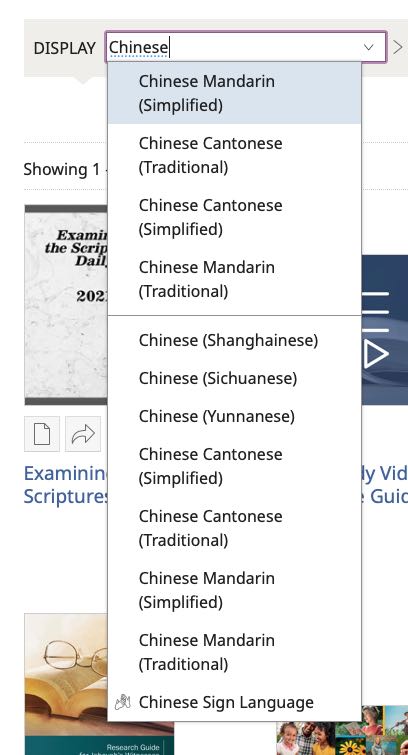
The organization has recently demonstrated that it recognizes the truth about how different many of the Chinese varieties of speech are from one another. For example, whereas before there was one Chinese edition of each publication (using Mandarin wording), now, some publications are available in different Chinese editions for different Chinese languages (including Cantonese), each with different wording.

List of different Chinese languages in which publications are available on jw.org
jw.org now has publications in different Chinese languages.

To help reduce the confusion around the inappropriate use of the English word “dialect” to translate “fāngyán (fāng·yán {direction → [place]} · speech → [topolect; dialect (common but misleading translation)] 方言)”, Professor Mair proposed that the word “topolect” (topo- (“place”) +‎ -lect (“[language] variety”)) be used instead as an exact, neutral English translation of “fāngyán (fāng·yán {direction → [place]} · speech → [topolect; dialect (common but misleading translation)] 方言)”. While not as well-known as “dialect”, the word “topolect” has gained a certain amount of recognition, and it can now be found in several dictionaries, e.g., The American Heritage Dictionary of the English Language, Wordnik, and Wiktionary.