Categories
Culture Current Events History Language Learning Science Technology

xuānchuán

xuānchuán (xuān·chuán declaring; proclaiming; announcing · {passing on}; spreading; transmitting → [conducting propaganda; propagating; disseminating; publicizing | propaganda] 宣传 宣傳) ← Tap/click to show/hide the “flashcard”

Several MEotW posts, including last week’s post on “cì’ěr (cì’·ěr {stabs; pricks → [irritates; pierces]} · ear → [grating on the ear; jarring; ear-piercing] 刺耳), have mentioned propaganda. So, it seems that it’s about time to consider the Mandarin expression “xuānchuán (xuān·chuán declaring; proclaiming; announcing · {passing on}; spreading; transmitting → [conducting propaganda; propagating; disseminating; publicizing | propaganda] 宣传 宣傳)”, which is often used to translate “propaganda”.

Morphemic Breakdown

The “xuān (declare; proclaim; announce 宣) in “xuānchuán (xuān·chuán declaring; proclaiming; announcing · {passing on}; spreading; transmitting → [conducting propaganda; propagating; disseminating; publicizing | propaganda] 宣传 宣傳) means “declare; proclaim; announce”, and it also appears in expressions like “xuānbù (xuān·bù declare; proclaim; announce · declare; spread; announce; publish; proclaim 宣布 宣布/佈)”, “xuānjiǎng (xuān·jiǎng declare; proclaim; announce · {speak of → [explain]} 宣讲 宣講)”, “xuānyáng (xuān·yáng declare; proclaim; announce · {raise → [make known]} 宣扬 宣揚)”, etc.

The “chuán ({pass on}; {hand down}; spread; transmit [→ [summon]]) in “xuānchuán (xuān·chuán declaring; proclaiming; announcing · {passing on}; spreading; transmitting → [conducting propaganda; propagating; disseminating; publicizing | propaganda] 宣传 宣傳) means “pass on; hand down; spread; transmit”, and it also appears in expressions like “chuándào (chuán·dào spreading · way → [preaching] 传道 傳道)”, “Chuándàoshū (Chuán·dào·shū Spreading · Way · Book → [Ecclesiastes] 传道书 傳道書)”, “chuánjiǎng (chuán·jiǎng spread · {speak of; say; tell} [(that)] 传讲 傳講)”, “chuántǒng (chuán·tǒng {passed on} · {gathered together (things) → [interconnected system]} → [tradition | traditional] 传统 傳統)”, etc.

The above-mentioned morphemes in “xuānchuán (xuān·chuán declaring; proclaiming; announcing · {passing on}; spreading; transmitting → [conducting propaganda; propagating; disseminating; publicizing | propaganda] 宣传 宣傳) are both basically verbs, and “xuānchuán (xuān·chuán declaring; proclaiming; announcing · {passing on}; spreading; transmitting → [conducting propaganda; propagating; disseminating; publicizing | propaganda] 宣传 宣傳) itself is also basically a verb. However, it’s also used as a noun, making it a verbal noun, or a gerundial noun, in those cases.

How Bad Is It?

As mentioned in the excellent Referenced Theo. Expressions (RTE) resource, “it seems 宣传 [xuānchuán] is a neutral word in Chinese (can be either positive or negative)”. Indeed, the morphemes that make up “xuānchuán (xuān·chuán declaring; proclaiming; announcing · {passing on}; spreading; transmitting → [conducting propaganda; propagating; disseminating; publicizing | propaganda] 宣传 宣傳), mentioned above, are themselves both morally neutral. Like any technology, whether the things that these morphemes represent result in good or harm depends on how they are used. Unfortunately, we are now living in the last days of a world ruled by Satan the Devil, a world filled with self-seeking people who totally would misuse anything that would potentially enable them to exert influence over other people.—2 Timothy 3:1–5; 1 John 5:19.

It should not be surprising, then, that the worldly Chinese governing authorities may at times disseminate what many would recognize as propaganda—biased, misleading distortions of the truth meant to promote certain viewpoints, political or cultural objectives, etc. Add to that how Eastern culture generally encourages people to conform to the group and not question authority, and it’s not surprising that many who grew up marinated in Chinese culture have come to just accept such propaganda as fact, as just the way things are in the Chinese world.

As for the West, even though it has more of a culture of questioning authority, it, along with the world in general that the Internet can reach, has been experiencing a rise in misinformation and disinformation. Social media and other technologies that have become available have given people more power to select what information they want to take in, and, egged on by engagement-seeking algorithms, many have unfortunately chosen to just focus on information sources that tell them what they want to hear, whether it’s true or not. As the Bible foretold long ago:

For there will be a period of time when they will not put up with the wholesome teaching, but according to their own desires, they will surround themselves with teachers to have their ears tickled. They will turn away from listening to the truth and give attention to false stories.
2 Timothy 4:3, 4.

As Jehovah’s people, we especially need to be wary of any worldly propaganda, because we want to be the true worshippers spoken of by Jesus, ones who “must worship with spirit and truth”.—John 4:23, 24.

Unfortunately, these days, even something as basically human as language gets politicized, so even just being language learners in the Mandarin field, we still need to watch out for worldly propaganda. Below are a couple of commonly accepted beliefs about the Chinese languages that are actually propaganda, not truth.

Propaganda About “Dialects”

“Mandarin, Cantonese, Shanghainese, etc. are just dialects of the one Chinese language.” The truth is that being mutually unintelligible, Mandarin, Cantonese, Shanghainese, etc. are really different languages, like French and English are different languages. The erroneous belief that Mandarin, Cantonese, Shanghainese, etc. are just dialects of the one Chinese language has been promoted by the worldly central governing authorities in China to bolster the idea that China is indeed one big happy political entity that should have a central government—them.

Historically, though, it wasn’t always the case that there was just one government over the land that China now occupies. That didn’t become the case until Qín Shǐhuáng ((Qín {Qin (dynasty)} 秦) (Shǐ·huáng Beginning · Emperor 始皇) (the founder of the Qín dynasty and the first emperor of China)) conquered the other Warring States—which were peers of his own state of Qín ({Qin (one of the Warring States)} 秦)—and became the first emperor of a forcefully unified China. If it wasn’t for this, China could conceivably have become like modern-day Europe, with several peer states which are recognized as having their own distinct languages and cultures.

So, there is no need to allow the idea that Mandarin, Cantonese, etc. are just dialects to sabotage our efforts to learn Mandarin well by making us think that we can just take Cantonese, etc. and twist it a little to get Mandarin—all we would get then is a twisted mess!

Propaganda and the Characters

“Chinese characters are the primary aspect of the Chinese languages.” The truth is that when it comes to human language, speech is primary, not writing.

However, given how so many people around the world are so enchanted with the visually intricate Chinese characters, some may feel that the characters give China a certain amount of cultural—and maybe even political—soft power. Many also feel that characters have a unifying effect on Chinese people, since they use characters to write even if they speak different Chinese languages, as explained above. Thus, many may also feel that there may be some political advantages to characters for China’s worldly central ruling authorities. So, they may thus be motivated to promote Chinese characters over, say, a system like Pīnyīn (Pīn·yīn {Piecing Together of} · Sounds → [Pinyin] 拼音) that doesn’t have the same perceived visual and cultural pizzaz that the characters have, and that is only for Mandarin.

The truth is, though, that there is really no technical requirement for any language, Chinese or otherwise, to be written using Chinese characters—Pīnyīn (Pīn·yīn {Piecing Together of} · Sounds → [Pinyin] 拼音) works fine as a writing system for Mandarin without incurring the extraordinary costs in time and effort that the characters do, and separate but similar alphabetical systems can conceivably be designed and used for other Chinese languages as well.

Re the supposed unifying effect of the Chinese characters, there is not necessarily really much of a unifying effect among the Mandarin-speakers, Cantonese-speakers, Japanese-speakers, Korean-speakers, etc. who may use characters to write, any more than the use of the Latin alphabet unifies English-speakers, French-speakers, Italian-speakers, Mandarin-speakers, etc. who may use it to write. An especially stark current example of the relative insignificance of any unifying effect that a script or writing system may have is that unfortunately, Russia and Ukraine have hardly been unified because of their both using the Cyrillic script.

We who are Jehovah’s people in particular don’t need a product of human culture like the Chinese characters to unite us—we are united by the culture of spirit and truth from Jehovah God himself!—John 4:23, 24.

Don’t Be a Gullible “Tourist”!

As Jehovah’s people, let us make sure we are advancing the interests of God’s Kingdom, and not unwittingly serving the interests of worldly Chinese governments. As missionaries and rescue workers in the Mandarin field, and not just tourists (email me for login information, and include information on who referred you and/or what group/cong. you are in), let us be focused on what really helps us to do our God-honouring and life-saving work better. Let us not be misled by the self-serving xuānchuán (xuān·chuán declaring · spreading → [propaganda] 宣传 宣傳), the propaganda, from Satan’s world.
Categories
Culture Language Learning Languages Science Technology

fā yǔyīn

({send out})
yǔyīn (yǔ·yīn {language → [speech]} · sounds → [voice message] 语音 語音) ← Tap/click to show/hide the “flashcard”

While doing research for the MEotW post on “tíbǐ (tí·bǐ {carry (hanging down from the hand) → [raise; lift]} · pen; pencil; {writing brush} [→ [start writing; write]] 提笔 提筆)wàng (forget 忘) (character 字), I came across the web article “Why is character amnesia in China considered problematic?”. One of the points it makes involves this week’s MEotW, “fā ({send out}) yǔyīn (yǔ·yīn {language → [speech]} · sounds → [voice message] 语音 語音) (send voice message):

Another feature that has gained huge popularity in China recently is that of ‘sending voice messages’ (发语音, fā yǔyīn). Chinese Whatsapp equivalent ‘WeChat’ was the first in the world to introduce this feature in its app. Social media research by University College London has shown that Chinese WeChat users find voice messaging convenient because it eliminates the need to text. Informants have reported that sending written messages always takes more time, and that inputting Chinese characters was a struggle (Wang & McDonald, 2013). With voice messaging, or even with pinyin input, people do not need to memorize the exact order of each stroke of a character when typing a text. They can just rely on knowing the pronunciation and recognizing the character. The prevalence of typing and texting on cellular devices has been correlated to reduced active-character knowledge by Chinese natives, leading to the tibiwangzi-phenomenon (Williams, 2016).

Sending, Language, Sounds

The “fā ({send out}; issue; emit [→ [deliver | utter; express | become rich]]) in “fā ({send out}) yǔyīn (yǔ·yīn {language → [speech]} · sounds → [voice message] 语音 語音) literally means “send out; issue; emit”, and it can also be used to mean various things such as “deliver”, “utter; express”, and “become rich”. With such a variety of meanings, it shows up in various expressions, such as:

  • fāchū (fā·chū issue; send; emit · out 发出 發出)
  • fāchòu (fā·chòu emit · {being stinking} → [smell bad; stink] 发臭 發臭)
  • fāshēng (fā·shēng {issue forth} · {come to life} → [happen] 发生 發生)
  • fācái (fā·cái {issue forth} · wealth; riches → [get rich; make a fortune] 发财 發財) (“Fā ({issue forth (riches)} → [become rich]) used on its own to mean “become rich” is probably an abbreviation of this expression.)
  • fāyīn (fā·yīn {sending out; issuing → [uttering] [of]} · sound → [pronouncing/articulating/enunciating | pronunciation; articulation; enunciation] 发音 發音)
  • etc.

The “yǔ (language; speech; tongue | saying; proverb | words; expression | speak; say) in “fā ({send out}) yǔyīn (yǔ·yīn {language → [speech]} · sounds → [voice message] 语音 語音) basically means “language”. It can also particularly mean “speech”—according to a basic principle of linguistics, speech is the primary aspect of human language. This “yǔ (language; speech; tongue | saying; proverb | words; expression | speak; say) is used in:

  • yǔyán (yǔ·yán language; tongue · {(type of) speech} 语言 語言)
  • Guóyǔ (Guó·yǔ National · Language → [(Modern Standard) Mandarin (term commonly used in Taiwan)] 国语 國語)
  • Hànyǔ (Hàn·yǔ {Han (Chinese)} · Language [→ [(Modern Standard) Mandarin]] 汉语 漢語)
  • Hányǔ (Hán·yǔ Korean · Language 韩语 韓語)
  • Yīngyǔ (Yīng·yǔ English · Language 英语 英語)
  • etc.

(Note that while “Yīngyǔ (Yīng·yǔ English · Language 英语 英語), for example, refers to English language speech, “Yīngwén (Yīng·wén English · Writing 英文) refers, not to English speech, but to English language writing.)

The “yīn (sound [→ [musical note/sound; tone; pronunciation | syllable | news; tidings]] 音) in “fā ({send out}) yǔyīn (yǔ·yīn {language → [speech]} · sounds → [voice message] 语音 語音) basically means “sound”, and it can also be used to mean “musical note/sound”, “tone”, “pronunciation”, “syllable”, and “news; tidings”. It is used in:

  • shēngyīn (shēng·yīn sound; voice · sound 声音 聲音)
  • yīnyuè (yīn·yuè {(musical) sound} · music → [music] 音乐 音樂)
  • Pīnyīn (Pīn·yīn {Piecing Together of} · Sounds → [Pinyin] 拼音)
  • Zhùyīn (Zhù·yīn {Annotating of} · Sounds → [Zhuyin] 注音 註/注音)
  • Mǎtài (Matthew 马太 馬太) Fúyīn (Fú·yīn Blessings · News 福音)
  • etc.

Speech is Natural, Characters, Not So Much

Writing is by now an age-old technology for recording and transmitting human speech. Now, in 2023, audio recording and transmitting technology has been available for a long time that actually allows one to directly hear the recorded speech pretty much as it originally sounded. Additionally, such technology is getting more and more common and accessible, to the point that many are finding that it often is faster and easier to send audio voice messages than to write and send written messages, especially when using as complex and cumbersome a writing system as Chinese characters.

True, in some situations, writing has some advantages over speech, but overall, the linguistic principle remains true that when it comes to human language, speech is primary and writing is secondary. Indeed, if God had meant for us humans to mainly use writing to communicate, then he could easily have designed our bodies with built-in screens that are able to dynamically display writing, like even humans know how to make. Instead, God designed our brains and bodies such that parts of them are specialized for directly understanding and producing speech.

Thus, it is quite natural that people would often take advantage of technology that has become available that allows one to actually hear recorded speech, instead of always settling for the visual abstractions of writing. And, when writing is appropriate, it is similarly relatively natural for people to make use of writing systems like Pīnyīn (Pīn·yīn {Piecing Together of} · Sounds → [Pinyin] 拼音) that are primarily phonetic, that is, focusing on directly representing the sounds of speech.

The National, the Political, the Universal(?), the Individual, the Rituals

On the other hand, rather than naturally reflecting divine wisdom, the attachment of many to Chinese characters instead reflects some human shortcomings. On a national level, the justification that characters are helpful in politically unifying China in spite of it being comprised of groups speaking different languages is yet another example of a human ruling authority prioritizing its own political power and survival over what’s actually good for the people. Besides, there’s actually nothing special about characters when it comes to being usable by people who speak different languages. As John DeFrancis put it in his book The Chinese Language: Fact and Fantasy, in the chapter entitled “The Universality Myth” (p. 159),

Chinese characters used by Asians speaking different languages are no more universal than are Latin letters used by Europeans who also speak different languages.

For example, while it’s true that the character “台” is recognized by both Mandarin-speakers and Cantonese-speakers as meaning “table”, it’s also true that “table”, written in Latin alphabet letters, is recognized by both English-speakers and French-speakers as meaning “table”.

(In China specifically, rather than characters, say, allowing Mandarin-speakers who don’t know Cantonese to understand written-out Cantonese speech, with its unique vocabulary and characters, and vice versa, what has actually happened is that the politically dominant Mandarin-speakers have basically forced speakers of Cantonese, Shanghainese, etc. to learn and use written Mandarin instead of actual written Cantonese, Shanghainese, etc.)

On a more individual level, many who are attached to characters show that they cling to what is old and familiar, even if it is problematic, instead of reaching out for and embracing positive change and progress. Also, many who cling to characters and the intricate procedures required to handwrite them show that they prioritize traditions, rituals, and procedures over what really brings better results. As Jesus said, though, “wisdom is proved righteous by its works”, not by its traditions, rituals, and procedures.—Matthew 11:19.

Categories
Culture History Language Learning

Zhùyīn

Zhùyīn (Zhù·yīn {Annotating of} · Sounds → [Zhuyin] 注音 註/注音) 👈🏼 Tap/click to show/hide the “flashcard”

The last imperial dynasty of China was the Qing dynasty. We call it the last dynasty, though, because it ended, and it was not followed by another dynasty. Towards the end of the Qing dynasty’s rule, China was in a bad way. Wikipedia provides this summary of the situation:

The dynasty reached its high point in the late 18th century, then gradually declined in the face of challenges from abroad, internal revolts, population growth, disruption of the economy, corruption, and the reluctance of ruling elites to change their mindsets.

One of the ways in which some sought to help with the deteriorating situation in China is described by American linguist, sinologist, author of Chinese language textbooks, lexicographer of Chinese dictionaries, and Professor Emeritus of Chinese Studies at the University of Hawaiʻi at Mānoa John DeFrancis, in his book The Chinese Language: Fact and Fantasy:

…toward the end of the nineteenth century…The obvious disintegration of Chinese society and the inability to cope with foreign aggressors led some reformers in contact with missionaries to conceive of carrying out a reform of the writing as part of a general educational reform that would help revitalize the country and save it from extinction.1

Professor DeFrancis goes on the describe the development and naming of an early result of the efforts of these reformers:

Official resolution of these issues was effected by the decisions reached by the Conference on Unification of Pronunciation that was held under government auspices in 1913. …The majority members of the conference reached the decision to adopt a set of thirty-nine phonetic symbols derived from Chinese characters, to use them as an adjunct to the characters, and to confine their scope to representing the Mandarin pronunciation as the national standard. The symbols were initially called Zhùyīn Zìmǔ (“Phonetic Alphabet”); later they were also called Guóyīn Zìmǔ (“National Phonetic Alphabet”). The fear that they might be considered an alphabetic system of writing independent of characters led in 1930 to their being renamed Zhùyīn Fúhào (“Phonetic Symbols”).2

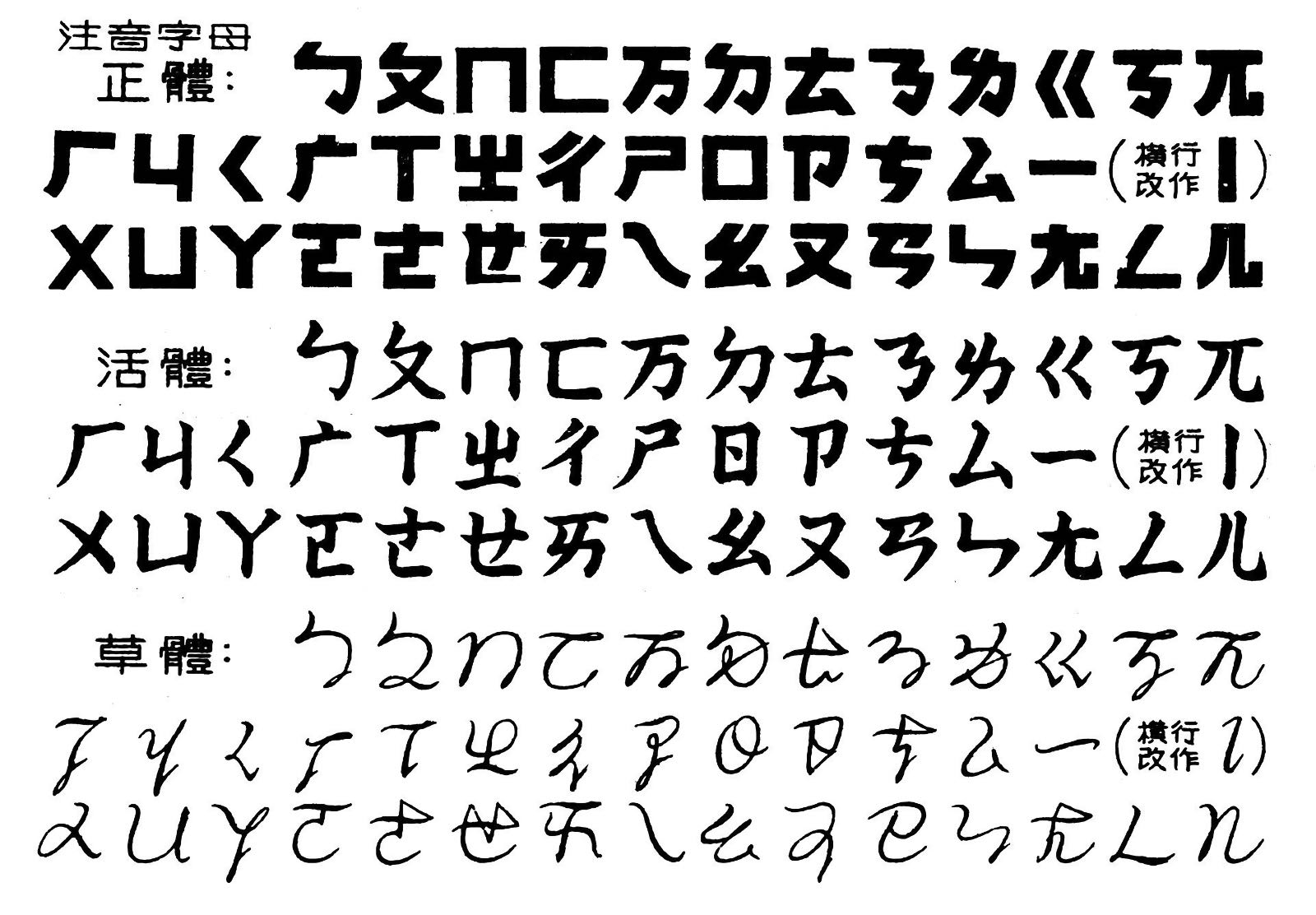
Bopomofo in Regular, Handwritten Regular, & Cursive formats

Zhùyīn (Zhù·yīn {Annotating of} · Sounds → [Zhuyin] 注音 註/注音), or Bopomofo, in regular, handwritten regular, and cursive formats

This week’s MEotW, “Zhùyīn (Zhù·yīn {Annotating of} · Sounds → [Zhuyin] 注音 註/注音)”, is a commonly used name for this system. It’s also commonly called “Bopomofo (ㄅㄆㄇㄈ)”, after the first four symbols of the system. This is similar to how in English we use “ABCs” to refer to the alphabet, and to how the word “alphabet” itself comes from alpha and bēta, the first two letters of the Greek alphabet.

The Zhùyīn (Zhù·yīn {Annotating of} · Sounds → [Zhuyin] 注音 註/注音) system continues to be used in elementary schools in Taiwan for teaching reading and writing, with the system’s symbols often appearing as ruby characters over Chinese characters in textbooks.

Zhùyīn (Zhù·yīn {Annotating of} · Sounds → [Zhuyin] 注音 註/注音) / Pīnyīn (Pīn·yīn {Piecing Together of} · Sounds → [Pinyin] 拼音)

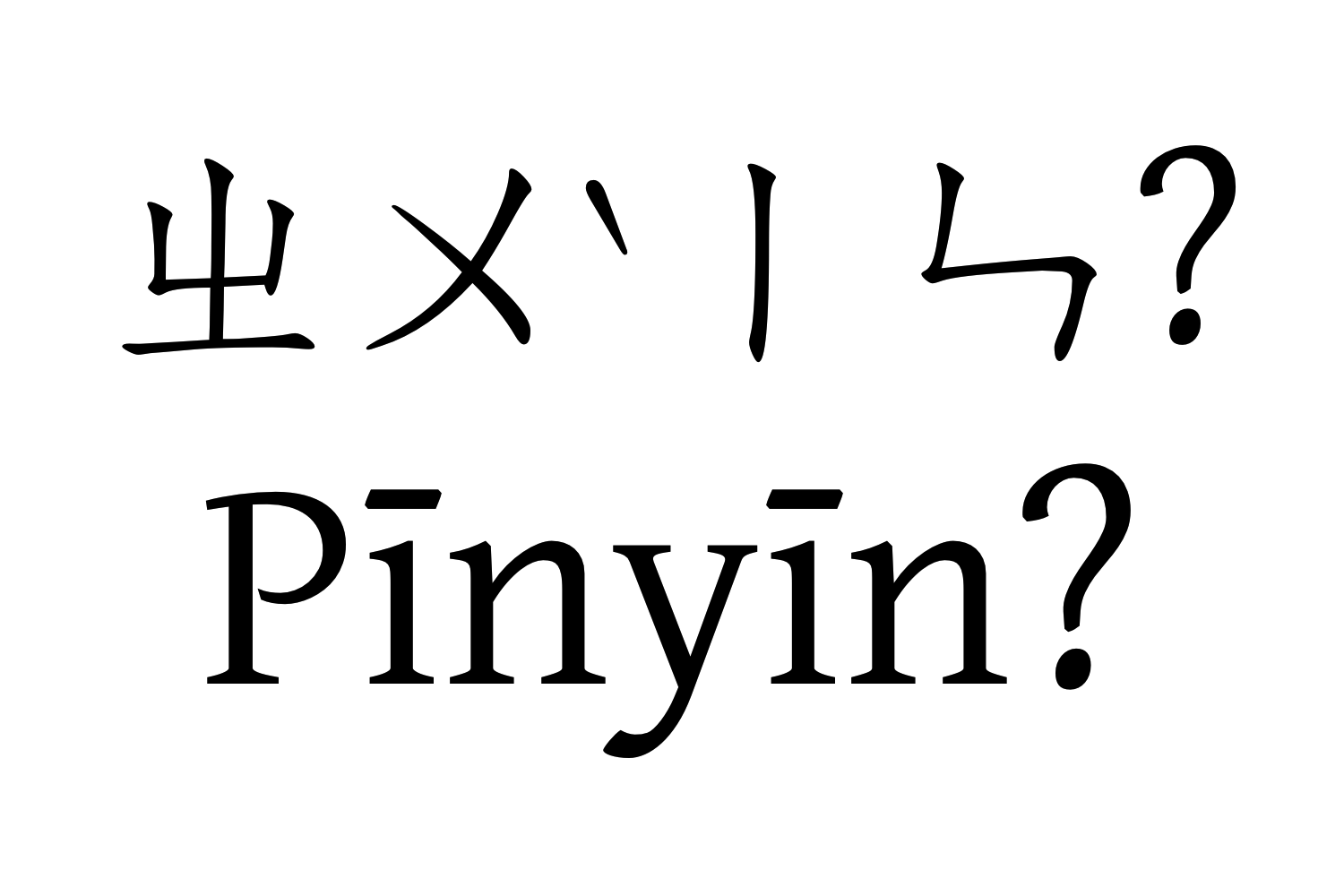
ㄓㄨ`ㄧㄣ? Pīnyīn?

In mainland China, Zhùyīn (Zhù·yīn {Annotating of} · Sounds → [Zhuyin] 注音 註/注音) has largely been replaced by Pīnyīn (Pīn·yīn {Piecing Together of} · Sounds → [Pinyin] 拼音), which was adopted by the mainland Chinese government in 1958. This was possible because Zhùyīn (Zhù·yīn {Annotating of} · Sounds → [Zhuyin] 注音 註/注音) and Pīnyīn (Pīn·yīn {Piecing Together of} · Sounds → [Pinyin] 拼音) both do the same job of representing in alphabetic writing the sounds of Mandarin speech—they just use different symbols.

Around the time that Pīnyīn (Pīn·yīn {Piecing Together of} · Sounds → [Pinyin] 拼音) was introduced, Premier of the People’s Republic of China Zhōu Ēnlái ((Zhōu {Circumference (surname)}周/週) (Ēn·lái Kindness · Comes 恩来 恩來) (the first Premier of the People’s Republic of China)) wrote the following comparing the different practical effects of using these different sets of symbols:

Although [Zhùyīn (Zhù·yīn {Annotating of} · Sounds → [Zhuyin] 注音 註/注音)] has been in existence for forty years and was popularized in primary schools by governments in the past, it has been forgotten by most of its students. Now only a few people know the phonetic transcript. In future, we shall adopt the Latin alphabet for the Chinese phonetic alphabet. Being in wide use in scientific and technological fields and in constant day-to-day usage, it will be easily remembered.

Some Mandarin field language learners prefer not to use the Latin alphabet-based Pīnyīn (Pīn·yīn {Piecing Together of} · Sounds → [Pinyin] 拼音) system, claiming that it makes them think of English sounds rather than Mandarin sounds. Perhaps those who feel this way could instead get the benefits of a phonetic alphabet by using Zhùyīn (Zhù·yīn {Annotating of} · Sounds → [Zhuyin] 注音 註/注音). However, they would first have to learn and remember the rarely-used symbols of Zhùyīn (Zhù·yīn {Annotating of} · Sounds → [Zhuyin] 注音 註/注音), which for almost everyone these days is going to be significantly harder than remembering the familiar Latin alphabet letters of Pīnyīn (Pīn·yīn {Piecing Together of} · Sounds → [Pinyin] 拼音).

Regarding associating language sounds with a writing system (which both Zhùyīn (Zhù·yīn {Annotating of} · Sounds → [Zhuyin] 注音 註/注音) and Pīnyīn (Pīn·yīn {Piecing Together of} · Sounds → [Pinyin] 拼音) qualify as), once a Mandarin learner passes the very beginning stage and gets familiar with Mandarin sounds and gets used to the Pīnyīn (Pīn·yīn {Piecing Together of} · Sounds → [Pinyin] 拼音) system, he or she will actually have no more problem associating Pīnyīn (Pīn·yīn {Piecing Together of} · Sounds → [Pinyin] 拼音) with Mandarin sounds than an English-speaking non-beginner student of French has associating French words with French sounds.

For more information on how Zhùyīn (Zhù·yīn {Annotating of} · Sounds → [Zhuyin] 注音 註/注音) compares to Pīnyīn (Pīn·yīn {Piecing Together of} · Sounds → [Pinyin] 拼音) for Mandarin field language learners, please see the tiandi.info post “Pinyin and Zhuyin”. (If you need login information for the parts of tiandi.info that require it, request it by email, and include information on who referred you and/or what group/cong. you are in.)

1. John DeFrancis, The Chinese Language: Fact and Fantasy (Honolulu: University of Hawaii Press, 1984), p. 241. ^

2. Ibid., p. 242. ^