shìjiè+
(shì·jiè
{generation → [world]} · extent →[world]
世界) hépíng+
(hé·píng
{being (together) with (one another)} · {being flat, level, even} →[peace (nwtsty-CHS Appx. A2 says this term mainly refers to the absence of war or conflict)]
和平) 👈🏼 Tap/click to show/hide the “flashcard”
[Notes:Tap/click on a Pīnyīn
(Pīn·yīn
{Piecing Together of} · Sounds →[Pinyin]
拼音) expression to reveal its “flashcard”; tap/click on a “flashcard”or its Pīnyīn
(Pīn·yīn
{Piecing Together of} · Sounds →[Pinyin]
拼音) expression to hide the“flashcard”. 📖📄 ➕ icons mean 📖Reveal All, 📄Reveal Advanced, and ➕ Reveal + Symbols re all the “flashcards” in the heading, paragraph, etc. that they are placed at the beginning of.]
At the time of this writing, jw.org was featuring the No. 1 2026 issue of The Watchtower, the theme of which is “Is World Peace Possible?”. By comparing the English version of this issue with the Mandarin version, we can see that the organization is using this week’s MEotW, “shìjiè
(shì·jiè
{generation → [world]} · extent →[world]
世界)hépíng
(hé·píng
{being (together) with (one another)} · {being flat, level, even} →[peace (nwtsty-CHS Appx. A2 says this term mainly refers to the absence of war or conflict)]
和平)”, to translate the English expression “world peace” into Mandarin:
📖📄➕Shìjiè
(Shì·jiè
{Generation → [World]} · Extent →[World]
世界)Hépíng
(Hé·píng
{Being (Together) with (One Another)} · {Being Flat, Level, Even} →[Peace (nwtsty-CHS Appx. A2 says this term mainly refers to the absence of war or conflict)]
和平)Zhǐshì
(Zhǐ·shì
Only · Is
只是)Mèng
({a Dream}
梦
夢)Ma([? ptcl for “yes/no” questions]
吗
嗎)?
📖📄➕Shìjiè
(Shì·jiè
{generation → [world]} · extent →[the world]
世界)yídìng
(yí·dìng
{(with) one} · {setting fixedly} → [definitely]
一定)huì
(will
会
會)hépíng
(hé·píng
{be (together) with (one another)} · {be flat, level, even} →[be peaceful (nwtsty-CHS Appx. A2 says this term mainly refers to the absence of war or conflict)]
和平),
dàn
(but
但)shíxiàn+
(shí·xiàn
(it) {solidly → [really]} · {will appear} → [(it) will come true]
实现
實現)de
(’s
的)fāngshì
(fāng·shì
direction · style →[way]
方式)yěxǔ
(yě·xǔ
{on the whole} · maybe
也许
也許)shì
({will be}
是)nǐ
(you
你)xiǎng‐budào+
((xiǎng
{thinking of}
想)‐(bu·dào
not · {are arriving at}
不到)
→[are not expecting])de
({’s (way)}
的)!
A Specific Kind of Peace
“Shìjiè
(Shì·jiè
{generation → [world]} · extent →[world]
世界)” effectively means “world”, and as Appendix A2 of the Mandarin New World Translation Bible tells us, “hépíng
(hé·píng
{[is/being] (together) with (one another)} · {[is/being] flat, level, even} →[peace | [is] peaceful | peacefully (nwtsty-CHS Appx. A2 says this term mainly refers to the absence of war or conflict)]
和平)” mainly refers to a specific kind of peace: the absence of war or conflict. So, it is the appropriate Mandarin expression to use to refer to the kind of peace that people generally have in mind when they use the English expression “world peace”.
Other Kinds of Peace
Past MEotW posts have discussed the Mandarin expressions used to refer to other kinds of peace, as discussed in Appendix A2 of the Mandarin New World Translation Bible. For example, the MEotW post on “ānníng
({being peaceful}; {being tranquil} [→ [peace; tranquillity]]
安宁
安寧)” has this to say:
Appendix A2 of the current Mandarin version of the New World Translation Bible (nwtsty) explains that “hépíng
(peace | {[is] peaceful} (nwtsty-CHS Appx. A2 says this term mainly refers to the absence of war or conflict)
和平)” mainly refers to the absence of war or conflict. However, even in a situation in which there is no hépíng
(peace | {[is] peaceful} (nwtsty-CHS Appx. A2 says this term mainly refers to the absence of war or conflict)
和平), God’s holy spirit can still help people to maintain the spiritual quality of ānníng
({being peaceful}; {being tranquil}
安宁
安寧) in their hearts—inner peace.
As for the MEotW post on “hémù
({[is] harmonious} [→ [harmony; peaceful relations]]
和睦)”, it says:
Appendix A2 of the current Mandarin version of the New World Translation Bible (nwtsty) explains that “hépíng
(peace | {[is] peaceful} (nwtsty-CHS Appx. A2 says this term mainly refers to the absence of war or conflict)
和平)” mainly refers to the absence of war or conflict. In contrast, “hémù
({[is] harmonious}
和睦)” is used here in a more positive and precise way to refer to the peaceful harmony and unity that the Christ makes possible for “shuāngfāng+
(shuāng·fāng
(the) two · {directions → [parties]}
双方
雙方)”, “the two groups”, Jews and non-Jews.
Additionally, the MEotW post on “héxié
({[is] harmonious} [→ [harmony]]
和谐
和諧)” says:
Why doesn’t the Mandarin translation use good old “píng’ān
(píng’·ān
{[is] flat, level, even → [[is] peaceful]} · {[is] safe, secure} (nwtsty-CHS Appx. A2 says this term mainly refers to things being smooth and stable, safe and secure, free of danger)
平安)” or “hépíng
(peace | {[is] peaceful} (nwtsty-CHS Appx. A2 says this term mainly refers to the absence of war or conflict)
和平)” to translate “peace” in this verse? Appendix A2 of the current Mandarin version of the New World Translation Bible (nwtsty) explains that “píng’ān
(píng’·ān
{[is] flat, level, even → [[is] peaceful]} · {[is] safe, secure} (nwtsty-CHS Appx. A2 says this term mainly refers to things being smooth and stable, safe and secure, free of danger)
平安)” mainly refers to things being smooth and stable, safe and secure, free of danger, and that “hépíng
(peace | {[is] peaceful} (nwtsty-CHS Appx. A2 says this term mainly refers to the absence of war or conflict)
和平)” mainly refers to the absence of war or conflict. These are specific aspects of peace that don’t necessarily apply in every context.
We can see that those who translated the current Mandarin NWT Bible felt that the context of 1 Corinthians 14:33, which discusses who should speak when during meetings for spiritual encouragement, calls for “héxié+
({[is] harmonious}
和谐
和諧)” to be used in this verse to translate the Greek word ei·reʹne, since the harmony that “héxié
({[is] harmonious}
和谐
和諧)” refers to contrasts well with the dissonance and disorder that would result if a meeting degenerated into a free-for-all of people speaking whenever and however they pleased.
réngōng+
(rén·gōng
human · work →[artificial]
人工) zhìnéng+
(zhì·néng
intelligence · ability →[intelligence]
智能) 👈🏼 Tap/click to show/hide the “flashcard”
[Notes:Tap/click on a Pīnyīn
(Pīn·yīn
{Piecing Together of} · Sounds →[Pinyin]
拼音) expression to reveal its “flashcard”; tap/click on a “flashcard”or its Pīnyīn
(Pīn·yīn
{Piecing Together of} · Sounds →[Pinyin]
拼音) expression to hide the“flashcard”. 📖📄 ➕ icons mean 📖Reveal All, 📄Reveal Advanced, and ➕ Reveal + Symbols re all the “flashcards” in the heading, paragraph, etc. that they are placed at the beginning of.
As of this writing, jw.org is again featuring the article referred to below. So, this is basically a reposting of a post from a few years back.]
At the time of this writing, jw.org was featuring the article “Artificial Intelligence—A Blessing or a Curse?—What Does the Bible Say?”. Where the English version of this article uses the expression “artificial intelligence”, the Mandarin version uses this week’s MEotW, “réngōng
(rén·gōng
human · work →[artificial]
人工)zhìnéng
(zhì·néng
intelligence · ability →[intelligence]
智能)”:
English:
Recently, world leaders, scientists, and technologists have commented on the power of artificial intelligence (AI). While acknowledging its value, they have also expressed concern over its potential misuse.
Mandarin:
📖📄➕Jìnqī
(Jìn·qī
{near → [recent]} · {period of time} →[recently]
近期),
xǔduō
(xǔ·duō
numbers · many
许多
許多)guójiā
(guó·jiā
nation · family →[national]
国家
國家)lǐngdǎorén
(lǐngdǎo·rén
leading · persons →[leaders]
领导人
領導人),
kēxuéjiā
(kē·xué·jiā
{{branches of study} · learning → [science]} · -ists →[scientists]
科学家
科學家),
yǐjí
(and
以及)kējì
(kē·jì
{branches of study → [science]} · {skills → [technology]} →[technology]
科技)jīngyīng+
(jīng·yīng
elite · {flowers → [outstanding persons]} →[elite]
精英)dōu
({all of them}
都)duì
(towards
对
對)réngōng
(rén·gōng
human · work →[artificial]
人工)zhìnéng
(zhì·néng
intelligence · ability →[intelligence]
智能)
(AI)
de
(’s
的)yòngtú
(yòng·tú
{to be used} · routes →[applications]
用途)shēn
(deeply
深)biǎo
({have expressed}
表)guānzhù
(guān·zhù
{closing with (them) → [being concerned about (them)]} · {pouring into (them) → [concentrating on (them)]} → [paying close attention to (them)]
关注
關注).
Suīrán
(Suī·rán
although · -ly
虽然
雖然)tāmen
(tā·men
he/she · [pl] →[they]
他们
他們)dōu
(all
都)zàntóng+
(zàn·tóng
favour · {are with} →[approve of]
赞同
贊/讚同)réngōng
(rén·gōng
human · work →[artificial]
人工)zhìnéng
(zhì·néng
intelligence · ability →[intelligence]
智能)yǒu
(having
有)hěn
(very
很)duō
(many
多)yìchu
(yì·chu
beneficial · places →[benefits]
益处
益處),
dàn
(however
但)yě
((they) also
也)hěn
({very much}
很)dānxīn
(dān·xīn
{carry on shoulder poles → [bear (heavy)]} · hearts →[worry]
担/耽心
擔/耽心)zhèi
(this
这
這)xiàng
({item of}
项
項)kējì
(kē·jì
{branches of study → [science]} · {skills → [technology]} →[technology]
科技)huì
(will
会
會)bèi
([passive signifier] →[be]
被)lànyòng
(làn·yòng
{overflowingly → [indiscriminately]} · used → [misused]
滥用
濫用).
Related Expressions
The “zhìnéng
(zhì·néng
wisdom; knowledge; intelligence; resourcefulness; wit; cleverness · ability →[intelligence; intellectual power/ability | smart(phone, etc.)]
智能)” in “réngōng
(rén·gōng
human · work →[artificial]
人工)zhìnéng
(zhì·néng
intelligence · ability →[intelligence]
智能)” also appears in “zhìnéng shǒujī+
((zhì·néng
intelligence · ability → [smart]
智能)
(shǒu·jī
hand · machine → [mobile phone]
手机
手機)
→[smartphone])”, which is used in China to mean “smartphone”. As pointed out by the Referenced Theo. Expressions (RTE) resource, this expression appears in the November 2009 issue of Awake! magazine, on page 3.
It’s also noteworthy that the “zhì
(wisdom; knowledge; intelligence; resourcefulness; wit; cleverness
智)” in “réngōng
(rén·gōng
human · work →[artificial]
人工)zhìnéng
(zhì·néng
intelligence · ability →[intelligence]
智能)” appears in “zhìhuì+
(zhì·huì
wisdom · intelligence →[wisdom]
智慧)”, the Mandarin word for “wisdom”. It also appears in “zhōngxìn
(zhōng·xìn
faithful · {believing → [having faith]} →[faithful]
忠信)ruìzhì+
(ruì·zhì
{having foresight} · {(having) wisdom}
睿智)de
(’s
的)núlì
(slave
奴隶
奴隸)”, the Mandarin expression for “faithful and discreet slave”.—Matthew 24:45 (English; Mandarin).
A Beginning? Or Not?
Regarding intelligence, artificial or otherwise, it’s illuminating to consider these verses in Proverbs:
The fear of Jehovah is the beginning of knowledge.
Only fools despise wisdom and discipline.
—Proverbs 1:7
The fear of Jehovah is the beginning of wisdom,
And knowledge of the Most Holy One is understanding.
—Proverbs 9:10
To show true knowledge and wisdom—and indeed, intelligence—in life, we need to consider all the factors that are relevant in life, and we especially need to not have insufficient regard for the biggest, most relevant factor of all in life—Jehovah God, who created human intelligence (which was perfect in the first human couple, but which that couple caused to become imperfect and corrupted). Humans who do not have fear of (or “reverence for”, as per the footnote for Pr. 1:7) Jehovah—the Creator of human life and human intelligence—do not even begin to have true knowledge or wisdom, and thus are not equipped to develop artificial intelligence with true knowledge or wisdom.
Indeed, while humans can now store, read, and perform some basic processes on data, even huge amounts of data, human researchers have limited understanding about, and disagree about, how a system like the human brain or an artificial intelligence system can truly—not just appear to—know or understand something, or have wisdom (scientific paper, Medium article) about something. This may help to partly explain why a significant percentage of the time, current artificial intelligence systems output incorrect statements with complete confidence, as if they were true.
Yes, while many are now fascinated by, and/or concerned about, the increasing power of artificial intelligence, people should be focusing first on Jehovah God’s divine intelligence, the most powerful intelligence in the entire universe, that thankfully is motivated by love, guided by wisdom, and dedicated to justice.—1 John 4:8; Romans 11:33; Deuteronomy 32: 3, 4.
jiāng‐xīn‐bǐ‐xīn+
((jiāng
take
将
將)‐(xīn
heart
心)‐(bǐ
{to compare}
比)‐(xīn
heart[s]
心)
→[be empathetic; put oneself in sb. else’s shoes; feel for another/others]) 👈🏼 Tap/click to show/hide the “flashcard”
[Notes:Tap/click on a Pīnyīn
(Pīn·yīn
{Piecing Together of} · Sounds →[Pinyin]
拼音) expression to reveal its “flashcard”; tap/click on a “flashcard”or its Pīnyīn
(Pīn·yīn
{Piecing Together of} · Sounds →[Pinyin]
拼音) expression to hide the“flashcard”. 📖📄 ➕ icons mean 📖Reveal All, 📄Reveal Advanced, and ➕ Reveal + Symbols re all the “flashcards” in the heading, paragraph, etc. that they are placed at the beginning of.]
Rather than dismissively thinking to ourselves that the songs produced by the organization are “just songs”, we should remember that the slave class takes seriously its responsibility to provide spiritual food to God’s people, and so it is going to make sure that the lyrics in its songs are spiritually correct, while also being emotionally moving.—Ezekiel 33:32; Matthew 24:45.
This week’s MEotW, “jiāng‐xīn‐bǐ‐xīn
((jiāng
take
将
將)‐(xīn
heart
心)‐(bǐ
{to compare}
比)‐(xīn
heart[s]
心)
→[be empathetic; put oneself in sb. else’s shoes; feel for another/others])”, comes from the first verse of song 163, this year’s convention song, which is entitled “Happy Are These Eyes” in English and “Wǒ de
((Wǒ
Me
我)
(de
’s
的)
→[My])Yǎnjing
(Yǎn·jing
Eyes’ · Eyeballs →[Eyes]
眼睛)Duōme
(Duō·me
{(How) Much} · [suf] →[How]
多么
多麼)Yǒufú
(Yǒu·fú
Have · Blessings → [Are Happy]
有福)” in Mandarin:
While not being a direct translation, “jiāng‐xīn‐bǐ‐xīn
((jiāng
{to take}
将
將)‐(xīn
heart
心)‐(bǐ
{to compare}
比)‐(xīn
hearts
心)
→[to be empathetic])” seems to correspond with “was kind to all” in the above example. A more literal translation of “jiāng‐xīn‐bǐ‐xīn
((jiāng
{to take}
将
將)‐(xīn
heart
心)‐(bǐ
{to compare}
比)‐(xīn
hearts
心)
→[to be empathetic])” as used above would be “to take heart to compare hearts”. Effectively, this is a rather poetic way to say “to be empathetic”.
Other Mandarin expressions related to empathy include:
The importance of empathy with regard to Mandarin field language learning is emphasized in the below excerpt from the article “Pīnyīn
(Pīn·yīn
{Piecing Together of} · Sounds →[Pinyin]
拼音)Was Plan A”:
Yes, Pīnyīn was Plan A, but China unfortunately let the proud, self-serving B players have their way.
Is that the way we as Jehovah’s people should be? Shouldn’t godly, self-sacrificing love move us to do what’s best for others rather than fulfilling the imperfect human instinct for being self-glorifying, self-justifying, and self-serving? Are we showing pride in the name of love?
In this, I agree with Zhōu Ēnlái (周恩来/周恩來, Zhou Enlai), the first Premier of the People’s Republic of China, who agreed with Lǐ Zhúchén (李烛尘/李燭塵, Li Zhuchen), who said,
Every time the question of the reform of Chinese characters is brought up, somebody raises an objection, or even stubbornly opposes it for this or that reason. Some say that the characters are not difficult. I will say that such a person is like one who, as soon as his wounds are healed, forgets the pain he suffered. …If he will but recall his bitter experience in learning characters, and consider the interests of the children and the illiterates by placing himself in their place, he will not dissent or object so strongly. [This was actually said regarding opposition to the simplification of the characters, but the principle applies to opposition to Pīnyīn as well.—W. W.]
If we have optimism, but we don’t have empathy, then it doesn’t matter how much we master the secrets of science, we’re not really solving problems—we’re just working on puzzles.
Mr. Gates’ above observation applies to the subject at hand in that while many enjoy trying to solve the puzzles presented by Chinese characters, and while many also enjoy being known for being good at solving these puzzles, empathy should move us to recognize that there are much bigger issues involved than just our personal enjoyment or glorification.
Yes, when even some worldly people can recognize the above points, we Christians should recognize even more the need to show love and empathy rather than being proud, self-glorifying, self-justifying, and self-serving. Also, we should be actively and determinedly following the course of true Christian love and empathy rather than just going along with others who are proud, self-glorifying, self-justifying, and self-serving. We should especially do so when we have scriptures such as this to guide us:
In this post about a Mandarin expression found in our songbook, another subject that I want to touch on is: Is musical notation 🎼 too hard to be worth the trouble of producing it and using it? Are fewer and fewer people able to read it? I was fortunate enough to have been taught how to read musical notation in school. I have never thought of musical notation as being particularly difficult to use (it’s much easier to learn than characters, which many unquestioningly try to learn), and I find that it helps me to sing Kingdom songs more correctly (according to the intended melody, message, etc.) and more confidently more of the time. However, I am aware that not everyone in the Mandarin field has the same experience with musical notation. For example, a while ago, an older brother told me that he didn’t know how to read musical notation. Also, some people in the Mandarin field may have been affected by how education systems in this old world have been facing significantchallenges relating to providing music education for younger ones.
Regardless of how the world may be failing in many cases to equitably provide good music education, Jehovah’s organization has pointed out that music is important in Jehovah’s worship. For example, not long ago, a Meeting Workbook said:
Music can have a powerful influence on the mind and body. Singing is an important part of our worship of Jehovah.
In accordance with the importance of music in Jehovah’s worship, Mandarin field language learners used to have available to them official material from the organization containing musical notation with Pīnyīn
(Pīn·yīn
{Piecing Together of} · Sounds →[Pinyin]
拼音) in the lyrics. However, perhaps at least partially because of the technical difficulty and costliness of producing material with musical notation and both Chinese characters and Pīnyīn
(Pīn·yīn
{Piecing Together of} · Sounds →[Pinyin]
拼音) in the lyrics, as of this writing, there is no official material currently available from the organization that shows Pīnyīn
(Pīn·yīn
{Piecing Together of} · Sounds →[Pinyin]
拼音) and musical notation on the same page or screen.
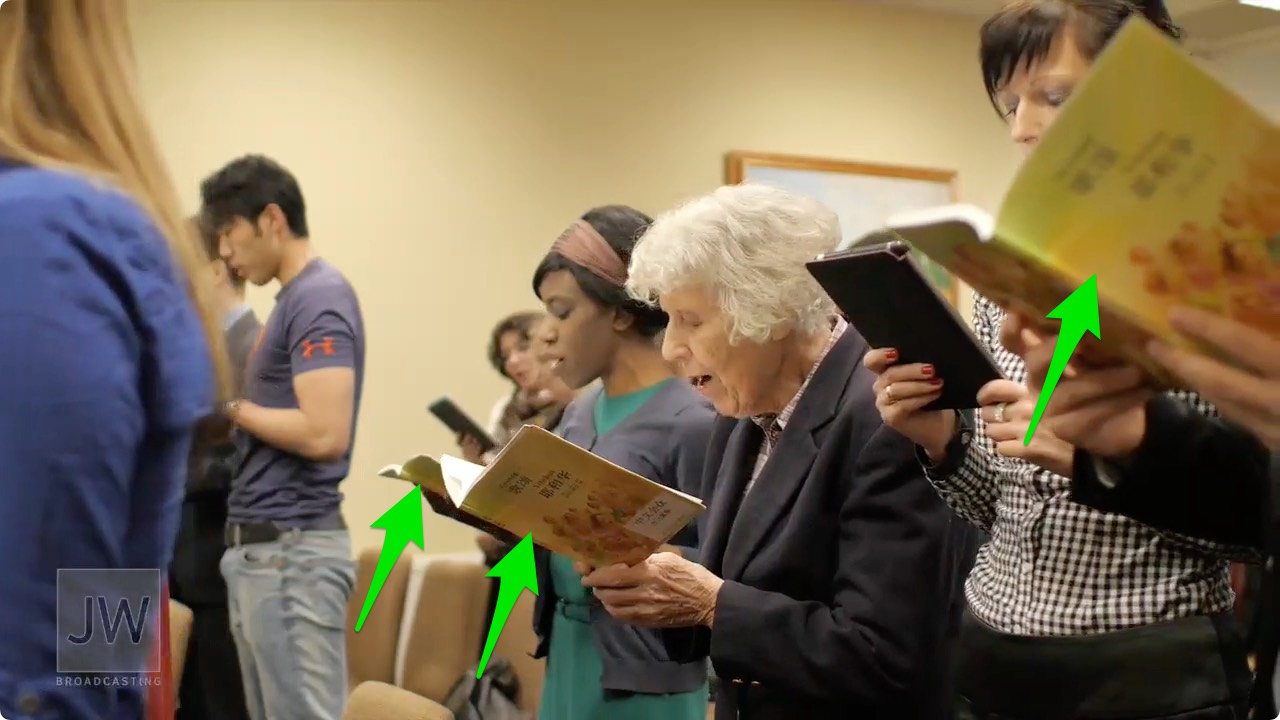
A screenshot from an official video, of Sis. Margarita Königer and others using official Pīnyīn
(Pīn·yīn
{Piecing Together of} · Sounds →[Pinyin]
拼音)Sing to Jehovah songbooks with musical notation
The organization continues to publish official songbook material for different languages in general that contains musical notation, so it evidently still considers musical notation to generally be worthwhile to produce. It continues to produce official material for the current songbook that uses musical notation along with lyrics rendered only in Chinese characters, without Pīnyīn
(Pīn·yīn
{Piecing Together of} · Sounds →[Pinyin]
拼音), and it has even produced official material that uses jiǎnpǔ+
(jiǎn·pǔ
simple · {register or record for reference → [musical notation]} →[numbered musical notation]
简谱
簡譜) (a kind of musical notation also known as numbered musical notation) and Chinese characters.
For Jehovah’s official organization, continuing to produce musical notation with lyrics rendered in Chinese characters but discontinuing production of musical notation that includes Pīnyīn
(Pīn·yīn
{Piecing Together of} · Sounds →[Pinyin]
拼音) lyrics when it becomes necessary to conserve time and effort makes sense, when we consider that the primary focus of Jehovah’s official organization is to provide spiritual instruction, not language instruction, even though language instruction can provide significant practical help to people seeking to learn or teach sprititual truths. (Another reminder of this primary focus is the recent discontinuation of the JW Language app.) The way the world is, with its deeply embedded traditions and prejudices, people whose mother tongue is Mandarin—and who thus learn spiritual truths best in Mandarin—mainly still use Chinese characters as their “mother writing system”, even as the game-changing practical benefits of Pīnyīn
(Pīn·yīn
{Piecing Together of} · Sounds →[Pinyin]
拼音) are obvious to unprejudiced Mandarin language learners.
And, even as the organization has continued to add Pīnyīn
(Pīn·yīn
{Piecing Together of} · Sounds →[Pinyin]
拼音)ruby text to much of its Mandarin material, in recognition of the value of these practical benefits—even people who have been learning characters since childhood occasionally, perhaps even regularly, suffer from character amnesia, due to the inhuman complexity and number of the characters, and also, there are actually tens of millions of Chinese people who are still illiterate regarding the characters—it seems that when faced with the prospect of producing a version of the current songbook with musical notation, characters, andPīnyīn
(Pīn·yīn
{Piecing Together of} · Sounds →[Pinyin]
拼音) ruby text, those in charge, perhaps remembering how difficult and time-consuming it was to do so for the previous songbook, felt that it would just be too much this time.
For those who find it helpful in their Mandarin field activities to put musical notation together with Pīnyīn
(Pīn·yīn
{Piecing Together of} · Sounds →[Pinyin]
拼音), the unofficial Pīnyīn
(Pīn·yīn
{Piecing Together of} · Sounds →[Pinyin]
拼音) Plus resource “Sing Out Joyfully” Bk. (Pīnyīn+Music, Pīnyīn Plus, Web) exists and is continuing to be improved. As shown in the screenshot near the beginning of this post, this resource aids Mandarin field language learners by breaking with tradition and featuring lyrics in the musical notation that are only in relatively large-print Pīnyīn
(Pīn·yīn
{Piecing Together of} · Sounds →[Pinyin]
拼音) by default—characters are relegated to Pīnyīn
(Pīn·yīn
{Piecing Together of} · Sounds →[Pinyin]
拼音) Plus “flashcards” that are added as time allows.
Unlike the traditionally-used but unnecessarily extraordinarily complex characters that need to be accompanied by Pīnyīn
(Pīn·yīn
{Piecing Together of} · Sounds →[Pinyin]
拼音) before many are able to read them, Pīnyīn
(Pīn·yīn
{Piecing Together of} · Sounds →[Pinyin]
拼音) itself is a simple, elegant alphabetical full writing system for Mandarin that is easy to learn and remember. Also, it is no harder to typeset than other alphabetical writing systems with diacritics, such as the writing systems now used for French, Czech, Vietnamese, etc.*
More Pīnyīn
(Pīn·yīn
{Piecing Together of} · Sounds →[Pinyin]
拼音) and Pīnyīn
(Pīn·yīn
{Piecing Together of} · Sounds →[Pinyin]
拼音) Plus web material based on the Mandarin “Sing Out Joyfully” book will be made available in the Pīnyīn
(Pīn·yīn
{Piecing Together of} · Sounds →[Pinyin]
拼音)Plus web resource as time allows.
* Thanks to ongoing advancements in personal computing hardware and software, producing material that contains things like musical notation and Pīnyīn
(Pīn·yīn
{Piecing Together of} · Sounds →[Pinyin]
拼音) text at reasonable cost is quicker and easier than ever. At this time, production of the musical notation in the “Sing Out Joyfully” Bk. (Pīnyīn+Music, Pīnyīn Plus, Web) resource begins in free open source software called MuseScore Studio, running on a Mac. Pīnyīn
(Pīn·yīn
{Piecing Together of} · Sounds →[Pinyin]
拼音) text for the lyrics in the musical notation is entered using macOS’s ABC – Extended input source (keyboard layout). (Just using Pīnyīn
(Pīn·yīn
{Piecing Together of} · Sounds →[Pinyin]
拼音) text only here simplifies things so much compared to having to somehow input characters with Pīnyīn
(Pīn·yīn
{Piecing Together of} · Sounds →[Pinyin]
拼音)ruby text!) When it’s ready, the musical notation for a song is exported from MuseScore Studio into SVG format, which is a plain text format that allows for the inclusion of links that activate Pīnyīn
(Pīn·yīn
{Piecing Together of} · Sounds →[Pinyin]
拼音) Plus flashcards on webpages. (These SVG links are a bit more involved to produce than “regular” web Pīnyīn
(Pīn·yīn
{Piecing Together of} · Sounds →[Pinyin]
拼音) Plus material, but at least the procedure for doing so is consistent and dependable, unlike Chinese characters, which have no consistent, dependable system regarding how they are designed compared to how they are pronounced.) The coding for the SVG links is currently done using the text editor BBEdit, in which editing large text files is quite performant. For Pīnyīn
(Pīn·yīn
{Piecing Together of} · Sounds →[Pinyin]
拼音) Plus web material production in general, my current favourite tool is Nova, but such web material can be produced in any application suitable for web development, such as Visual Studio Code, etc. ^